| Pope Leo XIV in Paris: A Historic Visit to Notre-Dame, the Concorde and La Madeleine|
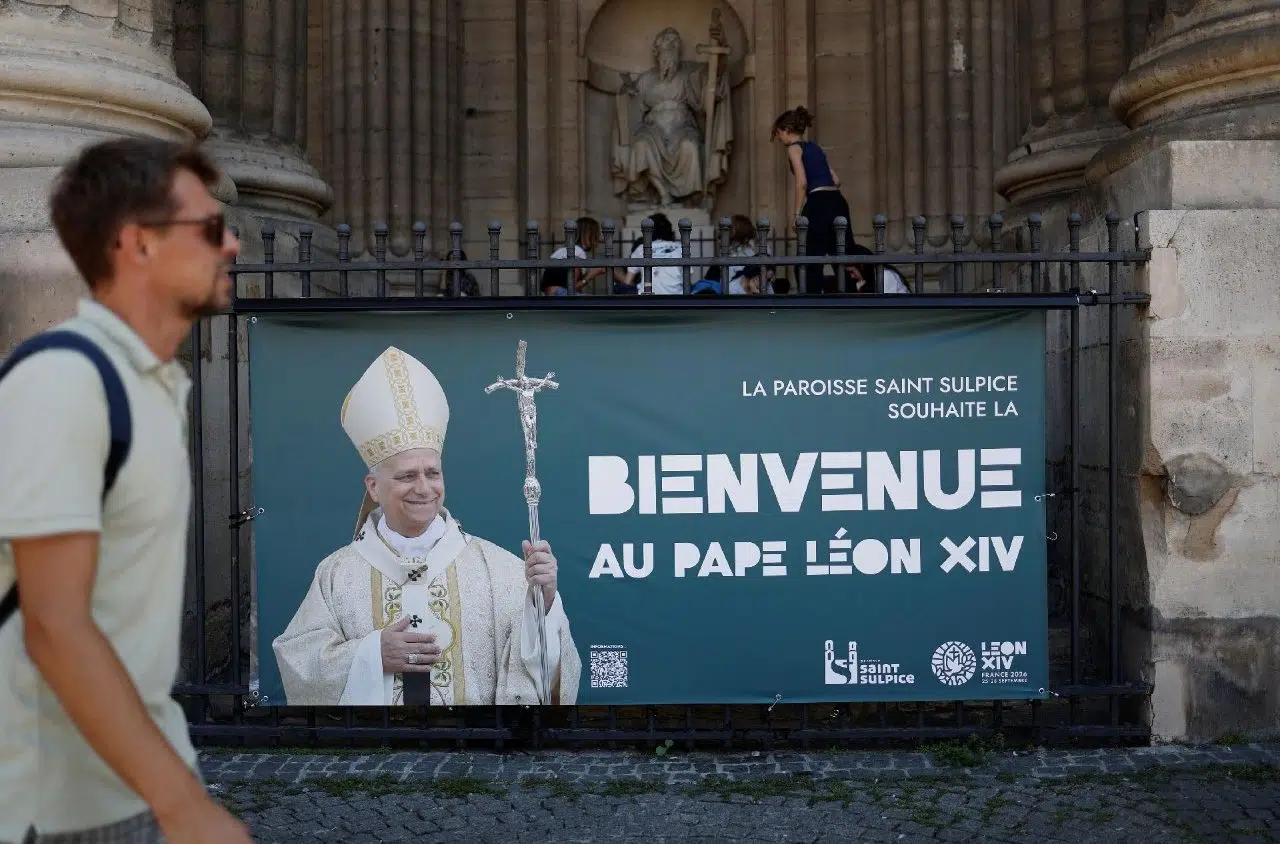
Pope Leo XIV is coming to Paris on September 25 and 26, 2026, marking an important moment for the Catholic Church in France and for the city itself. His visit is part of a four-day apostolic journey through France, from September 25 to 28, with stops in Paris including Notre Dame, Lourdes and Metz, as well as a major visit to UNESCO in Paris. Pope Leo XIV’s visit to Paris on September 25–26, 2026, is particularly significant because it will be the first papal visit to the French capital since Pope Benedict XVI’s visit in September 2008.
Tous les peuples doivent grandir dans la Paix
All peoples must grow in peace.
Pope Francis did visit France during his pontificate, traveling to Strasbourg in 2014, Marseille in 2023, and Corsica in 2024. However, none of these journeys included Paris. His September 2023 visit to Marseille was devoted to the Rencontres Méditerranéennes, while his December 2024 visit to Corsica focused on the Mediterranean island and its religious heritage. The last pope to visit Paris was therefore Benedict XVI, from September 12–13, 2008, when he celebrated Vespers at Notre-Dame Cathedral, met French authorities and representatives of the cultural world, and celebrated Mass at Concorde. His journey also continued to Lourdes for the 150th anniversary of the apparitions of the Virgin Mary to Bernadette Soubirous and Metz. Pope Leo XIV chose Metz to deliver a message of peace to the heart of Europe. A region marked by wars but also by Franco-German reconciliation, the Moselle is linked to the figure of Robert Schuman, one of the founders of the European Union. By celebrating a Mass for peace in Saint-Étienne Cathedral, the Holy Father wishes to remind us that reconciliation between peoples is possible and that Europe can offer the world a testament to fraternity, particularly in the context of current conflicts.
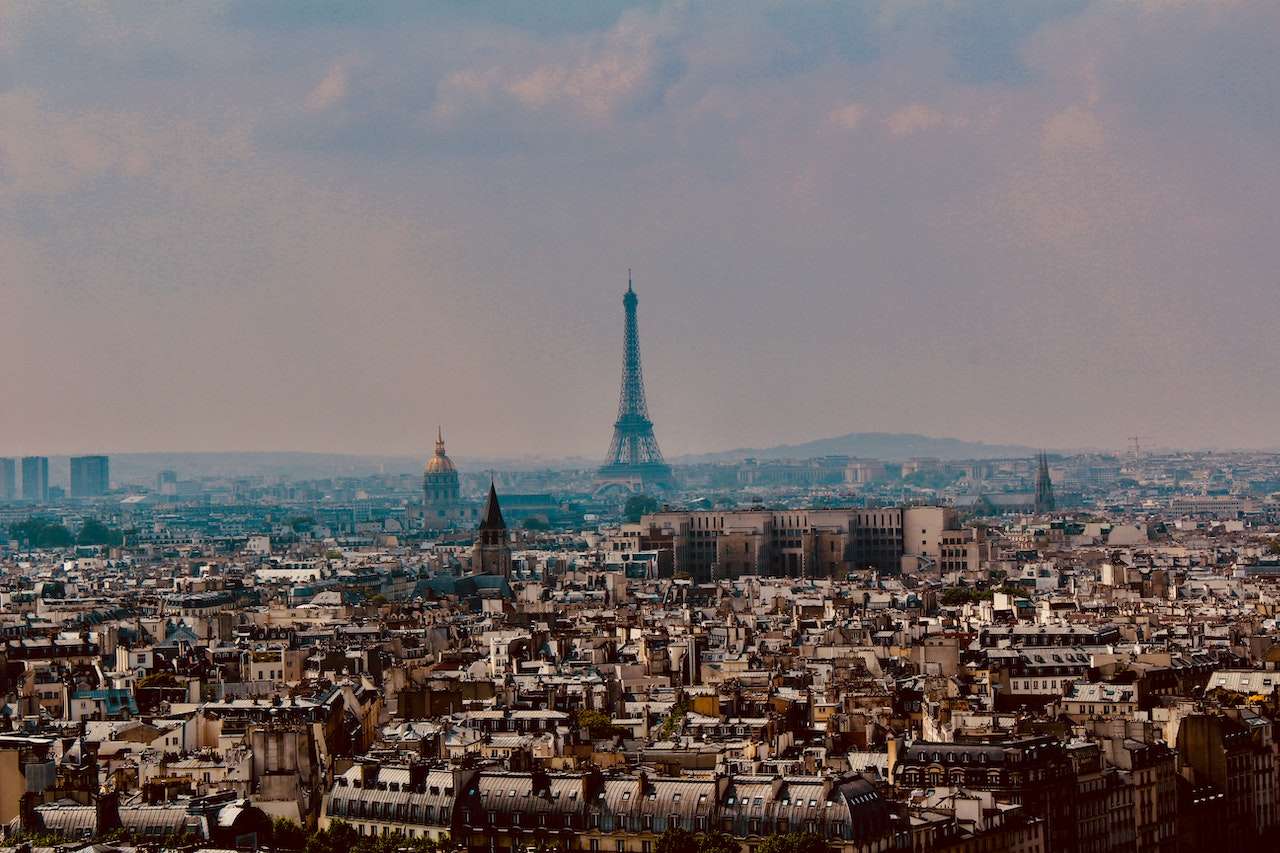
For visitors already in Paris, this extraordinary occasion also offers an opportunity to discover some of the city’s most meaningful places through a different lens: Notre-Dame Cathedral, the Place de la Concorde, the Champs-Élysées and the Church of La Madeleine.
Why Is Pope Leo XIV Coming to France?
Pope Leo XIV’s visit is not simply a religious pilgrimage. The Vatican describes the journey as an opportunity to meet French society, its people, culture, history and faith, while also addressing broader questions concerning humanity, education, culture, peace and Europe’s future. The Pope was invited by the French authorities and the Catholic Church in France, as well as by UNESCO for a visit to its Paris headquarters.
Les technologies doivent servir les humains. L’ IA ne peut répondre aux questions sur le sens de la vie – Technologies must serve humanity. AI cannot answer questions about the meaning of life.
His visit therefore brings together several dimensions:
Faith and the Catholic Church in France
French history and culture
Education and the role of culture
Science and technology
Artificial intelligence and human dignity
Peace and reconciliation
Dialogue with civil society and international institutions
At UNESCO, Pope Leo XIV is expected to address themes connecting art, education, culture, the environment and artificial intelligence. The Vatican has also emphasized the importance of education and culture as instruments for peace. His journey will later continue to Metz, where he will participate in a meeting entitled “At the Roots of Europe for Peace and Unity.” This gives the French visit a distinctly European dimension.
Pope Leo XIV’s Program in Paris
Friday, September 25, 2026
The Pope will arrive at Paris-Orly Airport at 10:00 a.m., where an official welcome ceremony will take place. He will then travel to the Élysée Palace, where he will meet the President of the French Republic at 11:00 a.m. and subsequently meet French authorities, representatives of civil society and the diplomatic corps.
L’avenir dépend du respect, de la dignité. L’homme vit grâce à la culture – The future depends on respect and dignity. Man lives through culture – Pope Leo XIV at UNESCO.
At 3:00 p.m., Pope Leo XIV will visit UNESCO, the United Nations Educational, Scientific and Cultural Organization, at its Paris headquarters.
This is a particularly significant part of the journey because UNESCO brings together questions that are central to the Pope’s message: education, science, culture, heritage and the future of humanity.
5:15 p.m. — Vespers at Notre-Dame de Paris
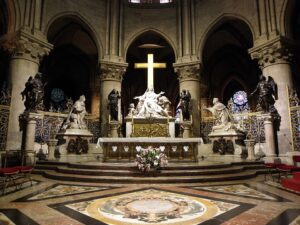
The Pope’s next major destination will be Notre-Dame Cathedral. At 5:15 p.m., Pope Leo XIV will celebrate Vespers, the Church’s evening prayer, with bishops, priests, deacons, consecrated men and women, and seminarians. This will be one of the most symbolic moments of his Paris visit. Here is the text of the Holy Father’s homily.
Dear brothers and sisters,
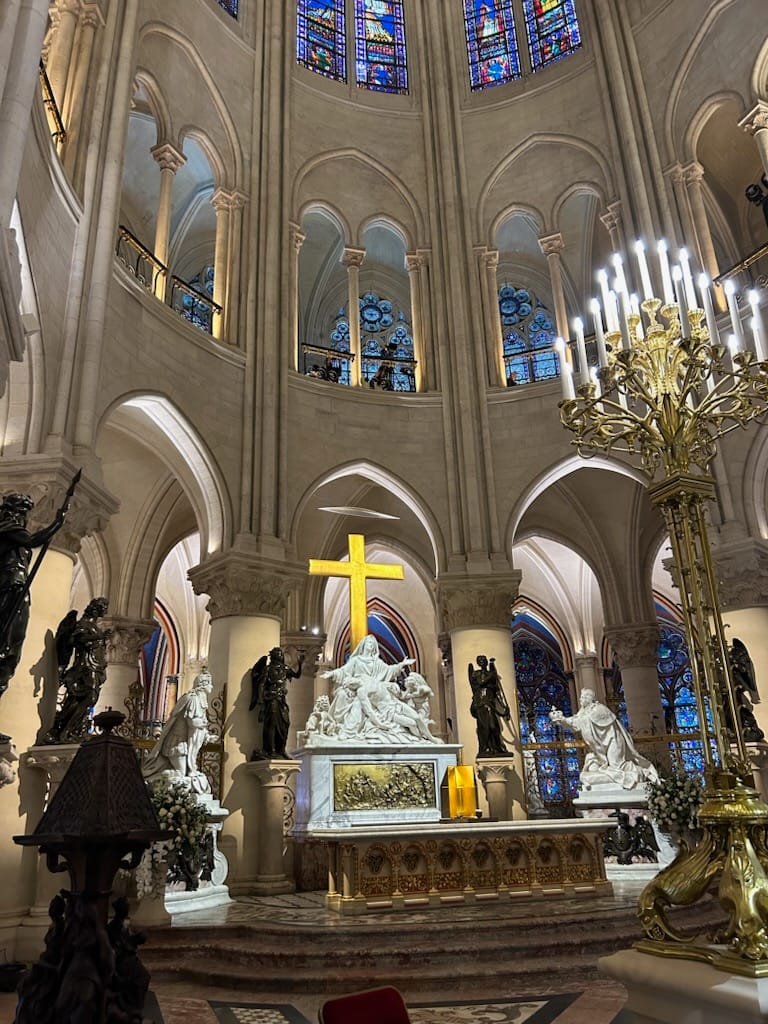
Evening prayer gathers us in this place which, more than any other, has for centuries invited Paris to look towards the heavens. Seven years have passed since the whole world, holding its breath, watched the cathedral engulfed in a terrifying blaze. Even then, we looked up in bewilderment, conscious of human powerlessness in the face of the unforeseeable. That pain was not felt by Catholics alone, nor merely by believers. In that dramatic hour, we realized that Notre-Dame is more than a monument. The collective effort of reconstruction—and the splendor of the result we see today—reveal that the heart of a people beats in this place, that we stand at the vital center of a civilization, that past and future embrace, and that heaven and earth meet.
I wished to meet you in this place that is so symbolic of the Church in France. It brings me joy to have crossed its threshold just moments ago, as do thousands of brothers and sisters from all over the world every day. The mere act of entering brings us face-to-face with a beauty that speaks to our restless hearts and calls them to peace. In restoring this space to humanity as a whole, there has been a profound recognition of how every visitor can be renewed by what they see, hear, and feel. The institutions—public, ecclesiastical, and private—involved in the restoration of Notre-Dame have thus contributed, through their specific roles, to revitalizing the cultural, existential, and spiritual journeys that the cathedral reveals. In this context, the Church has interpreted its mission not merely in terms of preservation but also of creativity, bringing tradition to life with the boldness of those who possess faith and look to the future with hope. I wish to thank the Archbishop, his collaborators, and the diocesan community of Paris, who have also devised a pastoral pathway for initial proclamation and Christian initiation that is accessible to all. The baptistery, situated at the entrance like a blessing and an invitation, stands as a sign of this.
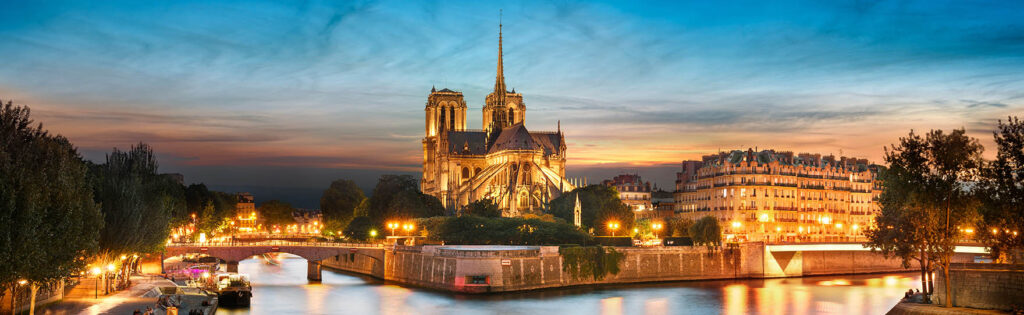
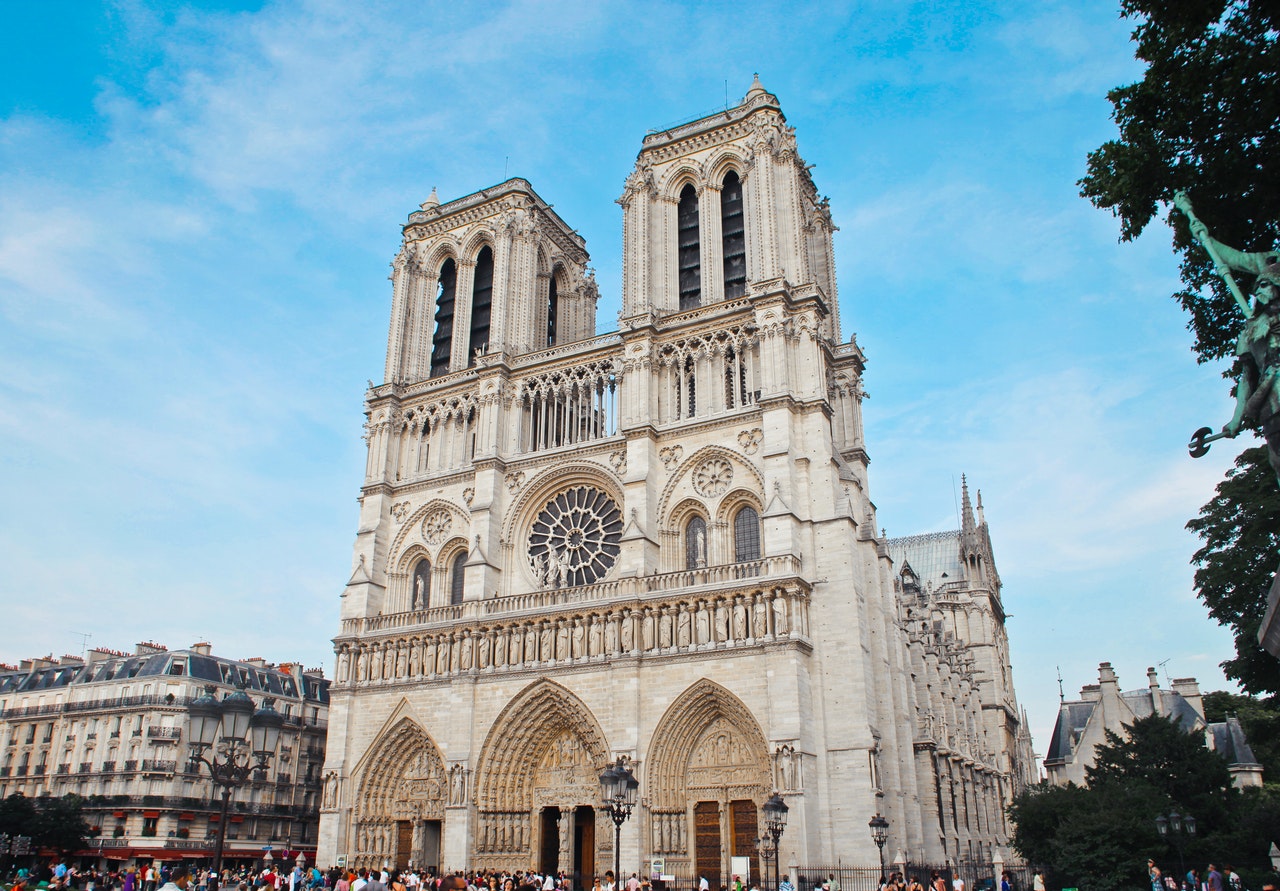
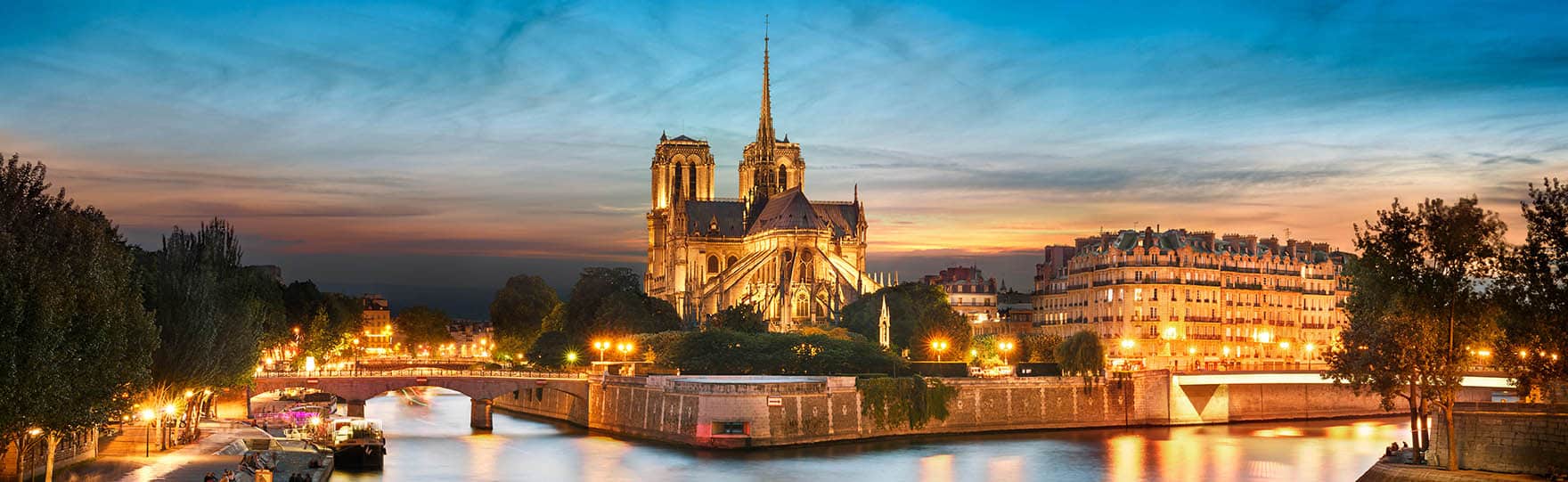
Notre-Dame is much more than one of the world’s most famous Gothic monuments. For more than eight centuries, the cathedral has been a place of Christian worship, pilgrimage, royal ceremonies, national history and artistic expression. The cathedral was begun in the 12th century on the Île de la Cité, at the historic heart of Paris. Its architecture tells the story of medieval France: its immense nave, flying buttresses, stained glass, sculptures and monumental portals were created not simply as decoration, but as part of a Christian vision of the world.
The fire of April 15, 2019, profoundly affected France and people around the world. After years of restoration, Notre-Dame reopened to the public in December 2024. Pope Leo XIV’s visit therefore takes place in a cathedral that has itself recently entered a new chapter of its long history. His celebration of Vespers here connects the contemporary Catholic Church with one of the most enduring symbols of Christianity in France.
From Notre-Dame to the Place de la Concorde
The following day, Saturday, September 26, Pope Leo XIV will continue his program in Paris.
At 9:00 a.m., he will visit Maison Bakhita, a center dedicated to welcoming and supporting migrants.
At 10:15 a.m., he will meet members of the provincial synodal assembly, catechumens and newly baptized Catholics at the Institut Catholique de Paris.
Then comes the major public event of his Paris visit.
3:00 p.m. — Mass at the Place de la Concorde
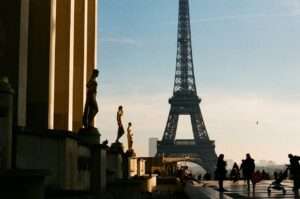
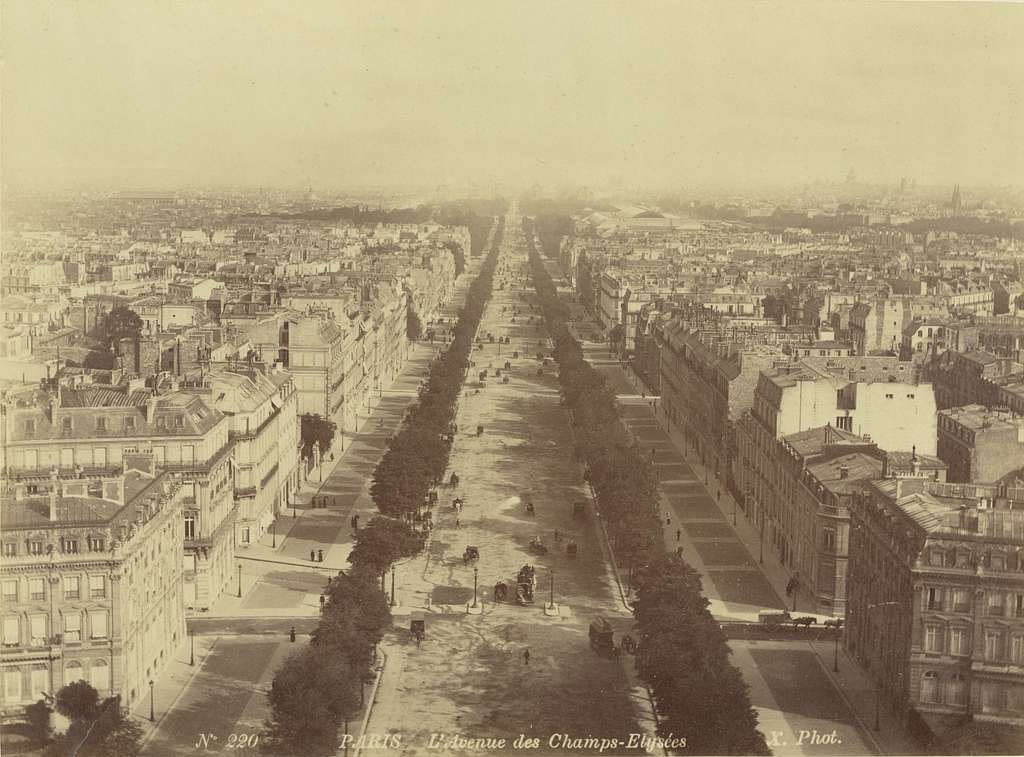
At 3:00 p.m. on Saturday, September 26, Pope Leo XIV will celebrate Mass at the Place de la Concorde, extending toward the Champs-Élysées.
The Diocese of Paris has announced that hundreds of thousands of people are expected, with approximately 600,000 registrations reported before registration closed.
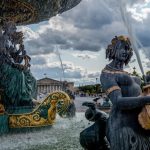
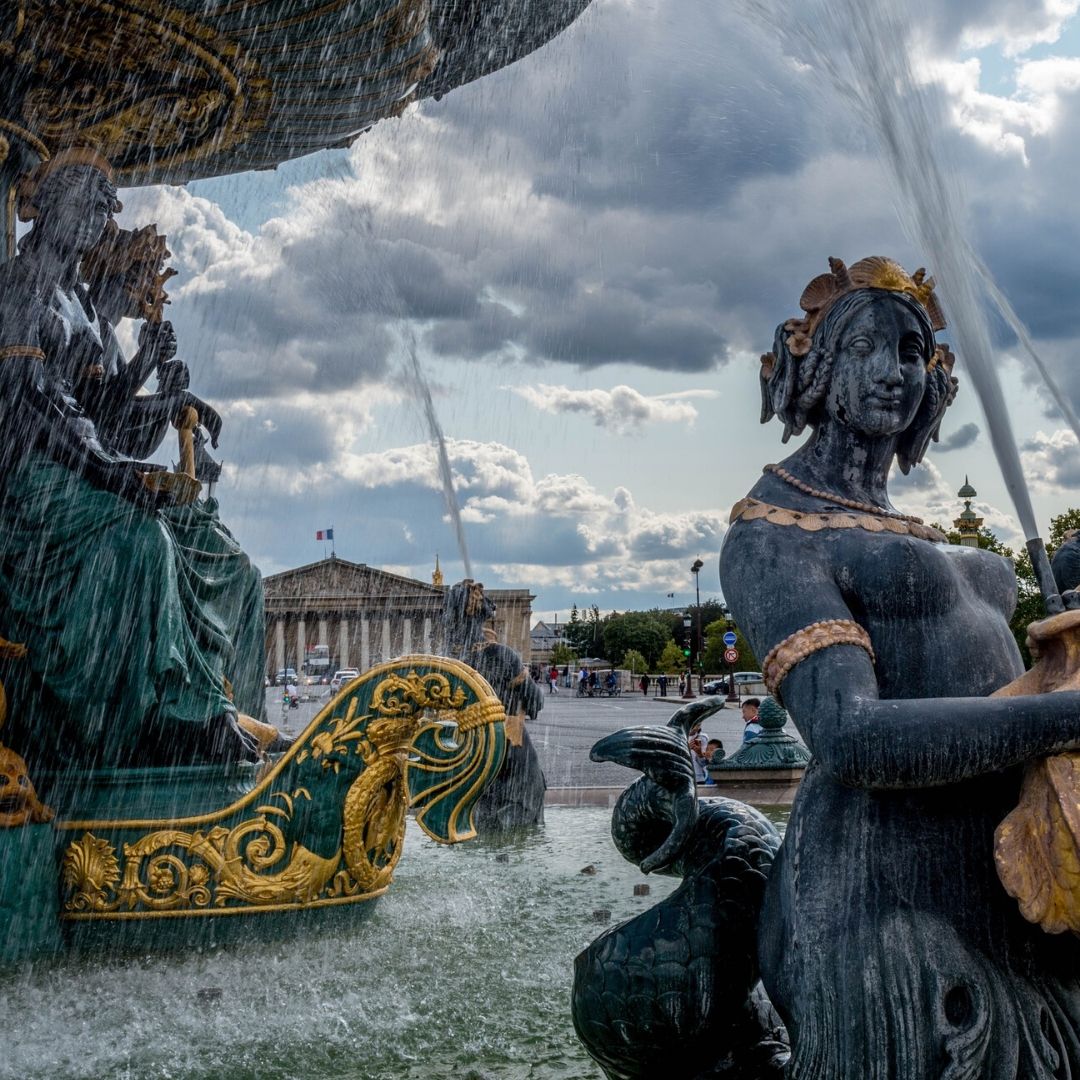
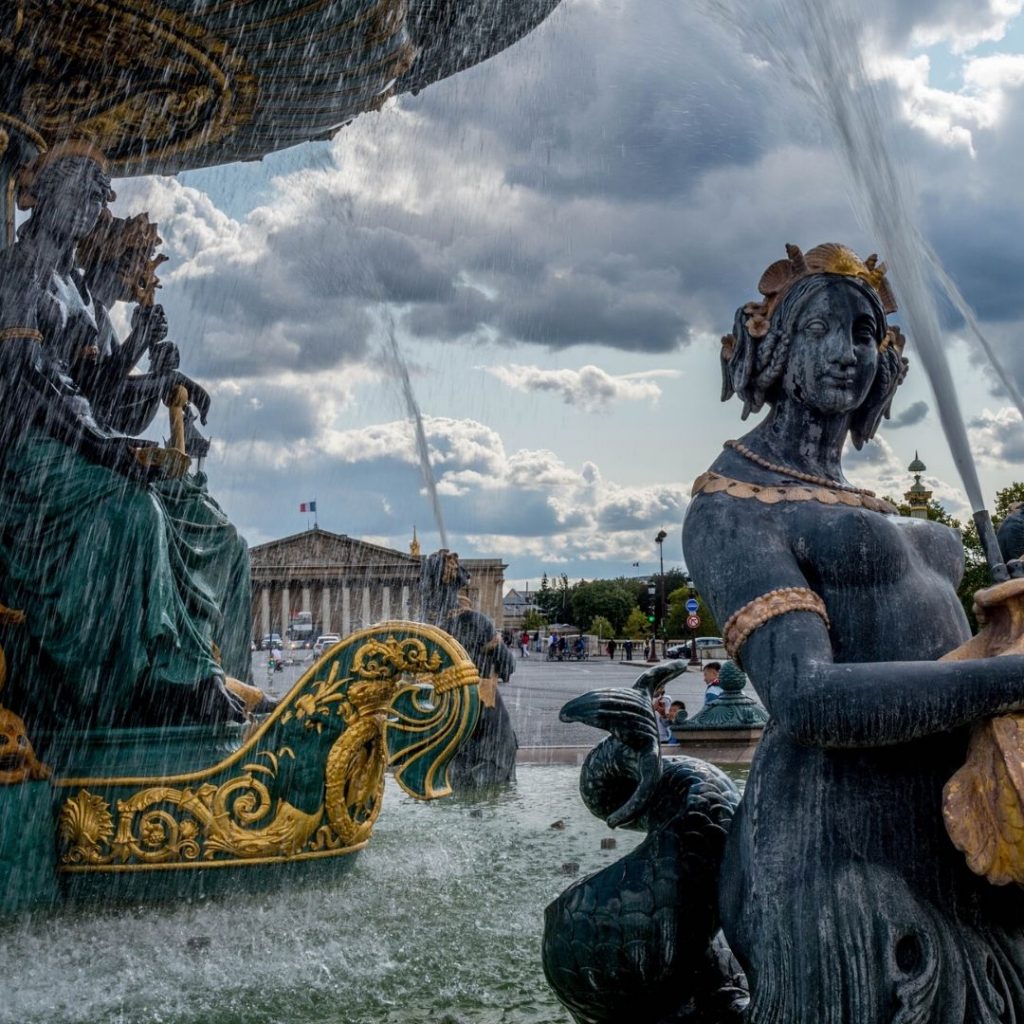
Place de la Concorde
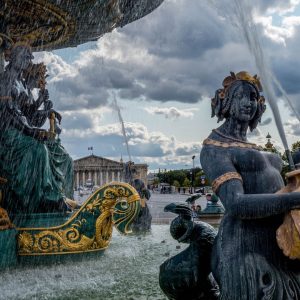
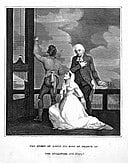
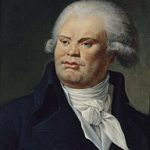
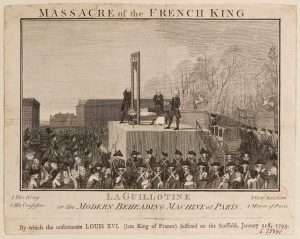
The choice of the Place de la Concorde is particularly striking because few places in Paris contain so much French history within a single square. The square was originally created in the 18th century as the Place Louis XV, honoring King Louis XV. During the French Revolution, it became the Place de la Révolution and was the site of the guillotine. King Louis XVI and Queen Marie-Antoinette were executed here, along with many other figures during the Revolution. After the revolutionary period, the square changed names several times before becoming the Place de la Concorde in 1830.
The name Concorde, meaning harmony or agreement, is itself significant.
Today, the square stands at the meeting point of several major Parisian perspectives: the Tuileries Gardens and Louvre to the east, the Champs-Élysées to the west, the Seine to the south and the Madeleine district to the north. Its history therefore encompasses the monarchy, the French Revolution, the Republic and modern France.
Holding a papal Mass here creates a powerful historical setting for a visit centered on themes of unity, peace and human dignity.
HOMILY OF POPE LEO XIV
“Place de la Concorde” (Paris)
Saturday, 26 September 2026
___________________________________
Dear brothers and sisters,
I give thanks to God for the grace of being here with you today, in the Place de la Concorde, to celebrate the Eucharist. It is truly good and pleasant when brothers and sisters dwell together in unity (cf. Ps 133:1) to proclaim God’s greatness. Indeed, I hope that my visit will strengthen you in faith and encourage you to shine forth ever more brightly, by sharing the life, peace and love of our Lord Jesus Christ.
“If anyone thirst, let him come to me and drink” (Jn 7:37). Brothers and sisters, in our thirst, we turn toward Christ, the source of living water: water that quenches our thirst and makes life flourish, the water of God’s love “poured into our hearts through the Holy Spirit who has been given to us” (Rom 5:5).
The desire for God dwells deep within our hearts, and we cry out with the psalmist: “My soul thirsts for God, for the living God” (Ps 42:2). This is the cry of a humble and passionate heart whose deepest, most existential thirst continues to grow. And it is Jesus Christ, through his Incarnation, who comes to meet every person in the midst of his or her own story, and reveals himself as the true source of living water capable of quenching our thirst. This thirst that dwells in every human heart is not so much a thirst for material things, but a thirst for meaning, for truth and fulfilment. Jesus responds to our profound desire for relationship, for communion with God, in whom the fullness of life forever resides.
In the first reading, the prophet Ezekiel saw water flowing out from the Temple and spreading through the desert, purifying and bringing life to everything it touched (cf. Ezek 47:1-2, 8-9, 12). Later, Saint John would see water flowing from the pierced side of Jesus as he gave up his spirit (cf. Jn 19:30-34). Everyone can now drink from this fountain, so as to receive the gift of the Spirit and be born anew, becoming children of God, a new creation.
Brothers and sisters, we must acknowledge that nothing in this world can ever fully satisfy us. When we think that our work is finished at last and our efforts have been rewarded, that inner emptiness often returns, deeper than before. And so, in an attempt to fill it, we may seek new pleasures, want to possess more and more things, or do everything we can to distract ourselves in order to numb that inner restlessness.
Today’s Liturgy of the Word invites us to look into our hearts and ask, what is my deepest thirst? What am I really seeking in life? We all long for happiness, love and fulfilment. But from what source do we seek to quench our thirst? Are we content with material goods, immediate satisfactions, the countless little idols that promise us everything but leave our hearts empty? We have been baptized and received the living water of which the Gospel speaks, but have we truly encountered Christ personally? In essence, the human person is a being of desire, and only God can fill the emptiness within us.
One of the most beautiful, and sometimes overlooked landmarks connected to this part of the Pope’s Paris itinerary is the Church of La Madeleine. La Madeleine stands at the northern end of Rue Royale, on the axis leading directly toward the Place de la Concorde. Its monumental classical façade, inspired by an ancient Roman temple, makes it immediately recognizable. The building is surrounded by 52 Corinthian columns and carries the inscription:
“D.O.M. SUB INVOC. S. MAR. MAGDALENAE” — dedicated to God, Most Good and Great, under the invocation of Saint Mary Magdalene.
Although La Madeleine is not listed as an official stop on Pope Leo XIV’s published itinerary, its location makes it an important landmark to understand when exploring the area surrounding the Concorde and Rue Royale. The official program specifically lists the Place de la Concorde for the September 26 Mass.
La Madeleine has one of the most unusual appearances of any Parisian church. From the outside, it looks more like an ancient Greek or Roman temple than a traditional Christian church. The current building was begun under the Ancien Régime and continued through the Revolutionary and Napoleonic periods. Napoleon initially envisioned the monument as a Temple to the Glory of the Great Army, before it was ultimately consecrated as a church dedicated to Saint Mary Magdalene. This makes La Madeleine a fascinating architectural expression of the transformation of France from monarchy to Revolution, Empire and eventually Republic.
Il faut construire un monde juste
We must build a world of justice
It also illustrates one of the most fascinating characteristics of Paris: religious buildings often carry layers of political, artistic and social history far beyond their original purpose.
A Papal Visit Through the Heart of Paris
Look at the geography of these places on a map and the symbolism becomes even more interesting.
Notre-Dame: the historic heart of medieval Christian Paris
UNESCO: culture, education, science and the future
Place de la Concorde: monarchy, Revolution and modern France
Champs-Élysées: the great ceremonial avenue of Paris
La Madeleine: the extraordinary meeting of Christianity, Empire and French history
These monuments tell different chapters of the French story.
And that is perhaps one of the most interesting aspects of Pope Leo XIV’s visit: he is not coming to a city without history. He is arriving in Paris, a city where Christianity, monarchy, revolution, republicanism, art, architecture and modern secular society exist side by side.
Pope Leo XIV and a Changing France
The Pope’s visit also comes at a significant moment for the Catholic Church in France. According to Vatican sources, the journey will address both the challenges facing French society and signs of renewed Catholic life, including the growing number of adults entering the Church. Vatican Press Office director Matteo Bruni noted that more than 13,000 adults were baptized at Easter 2026.
At the same time, the Church in France continues to confront the consequences of the sexual-abuse crisis and the need to listen to survivors and strengthen safeguarding and accountability. The visit therefore brings together celebration and reflection: faith, history, renewal, responsibility and dialogue with contemporary French society.
A Historic Weekend in Paris with Holy Father Pope Leo XIV
For two days, Paris will become an extraordinary meeting point between the history of France and the contemporary Catholic Church. On Friday, the Pope will encounter French political and diplomatic authorities, UNESCO, the clergy of Paris and young people.
On Saturday, he will meet people experiencing vulnerability, catechumens and newly baptized Catholics before celebrating Mass in one of the most historically charged squares in the capital. Then he will leave Paris for Lourdes, one of France’s most important Marian pilgrimage destinations and Metz.
For visitors interested in French history, Catholic heritage, architecture and the spiritual dimension of Paris, this is an exceptional moment to discover the city beyond its most familiar tourist landmarks. And perhaps nowhere is that connection more visible than in the short journey between Notre-Dame, the Place de la Concorde and La Madeleine, three places that reveal very different chapters of Paris and France.
Discover Paris Through Its Christian Heritage & Pope Leo XIV
Paris is filled with churches, chapels, monasteries, pilgrimage sites and works of sacred art that tell the story of the city and its people. From Notre-Dame and Sainte-Chapelle to Saint-Sulpice, the Miraculous Medal Chapel, Sacré-Cœur and the medieval churches of the Latin Quarter, Christian heritage is woven deeply into the history of Paris.
As a licensed private tour guide in Paris, I love helping visitors understand these places not simply as monuments, but through the stories, people, beliefs, architecture and historical events that shaped them.
A private Christian or Catholic tour can be customized around your interests, whether you are interested in Notre-Dame, Gothic architecture, French saints, Marian devotion, sacred art, medieval Paris or the history of Christianity in France.
Paris is not only a city to see. It is a city to understand and sometimes, to experience through the heart.
Notre Dame and Eugène Viollet Le Duc: Notre-Dame de Paris was already an extraordinary medieval monument when Eugène Viollet-le-Duc arrived on the scene, but by the early 19th century, the cathedral was in a deeply precarious condition. Centuries of alterations, neglect, pollution, structural deterioration, and the violence of the French Revolution had left one of Paris's greatest Gothic buildings badly damaged. During the Revolution, religious symbols and sculptures were destroyed, treasures were looted, and many statues on the western façade were mutilated. The cathedral's condition became so alarming that authorities eventually considered whether complete demolition might be necessary.
The story of its survival is therefore not simply an architectural story; it is also a story about changing attitudes toward medieval heritage in France. The official history of Notre-Dame explains that the cathedral was considered close to collapse after the revolutionary destruction, while the publication of Victor Hugo's Notre-Dame de Paris in 1831 helped create a powerful public movement to preserve it.
Enjoy a customized private walking tour covering Notre Dame on the City Island
From €240 for a 2-hour private walking tour
Available year-round with morning start times
Notre Dame pick-up meeting point
Viollet-le-Duc Vision for Notre-Dame
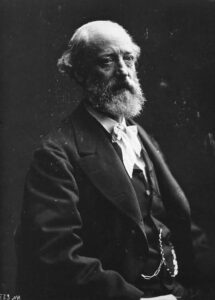
Eugène-Emmanuel Viollet-le-Duc was born in 1814 and was still relatively young when he became involved with Notre-Dame. He was not a conventional academic architect in the strictest sense; much of his knowledge developed through extensive study and travel, including his observations of medieval architecture in France and Italy. Before Notre-Dame, he had already become involved in important restoration projects, including the Basilica of Vézelay. The official Notre-Dame history describes him as a civil servant of the Historical Monuments and notes that he had directed the restoration of Vézelay at only 26 years old.
His approach was unusually analytical for the period. Rather than treating a medieval building as a collection of picturesque ruins, Viollet-le-Duc examined how its parts fitted together, how materials were used, how structural systems worked, and how the building might have evolved through time. He consulted old drawings, surviving fragments, archival evidence, and comparable medieval monuments. He also worked closely with specialized craftsmen and encouraged workshops to operate near the cathedral so that traditional techniques could be studied and applied.
This approach reveals something essential about Viollet-le-Duc: he was both historian and creator. He wanted to understand medieval architecture scientifically, but he also believed that restoration could involve reconstructing a building according to an architectural logic rather than simply preserving every surviving fragment. That philosophy would become one of the most influential—and controversial—aspects of his career.
A Cathedral in Danger After the Revolution
The situation is particularly interesting because the cathedral was not viewed by everyone in the early 19th century with the same admiration that visitors have today. Architectural tastes had changed dramatically, and Gothic architecture had spent long periods being regarded as old-fashioned or inferior to the classical styles favored by later generations. Parts of Notre-Dame had also been modified according to changing tastes, including interventions during the reigns of Louis XIV, Louis XV, and Louis XVI. The building that Viollet-le-Duc studied was therefore not a perfectly preserved medieval monument waiting to be cleaned; it was a layered historical structure containing evidence of many centuries. That distinction matters when trying to understand his restoration. He was not simply repairing a few broken stones. He was attempting to determine what the cathedral had originally looked like, what had disappeared, what had been altered, and what could reasonably be recreated. His answer would ultimately transform the appearance of Notre-Dame and profoundly influence the modern understanding of Gothic architecture.
A visit to Notre-Dame offers a unique opportunity to explore this fascinating dialogue between medieval craftsmanship, 19th-century restoration, and contemporary preservation. Eugène Viollet-le-Duc (1814–1879) played a defining role in shaping the modern image of Notre-Dame de Paris. A visionary French architect and theorist of medieval restoration, he was appointed in 1844, alongside Jean-Baptiste Lassus, to lead the ambitious restoration project of the cathedral after decades of neglect and damage. Inspired by Gothic architecture, Viollet-le-Duc sought not only to preserve the monument but also to restore its original spirit, sometimes recreating elements that had disappeared over time based on historical research and his own interpretation of the medieval style.
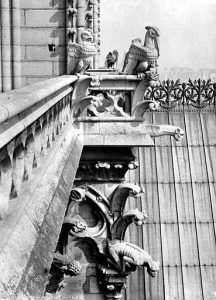
Among his most famous contributions was the reconstruction of the cathedral’s 19th-century spire (flèche), which became one of Notre-Dame’s most recognizable features. He also redesigned the famous chimera gallery, adding the now-iconic gargoyle-like creatures that overlook Paris, and restored numerous architectural details, sculptures, and decorative elements. His approach reflected the 19th-century philosophy of restoration: not simply conserving what remained, but recreating an ideal vision of the monument’s medieval identity.
Although Viollet-le-Duc’s methods have been debated by modern preservationists, his work was essential in saving Notre-Dame from deterioration and transforming it into the symbol of Gothic heritage known around the world today. His legacy remains deeply connected to the cathedral, and his influence was still visible during the restoration following the 2019 fire, when experts carefully studied his drawings and techniques to rebuild the spire and damaged structures.
The Notre-Dame Restoration by Viollet-Le-Duc: 1844–1864
The principal restoration campaign took place between 1844 and 1864, although some associated work continued later in the 19th century. Funding was a major challenge, and the project was interrupted between 1851 and 1859. After Lassus died in 1857, Viollet-le-Duc continued the restoration alone.
The project involved far more than repairing damaged stone. Viollet-le-Duc coordinated stonemasons, sculptors, glassmakers, carpenters, goldsmiths, and other craftsmen to restore the cathedral's architecture and decoration.
Viollet-le-Duc's Restoration Philosophy
Viollet-le-Duc did not simply want to preserve what remained. His goal was to recreate what he believed was a coherent Gothic vision of Notre-Dame, using historical documents, architectural research, surviving fragments, and comparisons with other medieval cathedrals.
This approach was innovative but controversial. Some of his additions were not exact medieval reconstructions but 19th-century interpretations inspired by medieval architecture.
The Gallery of Kings
One of the most visible parts of the restoration was the Gallery of Kings on the western façade. Many of its medieval statues had been destroyed during the Revolution.
Viollet-le-Duc and his team recreated approximately 100 statues, taking inspiration from surviving Gothic sculpture at cathedrals such as Amiens, Laon, Chartres, and Reims.
Today, these sculptures form an essential part of the famous façade, even though many are 19th-century creations.
The Restoration of the Interior
Viollet-le-Duc also transformed the interior of Notre-Dame. The restoration included the choir, sacristy, stained glass, liturgical furnishings, decorative metalwork, and medieval polychromy.
The choir was redesigned to emphasize its Gothic character, while the sacristy was reconstructed with a Gothic architectural vocabulary. New works were commissioned from specialized craftsmen, including goldsmiths and glassmakers.
The Famous Notre-Dame Spire
Perhaps Viollet-le-Duc's most famous creation was the central spire.
The cathedral had previously possessed a spire, but it was dismantled in the late 18th century. Viollet-le-Duc designed a completely new one, inspired by medieval Gothic architecture. Constructed from 1859, it reached approximately 96 meters high and was decorated with statues of the twelve apostles and the four Evangelists.
One fascinating detail is that Viollet-le-Duc gave the statue of Saint Thomas his own face.
The spire was destroyed in the 2019 Notre-Dame fire, but its importance to the cathedral's identity remains.
The Famous Chimeras
The strange creatures overlooking Paris from Notre-Dame's towers are another famous element associated with Viollet-le-Duc.
Although medieval Notre-Dame certainly had gargoyles, many of the famous chimeras visitors recognize today were created during the 19th-century restoration. Viollet-le-Duc used these fantastic creatures to reinforce the dramatic Gothic character of the cathedral.
This is one of the most interesting things to discover when visiting Notre-Dame: not everything that looks medieval is actually medieval.
Why Was Viollet-le-Duc's Work Controversial?
Viollet-le-Duc's restoration raised an important question: Should a historic monument be preserved exactly as it survives, or can missing elements be recreated according to historical research?
His approach sometimes involved reconstruction and artistic interpretation rather than simple conservation. Critics therefore questioned whether he was restoring Notre-Dame or creating his own vision of a Gothic cathedral.
Yet his work was based on extensive research into medieval architecture, historical documents, materials, and construction techniques. His restoration helped establish Gothic architecture as an important part of France's cultural heritage.
Viollet-le-Duc's Legacy at Notre-Dame
Viollet-le-Duc's restoration fundamentally changed the appearance of Notre-Dame and shaped how generations of visitors imagined the cathedral.
His spire, sculptures, façade restoration, interior decoration, and Gothic-inspired additions became part of Notre-Dame's identity. Even though some of these elements were 19th-century creations, they are now an important part of the cathedral's history.
This is what makes Notre-Dame so fascinating. It is not simply a medieval monument. It is a building shaped by the Middle Ages, the French Revolution, the 19th-century Gothic Revival, and modern conservation.
Conclusion
The restoration of Notre-Dame by Eugène Viollet-le-Duc in the 19th century was one of the most important restoration projects in French architectural history. Between 1844 and 1864, Viollet-le-Duc and his team repaired and recreated major architectural and decorative elements while giving the cathedral a renewed Gothic identity. His work remains controversial because some of what we see today was 19th-century interpretation rather than medieval survival. Yet that restoration is now itself part of Notre-Dame's history. When you visit the cathedral, look beyond its medieval origins. The Gallery of Kings, chimeras, interior decoration, and former spire tell another fascinating story: the story of how 19th-century France rediscovered, restored, and reinvented its medieval heritage.
Was Viollet-le-Duc the original architect of Notre-Dame?
No. Notre-Dame was primarily constructed between the 12th and 14th centuries. Viollet-le-Duc was the 19th-century architect responsible for its major restoration.
When did Viollet-le-Duc restore Notre-Dame?
The principal restoration campaign took place from 1844 to 1864, with additional related work continuing later.
Did Viollet-le-Duc create the Notre-Dame spire?
Yes. He designed the famous 19th-century spire, which was completed around 1860 and destroyed in the 2019 fire.
Are Notre-Dame's chimeras medieval?
Many of the famous chimeras on the towers were created during Viollet-le-Duc's 19th-century restoration, rather than being original medieval sculptures.
Why is Viollet-le-Duc important?
Viollet-le-Duc helped save Notre-Dame from serious deterioration and profoundly influenced the way Gothic architecture and medieval heritage were understood in France.
| The Best Covered Passages to Discover in Paris – Paris by Emy |
Covered Passages of Paris: Paris is home to several historic covered passages, each offering a different atmosphere and a unique glimpse into the elegance of nineteenth-century Paris. Some are famous for their architecture, others for their literary connections, antique shops, gourmet restaurants and luxury boutiques, or hidden treasures. During a Covered Passages of Paris private tour with Paris by Emy, you can discover the most remarkable galleries while learning the stories that make each one special.
Enjoy a customized private tour covering 2–3 nearby districts, with the option of a private driving experience for greater comfort and flexibility.
From €360 for a 3-hour private walking tour
From €950 for a private driving tour (up to 6 guests)
Available year-round with flexible start times
Hotel or central Paris pick-up meeting point
Private Tour Guide in Paris - Paris by Emy
Pricing
# of Person
Customized private tours in Paris
From €200
Per Person
2-hour Paris private museum tour + skip-the-line
From €360
Up to 6
2-hour private walking tour in Paris
From €950
Up to 6
Paris private walking tour + private museum tour
From €950
Up to 6
4-hour car tour Paris with private guide & driver
From €1,450
Up to 6
Paris Tour by private car + Museum private tour
Your personalized itinerary is set according to your preferences with recommendations before your arrival. No already-made tour. You can adjust the tour on the go as well. Our private guided tour comes with customization and recommendations.
Covered Passages of Paris Private Tour
Paris is celebrated for its magnificent monuments, elegant Haussmann boulevards, world-famous museums, and timeless cafés. Yet beyond the Eiffel Tower, Notre-Dame Cathedral, and the Louvre lies another Paris that many visitors never discover. Hidden between bustling streets are the covered passages of Paris, elegant glass-roofed shopping arcades dating back to the early nineteenth century. These remarkable galleries preserve the charm of Belle Époque Paris while offering a peaceful escape from the city’s busy avenues.
A Covered Passages of Paris private tour allows you to experience these architectural treasures with a licensed local guide who brings their fascinating history to life. Behind every decorative façade, mosaic floor, and iron-and-glass ceiling lies a story of Parisian innovation, luxury shopping, literature, gastronomy, and daily life during the nineteenth century.
Galerie Vivienne – The Most Elegant Covered Passage in Paris
4 Rue des Petits Champs, 75002 Paris
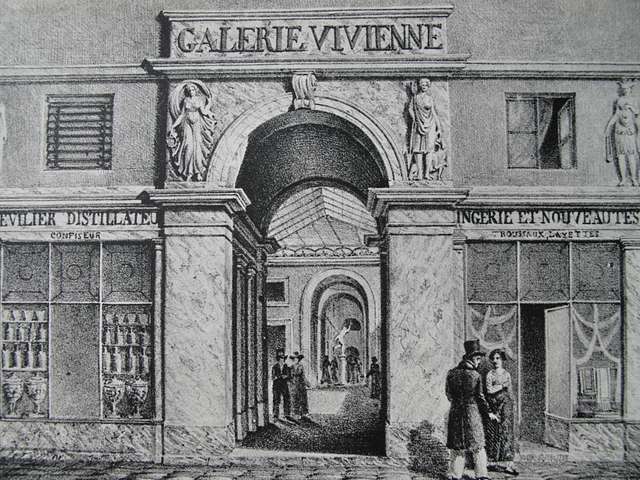
Located near the Palais-Royal, the Galerie Vivienne is often considered one of the most beautiful covered passages in Paris. Built in 1823 according to the plans of architect François Jean Delannoy, and originally named Galerie Marchoux after its first owner, it was inaugurated in 1826 as the Galerie Vivienne, taking its name from the Rue Vivienne on which it is located. Home to renowned boutiques and restaurants, and a true architectural masterpiece, it is now the venue for numerous events such as film shoots, haute couture fashion shows, and exhibitions by acclaimed artists. Over the years, the Galerie Vivienne has managed to preserve its old-world charm while modernizing to meet contemporary needs.
François-Jacques Delannoy designed a Pompeian-style neoclassical decor covered by an elegant glass roof, composed of mosaics, paintings, and sculptures celebrating commerce. Restoration work has allowed for the rehabilitation of the caducei, anchors, and cornucopias that adorn the semicircular windows, as well as the goddesses and nymphs that decorate the rotunda. Opened in 1826, it is famous for its magnificent mosaic floors, neoclassical decorations, elegant boutiques, and beautifully preserved glass roof. Walking through this gallery feels like entering a refined nineteenth-century Parisian salon.
The floor mosaics, with a terrazzo background, are signed by Giandomenico Facchina and Mazzioli. Their simplicity, emphasized by the repetition of basic geometric shapes, is reminiscent of the style of the mosaics on the Rue de Rivoli. The grand gallery, 42 meters long, is followed by a glass-roofed rotunda with a hemispherical glass dome, all of which are original.
The architect adopted the vocabulary of the Empire style: pilasters, arches, and cornices. He added decoration symbolizing wealth (cornucopias), success (laurel wreaths, sheaves of wheat, palm fronds), and commerce (Hermes’ caduceus). The floor, which is not original, is by Giandomenico Facchina.
Today, Galerie Vivienne combines historical charm with contemporary elegance. Visitors can discover luxury boutiques, wine shops, fashion designers, and charming cafés while admiring one of the finest examples of Parisian commercial architecture. Its connection to the Palais-Royal district makes it an ideal stop for travellers interested in history, architecture, and the refined lifestyle of old Paris. Walter Benjamin: The German philosopher made covered arcades (notably the Galerie Vivienne) the central subject of his monumental, unfinished work, the *Passagenwerk* (The Arcades Project), analyzing these architectural structures as the cradle of 19th-century modernity.
Passage des Panoramas – The Oldest Covered Passage in Paris
11-13 Boulevard Montmartre – 151 Rue Montmartre, 75002 Paris
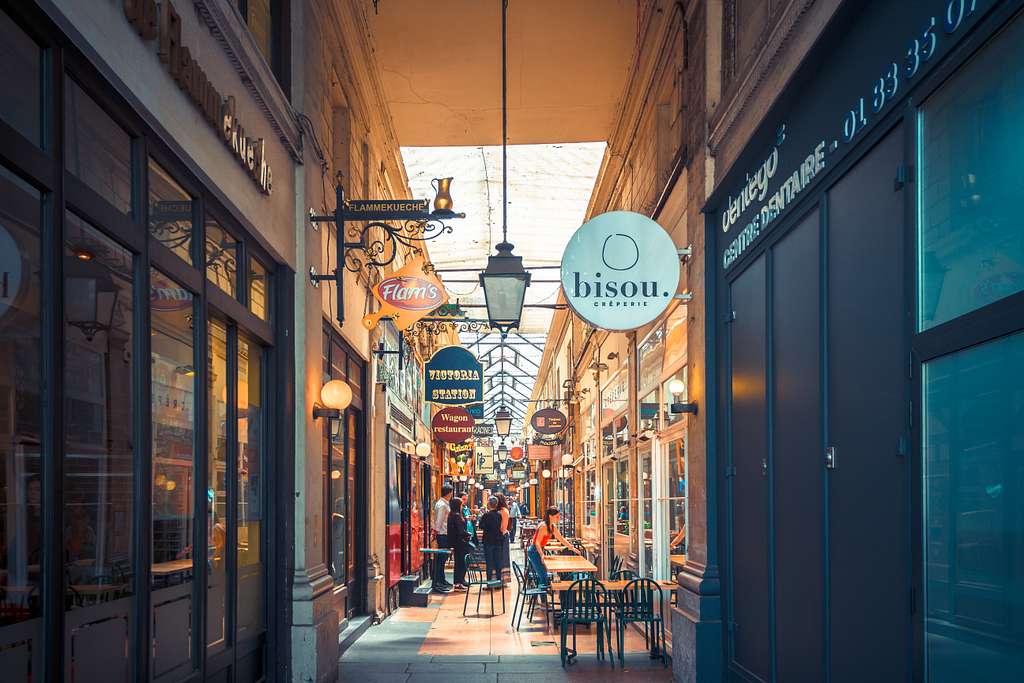
The signs: Flam’s (an Alsatian flammekueche restaurant), Bisou crêperie, Wagon restaurant, and what looks like part of the Racines sign on the left. Passage des Panoramas is known for packing restaurants and wine bars into the arcade.
The look: a glass-and-iron roof, hanging lanterns, and a narrow corridor lined with overhanging signs. It is one of the oldest covered passages in Paris (1799) and has this crowded, atmospheric look.
Opened in 1799, Passage des Panoramas is the oldest surviving covered passage in Paris. Originally created during the revolutionary period, it became a fashionable destination where Parisians could shop, socialize, and enjoy new forms of entertainment. The passage is particularly known for its historic restaurants, stamp collectors, antique shops, and authentic atmosphere. It was also connected to the world of theatre and journalism, reflecting the cultural energy of nineteenth-century Paris. Today, it remains a fascinating place where history and daily Parisian life continue to meet.
The facades and roofs of the buildings at 11-13 Boulevard Montmartre and 48 Rue Vivienne, including the entrances to the passage. In 1799, the American shipowner Thayer had two towers built on Boulevard Montmartre, in which he installed his panoramas, painted frescoes covering the walls of a rotunda. To facilitate access from the Palais Royal to the Boulevard and attract customers, he opened the Passage des Panoramas, which would shelter passersby from the rain and mud, on the site of the former Hôtel de Montmorency.
In 1834, the Galeries Saint-Marc, des Variétés, de Feydeau, and de Montmartre were added by the architect Jean-Louis Grisart to compete with the Galeries Colbert, Vivienne, and Véro-Dodat. The passage was an immediate success thanks to Parisians’ enthusiasm for panoramic views, its exceptional location on the boulevard, near the Bourse (Stock Exchange), and especially the Théâtre des Variétés, which was built against it in 1807. In 1816, gas lighting was tested there. The rotundas on Boulevard Montmartre were demolished in 1831. But while the popularity of panoramic views waned, the passage continued to thrive. In 1989, the southernmost section was significantly altered by the construction of an apartment building on Rue Saint-Marc.
– No. 57: The premises of the famous 19th-century chocolatier Marquis, of which a beautiful coffered ceiling, the wooden entrance columns, and the interior mirrors remain.
– No. 47: Stern Engraver, a shop listed as a historical monument, now Caffé Stern.
– No. 26: Antique postcard shop.
– No. 22: Numerous philatelic shops.
– No. 17 of the Passage des Variétés: The artists’ entrance to the Théâtre des Variétés. The Théâtre des Variétés has enlivened the passage for two centuries.
While the writer Émile Zola may not have been a regular patron, he immortalized the feverish atmosphere of these places in his novels—notably the Passage des Panoramas, which he describes in *Nana*.
Passage Jouffroy – A Journey into Nineteenth-Century Paris
10-12 Boulevard Montmartre – 9 Rue de la Grange Batelière, 75009 Paris
Built in 1846, Passage Jouffroy continues the elegant atmosphere of Passage des Panoramas. Located near the famous Grands Boulevards, it is recognized for its iron and glass structure, marble floors, and charming shops. The passage is home to bookstores, antique dealers, souvenir shops, and the entrance to the famous wax museum Musée Grévin. Its combination of architecture, culture, and history makes it one of the most enjoyable passages to explore during a private walking tour.
The passage itself, the facades and roofs of the buildings at 10-12 Boulevard Montmartre and 9 Rue de la Grange Batelière, including the two entrances to the passage, are listed as historical monuments. Created along the axis of the Passage des Panoramas, it is one of the most frequented passages. In 1882, Mr. Meyer, director of the newspaper “Le Gaulois,” had the idea of partnering with Mr. Grévin, then a famous caricaturist, to create a gallery of wax figures. The Passage Jouffroy was the first arcade built entirely of iron and glass.
Its metal structures bear witness to the evolution of techniques; cast-iron columns support the floors and rise to the glass roof. The arcade was the first to have underfloor heating. Note the pointed arch glass roof.
The terrain required the architects to create an L-shaped recess from a staircase that compensates for a slight slope. Café-concerts and cabarets enjoyed immense popularity in the 19th century; the most famous, the Estaminet Lyrique, was short-lived. The shops in the arcade were always of high quality: cafés, milliners, tailors, hairdressers, lingerie shops, glove shops, and more. It was completely renovated in 1987 and, on that occasion, its original paving was restored. The Passage Jouffroy has retained all its original charm and remains a popular destination.
Note: At the entrance to the passage on Boulevard Montmartre is the Hôtel Ronceray, where the composer Rossini lived from 1828 to 1832. He composed the opera “William Tell” there. Also located here is the entrance to the Musée Grévin.
No. 13: The Salon des Miroirs (Hall of Mirrors), a former cabaret known as a “beuglant” (a type of cabaret). The decorated panels are made of “crumpled” glass. This beautiful room is available for rent for events.
No. 58: Bookstore specializing in magazines and film posters.
Passage Verdeau – A Hidden Gem for Book Lovers and Collectors
Opened in 1847, Passage Verdeau is one of the quieter and more authentic covered passages in Paris. Located just behind Passage Jouffroy, it offers a peaceful atmosphere with antique shops, old booksellers, photography collections, and vintage treasures.
For travellers looking for a more intimate side of Paris, Passage Verdeau provides a wonderful opportunity to slow down, browse unique shops, and experience the charm of a less crowded historic gallery.
Passage du Grand Cerf – One of the Most Impressive Architectural Passages
The Passage du Grand Cerf, opened in 1825, is remarkable for its exceptional height and impressive glass-and-metal structure. With one of the highest ceilings among Parisian covered passages, it creates a bright and spacious atmosphere.
Today, the passage is known for artisan workshops, creative boutiques, and independent designers. It represents the artistic and craftsmanship side of Paris, where visitors can discover handmade creations and meet passionate shop owners.
Passage Choiseul – A Historic Parisian Shopping Arcade
Located near the Opéra district, Passage Choiseul was inaugurated in 1827 and once attracted writers, artists, and intellectuals. The passage has a more local atmosphere and offers a fascinating contrast between historical architecture and modern life.
Recently renovated, Passage Choiseul has regained much of its original charm while welcoming restaurants, boutiques, and creative businesses. It remains a wonderful example of how Paris successfully preserves its heritage.
Louis-Ferdinand Céline: He spent his childhood in the Passage Choiseul, where his mother ran an antique shop. He drew inspiration from this place (which he nicknamed “les Bérézinas”) for his novel *Death on the Installment Plan*.
Experience Authentic Paris
Discovering the covered passages of Paris is like opening a hidden door into another era. Behind their discreet entrances are stories of merchants, artists, writers, architects, and generations of Parisians who shaped the identity of the city.
A private Covered Passages of Paris tour with Paris by Emy allows you to explore these elegant galleries at a relaxed pace while understanding their historical, cultural, and architectural significance. Instead of simply visiting beautiful locations, you experience the atmosphere, stories, and hidden details that make Paris endlessly fascinating.
| A Saint-Germain Tour Dedicated to the Saint-Germain-des-Prés church and Ancient Abbey |
Saint-Germain-des-Prés Church and Abbey Private Tour: When travelers hear the name Saint-Germain-des-Prés, they often imagine charming cafés, legendary writers, jazz clubs, art galleries, and the intellectual atmosphere that made this Paris district famous during the 20th century. They think of philosophers gathering in cafés, artists discussing ideas over coffee, and the elegant streets that still preserve the spirit of old Paris. But long before becoming the symbol of existentialism and Parisian bohemian culture, Saint-Germain-des-Prés was something entirely different. It was one of the most powerful religious and intellectual centers of medieval France, built around a prestigious royal abbey that stood at the gates of the ancient city.
Enjoy a customized private walking tour covering 2–3 nearby districts, with the option of a private driving experience for greater comfort and flexibility.
From €360 for a 3-hour private walking tour
From €950 for a private driving tour (up to 6 guests)
Available year-round with flexible start times
Hotel or central Paris pick-up meeting point
Saint-Germain-des-Prés Church Private Tour – Founded in 558
“The monastery must, as much as possible, be arranged in such a way that everything necessary is found there: water, a mill, a garden and workshops so that one can practice the various trades inside of the enclosure. In this way, the monks will not need to disperse outside, which is not at all advantageous for their souls.” Saint Benedict (480-547 Italia)
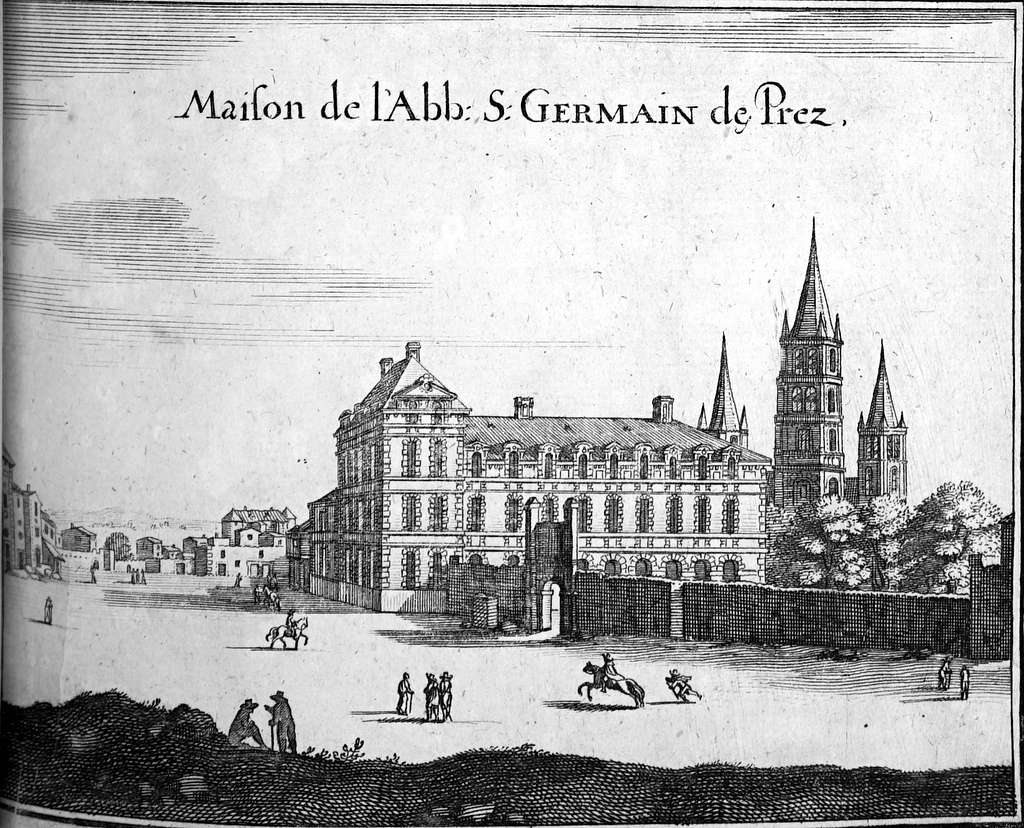
Saint-Germain-des-Prés Church and Abbey Private Tour Founded in 558 by Childebert I, the son of Clovis was originally the church of a Benedictine abbey. It was destroyed by the Vikings, rebuilt, and renamed in the 8th century for Saint Germain, Bishop of the city. Thus, It was a royal abbey, which therefore benefits from an exemption and was directly subject to the pope. The first abbey church was consecrated on April 23, 558 to the Holy Cross and Saint Vincent of Zaragoza. This basilica had marble columns, a paneled ceiling and glazed windows.
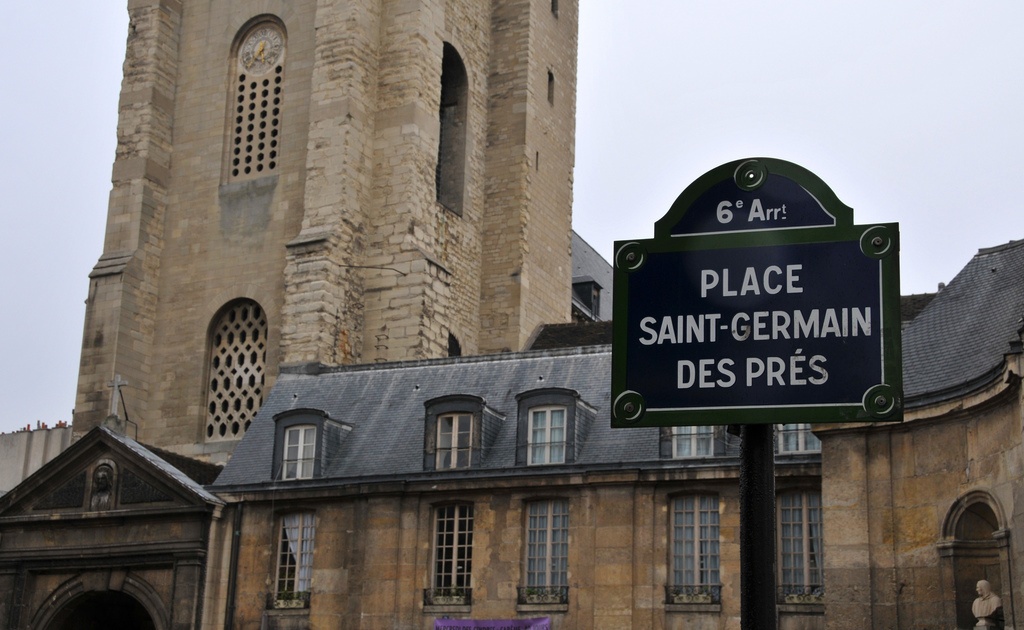
3 place Saint-Germain-des -Prés 75006 Paris
Ordre Saint-Benoît – Benedictine Congrégation de Saint-Maur
Fondation 558 – VI century
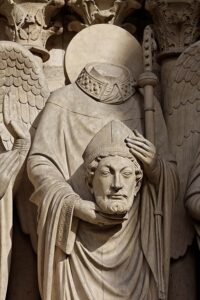
It was also a royal necropolis Germanus and of Childebert, Clovis’son and other rulers of the Merovingian Dynasty until the creation of that of the Saint-Denis basilica in the XII century. Saint Denis was a 3rd-century Christian martyr and the first bishop of Paris who is venerated as the patron saint of France. He was beheaded by Roman authorities and became famous in Christian legend as a cephalophore for allegedly walking while carrying his own head, in Montmartre. The relics of Saint Germain were venerated there, but no medieval burial remains to this day and the relics have considerably diminished.
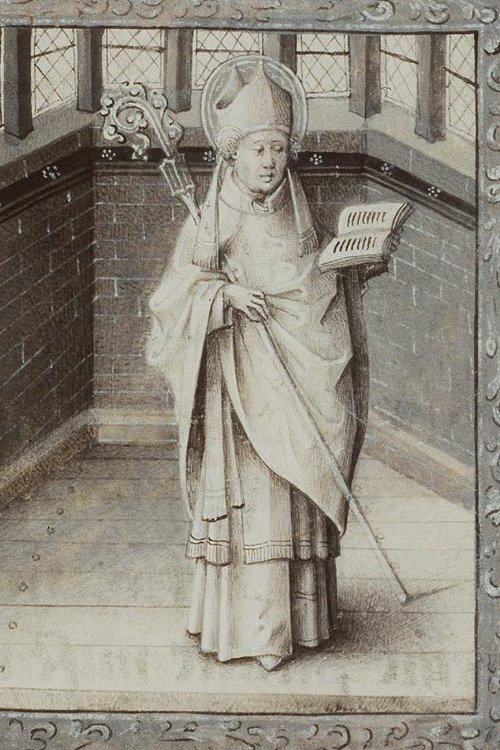
Saint Germain des Près – By Book of Hours, c. 1450-1460. Jean le Tavernier (illuminator)
Saint Germain des Près – Bishop of Paris
Saint Germain wasn’t the first bishop of Paris. That title traditionally belongs to Saint Denis, regarded as the first bishop of Paris, a 3rd-century martyr whose legend gave rise to the Basilica of Saint-Denis. By the time Germain took up the office, Paris had already had a line of bishops for roughly three centuries.
From monk to bishop
Germain studied at Avalon and Luzy under his cousin Scapilion, a priest, and was ordained around age thirty-four by Saint Agrippinus of Autun, becoming Abbot of Saint-Symphorien near Autun. He was known above all for his radical generosity to the poor, his alms-giving was so extreme that his own monks, fearing he’d give away the abbey’s entire wealth, rebelled against him. That reputation earned him the nickname “Germain d’Autun,” later rendered as the “Father of the Poor.”
Bishop of Paris
He happened to be in Paris in 555 when Bishop Eusebius died; Childebert I kept him there, and he was consecrated to the vacant see with the unanimous consent of clergy and people. As bishop, he held considerable moral influence over Childebert’s court and persuaded the king to found the church that would, after Germain’s death, be renamed Saint-Germain-des-Prés and become a royal burial site. He went on to preside over the third and fourth Councils of Paris in 557 and 573, and attended the second Council of Tours in 566.
The abbey’s name
Germain died in 576 and was originally buried in the church’s Saint-Symphorien chapel. He was later canonized, and once his relics were moved into the choir, the church, originally dedicated to the Holy Cross and Saint Vincent, gradually became known by his name instead, giving us “Saint-Germain-des-Prés.”
Different from Saint Germain L’Auxerrois
According to tradition, Germain was born in Autun, in Burgundy, around 496 CE. From an early age, he showed signs of piety and learning, entering the Church and rising through the ranks thanks to his education, humility, and compassion for the poor. Around 555 CE, Germain was appointed Bishop of Paris, making him one of the earliest and most influential spiritual leaders of the city. His episcopacy coincided with the reign of the Merovingian kings, and he became a close advisor to King Childebert I, son of Clovis. Under Germain’s influence, Childebert turned toward acts of Christian charity and religious patronage.
One of Germain’s most important achievements was persuading the king to build a grand basilica just outside the city walls to house holy relics. This church, dedicated to Saint Vincent and the Holy Cross, later became Saint-Germain-des-Prés, one of the oldest churches in Paris. Over time, Germain himself was buried there, and the church took his name. Saint Germain was known for his austerity, charity, and miraculous healings. He worked tirelessly to promote peace among warring nobles, to feed the hungry during famines, and to protect the rights of the poor.
Legends tell of him curing the sick, calming storms, and even interceding to stop invasions. He died on May 28, 576, and was buried in the basilica he founded. Soon after his death, people began to venerate him as a saint, and his tomb became a place of pilgrimage.
Why he matters today
Saint Germain’s legacy still shapes Paris:
The district of Saint-Germain-des-Prés takes its name from him.
The church he founded remains a historical landmark.
His life marks the bridge between ancient Roman Lutetia and medieval Christian Paris, showing how religion, politics, and urban growth intertwined.
How the Monks Lived in Saint Germain Abbey ?
Life inside the abbey walls followed a rhythm almost entirely foreign to the modern city that surrounds it today. The monks who lived here, first under Merovingian patronage, later as part of the powerful Benedictine network, and finally as the scholarly Maurist congregation organized their entire existence around prayer, manual or intellectual work, and silence.
The abbey was a self-contained world. It had its own dormitory, refectory (dining hall), chapter house for daily meetings, infirmary, cellars, gardens, and eventually one of the finest libraries in Europe. Monks rose before dawn for the first of several daily prayer services, worked through the day copying manuscripts or tending the abbey’s considerable landholdings, and observed periods of enforced silence meant to turn the mind toward contemplation. Guests, pilgrims, and scholars were also housed and fed here, since hospitality was itself considered a sacred duty.
Abbots, Priors, and the Abbot’s Palace
At the head of the community stood the abbot, not merely a spiritual leader but, in the case of Saint-Germain-des-Prés, a powerful feudal lord in his own right. Abbots here held enormous influence: they controlled vast tracts of land on the Left Bank, administered their own justice, and in some periods answered to almost no one but the king and the pope. Among the more famous holders of the title was Louis-César de Bourbon, an illegitimate son of Louis XIV, and John II Casimir Vasa, the former king of Poland who abdicated his throne and retired to become Abbot of Saint-Germain, his heart is still entombed inside the church.
Below the abbot, the prior handled the day-to-day discipline and organization of the monastic community, while a network of officials oversaw everything from the library to the wine cellars. Remarkably, one physical trace of this hierarchy still survives: the former Abbot’s Palace, standing beside the church, is one of only two abbey buildings that escaped destruction during the French Revolution, a rare chance to see, in stone, how a medieval prince of the Church actually lived.
The Rule of Saint Benedict: Ora, Labora, Lectio Divina
Everything about monastic life at Saint-Germain traced back to the Rule of Saint Benedict, written in the 6th century and adopted by Benedictine communities across Europe, including this one. The Rule organized life around three interlocking pillars:
Ora (pray) — the recitation of the Divine Office at fixed hours day and night
Labora (work) — manual labor, farming, and later the labor of copying texts
Lectio Divina (sacred reading) — meditative reading of Scripture to nourish the soul
This triad wasn’t a slogan; it was a literal daily schedule, and it shaped the physical layout of the abbey itself, church for prayer, workshops and fields for labor, library and cloister for reading. It’s also the thread that connects the abbey’s earliest Merovingian monks to its final generation of Maurist scholars over a thousand years later.
The Congregation of Saint-Maur
By the early 17th century, Benedictine monasticism in France was in need of reform, and in 1621 a new congregation was founded that would transform Saint-Germain-des-Prés into something closer to a research institute than a traditional monastery: the Congregation of Saint-Maur, or the Maurists. Named after Saint Maurus, a disciple of Saint Benedict credited with bringing the Benedictine rule to Gaul, the Maurists became famous across Europe for rigorous scholarship in history, theology, and manuscript editing.
Saint-Germain-des-Prés became their headquarters, the seat of the congregation’s superior general and the center of its intellectual output. At its height the Maurist network embraced close to two hundred houses across France. The Maurist library at Saint-Germain grew into one of the most important collections in the country, drawing scholars from across the continent and helping make the Left Bank, alongside the nearby Sorbonne, one of the great learning centers of Europe.
The former Abbot’s Palace (the building right next to the church, at what is now 3 rue de l’Abbaye) is one of the only two structures of the original abbey complex to survive the Revolution, the other being the church itself. Today, part of that building houses premises of the Institut Catholique de Paris. The abbey palace, restored in 1970, houses part of the Catholic Institute of Paris, though it bears little resemblance internally to its original appearance.
The Catholic University of Paris Next to Saint Germain Church
The Institut catholique de Paris was founded in 1875, under the name of the Université catholique de Paris by Maurice Le Sage d’Hauteroche d’Hulst.
The school settled on the site of the former convent of the Carmelites, however the premises were not well adapted. Gabriel Ruprich-Robert developed a new project for the site; however, due to a lack of sufficient funds, he decided to renovate some of the old buildings instead of destroying them. The first phase of the renovation took place between 1894 and 1897. Following the French law establishing the separation of the church and state, ownership of the premises was given to the state. In 1927, the premises were repurchased by the institute, allowing the second phase of the renovation to take place between 1929 and 1930, followed by a third phase between 1932 and 1933. The Neo-gothic architectural style is prevalent on the campus.
ICP is a non-for-profit association pursuant to the French Law of 1901, recognized as promoting public interest, in 1941. The current rector is Bishop Philippe Bordeyne, who has been the rector of ICP since 2011. In 2017, there were 10,000 students attending ICP. This was also the year that ICP inaugurated its renovated campus.
Where and How People Were Buried in Saint Germain?
For roughly two centuries, Saint-Germain-des-Prés functioned as the burial church of the Merovingian dynasty, beginning with Childebert I himself. Kings, queens, and members of the royal family were interred here in a sequence of increasingly elaborate tombs until the role of royal necropolis passed to Saint-Denis in the late 8th century. Later burials reflect the abbey’s continuing prestige: exiled royalty such as John II Casimir Vasa of Poland (whose heart remains entombed here), Scottish nobles who died in French royal service, and scholars such as the philosopher René Descartes were all laid to rest within its walls. Much of this funerary heritage was violently disrupted during the Revolution, when royal tombs were opened and desecrated; some Merovingian sarcophagi discovered in later excavations are now preserved in the Musée de Cluny rather than in the church itself.
Cluny Museum
Saint-Germain-des-Prés and Abbot Suger
The church was rebuilt by Abbé Morard, from the end of the 10th century. The first four levels of the western bell tower, the nave and the transept of the current church date back to this period, in which one can see in particular interesting capitals from around the year one thousand. The current choir was built in the middle of the twelfth century in the primitive Gothic style and consecrated by Pope Alexander III on April 21, 1163. It is one of the first Gothic buildings, which contributes to the spread of this new style and is of of major archaeological importance.
Originally, in the Merovingian and early Capetian periods, Saint-Germain-des-Prés was closely tied to the French monarchy. Kings and nobles contributed to its construction and maintenance, and it served as a burial and ceremonial site for important figures.
Over the centuries, the church lost some of its direct royal patronage, especially after the rise of larger royal abbeys and cathedrals, like Saint-Denis, which became the primary royal necropolis. By the 17th and 18th centuries, Saint-Germain-des-Prés functioned mostly as a parish church, though it retained some prestige due to its history.
The definitive break came during the French Revolution (1789–1799). The revolutionary government confiscated church property, secularized religious institutions, and often repurposed churches for civic use. Saint-Germain-des-Prés was stripped of its royal and religious privileges, its abbey dissolved, and its treasures removed.
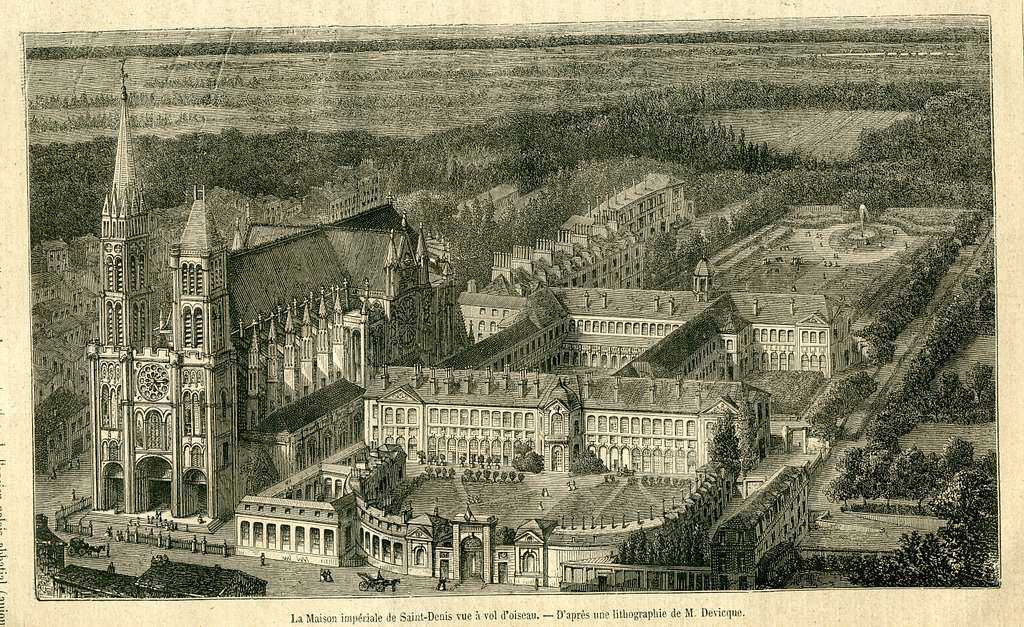
The building of the Basilica of Saint-Denis, just North of Paris, was ordered in the 12th century by Abbot Suger (c. 1081–1151), one of the most influential churchmen and political figures of medieval France.
Abbot Suger was the abbot of the Abbey of Saint-Denis from 1122 until his death. He was not a king, but he was both a close advisor to the Capetian monarchs (Louis VI and Louis VII) and the effective manager of the abbey’s vast resources. The abbey already existed as a site of deep significance — it was believed to hold the relics of Saint Denis, the 3rd-century martyr and first bishop of Paris, and it had been a burial place for French kings since the early Middle Ages. Around 1135, Suger launched an ambitious rebuilding project to honor Saint Denis, glorify God, and reflect the growing power of the French monarchy.
The vision Suger wanted the church to be not just a shrine, but a symbol of the divine order and the kingdom’s prestige.
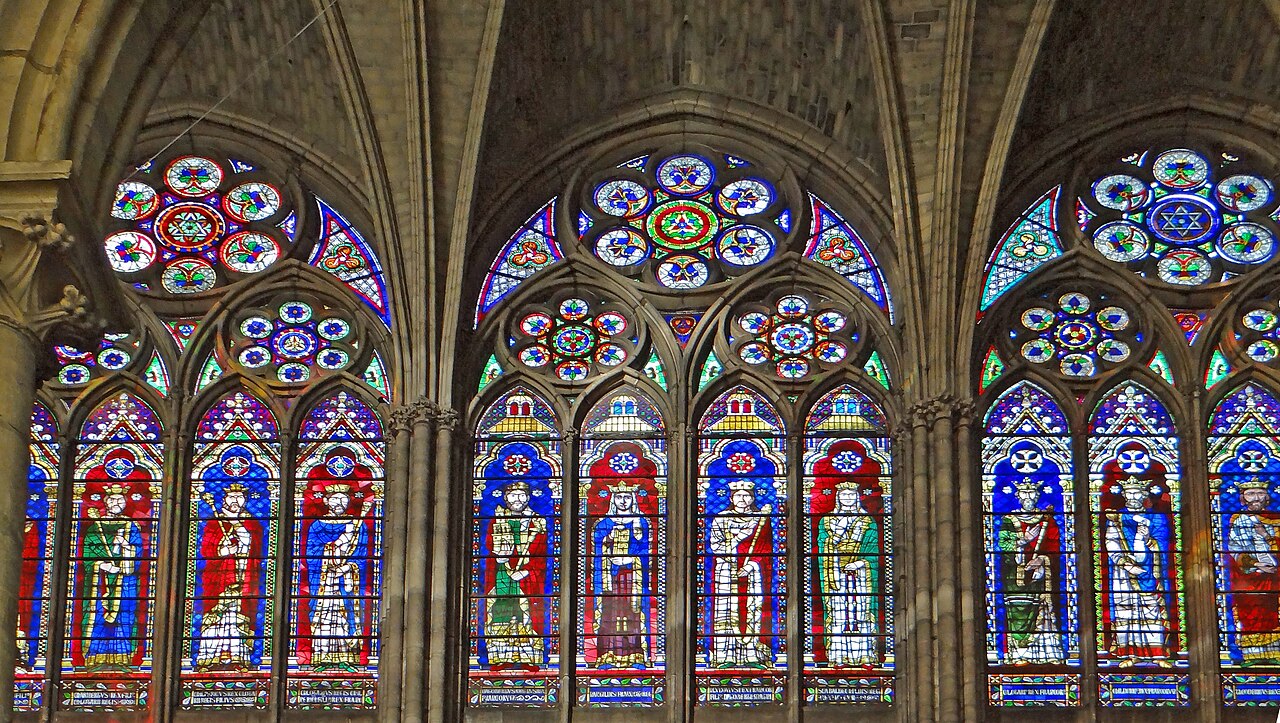
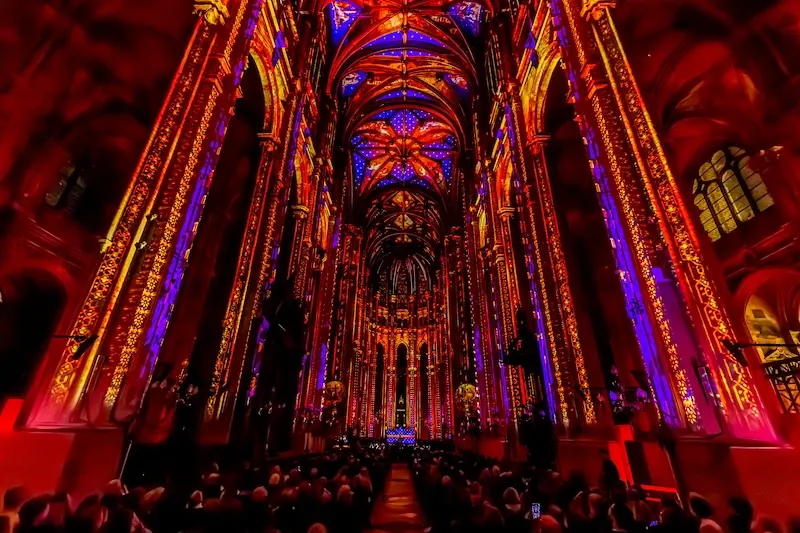
He pioneered architectural innovations, especially the use of ribbed vaults, pointed arches, and large stained-glass windows, which allowed the building to be flooded with colored light. This made Saint-Denis the first true masterpiece of Gothic architecture, setting the style for Notre Dame Gothic Cathedral and cathedrals across Europe. Abbot Suger left detailed writings about his work, making him one of the few medieval builders whose thought process we can still read today. Saint-Germain-des-Prés stopped being a royal church gradually during the French Revolution at the end of the 18th century. Here’s the context:
The Saint Germain Abbey’s Influence on Arts, Literature, History, and Archaeology
Few religious sites in France have left a deeper mark on Western culture. As the burial place of Merovingian kings, Saint-Germain-des-Prés was, for centuries, effectively a royal necropolis before that role passed to the Basilica of Saint-Denis. As a Maurist stronghold, its monks produced painstaking historical and textual scholarship that still underpins modern medieval studies. Its library circulated illuminated manuscripts across Europe and made the abbey a genuine center of the Republic of Letters.
Even after the Revolution, the neighborhood the abbey created never lost its intellectual gravity. The philosopher René Descartes is buried inside the church. Centuries later, the same streets around the old abbey walls would host Sartre, de Beauvoir, Picasso, and the Café de Flore crowd, and the district still carries the abbey’s name, a rare case of a demolished institution shaping a neighborhood’s identity for centuries after its disappearance.
Saint Germain Church Through the Ages
The church itself is a layered document of French architectural history almost every century between the 6th and the 20th has left a visible mark on it.
Merovingian Period (Late Antiquity)
The first church on this site was founded in the 6th century by the Merovingian king Childebert I, reportedly to house relics brought back from Spain, and it quickly became the burial church of the Merovingian dynasty. This original building was extraordinarily rich for its time — marble columns, gilded copper roofing, mosaic floors, and painted decoration befitting a royal mausoleum. Almost nothing of that first building survives above ground; it was burned and plundered repeatedly by Viking raiders toward the end of the 9th century.
Early Romanesque
The church was rebuilt from around the year 1000 under Abbot Morard, who gave it the three-tower Romanesque profile it would carry into the modern era. The surviving bell tower, completed in 1014, is one of the oldest Romanesque structures still standing in Paris, its lower courses date from this rebuilding, even though its upper stage was reworked in the following century.
Early Gothic
Through the 12th century, the church was steadily updated with the new Gothic vocabulary spreading from nearby Île-de-France building sites. The choir was rebuilt in the mid-12th century, and the whole church was reconsecrated by Pope Alexander III in 1163. Flying buttresses were added at the end of the century, among the very first used in the Île-de-France region, and the vast expansion of Gothic-era abbey buildings, including a Lady Chapel by the great architect Pierre de Montreuil, followed in the 13th century.
17th-Century Vaults
As the Maurists established their scholarly headquarters here, they also invested in the fabric of the church. The wooden Gothic-era vaulting of the nave was reworked and decorated with painted ornament during the 17th century, part of a broader campaign to keep the aging building both structurally sound and visually splendid for its new role as an intellectual capital.
19th-Century Restorations
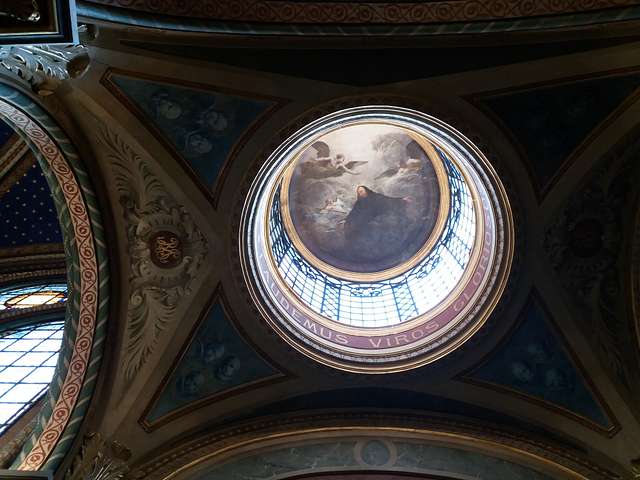
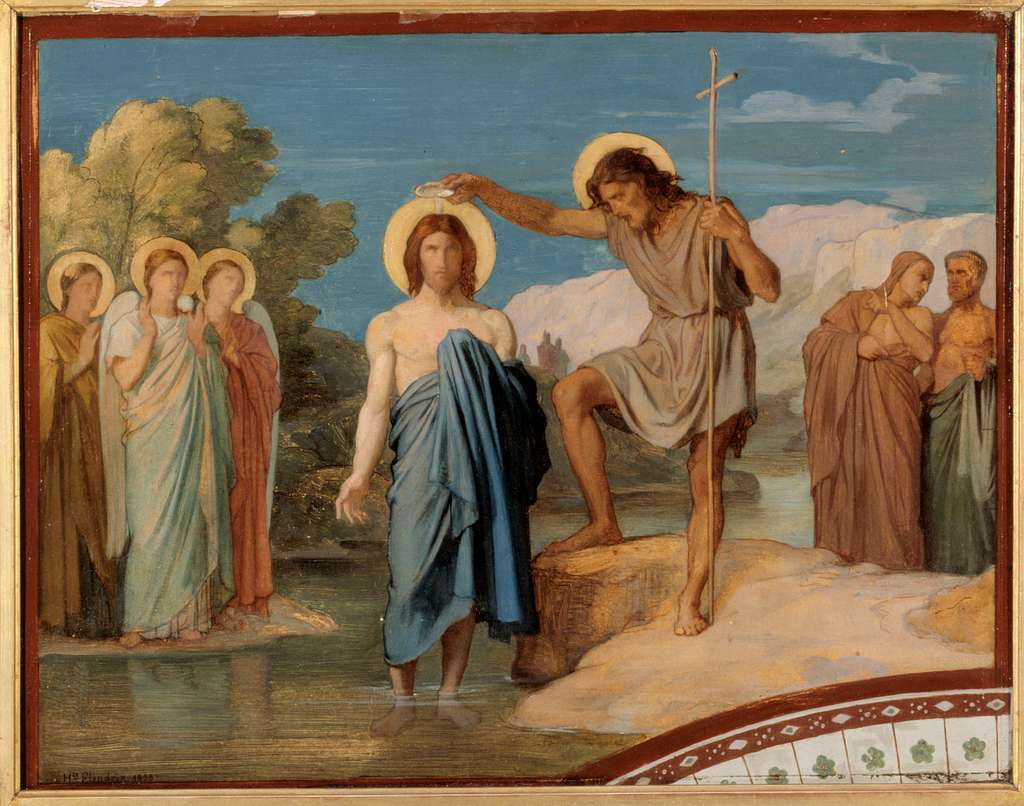
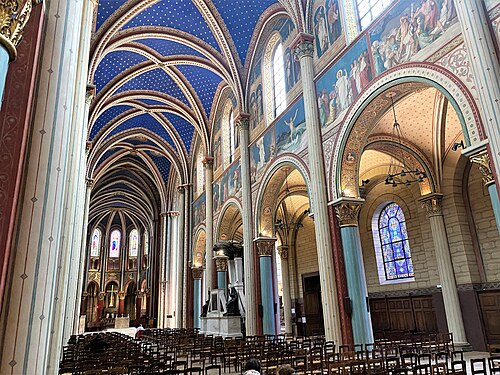
The Revolution left the church badly damaged and its abbey buildings almost entirely destroyed. By the 1820s parts of the structure were genuinely at risk of collapse, and it took a determined public campaign, supported by figures including Victor Hugo to save the building from demolition rather than restore it. The 19th-century campaign gave the church its current spire and included the celebrated mural cycle painted by Hippolyte Flandrin between 1842 and 1849, whose muted golds and terracottas still cover the nave and choir walls.
20th-Century Neo-Roman Work
Restoration didn’t stop with the 19th century. Twentieth-century campaigns, particularly from the 1950s onward, focused on stabilizing the structure, removing later overpainting, and returning parts of the interior closer to their Romanesque character — work that continues, in updated form, into the 21st century.
Saint-Germain-des-Prés Church of Paris – Art and Ornamentation
Merovingian Columns
The most direct physical link to the original 6th-century church survives in its marble columns, spoliated from earlier Roman buildings and reused in the triforium. They are, quite literally, the oldest visible material in the building.
Romanesque Chapiters (Capitals)
Above these ancient columns sit capitals carved in the Romanesque style, decorated with foliage, interlace, and figural scenes typical of 11th- and 12th-century sculpture, a striking contrast between antique material and medieval craftsmanship on the very same column.
Stained Glass, Across the Centuries
The story of the church’s stained glass is largely a story of loss and fragments. Only four windows survive from the 13th century, now grouped in the Chapel of Saint Genevieve; they depict scenes including the Annunciation and the marriage of the Virgin. Almost all the rest of the medieval glazing was destroyed during the Revolution, meaning most of what visitors see today dates from later restoration campaigns rather than the medieval period.
17th-Century Paintings
Alongside the vault decoration, the 17th century brought devotional paintings and sculpted monuments into the church, many commemorating abbots, nobles, and exiled royals connected to the abbey, traces of its role as a fashionable and politically connected institution under the Maurists.
19th-Century Fresco Work
The Flandrin murals remain the dominant artistic statement inside the church today: a continuous cycle running along the nave and choir depicting biblical scenes, allegorical virtues, and the abbey’s own founding legend, rendered in a restrained, almost Byzantine palette that was considered innovative for its time.
CC BY-SA 4.0
Other Buildings and Vestiges of the Abbey
The 13th-Century Lady Chapel
Among the abbey’s most celebrated losses is the Lady Chapel (Chapelle de la Vierge), built in the 13th century by Pierre de Montreuil, the same architect associated with parts of Notre-Dame and the Sainte-Chapelle. Contemporary accounts describe it as one of the most refined pieces of Gothic architecture in Paris, rivaling the royal chapel it was modeled on.
The Lady Chapel did not survive the upheaval of the Revolutionary period. The wider abbey complex — cloister, refectory, dormitory, chapter house — was almost entirely demolished after the monks were expelled in 1792 and the property nationalized. The chapel itself limped on for a few more years before being taken down in 1802, a casualty of the broader dismantling of the abbey’s estate.
Remaining Stained Glass
A small number of the chapel’s stained-glass windows were rescued before demolition and survive within the church today, offering one of the only direct visual links to Pierre de Montreuil’s lost masterpiece.
Other Architectural Remains in the Surrounding Streets
Walk the streets radiating from the church today and the old abbey reveals itself in fragments: carved arches from the Lady Chapel displayed in the small square (square Laurent-Prache) beside the church, medieval cellars preserved beneath private buildings along nearby streets, and the general street pattern of the 6th arrondissement, which still traces the footprint of the abbey’s original walls, gardens, and outbuildings.
A Brick-and-Stone Witness to the Late French Renaissance
Near the church, at the corner of the Place Saint-Germain-des-Prés, the 16th-century former bishop’s residence still stands, a rare example of late French Renaissance civil architecture built in the characteristic combination of red brick and cut stone. Along with the Abbot’s Palace, it’s one of the few structures that lets visitors picture the abbey precinct as a living complex of buildings, rather than the single isolated church that remains today.
Pierre Poschadel, CC BY-SA 3.0
Chapelle Sainte-Marguerite in Église Saint-Germain-des-Prés
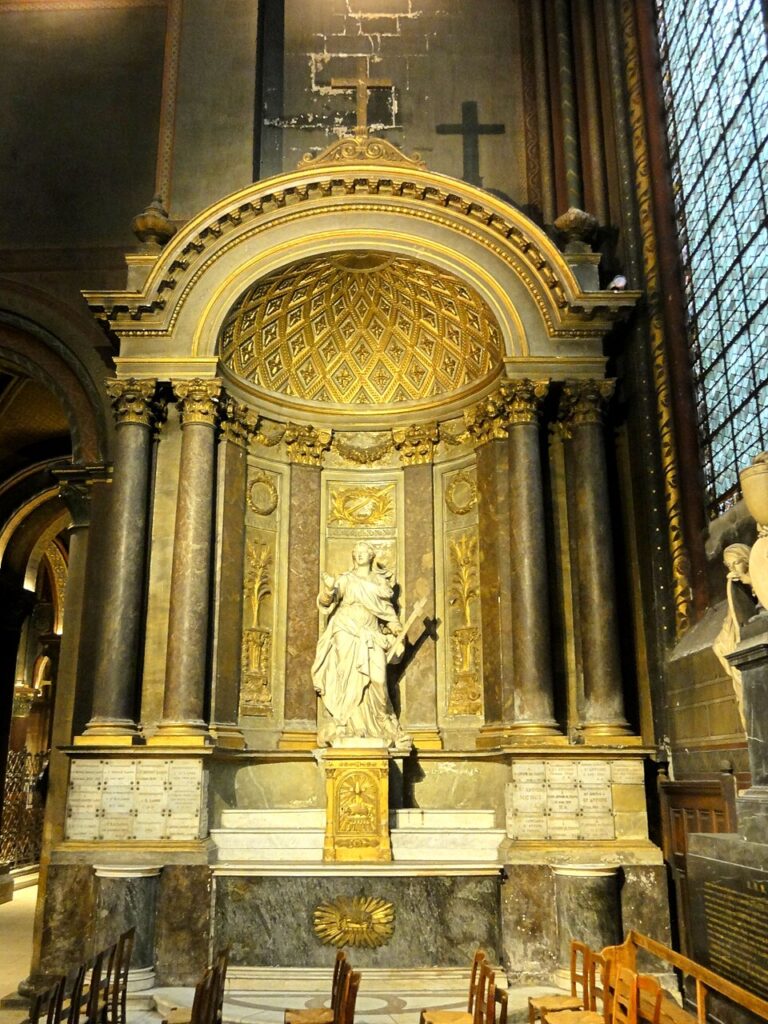
Tucked into the south transept of Saint-Germain-des-Prés is a small, easy-to-miss chapel that holds one of the finest pieces of 17th-century funerary sculpture in the church: the Castellan monument, carved by François Girardon.
Who commissioned it, and why
The chapel was founded in 1675 by Charles de Castellan, a commendatory abbot who financed the decoration of the transept’s south arm on one condition that a mausoleum honoring his family be built there. The result commemorates two soldiers from the Castellan line: Olivier de Castellan, who died fighting for Louis XIII during the war in Catalonia in 1644, and his son Louis, sent by Louis XIV to reinforce the French garrison on Crete, where he was killed charging Ottoman forces in 1669.
The Latin epitaph on the tomb was composed by the great Maurist scholar Dom Mabillon himself, a nice reminder of how tightly this chapel is woven into the abbey’s intellectual and family history.
The sculpture itself
Girardon — official sculptor to Louis XIV, and one of the two or three most important sculptors working at Versailleswas commissioned to design the monument, which was installed in 1683. It takes the form of two allegorical female figures flanking the tomb: Fidelity and Piety, each holding an engraved portrait medallion of one of the two Castellan men. Beneath a column topped with an antique-style urn sits the actual burial chamber, containing the hearts of Charles, Olivier, and Louis de Castellan.
A monument that moved
Like much of the church’s decoration, this tomb didn’t stay where it was first placed. It originally stood in the chapelle Saint-Maur, roughly where the confessional is today, before the Revolution scattered and damaged much of the church’s funerary sculpture. In 1828, the architect Étienne-Hippolyte Godde reassembled and reinstalled what survived in the south transept, in what is now the Chapelle Sainte-Marguerite (named for the altar statue of Saint Marguerite carved by the lay brother Jacques Bourlet in 1705).
A further restoration in 1945 removed some later plaster additions flanking the tomb. What visitors see today, then, is a 17th-century masterpiece that has essentially survived the Revolution in fragments — the two allegorical figures — reassembled a full generation after the original composition was broken apart.
It’s worth noting Girardon’s connection to Saint-Germain-des-Prés wasn’t a one-off commission, this is the same sculptor famous for the equestrian statue of Louis XIV once standing in the Place Vendôme (destroyed in 1792) and for major funerary work at the Sorbonne. Finding his hand in a quiet side chapel here is a small but genuine link between the parish church and the grand sculptural program of Versailles.
Chapelle Saint-Symphorien in Saint Germain
If the Castellan monument represents the abbey’s aristocratic 17th-century decoration, the Chapelle Saint-Symphorien represents something much older and rawer — arguably the single most historically dense square meter of the entire building.
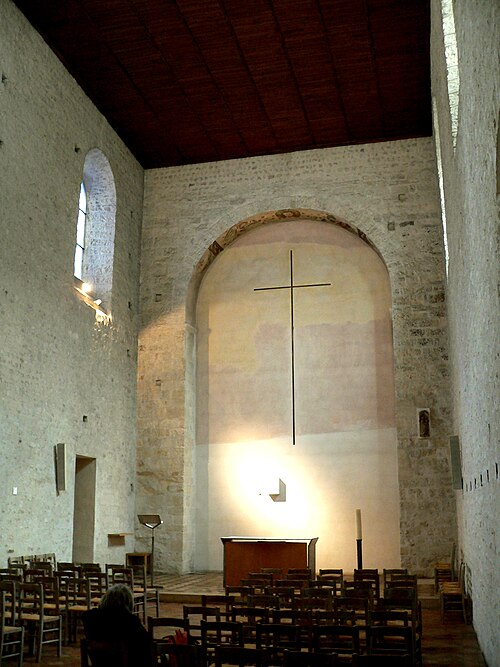
The oldest ground in the church. This chapel, just inside the entrance to the right, honors two figures: Saint Symphorien, a young martyr from the late 2nd century, and Saint Germain himself. Both men, notably, came from Autun, the same town Germain had left behind to become bishop of Paris. Tradition holds that when Germain died in 576, he was buried “under the portico” of Childebert’s original basilica, on this very spot; a stone slab today marks the location traditionally identified as his first tomb, before his relics were later moved into the choir.
Rebuilt and reused across the centuries. Around 1010, under Abbot Morard’s reconstruction of the abbey after the Viking raids, the chapel was rebuilt and enlarged to allow lay members of the surrounding village to attend services separately from the monks effectively functioning as the parish church for the town growing up around the abbey walls. In 1619, Saint Francis de Sales personally consecrated a new altar here in Symphorien’s honor.
The chapel’s darkest chapter came during the Revolution. In September 1792, more than a hundred priests who had refused to swear the oath of loyalty to the revolutionary government were locked inside this chapel before being taken outside and massacred on what is now the square in front of the church. That history is deliberately kept visible: a red rectangle painted on the north wall today evokes, in the words of the parish itself, the imprisonment and the blood of martyrs linking Symphorien’s own 2nd-century martyrdom to the priests killed in 1792 “and of all times.
Archaeology and contemporary art, side by side: In 1971, major excavations uncovered layered remains beneath the chapel floor spanning multiple periods of the building’s history, giving historians a much clearer (if still incomplete) chronology of the site. Two decades later, the City of Paris commissioned contemporary artist Pierre Buraglio to restore and redecorate the space; his work including a spare, modern Stations of the Cross in blue-and-white enameled sheet metal was completed and solemnly blessed by Cardinal Lustiger on 27 January 1993. It’s frequently cited as one of the more successful integrations of contemporary art into a historic French church interior: rather than imitating the past, Buraglio’s minimalist intervention sits quietly alongside sixth-century tombstones and Revolutionary scars.
The “Other” Virgin of Saint Germain – A Case of Mistaken Identity
Here’s the twist: the statue traditionally called the trumeau Virgin of Saint-Germain-des-Prés’s Lady Chapel — the one that passed through the Chantiers de Saint-Denis depot before reaching the Musée de Cluny, may not actually be from Saint-Germain-des-Prés at all.
The physical statue. She stands facing forward, crowned with a fleuron diadem (two of four fleurons now missing), holding the stem of what was likely a lily in one hand while cradling the Child with the other arm. Her dress has a circular clasp; a veil falls back from her head, showing two locks of hair; her cloak drapes in tube-like folds over her left arm. One foot is missing, the other just visible beneath the hem, and a stump of column remains at her back. Despite being stripped of surface material in 1887 and aggressively cleaned again in 1988, faint traces of the original red, blue, and gold paintwork still survive.
Two competing stories. Historians disagree on where she actually came from:
The Saint-Germain-des-Prés theory (the traditional view, going back to Alexandre Lenoir in the early 1800s) says she’s the missing trumeau Virgin from the abbey’s Lady Chapel though there’s a wrinkle: other 19th-century records suggest that when the old Museum of French Monuments closed, this particular Virgin was actually sent back to Saint-Germain-des-Prés, not to Saint-Denis.
The Saint-Denis theory (argued by later scholars, notably Marcel Aubert) holds that this is actually a different statue entirely, one recorded in the Saint-Denis depot in the 1850s and mistaken at the time for the Virgin from Saint-Denis’s own Coronation portal. Viollet-le-Duc even used her as the model for his 1861 restoration of that portal, which is exactly why the two look so alike.
The bigger problem: she might not be medieval at all. Scholars now think the statue’s stiffness, mechanical drapery folds, and oddly flat facial modeling aren’t just the result of heavy-handed restoration, they suggest she may be a 19th-century sculpture rather than a genuine 13th-century original. If so, the real question isn’t just “which abbey did she come from,” but whether she’s an authentic medieval Virgin at all, or a period recreation that later got mixed up with the real thing.
So: two Virgins, two rediscoveries, two contested identities, a fitting piece of art-historical detective work for a chapel that itself no longer exists.
| Discover the Legendary Cemetery with Paris by Emy |
Père Lachaise Private Tour in Paris: The City of Lights is famous for its grand monuments, elegant boulevards, world-class museums, and romantic atmosphere. But beyond the Eiffel Tower, the Louvre, and the charming streets of Montmartre lies another side of Paris, a quieter, more intimate world where history, art, and human stories come together. A Père Lachaise private tour in Paris offers a unique opportunity to explore one of the most fascinating places in the French capital with a knowledgeable local guide who can reveal the stories hidden behind the stone monuments.
Enjoy a customized private walking tour covering 2–3 nearby districts, with the option of a private driving experience for greater comfort and flexibility.
From €360 for a 3-hour private walking tour
From €950 for a private driving tour (up to 6 guests)
Available year-round with flexible start times
Hotel or central Paris pick-up meeting point
Private Tour Guide in Paris - Paris by Emy
Pricing
# of Person
Customized private tours in Paris
From €200
Per Person
2-hour Paris private museum tour + skip-the-line
From €360
Up to 6
2-hour private walking tour in Paris
From €950
Up to 6
Paris private walking tour + private museum tour
From €950
Up to 6
4-hour car tour Paris with private guide & driver
From €1,450
Up to 6
Paris Tour by private car + Museum private tour
Your personalized itinerary is set according to your preferences with recommendations before your arrival. No already-made tour. You can adjust the tour on the go as well. Our private guided tour comes with customization and recommendations.
The Père-Lachaise cemetery, also known as the “Eastern cemetery”, is the largest cemetery in Paris near Belleville Ménilmontant district, and covers 43 hectares. It is part of the parks and gardens under the management of the town hall of Paris. It is a unique place that invites contemplation and daydreaming, steeped in art, culture and history, where one travels through its maze of stones and vegetation. More than 3 million visitors from all over the world visit it every year.
It totals 70,000 burial plots. Many personalities are present there and we will have the opportunity to talk about them in the articles: artists, musicians and singers (Frédéric Chopin, Rossini, Jim Morrison, Edith Piaf, Alain Bashung…) and writers (Molière, Balzac, Colette, Marcel Proust, Jean de la Fontaine, Oscar Wilde…), philosophers and theologians (Abelard, Auguste Comte) statesmen (Adolphe Thiers, Félix Faure, Louis Blanc, Haussmann, Champollion), soldiers, historians, … The famous Parisian cemetery of Père-Lachaise takes its name from the time of Louis XIV and the king’s confessor: Father François d’Aix de La Chaise.
The Père-Lachaise Cemetery has a unique design that blends the rich characteristics of an English park with a place of deep contemplation. Today, the Père-Lachaise cemetery is a real open-air museum and thus houses many architectural and sculptural works intended for funerary art. You can come here to observe all the possible styles of this specific art: Haussmannian vaults, Gothic tombs, ancient mausoleums, works of the Second Empire, neo-classical buildings, sculptures of all styles.
Often described as an open-air museum, Père Lachaise Cemetery is not simply a burial place. It is a remarkable landscape filled with artistic tombs, symbolic sculptures, peaceful tree-lined paths, and the final resting places of some of the most influential figures in French and international history. Opened in 1804 under Napoleon’s reforms, the cemetery became one of Paris’ most iconic cultural sites.
Walking through Père Lachaise without guidance can feel like entering a vast historical maze. With thousands of graves spread across winding paths and hills, many visitors discover only a small fraction of what this extraordinary place has to offer. A private guided experience transforms the visit from a simple walk into a captivating journey through literature, music, philosophy, politics, art, and French heritage.
With Paris by Emy, your Père Lachaise private tour is designed around meaningful stories, fascinating personalities, and the aspects of Parisian history that interest you most. Rather than following a generic route, you explore this legendary cemetery through the eyes of a passionate licensed Paris guide.
Why Visit Père Lachaise Cemetery on a Private Guided Tour?
Père Lachaise is unlike any other attraction in Paris. It is not a monument you simply admire from outside or a museum where you follow numbered rooms. It is a living historical archive where every pathway reveals another chapter of human creativity, ambition, love, tragedy, and achievement.
A private tour allows you to slow down and appreciate the details that many visitors overlook. The shape of a sculpture, the meaning behind a symbol carved into marble, the story of a forgotten artist, or the personal journey of a famous writer can completely change the way you experience the cemetery.
Instead of simply searching for famous graves, you discover the personalities behind the names.
A Historic Open-Air Museum Beyond a Traditional Cemetery
Père Lachaise feels like a combination of a peaceful garden, an art exhibition, and a history book written in stone. Its winding avenues, mature trees, and impressive monuments create an atmosphere unlike anywhere else in Paris. The cemetery was originally designed as part of a transformation of Parisian burial practices, creating larger and more organized cemeteries outside the crowded city center.
The beauty of Père Lachaise comes from the way nature and architectureblend together. Some graves are simple and deeply personal, while others feature elaborate sculptures created by talented artists of the 19th and 20th centuries. Angels, mourning figures, busts, portraits, and symbolic objects tell stories about the people remembered there.
For travelers interested in French history, art, architecture, literature, or culture, Père Lachaise offers a completely different perspective on Paris. It reveals the city’s memories rather than only its famous landmarks.
The Advantage of Exploring Père Lachaise with a Licensed Paris Tour Guide
Because Père Lachaise covers a large area with thousands of graves, preparation makes a significant difference. Many visitors arrive with a list of famous names but leave without understanding why those individuals mattered or how their lives connected to French and European history.
A private guide helps bring the cemetery to life. Instead of simply saying, “This is Oscar Wilde’s grave,” a meaningful tour explores Oscar Wilde’s extraordinary personality, his influence on literature, his connection with Paris, and why visitors continue to leave messages at his memorial.
A knowledgeable guide also adapts the experience to your interests. Are you fascinated by French writers? Romantic stories? Music legends? Revolution and politics? Religious history? Art and sculpture? The route can be tailored accordingly.
With a private Père Lachaise tour, the cemetery becomes more than a sightseeing stop — it becomes a personal cultural experience.
I highly recommend a private tour with Paris by Emy. Emy secured a private transfer from the airport directly to our hotel in Paris and the arrival was flawless. Our driver gave us several highlights to explore just on the drive to the hotel. Then, we had a 1/2 day with Emy exploring Notre Dame, the Latin Quarter, and Saint Germain. Emy is incredibly passionate and knowledgeable about the history and culture of France—it was a wonderful introduction for me. In addition, Emy arranged a private tour of The Louvre for us—what an amazing experience! I hope to return in the future! Thank you, Emy for a truly memorable trip to Paris!
Posted on Google
Nichole Reinhardt
12 September 2026
Paris by Emy provided an amazing experience for my first European trip- which was also a solo trip! I reached out to Emy in March and she took the time to interview me over zoom to truly understand what I was looking to do during my two weeks in Paris. She accommodated my schedule even though France is 6 hours ahead. She customized a tour for me which ensured I saw all the things I asked for and related items she thought I would also enjoy. She ensured I had front of the line tickets for Versailles, and the Louvre. Ensured I got to the top of the Eiffel Tower, champagne and a river cruise included. She didn’t make my hotel reservations but did provide recommendations and the hotel I had was in the neighborhood of St Germaine Des Pres - with many restaurants options and a metro station right around the corner. It was a safe and quiet neighborhood so I wasn’t worried walking back to my hotel after dinner. The first day Emy met me at my hotel and we travelled together to Montmartre. This allowed her to introduce me to my neighborhood. Set me up with a metro card and an introduction on how to navigate the metro. We started at Sacre Coeur where she told me all about the basilica. And then wandered down through where the artists are and then the famous cabarets. We had a fabulous lunch at La Madison Rose. She even gave me some time to shop in the curious shops of Monmartre.
Emy also arranged for me to go to Auvers-sur-Ouse with a driver to see where Van Gogh spent his last days. And arranged a driver to take me to Giverny to see Monet’s water garden. My itinerary included a shopping day, Napoleon’s Tomb, the Rodin Museum,Notre Dame with specific instructions to go to Saint Louis Island for Berthillion ice cream after!
Together she also arranged for us to see Chatres (which if you don’t know you must look it up!) and I also got experience a real Parisian nightclub when she arranged for me to have a VIP experience at Arc.
I think the best part about my custom itinerary was Emy’s talent to anticipate my needs and built flexibility into my itinerary. So I had an itinerary of things to do but not all of them required tickets so if I wanted to switch my days, or sleep in, or do something inside because of the weather- I had that flexibility.
When I go back to France, and I will, I will be asking Emy to help me. When we were walking around together she mentioned for some people she has arranged “shopping in Paris” tours. Tours in the region of Champagne. And she and I have already discussed my thoughts on a multi-day trip to Normandy to visit the WWII sites.
Emy is warm, engaging, super knowledgeable and a delight to tour with. I really appreciated her taking time with me but then also letting me truly travel solo and experience Paris in the most magnificent way.
Posted on Google
R Travis
9 September 2026
I first utilized the services of Emy, my travel planner during my 2018 Christmas vacation to the “City of Lights”. She provided me and my family with a highly professional and well-rounded two days of experiencing so many wonderful things about Paris. So much so that I just returned from my second two-day visit (of course rebooking with Emy, my most favorite tour guide). She is exceptional--her knowledge of Paris history and culture is truly impressive, and extends beyond the typical tourist requirements. She seamlessly integrates fascinating stories and lesser-known facts, which makes my experience far richer than a mere recitation of dates and events. As I began to initially prepare for my travels, she patiently addressed all of my concerns and wishes from the very beginning of my plan making throughout until the tour days came and went…perfectly! While she is eager to see that all my needs are met, she is also efficient in making sure that mistakes are avoided. My trip this time was in August, and when Emy noticed that I was looking a bit pale, from pushing through the summer heat and crowds, we took a pause at one of the loveliest churches in Paris. She found a convenient church pew, and we sat and enjoyed a few minutes of a beautiful service that was taking place. It was a spur of the moment brief change in our plans…yet while giving me a much needed break, it also presented me with an unexpected memory to cherish while in an awesome setting. This demonstrates genuine concern and adaptability. In addition, she later took me to a lesser known and uncrowded location in the Montmartre area that had a picture-perfect view ideal for photos. She expertly connects historical events to the present-day social fabric, offering insightful perspectives. And for all the above reasons I look forward to returning to Paris again someday to both my favorite destination and my favorite travel planner, Emy!!!
Runette
Posted on Google
J Stuart Wolf
30 August 2026
Meaningful and very impactful tour of Notre Dame. Emy oriented and advised and then gave me space while still watching over me. Next level, and so much more than a tour guide!
Posted on Google
Vic Syldub
8 August 2026
Je voulais découvrir Paris dans toute son authenticité, son histoire et ses grands classiques, tout en profitant d’expériences plus personnalisées. Paris by Emy a parfaitement compris mes attentes et a organisé mon séjour entièrement sur mesure.
J’ai été émerveillé par les chefs-d’œuvre du Louvre, le château de Versailles, Notre-Dame et, bien sûr, la Tour Eiffel. Passionné par l’Histoire de France, j’ai particulièrement apprécié les visites qu’Emy a imaginées autour des rois de France et de la Révolution française de 1789.
Emy m’a également recommandé d’excellentes brasseries parisiennes ainsi que de très bonnes adresses pour le shopping, ce qui a rendu mon séjour encore plus agréable et authentique.
Emy est une personne extrêmement agréable, cultivée et passionnée, avec une connaissance remarquable de l’histoire de Paris et de la France. On sent qu’elle aime profondément transmettre et faire découvrir sa ville.
Un immense merci, Emy, pour ce magnifique séjour à Paris ! La prochaine fois, ce sera la Normandie et les plages du Débarquement avec Paris by Emy !
À bientôt !
Posted on Google
Christine Jones
7 August 2026
We booked Emy for two separate days in Paris, and she made both of them highlights of our trip. Day one was street art, medieval Paris and the historic sites with real history behind each stop, not just a list of stops. Day two she took us through antique book shops, Officine Universelle Buly 1803, and a run of patisseries that I never would have found on my own.
What set Emy apart was the feel of her tours. It was less like a tour and more like spending the day with a local friend who happens to know every insider spot in the city, and who also knows the classics well enough to fold them in without it feeling obligatory. She read what we were interested in and adjusted as we went. If you want Paris beyond the checklist but not instead of it, book her. We'd do it again in a heartbeat!
Posted on Google
Joan Deaton
7 August 2026
Emy transformed our trip to Paris into something we will remember for the rest of our lives. From the very first conversation, she took the time to understand exactly what we wanted and designed a completely personalized itinerary around our interests. Every recommendation—from museums and restaurants to hidden streets and local cafés—was perfect.
As a licensed guide, her knowledge of Paris, its history, art, and culture is extraordinary, but what truly sets her apart is her warmth, professionalism, and passion. She doesn't simply show you Paris—she brings it to life with fascinating stories and insider insights you would never discover on your own.
The pace was perfect, she adapted effortlessly to our requests throughout the day, and every detail was taken care of. We felt like we were exploring Paris with a knowledgeable friend who genuinely wanted us to have the best possible experience.
If you want an authentic, stress-free, luxury experience tailored specifically to you, Emy is worth every euro. We have traveled extensively around the world and can honestly say this was one of the finest private tours we've ever taken.
Without hesitation: 5 stars isn't enough. We would give her 10 stars if we could, and we can't wait to return to Paris for more exceptional private tours and unique experiences
Posted on Google
Gail Marquette
31 July 2026
Since we had only hours to visit Paris, our tour guide Emy, accommodated us in every way possible. Our 4 hour tour included a driver in an air conditioned van with replenished water to help ease the heat of July. As we traveled to each location of interest, Emy gave us a detailed description of what we were visiting. The driver dropped us off, Emy would walk with us to tell the significance of each place of interest. We traveled to many interesting sights to get a true understanding of Paris. Emy accommodated us in shopping locations, Restaurants, outside Cafes, museums, tourist and local areas. Emy took photos of us at each location. Having a private driver and Emy saved on travel time as well as physical walking time. At the end of our tour, we felt as if we had a great understanding of the city of Paris. We were so pleased with our private driving tour, Emy was then booked for a walking tour the next day. Emy’s expert knowledge and her keen eye for detail was so appreciated! There was never a dull moment and Emy’s personality left us with feeling as if we knew her for years. No question was unanswered and no request was too much. Loved both of our personalized, private tours!!! Emy is a wonderful tour guide and very experienced and knowledgeable with accommodating her client’s tour requests. Highly recommend Emy for any size group or private,
one-on-one tour. Exceptionally professional as well as personable!! Emy is worth it!! 5 STARS
Posted on Google
Cecilia Peirce
22 July 2026
Emy was an excellent guide for us! I am so glad I found her online. I gave Emy only a general outline of what we wanted to see (some of the Catholic churches in Paris, and learn about any related history) and she filled our scheduled time together with other Catholic churches I was not even aware of that were in the city and were just stunning, beautiful in unique ways. It was a joy to be with a guide who clearly treasured the faith and shared the day's precious time at each church so respectfully and lovingly with us without being over zealous. Thank you, Emy, for making our limited time together so worthwhile! And thanks to Olivier too for the smooth ride and timely pickups at each stop. It was a wonderful day for sure.
Posted on Google
Albie Vollero
5 July 2026
We had a great tour with Emy. She is very knowledgeable, flexible and fun. We had a great time together.
Posted on Google
Sherry McDonald
26 May 2026
“My friends and I had an absolutely wonderful experience with Paris by Emy! She planned everything for our trip perfectly, taking all the stress out of the process. She arranged all of our transportation to and from the airport, our tickets to Versailles, and an amazing tour of the Veuve Cliquot cellars. She also gave us shopping recommendations and a private tour of Mont Martre. Her attention to detail, excellent recommendations, and seamless organization made our time in Paris truly unforgettable. If you want a stress-free and beautifully curated Parisian experience, I highly recommend her services!"
Posted on Google
Taira Tregaskes
19 May 2026
My husband and I planned our first trip to Paris and had no idea where to begin. Feeling overwhelmed I found Emy and am so glad we did. You can customize and set up your whole vacation with as much assistance as you need. Emy set up transportation for us when we arrived, booked our tickets for shows and private tours and showed us around the city in a way we wouldn't have known to see otherwise. She made our dinner reservations and helped plan our 20th wedding anniversary so it was special. We were able to see everything we wanted and use the most of our time without being exhausted. Emy was fantastic company and so knowledgeable. I would definitely recommend booking with Emy for private tours or even as just your personal concierge for advice and booking reservations.
Posted on Google
Carlye Dundon
19 May 2026
Emy crafted a unique tour for me- A discovery the beauty, culture, and hidden gems of Paris. Her tour was greatly enhanced by our cultural exchange and the deeper understanding I gained of Paris' history, art and culture.
Thank you Emy, for creating a tour filled with surprises and wonder.
Posted on Google
Raymond Siegel
17 May 2026
Emy is knowledgeable and is great at sharing that knowledge with you. Our group of three certainly benefited from her excellent explanations. If you want to gain knowledge while having a very pleasant experience, then sign up for the Notre Dame tour with Emy.
Posted on Google
Peggy Legault
16 March 2026
We had booked a pilgrimage to Lourdes and Fatima for late February/early March 2026. We decided to come a few days early and see Paris before meeting our tour in Toulouse. Emy was so helpful and really understood what we wanted to see - we agreed on one half day with a driver and one half day on foot. Sadly all the planning went out the window when a blizzard hit New York and our 72 hours in Paris dwindled down to less than 24!! Emy was so good to us - she was able to change our two mornings into a 5 hour afternoon tour with a driver that allowed us to see what we wanted to see! Our tour was so personal!! Our driver got us so close to the sites which saved us precious time! We had a wonderful tour of Notre Dame, which we were so excited to see! Then up to Sacre Coeur - so beautiful! From there we were able to see the relics of St Genevieve at Saint Etienne du Mont - such amazing architecture! Then we finished at the Chapel of The Miraculous Medal - also on our “really hope to see” list that we feared we might miss! As we lingered there, well past our agreed on 5 hours, Emy then hailed us a taxi and made sure he would get us to our Seine River cruise - so kind!! We cannot recommend Emy enough! She really helped us start off our pilgrimage in the most wonderful way!!
Posted on Google
Carrie Dayton
25 January 2026
Emy made the planning effortless and the trip truly unforgettable.
My 75-year-old mother and I worked with Emy to plan a special mother–daughter trip to Paris over the Christmas holiday week in 2025, and we could not have had a better experience. From the very beginning, she guided us through thoughtful pre-planning, preparation, and consultations so we felt confident and excited heading into the trip.
When we arrived in Paris after a 12-hour flight, the experience was nothing short of incredible. At 6:00 a.m., we were met by a greeter who escorted us past all the lines at Charles de Gaulle, carried our bags, whisked us through border control, and had us in a chauffeured car within 30 minutes. It was such a gift—especially after a long international flight.
Emy helped us build a realistic, well-paced day-by-day itinerary that balanced sightseeing with breaks, downtime, and flexibility. She truly understands how Paris works and how to make the most of your time without feeling rushed.
We also booked a custom tour with her, which ended up being our favorite part of the trip. Emy is incredibly personable and deeply knowledgeable about Paris. With a chauffeured car, she guided us through the city, shared fascinating stories and local insights, and tailored the experience entirely to what we wanted to see and do. She shopped with us, pointed out details only a local would notice, helped translate during in-depth conversations at boutiques, and read information boards we were curious about—all while remaining flexible and happy to adjust plans on the fly.
Having Emy available via WhatsApp for questions and recommendations throughout the trip was also incredibly helpful and reassuring.
If you’re looking for a thoughtfully curated Paris experience that maximizes your time while still allowing freedom and spontaneity, I can’t recommend Emy enough. She helped us create memories we will cherish forever.
Posted on Google
Jen Hughes
16 January 2026
I requested a personalized Christian art tour at the Louvre. Emy was the perfect tour guide for me because she’s a very down-to-earth person and not intimidating or snobby in the least. She was very comfortable to spend time with and because she is relaxing to be around, I continued to feel as though I was on vacation even while being with a stranger. I had fun with her and am glad she was the one taking me around such a large museum. I didn’t need to know anything about art for her to be a good teacher. She did only give me two hours of her time even though some of that time was spent standing in line or having to ask employees how to get around certain blocked entrances. I appreciated that she was efficient and kept on teaching me even while we were in line, etc. and I know she did some homework to prepare for her tour with me. I only wonder if she might consider extending how much time she spends with her clients to 2 ½ to 3 hours for the same price to get to see more art pieces. But overall, I would say Paris by Emy was one of my favorite experiences in Paris in 2026!
Posted on Google
Carter Hladki
12 December 2025
Emy is awesome! My extended family of 10, ages 4 to 78, visited Paris in November. We booked Emy for two tours. A walking tour of Notre Dame Cathedral and a driving tour of Paris attractions. Emy was super knowledgeable, friendly and flexible. The arrangements she made for the driving tour were 1st class. In addition to the tours, Emy provided input and ideas to help us build out our full itinerary. The cost of her services was very fair and reasonable for the personalized top-notch service we received. I would highly recommend Emy's services for anyone looking to book private customized tours of Paris.
Posted on Google
David Lobdell
20 October 2025
Our time in Paris with Paris by Emy was truly exquisite! Emy went above and beyond to make our trip comfortable, educational, and unforgettable. We were traveling with my almost 80-year-old mom on her first visit to Paris, and Emy made her feel completely at ease — she even got her to try escargot (and she liked it!).
The private, licensed guides Emy arranged for Versailles and the Louvre were outstanding — knowledgeable, engaging, and full of passion for their work. Every detail was thoughtfully planned, allowing us to simply enjoy and take it all in. Our custom tours of Paris landmarks and the food-focused afternoon in the Marais were absolute highlights. Emy’s insider knowledge, warmth, and humor made Paris come alive — she wasn’t just our guide; she truly became part of our experience.
If you’re looking for a custom, one-of-a-kind Paris adventure crafted with care, expertise, and heart, look no further than Paris by Emy.
Posted on Google
N Judie
18 October 2025
Emy made my trip to Paris smooth and stress-free from start to finish. She was incredibly responsive and really listened to what my family and I wanted to see. Every tour ticket was purchased in advance, which made each excursion effortless. She also gave excellent restaurant recommendations and helpful tips for early bookings.
Our virtual meeting before the trip added a nice personal touch, and the car service she arranged was perfectly on time. Emy checked in often to make sure everything was going well.
I highly recommend working with Emy for your Paris travel plans — it was my first time in Paris, and having someone who truly knows the city made all the difference. I would have been lost without her and look forward to planning my next trip with her again!
Posted on Google
Jason Seal
13 October 2025
Emy did a wonderful job fulfilling all of our requests for everything we waned to see and do. She was extremely helpful and made our trip to Paris much much easier than trying to schedule and plan everything on our own.
Posted on Google
Devon Jordan
13 October 2025
Emy was incredible! She made the tour so enjoyable with her wonderful knowledge about the areas we were seeing and injected excitement with each area. My wife and I learned so much from her about the city of Paris and the monuments we got to see. Highly recommend using Emy for your tour in Paris.
Posted on Google
Lauryn Luttrull
4 August 2025
Paris by Emy made out trip absolutely magical. From the start, she took the time to understand what I wanted and created a personalized itinerary that went beyond the typical tourist spots. Every recommendation felt thoughtful and authentic — like discovering Paris through the eyes of a true local. Her attention to detail, warmth, and passion for the city made all the difference. I felt cared for every step of the way. If you want a custom, meaningful Paris experience, Paris by Emy is the way to go!!
Posted on Google
Paul Sorbera
1 August 2025
Emy was terrific. She is very knowledgeable. She gave us a tour of the major basilicas in Paris and gave historic perspectives as well
as catholic and christian faith perspectives. She herself attends the churches and serves as a great religious guided tour unlike many tours that are strictly factual and may include opinions that are not welcome. She is also very pleasant and a great guide overall. We loved our tour. Highly recommend to anyone looking for a Catholic / Christian faith based perspective. And even aside from a faith based perspective she is an excellent tour guide.
Posted on Google
Dan Sachar
23 July 2025
Emy gave us a wonderful, customized tour of Les Halles and Le Marais. She focused on our interests and led us on a really great, authentic, 3-hour walking tour. Thank you Emy!
Posted on Google
Julian Tonsmeire
16 July 2025
I found Emy online. She was responsive and I really benefited from a paid planning call with her a few months before my trip. I travel regularly to France for business but wanted to make the most of a few days as a tourist with my teenage daughter. Emy nailed it! She pointed me in the right direction for things we did on our own (Versailles and Catacombs) but most importantly we spent two days riding the metro, walking the streets of Paris, going to the perfect boutiques and patisserie's on the left and right banks. I'm most grateful for the way Emy inspired and engaged with my daughter. I highly recommend Paris by Emy. She is a great value, responsive, and just a fun person to spend your holiday with.
Posted on Google
Scott Becker
19 June 2025
We had a wonderful experience with our tour guide, Emy, during our family trip to Paris. Our group of seven included three generations: my wife and me, our 9-year-old daughter, and both sets of grandparents. Emy was incredible with everyone. Over two mornings, we were driven around the city in two comfortable vans with professional drivers, and Emy showed us many of the highlights of Paris. She was especially sweet with our daughter, telling her stories and sharing the history of the city in a way that kept her engaged and excited. Emy was warm, knowledgeable, and made our time in Paris truly memorable. I highly recommend her to anyone looking for a great guide in Paris.
Posted on Google
J
5 June 2025
Emy is a gem! We first asked her for hotel recommendations, which Emy found in an hour for the whole family during the high season and which we loved. From there we requested a package - highlights included a private magic show for our grandchildren, a private food tour, and a private Louvre tour! The TOP!!
Posted on Google
Germaine Krzan
4 June 2025
Emy took me and my sister on a personalized tour of Paris. We wanted to see Catholic sites and learn the history behind them. She did her research and showed us hidden gems! We appreciated her kindness and we all learned things from each other! Thanks Emy for a memorable 2 days
Posted on Google
Meredith Tomkovitch
14 May 2025
Had a wonderful video call session with Emy to help plan my trip. She gave me some great pointers on places to go and places to skip as well as help planning with toddlers. Very appreciated.
Posted on Google
Linda Strange
10 April 2025
Wow!!
What a wonderful day we had with Emy! I was traveling with my two daughters and wanted to surprise them with a totally unique custom tour - Emy worked with me to create an experience where we visited all the iconic Paris sites, designer and boutique shopping areas and the settings of all the famous scenes from Sex in the City and Emily in Paris! It’s apparent that Emy is passionate about sharing Paris with her clients, is energetic and lovely, and speaks English with ease- I highly recommend Emy for any type of tour you are looking for- she also provided wonderful restaurant recommendations- Excellente!! 💕🇫🇷
Posted on Google
Amber Morain
9 April 2025
Emy was a wonderful guide! We learned a lot and Emy even arranged for us to see the French President 😂 🌟
Posted on Google
Jodi Pink
21 March 2025
We spent two half days with Emi and she was great! We enjoyed walking through the different neighborhoods and learning the history of the area. We have two teenage sons and also spent a good amount of time eating treats at local gems along the way.
Posted on Google
Erik Young
17 March 2025
Paris by Emy
What a fabulous trip to Paris thanks to our planner and guide Emy Bonnes! This was our first time traveling to the city of lights and it couldn’t have gone any better. My wife and I have done a fair bit of traveling, especially now that our kids have grown. This was a special 5 day getaway for just us. We had a list of several “bucket list” items, but I left the planning and arrangements to the professional. It’s easy to be over ambitious with a trip, but Emy was able to schedule everything accordingly without feeling rushed or have too much downtime.
From the moment we arrived, we were met with a very professional driver and comfortable vehicle (same one for our departure). We stayed at the Relais Christine (phenomenal location, rooms, and staff) which served as our base for the trip. Most of our activities were within 4-25min walk or a short taxi ride. One day we spent in Versailles, but it was a comfortable taxi ride and she provided a detailed guide on what to see and how to do it written by Emy. She also had links and instructions on our catacombs, and Louvre tour. But the highlight was a 5hr personal guided tour with Emy herself. We strolled through neighborhoods, shops, and Notre Dame all while getting her insight and recommendations. She was both knowledgeable and professional, but it was like talking with a friend as we roamed the streets of Paris.
A trip can be enjoyable or stressful depending on your circumstances. For us, it was wonderful for many reasons. First, we started with Emy, who arranged all of our connections to and from the airport, purchased our tickets to the cabaret show, dinner cruise on the Seine, Louvre, Eiffel Tower, and made dinner reservations, and organized our entire itinerary. Everything went smoothly. But I will say part of it is up to the traveler. We’re not the loud, demanding, Americans that are looking to be entertained. We came no kids, an open opinion of the French people, and a willingness to learn and experience the city. For us it was a success! I highly recommend Paris by Emy and look forward to coming back and using her services again.
Posted on Google
Andrae Grey
10 February 2025
Our group of six took the Eurostar from London for a private tour with Paris by Emy, and it was absolutely fantastic! From the moment we arrived, everything was well-organized, seamless, and tailored perfectly to our group.
We took the EuroStar from London to Paris and Emy and our driver was right there waiting for us.
Emy crafted an incredible itinerary, allowing us to experience some of Paris' most iconic landmarks:
✅ Montmartre & Sacré-Cœur Basilica
✅ Champs-Élysées & Arc de Triomphe
✅ Trocadéro for breathtaking Eiffel Tower views
✅ Eiffel Tower (up close!)
✅ Latin Quarter & the Panthéon
✅ Louvre Pyramid
✅ Notre-Dame Cathedral
Our driver knew Paris inside out and the clean and prepared vehicle was never far away when we made stops. His kindness and consideration was evident with every turn, every accommodation.
Our guide was knowledgeable, friendly, and made the tour feel personal rather than rushed. Every stop was thoughtfully planned, with plenty of time for photos, exploration, and soaking in the beauty of Paris.
If you're looking for a private, customized Parisian experience, Paris by Emy is the way to go. Highly recommended!
Posted on Google
Valerie Henderson Cox
8 February 2025
Emy was incredible! She planned a fantastic trip for me and my family. We had my mom, who is older, and my 8 year old son, but that was no challenge for Emy! She was able to curate a trip that was truly for everyone. We all were able to do something that they loved and we all learned along the way. Emy was such a lovely human too and we enjoyed our time with her all over the Paris streets. Some of our favorite things are pictured below. We did a cooking class and we had a private tour of the flea markets. Emy also took us to some amazing churches that we would never have known to visit. If you’re smart, you’ll use Emy for your next trip to Paris.
Posted on Google
Ashley Bell
21 November 2024
We had a fantastic day with Emy! My boyfriend and I learned so much about the history of Sacré Coeur and Montmartre Village. She was knowledgeable and made our tour a lot of fun. I would highly recommend using Emy for upcoming tours.
It was a great day!
Posted on Google
Mallory Lewis
19 November 2024
EMY was the most amazing trip planner ever! It was like planning a trip with a girlfriend who knows you really well and the city really well. We spent half a day together seeing the sites and giggling, and all of the tours that she arranged for us, came off seamlessly. She recommended a guide for the Paris flea market who in two hours helped me spend a ridiculous amount of money… Which I thoroughly enjoyed! The private boat tour was wonderful. The restaurant recommendations were on point. Definitely have her arrange for a private greeter at the airport, we were whisked through customs like rock stars. From start to finish she did an amazing job if I could give her more than 5 stars I would!
Posted on Google
Farrah Yussouf
13 November 2024
I booked a private 2.5 hour walking tour of Montmartre including locations from the film Amelie. Emy prepared a tailor made itinerary and experience for me. She is passionate about her city and a true professional and I learnt many interesting things about the history of the area. The tour was the highlight of my trip!
Posted on Google
Jennifer Love
4 November 2024
Emy took my husband and I on a private tour throughout Paris, showing us the must see places along with several hidden gems. Her knowledge and history of Paris provided a great experience! Would highly recommend Emy!
Posted on Google
Rick Spare
2 November 2024
On a recent 3 day trip to Paris a small group of friends and I engaged Paris by Emy for private tours of the city . A truly great choice! The first day was a general tour of the city with stops at all the top tourist spots. What made it particularly special was the addition of a number of “hidden gems” that only a Parisian would know. Emy’s bubbly personality and kindness made the whole experience a joy! Her flawless English and extensive knowledge of the city surely added to the experience too. The next day was spent at Versailles with an extremely knowledgeable guide who not only informed us about the palace but also explained the political and historical aspects of the place and time. The third day was a tour of a few of the neighborhoods of Paris. Again adding stops at places one would never see on a regular tour. Totally charming! So if you want a personalized experience with a lovely knowledgeable guide who is happy to adapt your experience to your interests you can’t go wrong in choosing Paris by Emy!
Posted on Google
Tom Neubecker
28 October 2024
Our group of 5 friends from Fort Lauderdale organized a riverboat cruise in southern France followed by a 3-day stay in Paris. Since many of us had never been to Paris, we wanted to see and experience as much of the city as possible in our 3 short days there. We hired “Paris by Emy” as the most efficient way to do this as a group. She was able to adjust our tour to show us exactly what we wanted to see and make adjustments on the fly. Emy was outstanding. She gave us a half-day driving tour on day 1 and a half-day walking tour of the Les Halles, Pompidou and Marais areas on day 3. Day 2 was spent at Versailles. Besides the tours, Emy recommended two charming Parisian Bistros for dinner and made the reservations for us. She also secured tickets to a musical review one evening, booked us a private half-day tour of Versailles (with an excellent historian as a tour guide), and topped off our visit by booking us a spectacular evening dinner cruise on the Seine River on an exceptionally beautiful boat. One unexpected side benefit from the trip is we found out that Emy spent 4 years studying at college in Cincinnati. Four out of the 5 of us lived in Cincinnati at the same time she was studying there. So there were lots of Cincinnati memories for us to share. If you want a fun, personalized, high-quality, and efficient tour of Paris, then “Paris by Emy” is the way to go. Thank you Emy.
Posted on Google
Mark Dufton
8 October 2024
Emy’s curated tours are magnificent! We highly recommend her if you are visiting Paris. My wife and I spent two days with her and a private driver (the incomparable Ramsey)! We had a blast and saw and learned more than we would have in a month! Emy is funny, knowledgeable and adapts to your pace. Her customer service and attention to detail are simply amazing. She even followed up after the tour with some recommendations for our remaining vacation days. She does it all, sit back and relax. Merci Emy!
Posted on Google
Tim Trevarthen
3 October 2024
My wife and I spent a wonderful day with Emy when she took us, via limo, to Normandy to spend the day at the D-Day Beaches. As we started our trip, Emy provided us with the full day itinerary along with the histories for the areas we were visiting. Emy was extremely knowledgeable and she provided us with a first class tour. It has always been a dream of ours to visit Normandy because both of my mother and father served in the Navy during WWII and Joyce’s father served in the Army in the South Pacific and Philippines. I am also an history teacher and have taught about WWII for many years. Emy took all this into consideration long before the tour and she went out of her way to find facts that she shared with us about the D-Day landings. We would highly recommend Paris by Emy as part of your travel plans if you are ever in Paris.
Posted on Google
E Baquero
3 September 2024
I had the pleasure of hiring Emy from Paris by Emy as my personal tour guide during a one-day trip to Paris, and I couldn't be happier with my decision. If you're looking for an unforgettable experience in Paris, Emy is the guide you need.From the moment we met, Emy's friendly and approachable demeanor made us feel at ease. She speaks both English and French fluently, which made our interactions seamless. But what truly sets Emy apart is her deep knowledge of Parisian history and culture, which she shared with us in an engaging and insightful way. She took the time to ask what was important to us, and she tailored the tour to our interests with remarkable flexibility.One of the highlights of our trip was Emy's ability to make my son feel special. He had a particular wish to capture photos at the Eiffel Tower with the Olympic rings, and Emy went above and beyond to make this happen. Her attention to detail and genuine care for making our experience unique was evident throughout the day.Hiring a personal tour guide like Emy is an investment in your travel experience. If you're willing to invest, I highly recommend her services. Not only did she make our day in Paris special, but she also arranged a private driver who took us around the city with ease. Every moment was well-organized and enjoyable.I have no regrets about hiring Emy—her exceptional service and warm personality made our Paris adventure one to remember. If you're considering a tour guide, look no further than Paris by Emy. A special thanks to ChatGPT for recommending her services to me. It was the best decision we made for our trip! Best time ever!
Jaime Mejias
Fort Lauderdale FL
Posted on Google
Jacques Mahe
13 August 2024
Nous avons rencontré Emy pour la première fois à Paris pendant les JO and nous sommes ravis de la recommender à toute personnes intéressé pour des visites guidées. Nous l’avions contacté environ deux mois à l’avance pour discuter de l’itinéraire car nous ne voulions pas visiter de musées mais plutôt découvrir l’histoire de Paris (Napoléon Bonaparte, etc…) Elle nous a régalé par ses connaissances sur tous les coins les plus sympas de Paris, sur l’histoire de Paris (du 5eme au 20eme siècle). Elle vient toujours préparée (doc, images, etc….) et est honnête quand elle ne sait pas la réponse. On la sent passionnée et toujours à l’écoute. Elle nous a recommandée les cafes et autre restaurants lee plus emblématiques de Paris. Elle nous à même reservé des tables pour après la visite! Bref, idéal pour ce type de visite. Hautement recommendée!
Posted on Google
Phil M
5 August 2024
Even with the traffic issues associated with the Olympics Emy designed us the perfect chauffeur driven itinerary for our three day tour. She was a brilliant communicator and we can’t recommend her highly enough. If you’re coming to Paris you need Emy.
Posted on Google
Christina Tan
27 July 2024
Thank you Emy for the amazing day tour for our family and friends. We appreciate how you designed a program to cater to each of us. It's fantastic we managed to see many iconic sights in Paris, accompanied with your interesting commentaries, within the span of just a few hours!
Posted on Google
Alyson Brooks
16 July 2024
Highly recommend Emy to book a luxury shopping experience in Paris! She was amazing to communicate with and planned a great day with lunch for me. This was a very special day! Don’t miss your chance to get into the boutiques you want…have Emy help you!
Posted on Google
Dave G
8 July 2024
Emy was great! She helped to curate a magical experience for our family. Paris requires a lot of preplanning on tours, and she was excellent in anticipating our needs. Thanks!!
Posted on Google
Samuel Brotman
7 May 2024
Emy was absolutely fantastic. We traveled for Paris for three weeks with our three children and had the most amazing time there. Everything was absolutely seamless and, even when it wasn't, Emy made it seamless. Could not more strongly recommend Emy and her services.
Posted on Google
Lindsey Deaton
30 April 2024
EMY PROVIDED THE BEST PARISIAN GUIDE EXPERIENCE~EVER!!!!
My goodness, where to begin. From the moment we met Emelyne we knew we were in for a treat! She knows every nook and cranny of Paris and she will research everything you require for a bespoke tailored experience of Paris.
Emy met us on a Sunday afternoon at the Gare de l'Est train station with a van and private driver for our family, including my 93 year wheelchair bound father. She had a wheelchair assistant with her as we got off the train and helped us into the van ride to our first destination, Notre Dame de la Croix, for their 6 pm Mass.
We had made arrangements with Emelyne months in advance to attend a Mass there so we could also sign the Baptismal Records. It was a historic event for our family, seven years in the making.
It would not have happened without Emelyne Bonnes.
Emy worked for seven years to change the hearts and minds of those in charge of the sacraments for the Church of Paris to allow me to be her Godmother.
So I am a bit biased...:)
We also visited all the best shopping neighborhoods, ate at Le Sergent Recruteur, a Michelin one star restaurant in the I'lse de St. Louis and ate our way through Paris, all including my father.
It was the best Paris trip~!
Thank you dear Emy.
Linds xo
Posted on Google
Gregory Leighton
3 March 2024
We had a wonderful time traveling Paris along with Emy. Emy helped organize our week long trip, filled with food, site seeing, and cooking class recommendations. We are a family of 4 - 2 kids aged 4 & 6 came with us so it was critical to plan and select activities with this in mind. From when we landed to departed Emy was supportive throughout the whole process, readily available, and knowledgeable about our needs. I would absolutely recommend her to anyone looking for support in planning and assistance to all
things Paris and France! Thank you Emy for all the planning! It was wonderful to get to know you and will definitely reach out again the next time we are in Paris! Merci!
Posted on Google
Jon Engdahl
6 February 2024
We got super guided tour of Paris in three hours. We were a large group of 17 people who learned a lot about Paris, and we got to see several new sides of Paris. Engagingly told. Thanks!
Posted on Google
Alex B
3 January 2024
Immerse yourself in the heart of Parisian culture with a tour guide who not only loves her city but also revels in the joy of guiding others through its wonders. For an authentic and personalized experience in Paris, Emy is your ideal guide. Her extensive knowledge, warmth, and flexibility make her the perfect companion to explore the captivating beauty of the city. Emy tailored our tour to cater to diverse ages (8-48), ensuring everyone was engaged and included. Despite our sizable group of eight, Emy skillfully kept everyone, including the younger members, engaged and captivated throughout the tour. Her vibrant energy and enthusiasm infused our tour as she guided us through both historical landmarks and contemporary hotspots in Paris.
She seamlessly coordinated every facet of our tour, presenting a meticulously crafted daily itinerary customized to our interests. Staying in touch every step of the way, she made sure our plans perfectly reflected what truly interested us in our planning meeting. From renowned hotspots to enchanting hidden gems off the beaten path, she revealed the true beauty of Paris.
Having been on numerous tours, we can confidently say that Emy delivered an exceptional, five-star experience that delighted our entire family. We highly recommend it!
Posted on Google
Joanna Tomas
31 December 2023
In November we travelled to Paris to celebrate our 25th wedding anniversary. We contacted Emy before we left on our trip and from the moment we reached out she provided us with excellent recommendations for hotel accommodations, restaurant reservations, and provided us with a variety of tour itineraries. The entire tour experience we had in Paris with Emy was exceptional. Our time exploring the beautiful city was truly enhanced by her knowledge, enthusiasm, and friendly demeanor.
During our visit to Montmartre, Emy skillfully guided us through the charming streets, providing insightful historical and cultural information about the area. Her passion for the city and its rich history was evident, and it greatly enriched our understanding and enjoyment of the tour.
The night tour of St. Germain was another highlight of our trip. Emy effortlessly navigated the enchanting streets, creating a magical and memorable experience. Her ability to weave stories and historical anecdotes into the tour made it not only informative but also engaging and entertaining.
What truly stood out was Emy's exceptional friendliness and personable approach. She went above and beyond to make us feel welcome and catered to all of our requests and interests. Touring Paris with Emy felt like we were traveling with a friend. Her warm and approachable nature added a personal touch to the tour, making it a standout experience for us.
We wholeheartedly recommend Paris by Emy to anyone seeking an excellent and memorable tour experience in Paris.
Posted on Google
Joel Trevino
27 November 2023
A tour with Paris By Emy was the highlight of my trip to Paris - she is truly an angel. She cares so much about her clients and her work and was so happy to make a custom trip and accommodate us Americans in any way with no problem! Plus she spoke incredible English which was so helpful for us visiting from the states. Not only did she show us wonderful sights and tell us about the history of major Parisian monuments, she took us to local neighborhoods and bakeries to get a feel of living in the city. I cannot say enough incredible things about EMY, she is such a sweet and sincere person who I absolutely will be contacting next time I am in Paris - I feel like I made a new friend after using her service. THANK YOU EMY!!
Posted on Google
McQueen Family
5 October 2023
My wife and I came to Paris to celebrate our 9th anniversary. Leading up to the trip, I was searching for ways to enhance the trip and make it special - especially since neither of us had been to Paris before. I found Emy via a google search and decided to reach out. She was very responsive and helpful and planned a wonderful visit that was customized to our needs and likes. She has SO many contacts to enhance your trip: want to go shopping at a luxury boutique and avoid a line? Emy knows someone for that. Want dinner at a nice restaurant in town and don’t know where to go? Emy has someone for that. Want to see all the sights of Paris in a day? She can set you up with a personal driver AND join you for as your guide. We HIGHLY recommend and I look forward to visiting with her again - and maybe even having her come visit us in the states! Book her - you won’t regret it. You’ll enjoy every minute!
Posted on Google
Ron Goodrich
28 September 2023
My wife Barbra and I want to express our sincere gratitude to Emy for an outstanding experience while on our short stay in Paris. She is very knowledgeable of the area and most importantly went out of her way to take us to places that we were most interested in seeing as well as providing suggestions to enhance our experience. Emy arranged for us to have lunch at a small, typical French restaurant in a beautiful park-like setting away from the busy city streets. She is a wonderful person to be with and we highly recommend her services.
Posted on Google
Mary W
25 August 2023
Emy was delightful! The perfect tour guide and host to a city she lives in and loves!
We were going to be in Paris for a river cruise and based on past experiences did not want to use the cruise company’s excursions to see Paris. I contacted Emy and heard back almost immediately. She was so excited to help us and so willing to get us the perfect experience that she not only communicated often with emails but made several personal phone calls to us during the planning stages.
I told her the days we would be in Paris, both in the hotel and on the ship. My husband and I then presented her with a very very long wish list. And Emy made it happen! She knows the language, the people, the city…she’s the perfect Parisian hostess!
Emy gave us the option of having a personal driver. We decided that it would be worth the extra cost and it was the right decision. Emy coordinated everything with the driver and it allowed us to see and do more with the time it saved.
Emy is reasonably priced, prompt, knowledgeable, organized, pleasant and just really fun! We had a blast seeing Paris with Emy as she shared her city with us!
We highly recommend PARIS BY EMY!
Posted on Google
Batista Properties
21 August 2023
Emy was a delight. She took us on an amazing private tour. I highly recommend her.
Posted on Google
Jordan Brown
7 July 2023
The tour was absolutely fantastic! Emy was so friendly and welcoming. It made the tour feel like a friend gathering rather than a structured tour. All of the places were spot on with my desired destinations and some! I highly recommend Emy to anyone wanting to get an insider tour with a kind local. When I go back to Paris, I will definitely be touring with Emy again!! Thanks Emy!
Posted on Google
Nick Restrepo
6 July 2023
I had an Amazing Emily in Paris tour with Emy!! We were taken to many places that were filmed in the TV show and Emy was very knowledgeable about the surrounding area as well! I would recommend this to anyone who has seen the show or just wants to see Paris it was very informative about the show and Paris in general!
Posted on Google
Kate Evans
3 July 2023
Emy was wonderful! She catered our trip to include everything we wanted to see. I was with my niece and nephew and we did an Emily in Paris tour. The tour exceeded all my expectations and Emy made us feel safe and comfortable in a foreign city. I can’t wait to go back and use her again. I highly recommend Emy. She made a fabulous trip even better.
Posted on Google
Raul J Lozano
30 May 2023
If anyone needs a bit of help navigating Paris, please look up Paris by Emy and you will not be disappointed. You be taken care of by a thoughtful, well-versed english speaking Parisian that will go out of her way to show you her beautiful city. Emy actually interviewed us over the phone prior to our trip & then she developed a custom itinerary for our stay in Paris based on our interests. We were able to do so much more than what we could want. Thank you Emy!
Posted on Google
Heather Morales
29 April 2023
I would 💯 recommend Paris by Emy! Emy is an absolutely incredible tour guid. Her knowledge combined with her beautiful personality made my trip to Paris perfect! I will never forget what a lovely day I spent with her!!! I recommend her for your planning and tour needs!
Posted on Google
Shanna Dorrough
21 April 2023
Emy did a fantastic job of helping me organize and plan a “girl’s trip” to to Paris for my daughters, sister and I to enjoy. The plan for our trip that she made worked beautifully and we were able to see and experience so many things while we were in Paris. She got all the tickets for us to the places we wanted to visit and all the tickets worked out smoothly throughout our time in Paris. We LOVED Emy’s guided walking tours of the city. She was very knowledgeable and showed us so many cool places. She was very kind and very fun to get to know during our tours. We had an amazing time and I would highly recommend her to anyone wanting help planning a trip to Paris.
Posted on Google
Lori Franssen
19 April 2023
Highly recommend Paris by Emy! It was by far one of the best things we did in Paris. She’s warm, knowledgeable and so kind! Our family of 4 throughly enjoyed our tour with her!
Posted on Google
Bernadette Slawinski
31 March 2023
Emy helped make our Paris experience great. This was a three generation trip of grandma, aunt and 3 teenage girls. She made suggestions for our itinerary from tours, restaurants, landmarks, transportation and special activities Her services includes making bookings and reservations. Our day with her in Montmartre was especially wonderful and enjoyed by all of us. We all wanted to spend more time with her. She was easily available throughout the trip by phone, message or email to make suggestions or a booking.She researched alternative activities in Versailles when the Palace closed at the last minute before opening due to the strike. Emy made planning and enjoying Paris much less stressful by doing the work for me. I highly recommend Emy for planning your trip to Paris. She plans based on your needs and interests.
Posted on Google
Jennifer Qualen
31 March 2023
What can I say, Emy was the best! She booked some great experiences for us and when some fell through due to protests she went out of her way to send us a number of alternatives! And even called ahead to the place to say we were coming. We had extra special service due to this!! On our walking tour we did with her it was like being out with close girlfriends! We had a blast! If ever back in Paris I will be calling her again. You cannot go wrong with Emy!!
Posted on Google
Nicole Gherman
28 January 2023
The private tour organized by Emelyne was an amazing experience for us and our friends, all for the first time in Paris.She showed us places we certainly could not have seen without her recommendation. It was a very pleasant trip and we will definitely contact her on our next visit to Paris.
Posted on Google
Tanya Gopalan
27 January 2023
We had the best experience with Emy! She far exceeded any expectations I had. From the moment I booked to the time she dropped us back at our hotel, the experience was wonderful. After I booked, she called me and we figured out our plans. She was at the hotel exactly as promised the day of our tour. She went above and beyond making sure we saw everything possible in four hours. Even when we slowed down or saw something else we wanted to do, she would go with the flow. I learned more about Paris in four hours than I could have hoped. I highly recommend Emy to give you a glimpse of the beautiful city she loves!
Posted on Google
Stephan Kiefer
7 January 2023
We enjoyed Emy's insides, stories and tips very much and couldn't imagine a better guide. Would recommend Emy to everyone who wants to maximise their stay in Paris. Really friendly, responsive, helpful and flexible. A must go tour guide in Paris!
Posted on Google
John Griffing
17 October 2022
Emy Bonne goes out of her way to please her clients. My wife and I asked for a food and market tour and a tour of Montmartre. Emy designed the food and market tour in the Marais neighborhood, and she featured the finest boulangeries, fromageries, chocolate shops, patisseries in the world, and other things of interest to foodies.
Our tour of Montmartre was equally well researched and designed. Emy's knowledge of French culture and history added to the relevance of the tour. We began the tour with a walk through the Basilica of Sacre Coeur de Montmartre and ended the tour at the bottom of the hill with a view of Moulin Rouge.
Our tours with Emy were a portion of two days, but she was available the entire seven days we were in Paris for consultation and advice.
We highly recommend anyone visiting Paris whether it is a first visit or a multiple visit to use Emy's services. She is extremely knowledgeable, puts her clients first, and most of all, has the heart of an angel and wonderful to be around. John Griffing, Gulf Breeze, FL (USA).
Posted on Google
Robert Hunter
24 September 2022
My family was visiting Paris for just a few days and I wanted a tour guide to help make the most of a short amount of time, and I came across Emy's website. Her page covered so many different places, ideas, and themes, I knew she was an expert. We set up a time to speak and were able to come to a custom tour route with chauffeur around Paris, which included everything the family agreed was a "must see/do". A few members of my group were age 70+, and the visit was during the hottest days of this summer, and Emy kept everyone engaged and in good spirits. Everyone really hit it off, and Emy really made that brutally hot day a treat for all. Thanks Emy!
Posted on Google
Jennifer DiMarco
4 September 2022
My husband and I have been very fortunate to have taken some amazing vacations; we’ve visited a majority of the US states and most of the continents. We decided to spend my 50th birthday in Paris. I get intimidated when traveling to countries where I don’t speak the language and had never used a local guide before (although for some trips, we should have). After staring blankly at each other about what to do, we searched for a guide and found Emy. After a few email exchanges, I could see how helpful she would be and how authentic she is. We had visited Paris before and wanted to do something beyond the expected tourist offering, Eiffel Tower, Louvre, etc. Emy is so personable and truly took the time to understand who we are. She completely removed the guess-work. She customized our trip which included some time with her where we explored the different neighborhoods and experienced a taste of local life (I enjoy my chocolate). Emy also set the itinerary for the time we spent on our own which including lunch/dinner reservations, tickets to venues, etc. She suggested something for my birthday that I would never think to do: a dinner cruise on the Seine with a Michelin star chef. Emy helped make our trip to Paris one of the most memorable and enjoyable trips I’ve taken. We truly appreciated how Emy shared her city with us and helped us appreciate how much more we want to do there. We are looking forward to working with Emy on our next trip to Paris 😊
Posted on Google
Ferlito Peroy
10 July 2022
Without a doubt Paris by Emy is an amazing tour guide that my children and I experienced having just a short time in Paris. Not only did Emy catered our Itinerary to what we wanted to see and do, but she was also flexible to our needs in such short notice because of our time in Paris. Emy did not just showed us the main parts of Paris but also some hidden parts around the city and a story like the La Bonne Franquette! Best guide ever! Very knowledge and most of all a very warm personality that my 18yr old teenager daughter and 11yr old son admired. Many, many thanks Emy and I highly recommend Paris By Emy to everyone!!
Posted on Google
Janice Bramblett
19 May 2022
I visited Paris for the first time in April. EMY spent the entire first day with us shopping, walking us through the city, visiting museums, getting us comfortable with various transportation… all while sharing her knowledge and local history. EMY created a fantastic personal itinerary for our stay with our interests in mind. Everything was perfectly organized and spaced so we got the most of our stay and saw everything on our list. She’s a gem and her spirit is so fun and kind. She made our vacation everything it was with her knowledge and attention to detail. 5 star Experience
Posted on Google
Kelly Schroeder
22 November 2019
Emy was the reason our trip was so wonderful. My boyfriend and I have never been to Europe and were a bit nervous to travel. We met Emy on our first day with a beautiful tour and she put our minds at ease. She helped us with tickets to the sites, exceptional restaurant bookings, helped us with maps and suggestions and tips and was there to answer any questions. We could not have been happier with her services and she is a lovely and interesting person to talk with. We highly recommend engaging Paris by Emy!
Kelly, United States
Posted on Google
Jillian Sexton
11 August 2019
My aunt and I visited Paris for the first time in August. Emy hands down made the entire experience! She's such a warm, bubbly, and humble person! It's easy to say we are grateful for the experiences we had with her. She made our entire vacation a dream. I am extremely glad my aunt and I were able to meet such an accommodating trip planner, who we now call our friend! Merci Emy!
Posted on Google
George Magulak
14 April 2019
Recently, my wife and I made an 8 day sightseeing trip to Paris and wanted to utilize a trip planner to help negotiate our way to sights around Paris in what was our first trip to this beautiful and historic city. It was our best decision of our stay to enlist the services of Paris by Emy. We immediately felt an immediate connection to Emy as we communicated via email prior to arriving. After arriving Emy met us at our hotel and promptly gave us an overview of the highlights of Paris. We used her services for parts or entirely for 3 days. Emy provided us with suggestions for unusual and historic cafes, unusual local Paris attraction seldom visited by tourists and, of course, all the major attractions with her own thoughts , insights and fun facts into those attraction. One of the most beneficial things Emy provided us with is how to use Paris's version of the subway (Metro) system which proved quite valuable to us. Emy made it clear to us that had we contacted her earlier she could be most helpful in planning daily our entire trip including suggestions on hotels and food. This I do know....Emy loves Paris and she loves people and couldn't be more thoughtful. By the end of our trip we were sad and felt like we were saying goodbye an old friend. We cannot say enough wonderful things about Emy and her services. We will miss her.
.
Posted on Google
Prateek Adhikari
19 March 2019
We thoroughly enjoyed our trip to Paris in the summer, it truly was one of the best holidays we have ever had. We drove to France from the UK, something we hadn't done before as we usually fly to places, but our destination (an hour outside of Paris) was very easy to get to. We were a family of three; me, my wife, and our six year old daughter. I had personally never been to Paris, so wanted to contact someone professional who could arrange all the site tours for us. PARIS BY EMY was the one stop shop for everything we wanted to see. Emy met up with us at the train station when we arrived, was very friendly and kind, and communicated effectively so we got to experience all the charms of Paris. My daughter was keen to go to Disneyland obviously, and she had a blast, but it was a separate trip couple of days before as it took the whole day. From the beginning, we felt Emy's customer service was exemplary, and personally I felt the cost of everything we paid for site tours was rather economical. She really was the best tour guide ever. She was very knowledgeable about the city, and managed to show us everything we wanted all in one day, stopping by picture-perfect spots. We really loved the boat cruise too. I can't recommend PARIS BY EMY enough, we sure will be back.
Prateek & Joanna Adhikari
Sheffield, UK
Posted on Google
Reviewer RT
9 March 2019
Paris has been my #1 bucket list item for as long as I can remember. Although I normally travel to foreign countries with a large group, I decided for Christmas 2018 that I would travel to my dream destination with just my husband and my son. Once I started planning the trip; however, I realized that I would not feel comfortable venturing so far away from the United States, with just the three of us touring Paris on our own. As I began to search for a tour guide, I knew all of the things that I wanted to do while there that would make this trip designed perfectly to meet all MY needs (and, because I also enjoy shopping; I didn’t want to be stuck with a traditional sightseeing tour). From my very first contact with Emy, I was absolutely sure that she was the ideal person to provide the services we required. I had told her exactly what our desires were for the visit, then she provided us with a detailed itinerary which outlined not only how we would be spending our time while there; but also adding in many very helpful tips and informative facts that we were able to benefit from during the duration of our stay. Emy absolutely LOVES the career that she has chosen, knows so much about this wonderful city, and there was an immediate connection as soon we met. She made every effort to do everything she could to insure a successful, safe and memorable time for each of us. So many positive words come to mind in describing her: enthusiastic, kind-hearted, patient, understanding, trustworthy, dependable, and so much more! She even made herself accessible by offering her support if we were to run into any problems as we left Paris to journey further in Europe. Her services went far beyond what I had anticipated, or what was required. This family vacation was my absolute BEST ever, because we were fortunate to locate Emy as our private tour guide; and it is without any reservations that I highly recommend her to meet all of your travel needs too.
Posted on Google
Prince Ellis
8 November 2018
I visited Paris with students for a program. Emy saved our trip with her worth of knowledge and dedication to her work. She was very professional, team player, and flexible. I highly recommend her for all your travel needs and logistics. Thanks Emy.
Posted on Google
Philippe Isola
8 August 2018
Emelyne connaît Paris comme sa poche et parle couramment anglais, un super guide en somme !
French Revolution Timeline : Historians describe the French Revolution, taking place between 1789 and 1799, as a huge rupture, abolishing the monarchy, inventing new social relations and creating a new political order. This upheaval is the peak of revolutionary movements occurring in Europe and North America at the same time, attracting reformers from these countries to it. The violence expressed in a particularly strong way accentuates changes. The French Revolution thus alone embodies an era in the history of Europe and the world, breaking the chain of times.
Enjoy a customized private walking tour covering 2–3 nearby districts, with the option of a private driving experience for greater comfort and flexibility.
From €360 for a 3-hour private walking tour
From €950 for a private driving tour (up to 6 guests)
Available year-round with flexible start times
Hotel or central Paris pick-up meeting point
The origin of the French Revolution
The causes of the French Revolution encompassed social dissatisfaction, political oppression, acute economic crisis, and the rise of Enlightenment ideas. During the reign of King Louis XVI of France (r. 1774–1792), the first two orders enjoyed a significantly greater degree of privilege than the third, although the latter represented more than 90% of the French population and paid almost all taxes. The Third Estate itself was divided between the rising middle class, known as the bourgeoisie, and the increasingly impoverished working class, known as the sans-culottes. As social inequality worsened, tensions between these orders and the Crown, as well as between them, were one of the most important causes of the French Revolution timeline (1789-1799). From the meeting of the Estates General in May 1789, the question of social classes remained a dominant theme throughout the Revolution.
Orders in the Middle Ages: the clergy, the nobility and the third estate.
It was in the Middle Ages that the 3 social orders were established. Each social order was recognized by clothing and hairstyle. Officially, they were named and described by an 11th century monk, although they describe early medieval society very well. This hierarchy, divided according to people’s closeness to God, was still in place at the start of the French Revolution.
The Clergy
Those who devoted their lives to God and prayer deserved the first rank. Servant of God and invested with divine power on earth, the clergy was made up of all hierarchical levels of churchmen: bishops, priests, monks. The Early Middle Ages are also characterized by the beginnings and expansion of monastic life. Governed by strict rules, the monks’ lives focused mainly on prayer, religious chants, the study of sacred texts and manual labor. Several of them copied manuscripts.
Monks and members of the clergy were for a long time the only custodians of ancient culture. They were the ones who participated in the development of a new definition of Western culture based on Christianity. The Church thus regained control of spiritual life by imposing a Manichean vision of the world in which God and the Devil are opposed.
The Nobility
Those who fight form the second section of society. Not devoting their lives to God, they nevertheless deserved a place of distinction thanks to their involvement in power and in wars and also because of their duty of protection. Nobles in this case are “the titles of prince, duke, count, marquis, viscount, vidame, baron, knight, lord, squire, noble, and all other similar titles”.
The nobility formed a closed group, bringing together both poor and powerful lords. She is responsible for the management of the territory and the administration of people. The territory is crisscrossed by a tight network of castles which stand every 3 or 4 km. Some are imposing, others are just simple towers where no one resides except temporarily, to collect taxes, or “strong houses”, noble residences sometimes barely fortified. This restrictive power of the nobles is characterized by the control over peasant men, over space and over the means of production.
While the nobility is a legal and social state, the second order of the monarchical organization, after the clergy and before the third estate, the aristocracy has, in 1789, a political meaning: it designates the “privileged”, the ” party” (in the broad sense) of all those, nobles, prelates or great bourgeois
The third Estate
Those who worked, although representing almost the entire population (80 to 90% of the population), were called the third estate. This category was made up of the people, namely peasants, artisans, merchants and workers. At that time, working the land was considered degrading. Members of the third estate did not have the leisure to devote their lives to noble causes, they were more busy ensuring their survival and meeting their basic needs.
The Third Estate must pay taxes such as the tax to the king, the tithe to the clergy and the seigneurial rights to the nobles. Under the Ancien Régime, tax paid by commoners (i.e. those who are not noble) intended to finance the king’s standing army.
Christian economic and political network
In the 12th century, with the growth of towns and trade, this tripartite pattern became more complex: artisans and especially merchants became essential players in medieval life; seigniorial power weakens; chivalry tends to disappear and is no longer, in the 15th century, anything other than the occasion for beautiful tournaments and magnificent passes of arms. To this secular network, both economic and political, is added that of the Church which, around the 11th-12th centuries, completed the establishment of the system of parishes by offering the faithful its churches, its baptismal fonts and its cemeteries . Chapels, crossroads, crossroads punctuate the landscape.
The concept of serfs from the Latin servus, slave
At the beginning of the Middle Ages, on the fringes of the free peasantry, a minority of villeins (peasants) lived in complete dependence on the lord (castle, abbey or other). They suffer from a unique form of servitude, “servitude” (from the Latin servus, slave).
Lord and peasants
Deprived of freedom and even obliged to obtain the consent of their master to marry, the serfs were hereditarily attached to the lordship. They have no right to leave it. Reciprocally, the lord cannot drive them out or take away his protection. This is what makes the difference with conventional slavery. Naturally, emancipation and franchises were granted in return for money: the lord gives up vexatious rights for the peasants, of little benefit to him, in exchange for large sums of money.
Serfdom difficult definition
The term “serfdom” covers a reality that is difficult to grasp and varies in time and space. In the 11th century. and at the beginning of the 12th century, the difference between the free man and the serf was blurred. Serfdom did not have the same importance depending on the place. It was very widespread, in the 12th century, on a strip of land extending from the Loire region to southern Germany, via Champagne and Lorraine. However, serfdom did not exist in Normandy, in most of Picardy, in Saxony, in Lombardy. While serfdom disappeared from Western Europe during the modern era, it developed in the countries of Central and Eastern Europe which had not known it until then. It was not abolished in Austria-Hungary and Russia until the 19th century. (1861, by Tsar Alexander II).
Even today, certain forms of peasant dependencies can be similar to serfdom, if not even slavery (Mauritania, Saudi Arabia, or peasants on the large fazendas of the Brazilian Northeast, for example).
By the Edict of August 8, 1779, King Louis XVI abolished serfdom (that is to say “personal and real servitude”) on the royal domains of France. This order was favored by the intervention of Voltaire, who in 1778 had pleaded the cause of the serfs of Mont-Jura and the abbey of Saint-Claude at the end of his life.
In 1789, France experienced a period of major crisis. The harvests were poor and the price of bread reached new heights. Work is becoming scarcer, the purchasing power of the poorest is plummeting and they are faced with several episodes of famine and revolt is brewing.
French Revolution Timeline and the Enlightenment
The question of the relationship between the French philosophyof the Enlightenment and the French Revolution is as old as the Revolution itself. It continues to be present among the actors of the Revolution, not only through the references to the great authors, but also through the public tributes with which they are honored, as evidenced for example by the installation of a bust of Voltaireto the Constituent Assembly or the transfer of Rousseau’s remains to the Pantheon.
From 1788 to 1804 French revolution timeline :
On August 8, 1788, the king summoned the General States for May 1, 1789. In preparation for this meeting, more than 45,000 notebooks of grievances were drawn up throughout the kingdom so that the people could make their demands known.
French revolution timeline of 1789 : The big turn
On April 28th, 1789, in Faubourg Saint-Antoine street of Paris, the misery is so colossal that a riot arises like a thunderbolt. The revolution is on its track !
On June 20, 1789, part of the deputies decided to form a constituent assembly. In the Salle du Jeu de Paume of Versailles, they promise to never separate and to assemble wherever circumstances require, until the Constitution of the kingdom is established on solid foundations.
The question of the vote by order or the vote by head agitates the meeting of the General States. The clergy and aristocracy are certain to win against the third estate composed of the commons, in other words, the workers, the peasants but also the reformers, the bourgeoisie and traders. Tired of the deliberations, the king ordered the dispersal of the deputies who, at the instigation of Mirabeau, refused to leave the room.
“Do they want to stay? Well, let them stay! » Louis XVI, on the evening of June 23, 1789.
On July 11, 1789, the king dismissed his Minister of Finance, Necker, considered as a reformer. His dismissal is seen as a sign of hostility to power and will ignite the powder.
“The small town of Paris is as bustling as one can wish. We get weapons everywhere (…); 600 barrels of powder are seized from a boat on the Seine (…). The king’s furniture is attacked, and the weapons in it are distributed (…) ” Governor Morris, United States Ambassador to France.
On July 14, 1789, the crowd went to the Bastille to search for weapons, fearing that they would be attacked by royal regiments. This prison is commanded by M. de Launay, the embodiment of absolute power, the king himself, who orders his garrison to fire on the rioters: 100 people perish. The Bastille eventually surrendered under the pressure of the besiegers.
Bastille’day
On the night of August 4, 1789, the clergy and the aristocracy renounced their privileges, the third estate won’t have to pay taxes anymore to them but riots continued while the Constituent Assembly was seated. The Constituent Assembly of 1789 or National Constituent Assembly is the first French constituent assembly, instituted by deputies from the General States when they set themselves up as a “National Assembly” on June 17, 1789, birth of the French representative system.
On the August 26, 1789, it is The Declaration of the Rights of Man and of the Citizen. This Fundamental text of the French Revolution sets out individual and common natural rights, as well as the conditions for their implementation. The Declaration was originally drafted by Mirabeau, Mounier, Talleyrand, the Marquis de Lafayette, in consultation with Thomas Jefferson. It is included in the beginning of the constitutions of both the Fourth French Republic (1946) and Fifth Republic (1958) and is still current. Inspired by the Enlightenment philosophers, the Declaration is a core statement of the French Revolution values and had a major impact on the conceptions development of individual liberty and democracy in Europe and worldwide.
The French Declaration can be compared to the preamble to the Declaration of Independence of the United States of 1776, in particular “all men are created equal. When the first American constitution was drafted in Virginia, it was inspired by the declaration of Rights of 1689, and the works of British philosophers (John Locke, Henry Home, Thomas Hobbes) as well as of enlightenment philosophers (Charles de Montesquieu, Diderot, d’Alembert, Rousseau, Voltaire), read by the actors of the American Revolution, such as Benjamin Franklin or Thomas Jefferson.
On October 6, 1789, the crowd invaded Versailles and forced the Versailles departure of the king under the protection of Lafayette, whom escorted the royal family to the Tuileries Palace in Paris.
French revolution timeline of 1790 : Birth of a nation
On July 14th, 1790, Talleyrand, d’Autun bishop, active member of the constituent assembly, with hundreds of priests celebrate a mass in honor to the new nation. This is organized by Lafayette. With the king Louis XVI, they take an oath to the nation and the constitution. The legislative body in France until 1789, represents the 3 estates of the kingdom (the clergy, the nobility, and the commons).
Oath of Lafayette
On October 21, 1790, the tricolor flag replaced the royal flag. However, divergent voices have been heard since April against the Revolution. Before being a flag, the tricolor was a cockade. It is said that it was La Fayette who gave Louis XVI, 3 days after the storming of the Bastille, a tricolor cockade, declaring: “I bring you a cockade which will go around the world”. White represented the monarchy, while blue and red took up the colors of the city of Paris.
French revolution timeline of 1791 : Freedom
The question of the colonies and their slaves agitates the benches of the Constituent Assembly where some, including Robespierre, are in favor of the abolition of the slave trade and slavery. The status of the Jews is also a source of debate in the Constituent Assembly.
Women are always forgotten. They do not vote and they have not representatives and some grapple with this political issue head-on.
“Women have the right to climb the scaffold; she must also have the right to go up to the rostrum. » Olympe de Gouges (1748-1793), Declaration of the rights of women and citizens, September 1791.
June 1791, pushed by his supporters, the king with queen Marie-Antoinette and the royal family tries to escape abroad. Recognized on the road, the king was arrested in Varennes and brought back to Paris. His good faith is now disputed and, with it, the very idea of royalty.
French revolution timeline of 1792 : Facing the enemies
On April 15, 1792, Liberté, Égalité, Fraternité (Liberty, Equality, Fraternity) becomes the motto of the French Republic. The freedom and equality of men are laid down as a principle in France in article 1 of the Declaration of the rights of man and of the citizen of 1789.
On April 20, 1792, France declared war on Austria. The king and his family are placed under surveillance since the escape. The Duke of Brunswick is appointed commander of the allied Austrian and German army united to invade France and to crush the French Revolution. He commands the coalition army entered in France to defend the monarchy, threatening in July :
“If there is done the least violence, the least insult to their Majesties, the king, the queen and the royal family, if it is not immediately provided for their safety, their conservation and their freedom, [the imperial and royal majesties foreign] will take a vengeance from it exemplary and forever memorable. » Charles Guillaume Ferdinand of Brunswick.
The Duke of Brunswick’s declaration had the opposite effect to that expected: on August 10, the people invaded the Tuileries. Many people are killed, the king is a prisoner and will be tried.
The army of the united European monarchies continues its inexorable march towards the capital.
On August 1792, La Fayette lost his influence by threatening the people to lead his army against the Parisian revolutionaries. Declared traitor to the nation, he has no other choice to emigrate. He will be back to France in 1799.
On September 3, 1792, an unleashed crowd landed at the Force prison where the Princess of Lamballe, governess of the royal children and friend of Queen Marie-Antoinette, was detained. His body is torn to shreds, his severed head paraded on a pike all over Paris. This horror scene is replayed in several prisons in the capital. Galvanized by the journalist Jean-Paul Marat who agitates the fear of an invasion, the sans-culottes come to lynch the counter-revolutionary inmates. Danton leading figure in the early stages of the French Revolution lets this massacre go on. These are the September massacres.
On September 20, 1792, it is the French victory of Valmy against the Prussian forces.
On September 25, 1792, the Republic was declared “united and indivisible”. From 1792 to 1802, France was at war with the rest of Europe.
French revolution timeline of 1793 : The Terror
On January 21, 1793, the king Louis XVI was guillotined place de la Révolution (place de la Concorde nowadays).
On April 6, 1793, the Committee of Public Safety under Danton was created to coordinate the actions of other committees that act as ministries. In addition to border disturbances, there are now civil wars with the insurrection in the Vendée. If in 1791 the Civil Constitution of the Clergy provoked strong discontent, in March 1793, the Vendée rebellion broke out (North West of France by Britany), at first like a classic peasant jacquerie, before taking the form of a counter-revolutionary movement.
Marat also unceasingly denounces the vigorously Girondin warmongering in L’Ami du peuple, his newspaper. On July 13, 1793, while taking a bath to treat his eczema, Marat was assassinated by Charlotte Corday, linked to the Girondists. She is condemned to death. On October 31, 1793, 22 Girondins were guillotined.
Marie-Antoinette, symbol of the Ancien Régime and incarnation of evil for the Revolution is transferred to the Conciergerie. On October 15, 1793, after a hasty trial, she was sentenced to death for the crime of high treason. She was executed on October 16 at a quarter past twelve place de la Révolution (place de la Concorde nowadays next to the jardin des Tuileries).
Marie Antoinette, Queen of France, kneeling before the guill Wellcome
French revolution timeline of 1794 : The Purges
The Revolution has always more enemies and, far from softening, it accentuates the repression against the seditious or perceived as such. The Committee of Public Safety becomes the real organ of government. Soon, the Terror will succeed the “Great Terror” and the fall of Danton and Robespierre.
In March 1794, the Girondins called the “exaggerated” were arrested and were brought to the Revolutionary Tribunal from March 21 to 24, 1794. They were all condemned to death. The “exaggerated” eliminated, it is the turn of the “indulgent”. Desmoulins Danton, and even Fabre d´Eglantine were arrested on March 30. Danton had been advised to flee, but he had refused. He will be executed on April 5th.
Portrait of Danton
On June 8, 1794, the cult of the Supreme Being is, in France, a cultural need, which was manifested by a set of civic and religious events and festivals by Robespierre. The cult of the Supreme Being also proceeds from the deism of Voltaire and the Christian theism of Rousseau, from which Robespierre was inspired. Philosophically, the cult of the Supreme Being corresponds to a natural religion, a concept born in the Age of Enlightenment. Deism is a belief or a doctrine which defends the rational affirmation of the existence of God, proposing a religious form in accordance with reason.
Deism proposes to reach God – a God of reasoning rather than a God of faith or worship – by exclusively human ways. In fact, it can take different definitions. The cult of the supreme being was not a religion, as mentioned in the Decree of 18 Floréal Year II, but a set of festivals intended at the request of the people, to make them realize that they are sovereign in their country. The Supreme Being is explicitly referred to in the preamble to the Declaration of the Rights of Man and of the Citizen of 1789, which is a pillar of the French legal, political and social system.
In July 1794, Robespierre and his supporters were executed. Their executioners attribute to them the excesses during the Revolution. A young Corsican general, close to the Robespierrists, is questioned by representatives on a mission:
“In a revolutionary state, there are two classes, the suspects and the patriots. » Napoleon Bonaparte, July 1794.
1795 : The Directory
The royalists raise their heads and want an insurrection. In the fall of 1795, Napoleon Bonaparte is charged to restore order. On 13 Vendémiaire, he fired with his army at the demonstrators near the Saint-Roch church in Paris : 300 dead. The legend was made : “General Vendémiaire”. On October 26, 1795, a new regime succeeded the Convention: the Directory.
On 4 Brumaire Year IV (October 26, 1795), the Convention gave way to the Directory. By this change of regime, the moderate conventionals, or Thermidorians, who overthrew Robespierre on 9 Thermidor Year II (July 27, 1794) want to signify the end of the Terror and the Revolution.
The new regime begins by decreeing a general amnesty. It abolishes all legal proceedings “relating to facts purely relating to the Revolution”.
Symbolically, the Place de la Révolution, formerly Place Louis XV, changes its name to Place de la Concorde. This is also the name of this high place in Paris where the guillotine was installed under the Terror.
1799 : The epilogue
Bonaparte, who shone in the campaigns of Italy and Egypt, carried out a coup d’etat on November 9, 1799. He established the Consulate. This is the end of the first revolutionary period.
The Consulate is the period in the history of France between the coup d’état of Brumaire Year VIII (November 1799) which ended the Directory and the establishment of the First Empire in May 1804. The First Consul Napoleon Bonaparte established his authoritarian personal power. To end to the uncertainties of the revolutionary period, and to ensure the power of the bourgeoisie, he created administrative, financial, religious, social and civil institutions which still serve nowadays. These new institutions will be imposed or imitated in Western Europe in the nineteenth century. It is also the continuation of the revolution’s wars against the kings of Europe. Choose a Napoleon private tour guide with PARIS BY EMY.
Château de Chantilly, François Gérard, portrait of Napoleon Bonaparte
I highly recommend a private tour with Paris by Emy. Emy secured a private transfer from the airport directly to our hotel in Paris and the arrival was flawless. Our driver gave us several highlights to explore just on the drive to the hotel. Then, we had a 1/2 day with Emy exploring Notre Dame, the Latin Quarter, and Saint Germain. Emy is incredibly passionate and knowledgeable about the history and culture of France—it was a wonderful introduction for me. In addition, Emy arranged a private tour of The Louvre for us—what an amazing experience! I hope to return in the future! Thank you, Emy for a truly memorable trip to Paris!
Posted on Google
Nichole Reinhardt
12 September 2026
Paris by Emy provided an amazing experience for my first European trip- which was also a solo trip! I reached out to Emy in March and she took the time to interview me over zoom to truly understand what I was looking to do during my two weeks in Paris. She accommodated my schedule even though France is 6 hours ahead. She customized a tour for me which ensured I saw all the things I asked for and related items she thought I would also enjoy. She ensured I had front of the line tickets for Versailles, and the Louvre. Ensured I got to the top of the Eiffel Tower, champagne and a river cruise included. She didn’t make my hotel reservations but did provide recommendations and the hotel I had was in the neighborhood of St Germaine Des Pres - with many restaurants options and a metro station right around the corner. It was a safe and quiet neighborhood so I wasn’t worried walking back to my hotel after dinner. The first day Emy met me at my hotel and we travelled together to Montmartre. This allowed her to introduce me to my neighborhood. Set me up with a metro card and an introduction on how to navigate the metro. We started at Sacre Coeur where she told me all about the basilica. And then wandered down through where the artists are and then the famous cabarets. We had a fabulous lunch at La Madison Rose. She even gave me some time to shop in the curious shops of Monmartre.
Emy also arranged for me to go to Auvers-sur-Ouse with a driver to see where Van Gogh spent his last days. And arranged a driver to take me to Giverny to see Monet’s water garden. My itinerary included a shopping day, Napoleon’s Tomb, the Rodin Museum,Notre Dame with specific instructions to go to Saint Louis Island for Berthillion ice cream after!
Together she also arranged for us to see Chatres (which if you don’t know you must look it up!) and I also got experience a real Parisian nightclub when she arranged for me to have a VIP experience at Arc.
I think the best part about my custom itinerary was Emy’s talent to anticipate my needs and built flexibility into my itinerary. So I had an itinerary of things to do but not all of them required tickets so if I wanted to switch my days, or sleep in, or do something inside because of the weather- I had that flexibility.
When I go back to France, and I will, I will be asking Emy to help me. When we were walking around together she mentioned for some people she has arranged “shopping in Paris” tours. Tours in the region of Champagne. And she and I have already discussed my thoughts on a multi-day trip to Normandy to visit the WWII sites.
Emy is warm, engaging, super knowledgeable and a delight to tour with. I really appreciated her taking time with me but then also letting me truly travel solo and experience Paris in the most magnificent way.
Posted on Google
R Travis
9 September 2026
I first utilized the services of Emy, my travel planner during my 2018 Christmas vacation to the “City of Lights”. She provided me and my family with a highly professional and well-rounded two days of experiencing so many wonderful things about Paris. So much so that I just returned from my second two-day visit (of course rebooking with Emy, my most favorite tour guide). She is exceptional--her knowledge of Paris history and culture is truly impressive, and extends beyond the typical tourist requirements. She seamlessly integrates fascinating stories and lesser-known facts, which makes my experience far richer than a mere recitation of dates and events. As I began to initially prepare for my travels, she patiently addressed all of my concerns and wishes from the very beginning of my plan making throughout until the tour days came and went…perfectly! While she is eager to see that all my needs are met, she is also efficient in making sure that mistakes are avoided. My trip this time was in August, and when Emy noticed that I was looking a bit pale, from pushing through the summer heat and crowds, we took a pause at one of the loveliest churches in Paris. She found a convenient church pew, and we sat and enjoyed a few minutes of a beautiful service that was taking place. It was a spur of the moment brief change in our plans…yet while giving me a much needed break, it also presented me with an unexpected memory to cherish while in an awesome setting. This demonstrates genuine concern and adaptability. In addition, she later took me to a lesser known and uncrowded location in the Montmartre area that had a picture-perfect view ideal for photos. She expertly connects historical events to the present-day social fabric, offering insightful perspectives. And for all the above reasons I look forward to returning to Paris again someday to both my favorite destination and my favorite travel planner, Emy!!!
Runette
Posted on Google
J Stuart Wolf
30 August 2026
Meaningful and very impactful tour of Notre Dame. Emy oriented and advised and then gave me space while still watching over me. Next level, and so much more than a tour guide!
Posted on Google
Vic Syldub
8 August 2026
Je voulais découvrir Paris dans toute son authenticité, son histoire et ses grands classiques, tout en profitant d’expériences plus personnalisées. Paris by Emy a parfaitement compris mes attentes et a organisé mon séjour entièrement sur mesure.
J’ai été émerveillé par les chefs-d’œuvre du Louvre, le château de Versailles, Notre-Dame et, bien sûr, la Tour Eiffel. Passionné par l’Histoire de France, j’ai particulièrement apprécié les visites qu’Emy a imaginées autour des rois de France et de la Révolution française de 1789.
Emy m’a également recommandé d’excellentes brasseries parisiennes ainsi que de très bonnes adresses pour le shopping, ce qui a rendu mon séjour encore plus agréable et authentique.
Emy est une personne extrêmement agréable, cultivée et passionnée, avec une connaissance remarquable de l’histoire de Paris et de la France. On sent qu’elle aime profondément transmettre et faire découvrir sa ville.
Un immense merci, Emy, pour ce magnifique séjour à Paris ! La prochaine fois, ce sera la Normandie et les plages du Débarquement avec Paris by Emy !
À bientôt !
Posted on Google
Christine Jones
7 August 2026
We booked Emy for two separate days in Paris, and she made both of them highlights of our trip. Day one was street art, medieval Paris and the historic sites with real history behind each stop, not just a list of stops. Day two she took us through antique book shops, Officine Universelle Buly 1803, and a run of patisseries that I never would have found on my own.
What set Emy apart was the feel of her tours. It was less like a tour and more like spending the day with a local friend who happens to know every insider spot in the city, and who also knows the classics well enough to fold them in without it feeling obligatory. She read what we were interested in and adjusted as we went. If you want Paris beyond the checklist but not instead of it, book her. We'd do it again in a heartbeat!
Posted on Google
Joan Deaton
7 August 2026
Emy transformed our trip to Paris into something we will remember for the rest of our lives. From the very first conversation, she took the time to understand exactly what we wanted and designed a completely personalized itinerary around our interests. Every recommendation—from museums and restaurants to hidden streets and local cafés—was perfect.
As a licensed guide, her knowledge of Paris, its history, art, and culture is extraordinary, but what truly sets her apart is her warmth, professionalism, and passion. She doesn't simply show you Paris—she brings it to life with fascinating stories and insider insights you would never discover on your own.
The pace was perfect, she adapted effortlessly to our requests throughout the day, and every detail was taken care of. We felt like we were exploring Paris with a knowledgeable friend who genuinely wanted us to have the best possible experience.
If you want an authentic, stress-free, luxury experience tailored specifically to you, Emy is worth every euro. We have traveled extensively around the world and can honestly say this was one of the finest private tours we've ever taken.
Without hesitation: 5 stars isn't enough. We would give her 10 stars if we could, and we can't wait to return to Paris for more exceptional private tours and unique experiences
Posted on Google
Gail Marquette
31 July 2026
Since we had only hours to visit Paris, our tour guide Emy, accommodated us in every way possible. Our 4 hour tour included a driver in an air conditioned van with replenished water to help ease the heat of July. As we traveled to each location of interest, Emy gave us a detailed description of what we were visiting. The driver dropped us off, Emy would walk with us to tell the significance of each place of interest. We traveled to many interesting sights to get a true understanding of Paris. Emy accommodated us in shopping locations, Restaurants, outside Cafes, museums, tourist and local areas. Emy took photos of us at each location. Having a private driver and Emy saved on travel time as well as physical walking time. At the end of our tour, we felt as if we had a great understanding of the city of Paris. We were so pleased with our private driving tour, Emy was then booked for a walking tour the next day. Emy’s expert knowledge and her keen eye for detail was so appreciated! There was never a dull moment and Emy’s personality left us with feeling as if we knew her for years. No question was unanswered and no request was too much. Loved both of our personalized, private tours!!! Emy is a wonderful tour guide and very experienced and knowledgeable with accommodating her client’s tour requests. Highly recommend Emy for any size group or private,
one-on-one tour. Exceptionally professional as well as personable!! Emy is worth it!! 5 STARS
Posted on Google
Cecilia Peirce
22 July 2026
Emy was an excellent guide for us! I am so glad I found her online. I gave Emy only a general outline of what we wanted to see (some of the Catholic churches in Paris, and learn about any related history) and she filled our scheduled time together with other Catholic churches I was not even aware of that were in the city and were just stunning, beautiful in unique ways. It was a joy to be with a guide who clearly treasured the faith and shared the day's precious time at each church so respectfully and lovingly with us without being over zealous. Thank you, Emy, for making our limited time together so worthwhile! And thanks to Olivier too for the smooth ride and timely pickups at each stop. It was a wonderful day for sure.
Posted on Google
Albie Vollero
5 July 2026
We had a great tour with Emy. She is very knowledgeable, flexible and fun. We had a great time together.
Posted on Google
Sherry McDonald
26 May 2026
“My friends and I had an absolutely wonderful experience with Paris by Emy! She planned everything for our trip perfectly, taking all the stress out of the process. She arranged all of our transportation to and from the airport, our tickets to Versailles, and an amazing tour of the Veuve Cliquot cellars. She also gave us shopping recommendations and a private tour of Mont Martre. Her attention to detail, excellent recommendations, and seamless organization made our time in Paris truly unforgettable. If you want a stress-free and beautifully curated Parisian experience, I highly recommend her services!"
Posted on Google
Taira Tregaskes
19 May 2026
My husband and I planned our first trip to Paris and had no idea where to begin. Feeling overwhelmed I found Emy and am so glad we did. You can customize and set up your whole vacation with as much assistance as you need. Emy set up transportation for us when we arrived, booked our tickets for shows and private tours and showed us around the city in a way we wouldn't have known to see otherwise. She made our dinner reservations and helped plan our 20th wedding anniversary so it was special. We were able to see everything we wanted and use the most of our time without being exhausted. Emy was fantastic company and so knowledgeable. I would definitely recommend booking with Emy for private tours or even as just your personal concierge for advice and booking reservations.
Posted on Google
Carlye Dundon
19 May 2026
Emy crafted a unique tour for me- A discovery the beauty, culture, and hidden gems of Paris. Her tour was greatly enhanced by our cultural exchange and the deeper understanding I gained of Paris' history, art and culture.
Thank you Emy, for creating a tour filled with surprises and wonder.
Posted on Google
Raymond Siegel
17 May 2026
Emy is knowledgeable and is great at sharing that knowledge with you. Our group of three certainly benefited from her excellent explanations. If you want to gain knowledge while having a very pleasant experience, then sign up for the Notre Dame tour with Emy.
Posted on Google
Peggy Legault
16 March 2026
We had booked a pilgrimage to Lourdes and Fatima for late February/early March 2026. We decided to come a few days early and see Paris before meeting our tour in Toulouse. Emy was so helpful and really understood what we wanted to see - we agreed on one half day with a driver and one half day on foot. Sadly all the planning went out the window when a blizzard hit New York and our 72 hours in Paris dwindled down to less than 24!! Emy was so good to us - she was able to change our two mornings into a 5 hour afternoon tour with a driver that allowed us to see what we wanted to see! Our tour was so personal!! Our driver got us so close to the sites which saved us precious time! We had a wonderful tour of Notre Dame, which we were so excited to see! Then up to Sacre Coeur - so beautiful! From there we were able to see the relics of St Genevieve at Saint Etienne du Mont - such amazing architecture! Then we finished at the Chapel of The Miraculous Medal - also on our “really hope to see” list that we feared we might miss! As we lingered there, well past our agreed on 5 hours, Emy then hailed us a taxi and made sure he would get us to our Seine River cruise - so kind!! We cannot recommend Emy enough! She really helped us start off our pilgrimage in the most wonderful way!!
Posted on Google
Carrie Dayton
25 January 2026
Emy made the planning effortless and the trip truly unforgettable.
My 75-year-old mother and I worked with Emy to plan a special mother–daughter trip to Paris over the Christmas holiday week in 2025, and we could not have had a better experience. From the very beginning, she guided us through thoughtful pre-planning, preparation, and consultations so we felt confident and excited heading into the trip.
When we arrived in Paris after a 12-hour flight, the experience was nothing short of incredible. At 6:00 a.m., we were met by a greeter who escorted us past all the lines at Charles de Gaulle, carried our bags, whisked us through border control, and had us in a chauffeured car within 30 minutes. It was such a gift—especially after a long international flight.
Emy helped us build a realistic, well-paced day-by-day itinerary that balanced sightseeing with breaks, downtime, and flexibility. She truly understands how Paris works and how to make the most of your time without feeling rushed.
We also booked a custom tour with her, which ended up being our favorite part of the trip. Emy is incredibly personable and deeply knowledgeable about Paris. With a chauffeured car, she guided us through the city, shared fascinating stories and local insights, and tailored the experience entirely to what we wanted to see and do. She shopped with us, pointed out details only a local would notice, helped translate during in-depth conversations at boutiques, and read information boards we were curious about—all while remaining flexible and happy to adjust plans on the fly.
Having Emy available via WhatsApp for questions and recommendations throughout the trip was also incredibly helpful and reassuring.
If you’re looking for a thoughtfully curated Paris experience that maximizes your time while still allowing freedom and spontaneity, I can’t recommend Emy enough. She helped us create memories we will cherish forever.
Posted on Google
Jen Hughes
16 January 2026
I requested a personalized Christian art tour at the Louvre. Emy was the perfect tour guide for me because she’s a very down-to-earth person and not intimidating or snobby in the least. She was very comfortable to spend time with and because she is relaxing to be around, I continued to feel as though I was on vacation even while being with a stranger. I had fun with her and am glad she was the one taking me around such a large museum. I didn’t need to know anything about art for her to be a good teacher. She did only give me two hours of her time even though some of that time was spent standing in line or having to ask employees how to get around certain blocked entrances. I appreciated that she was efficient and kept on teaching me even while we were in line, etc. and I know she did some homework to prepare for her tour with me. I only wonder if she might consider extending how much time she spends with her clients to 2 ½ to 3 hours for the same price to get to see more art pieces. But overall, I would say Paris by Emy was one of my favorite experiences in Paris in 2026!
Posted on Google
Carter Hladki
12 December 2025
Emy is awesome! My extended family of 10, ages 4 to 78, visited Paris in November. We booked Emy for two tours. A walking tour of Notre Dame Cathedral and a driving tour of Paris attractions. Emy was super knowledgeable, friendly and flexible. The arrangements she made for the driving tour were 1st class. In addition to the tours, Emy provided input and ideas to help us build out our full itinerary. The cost of her services was very fair and reasonable for the personalized top-notch service we received. I would highly recommend Emy's services for anyone looking to book private customized tours of Paris.
Posted on Google
David Lobdell
20 October 2025
Our time in Paris with Paris by Emy was truly exquisite! Emy went above and beyond to make our trip comfortable, educational, and unforgettable. We were traveling with my almost 80-year-old mom on her first visit to Paris, and Emy made her feel completely at ease — she even got her to try escargot (and she liked it!).
The private, licensed guides Emy arranged for Versailles and the Louvre were outstanding — knowledgeable, engaging, and full of passion for their work. Every detail was thoughtfully planned, allowing us to simply enjoy and take it all in. Our custom tours of Paris landmarks and the food-focused afternoon in the Marais were absolute highlights. Emy’s insider knowledge, warmth, and humor made Paris come alive — she wasn’t just our guide; she truly became part of our experience.
If you’re looking for a custom, one-of-a-kind Paris adventure crafted with care, expertise, and heart, look no further than Paris by Emy.
Posted on Google
N Judie
18 October 2025
Emy made my trip to Paris smooth and stress-free from start to finish. She was incredibly responsive and really listened to what my family and I wanted to see. Every tour ticket was purchased in advance, which made each excursion effortless. She also gave excellent restaurant recommendations and helpful tips for early bookings.
Our virtual meeting before the trip added a nice personal touch, and the car service she arranged was perfectly on time. Emy checked in often to make sure everything was going well.
I highly recommend working with Emy for your Paris travel plans — it was my first time in Paris, and having someone who truly knows the city made all the difference. I would have been lost without her and look forward to planning my next trip with her again!
Posted on Google
Jason Seal
13 October 2025
Emy did a wonderful job fulfilling all of our requests for everything we waned to see and do. She was extremely helpful and made our trip to Paris much much easier than trying to schedule and plan everything on our own.
Posted on Google
Devon Jordan
13 October 2025
Emy was incredible! She made the tour so enjoyable with her wonderful knowledge about the areas we were seeing and injected excitement with each area. My wife and I learned so much from her about the city of Paris and the monuments we got to see. Highly recommend using Emy for your tour in Paris.
Posted on Google
Lauryn Luttrull
4 August 2025
Paris by Emy made out trip absolutely magical. From the start, she took the time to understand what I wanted and created a personalized itinerary that went beyond the typical tourist spots. Every recommendation felt thoughtful and authentic — like discovering Paris through the eyes of a true local. Her attention to detail, warmth, and passion for the city made all the difference. I felt cared for every step of the way. If you want a custom, meaningful Paris experience, Paris by Emy is the way to go!!
Posted on Google
Paul Sorbera
1 August 2025
Emy was terrific. She is very knowledgeable. She gave us a tour of the major basilicas in Paris and gave historic perspectives as well
as catholic and christian faith perspectives. She herself attends the churches and serves as a great religious guided tour unlike many tours that are strictly factual and may include opinions that are not welcome. She is also very pleasant and a great guide overall. We loved our tour. Highly recommend to anyone looking for a Catholic / Christian faith based perspective. And even aside from a faith based perspective she is an excellent tour guide.
Posted on Google
Dan Sachar
23 July 2025
Emy gave us a wonderful, customized tour of Les Halles and Le Marais. She focused on our interests and led us on a really great, authentic, 3-hour walking tour. Thank you Emy!
Posted on Google
Julian Tonsmeire
16 July 2025
I found Emy online. She was responsive and I really benefited from a paid planning call with her a few months before my trip. I travel regularly to France for business but wanted to make the most of a few days as a tourist with my teenage daughter. Emy nailed it! She pointed me in the right direction for things we did on our own (Versailles and Catacombs) but most importantly we spent two days riding the metro, walking the streets of Paris, going to the perfect boutiques and patisserie's on the left and right banks. I'm most grateful for the way Emy inspired and engaged with my daughter. I highly recommend Paris by Emy. She is a great value, responsive, and just a fun person to spend your holiday with.
Posted on Google
Scott Becker
19 June 2025
We had a wonderful experience with our tour guide, Emy, during our family trip to Paris. Our group of seven included three generations: my wife and me, our 9-year-old daughter, and both sets of grandparents. Emy was incredible with everyone. Over two mornings, we were driven around the city in two comfortable vans with professional drivers, and Emy showed us many of the highlights of Paris. She was especially sweet with our daughter, telling her stories and sharing the history of the city in a way that kept her engaged and excited. Emy was warm, knowledgeable, and made our time in Paris truly memorable. I highly recommend her to anyone looking for a great guide in Paris.
Posted on Google
J
5 June 2025
Emy is a gem! We first asked her for hotel recommendations, which Emy found in an hour for the whole family during the high season and which we loved. From there we requested a package - highlights included a private magic show for our grandchildren, a private food tour, and a private Louvre tour! The TOP!!
Posted on Google
Germaine Krzan
4 June 2025
Emy took me and my sister on a personalized tour of Paris. We wanted to see Catholic sites and learn the history behind them. She did her research and showed us hidden gems! We appreciated her kindness and we all learned things from each other! Thanks Emy for a memorable 2 days
Posted on Google
Meredith Tomkovitch
14 May 2025
Had a wonderful video call session with Emy to help plan my trip. She gave me some great pointers on places to go and places to skip as well as help planning with toddlers. Very appreciated.
Posted on Google
Linda Strange
10 April 2025
Wow!!
What a wonderful day we had with Emy! I was traveling with my two daughters and wanted to surprise them with a totally unique custom tour - Emy worked with me to create an experience where we visited all the iconic Paris sites, designer and boutique shopping areas and the settings of all the famous scenes from Sex in the City and Emily in Paris! It’s apparent that Emy is passionate about sharing Paris with her clients, is energetic and lovely, and speaks English with ease- I highly recommend Emy for any type of tour you are looking for- she also provided wonderful restaurant recommendations- Excellente!! 💕🇫🇷
Posted on Google
Amber Morain
9 April 2025
Emy was a wonderful guide! We learned a lot and Emy even arranged for us to see the French President 😂 🌟
Posted on Google
Jodi Pink
21 March 2025
We spent two half days with Emi and she was great! We enjoyed walking through the different neighborhoods and learning the history of the area. We have two teenage sons and also spent a good amount of time eating treats at local gems along the way.
Posted on Google
Erik Young
17 March 2025
Paris by Emy
What a fabulous trip to Paris thanks to our planner and guide Emy Bonnes! This was our first time traveling to the city of lights and it couldn’t have gone any better. My wife and I have done a fair bit of traveling, especially now that our kids have grown. This was a special 5 day getaway for just us. We had a list of several “bucket list” items, but I left the planning and arrangements to the professional. It’s easy to be over ambitious with a trip, but Emy was able to schedule everything accordingly without feeling rushed or have too much downtime.
From the moment we arrived, we were met with a very professional driver and comfortable vehicle (same one for our departure). We stayed at the Relais Christine (phenomenal location, rooms, and staff) which served as our base for the trip. Most of our activities were within 4-25min walk or a short taxi ride. One day we spent in Versailles, but it was a comfortable taxi ride and she provided a detailed guide on what to see and how to do it written by Emy. She also had links and instructions on our catacombs, and Louvre tour. But the highlight was a 5hr personal guided tour with Emy herself. We strolled through neighborhoods, shops, and Notre Dame all while getting her insight and recommendations. She was both knowledgeable and professional, but it was like talking with a friend as we roamed the streets of Paris.
A trip can be enjoyable or stressful depending on your circumstances. For us, it was wonderful for many reasons. First, we started with Emy, who arranged all of our connections to and from the airport, purchased our tickets to the cabaret show, dinner cruise on the Seine, Louvre, Eiffel Tower, and made dinner reservations, and organized our entire itinerary. Everything went smoothly. But I will say part of it is up to the traveler. We’re not the loud, demanding, Americans that are looking to be entertained. We came no kids, an open opinion of the French people, and a willingness to learn and experience the city. For us it was a success! I highly recommend Paris by Emy and look forward to coming back and using her services again.
Posted on Google
Andrae Grey
10 February 2025
Our group of six took the Eurostar from London for a private tour with Paris by Emy, and it was absolutely fantastic! From the moment we arrived, everything was well-organized, seamless, and tailored perfectly to our group.
We took the EuroStar from London to Paris and Emy and our driver was right there waiting for us.
Emy crafted an incredible itinerary, allowing us to experience some of Paris' most iconic landmarks:
✅ Montmartre & Sacré-Cœur Basilica
✅ Champs-Élysées & Arc de Triomphe
✅ Trocadéro for breathtaking Eiffel Tower views
✅ Eiffel Tower (up close!)
✅ Latin Quarter & the Panthéon
✅ Louvre Pyramid
✅ Notre-Dame Cathedral
Our driver knew Paris inside out and the clean and prepared vehicle was never far away when we made stops. His kindness and consideration was evident with every turn, every accommodation.
Our guide was knowledgeable, friendly, and made the tour feel personal rather than rushed. Every stop was thoughtfully planned, with plenty of time for photos, exploration, and soaking in the beauty of Paris.
If you're looking for a private, customized Parisian experience, Paris by Emy is the way to go. Highly recommended!
Posted on Google
Valerie Henderson Cox
8 February 2025
Emy was incredible! She planned a fantastic trip for me and my family. We had my mom, who is older, and my 8 year old son, but that was no challenge for Emy! She was able to curate a trip that was truly for everyone. We all were able to do something that they loved and we all learned along the way. Emy was such a lovely human too and we enjoyed our time with her all over the Paris streets. Some of our favorite things are pictured below. We did a cooking class and we had a private tour of the flea markets. Emy also took us to some amazing churches that we would never have known to visit. If you’re smart, you’ll use Emy for your next trip to Paris.
Posted on Google
Ashley Bell
21 November 2024
We had a fantastic day with Emy! My boyfriend and I learned so much about the history of Sacré Coeur and Montmartre Village. She was knowledgeable and made our tour a lot of fun. I would highly recommend using Emy for upcoming tours.
It was a great day!
Posted on Google
Mallory Lewis
19 November 2024
EMY was the most amazing trip planner ever! It was like planning a trip with a girlfriend who knows you really well and the city really well. We spent half a day together seeing the sites and giggling, and all of the tours that she arranged for us, came off seamlessly. She recommended a guide for the Paris flea market who in two hours helped me spend a ridiculous amount of money… Which I thoroughly enjoyed! The private boat tour was wonderful. The restaurant recommendations were on point. Definitely have her arrange for a private greeter at the airport, we were whisked through customs like rock stars. From start to finish she did an amazing job if I could give her more than 5 stars I would!
Posted on Google
Farrah Yussouf
13 November 2024
I booked a private 2.5 hour walking tour of Montmartre including locations from the film Amelie. Emy prepared a tailor made itinerary and experience for me. She is passionate about her city and a true professional and I learnt many interesting things about the history of the area. The tour was the highlight of my trip!
Posted on Google
Jennifer Love
4 November 2024
Emy took my husband and I on a private tour throughout Paris, showing us the must see places along with several hidden gems. Her knowledge and history of Paris provided a great experience! Would highly recommend Emy!
Posted on Google
Rick Spare
2 November 2024
On a recent 3 day trip to Paris a small group of friends and I engaged Paris by Emy for private tours of the city . A truly great choice! The first day was a general tour of the city with stops at all the top tourist spots. What made it particularly special was the addition of a number of “hidden gems” that only a Parisian would know. Emy’s bubbly personality and kindness made the whole experience a joy! Her flawless English and extensive knowledge of the city surely added to the experience too. The next day was spent at Versailles with an extremely knowledgeable guide who not only informed us about the palace but also explained the political and historical aspects of the place and time. The third day was a tour of a few of the neighborhoods of Paris. Again adding stops at places one would never see on a regular tour. Totally charming! So if you want a personalized experience with a lovely knowledgeable guide who is happy to adapt your experience to your interests you can’t go wrong in choosing Paris by Emy!
Posted on Google
Tom Neubecker
28 October 2024
Our group of 5 friends from Fort Lauderdale organized a riverboat cruise in southern France followed by a 3-day stay in Paris. Since many of us had never been to Paris, we wanted to see and experience as much of the city as possible in our 3 short days there. We hired “Paris by Emy” as the most efficient way to do this as a group. She was able to adjust our tour to show us exactly what we wanted to see and make adjustments on the fly. Emy was outstanding. She gave us a half-day driving tour on day 1 and a half-day walking tour of the Les Halles, Pompidou and Marais areas on day 3. Day 2 was spent at Versailles. Besides the tours, Emy recommended two charming Parisian Bistros for dinner and made the reservations for us. She also secured tickets to a musical review one evening, booked us a private half-day tour of Versailles (with an excellent historian as a tour guide), and topped off our visit by booking us a spectacular evening dinner cruise on the Seine River on an exceptionally beautiful boat. One unexpected side benefit from the trip is we found out that Emy spent 4 years studying at college in Cincinnati. Four out of the 5 of us lived in Cincinnati at the same time she was studying there. So there were lots of Cincinnati memories for us to share. If you want a fun, personalized, high-quality, and efficient tour of Paris, then “Paris by Emy” is the way to go. Thank you Emy.
Posted on Google
Mark Dufton
8 October 2024
Emy’s curated tours are magnificent! We highly recommend her if you are visiting Paris. My wife and I spent two days with her and a private driver (the incomparable Ramsey)! We had a blast and saw and learned more than we would have in a month! Emy is funny, knowledgeable and adapts to your pace. Her customer service and attention to detail are simply amazing. She even followed up after the tour with some recommendations for our remaining vacation days. She does it all, sit back and relax. Merci Emy!
Posted on Google
Tim Trevarthen
3 October 2024
My wife and I spent a wonderful day with Emy when she took us, via limo, to Normandy to spend the day at the D-Day Beaches. As we started our trip, Emy provided us with the full day itinerary along with the histories for the areas we were visiting. Emy was extremely knowledgeable and she provided us with a first class tour. It has always been a dream of ours to visit Normandy because both of my mother and father served in the Navy during WWII and Joyce’s father served in the Army in the South Pacific and Philippines. I am also an history teacher and have taught about WWII for many years. Emy took all this into consideration long before the tour and she went out of her way to find facts that she shared with us about the D-Day landings. We would highly recommend Paris by Emy as part of your travel plans if you are ever in Paris.
Posted on Google
E Baquero
3 September 2024
I had the pleasure of hiring Emy from Paris by Emy as my personal tour guide during a one-day trip to Paris, and I couldn't be happier with my decision. If you're looking for an unforgettable experience in Paris, Emy is the guide you need.From the moment we met, Emy's friendly and approachable demeanor made us feel at ease. She speaks both English and French fluently, which made our interactions seamless. But what truly sets Emy apart is her deep knowledge of Parisian history and culture, which she shared with us in an engaging and insightful way. She took the time to ask what was important to us, and she tailored the tour to our interests with remarkable flexibility.One of the highlights of our trip was Emy's ability to make my son feel special. He had a particular wish to capture photos at the Eiffel Tower with the Olympic rings, and Emy went above and beyond to make this happen. Her attention to detail and genuine care for making our experience unique was evident throughout the day.Hiring a personal tour guide like Emy is an investment in your travel experience. If you're willing to invest, I highly recommend her services. Not only did she make our day in Paris special, but she also arranged a private driver who took us around the city with ease. Every moment was well-organized and enjoyable.I have no regrets about hiring Emy—her exceptional service and warm personality made our Paris adventure one to remember. If you're considering a tour guide, look no further than Paris by Emy. A special thanks to ChatGPT for recommending her services to me. It was the best decision we made for our trip! Best time ever!
Jaime Mejias
Fort Lauderdale FL
Posted on Google
Jacques Mahe
13 August 2024
Nous avons rencontré Emy pour la première fois à Paris pendant les JO and nous sommes ravis de la recommender à toute personnes intéressé pour des visites guidées. Nous l’avions contacté environ deux mois à l’avance pour discuter de l’itinéraire car nous ne voulions pas visiter de musées mais plutôt découvrir l’histoire de Paris (Napoléon Bonaparte, etc…) Elle nous a régalé par ses connaissances sur tous les coins les plus sympas de Paris, sur l’histoire de Paris (du 5eme au 20eme siècle). Elle vient toujours préparée (doc, images, etc….) et est honnête quand elle ne sait pas la réponse. On la sent passionnée et toujours à l’écoute. Elle nous a recommandée les cafes et autre restaurants lee plus emblématiques de Paris. Elle nous à même reservé des tables pour après la visite! Bref, idéal pour ce type de visite. Hautement recommendée!
Posted on Google
Phil M
5 August 2024
Even with the traffic issues associated with the Olympics Emy designed us the perfect chauffeur driven itinerary for our three day tour. She was a brilliant communicator and we can’t recommend her highly enough. If you’re coming to Paris you need Emy.
Posted on Google
Christina Tan
27 July 2024
Thank you Emy for the amazing day tour for our family and friends. We appreciate how you designed a program to cater to each of us. It's fantastic we managed to see many iconic sights in Paris, accompanied with your interesting commentaries, within the span of just a few hours!
Posted on Google
Alyson Brooks
16 July 2024
Highly recommend Emy to book a luxury shopping experience in Paris! She was amazing to communicate with and planned a great day with lunch for me. This was a very special day! Don’t miss your chance to get into the boutiques you want…have Emy help you!
Posted on Google
Dave G
8 July 2024
Emy was great! She helped to curate a magical experience for our family. Paris requires a lot of preplanning on tours, and she was excellent in anticipating our needs. Thanks!!
Posted on Google
Samuel Brotman
7 May 2024
Emy was absolutely fantastic. We traveled for Paris for three weeks with our three children and had the most amazing time there. Everything was absolutely seamless and, even when it wasn't, Emy made it seamless. Could not more strongly recommend Emy and her services.
Posted on Google
Lindsey Deaton
30 April 2024
EMY PROVIDED THE BEST PARISIAN GUIDE EXPERIENCE~EVER!!!!
My goodness, where to begin. From the moment we met Emelyne we knew we were in for a treat! She knows every nook and cranny of Paris and she will research everything you require for a bespoke tailored experience of Paris.
Emy met us on a Sunday afternoon at the Gare de l'Est train station with a van and private driver for our family, including my 93 year wheelchair bound father. She had a wheelchair assistant with her as we got off the train and helped us into the van ride to our first destination, Notre Dame de la Croix, for their 6 pm Mass.
We had made arrangements with Emelyne months in advance to attend a Mass there so we could also sign the Baptismal Records. It was a historic event for our family, seven years in the making.
It would not have happened without Emelyne Bonnes.
Emy worked for seven years to change the hearts and minds of those in charge of the sacraments for the Church of Paris to allow me to be her Godmother.
So I am a bit biased...:)
We also visited all the best shopping neighborhoods, ate at Le Sergent Recruteur, a Michelin one star restaurant in the I'lse de St. Louis and ate our way through Paris, all including my father.
It was the best Paris trip~!
Thank you dear Emy.
Linds xo
Posted on Google
Gregory Leighton
3 March 2024
We had a wonderful time traveling Paris along with Emy. Emy helped organize our week long trip, filled with food, site seeing, and cooking class recommendations. We are a family of 4 - 2 kids aged 4 & 6 came with us so it was critical to plan and select activities with this in mind. From when we landed to departed Emy was supportive throughout the whole process, readily available, and knowledgeable about our needs. I would absolutely recommend her to anyone looking for support in planning and assistance to all
things Paris and France! Thank you Emy for all the planning! It was wonderful to get to know you and will definitely reach out again the next time we are in Paris! Merci!
Posted on Google
Jon Engdahl
6 February 2024
We got super guided tour of Paris in three hours. We were a large group of 17 people who learned a lot about Paris, and we got to see several new sides of Paris. Engagingly told. Thanks!
Posted on Google
Alex B
3 January 2024
Immerse yourself in the heart of Parisian culture with a tour guide who not only loves her city but also revels in the joy of guiding others through its wonders. For an authentic and personalized experience in Paris, Emy is your ideal guide. Her extensive knowledge, warmth, and flexibility make her the perfect companion to explore the captivating beauty of the city. Emy tailored our tour to cater to diverse ages (8-48), ensuring everyone was engaged and included. Despite our sizable group of eight, Emy skillfully kept everyone, including the younger members, engaged and captivated throughout the tour. Her vibrant energy and enthusiasm infused our tour as she guided us through both historical landmarks and contemporary hotspots in Paris.
She seamlessly coordinated every facet of our tour, presenting a meticulously crafted daily itinerary customized to our interests. Staying in touch every step of the way, she made sure our plans perfectly reflected what truly interested us in our planning meeting. From renowned hotspots to enchanting hidden gems off the beaten path, she revealed the true beauty of Paris.
Having been on numerous tours, we can confidently say that Emy delivered an exceptional, five-star experience that delighted our entire family. We highly recommend it!
Posted on Google
Joanna Tomas
31 December 2023
In November we travelled to Paris to celebrate our 25th wedding anniversary. We contacted Emy before we left on our trip and from the moment we reached out she provided us with excellent recommendations for hotel accommodations, restaurant reservations, and provided us with a variety of tour itineraries. The entire tour experience we had in Paris with Emy was exceptional. Our time exploring the beautiful city was truly enhanced by her knowledge, enthusiasm, and friendly demeanor.
During our visit to Montmartre, Emy skillfully guided us through the charming streets, providing insightful historical and cultural information about the area. Her passion for the city and its rich history was evident, and it greatly enriched our understanding and enjoyment of the tour.
The night tour of St. Germain was another highlight of our trip. Emy effortlessly navigated the enchanting streets, creating a magical and memorable experience. Her ability to weave stories and historical anecdotes into the tour made it not only informative but also engaging and entertaining.
What truly stood out was Emy's exceptional friendliness and personable approach. She went above and beyond to make us feel welcome and catered to all of our requests and interests. Touring Paris with Emy felt like we were traveling with a friend. Her warm and approachable nature added a personal touch to the tour, making it a standout experience for us.
We wholeheartedly recommend Paris by Emy to anyone seeking an excellent and memorable tour experience in Paris.
Posted on Google
Joel Trevino
27 November 2023
A tour with Paris By Emy was the highlight of my trip to Paris - she is truly an angel. She cares so much about her clients and her work and was so happy to make a custom trip and accommodate us Americans in any way with no problem! Plus she spoke incredible English which was so helpful for us visiting from the states. Not only did she show us wonderful sights and tell us about the history of major Parisian monuments, she took us to local neighborhoods and bakeries to get a feel of living in the city. I cannot say enough incredible things about EMY, she is such a sweet and sincere person who I absolutely will be contacting next time I am in Paris - I feel like I made a new friend after using her service. THANK YOU EMY!!
Posted on Google
McQueen Family
5 October 2023
My wife and I came to Paris to celebrate our 9th anniversary. Leading up to the trip, I was searching for ways to enhance the trip and make it special - especially since neither of us had been to Paris before. I found Emy via a google search and decided to reach out. She was very responsive and helpful and planned a wonderful visit that was customized to our needs and likes. She has SO many contacts to enhance your trip: want to go shopping at a luxury boutique and avoid a line? Emy knows someone for that. Want dinner at a nice restaurant in town and don’t know where to go? Emy has someone for that. Want to see all the sights of Paris in a day? She can set you up with a personal driver AND join you for as your guide. We HIGHLY recommend and I look forward to visiting with her again - and maybe even having her come visit us in the states! Book her - you won’t regret it. You’ll enjoy every minute!
Posted on Google
Ron Goodrich
28 September 2023
My wife Barbra and I want to express our sincere gratitude to Emy for an outstanding experience while on our short stay in Paris. She is very knowledgeable of the area and most importantly went out of her way to take us to places that we were most interested in seeing as well as providing suggestions to enhance our experience. Emy arranged for us to have lunch at a small, typical French restaurant in a beautiful park-like setting away from the busy city streets. She is a wonderful person to be with and we highly recommend her services.
Posted on Google
Mary W
25 August 2023
Emy was delightful! The perfect tour guide and host to a city she lives in and loves!
We were going to be in Paris for a river cruise and based on past experiences did not want to use the cruise company’s excursions to see Paris. I contacted Emy and heard back almost immediately. She was so excited to help us and so willing to get us the perfect experience that she not only communicated often with emails but made several personal phone calls to us during the planning stages.
I told her the days we would be in Paris, both in the hotel and on the ship. My husband and I then presented her with a very very long wish list. And Emy made it happen! She knows the language, the people, the city…she’s the perfect Parisian hostess!
Emy gave us the option of having a personal driver. We decided that it would be worth the extra cost and it was the right decision. Emy coordinated everything with the driver and it allowed us to see and do more with the time it saved.
Emy is reasonably priced, prompt, knowledgeable, organized, pleasant and just really fun! We had a blast seeing Paris with Emy as she shared her city with us!
We highly recommend PARIS BY EMY!
Posted on Google
Batista Properties
21 August 2023
Emy was a delight. She took us on an amazing private tour. I highly recommend her.
Posted on Google
Jordan Brown
7 July 2023
The tour was absolutely fantastic! Emy was so friendly and welcoming. It made the tour feel like a friend gathering rather than a structured tour. All of the places were spot on with my desired destinations and some! I highly recommend Emy to anyone wanting to get an insider tour with a kind local. When I go back to Paris, I will definitely be touring with Emy again!! Thanks Emy!
Posted on Google
Nick Restrepo
6 July 2023
I had an Amazing Emily in Paris tour with Emy!! We were taken to many places that were filmed in the TV show and Emy was very knowledgeable about the surrounding area as well! I would recommend this to anyone who has seen the show or just wants to see Paris it was very informative about the show and Paris in general!
Posted on Google
Kate Evans
3 July 2023
Emy was wonderful! She catered our trip to include everything we wanted to see. I was with my niece and nephew and we did an Emily in Paris tour. The tour exceeded all my expectations and Emy made us feel safe and comfortable in a foreign city. I can’t wait to go back and use her again. I highly recommend Emy. She made a fabulous trip even better.
Posted on Google
Raul J Lozano
30 May 2023
If anyone needs a bit of help navigating Paris, please look up Paris by Emy and you will not be disappointed. You be taken care of by a thoughtful, well-versed english speaking Parisian that will go out of her way to show you her beautiful city. Emy actually interviewed us over the phone prior to our trip & then she developed a custom itinerary for our stay in Paris based on our interests. We were able to do so much more than what we could want. Thank you Emy!
Posted on Google
Heather Morales
29 April 2023
I would 💯 recommend Paris by Emy! Emy is an absolutely incredible tour guid. Her knowledge combined with her beautiful personality made my trip to Paris perfect! I will never forget what a lovely day I spent with her!!! I recommend her for your planning and tour needs!
Posted on Google
Shanna Dorrough
21 April 2023
Emy did a fantastic job of helping me organize and plan a “girl’s trip” to to Paris for my daughters, sister and I to enjoy. The plan for our trip that she made worked beautifully and we were able to see and experience so many things while we were in Paris. She got all the tickets for us to the places we wanted to visit and all the tickets worked out smoothly throughout our time in Paris. We LOVED Emy’s guided walking tours of the city. She was very knowledgeable and showed us so many cool places. She was very kind and very fun to get to know during our tours. We had an amazing time and I would highly recommend her to anyone wanting help planning a trip to Paris.
Posted on Google
Lori Franssen
19 April 2023
Highly recommend Paris by Emy! It was by far one of the best things we did in Paris. She’s warm, knowledgeable and so kind! Our family of 4 throughly enjoyed our tour with her!
Posted on Google
Bernadette Slawinski
31 March 2023
Emy helped make our Paris experience great. This was a three generation trip of grandma, aunt and 3 teenage girls. She made suggestions for our itinerary from tours, restaurants, landmarks, transportation and special activities Her services includes making bookings and reservations. Our day with her in Montmartre was especially wonderful and enjoyed by all of us. We all wanted to spend more time with her. She was easily available throughout the trip by phone, message or email to make suggestions or a booking.She researched alternative activities in Versailles when the Palace closed at the last minute before opening due to the strike. Emy made planning and enjoying Paris much less stressful by doing the work for me. I highly recommend Emy for planning your trip to Paris. She plans based on your needs and interests.
Posted on Google
Jennifer Qualen
31 March 2023
What can I say, Emy was the best! She booked some great experiences for us and when some fell through due to protests she went out of her way to send us a number of alternatives! And even called ahead to the place to say we were coming. We had extra special service due to this!! On our walking tour we did with her it was like being out with close girlfriends! We had a blast! If ever back in Paris I will be calling her again. You cannot go wrong with Emy!!
Posted on Google
Nicole Gherman
28 January 2023
The private tour organized by Emelyne was an amazing experience for us and our friends, all for the first time in Paris.She showed us places we certainly could not have seen without her recommendation. It was a very pleasant trip and we will definitely contact her on our next visit to Paris.
Posted on Google
Tanya Gopalan
27 January 2023
We had the best experience with Emy! She far exceeded any expectations I had. From the moment I booked to the time she dropped us back at our hotel, the experience was wonderful. After I booked, she called me and we figured out our plans. She was at the hotel exactly as promised the day of our tour. She went above and beyond making sure we saw everything possible in four hours. Even when we slowed down or saw something else we wanted to do, she would go with the flow. I learned more about Paris in four hours than I could have hoped. I highly recommend Emy to give you a glimpse of the beautiful city she loves!
Posted on Google
Stephan Kiefer
7 January 2023
We enjoyed Emy's insides, stories and tips very much and couldn't imagine a better guide. Would recommend Emy to everyone who wants to maximise their stay in Paris. Really friendly, responsive, helpful and flexible. A must go tour guide in Paris!
Posted on Google
John Griffing
17 October 2022
Emy Bonne goes out of her way to please her clients. My wife and I asked for a food and market tour and a tour of Montmartre. Emy designed the food and market tour in the Marais neighborhood, and she featured the finest boulangeries, fromageries, chocolate shops, patisseries in the world, and other things of interest to foodies.
Our tour of Montmartre was equally well researched and designed. Emy's knowledge of French culture and history added to the relevance of the tour. We began the tour with a walk through the Basilica of Sacre Coeur de Montmartre and ended the tour at the bottom of the hill with a view of Moulin Rouge.
Our tours with Emy were a portion of two days, but she was available the entire seven days we were in Paris for consultation and advice.
We highly recommend anyone visiting Paris whether it is a first visit or a multiple visit to use Emy's services. She is extremely knowledgeable, puts her clients first, and most of all, has the heart of an angel and wonderful to be around. John Griffing, Gulf Breeze, FL (USA).
Posted on Google
Robert Hunter
24 September 2022
My family was visiting Paris for just a few days and I wanted a tour guide to help make the most of a short amount of time, and I came across Emy's website. Her page covered so many different places, ideas, and themes, I knew she was an expert. We set up a time to speak and were able to come to a custom tour route with chauffeur around Paris, which included everything the family agreed was a "must see/do". A few members of my group were age 70+, and the visit was during the hottest days of this summer, and Emy kept everyone engaged and in good spirits. Everyone really hit it off, and Emy really made that brutally hot day a treat for all. Thanks Emy!
Posted on Google
Jennifer DiMarco
4 September 2022
My husband and I have been very fortunate to have taken some amazing vacations; we’ve visited a majority of the US states and most of the continents. We decided to spend my 50th birthday in Paris. I get intimidated when traveling to countries where I don’t speak the language and had never used a local guide before (although for some trips, we should have). After staring blankly at each other about what to do, we searched for a guide and found Emy. After a few email exchanges, I could see how helpful she would be and how authentic she is. We had visited Paris before and wanted to do something beyond the expected tourist offering, Eiffel Tower, Louvre, etc. Emy is so personable and truly took the time to understand who we are. She completely removed the guess-work. She customized our trip which included some time with her where we explored the different neighborhoods and experienced a taste of local life (I enjoy my chocolate). Emy also set the itinerary for the time we spent on our own which including lunch/dinner reservations, tickets to venues, etc. She suggested something for my birthday that I would never think to do: a dinner cruise on the Seine with a Michelin star chef. Emy helped make our trip to Paris one of the most memorable and enjoyable trips I’ve taken. We truly appreciated how Emy shared her city with us and helped us appreciate how much more we want to do there. We are looking forward to working with Emy on our next trip to Paris 😊
Posted on Google
Ferlito Peroy
10 July 2022
Without a doubt Paris by Emy is an amazing tour guide that my children and I experienced having just a short time in Paris. Not only did Emy catered our Itinerary to what we wanted to see and do, but she was also flexible to our needs in such short notice because of our time in Paris. Emy did not just showed us the main parts of Paris but also some hidden parts around the city and a story like the La Bonne Franquette! Best guide ever! Very knowledge and most of all a very warm personality that my 18yr old teenager daughter and 11yr old son admired. Many, many thanks Emy and I highly recommend Paris By Emy to everyone!!
Posted on Google
Janice Bramblett
19 May 2022
I visited Paris for the first time in April. EMY spent the entire first day with us shopping, walking us through the city, visiting museums, getting us comfortable with various transportation… all while sharing her knowledge and local history. EMY created a fantastic personal itinerary for our stay with our interests in mind. Everything was perfectly organized and spaced so we got the most of our stay and saw everything on our list. She’s a gem and her spirit is so fun and kind. She made our vacation everything it was with her knowledge and attention to detail. 5 star Experience
Posted on Google
Kelly Schroeder
22 November 2019
Emy was the reason our trip was so wonderful. My boyfriend and I have never been to Europe and were a bit nervous to travel. We met Emy on our first day with a beautiful tour and she put our minds at ease. She helped us with tickets to the sites, exceptional restaurant bookings, helped us with maps and suggestions and tips and was there to answer any questions. We could not have been happier with her services and she is a lovely and interesting person to talk with. We highly recommend engaging Paris by Emy!
Kelly, United States
Posted on Google
Jillian Sexton
11 August 2019
My aunt and I visited Paris for the first time in August. Emy hands down made the entire experience! She's such a warm, bubbly, and humble person! It's easy to say we are grateful for the experiences we had with her. She made our entire vacation a dream. I am extremely glad my aunt and I were able to meet such an accommodating trip planner, who we now call our friend! Merci Emy!
Posted on Google
George Magulak
14 April 2019
Recently, my wife and I made an 8 day sightseeing trip to Paris and wanted to utilize a trip planner to help negotiate our way to sights around Paris in what was our first trip to this beautiful and historic city. It was our best decision of our stay to enlist the services of Paris by Emy. We immediately felt an immediate connection to Emy as we communicated via email prior to arriving. After arriving Emy met us at our hotel and promptly gave us an overview of the highlights of Paris. We used her services for parts or entirely for 3 days. Emy provided us with suggestions for unusual and historic cafes, unusual local Paris attraction seldom visited by tourists and, of course, all the major attractions with her own thoughts , insights and fun facts into those attraction. One of the most beneficial things Emy provided us with is how to use Paris's version of the subway (Metro) system which proved quite valuable to us. Emy made it clear to us that had we contacted her earlier she could be most helpful in planning daily our entire trip including suggestions on hotels and food. This I do know....Emy loves Paris and she loves people and couldn't be more thoughtful. By the end of our trip we were sad and felt like we were saying goodbye an old friend. We cannot say enough wonderful things about Emy and her services. We will miss her.
.
Posted on Google
Prateek Adhikari
19 March 2019
We thoroughly enjoyed our trip to Paris in the summer, it truly was one of the best holidays we have ever had. We drove to France from the UK, something we hadn't done before as we usually fly to places, but our destination (an hour outside of Paris) was very easy to get to. We were a family of three; me, my wife, and our six year old daughter. I had personally never been to Paris, so wanted to contact someone professional who could arrange all the site tours for us. PARIS BY EMY was the one stop shop for everything we wanted to see. Emy met up with us at the train station when we arrived, was very friendly and kind, and communicated effectively so we got to experience all the charms of Paris. My daughter was keen to go to Disneyland obviously, and she had a blast, but it was a separate trip couple of days before as it took the whole day. From the beginning, we felt Emy's customer service was exemplary, and personally I felt the cost of everything we paid for site tours was rather economical. She really was the best tour guide ever. She was very knowledgeable about the city, and managed to show us everything we wanted all in one day, stopping by picture-perfect spots. We really loved the boat cruise too. I can't recommend PARIS BY EMY enough, we sure will be back.
Prateek & Joanna Adhikari
Sheffield, UK
Posted on Google
Reviewer RT
9 March 2019
Paris has been my #1 bucket list item for as long as I can remember. Although I normally travel to foreign countries with a large group, I decided for Christmas 2018 that I would travel to my dream destination with just my husband and my son. Once I started planning the trip; however, I realized that I would not feel comfortable venturing so far away from the United States, with just the three of us touring Paris on our own. As I began to search for a tour guide, I knew all of the things that I wanted to do while there that would make this trip designed perfectly to meet all MY needs (and, because I also enjoy shopping; I didn’t want to be stuck with a traditional sightseeing tour). From my very first contact with Emy, I was absolutely sure that she was the ideal person to provide the services we required. I had told her exactly what our desires were for the visit, then she provided us with a detailed itinerary which outlined not only how we would be spending our time while there; but also adding in many very helpful tips and informative facts that we were able to benefit from during the duration of our stay. Emy absolutely LOVES the career that she has chosen, knows so much about this wonderful city, and there was an immediate connection as soon we met. She made every effort to do everything she could to insure a successful, safe and memorable time for each of us. So many positive words come to mind in describing her: enthusiastic, kind-hearted, patient, understanding, trustworthy, dependable, and so much more! She even made herself accessible by offering her support if we were to run into any problems as we left Paris to journey further in Europe. Her services went far beyond what I had anticipated, or what was required. This family vacation was my absolute BEST ever, because we were fortunate to locate Emy as our private tour guide; and it is without any reservations that I highly recommend her to meet all of your travel needs too.
Posted on Google
Prince Ellis
8 November 2018
I visited Paris with students for a program. Emy saved our trip with her worth of knowledge and dedication to her work. She was very professional, team player, and flexible. I highly recommend her for all your travel needs and logistics. Thanks Emy.
Posted on Google
Philippe Isola
8 August 2018
Emelyne connaît Paris comme sa poche et parle couramment anglais, un super guide en somme !
| Notre Dame Paris | The Cathedral of Notre-Dame is one of the most emblematic monuments of Paris. Notre Dame is more than a monument. Our Lady of Paris is above all a place of worship. Notre Dame welcomes any one like all our Paris churches. Enjoy a customized private walking tour covering 2–3 nearby districts, with the option of a private driving experience for greater comfort and flexibility.
From €360 for a 3-hour private walking tour
From €950 for a private driving tour (up to 6 guests)
Available year-round with flexible start times
Hotel or central Paris pick-up meeting point
Private Tour Guide in Paris - Paris by Emy
Pricing
# of Person
Customized private tours in Paris
From €200
Per Person
2-hour Paris private museum tour + skip-the-line
From €360
Up to 6
2-hour private walking tour in Paris
From €950
Up to 6
Paris private walking tour + private museum tour
From €950
Up to 6
4-hour car tour Paris with private guide & driver
From €1,450
Up to 6
Paris Tour by private car + Museum private tour
Your personalized itinerary is set according to your preferences with recommendations before your arrival. No already-made tour. You can adjust the tour on the go as well. Our private guided tour comes with customization and recommendations.
Heart of Notre Dame, December 2024
Before the Construction of Notre-Dame
Before the construction of Notre-Dame Cathedral, the site was home to earlier sights of worship. In the 4th century, Clovis converted to Christianity. As the Frankish king, he made Paris his capital and developed Christian worship. A first cathedral, Saint-Étienne, Saint Stephen Martyr is a 1st-century preacher, was built on the Île de la Cité. This church dated back to the 4th or 6th century and was built on the remains of a Gallo-Roman temple, reflecting the long history of worship.
In 1637, Louis XIII implores the Virgin Mary to give him a son. He undertook to consecrate his kingdom to Notre-Dame (the Virgin Mary) – August 15th, if she granted him the grace of having an heir to succeed him on the throne of France. Proof of his devotion, he decided to have the choir (choeur) of Our Lady modified and to offer a new high altar (autel). Work began under Louis XIV, son of Louis XIII. At the center of the new architectural composition is a monumental statuary group: a white marble Pietà by Nicolas Coustou, a statue of Louis XIII offering his crown to Marie and finally the statue of Louis XIV imploring the Virgin, sculpted by Antoine Coysevox .
Notre Dame of Paris nowadays
Notre-Dame Cathedral has the distinction of being the most visited monument in the world. 5 million people a year visit the Lincoln Memorial in Washington, D.C. 5 million people a year visit the Colosseum in Rome. 4 million go to the Statue of Liberty, and 3 million visit the pyramids of Giza in Egypt. 13 million were visiting Notre-Dame, an average of 30,000 visitors per day.
Parisian landscape for over 850 years
An emblematic monument of the capital, Notre-Dame de Paris cathedral is part of the Parisian landscape for over 850 years. The generosity following the fire in 2019 shows our attachment to Notre Dame and how it is part of our collective history. Scientists are leading Notre Dame’s restoration and probing mysteries laid bare by its devastating fire. Listed in 1862 on the Historical Monuments and UNESCO World Heritage Site, Notre-Dame is a must see in Paris, the most visited place in Europe. Road distances in France are calculated from point 0. It is on the forecourt of the Cathedral.
One of the oldest cathedrals in the world
Dedicated to the Virgin Mary, Notre-Dame de Paris is one of the oldest Gothic Cathedrals in the world. Built between 1163 and 1245, the cathedral building has been renovated and restored several times. The most significant renovation took place in 1845 and took twenty-five years to complete. The cathedral has two towers standing 226 ft (69 metres) tall on its façade. Visitors will have to climb 387 steep steps.
Notre Dame Paris a Christian worship place
Notre-Dame remains above all dedicated to welcoming believers and to liturgical celebrations. It is one of the high places of Christian worship in France but also in the world. Indeed, the cathedral of Notre Dame hosts the world famous relics with the Christ crown of thorn bought by King Saint Louis (1214-1270). Kind Saint Louis also brought to Paris in the XIIIe century, a fragment of the cross, a nail of the cross from the treasury of the Holy Sepulcher in Jerusalem, offered to Charlemagne in 799 and the tunic of Saint Louis himself. Considered as a saint during his lifetime, he was canonized by the Catholic Church in 1297.
Overall, building started in 1163 and lasted over 170 years. The bishops Eudes de Sully (1196-1208), Pierre de Nemours (1208-1219) and Guillaume de Seignelay (1220-1223) succeed each other until the cathedral is completed. Maurice de Sully’s project was revised around 1220-1230 to bring more light into the nave.
Maurice de Sully, bishop of Paris under King Louis VII
In the 12th century, Maurice de Sully, bishop of Paris under King Louis VII, launched the construction of a new cathedral in the heart of the Ile de la Cité, dedicated to the Virgin Mary. This space has been occupied since antiquity by numerous buildings, remains are visible in the Archaeological Crypt. Several decades are necessary for the completion of the works in order to raise the rib vaults, the flying buttresses, the frame…
Limestone, the forest and rose windows
Most of the limestone used came from quarries around Paris. Thousands of oaks were used for the construction of the framework, the “Forest of Notre-Dame”. After the fire, this structure was totally gone. The original plans chnaged in the first half of the 13th century with the addition of a water drainage system, the addition of a spire (which fall apart during the fire), the openwork of the towers and the drilling of 2 tall rose windows to allow more light. Those rose windows survived from the fire.
Stained glass of Notre Dame de Paris
The art of stained glass, appeared in the 12th century, was used from the earliest times of the construction of Notre-Dame. This project (same masters for the Sainte-Chapelle under king Saint Louis), enabled the mastery of the stained glass technique. It required significant financial means to obtain the metal oxides essential for the coloring of glass. Among the remarkable elements of Notre-Dame are its three rosettes, real stone lace and masterpieces of Gothic architecture. The western rose features the Madonna and Child at the center of the composition. The cathedral has also undergone many changes over the centuries and contains many masterpieces of sacred art. After the fire, relics and masterpieces are dispatched in safe places until the day will go back to Our Lady.
With its 127 meters long (416 foot) and 69 meters high 2 towers (226 foot and their 422 steps) Notre-Dame is one of the largest medieval cathedrals in Europe. Until the construction of the Eiffel Tower at the end of the 19th century, it was for hundreds of years the tallest monument in the capital.
The stained-glass windows of Notre-Dame Cathedral are among the finest masterpieces of Gothic art. Through their vibrant colors and intricate designs, they recount the story of salvation—from God’s promises of the Messiah in the Old Testament, to the coming of Christ in the New Testament, His Passion, Death, and Resurrection, and the central role of Mary, the Mother of God, in the mystery of the Incarnation. The cathedral’s three magnificent rose windows, dating from the 13th century, are especially renowned for their extraordinary beauty and craftsmanship, filling the interior with a rich, ever-changing light that symbolizes God’s presence and invites prayer, contemplation, and hope.
Stained Glass in Gothic Cathedrals – Light as a Reflection of the Divine
Stained-glass windows are one of the defining features of Gothic cathedrals, combining remarkable artistic skill with deep theological meaning. Created through a meticulous process in which pieces of colored glass are cut, painted with details, and assembled using lead cames, these windows transform natural light into vivid, luminous narratives. More than decoration, they serve as a “Bible in light,” teaching the stories of Scripture and the lives of the saints to all who enter the sacred space. The use of light itself carries profound symbolism: God is understood as light, and the radiant glow that floods the cathedral interior is meant to express divine presence and grace. In this way, Gothic architecture seeks not only to lift the eyes upward but also to fill the soul with a sense of transcendence, as earthly light becomes a reflection of heavenly truth.
Historical events
The story of the Cathedral is close to the History of France. Built in the 12th century, modified in the 18th century and then restored in the 19th century, it is the symbol of Christian worship in Paris over the centuries.
Medieval Time birth of Notre Dame Paris
In the 5th century, with king Clovis, Paris became the Christian capital of the kingdom of the Franks. It was then that a first Saint-Etienne cathedral was built in the 6th century. The city’s development began in the 12th century after the Norman invasions. Four popes stayed there during the century. The prosperous city was a place of artistic and intellectual exchanges, with colleges and a university of philosophy and theology such as the Sorbonne. This is how the story of Our Lady begins.
At the same time, the crusades to Jerusalem and the pilgrimages to Saint Jacques de Compostelle (Santiago de Compostela) displaced thousands of the faithful on the roads. The Ile de la Cité is an essential stopover to cross the Seine. In fact, the faithful flock to the district of the city. They generate businesses activities and offerings for worship. In this context, Maurice de Sully, bishop of Paris, undertook the construction of a new and vast cathedral to welcome the faithful.
In the 13th century, the population of Paris doubled. Saint Louis brought back from Jerusalem the relics of the passion of Christ in the cathedral in 1239. The cathedral thus became a high place of worship. It became a model of religious architecture with its pure Gothic style.
XVIIe century
In 1637, Louis XIII implores the Virgin Mary to give him a son. He undertook to consecrate his kingdom to Notre-Dame (the Virgin Mary), if she granted him the grace of having a son. Indeed, granting him an heir to succeed him on the throne of France. Proof of his devotion, he decided to have the choir of Our Lady modified and to offer a new high altar. Work began under Louis XIV, son of Louis XIII. At the center of the new architectural composition is a monumental statuary group: a white marble Pietà by Nicolas Coustou, a statue of Louis XIII offering his crown to Marie and finally the statue of Louis XIV imploring the Virgin, sculpted by Antoine Coysevox .
During the medieval time, Paris was one of the largest cities in the Western world and the Ile de la Citéwas its center. Dense area, occupied by numerous buildings (religious, royal or private) and crisscrossed by winding and narrow alleys, the architects of Notre-Dame need to create a vast space. In the XII century, the cathedral of Saint-Etienne was destroyed leaving a space in front of the monumental portal. The square in front of Notre-Dame de Paris was born around 1160.
After the Revolution of 1789
Until the Revolution, Notre-Dame was one of the main Catholic places of worship in Paris. Kings, popes, bishops and great figures came to participate in major events in the kingdom.
When the hour of the Revolutioncame, Notre-Dame and its goods are seized by the young emerging Republic. In the political and social turmoil that followed Bastille on July 14, 1789, the municipality of Paris was born. Jean-Sylvain Bailly, first president of the National Assembly, is appointed head of Paris and becomes the city’s first mayor. Notre-Dame is selected to celebrate the event.
From July 17, 1789 to December 31 of the same year, the flags of the National Guard were blessed at Notre-Dame. The cathedral was vandalized, in particular the sculptures of the gallery of kings on the facade. It also became a voting place and then, between 1793 and 1795, a warehouse for Republic wines. After the law of May 31, 1795 granting the use of non-alienated buildings to various cults. The famous Abbé Grégoire (bishop of Loir-et-Cher then president of the Constituent Assembly) formed the “Catholic Society of Notre-Dame”. He received the keys Of Notre-Dame.
XIXe Century
During the 19th century, Notre-Dame de Paris once again became the privileged place for major national ceremonies. The Concordat of 1801 re-established Catholic worship. Notre-Dame de Paris returned to its original function. In 1804, during the coronation of Napoleon, the building was adorned with a wooden portico, cardboard and stucco, silk and velvet draperies. The walls are also whitewashed.
Between 1847 and 1864, Lassus and Viollet-le-Duc restored part of the sculpted decorations, and even reconstructed parts basing their work on old documents and works in the Cathedrals of Chartres, Reims and Amiens. It was during this restoration that Viollet-le-Duc was inspired to create the 56 chimera that adorn the tower gallery today. Paris saw its urban planning metamorphosed for the most part by the works of Baron Haussmann. Wide avenues are pierced, the buildings are standardized and aligned, places are created and, as seen previously, the relocation of the Hôtel-Dieu to the north of the Notre-Dame square allows to ventilate and enhance the cathedral .
In the XIX century, by a resurgence in popularity, the state decided to restore it in the 19th century. Thanks to the hunchback of Notre Dame novel, by Victor Hugo, it actually revived the attention to Our Lady.
XXe Century to Nowadays
May 9, 1945: Cardinal Suhard, welcomes General de Gaulle for the liberation of Paris from WW2. Moreover, he welcomed as well as members of the government and the ambassadors of the United States, the USSR and Great Britain. During the service a Te Deum thanksgiving for the victory is sung, the Marseillaise did follow.
In the second part of the 20th century, numerous restoration works were carried out. On the stained glass windows in particular. On December 24, 1948, the first mass in television history was filmed live from Notre-Dame de Paris. Following Vatican Council II and at the request of Monsignor Lustiger, a new altar was installed. In 2008, at the invitation of Monseigneur Vingt Trois, Pope Benedict XVI went to Paris for the Cathedral’s jubilee, its 850th anniversary. On this occasion, the large organ and lighting are renovated, eight new bells and the drone installed.
Cathedral of Notre Dame Grand Reopening
Notre Dame Cathedral reopened to the public in December 2024. This reopening will mark five years since the devastating fire of April 15, 2019, which destroyed the cathedral’s roof, spire, and parts of its interior. Restoration teams have worked meticulously to recreate the original Gothic design using traditional techniques and materials, with a focus on returning the structure to its pre-fire glory. The restoration process has been extensive, involving stabilizing the structure, restoring intricate architectural details, and recreating the iconic 19th-century spire designed by Eugène Viollet-le-Duc. Financed exclusively by donations, “the construction site of the century” will have cost some 700 million euros and mobilized around 2,000 professionals, including many craftsmen.
December 7 – Reopening ceremony
In a message read by the apostolic nuncio, the Pope Francis invites “all the baptized who will joyfully enter this cathedral to feel legitimate pride and to reclaim their heritage of faith. »
December 8 – First public mass
The first public mass since the 2019 fire will take place the following day. The inaugural mass and the consecration of the altar will take place at 10:30 a.m., presided over by the Archbishop of Paris Laurent Ulrich. More than 150 bishops from France and around the world, priests and faithful representing the parishes of the Diocese of Paris will be present. The cathedral will then be open to the public, until 10 p.m. the first week.The first mass open to the public will take place at 6:30 p.m. The public will once again be able to walk around the cathedral.
December 15 – Mass in tribute
To the Paris firefighters, the companions and all those who participated in the construction site during these five years of reconstruction.
The Timeline of Notre-Dame de Paris
Timeline highlighting major events in the history of Notre-Dame Cathedral:
12th – 14th Century: Construction and Early History
1163: Construction of Notre Dame began under Bishop Maurice de Sully
1182: Completion of the high altar, and the cathedral began to hold services
1250: The main construction of the nave, choir, and western façade was completed
1260-1345: Additional elements, such as the two towers, spire, and other details
16th – 18th Century: Decline and Damage of Notre Dame
1548: Many statues and decorations were damaged during the Huguenot riots
France to the protection of the Virgin Mary in Notre Dame cathedral
1790s: During the French Revolution, the cathedral was desecrated and looted
The revolutionaries destroyed many of its religious treasures, and statues.
19th Century: Notre Dame de Paris Revival and Restoration
1804: Napoleon Bonaparte crowned himself Emperor in Notre Dame, symbolizing a temporary resurgence of interest in the cathedral.
1831: Victor Hugo published The Hunchback of Notre Dame, sparking public interest in preserving the building.
1844-1864: Architect Eugène Viollet-le-Duc led a major restoration project, adding the iconic spire and restoring damaged elements.
20th Century: War, and Renovation of Notre Dame de Paris
1909: Joan of Arc was beatified in the cathedral, which became an important religious and cultural symbol in France.
1944: After the liberation of Paris during World War II, the cathedral held a special service in honor of France’s freedom.
1963: To celebrate the cathedral’s 800th anniversary, a cleaning project was on to remove centuries of grime and pollution.
21st Century: Fire of Notre Dame in Paris and Reconstruction
2008: Pope Benedict XVI, 265th Pope of the Catholic Church and head of state of the Vatican, visits Notre-Dame de Paris
2013: Notre Dame celebrated its 850th anniversary, installing new bells and completing various restoration efforts.
April 15, 2019: A devastating fire broke out in the cathedral, destroying the spire and the wooden roof structure “the forest.”
2020-2024: Restoration with the goal of restoring Notre Dame by 2024 – Reopening in December 2024 to the public
Notre Dame Cathedral of Paris
Five years after a devastating fire, Notre-Dame Cathedral in Paris reopened to the public on December 7, 2024. Laurent Ulrich, Archbishop of Paris, said that we are going to recover the focal point of our life as a Church.
Religious Paintings in the Louvre : Enjoy a unique experience with a Bible Louvre private tour and a Licensed Christian guide expert in religious history and sacred art. The Louvre museum is a living archive of human creativity, history, and devotion. Among its vast collection, religious paintings stand out as timeless masterpieces that not only showcase artistic brilliance but also capture centuries of faith, storytelling, and cultural heritage. These works of art continue to fascinate visitors, whether they are religious or simply admirers of fine art.
Bible Louvre private tour and Christian Tour in Paris
Throughout history, religion has been one of the strongest driving forces behind art. Before secular themes took center stage, biblical stories and spiritual symbolism inspired countless artists. Religious paintings were more than decoration; they were teaching tools, illustrating stories for audiences who often couldn’t read. Every brushstroke carried meaning, whether to glorify the divine or to remind people of morality and redemption.
The Louvre’s Religious Art Collection
The Louvre houses thousands of artworks, but its religious collection is particularly striking. From early medieval pieces to Renaissance icons and Baroque epics, the museum presents a journey through centuries of sacred art. Different styles—from Italian to French, Flemish to Spanish—blend together to showcase how faith transcended borders and influenced entire schools of painting.
Iconic Religious Paintings in the Louvre
Leonardo da Vinci’s “The Virgin of the Rocks”
This masterpiece highlights Leonardo’s gift for blending the spiritual with the natural. With its mysterious background, delicate figures, and subtle gestures, it embodies both devotion and human intimacy.
Caravaggio’s “Death of the Virgin”
Caravaggio’s bold realism shocked viewers when it was first unveiled. Instead of glorifying Mary’s passing, he painted it with raw humanity, making it one of the most dramatic religious works in the Louvre.
Raphael’s “La Belle Jardinière”
Graceful and serene, this painting of the Virgin and Child reflects Raphael’s balance of divine purity and human tenderness. It remains one of the most admired religious works in the museum.
Veronese’s “The Wedding at Cana”
Spanning an entire wall, this enormous canvas celebrates the miracle of turning water into wine. Beyond its biblical subject, it is a dazzling showcase of Venetian color and festivity.
Renaissance Religious Masterpieces
The Renaissance reshaped how religious stories were told. Artists embraced humanism, portraying biblical figures with lifelike emotions and settings. The Louvre’s collection demonstrates this shift, where sacred subjects were painted with as much humanity as divinity.
Baroque and Beyond
The Baroque period took religious art to a new level of drama and grandeur. Artists used strong contrasts of light and dark, dynamic poses, and emotional intensity to captivate viewers. Paintings like Caravaggio’s reflect this theatrical style, which sought to make faith deeply personal and visceral.
La Cène, dite La Grande Cène vers 1662 , Philippe de Champaigne
Themes in Religious Paintings
The Virgin Mary
As one of the most recurring figures in Christian art, Mary is often depicted as a symbol of purity, compassion, and motherhood. The Louvre holds many renditions of her in moments of joy, grief, and devotion.
Christ’s Passion
Scenes from Christ’s suffering and crucifixion are central to religious art. These depictions highlight sacrifice, redemption, and ultimate faith.
Saints and Martyrs
The lives of saints provided powerful inspiration for painters. Their stories of courage, sacrifice, and miracles became visual lessons for believers.
Miracles and Divine Moments
From healings to biblical wonders, miracle-themed artworks emphasize divine intervention in human life. Paintings like “The Wedding at Cana” reflect both celebration and spirituality.
Minerve chassant les Vices du Jardin de la Vertu – Andrea Mantegna 1499 – 1502
Artistic Techniques and Symbolism
Artists often relied on symbolism to convey deeper meanings. Gold backgrounds suggested heavenly realms, lilies symbolized purity, and light was used to represent divine presence. Colors also held weight: blue for heaven, red for sacrifice, and white for innocence. These elements transformed paintings into visual sermons.
While Italian masters dominate, French painters also made lasting contributions. Artists like Nicolas Poussin and Georges de La Tour infused French sensitivity and style into religious art, blending classical order with spiritual depth.
Religious Paintings as Cultural Heritage
These paintings are more than relics; they are cultural milestones. They shaped Western thought, inspired generations of artists, and continue to influence modern interpretations of faith in art. Without them, the history of both religion and art would feel incomplete.
What makes these paintings so powerful is their emotional depth. Even if one isn’t religious, it’s impossible not to be moved by the expressions of hope, grief, love, and transcendence that radiate from these canvases. They remind us that art is not only about faith—it’s about humanity.
Experiencing Sacred Art at the Louvre
Religious paintings in the Louvre are more than beautiful works of art; they are windows into centuries of devotion, creativity, and storytelling. They embody both the divine and the human spirit, proving that faith and art have always been intertwined. Whether you visit the museum for its masterpieces or its history, these sacred artworks are experiences that stay with you long after you’ve left the gallery.
For visitors, exploring the Louvre’s religious collection can feel overwhelming. The key is to focus on highlights: da Vinci’s works, Caravaggio’s drama, Raphael’s grace, and Veronese’s grandeur. Taking time to study the details—the gestures, colors, and settings—can reveal hidden stories.
Piétà de Villeneuve-lès-Avignon 1450 – 1475 Louvre Museum
Christian Art Private Tour Guide at the Louvre
The placement of artworks can vary over time within the Louvre museum of Paris.
Italian & Northern Renaissance
The Wedding at Cana (Les Noces de Cana, Veronese, 1563) – Opposite the Mona Lisa.
The Annunciation (L’Annonciation, Rogier van der Weyden, c. 1435) – Flemish Early Renaissance, delicate and spiritual.
High Renaissance and Mannerist
Christ and the Samaritan Woman (Le Christ et la Samaritaine, attributed to Flemish school, not exposed)
Christ and the Woman Taken in Adultery (Le Christ et la Femme Adultère, Lorenzo Lotto).
Jesus Driving the Merchants from the Temple (Le Christ chassant les marchands du temple 16th–17th c. Italian school, not exposed)
French Baroque & Classicism
The Last Supper (La Petite Cène), Philippe de Champaigne – intimate devotional French Baroque masterpiece.
Christ in the Garden of Olives (Le Christ au Jardin des Oliviers, Champaigne or Italian school, not exposed)
Pietà of Villeneuve-lès-Avignon (La Pietà de Villeneuve-lès-Avignon, Enguerrand Quarton, 1455)
French & Italian Seventeenth Century
Mary Magdalene (Madeleine à la veilleuse, Georges de La Tour, c. 1640).
St. John the Baptist Preaching (Saint Jean Baptisant le Peuple, Nicolas Poussin, 1630s).
Magdalene with the Smoking Flame (c. 1640), by Georges de La Tour. Oil on canvas, 128 x 94 cm (50.3 x 37 in). Louvre, Paris
Optional: Medieval & Gothic
Gothic reliquaries, stained glass, and devotional ivories.
Pairs beautifully with the Quarton Pietà to show transition from medieval to Renaissance spirituality.
FAQs
1. Which is the most famous religious painting in the Louvre?
Leonardo da Vinci’s The Virgin of the Rocks is among the most renowned religious works in the Louvre.
2. Are all religious paintings in the Louvre Christian?
While most are Christian, the museum also houses some works with Islamic and ancient religious themes.
3. How old are the oldest religious paintings in the Louvre?
Some date back to the Middle Ages, while others span the Renaissance and Baroque periods.
4. Can visitors take photos of religious paintings in the Louvre?
Yes, photography is generally allowed, but without flash.
5. Why does the Louvre have so many religious artworks?
Because religion dominated European culture for centuries, many great artists created works with biblical themes, making them central to art history.
Have a private guided tour in Paris on Paris churches in addition to the Religious Paintings in the Louvre by PARIS BY EMY. Emy is a official licensed Christian guide setting your Paris tours upon your preferences. Each trip to Paris is unique, according the profile and aspirations of each client.
Top Ten Things to do in Paris – Everyone falls in love with a different side of Paris. From the Eiffel Tower and the Louvre Museum to Notre-Dame Cathedral, Montmartre, the Champs-Élysées, Le Marais, and the Palace of Versailles, experience the best of Paris with an expert local guide. Explore the city’s most famous landmarks, beautiful neighborhoods, museums, gardens, and cultural treasures with an expert local guide who can help you experience both the must-see highlights and the authentic character of Paris.
From €360 for a 3-hour private walking tour
From €950 for a private driving tour (up to 6 guests)
Fully customized and flexible itinerary
Available year-round with flexible start times
Hotel or central Paris pick-up meeting point
From first-time visitors to returning travelers, discover the Paris that best matches your interests, pace, and way of traveling: Each of these landmarks is among the most iconic in Paris and, as a result, attracts a large number of visitors. Whether you want to see the essential landmarks, explore Paris through art and history, discover its culinary and cultural traditions, or simply experience the city at a more leisurely pace, a private customized tour allows you to make the most of your time in Paris.
The Cathedral of Notre Dame, the most visited Holy place in Europe. About 30,000 people are visiting Notre Dame during the day ! Thus 32 people per minute ! 13 millions a year ! They are higher than the attendance at St. Peter’s Church in Rome. Have a Notre Dame private tour
The Eiffel Tower, the Parisian Icon by Excellence, Paris does not go without Mademoiselle Eiffel! Learn more about our private tours of the Eiffel Tower in Paris.
Originally a church dedicated to St. Genevieve, the Panthéon now serves as a mausoleum honoring France’s most illustrious figures. Have a Latin Quarter area private tour
Top Things to Do in Paris
Discover the soul of Paris through our carefully curated private sightseeing tours, each revealing the unique character, history, and charm of the city’s most iconic neighborhoods. Designed for curious travelers seeking authentic experiences, these tours combine Parisian history, culture, architecture, gastronomy, and local insights for an unforgettable journey through the City of Lights.
Among 20 districts, 2,200 monuments, 200 museums and more than 13 000 restaurants, you probably have your Top Things to do in Paris in mind. We have a tremendous Parisian Network. Be cosseted and faithful in our recommendations. We create unique custom-made private tours in Paris for each client.
Visiting Versailles is a journey back in time to the era of kings and queens, where lavishness knew no bounds. Let’s explore the must-see within the palace walls and the enchanting gardens. Versailles Palace, located just outside Paris, is a symbol of opulence, grandeur, and history.
Visiting Versailles on Your Own
Open every day except on Mondays
Opening times: 9.00 am – 6.30 pm
Last admission: 5.45 pm
Ticket office closes at 5.40 pm
A self-guided tour with an audio guide offers the flexibility to explore at your own pace, while a tour led by a certified guide provide personalized insights, and interactive engagement.
Versailles with a Private Tour Guide – From €250 per person – Tickets included
Versailles with Audio Guide & Tickets – From €50 per person – Unlimited
From €250 per person – USD $300
Duration: Minimum 3 hours to full day
Tickets are included as part of the tour
Tickets are not refundable and changeable
Availability: Offered year-round with flexible start times
How to go to Versailles by train ?
The Versailles Château Rive Gauche station is the closest to the Palace (10-minute walk). It is accessible from Paris at the metro stations Champs de Mars, Invalides, Musée d’Orsay, etc. It is part of Line C of the RER, the regional train, different from the metro system. All trains leaving from this station go through Paris. This station gets very busy, so you should buy a return ticket at the same time you buy your ticket from Paris.
Where to start ?
You can easily discover Versailles Palace, the garden and the Petit Trianon (Marie-Antoinette Estate) on your own for a “one day visit”. You should start with the State apartments of the Queen, North wing of the Palace, on the right when you enter the royal court right when you face the entrance. It includes the Royal Chapelle, the Hall of Mirrors and the Queen’s bedroom among other fabulous rooms.
Warning when Visiting Versailles
Warning, the petit and grand Trianon open only at 12pm! So start with the Queen apartments, then the garden and then the petit Trianon. Right there, it is about a 4 hour tour. Upload the free Château de Versailles application on your smart phone with an interactive map. You can rent an electric car, as big as a golf car when you start your visit of the garden. You need your driving licence to rent a car.
Commissioned by King Louis XIV in the 17th century, Versailles Palace, an impressive 17th century building that covers more than 800 hectares and has 2,300 rooms, was intended to be a symbol of absolute monarchy and French power. It started as a humble hunting lodge and was transformed into a magnificent palace over the years, becoming the center of French political power and culture.
Listed as a World Heritage Site, the Palace of Versailles is one of the most important 17th century sites on the continent. What was originally the hunting ground of Louis XIII has become over the years one of the most important monarchical complexes in the West. The accession to the throne of Louis XIV and the French Revolution transformed it over time.
Visiting Inside Versailles Palace
The most Iconic when Visiting Versailles Palace
Hall of Mirrors is the most iconic room for its 17 mirrored arches that reflect the palace’s gardens. What had been commissioned by King Louis XIV, the Sun King, to impress his visitors became the icon of the castle. The hall has an impressive vault painted by the artist Le Brun and was used for centuries as a venue for events, balls and parties, but also for signing important treaties such as the Treaty of Versailles, which ended to the First World War.
The most Important when Visiting Versailles Palace
King’s State Apartments:
These lavish rooms were once the private chambers of the king and are adorned with intricate decorations and priceless artworks. In the king’s bedroom, the court witnessed his awakening, breakfast and bedtime every morning. You can see the bed where Louis XIV himself slept and where he perished in 1715
Queen’s State Apartments:
Similarly adorned, the Queen’s State Apartments provide a glimpse into the luxurious lifestyle of the queen and her court.
Royal Chapel:
A masterpiece of Baroque architecture, the Royal Chapel hosted royal weddings and religious ceremonies. Palace must have a chapel worthy of the reputation of its members for daily masses and ceremonies. The paradox of this royal chapel is that Louis XIV spent a lot of effort and money on its construction. However, it was not completed until 1710, 5 years after the monarch died
Battle Gallery:
King Louis-Philippe had the idea in 1837 of building a huge gallery in the castle to represent the great battles of the country.
The Salons of the Empire:
The remains of a major project undertaken by Louis-Philippe to reflect the great glories of France. The eldest child of the Orléans family at the end of the Ancien Régime, he succeeded his cousin Charles , last reigning sovereign of the elder branch of the Bourbons.
The VIP room
The Royal Opera is a stunning example of 18th-century theater design. The Royal Opera is a major work by the architect Ange-Jacques Gabriel. The largest performance hall in Europe when it was inaugurated in 1770 under Louis XV, it constitutes a true feat of technique and decorative refinement. Theater of monarchical and then republican life, throughout its history it has hosted festivities, shows and parliamentary debates (ONLY with licensed guide)
The Cherry on the cake
The apartments of the daughters of Louis XV: The three daughters of Louis XV, called the “Ladies”. The sisters lived their entire lives in the castle during their father’s reign and remained unmarried throughout their lives. Discover where these three sisters lived all their lives until the French Revolution, forced to flee.
Exploring the Gardens of Versailles
The gardens of Versailles are as impressive as the palace itself, covering over 800 hectares of meticulously landscaped grounds.
Designed by landscape architect André Le Nôtre, the gardens feature symmetrical layouts, fountains, and meticulously trimmed hedges.
Grand Canal: The Grand Canal is the centerpiece of the gardens, offering picturesque views and opportunities for boating.
The Orangery: Home to exotic plants and citrus trees, the Orangery is a peaceful retreat within the gardens.
The Grand Trianon located within the grounds of Versailles was a private retreat for the royal family.
The Petit Trianon palace within the estate was favored by Queen Marie Antoinette and reflects her personal tastes in design.
The fountains : the pond of Latona, the Basin of Apollo, the Basin of the Mirror, the Basin of Neptune
I highly recommend a private tour with Paris by Emy. Emy secured a private transfer from the airport directly to our hotel in Paris and the arrival was flawless. Our driver gave us several highlights to explore just on the drive to the hotel. Then, we had a 1/2 day with Emy exploring Notre Dame, the Latin Quarter, and Saint Germain. Emy is incredibly passionate and knowledgeable about the history and culture of France—it was a wonderful introduction for me. In addition, Emy arranged a private tour of The Louvre for us—what an amazing experience! I hope to return in the future! Thank you, Emy for a truly memorable trip to Paris!
Posted on Google
Nichole Reinhardt
12 September 2026
Paris by Emy provided an amazing experience for my first European trip- which was also a solo trip! I reached out to Emy in March and she took the time to interview me over zoom to truly understand what I was looking to do during my two weeks in Paris. She accommodated my schedule even though France is 6 hours ahead. She customized a tour for me which ensured I saw all the things I asked for and related items she thought I would also enjoy. She ensured I had front of the line tickets for Versailles, and the Louvre. Ensured I got to the top of the Eiffel Tower, champagne and a river cruise included. She didn’t make my hotel reservations but did provide recommendations and the hotel I had was in the neighborhood of St Germaine Des Pres - with many restaurants options and a metro station right around the corner. It was a safe and quiet neighborhood so I wasn’t worried walking back to my hotel after dinner. The first day Emy met me at my hotel and we travelled together to Montmartre. This allowed her to introduce me to my neighborhood. Set me up with a metro card and an introduction on how to navigate the metro. We started at Sacre Coeur where she told me all about the basilica. And then wandered down through where the artists are and then the famous cabarets. We had a fabulous lunch at La Madison Rose. She even gave me some time to shop in the curious shops of Monmartre.
Emy also arranged for me to go to Auvers-sur-Ouse with a driver to see where Van Gogh spent his last days. And arranged a driver to take me to Giverny to see Monet’s water garden. My itinerary included a shopping day, Napoleon’s Tomb, the Rodin Museum,Notre Dame with specific instructions to go to Saint Louis Island for Berthillion ice cream after!
Together she also arranged for us to see Chatres (which if you don’t know you must look it up!) and I also got experience a real Parisian nightclub when she arranged for me to have a VIP experience at Arc.
I think the best part about my custom itinerary was Emy’s talent to anticipate my needs and built flexibility into my itinerary. So I had an itinerary of things to do but not all of them required tickets so if I wanted to switch my days, or sleep in, or do something inside because of the weather- I had that flexibility.
When I go back to France, and I will, I will be asking Emy to help me. When we were walking around together she mentioned for some people she has arranged “shopping in Paris” tours. Tours in the region of Champagne. And she and I have already discussed my thoughts on a multi-day trip to Normandy to visit the WWII sites.
Emy is warm, engaging, super knowledgeable and a delight to tour with. I really appreciated her taking time with me but then also letting me truly travel solo and experience Paris in the most magnificent way.
Posted on Google
R Travis
9 September 2026
I first utilized the services of Emy, my travel planner during my 2018 Christmas vacation to the “City of Lights”. She provided me and my family with a highly professional and well-rounded two days of experiencing so many wonderful things about Paris. So much so that I just returned from my second two-day visit (of course rebooking with Emy, my most favorite tour guide). She is exceptional--her knowledge of Paris history and culture is truly impressive, and extends beyond the typical tourist requirements. She seamlessly integrates fascinating stories and lesser-known facts, which makes my experience far richer than a mere recitation of dates and events. As I began to initially prepare for my travels, she patiently addressed all of my concerns and wishes from the very beginning of my plan making throughout until the tour days came and went…perfectly! While she is eager to see that all my needs are met, she is also efficient in making sure that mistakes are avoided. My trip this time was in August, and when Emy noticed that I was looking a bit pale, from pushing through the summer heat and crowds, we took a pause at one of the loveliest churches in Paris. She found a convenient church pew, and we sat and enjoyed a few minutes of a beautiful service that was taking place. It was a spur of the moment brief change in our plans…yet while giving me a much needed break, it also presented me with an unexpected memory to cherish while in an awesome setting. This demonstrates genuine concern and adaptability. In addition, she later took me to a lesser known and uncrowded location in the Montmartre area that had a picture-perfect view ideal for photos. She expertly connects historical events to the present-day social fabric, offering insightful perspectives. And for all the above reasons I look forward to returning to Paris again someday to both my favorite destination and my favorite travel planner, Emy!!!
Runette
Posted on Google
J Stuart Wolf
30 August 2026
Meaningful and very impactful tour of Notre Dame. Emy oriented and advised and then gave me space while still watching over me. Next level, and so much more than a tour guide!
Posted on Google
Vic Syldub
8 August 2026
Je voulais découvrir Paris dans toute son authenticité, son histoire et ses grands classiques, tout en profitant d’expériences plus personnalisées. Paris by Emy a parfaitement compris mes attentes et a organisé mon séjour entièrement sur mesure.
J’ai été émerveillé par les chefs-d’œuvre du Louvre, le château de Versailles, Notre-Dame et, bien sûr, la Tour Eiffel. Passionné par l’Histoire de France, j’ai particulièrement apprécié les visites qu’Emy a imaginées autour des rois de France et de la Révolution française de 1789.
Emy m’a également recommandé d’excellentes brasseries parisiennes ainsi que de très bonnes adresses pour le shopping, ce qui a rendu mon séjour encore plus agréable et authentique.
Emy est une personne extrêmement agréable, cultivée et passionnée, avec une connaissance remarquable de l’histoire de Paris et de la France. On sent qu’elle aime profondément transmettre et faire découvrir sa ville.
Un immense merci, Emy, pour ce magnifique séjour à Paris ! La prochaine fois, ce sera la Normandie et les plages du Débarquement avec Paris by Emy !
À bientôt !
Posted on Google
Christine Jones
7 August 2026
We booked Emy for two separate days in Paris, and she made both of them highlights of our trip. Day one was street art, medieval Paris and the historic sites with real history behind each stop, not just a list of stops. Day two she took us through antique book shops, Officine Universelle Buly 1803, and a run of patisseries that I never would have found on my own.
What set Emy apart was the feel of her tours. It was less like a tour and more like spending the day with a local friend who happens to know every insider spot in the city, and who also knows the classics well enough to fold them in without it feeling obligatory. She read what we were interested in and adjusted as we went. If you want Paris beyond the checklist but not instead of it, book her. We'd do it again in a heartbeat!
Posted on Google
Joan Deaton
7 August 2026
Emy transformed our trip to Paris into something we will remember for the rest of our lives. From the very first conversation, she took the time to understand exactly what we wanted and designed a completely personalized itinerary around our interests. Every recommendation—from museums and restaurants to hidden streets and local cafés—was perfect.
As a licensed guide, her knowledge of Paris, its history, art, and culture is extraordinary, but what truly sets her apart is her warmth, professionalism, and passion. She doesn't simply show you Paris—she brings it to life with fascinating stories and insider insights you would never discover on your own.
The pace was perfect, she adapted effortlessly to our requests throughout the day, and every detail was taken care of. We felt like we were exploring Paris with a knowledgeable friend who genuinely wanted us to have the best possible experience.
If you want an authentic, stress-free, luxury experience tailored specifically to you, Emy is worth every euro. We have traveled extensively around the world and can honestly say this was one of the finest private tours we've ever taken.
Without hesitation: 5 stars isn't enough. We would give her 10 stars if we could, and we can't wait to return to Paris for more exceptional private tours and unique experiences
Posted on Google
Gail Marquette
31 July 2026
Since we had only hours to visit Paris, our tour guide Emy, accommodated us in every way possible. Our 4 hour tour included a driver in an air conditioned van with replenished water to help ease the heat of July. As we traveled to each location of interest, Emy gave us a detailed description of what we were visiting. The driver dropped us off, Emy would walk with us to tell the significance of each place of interest. We traveled to many interesting sights to get a true understanding of Paris. Emy accommodated us in shopping locations, Restaurants, outside Cafes, museums, tourist and local areas. Emy took photos of us at each location. Having a private driver and Emy saved on travel time as well as physical walking time. At the end of our tour, we felt as if we had a great understanding of the city of Paris. We were so pleased with our private driving tour, Emy was then booked for a walking tour the next day. Emy’s expert knowledge and her keen eye for detail was so appreciated! There was never a dull moment and Emy’s personality left us with feeling as if we knew her for years. No question was unanswered and no request was too much. Loved both of our personalized, private tours!!! Emy is a wonderful tour guide and very experienced and knowledgeable with accommodating her client’s tour requests. Highly recommend Emy for any size group or private,
one-on-one tour. Exceptionally professional as well as personable!! Emy is worth it!! 5 STARS
Posted on Google
Cecilia Peirce
22 July 2026
Emy was an excellent guide for us! I am so glad I found her online. I gave Emy only a general outline of what we wanted to see (some of the Catholic churches in Paris, and learn about any related history) and she filled our scheduled time together with other Catholic churches I was not even aware of that were in the city and were just stunning, beautiful in unique ways. It was a joy to be with a guide who clearly treasured the faith and shared the day's precious time at each church so respectfully and lovingly with us without being over zealous. Thank you, Emy, for making our limited time together so worthwhile! And thanks to Olivier too for the smooth ride and timely pickups at each stop. It was a wonderful day for sure.
Posted on Google
Albie Vollero
5 July 2026
We had a great tour with Emy. She is very knowledgeable, flexible and fun. We had a great time together.
Posted on Google
Sherry McDonald
26 May 2026
“My friends and I had an absolutely wonderful experience with Paris by Emy! She planned everything for our trip perfectly, taking all the stress out of the process. She arranged all of our transportation to and from the airport, our tickets to Versailles, and an amazing tour of the Veuve Cliquot cellars. She also gave us shopping recommendations and a private tour of Mont Martre. Her attention to detail, excellent recommendations, and seamless organization made our time in Paris truly unforgettable. If you want a stress-free and beautifully curated Parisian experience, I highly recommend her services!"
Posted on Google
Taira Tregaskes
19 May 2026
My husband and I planned our first trip to Paris and had no idea where to begin. Feeling overwhelmed I found Emy and am so glad we did. You can customize and set up your whole vacation with as much assistance as you need. Emy set up transportation for us when we arrived, booked our tickets for shows and private tours and showed us around the city in a way we wouldn't have known to see otherwise. She made our dinner reservations and helped plan our 20th wedding anniversary so it was special. We were able to see everything we wanted and use the most of our time without being exhausted. Emy was fantastic company and so knowledgeable. I would definitely recommend booking with Emy for private tours or even as just your personal concierge for advice and booking reservations.
Posted on Google
Carlye Dundon
19 May 2026
Emy crafted a unique tour for me- A discovery the beauty, culture, and hidden gems of Paris. Her tour was greatly enhanced by our cultural exchange and the deeper understanding I gained of Paris' history, art and culture.
Thank you Emy, for creating a tour filled with surprises and wonder.
Posted on Google
Raymond Siegel
17 May 2026
Emy is knowledgeable and is great at sharing that knowledge with you. Our group of three certainly benefited from her excellent explanations. If you want to gain knowledge while having a very pleasant experience, then sign up for the Notre Dame tour with Emy.
Posted on Google
Peggy Legault
16 March 2026
We had booked a pilgrimage to Lourdes and Fatima for late February/early March 2026. We decided to come a few days early and see Paris before meeting our tour in Toulouse. Emy was so helpful and really understood what we wanted to see - we agreed on one half day with a driver and one half day on foot. Sadly all the planning went out the window when a blizzard hit New York and our 72 hours in Paris dwindled down to less than 24!! Emy was so good to us - she was able to change our two mornings into a 5 hour afternoon tour with a driver that allowed us to see what we wanted to see! Our tour was so personal!! Our driver got us so close to the sites which saved us precious time! We had a wonderful tour of Notre Dame, which we were so excited to see! Then up to Sacre Coeur - so beautiful! From there we were able to see the relics of St Genevieve at Saint Etienne du Mont - such amazing architecture! Then we finished at the Chapel of The Miraculous Medal - also on our “really hope to see” list that we feared we might miss! As we lingered there, well past our agreed on 5 hours, Emy then hailed us a taxi and made sure he would get us to our Seine River cruise - so kind!! We cannot recommend Emy enough! She really helped us start off our pilgrimage in the most wonderful way!!
Posted on Google
Carrie Dayton
25 January 2026
Emy made the planning effortless and the trip truly unforgettable.
My 75-year-old mother and I worked with Emy to plan a special mother–daughter trip to Paris over the Christmas holiday week in 2025, and we could not have had a better experience. From the very beginning, she guided us through thoughtful pre-planning, preparation, and consultations so we felt confident and excited heading into the trip.
When we arrived in Paris after a 12-hour flight, the experience was nothing short of incredible. At 6:00 a.m., we were met by a greeter who escorted us past all the lines at Charles de Gaulle, carried our bags, whisked us through border control, and had us in a chauffeured car within 30 minutes. It was such a gift—especially after a long international flight.
Emy helped us build a realistic, well-paced day-by-day itinerary that balanced sightseeing with breaks, downtime, and flexibility. She truly understands how Paris works and how to make the most of your time without feeling rushed.
We also booked a custom tour with her, which ended up being our favorite part of the trip. Emy is incredibly personable and deeply knowledgeable about Paris. With a chauffeured car, she guided us through the city, shared fascinating stories and local insights, and tailored the experience entirely to what we wanted to see and do. She shopped with us, pointed out details only a local would notice, helped translate during in-depth conversations at boutiques, and read information boards we were curious about—all while remaining flexible and happy to adjust plans on the fly.
Having Emy available via WhatsApp for questions and recommendations throughout the trip was also incredibly helpful and reassuring.
If you’re looking for a thoughtfully curated Paris experience that maximizes your time while still allowing freedom and spontaneity, I can’t recommend Emy enough. She helped us create memories we will cherish forever.
Posted on Google
Jen Hughes
16 January 2026
I requested a personalized Christian art tour at the Louvre. Emy was the perfect tour guide for me because she’s a very down-to-earth person and not intimidating or snobby in the least. She was very comfortable to spend time with and because she is relaxing to be around, I continued to feel as though I was on vacation even while being with a stranger. I had fun with her and am glad she was the one taking me around such a large museum. I didn’t need to know anything about art for her to be a good teacher. She did only give me two hours of her time even though some of that time was spent standing in line or having to ask employees how to get around certain blocked entrances. I appreciated that she was efficient and kept on teaching me even while we were in line, etc. and I know she did some homework to prepare for her tour with me. I only wonder if she might consider extending how much time she spends with her clients to 2 ½ to 3 hours for the same price to get to see more art pieces. But overall, I would say Paris by Emy was one of my favorite experiences in Paris in 2026!
Posted on Google
Carter Hladki
12 December 2025
Emy is awesome! My extended family of 10, ages 4 to 78, visited Paris in November. We booked Emy for two tours. A walking tour of Notre Dame Cathedral and a driving tour of Paris attractions. Emy was super knowledgeable, friendly and flexible. The arrangements she made for the driving tour were 1st class. In addition to the tours, Emy provided input and ideas to help us build out our full itinerary. The cost of her services was very fair and reasonable for the personalized top-notch service we received. I would highly recommend Emy's services for anyone looking to book private customized tours of Paris.
Posted on Google
David Lobdell
20 October 2025
Our time in Paris with Paris by Emy was truly exquisite! Emy went above and beyond to make our trip comfortable, educational, and unforgettable. We were traveling with my almost 80-year-old mom on her first visit to Paris, and Emy made her feel completely at ease — she even got her to try escargot (and she liked it!).
The private, licensed guides Emy arranged for Versailles and the Louvre were outstanding — knowledgeable, engaging, and full of passion for their work. Every detail was thoughtfully planned, allowing us to simply enjoy and take it all in. Our custom tours of Paris landmarks and the food-focused afternoon in the Marais were absolute highlights. Emy’s insider knowledge, warmth, and humor made Paris come alive — she wasn’t just our guide; she truly became part of our experience.
If you’re looking for a custom, one-of-a-kind Paris adventure crafted with care, expertise, and heart, look no further than Paris by Emy.
Posted on Google
N Judie
18 October 2025
Emy made my trip to Paris smooth and stress-free from start to finish. She was incredibly responsive and really listened to what my family and I wanted to see. Every tour ticket was purchased in advance, which made each excursion effortless. She also gave excellent restaurant recommendations and helpful tips for early bookings.
Our virtual meeting before the trip added a nice personal touch, and the car service she arranged was perfectly on time. Emy checked in often to make sure everything was going well.
I highly recommend working with Emy for your Paris travel plans — it was my first time in Paris, and having someone who truly knows the city made all the difference. I would have been lost without her and look forward to planning my next trip with her again!
Posted on Google
Jason Seal
13 October 2025
Emy did a wonderful job fulfilling all of our requests for everything we waned to see and do. She was extremely helpful and made our trip to Paris much much easier than trying to schedule and plan everything on our own.
Posted on Google
Devon Jordan
13 October 2025
Emy was incredible! She made the tour so enjoyable with her wonderful knowledge about the areas we were seeing and injected excitement with each area. My wife and I learned so much from her about the city of Paris and the monuments we got to see. Highly recommend using Emy for your tour in Paris.
Posted on Google
Lauryn Luttrull
4 August 2025
Paris by Emy made out trip absolutely magical. From the start, she took the time to understand what I wanted and created a personalized itinerary that went beyond the typical tourist spots. Every recommendation felt thoughtful and authentic — like discovering Paris through the eyes of a true local. Her attention to detail, warmth, and passion for the city made all the difference. I felt cared for every step of the way. If you want a custom, meaningful Paris experience, Paris by Emy is the way to go!!
Posted on Google
Paul Sorbera
1 August 2025
Emy was terrific. She is very knowledgeable. She gave us a tour of the major basilicas in Paris and gave historic perspectives as well
as catholic and christian faith perspectives. She herself attends the churches and serves as a great religious guided tour unlike many tours that are strictly factual and may include opinions that are not welcome. She is also very pleasant and a great guide overall. We loved our tour. Highly recommend to anyone looking for a Catholic / Christian faith based perspective. And even aside from a faith based perspective she is an excellent tour guide.
Posted on Google
Dan Sachar
23 July 2025
Emy gave us a wonderful, customized tour of Les Halles and Le Marais. She focused on our interests and led us on a really great, authentic, 3-hour walking tour. Thank you Emy!
Posted on Google
Julian Tonsmeire
16 July 2025
I found Emy online. She was responsive and I really benefited from a paid planning call with her a few months before my trip. I travel regularly to France for business but wanted to make the most of a few days as a tourist with my teenage daughter. Emy nailed it! She pointed me in the right direction for things we did on our own (Versailles and Catacombs) but most importantly we spent two days riding the metro, walking the streets of Paris, going to the perfect boutiques and patisserie's on the left and right banks. I'm most grateful for the way Emy inspired and engaged with my daughter. I highly recommend Paris by Emy. She is a great value, responsive, and just a fun person to spend your holiday with.
Posted on Google
Scott Becker
19 June 2025
We had a wonderful experience with our tour guide, Emy, during our family trip to Paris. Our group of seven included three generations: my wife and me, our 9-year-old daughter, and both sets of grandparents. Emy was incredible with everyone. Over two mornings, we were driven around the city in two comfortable vans with professional drivers, and Emy showed us many of the highlights of Paris. She was especially sweet with our daughter, telling her stories and sharing the history of the city in a way that kept her engaged and excited. Emy was warm, knowledgeable, and made our time in Paris truly memorable. I highly recommend her to anyone looking for a great guide in Paris.
Posted on Google
J
5 June 2025
Emy is a gem! We first asked her for hotel recommendations, which Emy found in an hour for the whole family during the high season and which we loved. From there we requested a package - highlights included a private magic show for our grandchildren, a private food tour, and a private Louvre tour! The TOP!!
Posted on Google
Germaine Krzan
4 June 2025
Emy took me and my sister on a personalized tour of Paris. We wanted to see Catholic sites and learn the history behind them. She did her research and showed us hidden gems! We appreciated her kindness and we all learned things from each other! Thanks Emy for a memorable 2 days
Posted on Google
Meredith Tomkovitch
14 May 2025
Had a wonderful video call session with Emy to help plan my trip. She gave me some great pointers on places to go and places to skip as well as help planning with toddlers. Very appreciated.
Posted on Google
Linda Strange
10 April 2025
Wow!!
What a wonderful day we had with Emy! I was traveling with my two daughters and wanted to surprise them with a totally unique custom tour - Emy worked with me to create an experience where we visited all the iconic Paris sites, designer and boutique shopping areas and the settings of all the famous scenes from Sex in the City and Emily in Paris! It’s apparent that Emy is passionate about sharing Paris with her clients, is energetic and lovely, and speaks English with ease- I highly recommend Emy for any type of tour you are looking for- she also provided wonderful restaurant recommendations- Excellente!! 💕🇫🇷
Posted on Google
Amber Morain
9 April 2025
Emy was a wonderful guide! We learned a lot and Emy even arranged for us to see the French President 😂 🌟
Posted on Google
Jodi Pink
21 March 2025
We spent two half days with Emi and she was great! We enjoyed walking through the different neighborhoods and learning the history of the area. We have two teenage sons and also spent a good amount of time eating treats at local gems along the way.
Posted on Google
Erik Young
17 March 2025
Paris by Emy
What a fabulous trip to Paris thanks to our planner and guide Emy Bonnes! This was our first time traveling to the city of lights and it couldn’t have gone any better. My wife and I have done a fair bit of traveling, especially now that our kids have grown. This was a special 5 day getaway for just us. We had a list of several “bucket list” items, but I left the planning and arrangements to the professional. It’s easy to be over ambitious with a trip, but Emy was able to schedule everything accordingly without feeling rushed or have too much downtime.
From the moment we arrived, we were met with a very professional driver and comfortable vehicle (same one for our departure). We stayed at the Relais Christine (phenomenal location, rooms, and staff) which served as our base for the trip. Most of our activities were within 4-25min walk or a short taxi ride. One day we spent in Versailles, but it was a comfortable taxi ride and she provided a detailed guide on what to see and how to do it written by Emy. She also had links and instructions on our catacombs, and Louvre tour. But the highlight was a 5hr personal guided tour with Emy herself. We strolled through neighborhoods, shops, and Notre Dame all while getting her insight and recommendations. She was both knowledgeable and professional, but it was like talking with a friend as we roamed the streets of Paris.
A trip can be enjoyable or stressful depending on your circumstances. For us, it was wonderful for many reasons. First, we started with Emy, who arranged all of our connections to and from the airport, purchased our tickets to the cabaret show, dinner cruise on the Seine, Louvre, Eiffel Tower, and made dinner reservations, and organized our entire itinerary. Everything went smoothly. But I will say part of it is up to the traveler. We’re not the loud, demanding, Americans that are looking to be entertained. We came no kids, an open opinion of the French people, and a willingness to learn and experience the city. For us it was a success! I highly recommend Paris by Emy and look forward to coming back and using her services again.
Posted on Google
Andrae Grey
10 February 2025
Our group of six took the Eurostar from London for a private tour with Paris by Emy, and it was absolutely fantastic! From the moment we arrived, everything was well-organized, seamless, and tailored perfectly to our group.
We took the EuroStar from London to Paris and Emy and our driver was right there waiting for us.
Emy crafted an incredible itinerary, allowing us to experience some of Paris' most iconic landmarks:
✅ Montmartre & Sacré-Cœur Basilica
✅ Champs-Élysées & Arc de Triomphe
✅ Trocadéro for breathtaking Eiffel Tower views
✅ Eiffel Tower (up close!)
✅ Latin Quarter & the Panthéon
✅ Louvre Pyramid
✅ Notre-Dame Cathedral
Our driver knew Paris inside out and the clean and prepared vehicle was never far away when we made stops. His kindness and consideration was evident with every turn, every accommodation.
Our guide was knowledgeable, friendly, and made the tour feel personal rather than rushed. Every stop was thoughtfully planned, with plenty of time for photos, exploration, and soaking in the beauty of Paris.
If you're looking for a private, customized Parisian experience, Paris by Emy is the way to go. Highly recommended!
Posted on Google
Valerie Henderson Cox
8 February 2025
Emy was incredible! She planned a fantastic trip for me and my family. We had my mom, who is older, and my 8 year old son, but that was no challenge for Emy! She was able to curate a trip that was truly for everyone. We all were able to do something that they loved and we all learned along the way. Emy was such a lovely human too and we enjoyed our time with her all over the Paris streets. Some of our favorite things are pictured below. We did a cooking class and we had a private tour of the flea markets. Emy also took us to some amazing churches that we would never have known to visit. If you’re smart, you’ll use Emy for your next trip to Paris.
Posted on Google
Ashley Bell
21 November 2024
We had a fantastic day with Emy! My boyfriend and I learned so much about the history of Sacré Coeur and Montmartre Village. She was knowledgeable and made our tour a lot of fun. I would highly recommend using Emy for upcoming tours.
It was a great day!
Posted on Google
Mallory Lewis
19 November 2024
EMY was the most amazing trip planner ever! It was like planning a trip with a girlfriend who knows you really well and the city really well. We spent half a day together seeing the sites and giggling, and all of the tours that she arranged for us, came off seamlessly. She recommended a guide for the Paris flea market who in two hours helped me spend a ridiculous amount of money… Which I thoroughly enjoyed! The private boat tour was wonderful. The restaurant recommendations were on point. Definitely have her arrange for a private greeter at the airport, we were whisked through customs like rock stars. From start to finish she did an amazing job if I could give her more than 5 stars I would!
Posted on Google
Farrah Yussouf
13 November 2024
I booked a private 2.5 hour walking tour of Montmartre including locations from the film Amelie. Emy prepared a tailor made itinerary and experience for me. She is passionate about her city and a true professional and I learnt many interesting things about the history of the area. The tour was the highlight of my trip!
Posted on Google
Jennifer Love
4 November 2024
Emy took my husband and I on a private tour throughout Paris, showing us the must see places along with several hidden gems. Her knowledge and history of Paris provided a great experience! Would highly recommend Emy!
Posted on Google
Rick Spare
2 November 2024
On a recent 3 day trip to Paris a small group of friends and I engaged Paris by Emy for private tours of the city . A truly great choice! The first day was a general tour of the city with stops at all the top tourist spots. What made it particularly special was the addition of a number of “hidden gems” that only a Parisian would know. Emy’s bubbly personality and kindness made the whole experience a joy! Her flawless English and extensive knowledge of the city surely added to the experience too. The next day was spent at Versailles with an extremely knowledgeable guide who not only informed us about the palace but also explained the political and historical aspects of the place and time. The third day was a tour of a few of the neighborhoods of Paris. Again adding stops at places one would never see on a regular tour. Totally charming! So if you want a personalized experience with a lovely knowledgeable guide who is happy to adapt your experience to your interests you can’t go wrong in choosing Paris by Emy!
Posted on Google
Tom Neubecker
28 October 2024
Our group of 5 friends from Fort Lauderdale organized a riverboat cruise in southern France followed by a 3-day stay in Paris. Since many of us had never been to Paris, we wanted to see and experience as much of the city as possible in our 3 short days there. We hired “Paris by Emy” as the most efficient way to do this as a group. She was able to adjust our tour to show us exactly what we wanted to see and make adjustments on the fly. Emy was outstanding. She gave us a half-day driving tour on day 1 and a half-day walking tour of the Les Halles, Pompidou and Marais areas on day 3. Day 2 was spent at Versailles. Besides the tours, Emy recommended two charming Parisian Bistros for dinner and made the reservations for us. She also secured tickets to a musical review one evening, booked us a private half-day tour of Versailles (with an excellent historian as a tour guide), and topped off our visit by booking us a spectacular evening dinner cruise on the Seine River on an exceptionally beautiful boat. One unexpected side benefit from the trip is we found out that Emy spent 4 years studying at college in Cincinnati. Four out of the 5 of us lived in Cincinnati at the same time she was studying there. So there were lots of Cincinnati memories for us to share. If you want a fun, personalized, high-quality, and efficient tour of Paris, then “Paris by Emy” is the way to go. Thank you Emy.
Posted on Google
Mark Dufton
8 October 2024
Emy’s curated tours are magnificent! We highly recommend her if you are visiting Paris. My wife and I spent two days with her and a private driver (the incomparable Ramsey)! We had a blast and saw and learned more than we would have in a month! Emy is funny, knowledgeable and adapts to your pace. Her customer service and attention to detail are simply amazing. She even followed up after the tour with some recommendations for our remaining vacation days. She does it all, sit back and relax. Merci Emy!
Posted on Google
Tim Trevarthen
3 October 2024
My wife and I spent a wonderful day with Emy when she took us, via limo, to Normandy to spend the day at the D-Day Beaches. As we started our trip, Emy provided us with the full day itinerary along with the histories for the areas we were visiting. Emy was extremely knowledgeable and she provided us with a first class tour. It has always been a dream of ours to visit Normandy because both of my mother and father served in the Navy during WWII and Joyce’s father served in the Army in the South Pacific and Philippines. I am also an history teacher and have taught about WWII for many years. Emy took all this into consideration long before the tour and she went out of her way to find facts that she shared with us about the D-Day landings. We would highly recommend Paris by Emy as part of your travel plans if you are ever in Paris.
Posted on Google
E Baquero
3 September 2024
I had the pleasure of hiring Emy from Paris by Emy as my personal tour guide during a one-day trip to Paris, and I couldn't be happier with my decision. If you're looking for an unforgettable experience in Paris, Emy is the guide you need.From the moment we met, Emy's friendly and approachable demeanor made us feel at ease. She speaks both English and French fluently, which made our interactions seamless. But what truly sets Emy apart is her deep knowledge of Parisian history and culture, which she shared with us in an engaging and insightful way. She took the time to ask what was important to us, and she tailored the tour to our interests with remarkable flexibility.One of the highlights of our trip was Emy's ability to make my son feel special. He had a particular wish to capture photos at the Eiffel Tower with the Olympic rings, and Emy went above and beyond to make this happen. Her attention to detail and genuine care for making our experience unique was evident throughout the day.Hiring a personal tour guide like Emy is an investment in your travel experience. If you're willing to invest, I highly recommend her services. Not only did she make our day in Paris special, but she also arranged a private driver who took us around the city with ease. Every moment was well-organized and enjoyable.I have no regrets about hiring Emy—her exceptional service and warm personality made our Paris adventure one to remember. If you're considering a tour guide, look no further than Paris by Emy. A special thanks to ChatGPT for recommending her services to me. It was the best decision we made for our trip! Best time ever!
Jaime Mejias
Fort Lauderdale FL
Posted on Google
Jacques Mahe
13 August 2024
Nous avons rencontré Emy pour la première fois à Paris pendant les JO and nous sommes ravis de la recommender à toute personnes intéressé pour des visites guidées. Nous l’avions contacté environ deux mois à l’avance pour discuter de l’itinéraire car nous ne voulions pas visiter de musées mais plutôt découvrir l’histoire de Paris (Napoléon Bonaparte, etc…) Elle nous a régalé par ses connaissances sur tous les coins les plus sympas de Paris, sur l’histoire de Paris (du 5eme au 20eme siècle). Elle vient toujours préparée (doc, images, etc….) et est honnête quand elle ne sait pas la réponse. On la sent passionnée et toujours à l’écoute. Elle nous a recommandée les cafes et autre restaurants lee plus emblématiques de Paris. Elle nous à même reservé des tables pour après la visite! Bref, idéal pour ce type de visite. Hautement recommendée!
Posted on Google
Phil M
5 August 2024
Even with the traffic issues associated with the Olympics Emy designed us the perfect chauffeur driven itinerary for our three day tour. She was a brilliant communicator and we can’t recommend her highly enough. If you’re coming to Paris you need Emy.
Posted on Google
Christina Tan
27 July 2024
Thank you Emy for the amazing day tour for our family and friends. We appreciate how you designed a program to cater to each of us. It's fantastic we managed to see many iconic sights in Paris, accompanied with your interesting commentaries, within the span of just a few hours!
Posted on Google
Alyson Brooks
16 July 2024
Highly recommend Emy to book a luxury shopping experience in Paris! She was amazing to communicate with and planned a great day with lunch for me. This was a very special day! Don’t miss your chance to get into the boutiques you want…have Emy help you!
Posted on Google
Dave G
8 July 2024
Emy was great! She helped to curate a magical experience for our family. Paris requires a lot of preplanning on tours, and she was excellent in anticipating our needs. Thanks!!
Posted on Google
Samuel Brotman
7 May 2024
Emy was absolutely fantastic. We traveled for Paris for three weeks with our three children and had the most amazing time there. Everything was absolutely seamless and, even when it wasn't, Emy made it seamless. Could not more strongly recommend Emy and her services.
Posted on Google
Lindsey Deaton
30 April 2024
EMY PROVIDED THE BEST PARISIAN GUIDE EXPERIENCE~EVER!!!!
My goodness, where to begin. From the moment we met Emelyne we knew we were in for a treat! She knows every nook and cranny of Paris and she will research everything you require for a bespoke tailored experience of Paris.
Emy met us on a Sunday afternoon at the Gare de l'Est train station with a van and private driver for our family, including my 93 year wheelchair bound father. She had a wheelchair assistant with her as we got off the train and helped us into the van ride to our first destination, Notre Dame de la Croix, for their 6 pm Mass.
We had made arrangements with Emelyne months in advance to attend a Mass there so we could also sign the Baptismal Records. It was a historic event for our family, seven years in the making.
It would not have happened without Emelyne Bonnes.
Emy worked for seven years to change the hearts and minds of those in charge of the sacraments for the Church of Paris to allow me to be her Godmother.
So I am a bit biased...:)
We also visited all the best shopping neighborhoods, ate at Le Sergent Recruteur, a Michelin one star restaurant in the I'lse de St. Louis and ate our way through Paris, all including my father.
It was the best Paris trip~!
Thank you dear Emy.
Linds xo
Posted on Google
Gregory Leighton
3 March 2024
We had a wonderful time traveling Paris along with Emy. Emy helped organize our week long trip, filled with food, site seeing, and cooking class recommendations. We are a family of 4 - 2 kids aged 4 & 6 came with us so it was critical to plan and select activities with this in mind. From when we landed to departed Emy was supportive throughout the whole process, readily available, and knowledgeable about our needs. I would absolutely recommend her to anyone looking for support in planning and assistance to all
things Paris and France! Thank you Emy for all the planning! It was wonderful to get to know you and will definitely reach out again the next time we are in Paris! Merci!
Posted on Google
Jon Engdahl
6 February 2024
We got super guided tour of Paris in three hours. We were a large group of 17 people who learned a lot about Paris, and we got to see several new sides of Paris. Engagingly told. Thanks!
Posted on Google
Alex B
3 January 2024
Immerse yourself in the heart of Parisian culture with a tour guide who not only loves her city but also revels in the joy of guiding others through its wonders. For an authentic and personalized experience in Paris, Emy is your ideal guide. Her extensive knowledge, warmth, and flexibility make her the perfect companion to explore the captivating beauty of the city. Emy tailored our tour to cater to diverse ages (8-48), ensuring everyone was engaged and included. Despite our sizable group of eight, Emy skillfully kept everyone, including the younger members, engaged and captivated throughout the tour. Her vibrant energy and enthusiasm infused our tour as she guided us through both historical landmarks and contemporary hotspots in Paris.
She seamlessly coordinated every facet of our tour, presenting a meticulously crafted daily itinerary customized to our interests. Staying in touch every step of the way, she made sure our plans perfectly reflected what truly interested us in our planning meeting. From renowned hotspots to enchanting hidden gems off the beaten path, she revealed the true beauty of Paris.
Having been on numerous tours, we can confidently say that Emy delivered an exceptional, five-star experience that delighted our entire family. We highly recommend it!
Posted on Google
Joanna Tomas
31 December 2023
In November we travelled to Paris to celebrate our 25th wedding anniversary. We contacted Emy before we left on our trip and from the moment we reached out she provided us with excellent recommendations for hotel accommodations, restaurant reservations, and provided us with a variety of tour itineraries. The entire tour experience we had in Paris with Emy was exceptional. Our time exploring the beautiful city was truly enhanced by her knowledge, enthusiasm, and friendly demeanor.
During our visit to Montmartre, Emy skillfully guided us through the charming streets, providing insightful historical and cultural information about the area. Her passion for the city and its rich history was evident, and it greatly enriched our understanding and enjoyment of the tour.
The night tour of St. Germain was another highlight of our trip. Emy effortlessly navigated the enchanting streets, creating a magical and memorable experience. Her ability to weave stories and historical anecdotes into the tour made it not only informative but also engaging and entertaining.
What truly stood out was Emy's exceptional friendliness and personable approach. She went above and beyond to make us feel welcome and catered to all of our requests and interests. Touring Paris with Emy felt like we were traveling with a friend. Her warm and approachable nature added a personal touch to the tour, making it a standout experience for us.
We wholeheartedly recommend Paris by Emy to anyone seeking an excellent and memorable tour experience in Paris.
Posted on Google
Joel Trevino
27 November 2023
A tour with Paris By Emy was the highlight of my trip to Paris - she is truly an angel. She cares so much about her clients and her work and was so happy to make a custom trip and accommodate us Americans in any way with no problem! Plus she spoke incredible English which was so helpful for us visiting from the states. Not only did she show us wonderful sights and tell us about the history of major Parisian monuments, she took us to local neighborhoods and bakeries to get a feel of living in the city. I cannot say enough incredible things about EMY, she is such a sweet and sincere person who I absolutely will be contacting next time I am in Paris - I feel like I made a new friend after using her service. THANK YOU EMY!!
Posted on Google
McQueen Family
5 October 2023
My wife and I came to Paris to celebrate our 9th anniversary. Leading up to the trip, I was searching for ways to enhance the trip and make it special - especially since neither of us had been to Paris before. I found Emy via a google search and decided to reach out. She was very responsive and helpful and planned a wonderful visit that was customized to our needs and likes. She has SO many contacts to enhance your trip: want to go shopping at a luxury boutique and avoid a line? Emy knows someone for that. Want dinner at a nice restaurant in town and don’t know where to go? Emy has someone for that. Want to see all the sights of Paris in a day? She can set you up with a personal driver AND join you for as your guide. We HIGHLY recommend and I look forward to visiting with her again - and maybe even having her come visit us in the states! Book her - you won’t regret it. You’ll enjoy every minute!
Posted on Google
Ron Goodrich
28 September 2023
My wife Barbra and I want to express our sincere gratitude to Emy for an outstanding experience while on our short stay in Paris. She is very knowledgeable of the area and most importantly went out of her way to take us to places that we were most interested in seeing as well as providing suggestions to enhance our experience. Emy arranged for us to have lunch at a small, typical French restaurant in a beautiful park-like setting away from the busy city streets. She is a wonderful person to be with and we highly recommend her services.
Posted on Google
Mary W
25 August 2023
Emy was delightful! The perfect tour guide and host to a city she lives in and loves!
We were going to be in Paris for a river cruise and based on past experiences did not want to use the cruise company’s excursions to see Paris. I contacted Emy and heard back almost immediately. She was so excited to help us and so willing to get us the perfect experience that she not only communicated often with emails but made several personal phone calls to us during the planning stages.
I told her the days we would be in Paris, both in the hotel and on the ship. My husband and I then presented her with a very very long wish list. And Emy made it happen! She knows the language, the people, the city…she’s the perfect Parisian hostess!
Emy gave us the option of having a personal driver. We decided that it would be worth the extra cost and it was the right decision. Emy coordinated everything with the driver and it allowed us to see and do more with the time it saved.
Emy is reasonably priced, prompt, knowledgeable, organized, pleasant and just really fun! We had a blast seeing Paris with Emy as she shared her city with us!
We highly recommend PARIS BY EMY!
Posted on Google
Batista Properties
21 August 2023
Emy was a delight. She took us on an amazing private tour. I highly recommend her.
Posted on Google
Jordan Brown
7 July 2023
The tour was absolutely fantastic! Emy was so friendly and welcoming. It made the tour feel like a friend gathering rather than a structured tour. All of the places were spot on with my desired destinations and some! I highly recommend Emy to anyone wanting to get an insider tour with a kind local. When I go back to Paris, I will definitely be touring with Emy again!! Thanks Emy!
Posted on Google
Nick Restrepo
6 July 2023
I had an Amazing Emily in Paris tour with Emy!! We were taken to many places that were filmed in the TV show and Emy was very knowledgeable about the surrounding area as well! I would recommend this to anyone who has seen the show or just wants to see Paris it was very informative about the show and Paris in general!
Posted on Google
Kate Evans
3 July 2023
Emy was wonderful! She catered our trip to include everything we wanted to see. I was with my niece and nephew and we did an Emily in Paris tour. The tour exceeded all my expectations and Emy made us feel safe and comfortable in a foreign city. I can’t wait to go back and use her again. I highly recommend Emy. She made a fabulous trip even better.
Posted on Google
Raul J Lozano
30 May 2023
If anyone needs a bit of help navigating Paris, please look up Paris by Emy and you will not be disappointed. You be taken care of by a thoughtful, well-versed english speaking Parisian that will go out of her way to show you her beautiful city. Emy actually interviewed us over the phone prior to our trip & then she developed a custom itinerary for our stay in Paris based on our interests. We were able to do so much more than what we could want. Thank you Emy!
Posted on Google
Heather Morales
29 April 2023
I would 💯 recommend Paris by Emy! Emy is an absolutely incredible tour guid. Her knowledge combined with her beautiful personality made my trip to Paris perfect! I will never forget what a lovely day I spent with her!!! I recommend her for your planning and tour needs!
Posted on Google
Shanna Dorrough
21 April 2023
Emy did a fantastic job of helping me organize and plan a “girl’s trip” to to Paris for my daughters, sister and I to enjoy. The plan for our trip that she made worked beautifully and we were able to see and experience so many things while we were in Paris. She got all the tickets for us to the places we wanted to visit and all the tickets worked out smoothly throughout our time in Paris. We LOVED Emy’s guided walking tours of the city. She was very knowledgeable and showed us so many cool places. She was very kind and very fun to get to know during our tours. We had an amazing time and I would highly recommend her to anyone wanting help planning a trip to Paris.
Posted on Google
Lori Franssen
19 April 2023
Highly recommend Paris by Emy! It was by far one of the best things we did in Paris. She’s warm, knowledgeable and so kind! Our family of 4 throughly enjoyed our tour with her!
Posted on Google
Bernadette Slawinski
31 March 2023
Emy helped make our Paris experience great. This was a three generation trip of grandma, aunt and 3 teenage girls. She made suggestions for our itinerary from tours, restaurants, landmarks, transportation and special activities Her services includes making bookings and reservations. Our day with her in Montmartre was especially wonderful and enjoyed by all of us. We all wanted to spend more time with her. She was easily available throughout the trip by phone, message or email to make suggestions or a booking.She researched alternative activities in Versailles when the Palace closed at the last minute before opening due to the strike. Emy made planning and enjoying Paris much less stressful by doing the work for me. I highly recommend Emy for planning your trip to Paris. She plans based on your needs and interests.
Posted on Google
Jennifer Qualen
31 March 2023
What can I say, Emy was the best! She booked some great experiences for us and when some fell through due to protests she went out of her way to send us a number of alternatives! And even called ahead to the place to say we were coming. We had extra special service due to this!! On our walking tour we did with her it was like being out with close girlfriends! We had a blast! If ever back in Paris I will be calling her again. You cannot go wrong with Emy!!
Posted on Google
Nicole Gherman
28 January 2023
The private tour organized by Emelyne was an amazing experience for us and our friends, all for the first time in Paris.She showed us places we certainly could not have seen without her recommendation. It was a very pleasant trip and we will definitely contact her on our next visit to Paris.
Posted on Google
Tanya Gopalan
27 January 2023
We had the best experience with Emy! She far exceeded any expectations I had. From the moment I booked to the time she dropped us back at our hotel, the experience was wonderful. After I booked, she called me and we figured out our plans. She was at the hotel exactly as promised the day of our tour. She went above and beyond making sure we saw everything possible in four hours. Even when we slowed down or saw something else we wanted to do, she would go with the flow. I learned more about Paris in four hours than I could have hoped. I highly recommend Emy to give you a glimpse of the beautiful city she loves!
Posted on Google
Stephan Kiefer
7 January 2023
We enjoyed Emy's insides, stories and tips very much and couldn't imagine a better guide. Would recommend Emy to everyone who wants to maximise their stay in Paris. Really friendly, responsive, helpful and flexible. A must go tour guide in Paris!
Posted on Google
John Griffing
17 October 2022
Emy Bonne goes out of her way to please her clients. My wife and I asked for a food and market tour and a tour of Montmartre. Emy designed the food and market tour in the Marais neighborhood, and she featured the finest boulangeries, fromageries, chocolate shops, patisseries in the world, and other things of interest to foodies.
Our tour of Montmartre was equally well researched and designed. Emy's knowledge of French culture and history added to the relevance of the tour. We began the tour with a walk through the Basilica of Sacre Coeur de Montmartre and ended the tour at the bottom of the hill with a view of Moulin Rouge.
Our tours with Emy were a portion of two days, but she was available the entire seven days we were in Paris for consultation and advice.
We highly recommend anyone visiting Paris whether it is a first visit or a multiple visit to use Emy's services. She is extremely knowledgeable, puts her clients first, and most of all, has the heart of an angel and wonderful to be around. John Griffing, Gulf Breeze, FL (USA).
Posted on Google
Robert Hunter
24 September 2022
My family was visiting Paris for just a few days and I wanted a tour guide to help make the most of a short amount of time, and I came across Emy's website. Her page covered so many different places, ideas, and themes, I knew she was an expert. We set up a time to speak and were able to come to a custom tour route with chauffeur around Paris, which included everything the family agreed was a "must see/do". A few members of my group were age 70+, and the visit was during the hottest days of this summer, and Emy kept everyone engaged and in good spirits. Everyone really hit it off, and Emy really made that brutally hot day a treat for all. Thanks Emy!
Posted on Google
Jennifer DiMarco
4 September 2022
My husband and I have been very fortunate to have taken some amazing vacations; we’ve visited a majority of the US states and most of the continents. We decided to spend my 50th birthday in Paris. I get intimidated when traveling to countries where I don’t speak the language and had never used a local guide before (although for some trips, we should have). After staring blankly at each other about what to do, we searched for a guide and found Emy. After a few email exchanges, I could see how helpful she would be and how authentic she is. We had visited Paris before and wanted to do something beyond the expected tourist offering, Eiffel Tower, Louvre, etc. Emy is so personable and truly took the time to understand who we are. She completely removed the guess-work. She customized our trip which included some time with her where we explored the different neighborhoods and experienced a taste of local life (I enjoy my chocolate). Emy also set the itinerary for the time we spent on our own which including lunch/dinner reservations, tickets to venues, etc. She suggested something for my birthday that I would never think to do: a dinner cruise on the Seine with a Michelin star chef. Emy helped make our trip to Paris one of the most memorable and enjoyable trips I’ve taken. We truly appreciated how Emy shared her city with us and helped us appreciate how much more we want to do there. We are looking forward to working with Emy on our next trip to Paris 😊
Posted on Google
Ferlito Peroy
10 July 2022
Without a doubt Paris by Emy is an amazing tour guide that my children and I experienced having just a short time in Paris. Not only did Emy catered our Itinerary to what we wanted to see and do, but she was also flexible to our needs in such short notice because of our time in Paris. Emy did not just showed us the main parts of Paris but also some hidden parts around the city and a story like the La Bonne Franquette! Best guide ever! Very knowledge and most of all a very warm personality that my 18yr old teenager daughter and 11yr old son admired. Many, many thanks Emy and I highly recommend Paris By Emy to everyone!!
Posted on Google
Janice Bramblett
19 May 2022
I visited Paris for the first time in April. EMY spent the entire first day with us shopping, walking us through the city, visiting museums, getting us comfortable with various transportation… all while sharing her knowledge and local history. EMY created a fantastic personal itinerary for our stay with our interests in mind. Everything was perfectly organized and spaced so we got the most of our stay and saw everything on our list. She’s a gem and her spirit is so fun and kind. She made our vacation everything it was with her knowledge and attention to detail. 5 star Experience
Posted on Google
Kelly Schroeder
22 November 2019
Emy was the reason our trip was so wonderful. My boyfriend and I have never been to Europe and were a bit nervous to travel. We met Emy on our first day with a beautiful tour and she put our minds at ease. She helped us with tickets to the sites, exceptional restaurant bookings, helped us with maps and suggestions and tips and was there to answer any questions. We could not have been happier with her services and she is a lovely and interesting person to talk with. We highly recommend engaging Paris by Emy!
Kelly, United States
Posted on Google
Jillian Sexton
11 August 2019
My aunt and I visited Paris for the first time in August. Emy hands down made the entire experience! She's such a warm, bubbly, and humble person! It's easy to say we are grateful for the experiences we had with her. She made our entire vacation a dream. I am extremely glad my aunt and I were able to meet such an accommodating trip planner, who we now call our friend! Merci Emy!
Posted on Google
George Magulak
14 April 2019
Recently, my wife and I made an 8 day sightseeing trip to Paris and wanted to utilize a trip planner to help negotiate our way to sights around Paris in what was our first trip to this beautiful and historic city. It was our best decision of our stay to enlist the services of Paris by Emy. We immediately felt an immediate connection to Emy as we communicated via email prior to arriving. After arriving Emy met us at our hotel and promptly gave us an overview of the highlights of Paris. We used her services for parts or entirely for 3 days. Emy provided us with suggestions for unusual and historic cafes, unusual local Paris attraction seldom visited by tourists and, of course, all the major attractions with her own thoughts , insights and fun facts into those attraction. One of the most beneficial things Emy provided us with is how to use Paris's version of the subway (Metro) system which proved quite valuable to us. Emy made it clear to us that had we contacted her earlier she could be most helpful in planning daily our entire trip including suggestions on hotels and food. This I do know....Emy loves Paris and she loves people and couldn't be more thoughtful. By the end of our trip we were sad and felt like we were saying goodbye an old friend. We cannot say enough wonderful things about Emy and her services. We will miss her.
.
Posted on Google
Prateek Adhikari
19 March 2019
We thoroughly enjoyed our trip to Paris in the summer, it truly was one of the best holidays we have ever had. We drove to France from the UK, something we hadn't done before as we usually fly to places, but our destination (an hour outside of Paris) was very easy to get to. We were a family of three; me, my wife, and our six year old daughter. I had personally never been to Paris, so wanted to contact someone professional who could arrange all the site tours for us. PARIS BY EMY was the one stop shop for everything we wanted to see. Emy met up with us at the train station when we arrived, was very friendly and kind, and communicated effectively so we got to experience all the charms of Paris. My daughter was keen to go to Disneyland obviously, and she had a blast, but it was a separate trip couple of days before as it took the whole day. From the beginning, we felt Emy's customer service was exemplary, and personally I felt the cost of everything we paid for site tours was rather economical. She really was the best tour guide ever. She was very knowledgeable about the city, and managed to show us everything we wanted all in one day, stopping by picture-perfect spots. We really loved the boat cruise too. I can't recommend PARIS BY EMY enough, we sure will be back.
Prateek & Joanna Adhikari
Sheffield, UK
Posted on Google
Reviewer RT
9 March 2019
Paris has been my #1 bucket list item for as long as I can remember. Although I normally travel to foreign countries with a large group, I decided for Christmas 2018 that I would travel to my dream destination with just my husband and my son. Once I started planning the trip; however, I realized that I would not feel comfortable venturing so far away from the United States, with just the three of us touring Paris on our own. As I began to search for a tour guide, I knew all of the things that I wanted to do while there that would make this trip designed perfectly to meet all MY needs (and, because I also enjoy shopping; I didn’t want to be stuck with a traditional sightseeing tour). From my very first contact with Emy, I was absolutely sure that she was the ideal person to provide the services we required. I had told her exactly what our desires were for the visit, then she provided us with a detailed itinerary which outlined not only how we would be spending our time while there; but also adding in many very helpful tips and informative facts that we were able to benefit from during the duration of our stay. Emy absolutely LOVES the career that she has chosen, knows so much about this wonderful city, and there was an immediate connection as soon we met. She made every effort to do everything she could to insure a successful, safe and memorable time for each of us. So many positive words come to mind in describing her: enthusiastic, kind-hearted, patient, understanding, trustworthy, dependable, and so much more! She even made herself accessible by offering her support if we were to run into any problems as we left Paris to journey further in Europe. Her services went far beyond what I had anticipated, or what was required. This family vacation was my absolute BEST ever, because we were fortunate to locate Emy as our private tour guide; and it is without any reservations that I highly recommend her to meet all of your travel needs too.
Posted on Google
Prince Ellis
8 November 2018
I visited Paris with students for a program. Emy saved our trip with her worth of knowledge and dedication to her work. She was very professional, team player, and flexible. I highly recommend her for all your travel needs and logistics. Thanks Emy.
Posted on Google
Philippe Isola
8 August 2018
Emelyne connaît Paris comme sa poche et parle couramment anglais, un super guide en somme !
A visit to Versailles Palace and Gardens is a journey through French history and culture. From the interiors of the palace to the gardens, Versailles offers an unforgettable experience for visitors. Plan your trip to this iconic landmark and immerse yourself in the grandeur of the past. Visiting the Palace of Versailles will probably take you all day, so you will need to take a lunch break. Versailles has plenty of restaurants and cafés such as Angelina and Ducasse restaurants. Moreover, you will find stalls and kiosks in the gardens where you can grab a bite to eat. You will also find shops at the entrance and exit of the Palace.
Famous French restaurants in Paris : Paris is home to some of the world’s most celebrated French restaurants, from historic institutions to contemporary Michelin-starred establishments. Whether you are looking for classic French cuisine, refined gastronomy, or a legendary Parisian dining experience, these restaurants offer a taste of France’s rich culinary heritage and savoir-faire. Le Procope is certainly THE café restaurant in Paris you HAVE to go. Legendary restaurant in Saint Germain, Le Procope is a historic place since 1686 where the greatest men met to talk during the Age of Enlightenment and the French revolution. There are two entrances to this historical restaurant : on the rue de l’Ancienne-Comedie and a “back” entrance called Le Passage de Cour de Commerce Saint-Andre.
Famous French restaurants in Paris
We recommend restaurants with a soul: Legendary restaurants, historical places, with a design, a decoration, an atmosphere, a view of Paris, where great people used to go and of course with delicious French traditional meals. In addition, we recommend the best Parisian trendy restaurants in a quiet and delightful street or district and make reservation for you.
The front of the restaurant, with its iron balconies, like the roof, were listed as historical monuments by a decree of January 20, 1962. Inside, many documents evoking the Revolution are present on the walls. A hat, said to be of Napoleon, is exposed at the entrance.
Le Procope offers French traditional cuisine with its specialties
Lunch, dinner or tea time – just to have a break
The average meal price with 3 courses is around 65 Euros per person.
A reproduction of The Declaration of the Rights of Man and of the Citizen of 1789 is on one wall. Nowadays, The Café Procope is in the 18th century style : Pompeian red walls, crystal chandeliers, oval portraits of famous people who had been patrons, and a piano.
Age of Enlightenment
Café of artists and intellectuals, it was frequented in the eighteenth century by Molière, Voltaire, Diderot and Alembert. Indeed, the café attracts philosopherswho have their habits there. The legend says that the idea of the Encyclopedia was born there from a conversation between d’Alembert and Diderot.
It has long remained a meeting place for writers and intellectuals such as Musset, Verlaine, Anatole France, politicians such as Gambetta and the “Tout Paris” meaning the fashionable and affluent elite of the city, who frequent fashionable events and places.
18th Century – Enlightenment Thinkers:
Voltaire – The famed philosopher and writer frequented Procope.
Jean-Jacques Rousseau – The philosopher and writer was a known visitor.
Diderot – A key figure of the Enlightenment and editor of the Encyclopédie.
French revolution
Another legend said that Benjamin Franklin prepared there the alliance project of Louis XVI with the new Republic during the French revolution and that he would have conceived elements of the future Constitution of the United States there. When Franklin died in 1790, a funeral service was improvised in the café in front of his portrait.
The small masters, court lords, philosophers gave their place away to the revolutionaries. The Cordeliers club met at Café Procope, with Danton and Marat ones of the main figures of the revolution. It quickly became a revolutionary home. Robespierre and the Jacobins also have their habits there. On one of the walls, there is a quote from Camille Desmoulins :
“This café is not adorned like the others with mirrors, gilding and busts, but it is adorned with the memory of Great Men who frequented it and whose works would cover the walls if they were stored there. “
Revolutionaries and Politicians:
Robespierre – The French Revolution leader was associated with the café.
Georges Danton – Another prominent revolutionary figure who frequented Procope.
Benjamin Franklin – He was connected to the French Enlightenment thinkers.
Napoleon Bonaparte – Reportedly at Procope, he even left his hat.
19th Century Writers and Poets:
Victor Hugo – The author of Les Misérables and The Hunchback of Notre Dame.
Honoré de Balzac – He was one of the literary figures to the café.
Paul Verlaine and Arthur Rimbaud – Both poets went to the Procope.
The Café Procope, established in 1686 in Paris, is one of the oldest restaurants in the city and has been a meeting place for many prominent figures over the centuries.
Famous French Restaurants in Paris
Paris offers a remarkable culinary scene where tradition meets innovation. From historic cafés to cutting-edge bistros, the city is home to some of the world’s most iconic dining destinations. Here are a few must-visit restaurants, each with its own unique atmosphere, address, and culinary identity:
Le Chateaubriand
Location: 11th arrondissement (Oberkampf district)
A celebrated modern bistro known for its ever-evolving prix fixe menu, Le Chateaubriand redefines French cuisine with a creative and experimental approach. The chef highlights seasonal ingredients through bold flavor combinations, offering a contemporary, avant-garde dining experience in a relaxed setting.
Café de Flore
Location: 6th arrondissement (Saint-Germain-des-Prés)
One of Paris’s most historic cafés, Café de Flore is synonymous with intellectual and artistic life, once frequented by figures like Jean-Paul Sartre and Simone de Beauvoir. It serves classic French café fare such as croque-monsieur, onion soup, and pastries, all in a timeless, elegant setting.
Le Fouquet’s
Location: 8th arrondissement (Champs-Élysées)
A legendary brasserie on the iconic Champs-Élysées, Le Fouquet’s embodies Parisian glamour. Its menu features traditional French specialties like steak frites, seafood platters, and refined brasserie classics, served in a luxurious, red-and-gold décor that has hosted countless celebrities.
Café de la Paix
Location: 9th arrondissement (Opéra district)
Located near the Opéra Garnier, Café de la Paix is a true Parisian institution. Known for its opulent Second Empire décor, it offers elegant French cuisine, including classics like beef tartare, foie gras, and seafood dishes, blending refinement with a rich historical ambiance.
Septime
Location: 11th arrondissement (Charonne district)
A Michelin-starred favorite, Septime is a contemporary bistro focused on sustainability and seasonal produce. Its cuisine is inventive and minimalist, emphasizing natural flavors and modern techniques, making it a top choice for food lovers seeking a fresh, creative take on French gastronomy.
Famous French Restaurants in Paris
These iconic restaurants showcase the diversity of Parisian dining—from historic charm to modern culinary artistry—offering unforgettable experiences across different districts of the city. We offer gourmet restaurants recommendations and Michelin Star restaurants to discover the French gastronomy. We also create tailor-made Food tour in Paris for your Paris Trip according to your profile and aspirations.
Top parks and gardens in Paris : Paris, often celebrated for its art, architecture, and cuisine, is also a city of remarkable green spaces. The French capital boasts over 400 parks and gardens, offering residents and visitors alike a breath of fresh air amid urban life. These green havens reflect the city’s rich history, artistic sensibilities, and commitment to beauty and leisure.
Enjoy a customized private walking tour covering 2–3 nearby districts, with the option of a private driving experience for greater comfort and flexibility.
From €360 for a 3-hour private walking tour
From €950 for a private driving tour (up to 6 guests)
Available year-round with flexible start times
Hotel or central Paris pick-up meeting point
Top gardens and parks in Paris:
Covering approximately 3,000 hectares (7,400 acres), Paris’s green spaces range from vast natural woodlands to meticulously designed formal gardens. Two of the largest parks—Bois de Boulogne (846 hectares) and Bois de Vincennes (995 hectares)—lie on the western and eastern edges of the city, respectively. Together, they account for nearly half of Paris’s total green area.
Top Gardens in Paris
Jardin du Luxembourg (Luxembourg Garden in Paris)
A timeless favorite for both locals and visitors, the Luxembourg Garden was commissioned in 1612 by Marie de’ Medici, the widow of King Henry IV, as part of the Luxembourg Palace grounds. This classic French garden combines formal symmetry with elegant artistry.
Highlights:
The beautifully arranged flowerbeds that change with the seasons
Iconic fountains, including the Medici Fountain
Numerous statues of French queens and historical figures
The Luxembourg Palace, providing a stunning architectural backdrop
Hidden Gems:
The small rose garden tucked behind the palace
Secluded benches under chestnut trees, perfect for quiet reflection
Areas where children can sail miniature boats in the Grand Bassin
Jardin des Tuileries (Tuileries Garden in Paris)
Nestled between the Louvre Museum and Place de la Concorde, the Tuileries Garden was originally created in 1564 by Catherine de’ Medici as the gardens of her Tuileries Palace. Redesigned in the 17th century by André Le Nôtre, the famed landscape architect of Versailles, it became a public park after the French Revolution.
Highlights:
Long, majestic walkways lined with trees
Tranquil reflecting ponds perfect for relaxation
Classical and modern sculptures, including works by Rodin and Giacometti
Views of the Louvre and Place de la Concorde, connecting history and art
Hidden Gems:
Small, peaceful corners ideal for sketching or reading
Lesser-known fountains and flowerbeds tucked behind larger trees
Parc des Buttes-Chaumont
One of Paris’ most unique and dramatic parks, Parc des Buttes-Chaumont was created in 1867 by Jean-Charles Alphand during Baron Haussmann’s renovation of Paris. Built on a former quarry, it features cliffs, waterfalls, and winding paths that create a sense of adventure in the city.
Highlights:
A suspension bridge designed by engineer Gustave Eiffel
A temple atop a hill, offering panoramic views of Paris
Waterfalls and rocky grottoes that create a naturalistic landscape
Hidden Gems:
Quiet corners along the cliffs for a peaceful escape
Hidden stairways and small bridges leading to secret viewpoints
Parc Monceau
Elegant, romantic, and steeped in history, Parc Monceau was designed in the late 18th century by Louis Carmontelle in the private Monceau estate. Known for its informal yet refined layout, it offers curved paths and classical architecture.
Highlights:
Curved walkways and shaded avenues
Classical statues and busts scattered throughout the park
A charming rotunda and small bridges
Hidden Gems:
Secluded garden corners perfect for a quiet picnic
Small gates that lead to hidden sections of the park rarely visited by tourists
Jardin des Plantes
Founded in 1626 as a royal medicinal herb garden and transformed into a public botanical garden, the Jardin des Plantes is Paris’ premier space for plant lovers and scientists. Its lush greenery spans greenhouses, themed gardens, and a small zoo.
Highlights:
Stunning greenhouses showcasing exotic plants
Themed gardens, such as the alpine and rose gardens
A mini zoo for families and children
Hidden Gems:
Quiet benches near rare plant collections
Hidden paths connecting lesser-known sections of the botanical gardens
Parc de la Villette
A modern, artistic park, Parc de la Villette was created in 1987 by architect Bernard Tschumi. Unlike traditional gardens, it blends green lawns with cultural venues, including the Cité des Sciences, concert halls, and open-air exhibition spaces.
Highlights:
Thematic gardens and modern sculptures throughout the park
Access to cultural hubs like the Philharmonie de Paris and science museum
Large lawns ideal for picnics and outdoor events
Hidden Gems:
Hidden playgrounds and themed garden areas
Sculptural follies inspired by modern art and geometry
Promenade Plantée (Coulée Verte René-Dumont)
The Promenade Plantée is an elevated park built on a former railway line, inaugurated in 1993, offering a unique perspective of Paris above the city streets. It inspired New York’s High Line and is a favorite for walking and jogging.
Highlights:
Elevated walkways lined with flowers and trees
Views of charming Parisian streets and architecture
Peaceful walking paths away from traffic
Hidden Gems:
Small gardens tucked along the route
Art installations and benches hidden behind foliage
Parc André Citroën
A contemporary urban park on the Left Bank, Parc André Citroën was opened in 1992 on the site of a former Citroën automobile factory. Its design is clean, modern, and perfect for family activities.
Highlights:
Large water features and fountains
Landscaped lawns and innovative gardens
A tethered hot-air balloon ride offering aerial views of Paris
Hidden Gems:
Secluded spots along canals and flowerbeds
Small terraces for quiet reflection and photography
These parks and gardens collectively showcase Paris’ blend of history, art, nature, and innovation, from royal palaces and formal French gardens to modern parks and elevated greenways. Each space offers both famous highlights and secret corners waiting to be explored, making them perfect stops.
Top Parks, Gardens and Woods in Paris
Square du Vert-Galant – Tiny, Charming Park
Square du Vert-Galant is a tiny, charming park tucked at the western tip of the Île de la Cité, Notre Dame island, in the heart of Paris. Shaped almost like the pointed bow of a ship, it feels as if it’s floating right on the Seine, surrounded by water on three sides. Because it sits below street level, you walk down into it, and the noise of the city softens into the sound of river currents and rustling leaves.
The garden is named after King of France Henry IV, who was nicknamed “Vert-Galant” (roughly “the evergreen ladies’ man”) because of his reputation for romance even later in life. His equestrian statue stands just above the park on the Pont Neuf, watching over the spot.
Unlike Paris’s grand formal gardens, Square du Vert-Galant is intimate and relaxed. There are grassy patches, a few benches, and old trees that provide shade, making it a favorite place for picnics, quiet reading, or just sitting close to the water. From here, you get beautiful, low-angle views of the Seine, passing boats, and the elegant stone bridges upstream.
It’s one of those places that feels slightly hidden despite being in the very center of the city — a peaceful pause point where you can feel both the history of Paris and the gentle movement of the river at the same time.
Bois de Boulogne – Nature, Lakes, and Leisure
Located on the western edge of Paris, Bois de Boulogne is a sprawling park covering over 2,000 acres, roughly the size of Central Park in New York. Originally a royal hunting ground for kings like Louis XIV, it has been transformed into a public oasis perfect for relaxation, recreation, and adventure.
Visitors can stroll along tree-lined paths, rent a boat on the scenic Lac Inférieur, or enjoy a picnic in one of the many meadows. Bois de Boulogne is also home to beautiful gardens, the Jardin d’Acclimatation amusement park, and sports facilities, making it an ideal destination for families and nature lovers alike.
Bois de Vincennes – History, Lakes, and Tranquility
On the eastern side of Paris lies Bois de Vincennes, slightly larger than Bois de Boulogne at over 2,400 acres. Once a royal hunting forest, it now serves as a peaceful retreat with historic landmarks, including the Château de Vincennes, a medieval fortress, and the Parc Floral de Paris, a spectacular botanical garden.
Bois de Vincennes also features tranquil lakes, cycling paths, horse-riding trails, and even a small zoo, offering visitors a diverse range of activities. Its quiet corners and natural landscapes provide a serene escape from the bustling city streets, making it perfect for leisurely walks, jogs, or picnics.
Why These woods, parks and gardens in Paris Are Special
Both parks offer a unique perspective on Paris, showing that the City of Lights isn’t just about monuments and history, it’s also about green spaces that nurture relaxation, culture, and outdoor activity. For those taking a Beyond the Scene Private Tour in Paris, a visit to these parks reveals Paris’ hidden natural beauty and its blend of royal history with modern leisure.
I highly recommend a private tour with Paris by Emy. Emy secured a private transfer from the airport directly to our hotel in Paris and the arrival was flawless. Our driver gave us several highlights to explore just on the drive to the hotel. Then, we had a 1/2 day with Emy exploring Notre Dame, the Latin Quarter, and Saint Germain. Emy is incredibly passionate and knowledgeable about the history and culture of France—it was a wonderful introduction for me. In addition, Emy arranged a private tour of The Louvre for us—what an amazing experience! I hope to return in the future! Thank you, Emy for a truly memorable trip to Paris!
Posted on Google
Nichole Reinhardt
12 September 2026
Paris by Emy provided an amazing experience for my first European trip- which was also a solo trip! I reached out to Emy in March and she took the time to interview me over zoom to truly understand what I was looking to do during my two weeks in Paris. She accommodated my schedule even though France is 6 hours ahead. She customized a tour for me which ensured I saw all the things I asked for and related items she thought I would also enjoy. She ensured I had front of the line tickets for Versailles, and the Louvre. Ensured I got to the top of the Eiffel Tower, champagne and a river cruise included. She didn’t make my hotel reservations but did provide recommendations and the hotel I had was in the neighborhood of St Germaine Des Pres - with many restaurants options and a metro station right around the corner. It was a safe and quiet neighborhood so I wasn’t worried walking back to my hotel after dinner. The first day Emy met me at my hotel and we travelled together to Montmartre. This allowed her to introduce me to my neighborhood. Set me up with a metro card and an introduction on how to navigate the metro. We started at Sacre Coeur where she told me all about the basilica. And then wandered down through where the artists are and then the famous cabarets. We had a fabulous lunch at La Madison Rose. She even gave me some time to shop in the curious shops of Monmartre.
Emy also arranged for me to go to Auvers-sur-Ouse with a driver to see where Van Gogh spent his last days. And arranged a driver to take me to Giverny to see Monet’s water garden. My itinerary included a shopping day, Napoleon’s Tomb, the Rodin Museum,Notre Dame with specific instructions to go to Saint Louis Island for Berthillion ice cream after!
Together she also arranged for us to see Chatres (which if you don’t know you must look it up!) and I also got experience a real Parisian nightclub when she arranged for me to have a VIP experience at Arc.
I think the best part about my custom itinerary was Emy’s talent to anticipate my needs and built flexibility into my itinerary. So I had an itinerary of things to do but not all of them required tickets so if I wanted to switch my days, or sleep in, or do something inside because of the weather- I had that flexibility.
When I go back to France, and I will, I will be asking Emy to help me. When we were walking around together she mentioned for some people she has arranged “shopping in Paris” tours. Tours in the region of Champagne. And she and I have already discussed my thoughts on a multi-day trip to Normandy to visit the WWII sites.
Emy is warm, engaging, super knowledgeable and a delight to tour with. I really appreciated her taking time with me but then also letting me truly travel solo and experience Paris in the most magnificent way.
Posted on Google
R Travis
9 September 2026
I first utilized the services of Emy, my travel planner during my 2018 Christmas vacation to the “City of Lights”. She provided me and my family with a highly professional and well-rounded two days of experiencing so many wonderful things about Paris. So much so that I just returned from my second two-day visit (of course rebooking with Emy, my most favorite tour guide). She is exceptional--her knowledge of Paris history and culture is truly impressive, and extends beyond the typical tourist requirements. She seamlessly integrates fascinating stories and lesser-known facts, which makes my experience far richer than a mere recitation of dates and events. As I began to initially prepare for my travels, she patiently addressed all of my concerns and wishes from the very beginning of my plan making throughout until the tour days came and went…perfectly! While she is eager to see that all my needs are met, she is also efficient in making sure that mistakes are avoided. My trip this time was in August, and when Emy noticed that I was looking a bit pale, from pushing through the summer heat and crowds, we took a pause at one of the loveliest churches in Paris. She found a convenient church pew, and we sat and enjoyed a few minutes of a beautiful service that was taking place. It was a spur of the moment brief change in our plans…yet while giving me a much needed break, it also presented me with an unexpected memory to cherish while in an awesome setting. This demonstrates genuine concern and adaptability. In addition, she later took me to a lesser known and uncrowded location in the Montmartre area that had a picture-perfect view ideal for photos. She expertly connects historical events to the present-day social fabric, offering insightful perspectives. And for all the above reasons I look forward to returning to Paris again someday to both my favorite destination and my favorite travel planner, Emy!!!
Runette
Posted on Google
J Stuart Wolf
30 August 2026
Meaningful and very impactful tour of Notre Dame. Emy oriented and advised and then gave me space while still watching over me. Next level, and so much more than a tour guide!
Posted on Google
Vic Syldub
8 August 2026
Je voulais découvrir Paris dans toute son authenticité, son histoire et ses grands classiques, tout en profitant d’expériences plus personnalisées. Paris by Emy a parfaitement compris mes attentes et a organisé mon séjour entièrement sur mesure.
J’ai été émerveillé par les chefs-d’œuvre du Louvre, le château de Versailles, Notre-Dame et, bien sûr, la Tour Eiffel. Passionné par l’Histoire de France, j’ai particulièrement apprécié les visites qu’Emy a imaginées autour des rois de France et de la Révolution française de 1789.
Emy m’a également recommandé d’excellentes brasseries parisiennes ainsi que de très bonnes adresses pour le shopping, ce qui a rendu mon séjour encore plus agréable et authentique.
Emy est une personne extrêmement agréable, cultivée et passionnée, avec une connaissance remarquable de l’histoire de Paris et de la France. On sent qu’elle aime profondément transmettre et faire découvrir sa ville.
Un immense merci, Emy, pour ce magnifique séjour à Paris ! La prochaine fois, ce sera la Normandie et les plages du Débarquement avec Paris by Emy !
À bientôt !
Posted on Google
Christine Jones
7 August 2026
We booked Emy for two separate days in Paris, and she made both of them highlights of our trip. Day one was street art, medieval Paris and the historic sites with real history behind each stop, not just a list of stops. Day two she took us through antique book shops, Officine Universelle Buly 1803, and a run of patisseries that I never would have found on my own.
What set Emy apart was the feel of her tours. It was less like a tour and more like spending the day with a local friend who happens to know every insider spot in the city, and who also knows the classics well enough to fold them in without it feeling obligatory. She read what we were interested in and adjusted as we went. If you want Paris beyond the checklist but not instead of it, book her. We'd do it again in a heartbeat!
Posted on Google
Joan Deaton
7 August 2026
Emy transformed our trip to Paris into something we will remember for the rest of our lives. From the very first conversation, she took the time to understand exactly what we wanted and designed a completely personalized itinerary around our interests. Every recommendation—from museums and restaurants to hidden streets and local cafés—was perfect.
As a licensed guide, her knowledge of Paris, its history, art, and culture is extraordinary, but what truly sets her apart is her warmth, professionalism, and passion. She doesn't simply show you Paris—she brings it to life with fascinating stories and insider insights you would never discover on your own.
The pace was perfect, she adapted effortlessly to our requests throughout the day, and every detail was taken care of. We felt like we were exploring Paris with a knowledgeable friend who genuinely wanted us to have the best possible experience.
If you want an authentic, stress-free, luxury experience tailored specifically to you, Emy is worth every euro. We have traveled extensively around the world and can honestly say this was one of the finest private tours we've ever taken.
Without hesitation: 5 stars isn't enough. We would give her 10 stars if we could, and we can't wait to return to Paris for more exceptional private tours and unique experiences
Posted on Google
Gail Marquette
31 July 2026
Since we had only hours to visit Paris, our tour guide Emy, accommodated us in every way possible. Our 4 hour tour included a driver in an air conditioned van with replenished water to help ease the heat of July. As we traveled to each location of interest, Emy gave us a detailed description of what we were visiting. The driver dropped us off, Emy would walk with us to tell the significance of each place of interest. We traveled to many interesting sights to get a true understanding of Paris. Emy accommodated us in shopping locations, Restaurants, outside Cafes, museums, tourist and local areas. Emy took photos of us at each location. Having a private driver and Emy saved on travel time as well as physical walking time. At the end of our tour, we felt as if we had a great understanding of the city of Paris. We were so pleased with our private driving tour, Emy was then booked for a walking tour the next day. Emy’s expert knowledge and her keen eye for detail was so appreciated! There was never a dull moment and Emy’s personality left us with feeling as if we knew her for years. No question was unanswered and no request was too much. Loved both of our personalized, private tours!!! Emy is a wonderful tour guide and very experienced and knowledgeable with accommodating her client’s tour requests. Highly recommend Emy for any size group or private,
one-on-one tour. Exceptionally professional as well as personable!! Emy is worth it!! 5 STARS
Posted on Google
Cecilia Peirce
22 July 2026
Emy was an excellent guide for us! I am so glad I found her online. I gave Emy only a general outline of what we wanted to see (some of the Catholic churches in Paris, and learn about any related history) and she filled our scheduled time together with other Catholic churches I was not even aware of that were in the city and were just stunning, beautiful in unique ways. It was a joy to be with a guide who clearly treasured the faith and shared the day's precious time at each church so respectfully and lovingly with us without being over zealous. Thank you, Emy, for making our limited time together so worthwhile! And thanks to Olivier too for the smooth ride and timely pickups at each stop. It was a wonderful day for sure.
Posted on Google
Albie Vollero
5 July 2026
We had a great tour with Emy. She is very knowledgeable, flexible and fun. We had a great time together.
Posted on Google
Sherry McDonald
26 May 2026
“My friends and I had an absolutely wonderful experience with Paris by Emy! She planned everything for our trip perfectly, taking all the stress out of the process. She arranged all of our transportation to and from the airport, our tickets to Versailles, and an amazing tour of the Veuve Cliquot cellars. She also gave us shopping recommendations and a private tour of Mont Martre. Her attention to detail, excellent recommendations, and seamless organization made our time in Paris truly unforgettable. If you want a stress-free and beautifully curated Parisian experience, I highly recommend her services!"
Posted on Google
Taira Tregaskes
19 May 2026
My husband and I planned our first trip to Paris and had no idea where to begin. Feeling overwhelmed I found Emy and am so glad we did. You can customize and set up your whole vacation with as much assistance as you need. Emy set up transportation for us when we arrived, booked our tickets for shows and private tours and showed us around the city in a way we wouldn't have known to see otherwise. She made our dinner reservations and helped plan our 20th wedding anniversary so it was special. We were able to see everything we wanted and use the most of our time without being exhausted. Emy was fantastic company and so knowledgeable. I would definitely recommend booking with Emy for private tours or even as just your personal concierge for advice and booking reservations.
Posted on Google
Carlye Dundon
19 May 2026
Emy crafted a unique tour for me- A discovery the beauty, culture, and hidden gems of Paris. Her tour was greatly enhanced by our cultural exchange and the deeper understanding I gained of Paris' history, art and culture.
Thank you Emy, for creating a tour filled with surprises and wonder.
Posted on Google
Raymond Siegel
17 May 2026
Emy is knowledgeable and is great at sharing that knowledge with you. Our group of three certainly benefited from her excellent explanations. If you want to gain knowledge while having a very pleasant experience, then sign up for the Notre Dame tour with Emy.
Posted on Google
Peggy Legault
16 March 2026
We had booked a pilgrimage to Lourdes and Fatima for late February/early March 2026. We decided to come a few days early and see Paris before meeting our tour in Toulouse. Emy was so helpful and really understood what we wanted to see - we agreed on one half day with a driver and one half day on foot. Sadly all the planning went out the window when a blizzard hit New York and our 72 hours in Paris dwindled down to less than 24!! Emy was so good to us - she was able to change our two mornings into a 5 hour afternoon tour with a driver that allowed us to see what we wanted to see! Our tour was so personal!! Our driver got us so close to the sites which saved us precious time! We had a wonderful tour of Notre Dame, which we were so excited to see! Then up to Sacre Coeur - so beautiful! From there we were able to see the relics of St Genevieve at Saint Etienne du Mont - such amazing architecture! Then we finished at the Chapel of The Miraculous Medal - also on our “really hope to see” list that we feared we might miss! As we lingered there, well past our agreed on 5 hours, Emy then hailed us a taxi and made sure he would get us to our Seine River cruise - so kind!! We cannot recommend Emy enough! She really helped us start off our pilgrimage in the most wonderful way!!
Posted on Google
Carrie Dayton
25 January 2026
Emy made the planning effortless and the trip truly unforgettable.
My 75-year-old mother and I worked with Emy to plan a special mother–daughter trip to Paris over the Christmas holiday week in 2025, and we could not have had a better experience. From the very beginning, she guided us through thoughtful pre-planning, preparation, and consultations so we felt confident and excited heading into the trip.
When we arrived in Paris after a 12-hour flight, the experience was nothing short of incredible. At 6:00 a.m., we were met by a greeter who escorted us past all the lines at Charles de Gaulle, carried our bags, whisked us through border control, and had us in a chauffeured car within 30 minutes. It was such a gift—especially after a long international flight.
Emy helped us build a realistic, well-paced day-by-day itinerary that balanced sightseeing with breaks, downtime, and flexibility. She truly understands how Paris works and how to make the most of your time without feeling rushed.
We also booked a custom tour with her, which ended up being our favorite part of the trip. Emy is incredibly personable and deeply knowledgeable about Paris. With a chauffeured car, she guided us through the city, shared fascinating stories and local insights, and tailored the experience entirely to what we wanted to see and do. She shopped with us, pointed out details only a local would notice, helped translate during in-depth conversations at boutiques, and read information boards we were curious about—all while remaining flexible and happy to adjust plans on the fly.
Having Emy available via WhatsApp for questions and recommendations throughout the trip was also incredibly helpful and reassuring.
If you’re looking for a thoughtfully curated Paris experience that maximizes your time while still allowing freedom and spontaneity, I can’t recommend Emy enough. She helped us create memories we will cherish forever.
Posted on Google
Jen Hughes
16 January 2026
I requested a personalized Christian art tour at the Louvre. Emy was the perfect tour guide for me because she’s a very down-to-earth person and not intimidating or snobby in the least. She was very comfortable to spend time with and because she is relaxing to be around, I continued to feel as though I was on vacation even while being with a stranger. I had fun with her and am glad she was the one taking me around such a large museum. I didn’t need to know anything about art for her to be a good teacher. She did only give me two hours of her time even though some of that time was spent standing in line or having to ask employees how to get around certain blocked entrances. I appreciated that she was efficient and kept on teaching me even while we were in line, etc. and I know she did some homework to prepare for her tour with me. I only wonder if she might consider extending how much time she spends with her clients to 2 ½ to 3 hours for the same price to get to see more art pieces. But overall, I would say Paris by Emy was one of my favorite experiences in Paris in 2026!
Posted on Google
Carter Hladki
12 December 2025
Emy is awesome! My extended family of 10, ages 4 to 78, visited Paris in November. We booked Emy for two tours. A walking tour of Notre Dame Cathedral and a driving tour of Paris attractions. Emy was super knowledgeable, friendly and flexible. The arrangements she made for the driving tour were 1st class. In addition to the tours, Emy provided input and ideas to help us build out our full itinerary. The cost of her services was very fair and reasonable for the personalized top-notch service we received. I would highly recommend Emy's services for anyone looking to book private customized tours of Paris.
Posted on Google
David Lobdell
20 October 2025
Our time in Paris with Paris by Emy was truly exquisite! Emy went above and beyond to make our trip comfortable, educational, and unforgettable. We were traveling with my almost 80-year-old mom on her first visit to Paris, and Emy made her feel completely at ease — she even got her to try escargot (and she liked it!).
The private, licensed guides Emy arranged for Versailles and the Louvre were outstanding — knowledgeable, engaging, and full of passion for their work. Every detail was thoughtfully planned, allowing us to simply enjoy and take it all in. Our custom tours of Paris landmarks and the food-focused afternoon in the Marais were absolute highlights. Emy’s insider knowledge, warmth, and humor made Paris come alive — she wasn’t just our guide; she truly became part of our experience.
If you’re looking for a custom, one-of-a-kind Paris adventure crafted with care, expertise, and heart, look no further than Paris by Emy.
Posted on Google
N Judie
18 October 2025
Emy made my trip to Paris smooth and stress-free from start to finish. She was incredibly responsive and really listened to what my family and I wanted to see. Every tour ticket was purchased in advance, which made each excursion effortless. She also gave excellent restaurant recommendations and helpful tips for early bookings.
Our virtual meeting before the trip added a nice personal touch, and the car service she arranged was perfectly on time. Emy checked in often to make sure everything was going well.
I highly recommend working with Emy for your Paris travel plans — it was my first time in Paris, and having someone who truly knows the city made all the difference. I would have been lost without her and look forward to planning my next trip with her again!
Posted on Google
Jason Seal
13 October 2025
Emy did a wonderful job fulfilling all of our requests for everything we waned to see and do. She was extremely helpful and made our trip to Paris much much easier than trying to schedule and plan everything on our own.
Posted on Google
Devon Jordan
13 October 2025
Emy was incredible! She made the tour so enjoyable with her wonderful knowledge about the areas we were seeing and injected excitement with each area. My wife and I learned so much from her about the city of Paris and the monuments we got to see. Highly recommend using Emy for your tour in Paris.
Posted on Google
Lauryn Luttrull
4 August 2025
Paris by Emy made out trip absolutely magical. From the start, she took the time to understand what I wanted and created a personalized itinerary that went beyond the typical tourist spots. Every recommendation felt thoughtful and authentic — like discovering Paris through the eyes of a true local. Her attention to detail, warmth, and passion for the city made all the difference. I felt cared for every step of the way. If you want a custom, meaningful Paris experience, Paris by Emy is the way to go!!
Posted on Google
Paul Sorbera
1 August 2025
Emy was terrific. She is very knowledgeable. She gave us a tour of the major basilicas in Paris and gave historic perspectives as well
as catholic and christian faith perspectives. She herself attends the churches and serves as a great religious guided tour unlike many tours that are strictly factual and may include opinions that are not welcome. She is also very pleasant and a great guide overall. We loved our tour. Highly recommend to anyone looking for a Catholic / Christian faith based perspective. And even aside from a faith based perspective she is an excellent tour guide.
Posted on Google
Dan Sachar
23 July 2025
Emy gave us a wonderful, customized tour of Les Halles and Le Marais. She focused on our interests and led us on a really great, authentic, 3-hour walking tour. Thank you Emy!
Posted on Google
Julian Tonsmeire
16 July 2025
I found Emy online. She was responsive and I really benefited from a paid planning call with her a few months before my trip. I travel regularly to France for business but wanted to make the most of a few days as a tourist with my teenage daughter. Emy nailed it! She pointed me in the right direction for things we did on our own (Versailles and Catacombs) but most importantly we spent two days riding the metro, walking the streets of Paris, going to the perfect boutiques and patisserie's on the left and right banks. I'm most grateful for the way Emy inspired and engaged with my daughter. I highly recommend Paris by Emy. She is a great value, responsive, and just a fun person to spend your holiday with.
Posted on Google
Scott Becker
19 June 2025
We had a wonderful experience with our tour guide, Emy, during our family trip to Paris. Our group of seven included three generations: my wife and me, our 9-year-old daughter, and both sets of grandparents. Emy was incredible with everyone. Over two mornings, we were driven around the city in two comfortable vans with professional drivers, and Emy showed us many of the highlights of Paris. She was especially sweet with our daughter, telling her stories and sharing the history of the city in a way that kept her engaged and excited. Emy was warm, knowledgeable, and made our time in Paris truly memorable. I highly recommend her to anyone looking for a great guide in Paris.
Posted on Google
J
5 June 2025
Emy is a gem! We first asked her for hotel recommendations, which Emy found in an hour for the whole family during the high season and which we loved. From there we requested a package - highlights included a private magic show for our grandchildren, a private food tour, and a private Louvre tour! The TOP!!
Posted on Google
Germaine Krzan
4 June 2025
Emy took me and my sister on a personalized tour of Paris. We wanted to see Catholic sites and learn the history behind them. She did her research and showed us hidden gems! We appreciated her kindness and we all learned things from each other! Thanks Emy for a memorable 2 days
Posted on Google
Meredith Tomkovitch
14 May 2025
Had a wonderful video call session with Emy to help plan my trip. She gave me some great pointers on places to go and places to skip as well as help planning with toddlers. Very appreciated.
Posted on Google
Linda Strange
10 April 2025
Wow!!
What a wonderful day we had with Emy! I was traveling with my two daughters and wanted to surprise them with a totally unique custom tour - Emy worked with me to create an experience where we visited all the iconic Paris sites, designer and boutique shopping areas and the settings of all the famous scenes from Sex in the City and Emily in Paris! It’s apparent that Emy is passionate about sharing Paris with her clients, is energetic and lovely, and speaks English with ease- I highly recommend Emy for any type of tour you are looking for- she also provided wonderful restaurant recommendations- Excellente!! 💕🇫🇷
Posted on Google
Amber Morain
9 April 2025
Emy was a wonderful guide! We learned a lot and Emy even arranged for us to see the French President 😂 🌟
Posted on Google
Jodi Pink
21 March 2025
We spent two half days with Emi and she was great! We enjoyed walking through the different neighborhoods and learning the history of the area. We have two teenage sons and also spent a good amount of time eating treats at local gems along the way.
Posted on Google
Erik Young
17 March 2025
Paris by Emy
What a fabulous trip to Paris thanks to our planner and guide Emy Bonnes! This was our first time traveling to the city of lights and it couldn’t have gone any better. My wife and I have done a fair bit of traveling, especially now that our kids have grown. This was a special 5 day getaway for just us. We had a list of several “bucket list” items, but I left the planning and arrangements to the professional. It’s easy to be over ambitious with a trip, but Emy was able to schedule everything accordingly without feeling rushed or have too much downtime.
From the moment we arrived, we were met with a very professional driver and comfortable vehicle (same one for our departure). We stayed at the Relais Christine (phenomenal location, rooms, and staff) which served as our base for the trip. Most of our activities were within 4-25min walk or a short taxi ride. One day we spent in Versailles, but it was a comfortable taxi ride and she provided a detailed guide on what to see and how to do it written by Emy. She also had links and instructions on our catacombs, and Louvre tour. But the highlight was a 5hr personal guided tour with Emy herself. We strolled through neighborhoods, shops, and Notre Dame all while getting her insight and recommendations. She was both knowledgeable and professional, but it was like talking with a friend as we roamed the streets of Paris.
A trip can be enjoyable or stressful depending on your circumstances. For us, it was wonderful for many reasons. First, we started with Emy, who arranged all of our connections to and from the airport, purchased our tickets to the cabaret show, dinner cruise on the Seine, Louvre, Eiffel Tower, and made dinner reservations, and organized our entire itinerary. Everything went smoothly. But I will say part of it is up to the traveler. We’re not the loud, demanding, Americans that are looking to be entertained. We came no kids, an open opinion of the French people, and a willingness to learn and experience the city. For us it was a success! I highly recommend Paris by Emy and look forward to coming back and using her services again.
Posted on Google
Andrae Grey
10 February 2025
Our group of six took the Eurostar from London for a private tour with Paris by Emy, and it was absolutely fantastic! From the moment we arrived, everything was well-organized, seamless, and tailored perfectly to our group.
We took the EuroStar from London to Paris and Emy and our driver was right there waiting for us.
Emy crafted an incredible itinerary, allowing us to experience some of Paris' most iconic landmarks:
✅ Montmartre & Sacré-Cœur Basilica
✅ Champs-Élysées & Arc de Triomphe
✅ Trocadéro for breathtaking Eiffel Tower views
✅ Eiffel Tower (up close!)
✅ Latin Quarter & the Panthéon
✅ Louvre Pyramid
✅ Notre-Dame Cathedral
Our driver knew Paris inside out and the clean and prepared vehicle was never far away when we made stops. His kindness and consideration was evident with every turn, every accommodation.
Our guide was knowledgeable, friendly, and made the tour feel personal rather than rushed. Every stop was thoughtfully planned, with plenty of time for photos, exploration, and soaking in the beauty of Paris.
If you're looking for a private, customized Parisian experience, Paris by Emy is the way to go. Highly recommended!
Posted on Google
Valerie Henderson Cox
8 February 2025
Emy was incredible! She planned a fantastic trip for me and my family. We had my mom, who is older, and my 8 year old son, but that was no challenge for Emy! She was able to curate a trip that was truly for everyone. We all were able to do something that they loved and we all learned along the way. Emy was such a lovely human too and we enjoyed our time with her all over the Paris streets. Some of our favorite things are pictured below. We did a cooking class and we had a private tour of the flea markets. Emy also took us to some amazing churches that we would never have known to visit. If you’re smart, you’ll use Emy for your next trip to Paris.
Posted on Google
Ashley Bell
21 November 2024
We had a fantastic day with Emy! My boyfriend and I learned so much about the history of Sacré Coeur and Montmartre Village. She was knowledgeable and made our tour a lot of fun. I would highly recommend using Emy for upcoming tours.
It was a great day!
Posted on Google
Mallory Lewis
19 November 2024
EMY was the most amazing trip planner ever! It was like planning a trip with a girlfriend who knows you really well and the city really well. We spent half a day together seeing the sites and giggling, and all of the tours that she arranged for us, came off seamlessly. She recommended a guide for the Paris flea market who in two hours helped me spend a ridiculous amount of money… Which I thoroughly enjoyed! The private boat tour was wonderful. The restaurant recommendations were on point. Definitely have her arrange for a private greeter at the airport, we were whisked through customs like rock stars. From start to finish she did an amazing job if I could give her more than 5 stars I would!
Posted on Google
Farrah Yussouf
13 November 2024
I booked a private 2.5 hour walking tour of Montmartre including locations from the film Amelie. Emy prepared a tailor made itinerary and experience for me. She is passionate about her city and a true professional and I learnt many interesting things about the history of the area. The tour was the highlight of my trip!
Posted on Google
Jennifer Love
4 November 2024
Emy took my husband and I on a private tour throughout Paris, showing us the must see places along with several hidden gems. Her knowledge and history of Paris provided a great experience! Would highly recommend Emy!
Posted on Google
Rick Spare
2 November 2024
On a recent 3 day trip to Paris a small group of friends and I engaged Paris by Emy for private tours of the city . A truly great choice! The first day was a general tour of the city with stops at all the top tourist spots. What made it particularly special was the addition of a number of “hidden gems” that only a Parisian would know. Emy’s bubbly personality and kindness made the whole experience a joy! Her flawless English and extensive knowledge of the city surely added to the experience too. The next day was spent at Versailles with an extremely knowledgeable guide who not only informed us about the palace but also explained the political and historical aspects of the place and time. The third day was a tour of a few of the neighborhoods of Paris. Again adding stops at places one would never see on a regular tour. Totally charming! So if you want a personalized experience with a lovely knowledgeable guide who is happy to adapt your experience to your interests you can’t go wrong in choosing Paris by Emy!
Posted on Google
Tom Neubecker
28 October 2024
Our group of 5 friends from Fort Lauderdale organized a riverboat cruise in southern France followed by a 3-day stay in Paris. Since many of us had never been to Paris, we wanted to see and experience as much of the city as possible in our 3 short days there. We hired “Paris by Emy” as the most efficient way to do this as a group. She was able to adjust our tour to show us exactly what we wanted to see and make adjustments on the fly. Emy was outstanding. She gave us a half-day driving tour on day 1 and a half-day walking tour of the Les Halles, Pompidou and Marais areas on day 3. Day 2 was spent at Versailles. Besides the tours, Emy recommended two charming Parisian Bistros for dinner and made the reservations for us. She also secured tickets to a musical review one evening, booked us a private half-day tour of Versailles (with an excellent historian as a tour guide), and topped off our visit by booking us a spectacular evening dinner cruise on the Seine River on an exceptionally beautiful boat. One unexpected side benefit from the trip is we found out that Emy spent 4 years studying at college in Cincinnati. Four out of the 5 of us lived in Cincinnati at the same time she was studying there. So there were lots of Cincinnati memories for us to share. If you want a fun, personalized, high-quality, and efficient tour of Paris, then “Paris by Emy” is the way to go. Thank you Emy.
Posted on Google
Mark Dufton
8 October 2024
Emy’s curated tours are magnificent! We highly recommend her if you are visiting Paris. My wife and I spent two days with her and a private driver (the incomparable Ramsey)! We had a blast and saw and learned more than we would have in a month! Emy is funny, knowledgeable and adapts to your pace. Her customer service and attention to detail are simply amazing. She even followed up after the tour with some recommendations for our remaining vacation days. She does it all, sit back and relax. Merci Emy!
Posted on Google
Tim Trevarthen
3 October 2024
My wife and I spent a wonderful day with Emy when she took us, via limo, to Normandy to spend the day at the D-Day Beaches. As we started our trip, Emy provided us with the full day itinerary along with the histories for the areas we were visiting. Emy was extremely knowledgeable and she provided us with a first class tour. It has always been a dream of ours to visit Normandy because both of my mother and father served in the Navy during WWII and Joyce’s father served in the Army in the South Pacific and Philippines. I am also an history teacher and have taught about WWII for many years. Emy took all this into consideration long before the tour and she went out of her way to find facts that she shared with us about the D-Day landings. We would highly recommend Paris by Emy as part of your travel plans if you are ever in Paris.
Posted on Google
E Baquero
3 September 2024
I had the pleasure of hiring Emy from Paris by Emy as my personal tour guide during a one-day trip to Paris, and I couldn't be happier with my decision. If you're looking for an unforgettable experience in Paris, Emy is the guide you need.From the moment we met, Emy's friendly and approachable demeanor made us feel at ease. She speaks both English and French fluently, which made our interactions seamless. But what truly sets Emy apart is her deep knowledge of Parisian history and culture, which she shared with us in an engaging and insightful way. She took the time to ask what was important to us, and she tailored the tour to our interests with remarkable flexibility.One of the highlights of our trip was Emy's ability to make my son feel special. He had a particular wish to capture photos at the Eiffel Tower with the Olympic rings, and Emy went above and beyond to make this happen. Her attention to detail and genuine care for making our experience unique was evident throughout the day.Hiring a personal tour guide like Emy is an investment in your travel experience. If you're willing to invest, I highly recommend her services. Not only did she make our day in Paris special, but she also arranged a private driver who took us around the city with ease. Every moment was well-organized and enjoyable.I have no regrets about hiring Emy—her exceptional service and warm personality made our Paris adventure one to remember. If you're considering a tour guide, look no further than Paris by Emy. A special thanks to ChatGPT for recommending her services to me. It was the best decision we made for our trip! Best time ever!
Jaime Mejias
Fort Lauderdale FL
Posted on Google
Jacques Mahe
13 August 2024
Nous avons rencontré Emy pour la première fois à Paris pendant les JO and nous sommes ravis de la recommender à toute personnes intéressé pour des visites guidées. Nous l’avions contacté environ deux mois à l’avance pour discuter de l’itinéraire car nous ne voulions pas visiter de musées mais plutôt découvrir l’histoire de Paris (Napoléon Bonaparte, etc…) Elle nous a régalé par ses connaissances sur tous les coins les plus sympas de Paris, sur l’histoire de Paris (du 5eme au 20eme siècle). Elle vient toujours préparée (doc, images, etc….) et est honnête quand elle ne sait pas la réponse. On la sent passionnée et toujours à l’écoute. Elle nous a recommandée les cafes et autre restaurants lee plus emblématiques de Paris. Elle nous à même reservé des tables pour après la visite! Bref, idéal pour ce type de visite. Hautement recommendée!
Posted on Google
Phil M
5 August 2024
Even with the traffic issues associated with the Olympics Emy designed us the perfect chauffeur driven itinerary for our three day tour. She was a brilliant communicator and we can’t recommend her highly enough. If you’re coming to Paris you need Emy.
Posted on Google
Christina Tan
27 July 2024
Thank you Emy for the amazing day tour for our family and friends. We appreciate how you designed a program to cater to each of us. It's fantastic we managed to see many iconic sights in Paris, accompanied with your interesting commentaries, within the span of just a few hours!
Posted on Google
Alyson Brooks
16 July 2024
Highly recommend Emy to book a luxury shopping experience in Paris! She was amazing to communicate with and planned a great day with lunch for me. This was a very special day! Don’t miss your chance to get into the boutiques you want…have Emy help you!
Posted on Google
Dave G
8 July 2024
Emy was great! She helped to curate a magical experience for our family. Paris requires a lot of preplanning on tours, and she was excellent in anticipating our needs. Thanks!!
Posted on Google
Samuel Brotman
7 May 2024
Emy was absolutely fantastic. We traveled for Paris for three weeks with our three children and had the most amazing time there. Everything was absolutely seamless and, even when it wasn't, Emy made it seamless. Could not more strongly recommend Emy and her services.
Posted on Google
Lindsey Deaton
30 April 2024
EMY PROVIDED THE BEST PARISIAN GUIDE EXPERIENCE~EVER!!!!
My goodness, where to begin. From the moment we met Emelyne we knew we were in for a treat! She knows every nook and cranny of Paris and she will research everything you require for a bespoke tailored experience of Paris.
Emy met us on a Sunday afternoon at the Gare de l'Est train station with a van and private driver for our family, including my 93 year wheelchair bound father. She had a wheelchair assistant with her as we got off the train and helped us into the van ride to our first destination, Notre Dame de la Croix, for their 6 pm Mass.
We had made arrangements with Emelyne months in advance to attend a Mass there so we could also sign the Baptismal Records. It was a historic event for our family, seven years in the making.
It would not have happened without Emelyne Bonnes.
Emy worked for seven years to change the hearts and minds of those in charge of the sacraments for the Church of Paris to allow me to be her Godmother.
So I am a bit biased...:)
We also visited all the best shopping neighborhoods, ate at Le Sergent Recruteur, a Michelin one star restaurant in the I'lse de St. Louis and ate our way through Paris, all including my father.
It was the best Paris trip~!
Thank you dear Emy.
Linds xo
Posted on Google
Gregory Leighton
3 March 2024
We had a wonderful time traveling Paris along with Emy. Emy helped organize our week long trip, filled with food, site seeing, and cooking class recommendations. We are a family of 4 - 2 kids aged 4 & 6 came with us so it was critical to plan and select activities with this in mind. From when we landed to departed Emy was supportive throughout the whole process, readily available, and knowledgeable about our needs. I would absolutely recommend her to anyone looking for support in planning and assistance to all
things Paris and France! Thank you Emy for all the planning! It was wonderful to get to know you and will definitely reach out again the next time we are in Paris! Merci!
Posted on Google
Jon Engdahl
6 February 2024
We got super guided tour of Paris in three hours. We were a large group of 17 people who learned a lot about Paris, and we got to see several new sides of Paris. Engagingly told. Thanks!
Posted on Google
Alex B
3 January 2024
Immerse yourself in the heart of Parisian culture with a tour guide who not only loves her city but also revels in the joy of guiding others through its wonders. For an authentic and personalized experience in Paris, Emy is your ideal guide. Her extensive knowledge, warmth, and flexibility make her the perfect companion to explore the captivating beauty of the city. Emy tailored our tour to cater to diverse ages (8-48), ensuring everyone was engaged and included. Despite our sizable group of eight, Emy skillfully kept everyone, including the younger members, engaged and captivated throughout the tour. Her vibrant energy and enthusiasm infused our tour as she guided us through both historical landmarks and contemporary hotspots in Paris.
She seamlessly coordinated every facet of our tour, presenting a meticulously crafted daily itinerary customized to our interests. Staying in touch every step of the way, she made sure our plans perfectly reflected what truly interested us in our planning meeting. From renowned hotspots to enchanting hidden gems off the beaten path, she revealed the true beauty of Paris.
Having been on numerous tours, we can confidently say that Emy delivered an exceptional, five-star experience that delighted our entire family. We highly recommend it!
Posted on Google
Joanna Tomas
31 December 2023
In November we travelled to Paris to celebrate our 25th wedding anniversary. We contacted Emy before we left on our trip and from the moment we reached out she provided us with excellent recommendations for hotel accommodations, restaurant reservations, and provided us with a variety of tour itineraries. The entire tour experience we had in Paris with Emy was exceptional. Our time exploring the beautiful city was truly enhanced by her knowledge, enthusiasm, and friendly demeanor.
During our visit to Montmartre, Emy skillfully guided us through the charming streets, providing insightful historical and cultural information about the area. Her passion for the city and its rich history was evident, and it greatly enriched our understanding and enjoyment of the tour.
The night tour of St. Germain was another highlight of our trip. Emy effortlessly navigated the enchanting streets, creating a magical and memorable experience. Her ability to weave stories and historical anecdotes into the tour made it not only informative but also engaging and entertaining.
What truly stood out was Emy's exceptional friendliness and personable approach. She went above and beyond to make us feel welcome and catered to all of our requests and interests. Touring Paris with Emy felt like we were traveling with a friend. Her warm and approachable nature added a personal touch to the tour, making it a standout experience for us.
We wholeheartedly recommend Paris by Emy to anyone seeking an excellent and memorable tour experience in Paris.
Posted on Google
Joel Trevino
27 November 2023
A tour with Paris By Emy was the highlight of my trip to Paris - she is truly an angel. She cares so much about her clients and her work and was so happy to make a custom trip and accommodate us Americans in any way with no problem! Plus she spoke incredible English which was so helpful for us visiting from the states. Not only did she show us wonderful sights and tell us about the history of major Parisian monuments, she took us to local neighborhoods and bakeries to get a feel of living in the city. I cannot say enough incredible things about EMY, she is such a sweet and sincere person who I absolutely will be contacting next time I am in Paris - I feel like I made a new friend after using her service. THANK YOU EMY!!
Posted on Google
McQueen Family
5 October 2023
My wife and I came to Paris to celebrate our 9th anniversary. Leading up to the trip, I was searching for ways to enhance the trip and make it special - especially since neither of us had been to Paris before. I found Emy via a google search and decided to reach out. She was very responsive and helpful and planned a wonderful visit that was customized to our needs and likes. She has SO many contacts to enhance your trip: want to go shopping at a luxury boutique and avoid a line? Emy knows someone for that. Want dinner at a nice restaurant in town and don’t know where to go? Emy has someone for that. Want to see all the sights of Paris in a day? She can set you up with a personal driver AND join you for as your guide. We HIGHLY recommend and I look forward to visiting with her again - and maybe even having her come visit us in the states! Book her - you won’t regret it. You’ll enjoy every minute!
Posted on Google
Ron Goodrich
28 September 2023
My wife Barbra and I want to express our sincere gratitude to Emy for an outstanding experience while on our short stay in Paris. She is very knowledgeable of the area and most importantly went out of her way to take us to places that we were most interested in seeing as well as providing suggestions to enhance our experience. Emy arranged for us to have lunch at a small, typical French restaurant in a beautiful park-like setting away from the busy city streets. She is a wonderful person to be with and we highly recommend her services.
Posted on Google
Mary W
25 August 2023
Emy was delightful! The perfect tour guide and host to a city she lives in and loves!
We were going to be in Paris for a river cruise and based on past experiences did not want to use the cruise company’s excursions to see Paris. I contacted Emy and heard back almost immediately. She was so excited to help us and so willing to get us the perfect experience that she not only communicated often with emails but made several personal phone calls to us during the planning stages.
I told her the days we would be in Paris, both in the hotel and on the ship. My husband and I then presented her with a very very long wish list. And Emy made it happen! She knows the language, the people, the city…she’s the perfect Parisian hostess!
Emy gave us the option of having a personal driver. We decided that it would be worth the extra cost and it was the right decision. Emy coordinated everything with the driver and it allowed us to see and do more with the time it saved.
Emy is reasonably priced, prompt, knowledgeable, organized, pleasant and just really fun! We had a blast seeing Paris with Emy as she shared her city with us!
We highly recommend PARIS BY EMY!
Posted on Google
Batista Properties
21 August 2023
Emy was a delight. She took us on an amazing private tour. I highly recommend her.
Posted on Google
Jordan Brown
7 July 2023
The tour was absolutely fantastic! Emy was so friendly and welcoming. It made the tour feel like a friend gathering rather than a structured tour. All of the places were spot on with my desired destinations and some! I highly recommend Emy to anyone wanting to get an insider tour with a kind local. When I go back to Paris, I will definitely be touring with Emy again!! Thanks Emy!
Posted on Google
Nick Restrepo
6 July 2023
I had an Amazing Emily in Paris tour with Emy!! We were taken to many places that were filmed in the TV show and Emy was very knowledgeable about the surrounding area as well! I would recommend this to anyone who has seen the show or just wants to see Paris it was very informative about the show and Paris in general!
Posted on Google
Kate Evans
3 July 2023
Emy was wonderful! She catered our trip to include everything we wanted to see. I was with my niece and nephew and we did an Emily in Paris tour. The tour exceeded all my expectations and Emy made us feel safe and comfortable in a foreign city. I can’t wait to go back and use her again. I highly recommend Emy. She made a fabulous trip even better.
Posted on Google
Raul J Lozano
30 May 2023
If anyone needs a bit of help navigating Paris, please look up Paris by Emy and you will not be disappointed. You be taken care of by a thoughtful, well-versed english speaking Parisian that will go out of her way to show you her beautiful city. Emy actually interviewed us over the phone prior to our trip & then she developed a custom itinerary for our stay in Paris based on our interests. We were able to do so much more than what we could want. Thank you Emy!
Posted on Google
Heather Morales
29 April 2023
I would 💯 recommend Paris by Emy! Emy is an absolutely incredible tour guid. Her knowledge combined with her beautiful personality made my trip to Paris perfect! I will never forget what a lovely day I spent with her!!! I recommend her for your planning and tour needs!
Posted on Google
Shanna Dorrough
21 April 2023
Emy did a fantastic job of helping me organize and plan a “girl’s trip” to to Paris for my daughters, sister and I to enjoy. The plan for our trip that she made worked beautifully and we were able to see and experience so many things while we were in Paris. She got all the tickets for us to the places we wanted to visit and all the tickets worked out smoothly throughout our time in Paris. We LOVED Emy’s guided walking tours of the city. She was very knowledgeable and showed us so many cool places. She was very kind and very fun to get to know during our tours. We had an amazing time and I would highly recommend her to anyone wanting help planning a trip to Paris.
Posted on Google
Lori Franssen
19 April 2023
Highly recommend Paris by Emy! It was by far one of the best things we did in Paris. She’s warm, knowledgeable and so kind! Our family of 4 throughly enjoyed our tour with her!
Posted on Google
Bernadette Slawinski
31 March 2023
Emy helped make our Paris experience great. This was a three generation trip of grandma, aunt and 3 teenage girls. She made suggestions for our itinerary from tours, restaurants, landmarks, transportation and special activities Her services includes making bookings and reservations. Our day with her in Montmartre was especially wonderful and enjoyed by all of us. We all wanted to spend more time with her. She was easily available throughout the trip by phone, message or email to make suggestions or a booking.She researched alternative activities in Versailles when the Palace closed at the last minute before opening due to the strike. Emy made planning and enjoying Paris much less stressful by doing the work for me. I highly recommend Emy for planning your trip to Paris. She plans based on your needs and interests.
Posted on Google
Jennifer Qualen
31 March 2023
What can I say, Emy was the best! She booked some great experiences for us and when some fell through due to protests she went out of her way to send us a number of alternatives! And even called ahead to the place to say we were coming. We had extra special service due to this!! On our walking tour we did with her it was like being out with close girlfriends! We had a blast! If ever back in Paris I will be calling her again. You cannot go wrong with Emy!!
Posted on Google
Nicole Gherman
28 January 2023
The private tour organized by Emelyne was an amazing experience for us and our friends, all for the first time in Paris.She showed us places we certainly could not have seen without her recommendation. It was a very pleasant trip and we will definitely contact her on our next visit to Paris.
Posted on Google
Tanya Gopalan
27 January 2023
We had the best experience with Emy! She far exceeded any expectations I had. From the moment I booked to the time she dropped us back at our hotel, the experience was wonderful. After I booked, she called me and we figured out our plans. She was at the hotel exactly as promised the day of our tour. She went above and beyond making sure we saw everything possible in four hours. Even when we slowed down or saw something else we wanted to do, she would go with the flow. I learned more about Paris in four hours than I could have hoped. I highly recommend Emy to give you a glimpse of the beautiful city she loves!
Posted on Google
Stephan Kiefer
7 January 2023
We enjoyed Emy's insides, stories and tips very much and couldn't imagine a better guide. Would recommend Emy to everyone who wants to maximise their stay in Paris. Really friendly, responsive, helpful and flexible. A must go tour guide in Paris!
Posted on Google
John Griffing
17 October 2022
Emy Bonne goes out of her way to please her clients. My wife and I asked for a food and market tour and a tour of Montmartre. Emy designed the food and market tour in the Marais neighborhood, and she featured the finest boulangeries, fromageries, chocolate shops, patisseries in the world, and other things of interest to foodies.
Our tour of Montmartre was equally well researched and designed. Emy's knowledge of French culture and history added to the relevance of the tour. We began the tour with a walk through the Basilica of Sacre Coeur de Montmartre and ended the tour at the bottom of the hill with a view of Moulin Rouge.
Our tours with Emy were a portion of two days, but she was available the entire seven days we were in Paris for consultation and advice.
We highly recommend anyone visiting Paris whether it is a first visit or a multiple visit to use Emy's services. She is extremely knowledgeable, puts her clients first, and most of all, has the heart of an angel and wonderful to be around. John Griffing, Gulf Breeze, FL (USA).
Posted on Google
Robert Hunter
24 September 2022
My family was visiting Paris for just a few days and I wanted a tour guide to help make the most of a short amount of time, and I came across Emy's website. Her page covered so many different places, ideas, and themes, I knew she was an expert. We set up a time to speak and were able to come to a custom tour route with chauffeur around Paris, which included everything the family agreed was a "must see/do". A few members of my group were age 70+, and the visit was during the hottest days of this summer, and Emy kept everyone engaged and in good spirits. Everyone really hit it off, and Emy really made that brutally hot day a treat for all. Thanks Emy!
Posted on Google
Jennifer DiMarco
4 September 2022
My husband and I have been very fortunate to have taken some amazing vacations; we’ve visited a majority of the US states and most of the continents. We decided to spend my 50th birthday in Paris. I get intimidated when traveling to countries where I don’t speak the language and had never used a local guide before (although for some trips, we should have). After staring blankly at each other about what to do, we searched for a guide and found Emy. After a few email exchanges, I could see how helpful she would be and how authentic she is. We had visited Paris before and wanted to do something beyond the expected tourist offering, Eiffel Tower, Louvre, etc. Emy is so personable and truly took the time to understand who we are. She completely removed the guess-work. She customized our trip which included some time with her where we explored the different neighborhoods and experienced a taste of local life (I enjoy my chocolate). Emy also set the itinerary for the time we spent on our own which including lunch/dinner reservations, tickets to venues, etc. She suggested something for my birthday that I would never think to do: a dinner cruise on the Seine with a Michelin star chef. Emy helped make our trip to Paris one of the most memorable and enjoyable trips I’ve taken. We truly appreciated how Emy shared her city with us and helped us appreciate how much more we want to do there. We are looking forward to working with Emy on our next trip to Paris 😊
Posted on Google
Ferlito Peroy
10 July 2022
Without a doubt Paris by Emy is an amazing tour guide that my children and I experienced having just a short time in Paris. Not only did Emy catered our Itinerary to what we wanted to see and do, but she was also flexible to our needs in such short notice because of our time in Paris. Emy did not just showed us the main parts of Paris but also some hidden parts around the city and a story like the La Bonne Franquette! Best guide ever! Very knowledge and most of all a very warm personality that my 18yr old teenager daughter and 11yr old son admired. Many, many thanks Emy and I highly recommend Paris By Emy to everyone!!
Posted on Google
Janice Bramblett
19 May 2022
I visited Paris for the first time in April. EMY spent the entire first day with us shopping, walking us through the city, visiting museums, getting us comfortable with various transportation… all while sharing her knowledge and local history. EMY created a fantastic personal itinerary for our stay with our interests in mind. Everything was perfectly organized and spaced so we got the most of our stay and saw everything on our list. She’s a gem and her spirit is so fun and kind. She made our vacation everything it was with her knowledge and attention to detail. 5 star Experience
Posted on Google
Kelly Schroeder
22 November 2019
Emy was the reason our trip was so wonderful. My boyfriend and I have never been to Europe and were a bit nervous to travel. We met Emy on our first day with a beautiful tour and she put our minds at ease. She helped us with tickets to the sites, exceptional restaurant bookings, helped us with maps and suggestions and tips and was there to answer any questions. We could not have been happier with her services and she is a lovely and interesting person to talk with. We highly recommend engaging Paris by Emy!
Kelly, United States
Posted on Google
Jillian Sexton
11 August 2019
My aunt and I visited Paris for the first time in August. Emy hands down made the entire experience! She's such a warm, bubbly, and humble person! It's easy to say we are grateful for the experiences we had with her. She made our entire vacation a dream. I am extremely glad my aunt and I were able to meet such an accommodating trip planner, who we now call our friend! Merci Emy!
Posted on Google
George Magulak
14 April 2019
Recently, my wife and I made an 8 day sightseeing trip to Paris and wanted to utilize a trip planner to help negotiate our way to sights around Paris in what was our first trip to this beautiful and historic city. It was our best decision of our stay to enlist the services of Paris by Emy. We immediately felt an immediate connection to Emy as we communicated via email prior to arriving. After arriving Emy met us at our hotel and promptly gave us an overview of the highlights of Paris. We used her services for parts or entirely for 3 days. Emy provided us with suggestions for unusual and historic cafes, unusual local Paris attraction seldom visited by tourists and, of course, all the major attractions with her own thoughts , insights and fun facts into those attraction. One of the most beneficial things Emy provided us with is how to use Paris's version of the subway (Metro) system which proved quite valuable to us. Emy made it clear to us that had we contacted her earlier she could be most helpful in planning daily our entire trip including suggestions on hotels and food. This I do know....Emy loves Paris and she loves people and couldn't be more thoughtful. By the end of our trip we were sad and felt like we were saying goodbye an old friend. We cannot say enough wonderful things about Emy and her services. We will miss her.
.
Posted on Google
Prateek Adhikari
19 March 2019
We thoroughly enjoyed our trip to Paris in the summer, it truly was one of the best holidays we have ever had. We drove to France from the UK, something we hadn't done before as we usually fly to places, but our destination (an hour outside of Paris) was very easy to get to. We were a family of three; me, my wife, and our six year old daughter. I had personally never been to Paris, so wanted to contact someone professional who could arrange all the site tours for us. PARIS BY EMY was the one stop shop for everything we wanted to see. Emy met up with us at the train station when we arrived, was very friendly and kind, and communicated effectively so we got to experience all the charms of Paris. My daughter was keen to go to Disneyland obviously, and she had a blast, but it was a separate trip couple of days before as it took the whole day. From the beginning, we felt Emy's customer service was exemplary, and personally I felt the cost of everything we paid for site tours was rather economical. She really was the best tour guide ever. She was very knowledgeable about the city, and managed to show us everything we wanted all in one day, stopping by picture-perfect spots. We really loved the boat cruise too. I can't recommend PARIS BY EMY enough, we sure will be back.
Prateek & Joanna Adhikari
Sheffield, UK
Posted on Google
Reviewer RT
9 March 2019
Paris has been my #1 bucket list item for as long as I can remember. Although I normally travel to foreign countries with a large group, I decided for Christmas 2018 that I would travel to my dream destination with just my husband and my son. Once I started planning the trip; however, I realized that I would not feel comfortable venturing so far away from the United States, with just the three of us touring Paris on our own. As I began to search for a tour guide, I knew all of the things that I wanted to do while there that would make this trip designed perfectly to meet all MY needs (and, because I also enjoy shopping; I didn’t want to be stuck with a traditional sightseeing tour). From my very first contact with Emy, I was absolutely sure that she was the ideal person to provide the services we required. I had told her exactly what our desires were for the visit, then she provided us with a detailed itinerary which outlined not only how we would be spending our time while there; but also adding in many very helpful tips and informative facts that we were able to benefit from during the duration of our stay. Emy absolutely LOVES the career that she has chosen, knows so much about this wonderful city, and there was an immediate connection as soon we met. She made every effort to do everything she could to insure a successful, safe and memorable time for each of us. So many positive words come to mind in describing her: enthusiastic, kind-hearted, patient, understanding, trustworthy, dependable, and so much more! She even made herself accessible by offering her support if we were to run into any problems as we left Paris to journey further in Europe. Her services went far beyond what I had anticipated, or what was required. This family vacation was my absolute BEST ever, because we were fortunate to locate Emy as our private tour guide; and it is without any reservations that I highly recommend her to meet all of your travel needs too.
Posted on Google
Prince Ellis
8 November 2018
I visited Paris with students for a program. Emy saved our trip with her worth of knowledge and dedication to her work. She was very professional, team player, and flexible. I highly recommend her for all your travel needs and logistics. Thanks Emy.
Posted on Google
Philippe Isola
8 August 2018
Emelyne connaît Paris comme sa poche et parle couramment anglais, un super guide en somme !
Iconic gardens such as the Jardin du Luxembourg (23 hectares), Tuileries Garden (28 hectares), and Jardin des Plantes (28 hectares) blend historic charm with natural beauty. Each offers a unique experience: from strolling among statues and fountains to exploring botanical collections or relaxing by serene ponds. These green spaces are not only visually stunning but also functional. Indeed, it is contributing to urban biodiversity, reducing pollution, and enhancing the overall quality of life. The city’s commitment to green living is underscored by its ongoing initiatives to expand vegetation, plant trees. Indeed, the goal is to create more eco-friendly public areas for a Green Paris City.
|Exploring the Iconic Paris Arch – Arc de Triomphe|
Arc de Triomphe Paris: In the heart of Paris stands an emblem of historic grandeur, the iconic Arc de Triomphe. This architectural marvel not only mesmerizes with its stunning design but also holds a significant place in the history and culture of France. Let’s embark on a journey to discover the captivating story and symbolism behind the renowned Parisian landmark.
Enjoy a customized private walking tour covering 2–3 nearby districts, with the option of a private driving experience for greater comfort and flexibility.
From €360 for a 3-hour private walking tour
From €950 for a private driving tour (up to 6 guests)
Available year-round with flexible start times
Hotel or central Paris pick-up meeting point
Private Tour Guide in Paris - Paris by Emy
Pricing
# of Person
Customized private tours in Paris
From €200
Per Person
2-hour Paris private museum tour + skip-the-line
From €360
Up to 6
2-hour private walking tour in Paris
From €950
Up to 6
Paris private walking tour + private museum tour
From €950
Up to 6
4-hour car tour Paris with private guide & driver
From €1,450
Up to 6
Paris Tour by private car + Museum private tour
Your personalized itinerary is set according to your preferences with recommendations before your arrival. No already-made tour. You can adjust the tour on the go as well. Our private guided tour comes with customization and recommendations.
A Triumph of Design and Architecture
Designed by architect Jean Chalgrin, the Arc de Triomphe boasts an awe-inspiring neoclassical design. Its colossal structure reaches a height of 164 feet, showcasing intricate sculptures and ornate detailing that captures the essence of France’s artistic prowess. Architect Jean-François Chalgrin took inspirations by the Roman Arch of Titus in a single arch, but went beyond it by exceptional dimensions (about 50 m high, 45 m long and 22 m wide) and abandoning columns. Inspired by the Arch of Titus in Rome, Italy.
The Arc de Triomphe was commissioned by Napoleon Bonaparte in 1806, following his victory at Austerlitz. However, due to various historical events, its construction was completed only in 1836 during the reign of King Louis-Philippe. The monument commemorates the French Revolutionary and Napoleonic Wars.
The Iconic Paris Arc de Triomphe
Crafted from locally sourced French limestone, the Arc de Triomphe reflects the meticulous craftsmanship of its era. The arch’s reliefs depict key historical moments and battles, transporting visitors back in time. Each sculpture and inscription on the monument holds symbolic significance. The intricate carvings narrate tales of heroism, patriotism, and unity, encapsulating the spirit of the French nation. The most famous sculpture in the Arc de Triomphe is the high relief sculptural group “The Departure of the Volunteers of 1792”, also known as “La Marseillaise”, which represents an allegory of the French Republic.
Ascending to the top of the Arc de Triomphe unveils a breathtaking panoramic view of Paris. With sweeping vistas that include iconic landmarks like the Eiffel Towerand the Louvre, this experience is truly unforgettable. Beneath the arch lies the Tomb of the Unknown Soldier, a poignant tribute to those who lost their lives in World War I. The eternal flame burns as a symbol of remembrance and gratitude. You can discover The Unknown Soldier at the base of the arch in 1921. The flame of remembrance is rekindled every day at 18:30.
Arc de Triomphe in Popular Culture
Indeed, the monument’s captivating presence has made it a favorite backdrop in various movies, books, and artworks. Its symbolic resonance continues to inspire creative minds worldwide. The influence of the Arc de Triomphe extends beyond Paris, with similar triumphal arches adorning cities around the globe. Each carries its own historical and cultural significance. Paris’s Arc de Triomphe was the tallest triumphal arch until the completion of the Monumento a la Revolución in Mexico City in 1938, which is 67 metres (220 ft) high. The Arch of Triumph in Pyongyang, completed in 1982, took example on the Arc de Triomphe and is slightly taller at 60 m (197 ft). La Grande Arche in La Défense near Paris is 110 metres high. Although it is not named an Arc de Triomphe, it has been designed on the same model and in the perspective of the Arc de Triomphe, as the world’s tallest arch.
Today, the Arc de Triomphe stands as a vibrant symbol of France’s rich history and enduring spirit. It continues to welcome visitors from all corners of the globe, offering a glimpse into the nation’s past. It beckons travelers to explore not only its grandeur but also the stories it holds within its stone walls.
Facts about the Eiffel Tower : Did you know that many notable Parisians have decried the Eiffel Tower project ? Despite those protests, the Eiffel Tower became the Parisienne icon by Excellence. Indeed, it had a significant role in French history and sciences too (meteorology, aerodynamics, wind pressure, solar spectrum study, broadcasting…) up to nowadays.
Enjoy a customized private walking tour covering 2–3 nearby districts, with the option of a private driving experience for greater comfort and flexibility.
From €360 for a 3-hour private walking tour
From €950 for a private driving tour (up to 6 guests)
Available year-round with flexible start times
Hotel or central Paris pick-up meeting point
Private Tour Guide in Paris - Paris by Emy
Pricing
# of Person
Customized private tours in Paris
From €200
Per Person
2-hour Paris private museum tour + skip-the-line
From €360
Up to 6
2-hour private walking tour in Paris
From €950
Up to 6
Paris private walking tour + private museum tour
From €950
Up to 6
4-hour car tour Paris with private guide & driver
From €1,450
Up to 6
Paris Tour by private car + Museum private tour
Your personalized itinerary is set according to your preferences with recommendations before your arrival. No already-made tour. You can adjust the tour on the go as well. Our private guided tour comes with customization and recommendations.
Facts about the Eiffel Tower : its inventors
Organizers of the 1889 Exposition Universelle (World’s Fair) staged an open competition to design a spectacular centerpiece to their world’s fair. Out of 107 proposals, they selected the design submitted by Eiffel along with architect Stephen Sauvestre and engineers Maurice Koechlin plus Emile Nouguier.
During the 1889 Exposition Universelle, it was also about commemorated the 100-year anniversary of the French Revolution,
Maurice Koechlin and Emile Nouguier
In May 1884, 2 principal engineers of the Gustave Eiffel company are consulted to seek an idea for the Paris Universal Exhibition of 1889.
Émile Nouguier has been working for the Eiffel company for 10 years. He is a steel construction veteran.
Maurice Koechlin is younger. Eiffel hired Koechlin in 1879 a brilliant engineer, from the Polytechnicum in Zurich, to do Garabit’s calculations and run the firm’s design office. Koechlin returns home, does a crude calculation, and draws a sketch dated June 6, 1884, showing a gigantic three-hundred-meter-high metal pylon, directly inspired by bridge piers. The curved shape of the piles is designed to make this tower more wind resistant.
Gustave Eiffel authorized the 2 engineers to continue the study. He added the architect Sylvain Sauvestre in charge to liven up the decorative element. The final project would be the 14th draft since the one initiated by Nouguier and Koechlin. It took 700 drawings, 3,600 drawings of the 18,000 pieces by around 40 engineers designers.
The Eiffel Tower is a wrought-iron lattice tower on the Champ de Mars in Paris. The assembly of the supports began on July 1, 1887 and was completed twenty-two months later. Constructed from 1887 to 1889 for the 1889 World’s Fair, it was initially very much criticized by some of France’s leading artists and intellectuals for its design. However, it has become a global cultural icon of France and one of the most recognizable icon in the world. The Eiffel Tower was inaugurated on March 31, 1889, as a preview of the Universal Exhibition in Paris, which commemorates the centenary of the French Revolution.
Koechlin’s first drawing for the Eiffel Tower
Named after Gustave Eiffel
It is named after the engineer Gustave Eiffel (1832-1923), whose company designed and built the tower. Gustave Eiffel (1832-1923) founded and developed a company specializing in metal structural work. The Eiffel Tower was his best achievement among many others.
When the initial designer of the Statue of Liberty’s interior elements died suddenly in 1879, French sculptor Frederic-Auguste Bartholdi hired Gustave Eiffel for his replacement. Already renowned as a structural engineer and railway bridge designer, Gustave Eiffel designed the skeletal support system to which the statue’s copper skin is affixed. On the artificial island of Swans located on the Seine, in Paris stands a replica of the Statue of Liberty since 1889, 3 years after the installation of the Statue of Liberty in New York.
He devoted the last thirty years of his life to his experimental research by using the Eiffel Tower in wind resistance research, as a meteorological observation post, and as an aerial mast for the new science of radio broadcasting at that time.
Fact : Most visited paid monument in the world
The Eiffel Tower is the most-visited paid monument in the world; 6.91 million people ascended it in 2015. The tower is 324 metres (1,063 ft) tall, about the same height as an 81-storey building, and the tallest structure in Paris. Its base is square, measuring 125 metres (410 ft) on each side. It was the first structure in the world to reach a height of 300 metres (984 ft) in 1889.
The tower has three levels for visitors, with bistro, restaurants and souvenir boutiques.
The first floor of the Eiffel Tower is the home of an exceptional brasserie.
The Jules Verne restaurant is a gastronomic restaurant on the second floor with Frédéric Anton, a Michelin-starred chef, and his brilliant team. Reservation month ahead are mandatory.
At the top of the Eiffel Tower, the Champagne Bar gives you the chance to enjoy a glass of champagne while taking in incredible views of Paris, seen from an altitude of 276m.
The climb from ground level to the first level is over 300 steps, as is the climb from the first level to the second. Although there is a staircase to the top level, it is usually accessible only by lift. While the Tower’s stairs have a total of 1,665 steps to go from the ground to the top of the Tower, you can only climb the 674 steps of the stairs from the ground to the 2nd floor (327, then 347 steps).
Other facts about the Eiffel tower : Colors
In fashionable Paris, even the Eiffel Tower must keep up with style trends. Over the decades, the “Iron Lady” has changed her looks with the application of a spectrum of paint colors. When it opened in 1889, the Eiffel Tower sported a reddish-brown color.
A decade later, it was coated in yellow paint. The tower was also yellow-brown and chestnut brown before the adoption of the current, specially mixed “Eiffel Tower Brown” in 1968. Every seven years, painters apply 60 tons of paint to the tower to keep her looking young. The tower is painted in three shades, progressively lighter with elevation, in order to augment the structure’s silhouette against the canvas of the Parisian sky.
The tower requires a fresh coat of paint every seven years to prevent rust. This keeps it looking pristine and protects the iron from the elements. Moreover, The Eiffel Tower lights up the Parisian night sky with 20,000 sparkling bulbs. Its nightly illuminations at sunset every hour for 5 minutes make it a beacon of light and romance. Indeed, it is embodying the nickname “The City of Lights.”
Fact : The Eiffel Tower was not supposed to last
Seeking a way to prove the structure’s strategic utility
Since Eiffel footed 80 percent of the tower’s construction costs, he was permitted to have the structure stand for 20 years. He could recoup his investment before it passed into the hands of the Parisian government. It was planned to disassemble it for scrap metal. Seeking a way to prove the structure’s strategic utility in a bid to save it, Eiffel erected an antenna atop the tower and financed experiments with wireless telegraphy that began in 1898. The value of the tower in sending and receiving wireless messages, particularly for the French military, caused the city to renew Eiffel’s concession when it expired in 1909.
Experiments and applications
The Eiffel Tower is a fantastic scientific support. Indeed, where else than in Paris stands a metal pylon more than 300m high, with such a mass? Such an object is inevitably a boon for scientists who, from its construction, took advantage of its size to carry out all the experiments they wanted to do. We must distinguish between experiments and applications. Experiments have only served to advance science (such as aerodynamics and wind pressure study). Applications have used the Eiffel Tower as a medium to provide special utility (such as telegraphy, radio and television broadcasting). Today, more than 100 antennae on the tower beam radio and television broadcasts around the world.
72 of the country’s scientists
Eiffel engraved the names of 72 of the country’s scientists in the tower’s first-level gallery. In addition, atop the structure he installed a laboratory that was used by himself. French scientists would study astronomy, meteorology, aerodynamics and physiology and test experiments such as Foucault’s Pendulum. In 1909, Eiffel installed an aerodynamic wind tunnel at the base of the tower. Indeed, it carried out thousands of tests, including those on Wright Brothers airplanes and Porsche automobiles.
Facts about the Eiffel Tower : Used by the Army
Facts about the Eiffel Tower during WWI
The Eiffel Tower then became a real military building, with an underground telecommunication room. It will allow communication with taxis in the Marne, and the United States. Moreover, it will even capture the Germans’ drafting message in 1918. When the First World War broke out in 1914, they took “the decision to make the tower a military observation post and to do everything possible to make the most of the enemy’s eavesdropping”.
Facts about the Eiffel Tower during WWII
During the Second World War, the occupation by the Germans of the Eiffel Tower, symbol of France, rhymed with victory. In 1944, the tower escaped the promised destruction. In August, a French flag flew there again, the elevators were restarted. However, it was still not reopened to the general public. The American troops set up their Transmission service on the third floor. It was ensuring communications between the Channel ports, England and the Allied troops stationed around Paris. They reserved entry to Allied soldiers in uniform for a free visit. Finally, the monument will be accessible to the public again from June 1946.
Discover one of Paris's greatest love stories: that of Héloïse and Abélard, a legendary 12th-century couple whose intellectual and romantic passion defied the conventions of their time. Brilliant philosopher and theologian Pierre Abélard fell deeply in love with his talented student Héloïse d'Argenteuil. Their secret affair, clandestine marriage, and the brutal revenge of Héloïse's uncle marked the beginning of a heartbreaking separation that led them both to monastic life. Yet their love endured through passionate correspondence that remains one of the most beautiful testimonies of eternal love. Today, their graves rest side by side at Père Lachaise Cemetery, symbolizing an unbreakable bond that has transcended centuries. A tragic and moving story that embodies the very essence of Parisian romance.
Héloise & Abelard - The greatest and scandalous Love story in Paris
Beginning of Heloise and Abelard love story in Paris
It began in 12th-century, Pierre Abélard , a brainy philosopher and Christian theologian, was employed as a tutor by Héloïse's uncle, named Fulbert a Canon, a member of Notre Dame subject to an ecclesiastical rule. After a brilliant youth, devoted entirely to study, “became an undisputed king in the domain of dialectics, Abelard entered, as if in triumph, the chair of Paris, to which his destiny led has been calling for a long time. Poet and musician, singing with taste the verses he wrote with art, to the glory of the philosopher he united that of the artist; his fame had spread beyond the School; it had reached the ears of the crowd. He was barely 38 years old, and he seemed to have exhausted all the ambitions of the mind. It was then that, with a calm decision, he would have sought the only satisfactions he did not yet know, the satisfactions of love.
Héloïse a rare distinction of intelligence
So, his pupil was Héloïse d’Argenteuil, a brilliant student. Without being gifted with remarkable beauty, Héloïse did not lack charm. A rare distinction of intelligence promised to add the most exquisite pleasures of the mind. According to Abelard, Héloïse, in addition to Latin, knew Greek and Hebrew. By this we must undoubtedly mean that she understood the words of Greek and Hebrew which most ordinarily brought before her eyes the study of theology. Her taste for study would serve to form the bond. No woman, however, could refuse Abelard's wishes. Héloïse and Abélard loved each other on the island of île de la Cité, 9-11, quai aux Fleurs, under the reign of King Louis Vl, around 1200. At that time, Abélard was teaching at Notre Dame de Paris. From this union, they had a son. Taking advantage of Fulbert's absence, Abelard convinced her to flee, dressed as a nun, and she sought asylum with her sister in Brittany, where she gave birth to Astrolabe. Abelard remained in Paris. He had sacrificed everything to her : work, teaching, fame. Indeed, at that time, Christian theologian did not have the right to get married.
A secret marriage love story in Paris
Abelard determined to offer Fulbert the reparation due to him. He will agree to marry the woman he has seduced, provided that his reputation does not suffer, that is to say, on the condition that the marriage remains secret. Despite the mystery with which he had surrounded her, their secret union had soon become known. Transported with anger, Abelard locked Héloïse in Argenteuil Abbey. At this news, Fulbert lost all measure. The scandal of their relationship finally erupts when Héloïse's uncle, the furious Canon Fulbert denounces their secret and harmful marriage to the career of Abélard. Indeed, Abélard did not respect the law by getting married as a cleric who was already engaged in the ecclesiastical state, according to the laws of this time. In addition, It was also clear that, his passion was beginning to cool, and that he was eager to freely resume his life of study, teaching and argument. Héloïse's uncle, Fulbert then employs 2 henchmen to punish Abélard. He will be emasculated, deprived of his reproductive organs.
Abélard's passion for theology
The 2 lovers embrace monastic life, she at the Argenteuil convent, he in Saint-Denis. More than ten years passed then, ten years of indifference and forgetting. The passion for the philosophical struggle had completely taken hold of him. Abelard had returned to the arena, where he was to find the two most formidable adversaries of the century, Norbert of Chartres and Saint Bernard. His new profession made theological teaching a duty for him. Removed from the abbey of Saint-Denis where he had first found asylum; condemned for the boldness of his proposals on the Trinity by the Council of Soissons; forced to throw his book into the fire with his own hand, and relegated to the cloister of Saint-Médard; shortly after returned to Saint-Denis.
Believing himself to be the target of persecution from the whole world, he ended up flee to Champagne, to Count Thibaut's land. There, his fame had, in a short time, gathered the crowd around his thatched oratory and his grass pulpit. The disciples arrived from all sides, abandoning towns and castles. But soon his aggressive confidence and the name of Paraclete given to the temple he had founded, had awakened the enmities of his adversaries.
The start of the love story in Paris correspondence
In the meantime, the abbot of Saint-Denis had, following serious disorders, claimed the abbey of Argenteuil as an annex formerly subject to his jurisdiction, and expelled the community of which Héloïse had become prioress. It was then that Abelard turned his thoughts towards her. He invited her to settle at the Paraclete with her nuns, and gave it to her. This is the start of the correspondence, letters between the 2 of them.
“To her master or rather to her father; to her husband, or rather to her brother; her servant, or rather his daughter; his wife, or rather his sister; to Abelard, Héloïse. »
From carnal love to the love of Christ, the adventure of Héloïse and Abelard is traced in the correspondence exchanged by the two lovers. A fascinating and enigmatic document. Fiery of the senses, intoxication of the imagination, rapture of the soul, never has passion been described with more penetrating energy. They have embodied romantic love, which knows no obstacles, and they remained a case study for the Catholic Church.
"I call God to witness, if Augustus himself, the master of the world, had judged me worthy of the honor of being his wife and forever assured of the empire of the Universe, I would have found gentler and more worthy to be called your whore rather than his empress",
writes Héloïse (c. 1100-1164) in letter II of her correspondence with Pierre Abélard (1079-1142), the husband of whom she is from now on separated. Abélard and Héloise suffered for each other within an outstanding passion, not only joy but pain, not only self-realization but self-abandonment to God and to each other.
Intellectual and spiritual love story in Paris
Héloïse started the first monastic order
Despite the ties that invincibly attach her to Abelard, the court of Rome blessed her, and the Rule, imbued with a free and wise spirit, which she had given to the Paraclete, became the basis of the constitutions of all women's monasteries of its time. Héloïse started the first monastic order with a specifically feminine rule. The Gregorian reform worked to ensure that it does not survive and that the nuns do not become « femmes savantes » (learned women) anymore, but failed in the end. Héloïse is accorded an important place in French literary history and in the development of feminist representation. She was a French nun, writer, scholar, abbess and spouse.
Abelard an outstanding dialectician
Pierre Abelard is probably the best-known French philosophical figure of the 12th century. An outstanding dialectician, Abelard devotes the most substantial part of his work to problems which, today, would be classified as belonging to the fields of logic, the philosophy of language or metaphysics. Abelard has the glory of having, one of the first, introduced the rules of dialectic into theology and claimed, in morality, the rights of reason: he is a precursor of Descartes. Abélard was an excellent philosopher, dialectician and Christian theologian, father of scholasticism and inventor of conceptualism. Abélard passed away in 1142, 22 years before Héloïse. Among his dialectical works, the most substantial are the Logica “Ingredientibus” and the Dialectica, which consist of commentaries on the texts of the Logica Vetus.
Abelard Dialectics
Pierre Abelard’s tool is dialectics, which leads him into a work on the word, the verb and the logic of propositions. Such teaching has been based, since Antiquity, on the practice of dialogue and discretion which serve reason and are therefore the virtues par excellence of the pedagogue. Indeed, dialectics, at the time of Abelard, is a much broader field than that which is covered by our current acceptance of the term. For him, philosophy is divided into three major fields, namely physics, ethics, and dialectics. According to him, logic consists in the examination of the validity of arguments, of what makes them "weak" or, on the contrary, "strong".
Abelard Trinity questions
Abelard's theological writings, for their part, are largely devoted to the question of the trinity, notably the Theologia "summi boni", the Theologia Christiana and the Theologia "scholarium". As we mentioned previously, it is the first of these which will be the subject of an accusation of heresy at the Council of Soissons, while it is probably the last which will earn him his accusation at the Council of Sense. Another major contribution of Abelard to theology is his Sic et Non, in which he examines 158 questions.
Abelard Regarding ethics
Abelard wrote two main works. His Ethica, also called Scito teipsum, focuses on determining the criteria for judging the good or bad character of the actions of a moral agent. He therefore defines the concepts of good and evil, but also elaborates, within the framework of his intentionalist ethics, the notions of will, consent of the soul to vice, and contempt or respect towards God. In the Collationes, or Dialogue of a Philosopher with a Jew and a Christian, Abelard focuses primarily on the question of the nature of good and happiness, but he also examines questions related to religious commandments.
The doctrine of intent from Abelard
This doctrine is based on the notion that actions are morally indifferent and that only the actor's intent, determined by his consent to evil, should be weighed in determining sin.
The doctrine of intention, has normally been understood as a moral position adopted by both Héloïse and Abélard, equally. The only uncertainty is in the question of which of the two inspired the other. Indeed, the similarities between the Ethics and Héloïse's personal letters on intention are quite obvious. It must be admitted, however, that Abelard alone is recognized by posterity as the author of this theological doctrine, apart from the testimony of Héloïse in the correspondence. The very existence of Abelard's Ethics (1138/39), an astonishing, but generally reasonable and coherent, philosophical investigation into the nature of sin, strongly suggests that the formulation of the doctrine in this text is the creation of Abelard.
Saint Thomas Aquinas begins by resituating the problem of the moral objectivity of the act as it has arisen in history (notably since Abelard) and found its most careful elaboration in the moral philosophy from the Doctor angelic, Saint Thomas d'Aquin.
“There is no crime or offense without the intention to commit it.”
In Law, intention is the will directed towards a goal of which the author knows the illicit nature, and in principle constitutes one of the components of the majority of offenses. The judge takes great care to note this intention in each action of the criminal.
Funerary monument
The funerary monument of Héloïse and Abelard love story is a remarkable funerary monument in the Père-Lachaise cemetery (20th arrondissement of Paris). The ashes of this couple of medieval intellectuals have had several destinations throughout history. First, the Saint-Marcel priory (1142), the Paraclet abbey (1142-1792), the Saint-Laurent church in Nogent-sur -Seine (1792-1800), the Museum of French Monuments in Paris (1800-1817) and finally the Père-Lachaise cemetery (since 1817).
They loved each other too much: they were unhappy; Let us moan at their graves, and not love like them
On April 23, 1800, the founder of the Museum of French Monuments, Alexandre Lenoir, obtained authorization from the Minister of the Interior Lucien Bonaparte to transfer these remains to Paris. Alexandre Lenoir begins to design a funerary monument worthy enough to accommodate the remaining ashes. It is a neo-Gothic building open to the outside, covering a tomb surmounted by two recumbent figures. The mausoleum is fabricated rather than reconstructed. After a mass in the Saint-Germain-des-Prés church, the two coffins were transferred on June 16, 1817 to the cemetery. First stored in a room then, once the reconstruction of the tomb was completed, in its heart on November 8 following. The monument was blessed then sealed.
Place Vendome Paris, named this way since 1799 after having successively been called Place des Conquests, Place Louis-le-Grand from 1699 and Place des Piques from 1792, is a square in Paris, located in the 1st arrondissement, located to the North of the Tuileries Gardens and East of the Église de la Madeleine. It is the starting point of the Rue de la Paix. Its architecture is from Jules Hardouin-Mansart (1646-1708 – the architect of the Palace of Versailles). Its pedimented screens canted across the corners give the Place Vendôme the aspect of an octagon.
The Royal Place Vendome Paris
Along with the Place des Victoires, the Place de la Concorde, the Place des Vosges and the Place Dauphine, it is one of the five royal squares. Becoming a central place in jewelry, the Place Vendôme is along with the Rue de la Paix, the epicentre of elegance. With a number of couturiers and milliners such as Dior, Chanel, Jaeger-LeCoultre, Chaumet, Rolex, Van Cleef, Cartier… Place Vendome Paris holds the Ritz Palace Hotel. Chancellors Residence and Seals keepers, the Hôtel de Bourvallais is the headquarters of the Ministry of Justice in Place Vendome.
Place Vendome Paris name origin
Actually, its name comes from the Hôtel de Vendôme and its gardens, on the site where they built the square. Built for César de Vendôme, he was the son of Henri IV and Gabrielle d’Estrées.
Imagined by Louis XIV to organize royal events in 1699, Place Vendôme was chosen by wealthy notables to establish their residence or business. It was also the scene of major political stages, such as the French Revolution. The Revolution leaders installed their provisional government there and destroyed the equestrian statue of Louis XIV. At the time the Sun King statut was built in its center.
Napoleon Place Vendome Paris Column
In 1810, the 44-metre-high Vendôme column, which still stands today was erected by Napoleon. He casts in the bronze 1,200 cannons of the enemy armies. Napoleon wanted to commemorate the Battle of Austerlitz. The column t was torn down on 16 May 1871, by decree of the Paris Commune, but subsequently re-erected. It remains a prominent feature on the square today. Since then, it is the luxury jewelers who have taken possession of the square. Indeed, Place Vendome in Paris is a symbol for foreign visitors of French luxury and refinement.
Moreover, most of the facades that line the square are classified as World Heritage by UNESCO, they represent the classical Parisian architecture and are worth the trip alone. But the Place Vendôme is above all renowned today throughout the world as one of the high places of luxury, the famous palace Le Ritz is an institution, as well as brands such as Chanel, Cartier or Chaumet International.
| The Greatest Love Stories Associated with Paris |
Paris has inspired some of the world’s most unforgettable love stories. Across the centuries, its streets, cafés, salons, monuments, and literary circles have provided the setting for romances marked by passion, devotion, scandal, heartbreak, and tragedy. From medieval scholars to famous artists, writers, politicians, and modern public figures, these couples each experienced love in their own extraordinary way. Some relationships lasted a lifetime, while others ended in separation or tragedy. Yet their stories remain deeply connected to Paris and to the enduring image of the city as a place where love, art, and history intertwine. Discover these stories and more on a private tour of Paris with a licensed guide, or explore the city comfortably with a private car tour.
1. Héloïse and Abélard (12th Century) love story
Perhaps Paris’s most famous tragic love story. Peter Abélard, a brilliant philosopher, and Héloïse, a gifted scholar, fell in love despite the strict rules of the Church. Their secret affair led to scandal, a child, and eventual separation, but their passionate letters remain a testament to eternal love.
2. Napoleon and Joséphine (Late 18th – Early 19th Century)
The powerful and complicated romance between Napoleon Bonaparte and Joséphine de Beauharnais defined an era. Despite his deep love for her, Napoleon eventually divorced Joséphine due to her inability to bear him an heir, though he reportedly whispered her name with his last breath.
3. Victor Hugo and Juliette Drouet Love story in Paris (19th Century)
The famous author of Les Misérables had a long and passionate affair with Juliette Drouet, a former actress. She became his devoted companion, writing him thousands of letters and following him into exile, standing by his side for nearly 50 years.
4. Edith Piaf and Marcel Cerdan (Mid-20th Century)
The iconic French singerand the world champion boxer shared a whirlwind romance cut short by tragedy when Cerdan died in a plane crash. Piaf’s grief inspired one of her most famous love songs, Hymne à l’Amour.
5. Jean-Paul Sartre and Simone de Beauvoir (20th Century)
The existentialist philosophers shared a lifelong open relationship built on intellectual and emotional companionship. Their unconventional love challenged norms and helped define Paris as a hub of intellectual and romantic freedom.
6. Serge Gainsbourg and Jane Birkin (1960s–1980s)
Their stormy yet iconic relationship symbolized the bohemian and provocative spirit of Paris in the 60s and 70s. Their duet Je t’aime… moi non plus remains a sultry anthem of passion and rebellion.
7. François Mitterrand and Anne Pingeot Love story in Paris (Late 20th Century)
The French President kept a secret love affair with art historian Anne Pingeot for decades. Their relationship, and the daughter they shared, was revealed in 1994 to the public before his death in 1996, adding a romantic twist to French political history.
8. Emmanuel and Brigitte Macron (21st Century)
One of the most talked-about modern Parisian love stories. Despite a 24-year age gap and early controversy, their enduring marriage and mutual support have captured global attention, reflecting a new kind of modern love in France.
9. George Sand and Alfred de Musset (1830s)
The novelist George Sand (real name Aurore Dupin) and the young poet Alfred de Musset shared a turbulent and fiery affair that began in Paris and continued in Venice. Their romance was full of passion, jealousy, and creative inspiration. Both wrote about their love in veiled (and sometimes not-so-veiled) literary works. Their affair is remembered as one of the most dramatic literary romances of 19th-century France.
10. Voltaire and Émilie du Châtelet (1730s–1740s)
The brilliant philosopher Voltaire and the mathematician and physicist Émilie du Châtelet formed an extraordinary intellectual and romantic partnership. Living together at her château in Cirey-sur-Blaise (while keeping a Parisian social presence), they collaborated on scientific experiments and translations, most notably Émilie’s French translation of Newton’s Principia. Their relationship combined deep affection with a shared passion for Enlightenment thinking.
Discover your Favorite Love Story in Paris
Paris is a city where the stories of famous lovers can still be discovered through its streets, monuments, museums, and historic neighborhoods. One of the most romantic things to do in Paris is to explore the story of Abélard and Héloïse, whose remains now rest together at Père Lachaise Cemetery. Their extraordinary story is just one of the many romances woven into the history of Paris. From literary passions and artistic affairs to royal and political romances, the city offers countless ways to experience its history through the lives of those who loved here.
| Private Full-Day Tour from Paris to Chartres Cathedral with Paris by Emy |
Visiting Chartres Cathedral from Paris: Discover One of France’s Greatest Gothic Masterpieces. If you’re dreaming of a quintessential French experience that pairs the grandeur of Paris with the spiritual and artistic wonder of medieval France, a day trip to Chartres Cathedral is hard to beat. Just an hour from the capital, this UNESCO World Heritage site is one of the best-preserved Gothic cathedrals in the world — and one of the most rewarding half-day escapes from Paris. From soaring stone spires to luminous stained glass, let’s explore what makes Chartres unforgettable with Paris by Emy, licensed private tour guide in Paris and Paris travel planner.
Private Tour From €650 – USD $800, up to 6 persons
4 to 6 hour half-day or full-day tour with a licensed guide and private driver
Departure from Paris, hotel pickup with a Mercedes driver
Personalized itinerary with stops, lunch break, and highlights
Official Licensed Tour Guides and VTC driver, English speaking
Personalized and Private Chartres Day Tour from Paris
Your tour itinerary is fully customized (cathedral highlights, old town walk, lunch break, nearby stops) and never a fixed, cookie-cutter route. The itinerary adapts to your preferences and interests, whether you want to focus on the architecture, the stained glass, the history, or the charming streets of the old town.
For budget-friendly travelers who prefer independence, a private driver-only option is also available, with a personalized travel itinerary and no guide.
Suggested Itinerary
We pick you up at your hotel in Paris, accompanied by your private guide and driver.
9am — Depart Paris
Chartres Cathedral — guided visit of the nave, choir, and stained-glass windows
Old Town of Chartres — stroll through the medieval streets and along the Eure River
LUNCH BREAK IN A LOCAL RESTAURANT
Optional: Stained Glass Centre (Centre International du Vitrail)
It is overall a 4 to 6 hour half-day trip, or can be extended into a full day when combined with nearby villages or chateaux.
Full Day Tour – Chartres Cathedral & Notre Dame Private Tour
Private Tour combining both Cathedrals Notre Dame and Chartres From €950 up to 6 persons
Full-day tour with a licensed guide and private driver
Private tour starts with Notre Dame at 9am for 2 hours
Departure from Paris with your private guide and driver
Personalized itinerary with stops, lunch break, and highlights
Private Chartres Tours from Paris
When it comes to travel destinations that seamlessly blend faith, art, and architecture, Chartres stands out as one of France’s true treasures. Located about 90 kilometers southwest of Paris, this small cathedral city has captivated pilgrims, art historians, and travelers for nearly a thousand years. A tour from Paris to Chartres is available upon quotation, with or without a guide, according to your preferences, always with a private driver.
From Paris to Chartres — 1 hour from Paris
Chartres is a compact, walkable city built around its towering cathedral, which dominates the skyline for miles across the surrounding wheat fields. The town itself is worth exploring, with half-timbered houses, quiet lanes leading down to the Eure River, and a handful of excellent bakeries and bistros.
Chartres Cathedral (Cathédrale Notre-Dame de Chartres)
Widely considered one of the finest examples of French Gothic architecture, Chartres Cathedral was largely built between 1194 and 1220, after a fire destroyed much of the earlier Romanesque church. Remarkably, the cathedral survived both World Wars almost untouched, meaning its stained glass and structure remain largely original — a rarity among France’s great cathedrals.
The cathedral is famous for:
The stained-glass windows — over 150 windows, many dating to the 13th century, celebrated for their vivid “Chartres blue” color
The two mismatched spires — the plain Romanesque Clocher Vieux and the flamboyant Gothic Clocher Neuf, built centuries apart
The labyrinth — an intricate stone labyrinth set into the nave floor, historically walked by pilgrims as an act of devotion
The Royal Portal — the sculpted west entrance, dating from the 12th century, depicting Christ in Majesty surrounded by saints and scholars
The Crypt – Beneath the cathedral lies the largest crypt in France, parts of which date back to the 9th century
Private guided tours into the crypt reveal earlier chapels and wells connected to the site’s long history as a place of pilgrimage, predating the Gothic structure above.
The Old Town and the Eure River
Below the cathedral, the streets of old Chartres tumble down toward the Eure River, lined with half-timbered houses, small footbridges, and tanneries once used by the town’s medieval leather workers. It’s a peaceful contrast to the grandeur of the cathedral above, and a lovely place for a slow lunch or an afternoon stroll.
Centre International du Vitrail (Stained Glass Centre)
Housed in a former medieval granary near the cathedral, this small museum is dedicated to the art and craft of stained glass, offering context for what visitors have just seen in the cathedral itself. It’s a worthwhile stop for anyone especially drawn to the windows.
I highly recommend a private tour with Paris by Emy. Emy secured a private transfer from the airport directly to our hotel in Paris and the arrival was flawless. Our driver gave us several highlights to explore just on the drive to the hotel. Then, we had a 1/2 day with Emy exploring Notre Dame, the Latin Quarter, and Saint Germain. Emy is incredibly passionate and knowledgeable about the history and culture of France—it was a wonderful introduction for me. In addition, Emy arranged a private tour of The Louvre for us—what an amazing experience! I hope to return in the future! Thank you, Emy for a truly memorable trip to Paris!
Posted on Google
Nichole Reinhardt
12 September 2026
Paris by Emy provided an amazing experience for my first European trip- which was also a solo trip! I reached out to Emy in March and she took the time to interview me over zoom to truly understand what I was looking to do during my two weeks in Paris. She accommodated my schedule even though France is 6 hours ahead. She customized a tour for me which ensured I saw all the things I asked for and related items she thought I would also enjoy. She ensured I had front of the line tickets for Versailles, and the Louvre. Ensured I got to the top of the Eiffel Tower, champagne and a river cruise included. She didn’t make my hotel reservations but did provide recommendations and the hotel I had was in the neighborhood of St Germaine Des Pres - with many restaurants options and a metro station right around the corner. It was a safe and quiet neighborhood so I wasn’t worried walking back to my hotel after dinner. The first day Emy met me at my hotel and we travelled together to Montmartre. This allowed her to introduce me to my neighborhood. Set me up with a metro card and an introduction on how to navigate the metro. We started at Sacre Coeur where she told me all about the basilica. And then wandered down through where the artists are and then the famous cabarets. We had a fabulous lunch at La Madison Rose. She even gave me some time to shop in the curious shops of Monmartre.
Emy also arranged for me to go to Auvers-sur-Ouse with a driver to see where Van Gogh spent his last days. And arranged a driver to take me to Giverny to see Monet’s water garden. My itinerary included a shopping day, Napoleon’s Tomb, the Rodin Museum,Notre Dame with specific instructions to go to Saint Louis Island for Berthillion ice cream after!
Together she also arranged for us to see Chatres (which if you don’t know you must look it up!) and I also got experience a real Parisian nightclub when she arranged for me to have a VIP experience at Arc.
I think the best part about my custom itinerary was Emy’s talent to anticipate my needs and built flexibility into my itinerary. So I had an itinerary of things to do but not all of them required tickets so if I wanted to switch my days, or sleep in, or do something inside because of the weather- I had that flexibility.
When I go back to France, and I will, I will be asking Emy to help me. When we were walking around together she mentioned for some people she has arranged “shopping in Paris” tours. Tours in the region of Champagne. And she and I have already discussed my thoughts on a multi-day trip to Normandy to visit the WWII sites.
Emy is warm, engaging, super knowledgeable and a delight to tour with. I really appreciated her taking time with me but then also letting me truly travel solo and experience Paris in the most magnificent way.
Posted on Google
R Travis
9 September 2026
I first utilized the services of Emy, my travel planner during my 2018 Christmas vacation to the “City of Lights”. She provided me and my family with a highly professional and well-rounded two days of experiencing so many wonderful things about Paris. So much so that I just returned from my second two-day visit (of course rebooking with Emy, my most favorite tour guide). She is exceptional--her knowledge of Paris history and culture is truly impressive, and extends beyond the typical tourist requirements. She seamlessly integrates fascinating stories and lesser-known facts, which makes my experience far richer than a mere recitation of dates and events. As I began to initially prepare for my travels, she patiently addressed all of my concerns and wishes from the very beginning of my plan making throughout until the tour days came and went…perfectly! While she is eager to see that all my needs are met, she is also efficient in making sure that mistakes are avoided. My trip this time was in August, and when Emy noticed that I was looking a bit pale, from pushing through the summer heat and crowds, we took a pause at one of the loveliest churches in Paris. She found a convenient church pew, and we sat and enjoyed a few minutes of a beautiful service that was taking place. It was a spur of the moment brief change in our plans…yet while giving me a much needed break, it also presented me with an unexpected memory to cherish while in an awesome setting. This demonstrates genuine concern and adaptability. In addition, she later took me to a lesser known and uncrowded location in the Montmartre area that had a picture-perfect view ideal for photos. She expertly connects historical events to the present-day social fabric, offering insightful perspectives. And for all the above reasons I look forward to returning to Paris again someday to both my favorite destination and my favorite travel planner, Emy!!!
Runette
Posted on Google
J Stuart Wolf
30 August 2026
Meaningful and very impactful tour of Notre Dame. Emy oriented and advised and then gave me space while still watching over me. Next level, and so much more than a tour guide!
Posted on Google
Vic Syldub
8 August 2026
Je voulais découvrir Paris dans toute son authenticité, son histoire et ses grands classiques, tout en profitant d’expériences plus personnalisées. Paris by Emy a parfaitement compris mes attentes et a organisé mon séjour entièrement sur mesure.
J’ai été émerveillé par les chefs-d’œuvre du Louvre, le château de Versailles, Notre-Dame et, bien sûr, la Tour Eiffel. Passionné par l’Histoire de France, j’ai particulièrement apprécié les visites qu’Emy a imaginées autour des rois de France et de la Révolution française de 1789.
Emy m’a également recommandé d’excellentes brasseries parisiennes ainsi que de très bonnes adresses pour le shopping, ce qui a rendu mon séjour encore plus agréable et authentique.
Emy est une personne extrêmement agréable, cultivée et passionnée, avec une connaissance remarquable de l’histoire de Paris et de la France. On sent qu’elle aime profondément transmettre et faire découvrir sa ville.
Un immense merci, Emy, pour ce magnifique séjour à Paris ! La prochaine fois, ce sera la Normandie et les plages du Débarquement avec Paris by Emy !
À bientôt !
Posted on Google
Christine Jones
7 August 2026
We booked Emy for two separate days in Paris, and she made both of them highlights of our trip. Day one was street art, medieval Paris and the historic sites with real history behind each stop, not just a list of stops. Day two she took us through antique book shops, Officine Universelle Buly 1803, and a run of patisseries that I never would have found on my own.
What set Emy apart was the feel of her tours. It was less like a tour and more like spending the day with a local friend who happens to know every insider spot in the city, and who also knows the classics well enough to fold them in without it feeling obligatory. She read what we were interested in and adjusted as we went. If you want Paris beyond the checklist but not instead of it, book her. We'd do it again in a heartbeat!
Posted on Google
Joan Deaton
7 August 2026
Emy transformed our trip to Paris into something we will remember for the rest of our lives. From the very first conversation, she took the time to understand exactly what we wanted and designed a completely personalized itinerary around our interests. Every recommendation—from museums and restaurants to hidden streets and local cafés—was perfect.
As a licensed guide, her knowledge of Paris, its history, art, and culture is extraordinary, but what truly sets her apart is her warmth, professionalism, and passion. She doesn't simply show you Paris—she brings it to life with fascinating stories and insider insights you would never discover on your own.
The pace was perfect, she adapted effortlessly to our requests throughout the day, and every detail was taken care of. We felt like we were exploring Paris with a knowledgeable friend who genuinely wanted us to have the best possible experience.
If you want an authentic, stress-free, luxury experience tailored specifically to you, Emy is worth every euro. We have traveled extensively around the world and can honestly say this was one of the finest private tours we've ever taken.
Without hesitation: 5 stars isn't enough. We would give her 10 stars if we could, and we can't wait to return to Paris for more exceptional private tours and unique experiences
Posted on Google
Gail Marquette
31 July 2026
Since we had only hours to visit Paris, our tour guide Emy, accommodated us in every way possible. Our 4 hour tour included a driver in an air conditioned van with replenished water to help ease the heat of July. As we traveled to each location of interest, Emy gave us a detailed description of what we were visiting. The driver dropped us off, Emy would walk with us to tell the significance of each place of interest. We traveled to many interesting sights to get a true understanding of Paris. Emy accommodated us in shopping locations, Restaurants, outside Cafes, museums, tourist and local areas. Emy took photos of us at each location. Having a private driver and Emy saved on travel time as well as physical walking time. At the end of our tour, we felt as if we had a great understanding of the city of Paris. We were so pleased with our private driving tour, Emy was then booked for a walking tour the next day. Emy’s expert knowledge and her keen eye for detail was so appreciated! There was never a dull moment and Emy’s personality left us with feeling as if we knew her for years. No question was unanswered and no request was too much. Loved both of our personalized, private tours!!! Emy is a wonderful tour guide and very experienced and knowledgeable with accommodating her client’s tour requests. Highly recommend Emy for any size group or private,
one-on-one tour. Exceptionally professional as well as personable!! Emy is worth it!! 5 STARS
Posted on Google
Cecilia Peirce
22 July 2026
Emy was an excellent guide for us! I am so glad I found her online. I gave Emy only a general outline of what we wanted to see (some of the Catholic churches in Paris, and learn about any related history) and she filled our scheduled time together with other Catholic churches I was not even aware of that were in the city and were just stunning, beautiful in unique ways. It was a joy to be with a guide who clearly treasured the faith and shared the day's precious time at each church so respectfully and lovingly with us without being over zealous. Thank you, Emy, for making our limited time together so worthwhile! And thanks to Olivier too for the smooth ride and timely pickups at each stop. It was a wonderful day for sure.
Posted on Google
Albie Vollero
5 July 2026
We had a great tour with Emy. She is very knowledgeable, flexible and fun. We had a great time together.
Posted on Google
Sherry McDonald
26 May 2026
“My friends and I had an absolutely wonderful experience with Paris by Emy! She planned everything for our trip perfectly, taking all the stress out of the process. She arranged all of our transportation to and from the airport, our tickets to Versailles, and an amazing tour of the Veuve Cliquot cellars. She also gave us shopping recommendations and a private tour of Mont Martre. Her attention to detail, excellent recommendations, and seamless organization made our time in Paris truly unforgettable. If you want a stress-free and beautifully curated Parisian experience, I highly recommend her services!"
Posted on Google
Taira Tregaskes
19 May 2026
My husband and I planned our first trip to Paris and had no idea where to begin. Feeling overwhelmed I found Emy and am so glad we did. You can customize and set up your whole vacation with as much assistance as you need. Emy set up transportation for us when we arrived, booked our tickets for shows and private tours and showed us around the city in a way we wouldn't have known to see otherwise. She made our dinner reservations and helped plan our 20th wedding anniversary so it was special. We were able to see everything we wanted and use the most of our time without being exhausted. Emy was fantastic company and so knowledgeable. I would definitely recommend booking with Emy for private tours or even as just your personal concierge for advice and booking reservations.
Posted on Google
Carlye Dundon
19 May 2026
Emy crafted a unique tour for me- A discovery the beauty, culture, and hidden gems of Paris. Her tour was greatly enhanced by our cultural exchange and the deeper understanding I gained of Paris' history, art and culture.
Thank you Emy, for creating a tour filled with surprises and wonder.
Posted on Google
Raymond Siegel
17 May 2026
Emy is knowledgeable and is great at sharing that knowledge with you. Our group of three certainly benefited from her excellent explanations. If you want to gain knowledge while having a very pleasant experience, then sign up for the Notre Dame tour with Emy.
Posted on Google
Peggy Legault
16 March 2026
We had booked a pilgrimage to Lourdes and Fatima for late February/early March 2026. We decided to come a few days early and see Paris before meeting our tour in Toulouse. Emy was so helpful and really understood what we wanted to see - we agreed on one half day with a driver and one half day on foot. Sadly all the planning went out the window when a blizzard hit New York and our 72 hours in Paris dwindled down to less than 24!! Emy was so good to us - she was able to change our two mornings into a 5 hour afternoon tour with a driver that allowed us to see what we wanted to see! Our tour was so personal!! Our driver got us so close to the sites which saved us precious time! We had a wonderful tour of Notre Dame, which we were so excited to see! Then up to Sacre Coeur - so beautiful! From there we were able to see the relics of St Genevieve at Saint Etienne du Mont - such amazing architecture! Then we finished at the Chapel of The Miraculous Medal - also on our “really hope to see” list that we feared we might miss! As we lingered there, well past our agreed on 5 hours, Emy then hailed us a taxi and made sure he would get us to our Seine River cruise - so kind!! We cannot recommend Emy enough! She really helped us start off our pilgrimage in the most wonderful way!!
Posted on Google
Carrie Dayton
25 January 2026
Emy made the planning effortless and the trip truly unforgettable.
My 75-year-old mother and I worked with Emy to plan a special mother–daughter trip to Paris over the Christmas holiday week in 2025, and we could not have had a better experience. From the very beginning, she guided us through thoughtful pre-planning, preparation, and consultations so we felt confident and excited heading into the trip.
When we arrived in Paris after a 12-hour flight, the experience was nothing short of incredible. At 6:00 a.m., we were met by a greeter who escorted us past all the lines at Charles de Gaulle, carried our bags, whisked us through border control, and had us in a chauffeured car within 30 minutes. It was such a gift—especially after a long international flight.
Emy helped us build a realistic, well-paced day-by-day itinerary that balanced sightseeing with breaks, downtime, and flexibility. She truly understands how Paris works and how to make the most of your time without feeling rushed.
We also booked a custom tour with her, which ended up being our favorite part of the trip. Emy is incredibly personable and deeply knowledgeable about Paris. With a chauffeured car, she guided us through the city, shared fascinating stories and local insights, and tailored the experience entirely to what we wanted to see and do. She shopped with us, pointed out details only a local would notice, helped translate during in-depth conversations at boutiques, and read information boards we were curious about—all while remaining flexible and happy to adjust plans on the fly.
Having Emy available via WhatsApp for questions and recommendations throughout the trip was also incredibly helpful and reassuring.
If you’re looking for a thoughtfully curated Paris experience that maximizes your time while still allowing freedom and spontaneity, I can’t recommend Emy enough. She helped us create memories we will cherish forever.
Posted on Google
Jen Hughes
16 January 2026
I requested a personalized Christian art tour at the Louvre. Emy was the perfect tour guide for me because she’s a very down-to-earth person and not intimidating or snobby in the least. She was very comfortable to spend time with and because she is relaxing to be around, I continued to feel as though I was on vacation even while being with a stranger. I had fun with her and am glad she was the one taking me around such a large museum. I didn’t need to know anything about art for her to be a good teacher. She did only give me two hours of her time even though some of that time was spent standing in line or having to ask employees how to get around certain blocked entrances. I appreciated that she was efficient and kept on teaching me even while we were in line, etc. and I know she did some homework to prepare for her tour with me. I only wonder if she might consider extending how much time she spends with her clients to 2 ½ to 3 hours for the same price to get to see more art pieces. But overall, I would say Paris by Emy was one of my favorite experiences in Paris in 2026!
Posted on Google
Carter Hladki
12 December 2025
Emy is awesome! My extended family of 10, ages 4 to 78, visited Paris in November. We booked Emy for two tours. A walking tour of Notre Dame Cathedral and a driving tour of Paris attractions. Emy was super knowledgeable, friendly and flexible. The arrangements she made for the driving tour were 1st class. In addition to the tours, Emy provided input and ideas to help us build out our full itinerary. The cost of her services was very fair and reasonable for the personalized top-notch service we received. I would highly recommend Emy's services for anyone looking to book private customized tours of Paris.
Posted on Google
David Lobdell
20 October 2025
Our time in Paris with Paris by Emy was truly exquisite! Emy went above and beyond to make our trip comfortable, educational, and unforgettable. We were traveling with my almost 80-year-old mom on her first visit to Paris, and Emy made her feel completely at ease — she even got her to try escargot (and she liked it!).
The private, licensed guides Emy arranged for Versailles and the Louvre were outstanding — knowledgeable, engaging, and full of passion for their work. Every detail was thoughtfully planned, allowing us to simply enjoy and take it all in. Our custom tours of Paris landmarks and the food-focused afternoon in the Marais were absolute highlights. Emy’s insider knowledge, warmth, and humor made Paris come alive — she wasn’t just our guide; she truly became part of our experience.
If you’re looking for a custom, one-of-a-kind Paris adventure crafted with care, expertise, and heart, look no further than Paris by Emy.
Posted on Google
N Judie
18 October 2025
Emy made my trip to Paris smooth and stress-free from start to finish. She was incredibly responsive and really listened to what my family and I wanted to see. Every tour ticket was purchased in advance, which made each excursion effortless. She also gave excellent restaurant recommendations and helpful tips for early bookings.
Our virtual meeting before the trip added a nice personal touch, and the car service she arranged was perfectly on time. Emy checked in often to make sure everything was going well.
I highly recommend working with Emy for your Paris travel plans — it was my first time in Paris, and having someone who truly knows the city made all the difference. I would have been lost without her and look forward to planning my next trip with her again!
Posted on Google
Jason Seal
13 October 2025
Emy did a wonderful job fulfilling all of our requests for everything we waned to see and do. She was extremely helpful and made our trip to Paris much much easier than trying to schedule and plan everything on our own.
Posted on Google
Devon Jordan
13 October 2025
Emy was incredible! She made the tour so enjoyable with her wonderful knowledge about the areas we were seeing and injected excitement with each area. My wife and I learned so much from her about the city of Paris and the monuments we got to see. Highly recommend using Emy for your tour in Paris.
Posted on Google
Lauryn Luttrull
4 August 2025
Paris by Emy made out trip absolutely magical. From the start, she took the time to understand what I wanted and created a personalized itinerary that went beyond the typical tourist spots. Every recommendation felt thoughtful and authentic — like discovering Paris through the eyes of a true local. Her attention to detail, warmth, and passion for the city made all the difference. I felt cared for every step of the way. If you want a custom, meaningful Paris experience, Paris by Emy is the way to go!!
Posted on Google
Paul Sorbera
1 August 2025
Emy was terrific. She is very knowledgeable. She gave us a tour of the major basilicas in Paris and gave historic perspectives as well
as catholic and christian faith perspectives. She herself attends the churches and serves as a great religious guided tour unlike many tours that are strictly factual and may include opinions that are not welcome. She is also very pleasant and a great guide overall. We loved our tour. Highly recommend to anyone looking for a Catholic / Christian faith based perspective. And even aside from a faith based perspective she is an excellent tour guide.
Posted on Google
Dan Sachar
23 July 2025
Emy gave us a wonderful, customized tour of Les Halles and Le Marais. She focused on our interests and led us on a really great, authentic, 3-hour walking tour. Thank you Emy!
Posted on Google
Julian Tonsmeire
16 July 2025
I found Emy online. She was responsive and I really benefited from a paid planning call with her a few months before my trip. I travel regularly to France for business but wanted to make the most of a few days as a tourist with my teenage daughter. Emy nailed it! She pointed me in the right direction for things we did on our own (Versailles and Catacombs) but most importantly we spent two days riding the metro, walking the streets of Paris, going to the perfect boutiques and patisserie's on the left and right banks. I'm most grateful for the way Emy inspired and engaged with my daughter. I highly recommend Paris by Emy. She is a great value, responsive, and just a fun person to spend your holiday with.
Posted on Google
Scott Becker
19 June 2025
We had a wonderful experience with our tour guide, Emy, during our family trip to Paris. Our group of seven included three generations: my wife and me, our 9-year-old daughter, and both sets of grandparents. Emy was incredible with everyone. Over two mornings, we were driven around the city in two comfortable vans with professional drivers, and Emy showed us many of the highlights of Paris. She was especially sweet with our daughter, telling her stories and sharing the history of the city in a way that kept her engaged and excited. Emy was warm, knowledgeable, and made our time in Paris truly memorable. I highly recommend her to anyone looking for a great guide in Paris.
Posted on Google
J
5 June 2025
Emy is a gem! We first asked her for hotel recommendations, which Emy found in an hour for the whole family during the high season and which we loved. From there we requested a package - highlights included a private magic show for our grandchildren, a private food tour, and a private Louvre tour! The TOP!!
Posted on Google
Germaine Krzan
4 June 2025
Emy took me and my sister on a personalized tour of Paris. We wanted to see Catholic sites and learn the history behind them. She did her research and showed us hidden gems! We appreciated her kindness and we all learned things from each other! Thanks Emy for a memorable 2 days
Posted on Google
Meredith Tomkovitch
14 May 2025
Had a wonderful video call session with Emy to help plan my trip. She gave me some great pointers on places to go and places to skip as well as help planning with toddlers. Very appreciated.
Posted on Google
Linda Strange
10 April 2025
Wow!!
What a wonderful day we had with Emy! I was traveling with my two daughters and wanted to surprise them with a totally unique custom tour - Emy worked with me to create an experience where we visited all the iconic Paris sites, designer and boutique shopping areas and the settings of all the famous scenes from Sex in the City and Emily in Paris! It’s apparent that Emy is passionate about sharing Paris with her clients, is energetic and lovely, and speaks English with ease- I highly recommend Emy for any type of tour you are looking for- she also provided wonderful restaurant recommendations- Excellente!! 💕🇫🇷
Posted on Google
Amber Morain
9 April 2025
Emy was a wonderful guide! We learned a lot and Emy even arranged for us to see the French President 😂 🌟
Posted on Google
Jodi Pink
21 March 2025
We spent two half days with Emi and she was great! We enjoyed walking through the different neighborhoods and learning the history of the area. We have two teenage sons and also spent a good amount of time eating treats at local gems along the way.
Posted on Google
Erik Young
17 March 2025
Paris by Emy
What a fabulous trip to Paris thanks to our planner and guide Emy Bonnes! This was our first time traveling to the city of lights and it couldn’t have gone any better. My wife and I have done a fair bit of traveling, especially now that our kids have grown. This was a special 5 day getaway for just us. We had a list of several “bucket list” items, but I left the planning and arrangements to the professional. It’s easy to be over ambitious with a trip, but Emy was able to schedule everything accordingly without feeling rushed or have too much downtime.
From the moment we arrived, we were met with a very professional driver and comfortable vehicle (same one for our departure). We stayed at the Relais Christine (phenomenal location, rooms, and staff) which served as our base for the trip. Most of our activities were within 4-25min walk or a short taxi ride. One day we spent in Versailles, but it was a comfortable taxi ride and she provided a detailed guide on what to see and how to do it written by Emy. She also had links and instructions on our catacombs, and Louvre tour. But the highlight was a 5hr personal guided tour with Emy herself. We strolled through neighborhoods, shops, and Notre Dame all while getting her insight and recommendations. She was both knowledgeable and professional, but it was like talking with a friend as we roamed the streets of Paris.
A trip can be enjoyable or stressful depending on your circumstances. For us, it was wonderful for many reasons. First, we started with Emy, who arranged all of our connections to and from the airport, purchased our tickets to the cabaret show, dinner cruise on the Seine, Louvre, Eiffel Tower, and made dinner reservations, and organized our entire itinerary. Everything went smoothly. But I will say part of it is up to the traveler. We’re not the loud, demanding, Americans that are looking to be entertained. We came no kids, an open opinion of the French people, and a willingness to learn and experience the city. For us it was a success! I highly recommend Paris by Emy and look forward to coming back and using her services again.
Posted on Google
Andrae Grey
10 February 2025
Our group of six took the Eurostar from London for a private tour with Paris by Emy, and it was absolutely fantastic! From the moment we arrived, everything was well-organized, seamless, and tailored perfectly to our group.
We took the EuroStar from London to Paris and Emy and our driver was right there waiting for us.
Emy crafted an incredible itinerary, allowing us to experience some of Paris' most iconic landmarks:
✅ Montmartre & Sacré-Cœur Basilica
✅ Champs-Élysées & Arc de Triomphe
✅ Trocadéro for breathtaking Eiffel Tower views
✅ Eiffel Tower (up close!)
✅ Latin Quarter & the Panthéon
✅ Louvre Pyramid
✅ Notre-Dame Cathedral
Our driver knew Paris inside out and the clean and prepared vehicle was never far away when we made stops. His kindness and consideration was evident with every turn, every accommodation.
Our guide was knowledgeable, friendly, and made the tour feel personal rather than rushed. Every stop was thoughtfully planned, with plenty of time for photos, exploration, and soaking in the beauty of Paris.
If you're looking for a private, customized Parisian experience, Paris by Emy is the way to go. Highly recommended!
Posted on Google
Valerie Henderson Cox
8 February 2025
Emy was incredible! She planned a fantastic trip for me and my family. We had my mom, who is older, and my 8 year old son, but that was no challenge for Emy! She was able to curate a trip that was truly for everyone. We all were able to do something that they loved and we all learned along the way. Emy was such a lovely human too and we enjoyed our time with her all over the Paris streets. Some of our favorite things are pictured below. We did a cooking class and we had a private tour of the flea markets. Emy also took us to some amazing churches that we would never have known to visit. If you’re smart, you’ll use Emy for your next trip to Paris.
Posted on Google
Ashley Bell
21 November 2024
We had a fantastic day with Emy! My boyfriend and I learned so much about the history of Sacré Coeur and Montmartre Village. She was knowledgeable and made our tour a lot of fun. I would highly recommend using Emy for upcoming tours.
It was a great day!
Posted on Google
Mallory Lewis
19 November 2024
EMY was the most amazing trip planner ever! It was like planning a trip with a girlfriend who knows you really well and the city really well. We spent half a day together seeing the sites and giggling, and all of the tours that she arranged for us, came off seamlessly. She recommended a guide for the Paris flea market who in two hours helped me spend a ridiculous amount of money… Which I thoroughly enjoyed! The private boat tour was wonderful. The restaurant recommendations were on point. Definitely have her arrange for a private greeter at the airport, we were whisked through customs like rock stars. From start to finish she did an amazing job if I could give her more than 5 stars I would!
Posted on Google
Farrah Yussouf
13 November 2024
I booked a private 2.5 hour walking tour of Montmartre including locations from the film Amelie. Emy prepared a tailor made itinerary and experience for me. She is passionate about her city and a true professional and I learnt many interesting things about the history of the area. The tour was the highlight of my trip!
Posted on Google
Jennifer Love
4 November 2024
Emy took my husband and I on a private tour throughout Paris, showing us the must see places along with several hidden gems. Her knowledge and history of Paris provided a great experience! Would highly recommend Emy!
Posted on Google
Rick Spare
2 November 2024
On a recent 3 day trip to Paris a small group of friends and I engaged Paris by Emy for private tours of the city . A truly great choice! The first day was a general tour of the city with stops at all the top tourist spots. What made it particularly special was the addition of a number of “hidden gems” that only a Parisian would know. Emy’s bubbly personality and kindness made the whole experience a joy! Her flawless English and extensive knowledge of the city surely added to the experience too. The next day was spent at Versailles with an extremely knowledgeable guide who not only informed us about the palace but also explained the political and historical aspects of the place and time. The third day was a tour of a few of the neighborhoods of Paris. Again adding stops at places one would never see on a regular tour. Totally charming! So if you want a personalized experience with a lovely knowledgeable guide who is happy to adapt your experience to your interests you can’t go wrong in choosing Paris by Emy!
Posted on Google
Tom Neubecker
28 October 2024
Our group of 5 friends from Fort Lauderdale organized a riverboat cruise in southern France followed by a 3-day stay in Paris. Since many of us had never been to Paris, we wanted to see and experience as much of the city as possible in our 3 short days there. We hired “Paris by Emy” as the most efficient way to do this as a group. She was able to adjust our tour to show us exactly what we wanted to see and make adjustments on the fly. Emy was outstanding. She gave us a half-day driving tour on day 1 and a half-day walking tour of the Les Halles, Pompidou and Marais areas on day 3. Day 2 was spent at Versailles. Besides the tours, Emy recommended two charming Parisian Bistros for dinner and made the reservations for us. She also secured tickets to a musical review one evening, booked us a private half-day tour of Versailles (with an excellent historian as a tour guide), and topped off our visit by booking us a spectacular evening dinner cruise on the Seine River on an exceptionally beautiful boat. One unexpected side benefit from the trip is we found out that Emy spent 4 years studying at college in Cincinnati. Four out of the 5 of us lived in Cincinnati at the same time she was studying there. So there were lots of Cincinnati memories for us to share. If you want a fun, personalized, high-quality, and efficient tour of Paris, then “Paris by Emy” is the way to go. Thank you Emy.
Posted on Google
Mark Dufton
8 October 2024
Emy’s curated tours are magnificent! We highly recommend her if you are visiting Paris. My wife and I spent two days with her and a private driver (the incomparable Ramsey)! We had a blast and saw and learned more than we would have in a month! Emy is funny, knowledgeable and adapts to your pace. Her customer service and attention to detail are simply amazing. She even followed up after the tour with some recommendations for our remaining vacation days. She does it all, sit back and relax. Merci Emy!
Posted on Google
Tim Trevarthen
3 October 2024
My wife and I spent a wonderful day with Emy when she took us, via limo, to Normandy to spend the day at the D-Day Beaches. As we started our trip, Emy provided us with the full day itinerary along with the histories for the areas we were visiting. Emy was extremely knowledgeable and she provided us with a first class tour. It has always been a dream of ours to visit Normandy because both of my mother and father served in the Navy during WWII and Joyce’s father served in the Army in the South Pacific and Philippines. I am also an history teacher and have taught about WWII for many years. Emy took all this into consideration long before the tour and she went out of her way to find facts that she shared with us about the D-Day landings. We would highly recommend Paris by Emy as part of your travel plans if you are ever in Paris.
Posted on Google
E Baquero
3 September 2024
I had the pleasure of hiring Emy from Paris by Emy as my personal tour guide during a one-day trip to Paris, and I couldn't be happier with my decision. If you're looking for an unforgettable experience in Paris, Emy is the guide you need.From the moment we met, Emy's friendly and approachable demeanor made us feel at ease. She speaks both English and French fluently, which made our interactions seamless. But what truly sets Emy apart is her deep knowledge of Parisian history and culture, which she shared with us in an engaging and insightful way. She took the time to ask what was important to us, and she tailored the tour to our interests with remarkable flexibility.One of the highlights of our trip was Emy's ability to make my son feel special. He had a particular wish to capture photos at the Eiffel Tower with the Olympic rings, and Emy went above and beyond to make this happen. Her attention to detail and genuine care for making our experience unique was evident throughout the day.Hiring a personal tour guide like Emy is an investment in your travel experience. If you're willing to invest, I highly recommend her services. Not only did she make our day in Paris special, but she also arranged a private driver who took us around the city with ease. Every moment was well-organized and enjoyable.I have no regrets about hiring Emy—her exceptional service and warm personality made our Paris adventure one to remember. If you're considering a tour guide, look no further than Paris by Emy. A special thanks to ChatGPT for recommending her services to me. It was the best decision we made for our trip! Best time ever!
Jaime Mejias
Fort Lauderdale FL
Posted on Google
Jacques Mahe
13 August 2024
Nous avons rencontré Emy pour la première fois à Paris pendant les JO and nous sommes ravis de la recommender à toute personnes intéressé pour des visites guidées. Nous l’avions contacté environ deux mois à l’avance pour discuter de l’itinéraire car nous ne voulions pas visiter de musées mais plutôt découvrir l’histoire de Paris (Napoléon Bonaparte, etc…) Elle nous a régalé par ses connaissances sur tous les coins les plus sympas de Paris, sur l’histoire de Paris (du 5eme au 20eme siècle). Elle vient toujours préparée (doc, images, etc….) et est honnête quand elle ne sait pas la réponse. On la sent passionnée et toujours à l’écoute. Elle nous a recommandée les cafes et autre restaurants lee plus emblématiques de Paris. Elle nous à même reservé des tables pour après la visite! Bref, idéal pour ce type de visite. Hautement recommendée!
Posted on Google
Phil M
5 August 2024
Even with the traffic issues associated with the Olympics Emy designed us the perfect chauffeur driven itinerary for our three day tour. She was a brilliant communicator and we can’t recommend her highly enough. If you’re coming to Paris you need Emy.
Posted on Google
Christina Tan
27 July 2024
Thank you Emy for the amazing day tour for our family and friends. We appreciate how you designed a program to cater to each of us. It's fantastic we managed to see many iconic sights in Paris, accompanied with your interesting commentaries, within the span of just a few hours!
Posted on Google
Alyson Brooks
16 July 2024
Highly recommend Emy to book a luxury shopping experience in Paris! She was amazing to communicate with and planned a great day with lunch for me. This was a very special day! Don’t miss your chance to get into the boutiques you want…have Emy help you!
Posted on Google
Dave G
8 July 2024
Emy was great! She helped to curate a magical experience for our family. Paris requires a lot of preplanning on tours, and she was excellent in anticipating our needs. Thanks!!
Posted on Google
Samuel Brotman
7 May 2024
Emy was absolutely fantastic. We traveled for Paris for three weeks with our three children and had the most amazing time there. Everything was absolutely seamless and, even when it wasn't, Emy made it seamless. Could not more strongly recommend Emy and her services.
Posted on Google
Lindsey Deaton
30 April 2024
EMY PROVIDED THE BEST PARISIAN GUIDE EXPERIENCE~EVER!!!!
My goodness, where to begin. From the moment we met Emelyne we knew we were in for a treat! She knows every nook and cranny of Paris and she will research everything you require for a bespoke tailored experience of Paris.
Emy met us on a Sunday afternoon at the Gare de l'Est train station with a van and private driver for our family, including my 93 year wheelchair bound father. She had a wheelchair assistant with her as we got off the train and helped us into the van ride to our first destination, Notre Dame de la Croix, for their 6 pm Mass.
We had made arrangements with Emelyne months in advance to attend a Mass there so we could also sign the Baptismal Records. It was a historic event for our family, seven years in the making.
It would not have happened without Emelyne Bonnes.
Emy worked for seven years to change the hearts and minds of those in charge of the sacraments for the Church of Paris to allow me to be her Godmother.
So I am a bit biased...:)
We also visited all the best shopping neighborhoods, ate at Le Sergent Recruteur, a Michelin one star restaurant in the I'lse de St. Louis and ate our way through Paris, all including my father.
It was the best Paris trip~!
Thank you dear Emy.
Linds xo
Posted on Google
Gregory Leighton
3 March 2024
We had a wonderful time traveling Paris along with Emy. Emy helped organize our week long trip, filled with food, site seeing, and cooking class recommendations. We are a family of 4 - 2 kids aged 4 & 6 came with us so it was critical to plan and select activities with this in mind. From when we landed to departed Emy was supportive throughout the whole process, readily available, and knowledgeable about our needs. I would absolutely recommend her to anyone looking for support in planning and assistance to all
things Paris and France! Thank you Emy for all the planning! It was wonderful to get to know you and will definitely reach out again the next time we are in Paris! Merci!
Posted on Google
Jon Engdahl
6 February 2024
We got super guided tour of Paris in three hours. We were a large group of 17 people who learned a lot about Paris, and we got to see several new sides of Paris. Engagingly told. Thanks!
Posted on Google
Alex B
3 January 2024
Immerse yourself in the heart of Parisian culture with a tour guide who not only loves her city but also revels in the joy of guiding others through its wonders. For an authentic and personalized experience in Paris, Emy is your ideal guide. Her extensive knowledge, warmth, and flexibility make her the perfect companion to explore the captivating beauty of the city. Emy tailored our tour to cater to diverse ages (8-48), ensuring everyone was engaged and included. Despite our sizable group of eight, Emy skillfully kept everyone, including the younger members, engaged and captivated throughout the tour. Her vibrant energy and enthusiasm infused our tour as she guided us through both historical landmarks and contemporary hotspots in Paris.
She seamlessly coordinated every facet of our tour, presenting a meticulously crafted daily itinerary customized to our interests. Staying in touch every step of the way, she made sure our plans perfectly reflected what truly interested us in our planning meeting. From renowned hotspots to enchanting hidden gems off the beaten path, she revealed the true beauty of Paris.
Having been on numerous tours, we can confidently say that Emy delivered an exceptional, five-star experience that delighted our entire family. We highly recommend it!
Posted on Google
Joanna Tomas
31 December 2023
In November we travelled to Paris to celebrate our 25th wedding anniversary. We contacted Emy before we left on our trip and from the moment we reached out she provided us with excellent recommendations for hotel accommodations, restaurant reservations, and provided us with a variety of tour itineraries. The entire tour experience we had in Paris with Emy was exceptional. Our time exploring the beautiful city was truly enhanced by her knowledge, enthusiasm, and friendly demeanor.
During our visit to Montmartre, Emy skillfully guided us through the charming streets, providing insightful historical and cultural information about the area. Her passion for the city and its rich history was evident, and it greatly enriched our understanding and enjoyment of the tour.
The night tour of St. Germain was another highlight of our trip. Emy effortlessly navigated the enchanting streets, creating a magical and memorable experience. Her ability to weave stories and historical anecdotes into the tour made it not only informative but also engaging and entertaining.
What truly stood out was Emy's exceptional friendliness and personable approach. She went above and beyond to make us feel welcome and catered to all of our requests and interests. Touring Paris with Emy felt like we were traveling with a friend. Her warm and approachable nature added a personal touch to the tour, making it a standout experience for us.
We wholeheartedly recommend Paris by Emy to anyone seeking an excellent and memorable tour experience in Paris.
Posted on Google
Joel Trevino
27 November 2023
A tour with Paris By Emy was the highlight of my trip to Paris - she is truly an angel. She cares so much about her clients and her work and was so happy to make a custom trip and accommodate us Americans in any way with no problem! Plus she spoke incredible English which was so helpful for us visiting from the states. Not only did she show us wonderful sights and tell us about the history of major Parisian monuments, she took us to local neighborhoods and bakeries to get a feel of living in the city. I cannot say enough incredible things about EMY, she is such a sweet and sincere person who I absolutely will be contacting next time I am in Paris - I feel like I made a new friend after using her service. THANK YOU EMY!!
Posted on Google
McQueen Family
5 October 2023
My wife and I came to Paris to celebrate our 9th anniversary. Leading up to the trip, I was searching for ways to enhance the trip and make it special - especially since neither of us had been to Paris before. I found Emy via a google search and decided to reach out. She was very responsive and helpful and planned a wonderful visit that was customized to our needs and likes. She has SO many contacts to enhance your trip: want to go shopping at a luxury boutique and avoid a line? Emy knows someone for that. Want dinner at a nice restaurant in town and don’t know where to go? Emy has someone for that. Want to see all the sights of Paris in a day? She can set you up with a personal driver AND join you for as your guide. We HIGHLY recommend and I look forward to visiting with her again - and maybe even having her come visit us in the states! Book her - you won’t regret it. You’ll enjoy every minute!
Posted on Google
Ron Goodrich
28 September 2023
My wife Barbra and I want to express our sincere gratitude to Emy for an outstanding experience while on our short stay in Paris. She is very knowledgeable of the area and most importantly went out of her way to take us to places that we were most interested in seeing as well as providing suggestions to enhance our experience. Emy arranged for us to have lunch at a small, typical French restaurant in a beautiful park-like setting away from the busy city streets. She is a wonderful person to be with and we highly recommend her services.
Posted on Google
Mary W
25 August 2023
Emy was delightful! The perfect tour guide and host to a city she lives in and loves!
We were going to be in Paris for a river cruise and based on past experiences did not want to use the cruise company’s excursions to see Paris. I contacted Emy and heard back almost immediately. She was so excited to help us and so willing to get us the perfect experience that she not only communicated often with emails but made several personal phone calls to us during the planning stages.
I told her the days we would be in Paris, both in the hotel and on the ship. My husband and I then presented her with a very very long wish list. And Emy made it happen! She knows the language, the people, the city…she’s the perfect Parisian hostess!
Emy gave us the option of having a personal driver. We decided that it would be worth the extra cost and it was the right decision. Emy coordinated everything with the driver and it allowed us to see and do more with the time it saved.
Emy is reasonably priced, prompt, knowledgeable, organized, pleasant and just really fun! We had a blast seeing Paris with Emy as she shared her city with us!
We highly recommend PARIS BY EMY!
Posted on Google
Batista Properties
21 August 2023
Emy was a delight. She took us on an amazing private tour. I highly recommend her.
Posted on Google
Jordan Brown
7 July 2023
The tour was absolutely fantastic! Emy was so friendly and welcoming. It made the tour feel like a friend gathering rather than a structured tour. All of the places were spot on with my desired destinations and some! I highly recommend Emy to anyone wanting to get an insider tour with a kind local. When I go back to Paris, I will definitely be touring with Emy again!! Thanks Emy!
Posted on Google
Nick Restrepo
6 July 2023
I had an Amazing Emily in Paris tour with Emy!! We were taken to many places that were filmed in the TV show and Emy was very knowledgeable about the surrounding area as well! I would recommend this to anyone who has seen the show or just wants to see Paris it was very informative about the show and Paris in general!
Posted on Google
Kate Evans
3 July 2023
Emy was wonderful! She catered our trip to include everything we wanted to see. I was with my niece and nephew and we did an Emily in Paris tour. The tour exceeded all my expectations and Emy made us feel safe and comfortable in a foreign city. I can’t wait to go back and use her again. I highly recommend Emy. She made a fabulous trip even better.
Posted on Google
Raul J Lozano
30 May 2023
If anyone needs a bit of help navigating Paris, please look up Paris by Emy and you will not be disappointed. You be taken care of by a thoughtful, well-versed english speaking Parisian that will go out of her way to show you her beautiful city. Emy actually interviewed us over the phone prior to our trip & then she developed a custom itinerary for our stay in Paris based on our interests. We were able to do so much more than what we could want. Thank you Emy!
Posted on Google
Heather Morales
29 April 2023
I would 💯 recommend Paris by Emy! Emy is an absolutely incredible tour guid. Her knowledge combined with her beautiful personality made my trip to Paris perfect! I will never forget what a lovely day I spent with her!!! I recommend her for your planning and tour needs!
Posted on Google
Shanna Dorrough
21 April 2023
Emy did a fantastic job of helping me organize and plan a “girl’s trip” to to Paris for my daughters, sister and I to enjoy. The plan for our trip that she made worked beautifully and we were able to see and experience so many things while we were in Paris. She got all the tickets for us to the places we wanted to visit and all the tickets worked out smoothly throughout our time in Paris. We LOVED Emy’s guided walking tours of the city. She was very knowledgeable and showed us so many cool places. She was very kind and very fun to get to know during our tours. We had an amazing time and I would highly recommend her to anyone wanting help planning a trip to Paris.
Posted on Google
Lori Franssen
19 April 2023
Highly recommend Paris by Emy! It was by far one of the best things we did in Paris. She’s warm, knowledgeable and so kind! Our family of 4 throughly enjoyed our tour with her!
Posted on Google
Bernadette Slawinski
31 March 2023
Emy helped make our Paris experience great. This was a three generation trip of grandma, aunt and 3 teenage girls. She made suggestions for our itinerary from tours, restaurants, landmarks, transportation and special activities Her services includes making bookings and reservations. Our day with her in Montmartre was especially wonderful and enjoyed by all of us. We all wanted to spend more time with her. She was easily available throughout the trip by phone, message or email to make suggestions or a booking.She researched alternative activities in Versailles when the Palace closed at the last minute before opening due to the strike. Emy made planning and enjoying Paris much less stressful by doing the work for me. I highly recommend Emy for planning your trip to Paris. She plans based on your needs and interests.
Posted on Google
Jennifer Qualen
31 March 2023
What can I say, Emy was the best! She booked some great experiences for us and when some fell through due to protests she went out of her way to send us a number of alternatives! And even called ahead to the place to say we were coming. We had extra special service due to this!! On our walking tour we did with her it was like being out with close girlfriends! We had a blast! If ever back in Paris I will be calling her again. You cannot go wrong with Emy!!
Posted on Google
Nicole Gherman
28 January 2023
The private tour organized by Emelyne was an amazing experience for us and our friends, all for the first time in Paris.She showed us places we certainly could not have seen without her recommendation. It was a very pleasant trip and we will definitely contact her on our next visit to Paris.
Posted on Google
Tanya Gopalan
27 January 2023
We had the best experience with Emy! She far exceeded any expectations I had. From the moment I booked to the time she dropped us back at our hotel, the experience was wonderful. After I booked, she called me and we figured out our plans. She was at the hotel exactly as promised the day of our tour. She went above and beyond making sure we saw everything possible in four hours. Even when we slowed down or saw something else we wanted to do, she would go with the flow. I learned more about Paris in four hours than I could have hoped. I highly recommend Emy to give you a glimpse of the beautiful city she loves!
Posted on Google
Stephan Kiefer
7 January 2023
We enjoyed Emy's insides, stories and tips very much and couldn't imagine a better guide. Would recommend Emy to everyone who wants to maximise their stay in Paris. Really friendly, responsive, helpful and flexible. A must go tour guide in Paris!
Posted on Google
John Griffing
17 October 2022
Emy Bonne goes out of her way to please her clients. My wife and I asked for a food and market tour and a tour of Montmartre. Emy designed the food and market tour in the Marais neighborhood, and she featured the finest boulangeries, fromageries, chocolate shops, patisseries in the world, and other things of interest to foodies.
Our tour of Montmartre was equally well researched and designed. Emy's knowledge of French culture and history added to the relevance of the tour. We began the tour with a walk through the Basilica of Sacre Coeur de Montmartre and ended the tour at the bottom of the hill with a view of Moulin Rouge.
Our tours with Emy were a portion of two days, but she was available the entire seven days we were in Paris for consultation and advice.
We highly recommend anyone visiting Paris whether it is a first visit or a multiple visit to use Emy's services. She is extremely knowledgeable, puts her clients first, and most of all, has the heart of an angel and wonderful to be around. John Griffing, Gulf Breeze, FL (USA).
Posted on Google
Robert Hunter
24 September 2022
My family was visiting Paris for just a few days and I wanted a tour guide to help make the most of a short amount of time, and I came across Emy's website. Her page covered so many different places, ideas, and themes, I knew she was an expert. We set up a time to speak and were able to come to a custom tour route with chauffeur around Paris, which included everything the family agreed was a "must see/do". A few members of my group were age 70+, and the visit was during the hottest days of this summer, and Emy kept everyone engaged and in good spirits. Everyone really hit it off, and Emy really made that brutally hot day a treat for all. Thanks Emy!
Posted on Google
Jennifer DiMarco
4 September 2022
My husband and I have been very fortunate to have taken some amazing vacations; we’ve visited a majority of the US states and most of the continents. We decided to spend my 50th birthday in Paris. I get intimidated when traveling to countries where I don’t speak the language and had never used a local guide before (although for some trips, we should have). After staring blankly at each other about what to do, we searched for a guide and found Emy. After a few email exchanges, I could see how helpful she would be and how authentic she is. We had visited Paris before and wanted to do something beyond the expected tourist offering, Eiffel Tower, Louvre, etc. Emy is so personable and truly took the time to understand who we are. She completely removed the guess-work. She customized our trip which included some time with her where we explored the different neighborhoods and experienced a taste of local life (I enjoy my chocolate). Emy also set the itinerary for the time we spent on our own which including lunch/dinner reservations, tickets to venues, etc. She suggested something for my birthday that I would never think to do: a dinner cruise on the Seine with a Michelin star chef. Emy helped make our trip to Paris one of the most memorable and enjoyable trips I’ve taken. We truly appreciated how Emy shared her city with us and helped us appreciate how much more we want to do there. We are looking forward to working with Emy on our next trip to Paris 😊
Posted on Google
Ferlito Peroy
10 July 2022
Without a doubt Paris by Emy is an amazing tour guide that my children and I experienced having just a short time in Paris. Not only did Emy catered our Itinerary to what we wanted to see and do, but she was also flexible to our needs in such short notice because of our time in Paris. Emy did not just showed us the main parts of Paris but also some hidden parts around the city and a story like the La Bonne Franquette! Best guide ever! Very knowledge and most of all a very warm personality that my 18yr old teenager daughter and 11yr old son admired. Many, many thanks Emy and I highly recommend Paris By Emy to everyone!!
Posted on Google
Janice Bramblett
19 May 2022
I visited Paris for the first time in April. EMY spent the entire first day with us shopping, walking us through the city, visiting museums, getting us comfortable with various transportation… all while sharing her knowledge and local history. EMY created a fantastic personal itinerary for our stay with our interests in mind. Everything was perfectly organized and spaced so we got the most of our stay and saw everything on our list. She’s a gem and her spirit is so fun and kind. She made our vacation everything it was with her knowledge and attention to detail. 5 star Experience
Posted on Google
Kelly Schroeder
22 November 2019
Emy was the reason our trip was so wonderful. My boyfriend and I have never been to Europe and were a bit nervous to travel. We met Emy on our first day with a beautiful tour and she put our minds at ease. She helped us with tickets to the sites, exceptional restaurant bookings, helped us with maps and suggestions and tips and was there to answer any questions. We could not have been happier with her services and she is a lovely and interesting person to talk with. We highly recommend engaging Paris by Emy!
Kelly, United States
Posted on Google
Jillian Sexton
11 August 2019
My aunt and I visited Paris for the first time in August. Emy hands down made the entire experience! She's such a warm, bubbly, and humble person! It's easy to say we are grateful for the experiences we had with her. She made our entire vacation a dream. I am extremely glad my aunt and I were able to meet such an accommodating trip planner, who we now call our friend! Merci Emy!
Posted on Google
George Magulak
14 April 2019
Recently, my wife and I made an 8 day sightseeing trip to Paris and wanted to utilize a trip planner to help negotiate our way to sights around Paris in what was our first trip to this beautiful and historic city. It was our best decision of our stay to enlist the services of Paris by Emy. We immediately felt an immediate connection to Emy as we communicated via email prior to arriving. After arriving Emy met us at our hotel and promptly gave us an overview of the highlights of Paris. We used her services for parts or entirely for 3 days. Emy provided us with suggestions for unusual and historic cafes, unusual local Paris attraction seldom visited by tourists and, of course, all the major attractions with her own thoughts , insights and fun facts into those attraction. One of the most beneficial things Emy provided us with is how to use Paris's version of the subway (Metro) system which proved quite valuable to us. Emy made it clear to us that had we contacted her earlier she could be most helpful in planning daily our entire trip including suggestions on hotels and food. This I do know....Emy loves Paris and she loves people and couldn't be more thoughtful. By the end of our trip we were sad and felt like we were saying goodbye an old friend. We cannot say enough wonderful things about Emy and her services. We will miss her.
.
Posted on Google
Prateek Adhikari
19 March 2019
We thoroughly enjoyed our trip to Paris in the summer, it truly was one of the best holidays we have ever had. We drove to France from the UK, something we hadn't done before as we usually fly to places, but our destination (an hour outside of Paris) was very easy to get to. We were a family of three; me, my wife, and our six year old daughter. I had personally never been to Paris, so wanted to contact someone professional who could arrange all the site tours for us. PARIS BY EMY was the one stop shop for everything we wanted to see. Emy met up with us at the train station when we arrived, was very friendly and kind, and communicated effectively so we got to experience all the charms of Paris. My daughter was keen to go to Disneyland obviously, and she had a blast, but it was a separate trip couple of days before as it took the whole day. From the beginning, we felt Emy's customer service was exemplary, and personally I felt the cost of everything we paid for site tours was rather economical. She really was the best tour guide ever. She was very knowledgeable about the city, and managed to show us everything we wanted all in one day, stopping by picture-perfect spots. We really loved the boat cruise too. I can't recommend PARIS BY EMY enough, we sure will be back.
Prateek & Joanna Adhikari
Sheffield, UK
Posted on Google
Reviewer RT
9 March 2019
Paris has been my #1 bucket list item for as long as I can remember. Although I normally travel to foreign countries with a large group, I decided for Christmas 2018 that I would travel to my dream destination with just my husband and my son. Once I started planning the trip; however, I realized that I would not feel comfortable venturing so far away from the United States, with just the three of us touring Paris on our own. As I began to search for a tour guide, I knew all of the things that I wanted to do while there that would make this trip designed perfectly to meet all MY needs (and, because I also enjoy shopping; I didn’t want to be stuck with a traditional sightseeing tour). From my very first contact with Emy, I was absolutely sure that she was the ideal person to provide the services we required. I had told her exactly what our desires were for the visit, then she provided us with a detailed itinerary which outlined not only how we would be spending our time while there; but also adding in many very helpful tips and informative facts that we were able to benefit from during the duration of our stay. Emy absolutely LOVES the career that she has chosen, knows so much about this wonderful city, and there was an immediate connection as soon we met. She made every effort to do everything she could to insure a successful, safe and memorable time for each of us. So many positive words come to mind in describing her: enthusiastic, kind-hearted, patient, understanding, trustworthy, dependable, and so much more! She even made herself accessible by offering her support if we were to run into any problems as we left Paris to journey further in Europe. Her services went far beyond what I had anticipated, or what was required. This family vacation was my absolute BEST ever, because we were fortunate to locate Emy as our private tour guide; and it is without any reservations that I highly recommend her to meet all of your travel needs too.
Posted on Google
Prince Ellis
8 November 2018
I visited Paris with students for a program. Emy saved our trip with her worth of knowledge and dedication to her work. She was very professional, team player, and flexible. I highly recommend her for all your travel needs and logistics. Thanks Emy.
Posted on Google
Philippe Isola
8 August 2018
Emelyne connaît Paris comme sa poche et parle couramment anglais, un super guide en somme !
Combining Chartres with Other Day Trips from Paris with Paris by Emy
Because Chartres is relatively close to Paris and sits on the way toward the Loire Valley, it can be combined into a longer day with other stops depending on your interests and available time.
How Chartres Compares to Notre-Dame and Saint-Denis
Chartres is often discussed alongside Paris’s two other great Gothic landmarks, Notre-Dame de Paris and the Basilica of Saint-Denis, though each represents a different moment in the style’s evolution. Saint-Denis is generally considered the birthplace of Gothic architecture: its choir, rebuilt starting in the 1140s under Abbot Suger, introduced the pointed arches, ribbed vaults, and large stained-glass windows that would define the style for centuries.
However, Saint Denis basilica itself is comparatively modest in scale, roughly 108 meters long. Notre-Dame de Paris came next, begun in 1163 and built over nearly two centuries, with a nave vault around 33 meters high and twin towers reaching about 69 meters; its scale and famous rose windows made it a showcase of “classic” Gothic design. Chartres, largely rebuilt in a single sustained campaign after the 1194 fire and finished by around 1220, represents the mature High Gothic phase: its nave vault rises to about 37 meters, higher than Notre-Dame’s, and its two mismatched spires reach 105 and 113 meters.
What sets Chartres apart isn’t just height, though it’s completeness. Unlike Notre-Dame, which lost most of its medieval glass over the centuries (and suffered further damage in the 2019 fire), Chartres retains roughly 90% of its original 13th-century stained glass, making it the best-preserved large-scale example of how a Gothic cathedral actually looked and felt to medieval eyes.
A: Yes, Chartres is about an hour from Paris by car or train, making it an easy and popular half-day or full-day trip.
Q: How much time should I plan for the cathedral itself?
A: Most visitors spend 1.5 to 2 hours inside the cathedral, longer if you include the crypt and take time with the stained glass.
Q: What’s the best time to visit?
A: Mornings tend to be quieter, and the stained glass is especially striking with the morning light coming through the south and east windows. Spring and early fall also offer milder weather and fewer crowds.
Q: Is Chartres Cathedral still an active place of worship?
A: Yes, Mass and religious services are still held regularly, so visitors are asked to be respectful of ongoing services during their visit.
Q: Can the cathedral be visited without a guide?
A: Yes, but a guide adds significant value at Chartres, since much of the meaning behind the windows, sculptures, and layout is not immediately obvious without context.
Place de la Concorde, the largest public square in Paris, is a site rich in history, art, and culture. Located nearby by the Louvre and at the Eastern end of the Champs-Élysées, this iconic square has witnessed some of France’s most pivotal moments, from royal celebrations to the grim executions of the French Revolution. Today, it stands as a stunning landmark, blending historical significance with architectural grandeur. Let’s take a deep dive into the fascinating history and attractions of Place de la Concorde.
Enjoy a customized private walking tour covering 2–3 nearby districts, with the option of a private driving experience for greater comfort and flexibility.
From €360 for a 3-hour private walking tour
From €950 for a private driving tour (up to 6 guests)
Available year-round with flexible start times
Hotel or central Paris pick-up meeting point
Private Tour Guide in Paris - Paris by Emy
Pricing
# of Person
Customized private tours in Paris
From €200
Per Person
2-hour Paris private museum tour + skip-the-line
From €360
Up to 6
2-hour private walking tour in Paris
From €950
Up to 6
Paris private walking tour + private museum tour
From €950
Up to 6
4-hour car tour Paris with private guide & driver
From €1,450
Up to 6
Paris Tour by private car + Museum private tour
Your personalized itinerary is set according to your preferences with recommendations before your arrival. No already-made tour. You can adjust the tour on the go as well. Our private guided tour comes with customization and recommendations.
Place de la Concorde Historical Background
Originally commissioned in the 18th century, Place de la Concorde was designed by architect Ange-Jacques Gabriel. It was initially named Place Louis XV, honoring the reigning king at the time. The octagonal square featured an equestrian statue of the king at its center, showcasing the monarchy’s grandeur.
The French Revolution and Its Dark Past
During the French Revolution, the square was renamed Place de la Révolution and became a significant execution site. Indeed, the infamous guillotine was erected here, claiming the lives of King Louis XVI, Queen Marie Antoinette, and thousands of others during the Reign of Terror. The monarchy’s downfall marked a turning point in French history, and thus the square became a symbol of both power and upheaval.
The Transformation Over the Years
After the revolution, the square was renamed Place de la Concorde in 1795, symbolizing national reconciliation. Over the years, the area was redesigned, incorporating the stunning landmarks we see today, including the Luxor Obelisk and magnificent fountains. After various name changes under Napoleon, it was only under Louis-Philippe, in 1830, that it finally took back its current name: “Place de la Concorde”. Concorde means peace that results from good understanding; union of wills.
Architectural and Artistic Marvels
The Place de la Concorde is one of the major public squares in Paris, France. Measuring 7.6 ha (19 acres) in area, it is the largest square in the French capital. It is located in the city’s eighth arrondissement, at the eastern end of the Champs-Élysées.
The Luxor Obelisk
One of the most striking features of Place de la Concorde is the Luxor Obelisk, a 3,300-year-old Egyptian monument gifted by Muhammad Ali of Egypt in the 19th century. Standing 23 meters tall, this pink granite monolith is covered in hieroglyphics and serves as a testament to France’s historical connections with Egypt. The obelisk, a yellow granite column, rises 23 metres (75 ft) high, including the base, and weighs over 250 tonnes (280 short tons). Given the technical limitations of the day, transporting it was no easy feat – on the pedestal are drawn diagrams explaining the machinery that was used for the transportation. The government of France added a gold-leafed pyramidal cap to the top of the obelisk in 1998, replacing the missing original, believed stolen in the 6th century BC.
Fountains of Place de la Concorde
The square boasts two breathtaking fountains: Fontaine des Mers and Fontaine des Fleuves. These masterpieces, designed in the 19th century, feature elaborate sculptures representing river gods, mythical sea creatures, and flowing water, adding to the square’s artistic elegance. When he had completed the installation of the Luxor Obelisk, in 1836, Jacques-Ignace Hittorff, chief architect of the square, moved ahead with two new fountains to complement the obelisk. Hittorff had been a student of the Neoclassical designer Charles Percier at the École des Beaux-Arts. He had spent two years studying the architecture and fountains of Rome, particularly the Piazza Navona and Piazza San Pietro, each of which had obelisks aligned with fountains. Hittorff’s fountains were each nine meters high, matching the height of the earlier columns and statues around the Place representing great French cities.
The Maritime Fountain was on the south, between the obelisk and Seine
The Fluvial Fountains or river fountain, on the north, between the Obelisk and Rue Royale
Major Buildings
The north side of the square, along the Rue de Rivoli, is occupied by two palatial buildings, whose matching facades were designed by Ange-Jacques Gabriel. They are separated by the Rue Royale, which enters the square from the north and was also designed by Gabriel. He planned the harmonious facades of the buildings along Rue Royale, including the facade and interior of his own residence at Number eight.
Hôtel de Crillon
This luxurious 18th-century palace-turned-hotel has hosted royalty, celebrities, and dignitaries for centuries. It remains one of Paris’s most prestigious accommodations. Number 10 was occupied by the Duc d’Aumont beginning in 1775. He ceded it in 1788 to the Duke of Crillon, who emigrated from France during the French Revolution. The Duchess of Crillon returned and she and her descendants occupied it from 1820 until 1904. In 1909 it became a hotel for wealthy travellers, the Hotel Crillon.
The French Naval Ministry (Hôtel de la Marine)
Located on the northern side of the square, this building once housed France’s naval ministry. Today, it serves as a museum showcasing France’s naval history and stunning period interiors. The Hôtel de la Marine, was originally the royal Garde-Meuble, the depot for all the royal furnishings. Marie-Antoinette also had a small apartment there. In 1792, during the Revolution, it became the headquarters of the French Navy. The Navy departed in 2015, and the building is now a national monument and museum.
The Tuileries Garden
Adjacent to the square, the Tuileries Garden offers a scenic escape with beautifully manicured lawns, sculptures, and fountains. It is a perfect spot for a leisurely stroll. The Tuileries Garden is a Parisian park with fence in the 1st arrondissement from the 16th century, on the site of a tile factory. In French, tile factory is tuilerie. It is bounded by the Louvre Palace to the south-east, the rue de Rivoli to the north-east, the Place de la Concorde to the north-west and the Seine to the south-west. It is the largest and oldest French-style garden in the capital, which once was that of the Tuileries Palace, a former royal and imperial residence, now disappeared. The Tuileries Garden is a historical monument since 1914.
The Role of Concorde in French History
As mentioned earlier, Place de la Concorde was the primary execution ground during the French Revolution, with King Louis XVI and Queen Marie-Antoinetteamong many others. The guillotine was stationed here, witnessing the fall of the monarchy and the rise of a new era. Today, Place de la Concorde is a venue for national events, parades, and celebrations, including the Bastille Day military parade. It remains a focal point for gatherings and commemorations. The square frequently hosts exhibitions, rallies, and performances, making it an ever-evolving cultural hub.
Nearby Attractions to Visit
Champs-Élysées – The most famous avenue in Paris
Arc de Triomphe – To remember Napoleon Grande Armée
Louvre Museum – Home to the Mona Lisa and countless masterpieces
Orangerie Museum – Showcasing Monet’s Water Lilies
Place de la Concorde is not just a historic landmark; it is a testament to France’s resilience, artistry, and cultural evolution. From its grim revolutionary past to its modern-day charm, the square remains one of the most significant and visually stunning places in Paris.
The Opera Garnier, the Palais Garnier, is one of Paris’s most stunning landmarks. Indeed, it is a true masterpiece of architecture, art, and culture. Standing proudly in the 9th arrondissement, it’s more than just an opera house, it’s a living symbol of 19th-century French elegance and artistic ambition.
Enjoy a customized private walking tour covering 2–3 nearby districts, with the option of a private driving experience for greater comfort and flexibility.
From €360 for a 3-hour private walking tour
From €950 for a private driving tour (up to 6 guests)
Available year-round with flexible start times
Hotel or central Paris pick-up meeting point
Private Tour Guide in Paris - Paris by Emy
Pricing
# of Person
Customized private tours in Paris
From €200
Per Person
2-hour Paris private museum tour + skip-the-line
From €360
Up to 6
2-hour private walking tour in Paris
From €950
Up to 6
Paris private walking tour + private museum tour
From €950
Up to 6
4-hour car tour Paris with private guide & driver
From €1,450
Up to 6
Paris Tour by private car + Museum private tour
Your personalized itinerary is set according to your preferences with recommendations before your arrival. No already-made tour. You can adjust the tour on the go as well. Our private guided tour comes with customization and recommendations.
History of the Opera Garnier Paris National Opera House
The Palais Garnier also known as Opéra Garnier in French is a 1,979-seat opera house at the Place de l’Opéra in the 9th arrondissement of Paris, France. It was built for the Paris Opera from 1861 to 1875 at the behest of Emperor Napoleon III. Napoleon III (Charles Louis Napoléon Bonaparte; 20 April 1808 – 9 January 1873) was the first President of France (as Louis-Napoléon Bonaparte) from 1848 to 1852 and the Emperor of the French from 1852 to 1870. A nephew of Napoleon I, he was the last monarch to rule over France. Elected to the presidency of the Second Republic in 1848, he seized power by force in 1851, when he could not constitutionally be reelected; he later proclaimed himself Emperor of the French.
The Vision of Napoleon III for Paris National Opera House
In the 1860s, Emperor Napoleon III dreamed of creating a new opera house that would reflect the power and prestige of his reign. It was meant to be part of the grand reconstruction of Paris led by Baron Haussmann, a vision of modernization and magnificence.
The Architect: Charles Garnier’s Genius
The task of bringing this vision to life fell to Charles Garnier, a young and relatively unknown architect. His design won a national competition, and the result was nothing short of spectacular. Garnier blended Beaux-Arts architecture with Baroque and Renaissance elements, creating a building that dazzles inside and out.
The Grand Opening in 1875 of Paris National Opera House
After 14 years of construction and countless challenges—including the discovery of an underground lake, the Opera Garnier officially opened in 1875. Since then, it has hosted countless operas, ballets, and high-society galas.
Construction started: August 1861
Opened: January 5, 1875
Architect: Charles Garnier
Capacity: 1,979
Architectural styles: Beaux-Arts architecture, Baroque Revival architecture, Second Empire
Function: Opera House – The theatre has been a monument historique since 1923
Initially referred to as le nouvel Opéra de Paris (the new Paris Opera), it soon became known as the Palais Garnier, in acknowledgment of its extraordinary opulence and the architect Charles Garnier’s plans and designs, which are representative of the Napoleon III style. It was the primary theatre of the Paris Opera and its associated Paris Opera Ballet until 1989, when a new opera house, the Opéra Bastille, opened at the Place de la Bastille. The company now uses the Palais Garnier mainly for ballet.
The Grand Staircase – A Symbol of Elegance
The Design and Structure
The Grand Staircase (Le Grand Escalier) is perhaps the most photographed spot in the Opera Garnier. Built from white marble with balustrades of green and red marble, it leads to various floors of the theater in the most dramatic fashion.
The Role in Parisian Society
In the 19th century, attending the opera wasn’t just about the show, it was about being seen. The staircase became the ultimate stage for Paris’s elite to display their wealth.
Architectural Marvel of Garnier Paris National Opera House
The Palais Garnier inspired many other buildings over the following years.
Teatro Massimo Bellini built from 1870 to 1890 in Catania, Sicily
The Amazon Theatre in Manaus (Brazil) built from 1884 to 1896. The overview is very similar, though the decoration is simpler
The Thomas Jefferson Building, built from 1890 to 1897, of the Library of Congress in Washington, D.C. is modelled after the Palais Garnier, most notably the facade and Great Hall
The Opéra-Comique’s Salle Favart, which opened in 1898, is an adaptation of Garnier’s design on a smaller scale to fit a restricted site.
Several buildings in Poland were based on the design of the Palais Garnier. These include the Juliusz Słowacki Theatre in Kraków, built during 1893, and also the Warsaw Philharmonic edifice in Warsaw, built between 1900 and 1901.
The Hanoi Opera House in Vietnam was built 1901–1911 during French Indochina colonial period based upon Palais Garnier. It is considered a representative French colonial architectural monument in Indochina.
The Theatro Municipal do Rio de Janeiro (1905–1909) was also modelled after Palais Garnier, particularly the Great Hall and stairs.
The Legends Hotel Chennai in India is inspired by the Palais Garnier, especially the Facade and statues.
The Façade of the Rialto Theatre, a former movie palace built in 1923–1924 and located in Montreal, Quebec, Canada, was designed after Palais Garnier.
The Beaux-Arts Style Explained
The Opera Garnier is one of the finest examples of Beaux-Arts architecture, a style that celebrates ornamentation, symmetry, and grandeur. Think marble staircases, gilded ceilings, and detailed sculptures that make your jaw drop.
Exterior Grandeur and Details
From the outside, the building commands attention with its golden statues, carved columns, and majestic dome. The façade is a masterpiece featuring allegorical figures representing music, poetry, and dance.
The Interior: A Symphony of Luxury
Step inside, and it’s like entering a royal palace. Every corner bursts with detail mosaics, frescoes, chandeliers, and red velvet seats that transport you to another era.
The Auditorium and Acoustics of Paris National Opera House
Design and Seating
The main auditorium seats about 1,979 people featuring a horseshoe-shaped layout for perfect acoustics and visibility. Gold leaf, red velvet, and intricate carvings create a royal ambiance.
The Famous Chagall Ceiling
In 1964, artist Marc Chagall painted a new ceiling, a colorful, dreamlike masterpiece celebrating composers like Mozart, Wagner, and Berlioz. It beautifully contrasts the hall’s classic gold detailing.
Art and Sculptures Inside Opera Garnier
Masterpieces You Shouldn’t Miss
Every corridor is a mini-museum. Look for Jean-Baptiste Carpeaux’s sculptures, Paul Baudry’s ceiling frescoes, and stunning mosaics that tell stories of art, music, and mythology.
The Artists Behind the Beauty
Charles Garnier collaborated with dozens of artists, sculptors, and painters to craft this visual feast. It’s a true celebration of collaboration in art.
The Phantom of the Opera Connection
The Palais Garnier has been called “probably the most famous opera house in the world, a symbol of Paris like Notre Dame Cathedral, the Louvre, or the Sacré Coeur Basilica.” This is at least partly due to its use as the setting for Gaston Leroux’s 1910 novel The Phantom of the Opera and, especially, the novel’s subsequent adaptations in films and the popular 1986 musical. Another contributing factor is that among the buildings constructed in Paris during the Second Empire, besides being the most expensive, it has been described as the only one that is “unquestionably a masterpiece of the first rank.”
The Real-Life Inspiration
Did you know that Gaston Leroux’s novel “The Phantom of the Opera” was inspired by real events at the Palais Garnier? The underground lake, mysterious accidents, and ghostly legends gave birth to one of the most famous tales in history.
How It Shaped Popular Culture
From stage musicals to Hollywood films, the Opera Garnier continues to haunt our imaginations. Visiting the opera feels like stepping into the pages of that gothic story.
The Opera Garnier Paris National Opera House Today Hosting Ballets
From Opera House to Cultural Landmark
While it originally hosted the Paris Opera, today it mainly presents ballet performances and serves as a museum for art and architecture lovers.
Modern Use and Performances
Despite being over a century old, the Palais Garnier remains vibrant, hosting operas, ballets, galas, and even modern art exhibitions.
Tours and Visitor Experience of the Paris National Opera House
How to Visit the Opera Garnier
You can explore the Opera Garnier through guided or self-guided tours. Don’t miss the chance to walk through the grand staircase, library, and auditorium.
Ticket Prices and Best Times to Go
Tickets generally range from €14 to €17, and mornings tend to be less crowded. Nighttime tours offer a magical ambiance under golden lights.
Hidden Gems You Might Miss
Keep an eye out for the underground water reservoir (yes, the “lake” that inspired The Phantom) and the secret rooftop view.
The Rooftop and Breathtaking View from the Paris National Opera House
Climb to the top, and you’ll be rewarded with panoramic views of Paris’s skyline, including the Eiffel Tower and Sacré-Cœur.
The Palais Garnier Library and Museum in Paris
The Palais Garnier also houses the Bibliothèque-Musée de l’Opéra de Paris (Paris Opera Library-Museum), which is managed by the Bibliothèque Nationale de France and is included in unaccompanied tours of the Palais Garnier.
What to See Inside the Paris National Opera House
The Library-Museum of the Opera (Bibliothèque-Musée de l’Opéra) holds archives, costumes, and old stage designs that reveal centuries of theatrical evolution.
The Historical Archives
Researchers and historians can explore rare manuscripts, letters, and drawings—a treasure trove for anyone interested in the arts.
Opera Garnier vs. Opera Bastille
The Old and the New
The Opera Bastille, opened in 1989, is the modern counterpart to the Garnier. Sleek, minimal, and high-tech—it represents the evolution of French opera.
Which One Should You Visit?
If you love history, art, and old-world glamour, choose Opera Garnier. For modern performances, head to Opera Bastille. Both reflect Paris’s artistic soul.
Events and Galas at Opera Garnier
A Hub for Culture and Fashion
From high-profile fashion shows to charity galas, the Garnier hosts some of the city’s most glamorous events.
Annual Events Worth Attending
Don’t miss the Paris Opera Ballet season, the Gala des Étoiles, and special holiday performances that fill the palace with magic.
What to Wear for the Opera Garnier Paris National Opera House
For tours, casual is fine. But if you’re attending a performance, dress smartly—think elegant evening wear.
Photography Etiquette
Photos are allowed in public areas, but no flash or tripods. During performances, photography is prohibited.
Accessibility Info
The Opera Garnier is accessible to visitors with mobility challenges. Elevators and assistance are available upon request.
The Opera Garnier isn’t just an opera house—it’s a living masterpiece that captures the essence of Parisian luxury and creativity. From its grand staircase to the Chagall ceiling, every inch tells a story of art, ambition, and timeless beauty. Whether you’re an art lover, a history buff, or a traveler seeking awe, the Palais Garnier is an experience that stays with you long after you leave.
Paris National Opera House FAQs
1. When was the Opera Garnier built? Construction began in 1861 until 1875.
2. Who designed the Opera Garnier? Charles Garnier designed the opera, a young French architect.
3. Can visitors tour the inside? Yes! You can explore the grand staircase, auditorium, museum, and more through self-guided or guided tours.
4. Is there a dress code for performances? Smart-casual is acceptable, but for galas or evening shows, formal attire is recommended.
5. What is the difference between Opera Garnier and Opera Bastille? The Garnier is the historic opera house, while the Bastille is a modern venue built for larger productions.
Have a private tour guide in Paris or enjoy a ballet at the Opera Garnier. We set your tours upon your preferences. Each trip is unique, according the profile and aspirations of each client.
| Picasso in Paris: A Complete Artistic Timeline |
Picasso Private Tour in Paris: A private walking tour in Paris with a licensed guide and Picasso in mind feels like stepping into a living painting where every street corner whispers creativity. This city wasn’t just where Pablo Picasso lived — it was where he transformed from a young struggling artist into one of the most influential figures in modern art history. His journey unfolded across Montmartre, Montparnasse, Saint-Germain, and the Seine, each district shaping a different phase of his artistic evolution.
Private Paris Museum Tour
Pricing in Euros
Number of people
Duration
Custom Features
From €25
Per person
Unlimited
Skip-the-line + audio guide
From €200
Per person
2 hours
Private Museum tour
From €1,450
Up to 6
Full Day
2hr museum + 4hr car tour
From €1,500
Up to 6
1.5 hours
VIP access & Exclusive Tour
Whether you’re interested in a particular museum, a specific art department within a museum or a cultural site, the guide is highly qualified in the fields you are choosing upon your level of interest and expertise.
Brief Introduction to Pablo Picasso: Origins, Family Heritage, and Move to Paris
Pablo Picasso, one of the most influential artists in modern history, was born on October 25, 1881, in Málaga, Spain. His full name was Pablo Diego José Francisco de Paula Juan Nepomuceno María de los Remedios Cipriano de la Santísima Trinidad Ruiz y Picasso, reflecting his deeply rooted Spanish and Catholic family background. From an early age, Picasso was surrounded by art, as his father, José Ruiz y Blasco, was a painter and art teacher who specialized in academic and naturalistic painting. His mother, María Picasso y López, came from a family with strong Genoese Italian ancestry, and it was from her side that he adopted the surname “Picasso,” which would later become globally iconic.
Picasso’s artistic talent appeared extraordinarily early. According to family accounts, he began drawing before he could properly speak, and his father quickly recognized his exceptional ability. By his teenage years, Picasso had already surpassed his father’s artistic skill, which led José Ruiz to formally stop painting and fully support his son’s training. Picasso studied at prestigious art schools in La Coruña, Barcelona, and Madrid, where he was exposed to both classical academic techniques and emerging modernist ideas.
Despite his early success in Spain, Picasso felt increasingly restricted by the conservative artistic environment of the country. At the turn of the 20th century, Paris was the undisputed capital of the art world — a city filled with innovation, avant-garde movements, and international artists challenging traditional rules. This cultural energy deeply attracted Picasso.
He first visited Paris in 1900, but his permanent move came around 1904, when he settled in Montmartre. The decision was driven by both ambition and necessity: Paris offered exposure, galleries, collectors, and a vibrant artistic community that Spain could not provide at the time. In Montmartre’s bohemian atmosphere, Picasso found the freedom to experiment, collaborate, and ultimately transform himself into a pioneer of modern art.
Introduction to Picasso’s Paris Journey (1900–1973 Overview)
Picasso’s relationship with Paris isn’t just a biography — it’s a living timeline of modern art itself. From his arrival in the early 1900s to his death in 1973, every district of Paris became a chapter in his artistic evolution. Montmartre gave him rebellion, Montparnasse gave him intellect, Saint-Germain gave him philosophy, and the Marais(today’s Musée Picasso) preserves his legacy. Before diving into the walking tour, it helps to see the full life timeline of Picasso in Paris, because every street you’ll visit connects directly to a specific turning point in his career.
Picasso Private Tour in Paris, Montmartre — Where Picasso Became Picasso
1900–1904: Arrival and Early Struggles in Montmartre
Picasso arrives in Paris for the first time in 1900, then settles more permanently around 1904 in Montmartre. He lives in poverty, moving between cheap studios while absorbing Parisian bohemian culture.
Moves into Montmartre (1904)
Meets poets like Max Jacob
Develops Blue Period (1901–1904) and Rose Period (1904–1906)
Paris at this time feels like a chaotic canvas — cold winters, warm cafés, and endless artistic competition.
Montmartre was the beating heart of Picasso’s early Paris life, a place filled with cheap rents, wild creativity, and a bohemian spirit that attracted artists from across Europe. It was here that he settled in the famous Bateau-Lavoir, a crumbling but vibrant building that became one of the most important artistic hubs in history. The structure itself was chaotic — dark corridors, shared water, and freezing winters — yet it became the birthplace of revolutionary ideas. This was not luxury; it was survival mixed with genius. Inside these walls, Picasso met writers like Guillaume Apollinaire and fellow painters who would challenge and inspire him. The environment pushed him to break rules, not follow them. Montmartre didn’t just host Picasso — it forged him.
1904–1907: Bateau-Lavoir and the Birth of Modern Art
At the legendary Bateau-Lavoir studio, Picasso enters his most revolutionary phase.
Bateau-Lavoir becomes the epicenter of avant-garde creation.
Lives and works at Bateau-Lavoir
Forms circle with Apollinaire, Braque, Stein family
Paints Les Demoiselles d’Avignon (1907)
Bateau-Lavoir Studio and Artistic Breakthrough
The Bateau-Lavoir became Picasso’s laboratory of experimentation, where he worked through emotional intensity and artistic rebellion. The studio was famously simple and harsh, but it allowed freedom that traditional academies never could. Here, Picasso developed his most radical ideas, surrounded by conversations that blurred the line between poetry, philosophy, and painting.
This space also marked his transition into proto-Cubism, where structure began to replace traditional realism. The creative energy of the place was so intense that many historians describe it as the birthplace of modern art. Even today, standing near Place Émile-Goudeau feels like stepping into a moment where art history changed forever.
Les Demoiselles d’Avignon and the Birth of Modern Art
It was inside the Bateau-Lavoir that Picasso created Les Demoiselles d’Avignon, one of the most revolutionary paintings ever made. The work shattered traditional perspectives and introduced fragmented forms that would later define Cubism. The painting was initially shocking even to his closest friends, who struggled to understand its raw intensity and distortion.
This piece didn’t just change Picasso’s career — it changed the entire direction of modern art. It blended influences from African sculpture, Iberian art, and classical European painting into something entirely new. The result was chaos on canvas, but also genius in structure. Montmartre gave Picasso the courage to destroy tradition and rebuild it in his own image.
Picasso Private Tour in Paris, Montparnasse — The Bohemian Expansion
1908–1914: Cubism Revolution and Montparnasse Expansion
Picasso moves between Montmartre and Montparnasse, collaborating with Georges Braque.
Key developments:
Birth of Cubism (1909–1912)
Development of collage technique
Frequent meetings at cafés and brasseries
Montparnasse becomes his intellectual battlefield.
1916–1923: War Era, Ballets, and Olga Khokhlova
During WWI, Picasso enters a more international and structured artistic phase.
1917: Meets Olga Khokhlova during Ballets Russes project
1918: Marries Olga in Paris (Orthodox ceremony)
1919–1921: Moves between Paris and European cities
Olga Khokhlova becomes central to his bourgeois transformation.
As Picasso’s reputation grew, his world expanded into Montparnasse, another artistic hub filled with cafés, art galleries, and intellectual debates. This district attracted a new wave of modern artists who were shaping European avant-garde culture. Unlike Montmartre’s raw energy, Montparnasse was more polished but equally rebellious. This is where Picasso’s social and artistic life became more structured, as he engaged with writers, collectors, and rival painters. The cafés became extensions of his studio, where ideas were exchanged as freely as coffee cups.
La Rotonde Brasserie and the Intellectual Circle
La Rotonde was one of the most famous meeting points in Montparnasse, where artists like Amedeo Modigliani, writers, and poets gathered daily. Conversations here often turned into heated debates about the future of art, identity, and modern society. Picasso was at the center of these discussions, often both admired and challenged. The atmosphere was electric, almost theatrical, where ideas competed like artworks on a gallery wall. Every table felt like a creative battlefield where reputations were built or destroyed.
Modigliani, Apollinaire, and Artistic Rivalries
Picasso’s circle included figures like Modigliani and Apollinaire, whose presence added intellectual depth and artistic competition. Apollinaire, in particular, was a major supporter of modern art and a close friend who helped promote Cubism. Their conversations often blurred poetry and painting into one shared language.
Rivalries also played a key role. Picasso thrived under pressure, constantly pushing himself to outdo his peers. Montparnasse became not just a place of friendship, but a stage for artistic evolution driven by competition.
The Galleries That Shaped Picasso’s Career
Paris galleries were essential in transforming Picasso from outsider to global artist.
Key names:
Ambroise Vollard
Berthe Weill
Daniel-Henry Kahnweiler
These dealers introduced Picasso to collectors who funded his experiments.
Behind Picasso’s rise were influential galleries that recognized and promoted his work. Dealers like Ambroise Vollard played a crucial role in introducing his art to collectors and critics. Without these galleries, Picasso’s revolutionary ideas might have remained underground experiments.
These spaces were where art met commerce, and where Picasso learned how to navigate fame and financial survival. The relationship between artist and dealer shaped the modern art market as we know it.
Picasso Private Tour in Paris - Champs-Élysées and the Trocadéro Museum Moment
One of the most transformative moments in Picasso’s artistic journey occurred after visiting the ethnographic displays at the Trocadéro Museum. The experience exposed him to African and tribal art forms that deeply influenced his visual language.
This moment marked a turning point in his artistic philosophy. He began to see art not just as representation but as symbolic power. This influence became central to the development of Cubism and his break from classical European traditions.
Grand Palais Exhibitions and Public Recognition
As Picasso’s fame grew, exhibitions at prestigious venues like the Grand Palais marked his acceptance into the mainstream art world. These exhibitions showcased his evolution from radical outsider to celebrated master.
Public recognition brought both success and pressure, as Picasso navigated the expectations of critics, collectors, and institutions.
Olga Khokhlova and Orthodox Wedding in Paris
Picasso marries Olga in 1918 in an Orthodox ceremony in Paris.
This marks a shift:
From bohemian life → bourgeois society
From chaos → structure
From experimentation → recognition
But emotionally, it also introduces tension that influences later works.
Picasso’s personal life also intersected with Parisian culture when he married Olga Khokhlova, a Russian ballerina. Their Orthodox wedding in Paris symbolized his entry into a more formal and socially elevated world. This relationship introduced a new emotional dimension to his life, contrasting sharply with his earlier bohemian lifestyle. It also influenced his artistic themes, bringing elegance and structure into his work.
Picasso Private Tour in Paris, Parisian Cafés and Literary Friendships
Paris cafés were more than places to drink coffee — they were intellectual headquarters. Picasso spent countless hours in cafés where writers, philosophers, and artists debated the future of culture. These environments influenced his thinking as much as his studio work.
Café de Flore and Brasserie Lipp as Cultural Hubs
Café de Flore and Brasserie Lipp in Saint-Germain-des-Prés became essential stops in Picasso’s Paris life. These cafés were filled with thinkers, critics, and emerging artists discussing everything from politics to painting. The atmosphere was informal but intellectually charged, making them ideal spaces for creative exchange.
Picasso absorbed ideas in these cafés like a sponge, often sketching or planning new works while surrounded by conversation. These locations still preserve that artistic aura today, making them essential stops on any Picasso-themed tour. Saint-Germain-des-Prés became another important chapter in Picasso’s Paris story. The intellectual cafés here were filled with philosophers, writers, and artists shaping post-war culture.
Dora Maar & Les Deux Magots Meeting (1935)
At the café Les Deux Magots, Picasso meets Dora Maar.
Photographer
Surrealist
Emotional influence on Picasso’s darker works
This relationship inspires some of his most psychologically intense paintings.
At Les Deux Magots, Picasso met Dora Maar, a photographer and artist who would become one of his most important muses. Their relationship was intense and emotionally charged, influencing some of his most powerful works. This café remains a symbolic meeting point of art, love, and psychological depth in Picasso’s life.
Picasso Private Tour in Paris - Seine River Walks and Artistic Inspiration
Walking along the Seine River offered Picasso moments of reflection away from the intensity of artistic life. The river represented calm in contrast to the chaos of studios and cafés.
Saint-Louis Island and Parisian Atmosphere
Île Saint-Louis provided a peaceful escape within the city, offering inspiration through its architecture and atmosphere. These walks allowed Picasso to process ideas and emotions that later appeared in his work.
Notre Dame and Saint Louis
Notre-Dame Cathedral and Île Saint-Louis are both located on the Seine River in the heart of Paris, forming part of the historic islands that define the city’s center. The river flows directly between and around them, linking these landmarks as key points in Paris’s cultural and geographical landscape.
The Picasso Museum Private Tour in Paris - Le Marais
The Musée Picasso in Le Marais is the ultimate destination for anyone following his Paris journey. It houses an extensive collection of his works, offering insight into his evolving style and creative process. A private tour here feels intimate, almost like stepping inside Picasso’s mind. From early sketches to major masterpieces, the museum captures the full arc of his artistic life.
What’s Inside the Musée Picasso Collection?
According to museum archives, the collection includes:
5,000+ artworks
200,000 archival documents
Paintings, sculptures, drawings, ceramics, prints
Picasso Private Tour in Paris - Paintings Collection
The museum covers every major artistic phase:
Blue Period works (melancholy themes)
Cubist masterpieces
Surrealist experiments
Late expressive paintings
Highlights include:
Early self-portraits
Studies for Les Demoiselles d’Avignon
Cubist compositions
Late emotional works from the 1960s
Archives and Picasso Personal Life
The museum also preserves:
Letters and sketches
Photographs
Sketchbooks
Personal notes
This makes it not just a museum, but a complete biography in physical form.
Why the Musée Picasso Is Unique
Unlike other museums, this one shows:
Entire artistic evolution in one place
Personal belongings of the artist
Creative process from sketch to masterpiece
It is essentially Picasso’s mind made visible.
Picasso Private Tour in Paris - Walking Through Picasso’s Paris Today
The Picasso private tour in Paris is like walking through the evolution of modern art itself. Every district reveals a different version of him — the struggling artist, the revolutionary thinker, the social figure, and the global icon. His story is deeply tied to the city’s streets, cafés, and studios, making Paris an essential pilgrimage for art lovers. A private tour isn’t just about locations; it’s about understanding how environment shapes genius. Picasso didn’t just live in Paris — he absorbed it, transformed it, and left it permanently changed.
1. What is the most important Picasso location in Paris?
The Bateau-Lavoir in Montmartre is considered the most important, as it’s where he painted Les Demoiselles d’Avignon.
2. Can you visit Picasso’s studio in Paris today?
The original studio cannot be visited, but its site in Montmartre still exists as a historical landmark.
3. Where is the best Picasso museum in Paris?
The Musée Picasso in Le Marais holds the largest collection of his works in France.
4. Did Picasso live in Montparnasse?
Yes, he frequently spent time there and interacted with artists in its cafés and brasseries.
5. What cafés did Picasso visit in Paris?
Famous cafés include Café de Flore, Brasserie Lipp, and Les Deux Magots.
| Chapelle Notre-Dame de la Médaille Miraculeuse Tour Rue du Bac in Paris with Paris by Emy |
The Chapel of Our Lady of the Miraculous Medal in Paris: Paris is often imagined through its famous monuments: the Eiffel Tower, the Louvre Museum, Versailles, and the grand boulevards created by Baron Haussmann. Yet behind these iconic landmarks exists another Paris, quieter and more intimate, a city of faith, spirituality, traditions, and centuries-old stories. Among these hidden treasures, the Chapel of the Miraculous Medal on Rue du Bac remains one of the most important Catholic pilgrimage sites in Paris and one of the most meaningful places to discover with a private guide.
Located in the heart of the elegant Saint-Germain-des-Prés district, just a short walk from the Seine River and the famous Le Bon Marché department store, the chapel welcomes visitors from around the world who come to pray, reflect, and discover the extraordinary story of Saint Catherine Labouré and the apparitions of the Virgin Mary in 1830. Unlike many of Paris’ monumental churches, this chapel does not impress through its size or architectural grandeur. Its power comes from something much deeper: the spiritual atmosphere, the personal story of a young French nun, and the worldwide devotion created by the Miraculous Medal.
A private Chapel of the Miraculous Medal tour in Paris with Paris by Emy forChristian travelersoffers travelers the opportunity to understand this sacred place beyond a simple visit. Instead of only seeing the chapel, guests discover the historical context of 19th-century France, the role of religious communities in Paris, the meaning of Catholic symbols, and the personal journey of Saint Catherine Labouré. It becomes a moment of connection between history, faith, art, and French heritage.
For Christian travelers, pilgrims, families, and visitors interested in the spiritual identity of Paris, Rue du Bac is an unforgettable stop. It reveals another side of the French capital: a city where faith has shaped neighborhoods, architecture, culture, and the lives of millions of people throughout history.
What You Will Discover During a Private Guided Tour
A private visit to the Chapel of the Miraculous Medal with Paris by Emy is designed to provide a personalized and meaningful experience. Rather than following a large group schedule, guests can explore the chapel at a comfortable pace while receiving explanations adapted to their interests.
During the tour, visitors can discover:
The life and mission of Saint Catherine Labouré
The history of the Daughters of Charity of Saint Vincent de Paul
The story of the 1830 Marian apparitions
The symbolism of the Miraculous Medal
The religious and historical context of 19th-century Paris
The importance of Rue du Bac as a worldwide pilgrimage destination
The experience is especially appreciated by travelers who want a shared spiritual experience. Religious sites often contain layers of meaning that are not immediately visible. A guide acts as a bridge between the visitor and the story behind the walls.
From €480 – USD $390 up to 6 persons upon level of customization
3 hours private tour guide with stops and highlights
Official licensed guides English Speaking
Hotel pick up and Drop off at your convenience
With Notre Dame combination and private driver options
Private Tour Guide in Paris - Paris by Emy
Pricing
# of Person
Customized private tours in Paris
From €200
Per Person
2-hour Paris private museum tour + skip-the-line
From €360
Up to 6
2-hour private walking tour in Paris
From €950
Up to 6
Paris private walking tour + private museum tour
From €950
Up to 6
4-hour car tour Paris with private guide & driver
From €1,450
Up to 6
Paris Tour by private car + Museum private tour
Your personalized itinerary is set according to your preferences with recommendations before your arrival. No already-made tour. You can adjust the tour on the go as well. Our private guided tour comes with customization and recommendations.
Discovering One of Paris’ Most Sacred Hidden Places
Many visitors walk through Paris without realizing that some of its most meaningful religious sites are hidden behind simple doors. The Chapel of the Miraculous Medal is a perfect example. Situated at 140 Rue du Bac, the entrance does not announce the importance of what lies inside. There is no massive cathedral façade, no towering spire dominating the skyline, and no long tourist queues like at other famous monuments.
Yet this modest chapel has become a destination for millions of pilgrims and visitors because of the spiritual event that transformed it forever. The story begins in 1830, during a period of political and social uncertainty in France. The country was experiencing major changes following the French Revolution, the rise and fall of different governments, and deep questions about society, religion, and identity.
It was in this environment that a young woman named Catherine Labouré, a novice of the Daughters of Charity of Saint Vincent de Paul, experienced a series of visions of the Virgin Mary. These events would lead to the creation of the Miraculous Medal, one of the most recognized Catholic devotional objects in the world.
Walking into the chapel today feels like entering a place where history is still alive. Visitors can see the exact location connected with Saint Catherine Labouré, pray near her incorrupt body, and admire the peaceful interior where generations of faithful have gathered. The chapel is not simply a religious building; it is a living testimony of devotion that continues more than 190 years after the apparitions.
Why Rue du Bac Is a Must-Visit Spiritual Destination in Paris
A visit to Rue du Bac provides a different perspective on Paris. While many tours focus on royal power, artistic masterpieces, and political history, this experience explores the spiritual foundations that shaped French culture. Christianity influenced French architecture, literature, charitable institutions, education, and social traditions for centuries.
The neighborhood itself adds another layer of discovery. Rue du Bac is located in the elegant 7th arrondissement, near historic landmarks such as the Saint-Germain-des-Prés area, the Musée d’Orsay, and the Invalides. This part of Paris represents a fascinating combination of aristocratic history, religious heritage, intellectual life, and French elegance.
A private guided visit allows travelers to slow down and appreciate details they might otherwise miss. Why was the medal designed with specific symbols? Why did this small chapel become a worldwide pilgrimage destination? How did a humble young nun influence millions of believers around the globe?
These questions transform the visit from simple sightseeing into a meaningful cultural experience.
A Rue du Bac tour is particularly valuable for visitors who want to understand the connection between Paris and Christianity. The city is not only a capital of art and fashion; it is also a place where churches, monasteries, saints, and religious traditions have played a major role in shaping French identity.
The History of the Chapel of the Miraculous Medal
The history of the Chapel of the Miraculous Medal begins with a young woman whose life appeared ordinary but became extraordinary through faith and humility. Catherine Labouré was born in Burgundy in 1806 and entered religious life with the Daughters of Charity, a congregation founded by Saint Vincent de Paul and Saint Louise de Marillac dedicated to serving the poor and vulnerable.
In 1830, Catherine was living at the convent located on Rue du Bac in Paris. According to Catholic tradition, she experienced several apparitions of the Virgin Mary during that year. The first occurred during the night of July 18–19, when Catherine reported being awakened and guided to the chapel, where she encountered the Virgin Mary.
A few months later, on November 27, 1830, Catherine described another vision in which the Virgin Mary appeared standing on a globe, surrounded by rays of light. According to the account, Mary asked Catherine to create a medal based on this image.
The design included several important symbols: Mary standing on a globe represented her role as the Mother of the world; rays coming from her hands symbolized graces given to humanity; and the inscription “O Mary, conceived without sin, pray for us who have recourse to thee” expressed the devotion associated with the medal.
The first medals were produced in 1832. Very quickly, stories of healings, conversions, and spiritual experiences associated with the medal spread throughout France and beyond. This popularity gave the object its name: the Miraculous Medal.
Today, the chapel preserves this extraordinary history and remains a major Catholic pilgrimage destination. Visitors come not only to admire the site but also to experience the peaceful environment where one of the most famous Marian devotions of modern Catholic history began.
The Apparitions of the Virgin Mary to Saint Catherine Labouré
The apparitions of 1830 are central to understanding why the Chapel of the Miraculous Medal has such importance. For Catholics, these events represent a moment when divine guidance was communicated through a humble person chosen for a special mission. For historians and cultural visitors, they offer insight into 19th-century religious life in France and the powerful role of spiritual movements during a period of transformation.
Saint Catherine Labouré was not a public figure seeking recognition. On the contrary, she was known for her simplicity, discretion, and dedication to serving others. After the apparitions, she continued her ordinary religious duties and did not publicly reveal her experiences during her lifetime.
This humility is one of the reasons her story continues to inspire visitors today. The chapel does not celebrate fame or power; it celebrates faith, service, and quiet devotion.
During a private tour, visitors can explore the meaning behind the apparition narratives and understand how they influenced Catholic traditions throughout the world. The story becomes more than a religious account; it becomes a reflection on personal calling, courage, and the impact one individual can have on millions of lives.
I highly recommend a private tour with Paris by Emy. Emy secured a private transfer from the airport directly to our hotel in Paris and the arrival was flawless. Our driver gave us several highlights to explore just on the drive to the hotel. Then, we had a 1/2 day with Emy exploring Notre Dame, the Latin Quarter, and Saint Germain. Emy is incredibly passionate and knowledgeable about the history and culture of France—it was a wonderful introduction for me. In addition, Emy arranged a private tour of The Louvre for us—what an amazing experience! I hope to return in the future! Thank you, Emy for a truly memorable trip to Paris!
Posted on Google
Nichole Reinhardt
12 September 2026
Paris by Emy provided an amazing experience for my first European trip- which was also a solo trip! I reached out to Emy in March and she took the time to interview me over zoom to truly understand what I was looking to do during my two weeks in Paris. She accommodated my schedule even though France is 6 hours ahead. She customized a tour for me which ensured I saw all the things I asked for and related items she thought I would also enjoy. She ensured I had front of the line tickets for Versailles, and the Louvre. Ensured I got to the top of the Eiffel Tower, champagne and a river cruise included. She didn’t make my hotel reservations but did provide recommendations and the hotel I had was in the neighborhood of St Germaine Des Pres - with many restaurants options and a metro station right around the corner. It was a safe and quiet neighborhood so I wasn’t worried walking back to my hotel after dinner. The first day Emy met me at my hotel and we travelled together to Montmartre. This allowed her to introduce me to my neighborhood. Set me up with a metro card and an introduction on how to navigate the metro. We started at Sacre Coeur where she told me all about the basilica. And then wandered down through where the artists are and then the famous cabarets. We had a fabulous lunch at La Madison Rose. She even gave me some time to shop in the curious shops of Monmartre.
Emy also arranged for me to go to Auvers-sur-Ouse with a driver to see where Van Gogh spent his last days. And arranged a driver to take me to Giverny to see Monet’s water garden. My itinerary included a shopping day, Napoleon’s Tomb, the Rodin Museum,Notre Dame with specific instructions to go to Saint Louis Island for Berthillion ice cream after!
Together she also arranged for us to see Chatres (which if you don’t know you must look it up!) and I also got experience a real Parisian nightclub when she arranged for me to have a VIP experience at Arc.
I think the best part about my custom itinerary was Emy’s talent to anticipate my needs and built flexibility into my itinerary. So I had an itinerary of things to do but not all of them required tickets so if I wanted to switch my days, or sleep in, or do something inside because of the weather- I had that flexibility.
When I go back to France, and I will, I will be asking Emy to help me. When we were walking around together she mentioned for some people she has arranged “shopping in Paris” tours. Tours in the region of Champagne. And she and I have already discussed my thoughts on a multi-day trip to Normandy to visit the WWII sites.
Emy is warm, engaging, super knowledgeable and a delight to tour with. I really appreciated her taking time with me but then also letting me truly travel solo and experience Paris in the most magnificent way.
Posted on Google
R Travis
9 September 2026
I first utilized the services of Emy, my travel planner during my 2018 Christmas vacation to the “City of Lights”. She provided me and my family with a highly professional and well-rounded two days of experiencing so many wonderful things about Paris. So much so that I just returned from my second two-day visit (of course rebooking with Emy, my most favorite tour guide). She is exceptional--her knowledge of Paris history and culture is truly impressive, and extends beyond the typical tourist requirements. She seamlessly integrates fascinating stories and lesser-known facts, which makes my experience far richer than a mere recitation of dates and events. As I began to initially prepare for my travels, she patiently addressed all of my concerns and wishes from the very beginning of my plan making throughout until the tour days came and went…perfectly! While she is eager to see that all my needs are met, she is also efficient in making sure that mistakes are avoided. My trip this time was in August, and when Emy noticed that I was looking a bit pale, from pushing through the summer heat and crowds, we took a pause at one of the loveliest churches in Paris. She found a convenient church pew, and we sat and enjoyed a few minutes of a beautiful service that was taking place. It was a spur of the moment brief change in our plans…yet while giving me a much needed break, it also presented me with an unexpected memory to cherish while in an awesome setting. This demonstrates genuine concern and adaptability. In addition, she later took me to a lesser known and uncrowded location in the Montmartre area that had a picture-perfect view ideal for photos. She expertly connects historical events to the present-day social fabric, offering insightful perspectives. And for all the above reasons I look forward to returning to Paris again someday to both my favorite destination and my favorite travel planner, Emy!!!
Runette
Posted on Google
J Stuart Wolf
30 August 2026
Meaningful and very impactful tour of Notre Dame. Emy oriented and advised and then gave me space while still watching over me. Next level, and so much more than a tour guide!
Posted on Google
Vic Syldub
8 August 2026
Je voulais découvrir Paris dans toute son authenticité, son histoire et ses grands classiques, tout en profitant d’expériences plus personnalisées. Paris by Emy a parfaitement compris mes attentes et a organisé mon séjour entièrement sur mesure.
J’ai été émerveillé par les chefs-d’œuvre du Louvre, le château de Versailles, Notre-Dame et, bien sûr, la Tour Eiffel. Passionné par l’Histoire de France, j’ai particulièrement apprécié les visites qu’Emy a imaginées autour des rois de France et de la Révolution française de 1789.
Emy m’a également recommandé d’excellentes brasseries parisiennes ainsi que de très bonnes adresses pour le shopping, ce qui a rendu mon séjour encore plus agréable et authentique.
Emy est une personne extrêmement agréable, cultivée et passionnée, avec une connaissance remarquable de l’histoire de Paris et de la France. On sent qu’elle aime profondément transmettre et faire découvrir sa ville.
Un immense merci, Emy, pour ce magnifique séjour à Paris ! La prochaine fois, ce sera la Normandie et les plages du Débarquement avec Paris by Emy !
À bientôt !
Posted on Google
Christine Jones
7 August 2026
We booked Emy for two separate days in Paris, and she made both of them highlights of our trip. Day one was street art, medieval Paris and the historic sites with real history behind each stop, not just a list of stops. Day two she took us through antique book shops, Officine Universelle Buly 1803, and a run of patisseries that I never would have found on my own.
What set Emy apart was the feel of her tours. It was less like a tour and more like spending the day with a local friend who happens to know every insider spot in the city, and who also knows the classics well enough to fold them in without it feeling obligatory. She read what we were interested in and adjusted as we went. If you want Paris beyond the checklist but not instead of it, book her. We'd do it again in a heartbeat!
Posted on Google
Joan Deaton
7 August 2026
Emy transformed our trip to Paris into something we will remember for the rest of our lives. From the very first conversation, she took the time to understand exactly what we wanted and designed a completely personalized itinerary around our interests. Every recommendation—from museums and restaurants to hidden streets and local cafés—was perfect.
As a licensed guide, her knowledge of Paris, its history, art, and culture is extraordinary, but what truly sets her apart is her warmth, professionalism, and passion. She doesn't simply show you Paris—she brings it to life with fascinating stories and insider insights you would never discover on your own.
The pace was perfect, she adapted effortlessly to our requests throughout the day, and every detail was taken care of. We felt like we were exploring Paris with a knowledgeable friend who genuinely wanted us to have the best possible experience.
If you want an authentic, stress-free, luxury experience tailored specifically to you, Emy is worth every euro. We have traveled extensively around the world and can honestly say this was one of the finest private tours we've ever taken.
Without hesitation: 5 stars isn't enough. We would give her 10 stars if we could, and we can't wait to return to Paris for more exceptional private tours and unique experiences
Posted on Google
Gail Marquette
31 July 2026
Since we had only hours to visit Paris, our tour guide Emy, accommodated us in every way possible. Our 4 hour tour included a driver in an air conditioned van with replenished water to help ease the heat of July. As we traveled to each location of interest, Emy gave us a detailed description of what we were visiting. The driver dropped us off, Emy would walk with us to tell the significance of each place of interest. We traveled to many interesting sights to get a true understanding of Paris. Emy accommodated us in shopping locations, Restaurants, outside Cafes, museums, tourist and local areas. Emy took photos of us at each location. Having a private driver and Emy saved on travel time as well as physical walking time. At the end of our tour, we felt as if we had a great understanding of the city of Paris. We were so pleased with our private driving tour, Emy was then booked for a walking tour the next day. Emy’s expert knowledge and her keen eye for detail was so appreciated! There was never a dull moment and Emy’s personality left us with feeling as if we knew her for years. No question was unanswered and no request was too much. Loved both of our personalized, private tours!!! Emy is a wonderful tour guide and very experienced and knowledgeable with accommodating her client’s tour requests. Highly recommend Emy for any size group or private,
one-on-one tour. Exceptionally professional as well as personable!! Emy is worth it!! 5 STARS
Posted on Google
Cecilia Peirce
22 July 2026
Emy was an excellent guide for us! I am so glad I found her online. I gave Emy only a general outline of what we wanted to see (some of the Catholic churches in Paris, and learn about any related history) and she filled our scheduled time together with other Catholic churches I was not even aware of that were in the city and were just stunning, beautiful in unique ways. It was a joy to be with a guide who clearly treasured the faith and shared the day's precious time at each church so respectfully and lovingly with us without being over zealous. Thank you, Emy, for making our limited time together so worthwhile! And thanks to Olivier too for the smooth ride and timely pickups at each stop. It was a wonderful day for sure.
Posted on Google
Albie Vollero
5 July 2026
We had a great tour with Emy. She is very knowledgeable, flexible and fun. We had a great time together.
Posted on Google
Sherry McDonald
26 May 2026
“My friends and I had an absolutely wonderful experience with Paris by Emy! She planned everything for our trip perfectly, taking all the stress out of the process. She arranged all of our transportation to and from the airport, our tickets to Versailles, and an amazing tour of the Veuve Cliquot cellars. She also gave us shopping recommendations and a private tour of Mont Martre. Her attention to detail, excellent recommendations, and seamless organization made our time in Paris truly unforgettable. If you want a stress-free and beautifully curated Parisian experience, I highly recommend her services!"
Posted on Google
Taira Tregaskes
19 May 2026
My husband and I planned our first trip to Paris and had no idea where to begin. Feeling overwhelmed I found Emy and am so glad we did. You can customize and set up your whole vacation with as much assistance as you need. Emy set up transportation for us when we arrived, booked our tickets for shows and private tours and showed us around the city in a way we wouldn't have known to see otherwise. She made our dinner reservations and helped plan our 20th wedding anniversary so it was special. We were able to see everything we wanted and use the most of our time without being exhausted. Emy was fantastic company and so knowledgeable. I would definitely recommend booking with Emy for private tours or even as just your personal concierge for advice and booking reservations.
Posted on Google
Carlye Dundon
19 May 2026
Emy crafted a unique tour for me- A discovery the beauty, culture, and hidden gems of Paris. Her tour was greatly enhanced by our cultural exchange and the deeper understanding I gained of Paris' history, art and culture.
Thank you Emy, for creating a tour filled with surprises and wonder.
Posted on Google
Raymond Siegel
17 May 2026
Emy is knowledgeable and is great at sharing that knowledge with you. Our group of three certainly benefited from her excellent explanations. If you want to gain knowledge while having a very pleasant experience, then sign up for the Notre Dame tour with Emy.
Posted on Google
Peggy Legault
16 March 2026
We had booked a pilgrimage to Lourdes and Fatima for late February/early March 2026. We decided to come a few days early and see Paris before meeting our tour in Toulouse. Emy was so helpful and really understood what we wanted to see - we agreed on one half day with a driver and one half day on foot. Sadly all the planning went out the window when a blizzard hit New York and our 72 hours in Paris dwindled down to less than 24!! Emy was so good to us - she was able to change our two mornings into a 5 hour afternoon tour with a driver that allowed us to see what we wanted to see! Our tour was so personal!! Our driver got us so close to the sites which saved us precious time! We had a wonderful tour of Notre Dame, which we were so excited to see! Then up to Sacre Coeur - so beautiful! From there we were able to see the relics of St Genevieve at Saint Etienne du Mont - such amazing architecture! Then we finished at the Chapel of The Miraculous Medal - also on our “really hope to see” list that we feared we might miss! As we lingered there, well past our agreed on 5 hours, Emy then hailed us a taxi and made sure he would get us to our Seine River cruise - so kind!! We cannot recommend Emy enough! She really helped us start off our pilgrimage in the most wonderful way!!
Posted on Google
Carrie Dayton
25 January 2026
Emy made the planning effortless and the trip truly unforgettable.
My 75-year-old mother and I worked with Emy to plan a special mother–daughter trip to Paris over the Christmas holiday week in 2025, and we could not have had a better experience. From the very beginning, she guided us through thoughtful pre-planning, preparation, and consultations so we felt confident and excited heading into the trip.
When we arrived in Paris after a 12-hour flight, the experience was nothing short of incredible. At 6:00 a.m., we were met by a greeter who escorted us past all the lines at Charles de Gaulle, carried our bags, whisked us through border control, and had us in a chauffeured car within 30 minutes. It was such a gift—especially after a long international flight.
Emy helped us build a realistic, well-paced day-by-day itinerary that balanced sightseeing with breaks, downtime, and flexibility. She truly understands how Paris works and how to make the most of your time without feeling rushed.
We also booked a custom tour with her, which ended up being our favorite part of the trip. Emy is incredibly personable and deeply knowledgeable about Paris. With a chauffeured car, she guided us through the city, shared fascinating stories and local insights, and tailored the experience entirely to what we wanted to see and do. She shopped with us, pointed out details only a local would notice, helped translate during in-depth conversations at boutiques, and read information boards we were curious about—all while remaining flexible and happy to adjust plans on the fly.
Having Emy available via WhatsApp for questions and recommendations throughout the trip was also incredibly helpful and reassuring.
If you’re looking for a thoughtfully curated Paris experience that maximizes your time while still allowing freedom and spontaneity, I can’t recommend Emy enough. She helped us create memories we will cherish forever.
Posted on Google
Jen Hughes
16 January 2026
I requested a personalized Christian art tour at the Louvre. Emy was the perfect tour guide for me because she’s a very down-to-earth person and not intimidating or snobby in the least. She was very comfortable to spend time with and because she is relaxing to be around, I continued to feel as though I was on vacation even while being with a stranger. I had fun with her and am glad she was the one taking me around such a large museum. I didn’t need to know anything about art for her to be a good teacher. She did only give me two hours of her time even though some of that time was spent standing in line or having to ask employees how to get around certain blocked entrances. I appreciated that she was efficient and kept on teaching me even while we were in line, etc. and I know she did some homework to prepare for her tour with me. I only wonder if she might consider extending how much time she spends with her clients to 2 ½ to 3 hours for the same price to get to see more art pieces. But overall, I would say Paris by Emy was one of my favorite experiences in Paris in 2026!
Posted on Google
Carter Hladki
12 December 2025
Emy is awesome! My extended family of 10, ages 4 to 78, visited Paris in November. We booked Emy for two tours. A walking tour of Notre Dame Cathedral and a driving tour of Paris attractions. Emy was super knowledgeable, friendly and flexible. The arrangements she made for the driving tour were 1st class. In addition to the tours, Emy provided input and ideas to help us build out our full itinerary. The cost of her services was very fair and reasonable for the personalized top-notch service we received. I would highly recommend Emy's services for anyone looking to book private customized tours of Paris.
Posted on Google
David Lobdell
20 October 2025
Our time in Paris with Paris by Emy was truly exquisite! Emy went above and beyond to make our trip comfortable, educational, and unforgettable. We were traveling with my almost 80-year-old mom on her first visit to Paris, and Emy made her feel completely at ease — she even got her to try escargot (and she liked it!).
The private, licensed guides Emy arranged for Versailles and the Louvre were outstanding — knowledgeable, engaging, and full of passion for their work. Every detail was thoughtfully planned, allowing us to simply enjoy and take it all in. Our custom tours of Paris landmarks and the food-focused afternoon in the Marais were absolute highlights. Emy’s insider knowledge, warmth, and humor made Paris come alive — she wasn’t just our guide; she truly became part of our experience.
If you’re looking for a custom, one-of-a-kind Paris adventure crafted with care, expertise, and heart, look no further than Paris by Emy.
Posted on Google
N Judie
18 October 2025
Emy made my trip to Paris smooth and stress-free from start to finish. She was incredibly responsive and really listened to what my family and I wanted to see. Every tour ticket was purchased in advance, which made each excursion effortless. She also gave excellent restaurant recommendations and helpful tips for early bookings.
Our virtual meeting before the trip added a nice personal touch, and the car service she arranged was perfectly on time. Emy checked in often to make sure everything was going well.
I highly recommend working with Emy for your Paris travel plans — it was my first time in Paris, and having someone who truly knows the city made all the difference. I would have been lost without her and look forward to planning my next trip with her again!
Posted on Google
Jason Seal
13 October 2025
Emy did a wonderful job fulfilling all of our requests for everything we waned to see and do. She was extremely helpful and made our trip to Paris much much easier than trying to schedule and plan everything on our own.
Posted on Google
Devon Jordan
13 October 2025
Emy was incredible! She made the tour so enjoyable with her wonderful knowledge about the areas we were seeing and injected excitement with each area. My wife and I learned so much from her about the city of Paris and the monuments we got to see. Highly recommend using Emy for your tour in Paris.
Posted on Google
Lauryn Luttrull
4 August 2025
Paris by Emy made out trip absolutely magical. From the start, she took the time to understand what I wanted and created a personalized itinerary that went beyond the typical tourist spots. Every recommendation felt thoughtful and authentic — like discovering Paris through the eyes of a true local. Her attention to detail, warmth, and passion for the city made all the difference. I felt cared for every step of the way. If you want a custom, meaningful Paris experience, Paris by Emy is the way to go!!
Posted on Google
Paul Sorbera
1 August 2025
Emy was terrific. She is very knowledgeable. She gave us a tour of the major basilicas in Paris and gave historic perspectives as well
as catholic and christian faith perspectives. She herself attends the churches and serves as a great religious guided tour unlike many tours that are strictly factual and may include opinions that are not welcome. She is also very pleasant and a great guide overall. We loved our tour. Highly recommend to anyone looking for a Catholic / Christian faith based perspective. And even aside from a faith based perspective she is an excellent tour guide.
Posted on Google
Dan Sachar
23 July 2025
Emy gave us a wonderful, customized tour of Les Halles and Le Marais. She focused on our interests and led us on a really great, authentic, 3-hour walking tour. Thank you Emy!
Posted on Google
Julian Tonsmeire
16 July 2025
I found Emy online. She was responsive and I really benefited from a paid planning call with her a few months before my trip. I travel regularly to France for business but wanted to make the most of a few days as a tourist with my teenage daughter. Emy nailed it! She pointed me in the right direction for things we did on our own (Versailles and Catacombs) but most importantly we spent two days riding the metro, walking the streets of Paris, going to the perfect boutiques and patisserie's on the left and right banks. I'm most grateful for the way Emy inspired and engaged with my daughter. I highly recommend Paris by Emy. She is a great value, responsive, and just a fun person to spend your holiday with.
Posted on Google
Scott Becker
19 June 2025
We had a wonderful experience with our tour guide, Emy, during our family trip to Paris. Our group of seven included three generations: my wife and me, our 9-year-old daughter, and both sets of grandparents. Emy was incredible with everyone. Over two mornings, we were driven around the city in two comfortable vans with professional drivers, and Emy showed us many of the highlights of Paris. She was especially sweet with our daughter, telling her stories and sharing the history of the city in a way that kept her engaged and excited. Emy was warm, knowledgeable, and made our time in Paris truly memorable. I highly recommend her to anyone looking for a great guide in Paris.
Posted on Google
J
5 June 2025
Emy is a gem! We first asked her for hotel recommendations, which Emy found in an hour for the whole family during the high season and which we loved. From there we requested a package - highlights included a private magic show for our grandchildren, a private food tour, and a private Louvre tour! The TOP!!
Posted on Google
Germaine Krzan
4 June 2025
Emy took me and my sister on a personalized tour of Paris. We wanted to see Catholic sites and learn the history behind them. She did her research and showed us hidden gems! We appreciated her kindness and we all learned things from each other! Thanks Emy for a memorable 2 days
Posted on Google
Meredith Tomkovitch
14 May 2025
Had a wonderful video call session with Emy to help plan my trip. She gave me some great pointers on places to go and places to skip as well as help planning with toddlers. Very appreciated.
Posted on Google
Linda Strange
10 April 2025
Wow!!
What a wonderful day we had with Emy! I was traveling with my two daughters and wanted to surprise them with a totally unique custom tour - Emy worked with me to create an experience where we visited all the iconic Paris sites, designer and boutique shopping areas and the settings of all the famous scenes from Sex in the City and Emily in Paris! It’s apparent that Emy is passionate about sharing Paris with her clients, is energetic and lovely, and speaks English with ease- I highly recommend Emy for any type of tour you are looking for- she also provided wonderful restaurant recommendations- Excellente!! 💕🇫🇷
Posted on Google
Amber Morain
9 April 2025
Emy was a wonderful guide! We learned a lot and Emy even arranged for us to see the French President 😂 🌟
Posted on Google
Jodi Pink
21 March 2025
We spent two half days with Emi and she was great! We enjoyed walking through the different neighborhoods and learning the history of the area. We have two teenage sons and also spent a good amount of time eating treats at local gems along the way.
Posted on Google
Erik Young
17 March 2025
Paris by Emy
What a fabulous trip to Paris thanks to our planner and guide Emy Bonnes! This was our first time traveling to the city of lights and it couldn’t have gone any better. My wife and I have done a fair bit of traveling, especially now that our kids have grown. This was a special 5 day getaway for just us. We had a list of several “bucket list” items, but I left the planning and arrangements to the professional. It’s easy to be over ambitious with a trip, but Emy was able to schedule everything accordingly without feeling rushed or have too much downtime.
From the moment we arrived, we were met with a very professional driver and comfortable vehicle (same one for our departure). We stayed at the Relais Christine (phenomenal location, rooms, and staff) which served as our base for the trip. Most of our activities were within 4-25min walk or a short taxi ride. One day we spent in Versailles, but it was a comfortable taxi ride and she provided a detailed guide on what to see and how to do it written by Emy. She also had links and instructions on our catacombs, and Louvre tour. But the highlight was a 5hr personal guided tour with Emy herself. We strolled through neighborhoods, shops, and Notre Dame all while getting her insight and recommendations. She was both knowledgeable and professional, but it was like talking with a friend as we roamed the streets of Paris.
A trip can be enjoyable or stressful depending on your circumstances. For us, it was wonderful for many reasons. First, we started with Emy, who arranged all of our connections to and from the airport, purchased our tickets to the cabaret show, dinner cruise on the Seine, Louvre, Eiffel Tower, and made dinner reservations, and organized our entire itinerary. Everything went smoothly. But I will say part of it is up to the traveler. We’re not the loud, demanding, Americans that are looking to be entertained. We came no kids, an open opinion of the French people, and a willingness to learn and experience the city. For us it was a success! I highly recommend Paris by Emy and look forward to coming back and using her services again.
Posted on Google
Andrae Grey
10 February 2025
Our group of six took the Eurostar from London for a private tour with Paris by Emy, and it was absolutely fantastic! From the moment we arrived, everything was well-organized, seamless, and tailored perfectly to our group.
We took the EuroStar from London to Paris and Emy and our driver was right there waiting for us.
Emy crafted an incredible itinerary, allowing us to experience some of Paris' most iconic landmarks:
✅ Montmartre & Sacré-Cœur Basilica
✅ Champs-Élysées & Arc de Triomphe
✅ Trocadéro for breathtaking Eiffel Tower views
✅ Eiffel Tower (up close!)
✅ Latin Quarter & the Panthéon
✅ Louvre Pyramid
✅ Notre-Dame Cathedral
Our driver knew Paris inside out and the clean and prepared vehicle was never far away when we made stops. His kindness and consideration was evident with every turn, every accommodation.
Our guide was knowledgeable, friendly, and made the tour feel personal rather than rushed. Every stop was thoughtfully planned, with plenty of time for photos, exploration, and soaking in the beauty of Paris.
If you're looking for a private, customized Parisian experience, Paris by Emy is the way to go. Highly recommended!
Posted on Google
Valerie Henderson Cox
8 February 2025
Emy was incredible! She planned a fantastic trip for me and my family. We had my mom, who is older, and my 8 year old son, but that was no challenge for Emy! She was able to curate a trip that was truly for everyone. We all were able to do something that they loved and we all learned along the way. Emy was such a lovely human too and we enjoyed our time with her all over the Paris streets. Some of our favorite things are pictured below. We did a cooking class and we had a private tour of the flea markets. Emy also took us to some amazing churches that we would never have known to visit. If you’re smart, you’ll use Emy for your next trip to Paris.
Posted on Google
Ashley Bell
21 November 2024
We had a fantastic day with Emy! My boyfriend and I learned so much about the history of Sacré Coeur and Montmartre Village. She was knowledgeable and made our tour a lot of fun. I would highly recommend using Emy for upcoming tours.
It was a great day!
Posted on Google
Mallory Lewis
19 November 2024
EMY was the most amazing trip planner ever! It was like planning a trip with a girlfriend who knows you really well and the city really well. We spent half a day together seeing the sites and giggling, and all of the tours that she arranged for us, came off seamlessly. She recommended a guide for the Paris flea market who in two hours helped me spend a ridiculous amount of money… Which I thoroughly enjoyed! The private boat tour was wonderful. The restaurant recommendations were on point. Definitely have her arrange for a private greeter at the airport, we were whisked through customs like rock stars. From start to finish she did an amazing job if I could give her more than 5 stars I would!
Posted on Google
Farrah Yussouf
13 November 2024
I booked a private 2.5 hour walking tour of Montmartre including locations from the film Amelie. Emy prepared a tailor made itinerary and experience for me. She is passionate about her city and a true professional and I learnt many interesting things about the history of the area. The tour was the highlight of my trip!
Posted on Google
Jennifer Love
4 November 2024
Emy took my husband and I on a private tour throughout Paris, showing us the must see places along with several hidden gems. Her knowledge and history of Paris provided a great experience! Would highly recommend Emy!
Posted on Google
Rick Spare
2 November 2024
On a recent 3 day trip to Paris a small group of friends and I engaged Paris by Emy for private tours of the city . A truly great choice! The first day was a general tour of the city with stops at all the top tourist spots. What made it particularly special was the addition of a number of “hidden gems” that only a Parisian would know. Emy’s bubbly personality and kindness made the whole experience a joy! Her flawless English and extensive knowledge of the city surely added to the experience too. The next day was spent at Versailles with an extremely knowledgeable guide who not only informed us about the palace but also explained the political and historical aspects of the place and time. The third day was a tour of a few of the neighborhoods of Paris. Again adding stops at places one would never see on a regular tour. Totally charming! So if you want a personalized experience with a lovely knowledgeable guide who is happy to adapt your experience to your interests you can’t go wrong in choosing Paris by Emy!
Posted on Google
Tom Neubecker
28 October 2024
Our group of 5 friends from Fort Lauderdale organized a riverboat cruise in southern France followed by a 3-day stay in Paris. Since many of us had never been to Paris, we wanted to see and experience as much of the city as possible in our 3 short days there. We hired “Paris by Emy” as the most efficient way to do this as a group. She was able to adjust our tour to show us exactly what we wanted to see and make adjustments on the fly. Emy was outstanding. She gave us a half-day driving tour on day 1 and a half-day walking tour of the Les Halles, Pompidou and Marais areas on day 3. Day 2 was spent at Versailles. Besides the tours, Emy recommended two charming Parisian Bistros for dinner and made the reservations for us. She also secured tickets to a musical review one evening, booked us a private half-day tour of Versailles (with an excellent historian as a tour guide), and topped off our visit by booking us a spectacular evening dinner cruise on the Seine River on an exceptionally beautiful boat. One unexpected side benefit from the trip is we found out that Emy spent 4 years studying at college in Cincinnati. Four out of the 5 of us lived in Cincinnati at the same time she was studying there. So there were lots of Cincinnati memories for us to share. If you want a fun, personalized, high-quality, and efficient tour of Paris, then “Paris by Emy” is the way to go. Thank you Emy.
Posted on Google
Mark Dufton
8 October 2024
Emy’s curated tours are magnificent! We highly recommend her if you are visiting Paris. My wife and I spent two days with her and a private driver (the incomparable Ramsey)! We had a blast and saw and learned more than we would have in a month! Emy is funny, knowledgeable and adapts to your pace. Her customer service and attention to detail are simply amazing. She even followed up after the tour with some recommendations for our remaining vacation days. She does it all, sit back and relax. Merci Emy!
Posted on Google
Tim Trevarthen
3 October 2024
My wife and I spent a wonderful day with Emy when she took us, via limo, to Normandy to spend the day at the D-Day Beaches. As we started our trip, Emy provided us with the full day itinerary along with the histories for the areas we were visiting. Emy was extremely knowledgeable and she provided us with a first class tour. It has always been a dream of ours to visit Normandy because both of my mother and father served in the Navy during WWII and Joyce’s father served in the Army in the South Pacific and Philippines. I am also an history teacher and have taught about WWII for many years. Emy took all this into consideration long before the tour and she went out of her way to find facts that she shared with us about the D-Day landings. We would highly recommend Paris by Emy as part of your travel plans if you are ever in Paris.
Posted on Google
E Baquero
3 September 2024
I had the pleasure of hiring Emy from Paris by Emy as my personal tour guide during a one-day trip to Paris, and I couldn't be happier with my decision. If you're looking for an unforgettable experience in Paris, Emy is the guide you need.From the moment we met, Emy's friendly and approachable demeanor made us feel at ease. She speaks both English and French fluently, which made our interactions seamless. But what truly sets Emy apart is her deep knowledge of Parisian history and culture, which she shared with us in an engaging and insightful way. She took the time to ask what was important to us, and she tailored the tour to our interests with remarkable flexibility.One of the highlights of our trip was Emy's ability to make my son feel special. He had a particular wish to capture photos at the Eiffel Tower with the Olympic rings, and Emy went above and beyond to make this happen. Her attention to detail and genuine care for making our experience unique was evident throughout the day.Hiring a personal tour guide like Emy is an investment in your travel experience. If you're willing to invest, I highly recommend her services. Not only did she make our day in Paris special, but she also arranged a private driver who took us around the city with ease. Every moment was well-organized and enjoyable.I have no regrets about hiring Emy—her exceptional service and warm personality made our Paris adventure one to remember. If you're considering a tour guide, look no further than Paris by Emy. A special thanks to ChatGPT for recommending her services to me. It was the best decision we made for our trip! Best time ever!
Jaime Mejias
Fort Lauderdale FL
Posted on Google
Jacques Mahe
13 August 2024
Nous avons rencontré Emy pour la première fois à Paris pendant les JO and nous sommes ravis de la recommender à toute personnes intéressé pour des visites guidées. Nous l’avions contacté environ deux mois à l’avance pour discuter de l’itinéraire car nous ne voulions pas visiter de musées mais plutôt découvrir l’histoire de Paris (Napoléon Bonaparte, etc…) Elle nous a régalé par ses connaissances sur tous les coins les plus sympas de Paris, sur l’histoire de Paris (du 5eme au 20eme siècle). Elle vient toujours préparée (doc, images, etc….) et est honnête quand elle ne sait pas la réponse. On la sent passionnée et toujours à l’écoute. Elle nous a recommandée les cafes et autre restaurants lee plus emblématiques de Paris. Elle nous à même reservé des tables pour après la visite! Bref, idéal pour ce type de visite. Hautement recommendée!
Posted on Google
Phil M
5 August 2024
Even with the traffic issues associated with the Olympics Emy designed us the perfect chauffeur driven itinerary for our three day tour. She was a brilliant communicator and we can’t recommend her highly enough. If you’re coming to Paris you need Emy.
Posted on Google
Christina Tan
27 July 2024
Thank you Emy for the amazing day tour for our family and friends. We appreciate how you designed a program to cater to each of us. It's fantastic we managed to see many iconic sights in Paris, accompanied with your interesting commentaries, within the span of just a few hours!
Posted on Google
Alyson Brooks
16 July 2024
Highly recommend Emy to book a luxury shopping experience in Paris! She was amazing to communicate with and planned a great day with lunch for me. This was a very special day! Don’t miss your chance to get into the boutiques you want…have Emy help you!
Posted on Google
Dave G
8 July 2024
Emy was great! She helped to curate a magical experience for our family. Paris requires a lot of preplanning on tours, and she was excellent in anticipating our needs. Thanks!!
Posted on Google
Samuel Brotman
7 May 2024
Emy was absolutely fantastic. We traveled for Paris for three weeks with our three children and had the most amazing time there. Everything was absolutely seamless and, even when it wasn't, Emy made it seamless. Could not more strongly recommend Emy and her services.
Posted on Google
Lindsey Deaton
30 April 2024
EMY PROVIDED THE BEST PARISIAN GUIDE EXPERIENCE~EVER!!!!
My goodness, where to begin. From the moment we met Emelyne we knew we were in for a treat! She knows every nook and cranny of Paris and she will research everything you require for a bespoke tailored experience of Paris.
Emy met us on a Sunday afternoon at the Gare de l'Est train station with a van and private driver for our family, including my 93 year wheelchair bound father. She had a wheelchair assistant with her as we got off the train and helped us into the van ride to our first destination, Notre Dame de la Croix, for their 6 pm Mass.
We had made arrangements with Emelyne months in advance to attend a Mass there so we could also sign the Baptismal Records. It was a historic event for our family, seven years in the making.
It would not have happened without Emelyne Bonnes.
Emy worked for seven years to change the hearts and minds of those in charge of the sacraments for the Church of Paris to allow me to be her Godmother.
So I am a bit biased...:)
We also visited all the best shopping neighborhoods, ate at Le Sergent Recruteur, a Michelin one star restaurant in the I'lse de St. Louis and ate our way through Paris, all including my father.
It was the best Paris trip~!
Thank you dear Emy.
Linds xo
Posted on Google
Gregory Leighton
3 March 2024
We had a wonderful time traveling Paris along with Emy. Emy helped organize our week long trip, filled with food, site seeing, and cooking class recommendations. We are a family of 4 - 2 kids aged 4 & 6 came with us so it was critical to plan and select activities with this in mind. From when we landed to departed Emy was supportive throughout the whole process, readily available, and knowledgeable about our needs. I would absolutely recommend her to anyone looking for support in planning and assistance to all
things Paris and France! Thank you Emy for all the planning! It was wonderful to get to know you and will definitely reach out again the next time we are in Paris! Merci!
Posted on Google
Jon Engdahl
6 February 2024
We got super guided tour of Paris in three hours. We were a large group of 17 people who learned a lot about Paris, and we got to see several new sides of Paris. Engagingly told. Thanks!
Posted on Google
Alex B
3 January 2024
Immerse yourself in the heart of Parisian culture with a tour guide who not only loves her city but also revels in the joy of guiding others through its wonders. For an authentic and personalized experience in Paris, Emy is your ideal guide. Her extensive knowledge, warmth, and flexibility make her the perfect companion to explore the captivating beauty of the city. Emy tailored our tour to cater to diverse ages (8-48), ensuring everyone was engaged and included. Despite our sizable group of eight, Emy skillfully kept everyone, including the younger members, engaged and captivated throughout the tour. Her vibrant energy and enthusiasm infused our tour as she guided us through both historical landmarks and contemporary hotspots in Paris.
She seamlessly coordinated every facet of our tour, presenting a meticulously crafted daily itinerary customized to our interests. Staying in touch every step of the way, she made sure our plans perfectly reflected what truly interested us in our planning meeting. From renowned hotspots to enchanting hidden gems off the beaten path, she revealed the true beauty of Paris.
Having been on numerous tours, we can confidently say that Emy delivered an exceptional, five-star experience that delighted our entire family. We highly recommend it!
Posted on Google
Joanna Tomas
31 December 2023
In November we travelled to Paris to celebrate our 25th wedding anniversary. We contacted Emy before we left on our trip and from the moment we reached out she provided us with excellent recommendations for hotel accommodations, restaurant reservations, and provided us with a variety of tour itineraries. The entire tour experience we had in Paris with Emy was exceptional. Our time exploring the beautiful city was truly enhanced by her knowledge, enthusiasm, and friendly demeanor.
During our visit to Montmartre, Emy skillfully guided us through the charming streets, providing insightful historical and cultural information about the area. Her passion for the city and its rich history was evident, and it greatly enriched our understanding and enjoyment of the tour.
The night tour of St. Germain was another highlight of our trip. Emy effortlessly navigated the enchanting streets, creating a magical and memorable experience. Her ability to weave stories and historical anecdotes into the tour made it not only informative but also engaging and entertaining.
What truly stood out was Emy's exceptional friendliness and personable approach. She went above and beyond to make us feel welcome and catered to all of our requests and interests. Touring Paris with Emy felt like we were traveling with a friend. Her warm and approachable nature added a personal touch to the tour, making it a standout experience for us.
We wholeheartedly recommend Paris by Emy to anyone seeking an excellent and memorable tour experience in Paris.
Posted on Google
Joel Trevino
27 November 2023
A tour with Paris By Emy was the highlight of my trip to Paris - she is truly an angel. She cares so much about her clients and her work and was so happy to make a custom trip and accommodate us Americans in any way with no problem! Plus she spoke incredible English which was so helpful for us visiting from the states. Not only did she show us wonderful sights and tell us about the history of major Parisian monuments, she took us to local neighborhoods and bakeries to get a feel of living in the city. I cannot say enough incredible things about EMY, she is such a sweet and sincere person who I absolutely will be contacting next time I am in Paris - I feel like I made a new friend after using her service. THANK YOU EMY!!
Posted on Google
McQueen Family
5 October 2023
My wife and I came to Paris to celebrate our 9th anniversary. Leading up to the trip, I was searching for ways to enhance the trip and make it special - especially since neither of us had been to Paris before. I found Emy via a google search and decided to reach out. She was very responsive and helpful and planned a wonderful visit that was customized to our needs and likes. She has SO many contacts to enhance your trip: want to go shopping at a luxury boutique and avoid a line? Emy knows someone for that. Want dinner at a nice restaurant in town and don’t know where to go? Emy has someone for that. Want to see all the sights of Paris in a day? She can set you up with a personal driver AND join you for as your guide. We HIGHLY recommend and I look forward to visiting with her again - and maybe even having her come visit us in the states! Book her - you won’t regret it. You’ll enjoy every minute!
Posted on Google
Ron Goodrich
28 September 2023
My wife Barbra and I want to express our sincere gratitude to Emy for an outstanding experience while on our short stay in Paris. She is very knowledgeable of the area and most importantly went out of her way to take us to places that we were most interested in seeing as well as providing suggestions to enhance our experience. Emy arranged for us to have lunch at a small, typical French restaurant in a beautiful park-like setting away from the busy city streets. She is a wonderful person to be with and we highly recommend her services.
Posted on Google
Mary W
25 August 2023
Emy was delightful! The perfect tour guide and host to a city she lives in and loves!
We were going to be in Paris for a river cruise and based on past experiences did not want to use the cruise company’s excursions to see Paris. I contacted Emy and heard back almost immediately. She was so excited to help us and so willing to get us the perfect experience that she not only communicated often with emails but made several personal phone calls to us during the planning stages.
I told her the days we would be in Paris, both in the hotel and on the ship. My husband and I then presented her with a very very long wish list. And Emy made it happen! She knows the language, the people, the city…she’s the perfect Parisian hostess!
Emy gave us the option of having a personal driver. We decided that it would be worth the extra cost and it was the right decision. Emy coordinated everything with the driver and it allowed us to see and do more with the time it saved.
Emy is reasonably priced, prompt, knowledgeable, organized, pleasant and just really fun! We had a blast seeing Paris with Emy as she shared her city with us!
We highly recommend PARIS BY EMY!
Posted on Google
Batista Properties
21 August 2023
Emy was a delight. She took us on an amazing private tour. I highly recommend her.
Posted on Google
Jordan Brown
7 July 2023
The tour was absolutely fantastic! Emy was so friendly and welcoming. It made the tour feel like a friend gathering rather than a structured tour. All of the places were spot on with my desired destinations and some! I highly recommend Emy to anyone wanting to get an insider tour with a kind local. When I go back to Paris, I will definitely be touring with Emy again!! Thanks Emy!
Posted on Google
Nick Restrepo
6 July 2023
I had an Amazing Emily in Paris tour with Emy!! We were taken to many places that were filmed in the TV show and Emy was very knowledgeable about the surrounding area as well! I would recommend this to anyone who has seen the show or just wants to see Paris it was very informative about the show and Paris in general!
Posted on Google
Kate Evans
3 July 2023
Emy was wonderful! She catered our trip to include everything we wanted to see. I was with my niece and nephew and we did an Emily in Paris tour. The tour exceeded all my expectations and Emy made us feel safe and comfortable in a foreign city. I can’t wait to go back and use her again. I highly recommend Emy. She made a fabulous trip even better.
Posted on Google
Raul J Lozano
30 May 2023
If anyone needs a bit of help navigating Paris, please look up Paris by Emy and you will not be disappointed. You be taken care of by a thoughtful, well-versed english speaking Parisian that will go out of her way to show you her beautiful city. Emy actually interviewed us over the phone prior to our trip & then she developed a custom itinerary for our stay in Paris based on our interests. We were able to do so much more than what we could want. Thank you Emy!
Posted on Google
Heather Morales
29 April 2023
I would 💯 recommend Paris by Emy! Emy is an absolutely incredible tour guid. Her knowledge combined with her beautiful personality made my trip to Paris perfect! I will never forget what a lovely day I spent with her!!! I recommend her for your planning and tour needs!
Posted on Google
Shanna Dorrough
21 April 2023
Emy did a fantastic job of helping me organize and plan a “girl’s trip” to to Paris for my daughters, sister and I to enjoy. The plan for our trip that she made worked beautifully and we were able to see and experience so many things while we were in Paris. She got all the tickets for us to the places we wanted to visit and all the tickets worked out smoothly throughout our time in Paris. We LOVED Emy’s guided walking tours of the city. She was very knowledgeable and showed us so many cool places. She was very kind and very fun to get to know during our tours. We had an amazing time and I would highly recommend her to anyone wanting help planning a trip to Paris.
Posted on Google
Lori Franssen
19 April 2023
Highly recommend Paris by Emy! It was by far one of the best things we did in Paris. She’s warm, knowledgeable and so kind! Our family of 4 throughly enjoyed our tour with her!
Posted on Google
Bernadette Slawinski
31 March 2023
Emy helped make our Paris experience great. This was a three generation trip of grandma, aunt and 3 teenage girls. She made suggestions for our itinerary from tours, restaurants, landmarks, transportation and special activities Her services includes making bookings and reservations. Our day with her in Montmartre was especially wonderful and enjoyed by all of us. We all wanted to spend more time with her. She was easily available throughout the trip by phone, message or email to make suggestions or a booking.She researched alternative activities in Versailles when the Palace closed at the last minute before opening due to the strike. Emy made planning and enjoying Paris much less stressful by doing the work for me. I highly recommend Emy for planning your trip to Paris. She plans based on your needs and interests.
Posted on Google
Jennifer Qualen
31 March 2023
What can I say, Emy was the best! She booked some great experiences for us and when some fell through due to protests she went out of her way to send us a number of alternatives! And even called ahead to the place to say we were coming. We had extra special service due to this!! On our walking tour we did with her it was like being out with close girlfriends! We had a blast! If ever back in Paris I will be calling her again. You cannot go wrong with Emy!!
Posted on Google
Nicole Gherman
28 January 2023
The private tour organized by Emelyne was an amazing experience for us and our friends, all for the first time in Paris.She showed us places we certainly could not have seen without her recommendation. It was a very pleasant trip and we will definitely contact her on our next visit to Paris.
Posted on Google
Tanya Gopalan
27 January 2023
We had the best experience with Emy! She far exceeded any expectations I had. From the moment I booked to the time she dropped us back at our hotel, the experience was wonderful. After I booked, she called me and we figured out our plans. She was at the hotel exactly as promised the day of our tour. She went above and beyond making sure we saw everything possible in four hours. Even when we slowed down or saw something else we wanted to do, she would go with the flow. I learned more about Paris in four hours than I could have hoped. I highly recommend Emy to give you a glimpse of the beautiful city she loves!
Posted on Google
Stephan Kiefer
7 January 2023
We enjoyed Emy's insides, stories and tips very much and couldn't imagine a better guide. Would recommend Emy to everyone who wants to maximise their stay in Paris. Really friendly, responsive, helpful and flexible. A must go tour guide in Paris!
Posted on Google
John Griffing
17 October 2022
Emy Bonne goes out of her way to please her clients. My wife and I asked for a food and market tour and a tour of Montmartre. Emy designed the food and market tour in the Marais neighborhood, and she featured the finest boulangeries, fromageries, chocolate shops, patisseries in the world, and other things of interest to foodies.
Our tour of Montmartre was equally well researched and designed. Emy's knowledge of French culture and history added to the relevance of the tour. We began the tour with a walk through the Basilica of Sacre Coeur de Montmartre and ended the tour at the bottom of the hill with a view of Moulin Rouge.
Our tours with Emy were a portion of two days, but she was available the entire seven days we were in Paris for consultation and advice.
We highly recommend anyone visiting Paris whether it is a first visit or a multiple visit to use Emy's services. She is extremely knowledgeable, puts her clients first, and most of all, has the heart of an angel and wonderful to be around. John Griffing, Gulf Breeze, FL (USA).
Posted on Google
Robert Hunter
24 September 2022
My family was visiting Paris for just a few days and I wanted a tour guide to help make the most of a short amount of time, and I came across Emy's website. Her page covered so many different places, ideas, and themes, I knew she was an expert. We set up a time to speak and were able to come to a custom tour route with chauffeur around Paris, which included everything the family agreed was a "must see/do". A few members of my group were age 70+, and the visit was during the hottest days of this summer, and Emy kept everyone engaged and in good spirits. Everyone really hit it off, and Emy really made that brutally hot day a treat for all. Thanks Emy!
Posted on Google
Jennifer DiMarco
4 September 2022
My husband and I have been very fortunate to have taken some amazing vacations; we’ve visited a majority of the US states and most of the continents. We decided to spend my 50th birthday in Paris. I get intimidated when traveling to countries where I don’t speak the language and had never used a local guide before (although for some trips, we should have). After staring blankly at each other about what to do, we searched for a guide and found Emy. After a few email exchanges, I could see how helpful she would be and how authentic she is. We had visited Paris before and wanted to do something beyond the expected tourist offering, Eiffel Tower, Louvre, etc. Emy is so personable and truly took the time to understand who we are. She completely removed the guess-work. She customized our trip which included some time with her where we explored the different neighborhoods and experienced a taste of local life (I enjoy my chocolate). Emy also set the itinerary for the time we spent on our own which including lunch/dinner reservations, tickets to venues, etc. She suggested something for my birthday that I would never think to do: a dinner cruise on the Seine with a Michelin star chef. Emy helped make our trip to Paris one of the most memorable and enjoyable trips I’ve taken. We truly appreciated how Emy shared her city with us and helped us appreciate how much more we want to do there. We are looking forward to working with Emy on our next trip to Paris 😊
Posted on Google
Ferlito Peroy
10 July 2022
Without a doubt Paris by Emy is an amazing tour guide that my children and I experienced having just a short time in Paris. Not only did Emy catered our Itinerary to what we wanted to see and do, but she was also flexible to our needs in such short notice because of our time in Paris. Emy did not just showed us the main parts of Paris but also some hidden parts around the city and a story like the La Bonne Franquette! Best guide ever! Very knowledge and most of all a very warm personality that my 18yr old teenager daughter and 11yr old son admired. Many, many thanks Emy and I highly recommend Paris By Emy to everyone!!
Posted on Google
Janice Bramblett
19 May 2022
I visited Paris for the first time in April. EMY spent the entire first day with us shopping, walking us through the city, visiting museums, getting us comfortable with various transportation… all while sharing her knowledge and local history. EMY created a fantastic personal itinerary for our stay with our interests in mind. Everything was perfectly organized and spaced so we got the most of our stay and saw everything on our list. She’s a gem and her spirit is so fun and kind. She made our vacation everything it was with her knowledge and attention to detail. 5 star Experience
Posted on Google
Kelly Schroeder
22 November 2019
Emy was the reason our trip was so wonderful. My boyfriend and I have never been to Europe and were a bit nervous to travel. We met Emy on our first day with a beautiful tour and she put our minds at ease. She helped us with tickets to the sites, exceptional restaurant bookings, helped us with maps and suggestions and tips and was there to answer any questions. We could not have been happier with her services and she is a lovely and interesting person to talk with. We highly recommend engaging Paris by Emy!
Kelly, United States
Posted on Google
Jillian Sexton
11 August 2019
My aunt and I visited Paris for the first time in August. Emy hands down made the entire experience! She's such a warm, bubbly, and humble person! It's easy to say we are grateful for the experiences we had with her. She made our entire vacation a dream. I am extremely glad my aunt and I were able to meet such an accommodating trip planner, who we now call our friend! Merci Emy!
Posted on Google
George Magulak
14 April 2019
Recently, my wife and I made an 8 day sightseeing trip to Paris and wanted to utilize a trip planner to help negotiate our way to sights around Paris in what was our first trip to this beautiful and historic city. It was our best decision of our stay to enlist the services of Paris by Emy. We immediately felt an immediate connection to Emy as we communicated via email prior to arriving. After arriving Emy met us at our hotel and promptly gave us an overview of the highlights of Paris. We used her services for parts or entirely for 3 days. Emy provided us with suggestions for unusual and historic cafes, unusual local Paris attraction seldom visited by tourists and, of course, all the major attractions with her own thoughts , insights and fun facts into those attraction. One of the most beneficial things Emy provided us with is how to use Paris's version of the subway (Metro) system which proved quite valuable to us. Emy made it clear to us that had we contacted her earlier she could be most helpful in planning daily our entire trip including suggestions on hotels and food. This I do know....Emy loves Paris and she loves people and couldn't be more thoughtful. By the end of our trip we were sad and felt like we were saying goodbye an old friend. We cannot say enough wonderful things about Emy and her services. We will miss her.
.
Posted on Google
Prateek Adhikari
19 March 2019
We thoroughly enjoyed our trip to Paris in the summer, it truly was one of the best holidays we have ever had. We drove to France from the UK, something we hadn't done before as we usually fly to places, but our destination (an hour outside of Paris) was very easy to get to. We were a family of three; me, my wife, and our six year old daughter. I had personally never been to Paris, so wanted to contact someone professional who could arrange all the site tours for us. PARIS BY EMY was the one stop shop for everything we wanted to see. Emy met up with us at the train station when we arrived, was very friendly and kind, and communicated effectively so we got to experience all the charms of Paris. My daughter was keen to go to Disneyland obviously, and she had a blast, but it was a separate trip couple of days before as it took the whole day. From the beginning, we felt Emy's customer service was exemplary, and personally I felt the cost of everything we paid for site tours was rather economical. She really was the best tour guide ever. She was very knowledgeable about the city, and managed to show us everything we wanted all in one day, stopping by picture-perfect spots. We really loved the boat cruise too. I can't recommend PARIS BY EMY enough, we sure will be back.
Prateek & Joanna Adhikari
Sheffield, UK
Posted on Google
Reviewer RT
9 March 2019
Paris has been my #1 bucket list item for as long as I can remember. Although I normally travel to foreign countries with a large group, I decided for Christmas 2018 that I would travel to my dream destination with just my husband and my son. Once I started planning the trip; however, I realized that I would not feel comfortable venturing so far away from the United States, with just the three of us touring Paris on our own. As I began to search for a tour guide, I knew all of the things that I wanted to do while there that would make this trip designed perfectly to meet all MY needs (and, because I also enjoy shopping; I didn’t want to be stuck with a traditional sightseeing tour). From my very first contact with Emy, I was absolutely sure that she was the ideal person to provide the services we required. I had told her exactly what our desires were for the visit, then she provided us with a detailed itinerary which outlined not only how we would be spending our time while there; but also adding in many very helpful tips and informative facts that we were able to benefit from during the duration of our stay. Emy absolutely LOVES the career that she has chosen, knows so much about this wonderful city, and there was an immediate connection as soon we met. She made every effort to do everything she could to insure a successful, safe and memorable time for each of us. So many positive words come to mind in describing her: enthusiastic, kind-hearted, patient, understanding, trustworthy, dependable, and so much more! She even made herself accessible by offering her support if we were to run into any problems as we left Paris to journey further in Europe. Her services went far beyond what I had anticipated, or what was required. This family vacation was my absolute BEST ever, because we were fortunate to locate Emy as our private tour guide; and it is without any reservations that I highly recommend her to meet all of your travel needs too.
Posted on Google
Prince Ellis
8 November 2018
I visited Paris with students for a program. Emy saved our trip with her worth of knowledge and dedication to her work. She was very professional, team player, and flexible. I highly recommend her for all your travel needs and logistics. Thanks Emy.
Posted on Google
Philippe Isola
8 August 2018
Emelyne connaît Paris comme sa poche et parle couramment anglais, un super guide en somme !
A Catholic Licensed Local Guide with Historical and Religious Expertise
Choosing the right guide is especially important when visiting sacred places. Religious heritage sites require more than historical information; they require respect, sensitivity, and an understanding of the traditions that continue to make these places meaningful.
Paris by Emy offers private tours created around authenticity and cultural depth. The approach is based on revealing the soul of Paris rather than simply presenting a list of facts. During a Rue du Bac visit, guests can explore the connection between the chapel, French Catholic history, and the role of religious communities in Paris.
The expertise behind the tour includes knowledge of:
French history and cultural heritage
Religious architecture and sacred art
The history of Christianity in France
Parisian neighborhoods and hidden treasures
The traditions behind major pilgrimage sites
Optional private tour of Paris churches
This perspective allows visitors to understand that places like Rue du Bac are not isolated monuments. They are part of a larger story that includes the development of hospitals, charitable organizations, education, and social support systems created by religious communities.
| How to Choose the Right Guide in Paris – What to Look For |
How to Choose a Private Tour Guide in Paris : I am Emy, founder of Paris by Emy since 2018, a licensed guide-conférencier based in Paris. The profile of the best private tour guides in Paris is characterized by solid, certified training (state professional license), strong interpersonal skills, and proven proficiency in several languages. After more than a decade working in this field, I have developed a deep understanding of the Paris guiding community and the standards required for truly exceptional experiences. I know the professionals who are passionate, knowledgeable, and trustworthy, and I work with exceptional private tour guides, selected to meet your specific needs.
The Best Private Tour Guides in Paris – Who Are They ?
The finest private guides in Paris are rarely found on websites or booking platforms. They are highly accomplished professionals with exceptional expertise in art, art history, and history, and work directly with ultra-high-net-worth clients and VIP guests at the world’s leading museums and cultural institutions. Alongside their private guiding, many are active researchers bringing a remarkable depth of intellectual insight.
Independent professionals, not listed on mass-market tour platforms
Extensive university studies, museum curator, and university professor
Recommended through exclusive networks and personal referrals
Authors of books or published research on French history, art, or culture
Historians, researchers, or recognized subject-matter experts
Trusted by prestigious institutions, museums, embassies, VIP travel advisors
Passionate storytellers who bring history to life with depth, and accuracy
Dedicated to creating custom experiences rather than scripted tours
Continuously researching and expanding their knowledge to the world
Education and Key Skills
Official Qualification: Holder of a professional license as a tour guide (*guide-conférencier*) or a Master’s degree, authorizing legal guided tours in all national museums and monuments.
Academic Knowledge: In-depth command of history, art history, architecture, and local cultural characteristics.
Linguistic Versatility: Fluency in at least one or two foreign languages (English, Spanish, German, etc.) to communicate with international audiences.
What is the Difference Between a Licensed Guide and a Tour Guide
A licensed tour guide (Guide Conférencier) is certified by the French Ministry of Tourism or Culture after completing a Bachelor’s degree in outdoors and indoors tour guiding. Only licensed tour guides are authorized to conduct private tours inside museums or landmarks.
Diverse Professional Backgrounds – Licensed private tour guides come from a wide range of fields, including Art History, History, Cultural Mediation, Fine Arts, Hospitality, and many other professions.
Expert Knowledge and Training – Each licensed guide brings specialized expertise, offering insights shaped by their personalities, academic, professional experience, and communication skills.
Officially Licensed in France – Licensed tour guides are certified professionals authorized to interpret and present France’s cultural and historical heritage, including museums and landmarks, nationwide.
Ambassadors of French Heritage – In France, licensed guides play a key role in preserving, promoting, and sharing the country’s rich cultural heritage with French visitors and from around the world.
Advanced-level English-speaking guide – C1 proficiency level and any other languages including French, Spanish, German, Italian, Portuguese, Arab, the Mandarin language, Russian, etc
Licensed Tour Guides in France: Professional Standards & Transparency
A tour guide is a qualified professional who provides commentary and conducts tours of museums, historical monuments, cities, and exhibitions. Holders of the professional tour guide card must possess at least C1-level proficiency according to the Common European Framework of Reference for Languages in a modern foreign language, a regional language of France, or French Sign Language.
In France, the profession of licensed tour guide is regulated by law. To operate professionally and transparently, licensed tour guides should be able to provide:
A quotation and invoice with terms and conditions.
Their company registration identification number
A VAT tax number (if their annual turnover exceeds the legal threshold).
Their official licensed tour guide card number.
Proof of professional liability insurance, including the policy number.
What to Look for in a Truly Exceptional Private Guide in Paris
Choosing the right private tour guide in Paris makes all the difference. Consider whether you want a tour guide who simply delivers a scripted tour or an expert guide in traveling to Paris who creates a personalized experience. Make sure the values and personality of your private guide align with your expectations. The finest private guides in Paris are discovered through trusted networks, not mass-market platforms. The most important criteria to consider are:
All tours are 100% private, ensuring a fully personalized experience
Book with a Paris-based private tour guide or agency for local knowledge
Look for licensed local guides with proven expertise and credentials
Review authentic testimonials (verified reviews and direct links)
Prioritize flexibility and customization for the best private tours
Consider the guide’s personality, approach and type of services
Be mindful that online visibility does not always reflect true expertise. Some guides may overstate their experience or qualifications to attract attention and rank higher in search results. Extremely low prices combined with claims of elite credentials should be approached with caution. Likewise, travelers should look for genuine reviews from trusted sources, as not all online feedback accurately reflects the quality of an experience. A truly exceptional private guide is defined not only by knowledge, but also by authenticity, professionalism, and personality.
Avoiding an overloaded schedule designed to maximize sales
Leaving room for unexpected discoveries
Mixing famous attractions with local neighborhoods
Looking beyond guidebooks and social media trends
Enjoying French cafés and restaurants without rushing
A serious professional should naturally understand all of these principles. Your guide should provide genuine expertise and thoughtful advice—not take advantage of your lack of local knowledge to sell unnecessary services or add costs. Just as importantly, choose someone whose personality, experience, and expertise are right for you and the kind of Paris experience you want.
Choosing the Best Private Tour Guides in Paris – How to Find the Right Guide
Choosing the right private tour guide in Paris can make a significant difference, especially on your first visit. Look for a licensed and experienced guide with strong local knowledge, excellent communication skills, and the ability to adapt the experience to your interests, pace, and travel style. The best private tours go beyond sightseeing to help you discover Paris with confidence, insight, and a more personal connection to the city.
Voltaire private tour in Paris: Voltaire (1694 – 1778) is a humanist who fought all his life against religious fanaticism and for freedom. Author of the Philosophical Letters and Candide or Optimism, he is a French poet, writer, playwright, historian and philosopher born on November 21, 1694 and died on May 30, 1778 in Paris. In addition, he is one of the fathers of the French Revolution of 1789, through his writings and philosophy about freedom. Voltaire was a terrific business man and a vegetarian because he could not stand the killing of animals. In his book “Candide”, Voltaire denounces slavery in particular through the character of the negro from Surinam, in chapter 19. It is the very example of the violation of human rights and freedom which is exposed in this chapter.
Enjoy a customized private walking tour covering 2–3 nearby districts, with the option of a private driving experience for greater comfort and flexibility.
From €360 for a 3-hour private walking tour
From €950 for a private driving tour (up to 6 guests)
Available year-round with flexible start times
Hotel or central Paris pick-up meeting point
Private Tour Guide in Paris - Paris by Emy
Pricing
# of Person
Customized private tours in Paris
From €200
Per Person
2-hour Paris private museum tour + skip-the-line
From €360
Up to 6
2-hour private walking tour in Paris
From €950
Up to 6
Paris private walking tour + private museum tour
From €950
Up to 6
4-hour car tour Paris with private guide & driver
From €1,450
Up to 6
Paris Tour by private car + Museum private tour
Your personalized itinerary is set according to your preferences with recommendations before your arrival. No already-made tour. You can adjust the tour on the go as well. Our private guided tour comes with customization and recommendations.
How Voltaire Helped Inspire the French Revolution
Voltaire is often regarded as one of the intellectual fathers of the French Revolution, although he died in 1778, more than a decade before the Revolution began. Through his writings and philosophy, he challenged absolute monarchy, religious intolerance, censorship, and the arbitrary exercise of power. His defense of freedom of thought, freedom of expression, religious tolerance, and reason helped shape the Enlightenment ideas that influenced the revolutionaries of 1789. Voltaire did not advocate the Revolution itself, but his criticism of the Ancien Régime helped create the intellectual climate in which revolutionary ideas could flourish.
François-Marie Arouet, Voltaire. Photograph by E. Desmaisons
Voltaire Timeline
1694 November 21: François-Marie Arouet (later known as Voltaire) is born in Paris, France.
1704-1711 Attends the Jesuit school Collège Louis-le-Grand in Paris, where he receives a classical education.
1711-1713 Studies law, although he never completes his legal studies as he is more interested in literature and writing.
1717-1718 May 1717: Imprisoned in the Bastille for 11 months due to his satirical writings against the French government and the regent, Philippe II, Duke of Orléans.
1718 Adopts the pen name “Voltaire.”December: His play “Oedipus” is successfully performed, establishing him as a playwright.
1726-1729 Exiled to England after a quarrel with the Chevalier de Rohan. In England, he is influenced by British writers such as John Locke and Isaac Newton.
1733 Publishes “Letters Concerning the English Nation” (also known as “Philosophical Letters”), praising English society and critiquing French institutions. This leads to his works being banned in France.
1746 Elected to the Académie Française.
1750-1753 Lives in the court of Frederick the Great in Potsdam, Prussia, enjoying the protection and patronage of the King of Prussia.
1759 Publishes “Candide,” one of his most famous works, which satirizes the optimistic philosophy of Leibniz.
1764 Publishes “Dictionnaire philosophique” (Philosophical Dictionary), a series of articles criticizing the Catholic Church and advocating for freedom of thought and expression.
1778 February: Returns to Paris after a long exile in Ferney, near the Swiss border.
May 30: Dies in Paris.
Posthumous Recognition
Voltaire’s remains are moved to the Panthéon in Paris in 1791, honoring him as a champion of Enlightenment thought and a key figure in French literature and French philosophy. Voltaire’s life was marked by his relentless advocacy for civil liberties, his criticism of religious dogma, and his contributions to literature and philosophy.
His childhood with the Jesuits and his uncle’s influence
Childhood
Voltaire born as François-Marie Arouet is the son of a notary. He was born in Paris in 1694. His first years were austere. Only his godfather, an abbot, comes out of the frame and makes he reads, including works censored by the authorities. It was this godfather who one day introduced François-Marie to Ninon de Lenclos, a French author, courtesan and patron of the arts, then 88 years old.
His mother died when he was 7 years old. From 9 to 17 years old, he attended the Louis-le-Grand college, in Paris, school founded in 1563 by the Jesuits. There, he was introduced to the theater and poetry, made friends with future great aristocrats and already showed his great ambition. In 1714, at the age of 20, he was found a clerk in a study in the rue des Grands-Degrés in Paris 5th district but he takes more pleasure in frequenting literary salons. After the death of Louis XIV in 1715, Voltaire embellished the courtyard with tales and entertainment. The Regent and then the Queen granted him a pension.
The Baroness of Fontaine-Martel
In December 1731, he moved to the Baroness of Fontaine-Martel rue de Valois in 1782 (near n ° 20). The Bank of France has since taken possession of the buildings. Voltaire was then 28, the baroness was over 60. Their common pleasure is to receive people and play theater, including his plays. Following the death of the baroness, in May 1733 he left the Hôtel de la Fontaine-Martel. He lives in rue de Brosse Paris 4th district later in the year.
Voltaire Bastille imprisonment & exiles
Jail and freedom
The Bastille jail in Paris, Voltaire knows it as well as Diderot and the Encyclopédistes, the Enlightenment philosophers. He spent 11 months there in 1717, accused of insulting the regent Philippe II of Orleans. Voltaire wrote his first play – Oedipus – in the shadow of the Bastille. He chose his famous pen name in 1719. This tragedy was performed a few months later at the Comédie-Française in Paris.
He returned to the Bastille in 1726. For a remark taken as an insult, the Chevalier de Rohan had him thrashed in front of the hotel at 62 rue Saint-Antoine. The writer takes up fencing classes to avenge his honor. However, a letter by the Rohans family had him imprisoned in the Bastille and then forced him to exile in England until 1728. There, he discovered that the freedom of opinion is possible and exists.
After these sad experiences, however, he is not immune to threats and death. Despite of it, he makes up his mind : to be able to write in total freedom while living on other income. He published in Amsterdam, in La Haye or Geneva to escape royal censorship.
Voltaire was a millionaire in his forties
Copyrights did not exist at that time and it was normal for publishers to print anything that came into their hands and not share their profits with the writer. This is why Voltaire derived very little profit from his writings. He understood early on that it was necessary to have an independent livelihood if he was to encourage the reform of society through his books.
Voltaire was a millionaire in his forties. When he was in his twenties, he cultivated the friendship of wealthy bankers, especially the Pâris brothers. It was through them that he learned to invest, to speculate etc… the Pâris had a contract to supply the French army with food and ammunition and they invited him to participate with them in this extremely profitable enterprise. When he was in England, he noticed that you could make a lot of money in foreign trade and he invested in ships that sailed around the world. He also invested in works of art, lent to individuals and took interest on the loans.
Voltaire’s secretary, Longchamp, reports that Voltaire’s income in 1749 was 80,000 francs, which corresponds approximately to $600,000 (592,200 Euros) today. Voltaire kept investments which yielded 45,000 francs in several foreign countries. This was done to ensure his means of subsistence in case he had to leave France quickly.
His geographical journey starts from the Parisian salons to settle from 1734 in various places abroad within Europe or not far from a border, just in case.
The love of his life and his Commitment to Freedom
Émilie du Châtelet
In Cirey-sur-Blaise (Haute-Marne), he stops by Madame du Châtelet, marquise, whom he has known for a year. The Château de Cirey, close to the border with the then independent Lorraine, is an ideal refuge. In fact, seduced by the place and above all by Madame du Châtelet, Emilie de Breteuil, he settled there for 15 years, until the death of Émilie du Châtelet in 1749. They also like to settle in Paris, on Saint Louis Island, at Emilie’s mansion, the Hôtel Lambert, a private mansion located on the Île Saint-Louis close to Notre Dame, at no. 2 rue Saint-Louis-en-l’Île. The arrangement was simple: he maintained the castle and Émilie (who, after living in Paris for some time, also moved to Cirey), while her husband M. du Châtelet devoted himself to other mistresses as was customary, if not recommended for someone of his rank.
Emilie’s profile
Emilie has something to charm the philosopher. It’s Voltaire as a “she”. At the age of 12, she practiced German, Latin and Greek. Four hours of sleep are enough for her every night. Emilie became a high profile mathematician thanks to her father, she was also talented in music, theatre. She was also a big spender in dresses and jewellery. Highly intelligent and cultivated, she had a passionate love for life and she was the love of Voltaire’s life. Voltaire and her had a true intellectual love story even though they had a free relationship.
From Cirey, Voltaire sometimes made stays in Paris, in particular with the Châtelet family at the Lambert hotel (1-3 quai d’Anjou, entered by 2 rue Saint-Louis-en-L’Ile) in 1742, or rue Molière (at the current level of the first even numbers; at the time, at 43 rue Traversière) in 1746 then in 1749-50. He was appointed historiographer to the king in 1745 and became an academician the following year. But he did not have the favor of Louis XV.
Berlin Geneva Fernay Paris
Between 1750 and 1753 he lived in Berlin. His story of the Doctor Akakia discontented Maupertuis, president of the Berlin Academy, and Voltaire had to leave Prussia and the court of Frederick II, with whom relations were already electric. Despite of his desire to settle again in Paris, he bought a property in Montriond near Lausanne, then, in early 1755, Les Délices near Geneva.
He had to leave Switzerland soon and obtained a lease for life from the seigneury of Tournay in Prigny, and finally bought the Château de Ferney at the start of 1759, on the Franco-Swiss border. While developing the Délices and the lands of Tournay, he also financed numerous businesses in the village of Ferney, which was greatly transformed under his impetus, becoming the incarnation of the small farm of his book Candide and a necessary stopover for any enlightened traveler of the time.
Calas is rehabilitated thanks to Voltaire
From 1756 he collaborated in the writing of L’Encyclopédie. A year later, he wrote Candide. In 1762, he defended in his book le traité de la tolérance, Jean Calas a Protestant who was executed for having, they say, murdered his son to prevent him from renouncing his Protestant faith for Catholicism faith. After 3 years of campaigning, Calas is rehabilitated thanks to Voltaire.
Fanaticism is a monster that dares to call itself the son of religion
He did not return to Paris until 1778, citing the pretext of rehearsing his tragedy Irene, which was to be performed at the Comédie-Française. It is a huge success. The Comédie-Française brought a bust of Voltaire at the end of the performance and the actors sing verses in honor of the great man. He was acclaimed by all of Paris. He moved to 27 quai Voltaire, from February 1778 until his death on May 30 at 83, in a room on the second floor overlooking the courtyard. Before his death, the Church, which he had criticized all his life for its refusal to appeal to reason, its obscurantism and censorship, asked him to renounce his anti-Christian ideas in order to give him the extreme unction. However, Voltaire never denied his works even though he always believed in God.
I die worshiping god, loving my friends, not hating my enemies, hating superstition
To the end, he was the greatest icon of – Tolerance and Freedom – freedom of thought, of speech, toward the Catholic Church. Voltaire had the merit of putting his actions in accordance with his speech. This is why he inspired the Revolution of 1789. His body was transferred to the Sellieres Abbey, in Champagne, for which Voltaire’s nephew was responsible. Today, it is a private property but this one preserved the vestige of the burial.
Voltaire enters the Pantheon
When Voltaire’s body was transferred to the Pantheon in Parison July 11, 1791, 13 years after his death, some of the organs of the late philosopher were lost in the process. Emblematic figure of the Age of Enlightenment, it is quite naturally that the philosopher is transferred to the Pantheon in July 1791.
His heart and brain are missing !
Indeed, when Voltaire died on May 30, 1778, he was visiting Paris with his friend the Marquis de Villette. The latter then orders the embalmer to extract the heart of the philosopher to keep it. Also, the Marquis knows his friend’s attachment to the Château de Ferney, the residence of the author of Candide for nearly 20 years. Therefore, he bought the building in order to expose the heart of his deceased friend. The organ of the philosopher will remain in his old chamber, transformed into a sanctuary for the occasion, for almost a century. You can visit the château de Fernay nowadays. It is located French side, close to Geneva.
His Heart
In 1864, Napoleon III decided to bring the heart of the philosopher to Paris. He transfered it to the National Library. He had it placed in the plaster of a statue made by sculptor Houdon: it is still there today.
His Brain
Voltaire’s brain had been kept by M. Mitouart, the apothecary in charge of his autopsy and embalming. This embalmer, far from being disinterested, did not hesitate to expose Voltaire brain in his dispensary. However, the descendants of Mitouart would prefer to exchange Voltaire’s brain. Indeed, they exchange his brain at the Comédie-Française at the beginning of the 20th century. They did it for two places in the orchestra reserved for 20 years! The theater then installed Voltaire’s brain in Voltaire’s statue made by Houdon which can still be admired today.
I highly recommend a private tour with Paris by Emy. Emy secured a private transfer from the airport directly to our hotel in Paris and the arrival was flawless. Our driver gave us several highlights to explore just on the drive to the hotel. Then, we had a 1/2 day with Emy exploring Notre Dame, the Latin Quarter, and Saint Germain. Emy is incredibly passionate and knowledgeable about the history and culture of France—it was a wonderful introduction for me. In addition, Emy arranged a private tour of The Louvre for us—what an amazing experience! I hope to return in the future! Thank you, Emy for a truly memorable trip to Paris!
Posted on Google
Nichole Reinhardt
12 September 2026
Paris by Emy provided an amazing experience for my first European trip- which was also a solo trip! I reached out to Emy in March and she took the time to interview me over zoom to truly understand what I was looking to do during my two weeks in Paris. She accommodated my schedule even though France is 6 hours ahead. She customized a tour for me which ensured I saw all the things I asked for and related items she thought I would also enjoy. She ensured I had front of the line tickets for Versailles, and the Louvre. Ensured I got to the top of the Eiffel Tower, champagne and a river cruise included. She didn’t make my hotel reservations but did provide recommendations and the hotel I had was in the neighborhood of St Germaine Des Pres - with many restaurants options and a metro station right around the corner. It was a safe and quiet neighborhood so I wasn’t worried walking back to my hotel after dinner. The first day Emy met me at my hotel and we travelled together to Montmartre. This allowed her to introduce me to my neighborhood. Set me up with a metro card and an introduction on how to navigate the metro. We started at Sacre Coeur where she told me all about the basilica. And then wandered down through where the artists are and then the famous cabarets. We had a fabulous lunch at La Madison Rose. She even gave me some time to shop in the curious shops of Monmartre.
Emy also arranged for me to go to Auvers-sur-Ouse with a driver to see where Van Gogh spent his last days. And arranged a driver to take me to Giverny to see Monet’s water garden. My itinerary included a shopping day, Napoleon’s Tomb, the Rodin Museum,Notre Dame with specific instructions to go to Saint Louis Island for Berthillion ice cream after!
Together she also arranged for us to see Chatres (which if you don’t know you must look it up!) and I also got experience a real Parisian nightclub when she arranged for me to have a VIP experience at Arc.
I think the best part about my custom itinerary was Emy’s talent to anticipate my needs and built flexibility into my itinerary. So I had an itinerary of things to do but not all of them required tickets so if I wanted to switch my days, or sleep in, or do something inside because of the weather- I had that flexibility.
When I go back to France, and I will, I will be asking Emy to help me. When we were walking around together she mentioned for some people she has arranged “shopping in Paris” tours. Tours in the region of Champagne. And she and I have already discussed my thoughts on a multi-day trip to Normandy to visit the WWII sites.
Emy is warm, engaging, super knowledgeable and a delight to tour with. I really appreciated her taking time with me but then also letting me truly travel solo and experience Paris in the most magnificent way.
Posted on Google
R Travis
9 September 2026
I first utilized the services of Emy, my travel planner during my 2018 Christmas vacation to the “City of Lights”. She provided me and my family with a highly professional and well-rounded two days of experiencing so many wonderful things about Paris. So much so that I just returned from my second two-day visit (of course rebooking with Emy, my most favorite tour guide). She is exceptional--her knowledge of Paris history and culture is truly impressive, and extends beyond the typical tourist requirements. She seamlessly integrates fascinating stories and lesser-known facts, which makes my experience far richer than a mere recitation of dates and events. As I began to initially prepare for my travels, she patiently addressed all of my concerns and wishes from the very beginning of my plan making throughout until the tour days came and went…perfectly! While she is eager to see that all my needs are met, she is also efficient in making sure that mistakes are avoided. My trip this time was in August, and when Emy noticed that I was looking a bit pale, from pushing through the summer heat and crowds, we took a pause at one of the loveliest churches in Paris. She found a convenient church pew, and we sat and enjoyed a few minutes of a beautiful service that was taking place. It was a spur of the moment brief change in our plans…yet while giving me a much needed break, it also presented me with an unexpected memory to cherish while in an awesome setting. This demonstrates genuine concern and adaptability. In addition, she later took me to a lesser known and uncrowded location in the Montmartre area that had a picture-perfect view ideal for photos. She expertly connects historical events to the present-day social fabric, offering insightful perspectives. And for all the above reasons I look forward to returning to Paris again someday to both my favorite destination and my favorite travel planner, Emy!!!
Runette
Posted on Google
J Stuart Wolf
30 August 2026
Meaningful and very impactful tour of Notre Dame. Emy oriented and advised and then gave me space while still watching over me. Next level, and so much more than a tour guide!
Posted on Google
Vic Syldub
8 August 2026
Je voulais découvrir Paris dans toute son authenticité, son histoire et ses grands classiques, tout en profitant d’expériences plus personnalisées. Paris by Emy a parfaitement compris mes attentes et a organisé mon séjour entièrement sur mesure.
J’ai été émerveillé par les chefs-d’œuvre du Louvre, le château de Versailles, Notre-Dame et, bien sûr, la Tour Eiffel. Passionné par l’Histoire de France, j’ai particulièrement apprécié les visites qu’Emy a imaginées autour des rois de France et de la Révolution française de 1789.
Emy m’a également recommandé d’excellentes brasseries parisiennes ainsi que de très bonnes adresses pour le shopping, ce qui a rendu mon séjour encore plus agréable et authentique.
Emy est une personne extrêmement agréable, cultivée et passionnée, avec une connaissance remarquable de l’histoire de Paris et de la France. On sent qu’elle aime profondément transmettre et faire découvrir sa ville.
Un immense merci, Emy, pour ce magnifique séjour à Paris ! La prochaine fois, ce sera la Normandie et les plages du Débarquement avec Paris by Emy !
À bientôt !
Posted on Google
Christine Jones
7 August 2026
We booked Emy for two separate days in Paris, and she made both of them highlights of our trip. Day one was street art, medieval Paris and the historic sites with real history behind each stop, not just a list of stops. Day two she took us through antique book shops, Officine Universelle Buly 1803, and a run of patisseries that I never would have found on my own.
What set Emy apart was the feel of her tours. It was less like a tour and more like spending the day with a local friend who happens to know every insider spot in the city, and who also knows the classics well enough to fold them in without it feeling obligatory. She read what we were interested in and adjusted as we went. If you want Paris beyond the checklist but not instead of it, book her. We'd do it again in a heartbeat!
Posted on Google
Joan Deaton
7 August 2026
Emy transformed our trip to Paris into something we will remember for the rest of our lives. From the very first conversation, she took the time to understand exactly what we wanted and designed a completely personalized itinerary around our interests. Every recommendation—from museums and restaurants to hidden streets and local cafés—was perfect.
As a licensed guide, her knowledge of Paris, its history, art, and culture is extraordinary, but what truly sets her apart is her warmth, professionalism, and passion. She doesn't simply show you Paris—she brings it to life with fascinating stories and insider insights you would never discover on your own.
The pace was perfect, she adapted effortlessly to our requests throughout the day, and every detail was taken care of. We felt like we were exploring Paris with a knowledgeable friend who genuinely wanted us to have the best possible experience.
If you want an authentic, stress-free, luxury experience tailored specifically to you, Emy is worth every euro. We have traveled extensively around the world and can honestly say this was one of the finest private tours we've ever taken.
Without hesitation: 5 stars isn't enough. We would give her 10 stars if we could, and we can't wait to return to Paris for more exceptional private tours and unique experiences
Posted on Google
Gail Marquette
31 July 2026
Since we had only hours to visit Paris, our tour guide Emy, accommodated us in every way possible. Our 4 hour tour included a driver in an air conditioned van with replenished water to help ease the heat of July. As we traveled to each location of interest, Emy gave us a detailed description of what we were visiting. The driver dropped us off, Emy would walk with us to tell the significance of each place of interest. We traveled to many interesting sights to get a true understanding of Paris. Emy accommodated us in shopping locations, Restaurants, outside Cafes, museums, tourist and local areas. Emy took photos of us at each location. Having a private driver and Emy saved on travel time as well as physical walking time. At the end of our tour, we felt as if we had a great understanding of the city of Paris. We were so pleased with our private driving tour, Emy was then booked for a walking tour the next day. Emy’s expert knowledge and her keen eye for detail was so appreciated! There was never a dull moment and Emy’s personality left us with feeling as if we knew her for years. No question was unanswered and no request was too much. Loved both of our personalized, private tours!!! Emy is a wonderful tour guide and very experienced and knowledgeable with accommodating her client’s tour requests. Highly recommend Emy for any size group or private,
one-on-one tour. Exceptionally professional as well as personable!! Emy is worth it!! 5 STARS
Posted on Google
Cecilia Peirce
22 July 2026
Emy was an excellent guide for us! I am so glad I found her online. I gave Emy only a general outline of what we wanted to see (some of the Catholic churches in Paris, and learn about any related history) and she filled our scheduled time together with other Catholic churches I was not even aware of that were in the city and were just stunning, beautiful in unique ways. It was a joy to be with a guide who clearly treasured the faith and shared the day's precious time at each church so respectfully and lovingly with us without being over zealous. Thank you, Emy, for making our limited time together so worthwhile! And thanks to Olivier too for the smooth ride and timely pickups at each stop. It was a wonderful day for sure.
Posted on Google
Albie Vollero
5 July 2026
We had a great tour with Emy. She is very knowledgeable, flexible and fun. We had a great time together.
Posted on Google
Sherry McDonald
26 May 2026
“My friends and I had an absolutely wonderful experience with Paris by Emy! She planned everything for our trip perfectly, taking all the stress out of the process. She arranged all of our transportation to and from the airport, our tickets to Versailles, and an amazing tour of the Veuve Cliquot cellars. She also gave us shopping recommendations and a private tour of Mont Martre. Her attention to detail, excellent recommendations, and seamless organization made our time in Paris truly unforgettable. If you want a stress-free and beautifully curated Parisian experience, I highly recommend her services!"
Posted on Google
Taira Tregaskes
19 May 2026
My husband and I planned our first trip to Paris and had no idea where to begin. Feeling overwhelmed I found Emy and am so glad we did. You can customize and set up your whole vacation with as much assistance as you need. Emy set up transportation for us when we arrived, booked our tickets for shows and private tours and showed us around the city in a way we wouldn't have known to see otherwise. She made our dinner reservations and helped plan our 20th wedding anniversary so it was special. We were able to see everything we wanted and use the most of our time without being exhausted. Emy was fantastic company and so knowledgeable. I would definitely recommend booking with Emy for private tours or even as just your personal concierge for advice and booking reservations.
Posted on Google
Carlye Dundon
19 May 2026
Emy crafted a unique tour for me- A discovery the beauty, culture, and hidden gems of Paris. Her tour was greatly enhanced by our cultural exchange and the deeper understanding I gained of Paris' history, art and culture.
Thank you Emy, for creating a tour filled with surprises and wonder.
Posted on Google
Raymond Siegel
17 May 2026
Emy is knowledgeable and is great at sharing that knowledge with you. Our group of three certainly benefited from her excellent explanations. If you want to gain knowledge while having a very pleasant experience, then sign up for the Notre Dame tour with Emy.
Posted on Google
Peggy Legault
16 March 2026
We had booked a pilgrimage to Lourdes and Fatima for late February/early March 2026. We decided to come a few days early and see Paris before meeting our tour in Toulouse. Emy was so helpful and really understood what we wanted to see - we agreed on one half day with a driver and one half day on foot. Sadly all the planning went out the window when a blizzard hit New York and our 72 hours in Paris dwindled down to less than 24!! Emy was so good to us - she was able to change our two mornings into a 5 hour afternoon tour with a driver that allowed us to see what we wanted to see! Our tour was so personal!! Our driver got us so close to the sites which saved us precious time! We had a wonderful tour of Notre Dame, which we were so excited to see! Then up to Sacre Coeur - so beautiful! From there we were able to see the relics of St Genevieve at Saint Etienne du Mont - such amazing architecture! Then we finished at the Chapel of The Miraculous Medal - also on our “really hope to see” list that we feared we might miss! As we lingered there, well past our agreed on 5 hours, Emy then hailed us a taxi and made sure he would get us to our Seine River cruise - so kind!! We cannot recommend Emy enough! She really helped us start off our pilgrimage in the most wonderful way!!
Posted on Google
Carrie Dayton
25 January 2026
Emy made the planning effortless and the trip truly unforgettable.
My 75-year-old mother and I worked with Emy to plan a special mother–daughter trip to Paris over the Christmas holiday week in 2025, and we could not have had a better experience. From the very beginning, she guided us through thoughtful pre-planning, preparation, and consultations so we felt confident and excited heading into the trip.
When we arrived in Paris after a 12-hour flight, the experience was nothing short of incredible. At 6:00 a.m., we were met by a greeter who escorted us past all the lines at Charles de Gaulle, carried our bags, whisked us through border control, and had us in a chauffeured car within 30 minutes. It was such a gift—especially after a long international flight.
Emy helped us build a realistic, well-paced day-by-day itinerary that balanced sightseeing with breaks, downtime, and flexibility. She truly understands how Paris works and how to make the most of your time without feeling rushed.
We also booked a custom tour with her, which ended up being our favorite part of the trip. Emy is incredibly personable and deeply knowledgeable about Paris. With a chauffeured car, she guided us through the city, shared fascinating stories and local insights, and tailored the experience entirely to what we wanted to see and do. She shopped with us, pointed out details only a local would notice, helped translate during in-depth conversations at boutiques, and read information boards we were curious about—all while remaining flexible and happy to adjust plans on the fly.
Having Emy available via WhatsApp for questions and recommendations throughout the trip was also incredibly helpful and reassuring.
If you’re looking for a thoughtfully curated Paris experience that maximizes your time while still allowing freedom and spontaneity, I can’t recommend Emy enough. She helped us create memories we will cherish forever.
Posted on Google
Jen Hughes
16 January 2026
I requested a personalized Christian art tour at the Louvre. Emy was the perfect tour guide for me because she’s a very down-to-earth person and not intimidating or snobby in the least. She was very comfortable to spend time with and because she is relaxing to be around, I continued to feel as though I was on vacation even while being with a stranger. I had fun with her and am glad she was the one taking me around such a large museum. I didn’t need to know anything about art for her to be a good teacher. She did only give me two hours of her time even though some of that time was spent standing in line or having to ask employees how to get around certain blocked entrances. I appreciated that she was efficient and kept on teaching me even while we were in line, etc. and I know she did some homework to prepare for her tour with me. I only wonder if she might consider extending how much time she spends with her clients to 2 ½ to 3 hours for the same price to get to see more art pieces. But overall, I would say Paris by Emy was one of my favorite experiences in Paris in 2026!
Posted on Google
Carter Hladki
12 December 2025
Emy is awesome! My extended family of 10, ages 4 to 78, visited Paris in November. We booked Emy for two tours. A walking tour of Notre Dame Cathedral and a driving tour of Paris attractions. Emy was super knowledgeable, friendly and flexible. The arrangements she made for the driving tour were 1st class. In addition to the tours, Emy provided input and ideas to help us build out our full itinerary. The cost of her services was very fair and reasonable for the personalized top-notch service we received. I would highly recommend Emy's services for anyone looking to book private customized tours of Paris.
Posted on Google
David Lobdell
20 October 2025
Our time in Paris with Paris by Emy was truly exquisite! Emy went above and beyond to make our trip comfortable, educational, and unforgettable. We were traveling with my almost 80-year-old mom on her first visit to Paris, and Emy made her feel completely at ease — she even got her to try escargot (and she liked it!).
The private, licensed guides Emy arranged for Versailles and the Louvre were outstanding — knowledgeable, engaging, and full of passion for their work. Every detail was thoughtfully planned, allowing us to simply enjoy and take it all in. Our custom tours of Paris landmarks and the food-focused afternoon in the Marais were absolute highlights. Emy’s insider knowledge, warmth, and humor made Paris come alive — she wasn’t just our guide; she truly became part of our experience.
If you’re looking for a custom, one-of-a-kind Paris adventure crafted with care, expertise, and heart, look no further than Paris by Emy.
Posted on Google
N Judie
18 October 2025
Emy made my trip to Paris smooth and stress-free from start to finish. She was incredibly responsive and really listened to what my family and I wanted to see. Every tour ticket was purchased in advance, which made each excursion effortless. She also gave excellent restaurant recommendations and helpful tips for early bookings.
Our virtual meeting before the trip added a nice personal touch, and the car service she arranged was perfectly on time. Emy checked in often to make sure everything was going well.
I highly recommend working with Emy for your Paris travel plans — it was my first time in Paris, and having someone who truly knows the city made all the difference. I would have been lost without her and look forward to planning my next trip with her again!
Posted on Google
Jason Seal
13 October 2025
Emy did a wonderful job fulfilling all of our requests for everything we waned to see and do. She was extremely helpful and made our trip to Paris much much easier than trying to schedule and plan everything on our own.
Posted on Google
Devon Jordan
13 October 2025
Emy was incredible! She made the tour so enjoyable with her wonderful knowledge about the areas we were seeing and injected excitement with each area. My wife and I learned so much from her about the city of Paris and the monuments we got to see. Highly recommend using Emy for your tour in Paris.
Posted on Google
Lauryn Luttrull
4 August 2025
Paris by Emy made out trip absolutely magical. From the start, she took the time to understand what I wanted and created a personalized itinerary that went beyond the typical tourist spots. Every recommendation felt thoughtful and authentic — like discovering Paris through the eyes of a true local. Her attention to detail, warmth, and passion for the city made all the difference. I felt cared for every step of the way. If you want a custom, meaningful Paris experience, Paris by Emy is the way to go!!
Posted on Google
Paul Sorbera
1 August 2025
Emy was terrific. She is very knowledgeable. She gave us a tour of the major basilicas in Paris and gave historic perspectives as well
as catholic and christian faith perspectives. She herself attends the churches and serves as a great religious guided tour unlike many tours that are strictly factual and may include opinions that are not welcome. She is also very pleasant and a great guide overall. We loved our tour. Highly recommend to anyone looking for a Catholic / Christian faith based perspective. And even aside from a faith based perspective she is an excellent tour guide.
Posted on Google
Dan Sachar
23 July 2025
Emy gave us a wonderful, customized tour of Les Halles and Le Marais. She focused on our interests and led us on a really great, authentic, 3-hour walking tour. Thank you Emy!
Posted on Google
Julian Tonsmeire
16 July 2025
I found Emy online. She was responsive and I really benefited from a paid planning call with her a few months before my trip. I travel regularly to France for business but wanted to make the most of a few days as a tourist with my teenage daughter. Emy nailed it! She pointed me in the right direction for things we did on our own (Versailles and Catacombs) but most importantly we spent two days riding the metro, walking the streets of Paris, going to the perfect boutiques and patisserie's on the left and right banks. I'm most grateful for the way Emy inspired and engaged with my daughter. I highly recommend Paris by Emy. She is a great value, responsive, and just a fun person to spend your holiday with.
Posted on Google
Scott Becker
19 June 2025
We had a wonderful experience with our tour guide, Emy, during our family trip to Paris. Our group of seven included three generations: my wife and me, our 9-year-old daughter, and both sets of grandparents. Emy was incredible with everyone. Over two mornings, we were driven around the city in two comfortable vans with professional drivers, and Emy showed us many of the highlights of Paris. She was especially sweet with our daughter, telling her stories and sharing the history of the city in a way that kept her engaged and excited. Emy was warm, knowledgeable, and made our time in Paris truly memorable. I highly recommend her to anyone looking for a great guide in Paris.
Posted on Google
J
5 June 2025
Emy is a gem! We first asked her for hotel recommendations, which Emy found in an hour for the whole family during the high season and which we loved. From there we requested a package - highlights included a private magic show for our grandchildren, a private food tour, and a private Louvre tour! The TOP!!
Posted on Google
Germaine Krzan
4 June 2025
Emy took me and my sister on a personalized tour of Paris. We wanted to see Catholic sites and learn the history behind them. She did her research and showed us hidden gems! We appreciated her kindness and we all learned things from each other! Thanks Emy for a memorable 2 days
Posted on Google
Meredith Tomkovitch
14 May 2025
Had a wonderful video call session with Emy to help plan my trip. She gave me some great pointers on places to go and places to skip as well as help planning with toddlers. Very appreciated.
Posted on Google
Linda Strange
10 April 2025
Wow!!
What a wonderful day we had with Emy! I was traveling with my two daughters and wanted to surprise them with a totally unique custom tour - Emy worked with me to create an experience where we visited all the iconic Paris sites, designer and boutique shopping areas and the settings of all the famous scenes from Sex in the City and Emily in Paris! It’s apparent that Emy is passionate about sharing Paris with her clients, is energetic and lovely, and speaks English with ease- I highly recommend Emy for any type of tour you are looking for- she also provided wonderful restaurant recommendations- Excellente!! 💕🇫🇷
Posted on Google
Amber Morain
9 April 2025
Emy was a wonderful guide! We learned a lot and Emy even arranged for us to see the French President 😂 🌟
Posted on Google
Jodi Pink
21 March 2025
We spent two half days with Emi and she was great! We enjoyed walking through the different neighborhoods and learning the history of the area. We have two teenage sons and also spent a good amount of time eating treats at local gems along the way.
Posted on Google
Erik Young
17 March 2025
Paris by Emy
What a fabulous trip to Paris thanks to our planner and guide Emy Bonnes! This was our first time traveling to the city of lights and it couldn’t have gone any better. My wife and I have done a fair bit of traveling, especially now that our kids have grown. This was a special 5 day getaway for just us. We had a list of several “bucket list” items, but I left the planning and arrangements to the professional. It’s easy to be over ambitious with a trip, but Emy was able to schedule everything accordingly without feeling rushed or have too much downtime.
From the moment we arrived, we were met with a very professional driver and comfortable vehicle (same one for our departure). We stayed at the Relais Christine (phenomenal location, rooms, and staff) which served as our base for the trip. Most of our activities were within 4-25min walk or a short taxi ride. One day we spent in Versailles, but it was a comfortable taxi ride and she provided a detailed guide on what to see and how to do it written by Emy. She also had links and instructions on our catacombs, and Louvre tour. But the highlight was a 5hr personal guided tour with Emy herself. We strolled through neighborhoods, shops, and Notre Dame all while getting her insight and recommendations. She was both knowledgeable and professional, but it was like talking with a friend as we roamed the streets of Paris.
A trip can be enjoyable or stressful depending on your circumstances. For us, it was wonderful for many reasons. First, we started with Emy, who arranged all of our connections to and from the airport, purchased our tickets to the cabaret show, dinner cruise on the Seine, Louvre, Eiffel Tower, and made dinner reservations, and organized our entire itinerary. Everything went smoothly. But I will say part of it is up to the traveler. We’re not the loud, demanding, Americans that are looking to be entertained. We came no kids, an open opinion of the French people, and a willingness to learn and experience the city. For us it was a success! I highly recommend Paris by Emy and look forward to coming back and using her services again.
Posted on Google
Andrae Grey
10 February 2025
Our group of six took the Eurostar from London for a private tour with Paris by Emy, and it was absolutely fantastic! From the moment we arrived, everything was well-organized, seamless, and tailored perfectly to our group.
We took the EuroStar from London to Paris and Emy and our driver was right there waiting for us.
Emy crafted an incredible itinerary, allowing us to experience some of Paris' most iconic landmarks:
✅ Montmartre & Sacré-Cœur Basilica
✅ Champs-Élysées & Arc de Triomphe
✅ Trocadéro for breathtaking Eiffel Tower views
✅ Eiffel Tower (up close!)
✅ Latin Quarter & the Panthéon
✅ Louvre Pyramid
✅ Notre-Dame Cathedral
Our driver knew Paris inside out and the clean and prepared vehicle was never far away when we made stops. His kindness and consideration was evident with every turn, every accommodation.
Our guide was knowledgeable, friendly, and made the tour feel personal rather than rushed. Every stop was thoughtfully planned, with plenty of time for photos, exploration, and soaking in the beauty of Paris.
If you're looking for a private, customized Parisian experience, Paris by Emy is the way to go. Highly recommended!
Posted on Google
Valerie Henderson Cox
8 February 2025
Emy was incredible! She planned a fantastic trip for me and my family. We had my mom, who is older, and my 8 year old son, but that was no challenge for Emy! She was able to curate a trip that was truly for everyone. We all were able to do something that they loved and we all learned along the way. Emy was such a lovely human too and we enjoyed our time with her all over the Paris streets. Some of our favorite things are pictured below. We did a cooking class and we had a private tour of the flea markets. Emy also took us to some amazing churches that we would never have known to visit. If you’re smart, you’ll use Emy for your next trip to Paris.
Posted on Google
Ashley Bell
21 November 2024
We had a fantastic day with Emy! My boyfriend and I learned so much about the history of Sacré Coeur and Montmartre Village. She was knowledgeable and made our tour a lot of fun. I would highly recommend using Emy for upcoming tours.
It was a great day!
Posted on Google
Mallory Lewis
19 November 2024
EMY was the most amazing trip planner ever! It was like planning a trip with a girlfriend who knows you really well and the city really well. We spent half a day together seeing the sites and giggling, and all of the tours that she arranged for us, came off seamlessly. She recommended a guide for the Paris flea market who in two hours helped me spend a ridiculous amount of money… Which I thoroughly enjoyed! The private boat tour was wonderful. The restaurant recommendations were on point. Definitely have her arrange for a private greeter at the airport, we were whisked through customs like rock stars. From start to finish she did an amazing job if I could give her more than 5 stars I would!
Posted on Google
Farrah Yussouf
13 November 2024
I booked a private 2.5 hour walking tour of Montmartre including locations from the film Amelie. Emy prepared a tailor made itinerary and experience for me. She is passionate about her city and a true professional and I learnt many interesting things about the history of the area. The tour was the highlight of my trip!
Posted on Google
Jennifer Love
4 November 2024
Emy took my husband and I on a private tour throughout Paris, showing us the must see places along with several hidden gems. Her knowledge and history of Paris provided a great experience! Would highly recommend Emy!
Posted on Google
Rick Spare
2 November 2024
On a recent 3 day trip to Paris a small group of friends and I engaged Paris by Emy for private tours of the city . A truly great choice! The first day was a general tour of the city with stops at all the top tourist spots. What made it particularly special was the addition of a number of “hidden gems” that only a Parisian would know. Emy’s bubbly personality and kindness made the whole experience a joy! Her flawless English and extensive knowledge of the city surely added to the experience too. The next day was spent at Versailles with an extremely knowledgeable guide who not only informed us about the palace but also explained the political and historical aspects of the place and time. The third day was a tour of a few of the neighborhoods of Paris. Again adding stops at places one would never see on a regular tour. Totally charming! So if you want a personalized experience with a lovely knowledgeable guide who is happy to adapt your experience to your interests you can’t go wrong in choosing Paris by Emy!
Posted on Google
Tom Neubecker
28 October 2024
Our group of 5 friends from Fort Lauderdale organized a riverboat cruise in southern France followed by a 3-day stay in Paris. Since many of us had never been to Paris, we wanted to see and experience as much of the city as possible in our 3 short days there. We hired “Paris by Emy” as the most efficient way to do this as a group. She was able to adjust our tour to show us exactly what we wanted to see and make adjustments on the fly. Emy was outstanding. She gave us a half-day driving tour on day 1 and a half-day walking tour of the Les Halles, Pompidou and Marais areas on day 3. Day 2 was spent at Versailles. Besides the tours, Emy recommended two charming Parisian Bistros for dinner and made the reservations for us. She also secured tickets to a musical review one evening, booked us a private half-day tour of Versailles (with an excellent historian as a tour guide), and topped off our visit by booking us a spectacular evening dinner cruise on the Seine River on an exceptionally beautiful boat. One unexpected side benefit from the trip is we found out that Emy spent 4 years studying at college in Cincinnati. Four out of the 5 of us lived in Cincinnati at the same time she was studying there. So there were lots of Cincinnati memories for us to share. If you want a fun, personalized, high-quality, and efficient tour of Paris, then “Paris by Emy” is the way to go. Thank you Emy.
Posted on Google
Mark Dufton
8 October 2024
Emy’s curated tours are magnificent! We highly recommend her if you are visiting Paris. My wife and I spent two days with her and a private driver (the incomparable Ramsey)! We had a blast and saw and learned more than we would have in a month! Emy is funny, knowledgeable and adapts to your pace. Her customer service and attention to detail are simply amazing. She even followed up after the tour with some recommendations for our remaining vacation days. She does it all, sit back and relax. Merci Emy!
Posted on Google
Tim Trevarthen
3 October 2024
My wife and I spent a wonderful day with Emy when she took us, via limo, to Normandy to spend the day at the D-Day Beaches. As we started our trip, Emy provided us with the full day itinerary along with the histories for the areas we were visiting. Emy was extremely knowledgeable and she provided us with a first class tour. It has always been a dream of ours to visit Normandy because both of my mother and father served in the Navy during WWII and Joyce’s father served in the Army in the South Pacific and Philippines. I am also an history teacher and have taught about WWII for many years. Emy took all this into consideration long before the tour and she went out of her way to find facts that she shared with us about the D-Day landings. We would highly recommend Paris by Emy as part of your travel plans if you are ever in Paris.
Posted on Google
E Baquero
3 September 2024
I had the pleasure of hiring Emy from Paris by Emy as my personal tour guide during a one-day trip to Paris, and I couldn't be happier with my decision. If you're looking for an unforgettable experience in Paris, Emy is the guide you need.From the moment we met, Emy's friendly and approachable demeanor made us feel at ease. She speaks both English and French fluently, which made our interactions seamless. But what truly sets Emy apart is her deep knowledge of Parisian history and culture, which she shared with us in an engaging and insightful way. She took the time to ask what was important to us, and she tailored the tour to our interests with remarkable flexibility.One of the highlights of our trip was Emy's ability to make my son feel special. He had a particular wish to capture photos at the Eiffel Tower with the Olympic rings, and Emy went above and beyond to make this happen. Her attention to detail and genuine care for making our experience unique was evident throughout the day.Hiring a personal tour guide like Emy is an investment in your travel experience. If you're willing to invest, I highly recommend her services. Not only did she make our day in Paris special, but she also arranged a private driver who took us around the city with ease. Every moment was well-organized and enjoyable.I have no regrets about hiring Emy—her exceptional service and warm personality made our Paris adventure one to remember. If you're considering a tour guide, look no further than Paris by Emy. A special thanks to ChatGPT for recommending her services to me. It was the best decision we made for our trip! Best time ever!
Jaime Mejias
Fort Lauderdale FL
Posted on Google
Jacques Mahe
13 August 2024
Nous avons rencontré Emy pour la première fois à Paris pendant les JO and nous sommes ravis de la recommender à toute personnes intéressé pour des visites guidées. Nous l’avions contacté environ deux mois à l’avance pour discuter de l’itinéraire car nous ne voulions pas visiter de musées mais plutôt découvrir l’histoire de Paris (Napoléon Bonaparte, etc…) Elle nous a régalé par ses connaissances sur tous les coins les plus sympas de Paris, sur l’histoire de Paris (du 5eme au 20eme siècle). Elle vient toujours préparée (doc, images, etc….) et est honnête quand elle ne sait pas la réponse. On la sent passionnée et toujours à l’écoute. Elle nous a recommandée les cafes et autre restaurants lee plus emblématiques de Paris. Elle nous à même reservé des tables pour après la visite! Bref, idéal pour ce type de visite. Hautement recommendée!
Posted on Google
Phil M
5 August 2024
Even with the traffic issues associated with the Olympics Emy designed us the perfect chauffeur driven itinerary for our three day tour. She was a brilliant communicator and we can’t recommend her highly enough. If you’re coming to Paris you need Emy.
Posted on Google
Christina Tan
27 July 2024
Thank you Emy for the amazing day tour for our family and friends. We appreciate how you designed a program to cater to each of us. It's fantastic we managed to see many iconic sights in Paris, accompanied with your interesting commentaries, within the span of just a few hours!
Posted on Google
Alyson Brooks
16 July 2024
Highly recommend Emy to book a luxury shopping experience in Paris! She was amazing to communicate with and planned a great day with lunch for me. This was a very special day! Don’t miss your chance to get into the boutiques you want…have Emy help you!
Posted on Google
Dave G
8 July 2024
Emy was great! She helped to curate a magical experience for our family. Paris requires a lot of preplanning on tours, and she was excellent in anticipating our needs. Thanks!!
Posted on Google
Samuel Brotman
7 May 2024
Emy was absolutely fantastic. We traveled for Paris for three weeks with our three children and had the most amazing time there. Everything was absolutely seamless and, even when it wasn't, Emy made it seamless. Could not more strongly recommend Emy and her services.
Posted on Google
Lindsey Deaton
30 April 2024
EMY PROVIDED THE BEST PARISIAN GUIDE EXPERIENCE~EVER!!!!
My goodness, where to begin. From the moment we met Emelyne we knew we were in for a treat! She knows every nook and cranny of Paris and she will research everything you require for a bespoke tailored experience of Paris.
Emy met us on a Sunday afternoon at the Gare de l'Est train station with a van and private driver for our family, including my 93 year wheelchair bound father. She had a wheelchair assistant with her as we got off the train and helped us into the van ride to our first destination, Notre Dame de la Croix, for their 6 pm Mass.
We had made arrangements with Emelyne months in advance to attend a Mass there so we could also sign the Baptismal Records. It was a historic event for our family, seven years in the making.
It would not have happened without Emelyne Bonnes.
Emy worked for seven years to change the hearts and minds of those in charge of the sacraments for the Church of Paris to allow me to be her Godmother.
So I am a bit biased...:)
We also visited all the best shopping neighborhoods, ate at Le Sergent Recruteur, a Michelin one star restaurant in the I'lse de St. Louis and ate our way through Paris, all including my father.
It was the best Paris trip~!
Thank you dear Emy.
Linds xo
Posted on Google
Gregory Leighton
3 March 2024
We had a wonderful time traveling Paris along with Emy. Emy helped organize our week long trip, filled with food, site seeing, and cooking class recommendations. We are a family of 4 - 2 kids aged 4 & 6 came with us so it was critical to plan and select activities with this in mind. From when we landed to departed Emy was supportive throughout the whole process, readily available, and knowledgeable about our needs. I would absolutely recommend her to anyone looking for support in planning and assistance to all
things Paris and France! Thank you Emy for all the planning! It was wonderful to get to know you and will definitely reach out again the next time we are in Paris! Merci!
Posted on Google
Jon Engdahl
6 February 2024
We got super guided tour of Paris in three hours. We were a large group of 17 people who learned a lot about Paris, and we got to see several new sides of Paris. Engagingly told. Thanks!
Posted on Google
Alex B
3 January 2024
Immerse yourself in the heart of Parisian culture with a tour guide who not only loves her city but also revels in the joy of guiding others through its wonders. For an authentic and personalized experience in Paris, Emy is your ideal guide. Her extensive knowledge, warmth, and flexibility make her the perfect companion to explore the captivating beauty of the city. Emy tailored our tour to cater to diverse ages (8-48), ensuring everyone was engaged and included. Despite our sizable group of eight, Emy skillfully kept everyone, including the younger members, engaged and captivated throughout the tour. Her vibrant energy and enthusiasm infused our tour as she guided us through both historical landmarks and contemporary hotspots in Paris.
She seamlessly coordinated every facet of our tour, presenting a meticulously crafted daily itinerary customized to our interests. Staying in touch every step of the way, she made sure our plans perfectly reflected what truly interested us in our planning meeting. From renowned hotspots to enchanting hidden gems off the beaten path, she revealed the true beauty of Paris.
Having been on numerous tours, we can confidently say that Emy delivered an exceptional, five-star experience that delighted our entire family. We highly recommend it!
Posted on Google
Joanna Tomas
31 December 2023
In November we travelled to Paris to celebrate our 25th wedding anniversary. We contacted Emy before we left on our trip and from the moment we reached out she provided us with excellent recommendations for hotel accommodations, restaurant reservations, and provided us with a variety of tour itineraries. The entire tour experience we had in Paris with Emy was exceptional. Our time exploring the beautiful city was truly enhanced by her knowledge, enthusiasm, and friendly demeanor.
During our visit to Montmartre, Emy skillfully guided us through the charming streets, providing insightful historical and cultural information about the area. Her passion for the city and its rich history was evident, and it greatly enriched our understanding and enjoyment of the tour.
The night tour of St. Germain was another highlight of our trip. Emy effortlessly navigated the enchanting streets, creating a magical and memorable experience. Her ability to weave stories and historical anecdotes into the tour made it not only informative but also engaging and entertaining.
What truly stood out was Emy's exceptional friendliness and personable approach. She went above and beyond to make us feel welcome and catered to all of our requests and interests. Touring Paris with Emy felt like we were traveling with a friend. Her warm and approachable nature added a personal touch to the tour, making it a standout experience for us.
We wholeheartedly recommend Paris by Emy to anyone seeking an excellent and memorable tour experience in Paris.
Posted on Google
Joel Trevino
27 November 2023
A tour with Paris By Emy was the highlight of my trip to Paris - she is truly an angel. She cares so much about her clients and her work and was so happy to make a custom trip and accommodate us Americans in any way with no problem! Plus she spoke incredible English which was so helpful for us visiting from the states. Not only did she show us wonderful sights and tell us about the history of major Parisian monuments, she took us to local neighborhoods and bakeries to get a feel of living in the city. I cannot say enough incredible things about EMY, she is such a sweet and sincere person who I absolutely will be contacting next time I am in Paris - I feel like I made a new friend after using her service. THANK YOU EMY!!
Posted on Google
McQueen Family
5 October 2023
My wife and I came to Paris to celebrate our 9th anniversary. Leading up to the trip, I was searching for ways to enhance the trip and make it special - especially since neither of us had been to Paris before. I found Emy via a google search and decided to reach out. She was very responsive and helpful and planned a wonderful visit that was customized to our needs and likes. She has SO many contacts to enhance your trip: want to go shopping at a luxury boutique and avoid a line? Emy knows someone for that. Want dinner at a nice restaurant in town and don’t know where to go? Emy has someone for that. Want to see all the sights of Paris in a day? She can set you up with a personal driver AND join you for as your guide. We HIGHLY recommend and I look forward to visiting with her again - and maybe even having her come visit us in the states! Book her - you won’t regret it. You’ll enjoy every minute!
Posted on Google
Ron Goodrich
28 September 2023
My wife Barbra and I want to express our sincere gratitude to Emy for an outstanding experience while on our short stay in Paris. She is very knowledgeable of the area and most importantly went out of her way to take us to places that we were most interested in seeing as well as providing suggestions to enhance our experience. Emy arranged for us to have lunch at a small, typical French restaurant in a beautiful park-like setting away from the busy city streets. She is a wonderful person to be with and we highly recommend her services.
Posted on Google
Mary W
25 August 2023
Emy was delightful! The perfect tour guide and host to a city she lives in and loves!
We were going to be in Paris for a river cruise and based on past experiences did not want to use the cruise company’s excursions to see Paris. I contacted Emy and heard back almost immediately. She was so excited to help us and so willing to get us the perfect experience that she not only communicated often with emails but made several personal phone calls to us during the planning stages.
I told her the days we would be in Paris, both in the hotel and on the ship. My husband and I then presented her with a very very long wish list. And Emy made it happen! She knows the language, the people, the city…she’s the perfect Parisian hostess!
Emy gave us the option of having a personal driver. We decided that it would be worth the extra cost and it was the right decision. Emy coordinated everything with the driver and it allowed us to see and do more with the time it saved.
Emy is reasonably priced, prompt, knowledgeable, organized, pleasant and just really fun! We had a blast seeing Paris with Emy as she shared her city with us!
We highly recommend PARIS BY EMY!
Posted on Google
Batista Properties
21 August 2023
Emy was a delight. She took us on an amazing private tour. I highly recommend her.
Posted on Google
Jordan Brown
7 July 2023
The tour was absolutely fantastic! Emy was so friendly and welcoming. It made the tour feel like a friend gathering rather than a structured tour. All of the places were spot on with my desired destinations and some! I highly recommend Emy to anyone wanting to get an insider tour with a kind local. When I go back to Paris, I will definitely be touring with Emy again!! Thanks Emy!
Posted on Google
Nick Restrepo
6 July 2023
I had an Amazing Emily in Paris tour with Emy!! We were taken to many places that were filmed in the TV show and Emy was very knowledgeable about the surrounding area as well! I would recommend this to anyone who has seen the show or just wants to see Paris it was very informative about the show and Paris in general!
Posted on Google
Kate Evans
3 July 2023
Emy was wonderful! She catered our trip to include everything we wanted to see. I was with my niece and nephew and we did an Emily in Paris tour. The tour exceeded all my expectations and Emy made us feel safe and comfortable in a foreign city. I can’t wait to go back and use her again. I highly recommend Emy. She made a fabulous trip even better.
Posted on Google
Raul J Lozano
30 May 2023
If anyone needs a bit of help navigating Paris, please look up Paris by Emy and you will not be disappointed. You be taken care of by a thoughtful, well-versed english speaking Parisian that will go out of her way to show you her beautiful city. Emy actually interviewed us over the phone prior to our trip & then she developed a custom itinerary for our stay in Paris based on our interests. We were able to do so much more than what we could want. Thank you Emy!
Posted on Google
Heather Morales
29 April 2023
I would 💯 recommend Paris by Emy! Emy is an absolutely incredible tour guid. Her knowledge combined with her beautiful personality made my trip to Paris perfect! I will never forget what a lovely day I spent with her!!! I recommend her for your planning and tour needs!
Posted on Google
Shanna Dorrough
21 April 2023
Emy did a fantastic job of helping me organize and plan a “girl’s trip” to to Paris for my daughters, sister and I to enjoy. The plan for our trip that she made worked beautifully and we were able to see and experience so many things while we were in Paris. She got all the tickets for us to the places we wanted to visit and all the tickets worked out smoothly throughout our time in Paris. We LOVED Emy’s guided walking tours of the city. She was very knowledgeable and showed us so many cool places. She was very kind and very fun to get to know during our tours. We had an amazing time and I would highly recommend her to anyone wanting help planning a trip to Paris.
Posted on Google
Lori Franssen
19 April 2023
Highly recommend Paris by Emy! It was by far one of the best things we did in Paris. She’s warm, knowledgeable and so kind! Our family of 4 throughly enjoyed our tour with her!
Posted on Google
Bernadette Slawinski
31 March 2023
Emy helped make our Paris experience great. This was a three generation trip of grandma, aunt and 3 teenage girls. She made suggestions for our itinerary from tours, restaurants, landmarks, transportation and special activities Her services includes making bookings and reservations. Our day with her in Montmartre was especially wonderful and enjoyed by all of us. We all wanted to spend more time with her. She was easily available throughout the trip by phone, message or email to make suggestions or a booking.She researched alternative activities in Versailles when the Palace closed at the last minute before opening due to the strike. Emy made planning and enjoying Paris much less stressful by doing the work for me. I highly recommend Emy for planning your trip to Paris. She plans based on your needs and interests.
Posted on Google
Jennifer Qualen
31 March 2023
What can I say, Emy was the best! She booked some great experiences for us and when some fell through due to protests she went out of her way to send us a number of alternatives! And even called ahead to the place to say we were coming. We had extra special service due to this!! On our walking tour we did with her it was like being out with close girlfriends! We had a blast! If ever back in Paris I will be calling her again. You cannot go wrong with Emy!!
Posted on Google
Nicole Gherman
28 January 2023
The private tour organized by Emelyne was an amazing experience for us and our friends, all for the first time in Paris.She showed us places we certainly could not have seen without her recommendation. It was a very pleasant trip and we will definitely contact her on our next visit to Paris.
Posted on Google
Tanya Gopalan
27 January 2023
We had the best experience with Emy! She far exceeded any expectations I had. From the moment I booked to the time she dropped us back at our hotel, the experience was wonderful. After I booked, she called me and we figured out our plans. She was at the hotel exactly as promised the day of our tour. She went above and beyond making sure we saw everything possible in four hours. Even when we slowed down or saw something else we wanted to do, she would go with the flow. I learned more about Paris in four hours than I could have hoped. I highly recommend Emy to give you a glimpse of the beautiful city she loves!
Posted on Google
Stephan Kiefer
7 January 2023
We enjoyed Emy's insides, stories and tips very much and couldn't imagine a better guide. Would recommend Emy to everyone who wants to maximise their stay in Paris. Really friendly, responsive, helpful and flexible. A must go tour guide in Paris!
Posted on Google
John Griffing
17 October 2022
Emy Bonne goes out of her way to please her clients. My wife and I asked for a food and market tour and a tour of Montmartre. Emy designed the food and market tour in the Marais neighborhood, and she featured the finest boulangeries, fromageries, chocolate shops, patisseries in the world, and other things of interest to foodies.
Our tour of Montmartre was equally well researched and designed. Emy's knowledge of French culture and history added to the relevance of the tour. We began the tour with a walk through the Basilica of Sacre Coeur de Montmartre and ended the tour at the bottom of the hill with a view of Moulin Rouge.
Our tours with Emy were a portion of two days, but she was available the entire seven days we were in Paris for consultation and advice.
We highly recommend anyone visiting Paris whether it is a first visit or a multiple visit to use Emy's services. She is extremely knowledgeable, puts her clients first, and most of all, has the heart of an angel and wonderful to be around. John Griffing, Gulf Breeze, FL (USA).
Posted on Google
Robert Hunter
24 September 2022
My family was visiting Paris for just a few days and I wanted a tour guide to help make the most of a short amount of time, and I came across Emy's website. Her page covered so many different places, ideas, and themes, I knew she was an expert. We set up a time to speak and were able to come to a custom tour route with chauffeur around Paris, which included everything the family agreed was a "must see/do". A few members of my group were age 70+, and the visit was during the hottest days of this summer, and Emy kept everyone engaged and in good spirits. Everyone really hit it off, and Emy really made that brutally hot day a treat for all. Thanks Emy!
Posted on Google
Jennifer DiMarco
4 September 2022
My husband and I have been very fortunate to have taken some amazing vacations; we’ve visited a majority of the US states and most of the continents. We decided to spend my 50th birthday in Paris. I get intimidated when traveling to countries where I don’t speak the language and had never used a local guide before (although for some trips, we should have). After staring blankly at each other about what to do, we searched for a guide and found Emy. After a few email exchanges, I could see how helpful she would be and how authentic she is. We had visited Paris before and wanted to do something beyond the expected tourist offering, Eiffel Tower, Louvre, etc. Emy is so personable and truly took the time to understand who we are. She completely removed the guess-work. She customized our trip which included some time with her where we explored the different neighborhoods and experienced a taste of local life (I enjoy my chocolate). Emy also set the itinerary for the time we spent on our own which including lunch/dinner reservations, tickets to venues, etc. She suggested something for my birthday that I would never think to do: a dinner cruise on the Seine with a Michelin star chef. Emy helped make our trip to Paris one of the most memorable and enjoyable trips I’ve taken. We truly appreciated how Emy shared her city with us and helped us appreciate how much more we want to do there. We are looking forward to working with Emy on our next trip to Paris 😊
Posted on Google
Ferlito Peroy
10 July 2022
Without a doubt Paris by Emy is an amazing tour guide that my children and I experienced having just a short time in Paris. Not only did Emy catered our Itinerary to what we wanted to see and do, but she was also flexible to our needs in such short notice because of our time in Paris. Emy did not just showed us the main parts of Paris but also some hidden parts around the city and a story like the La Bonne Franquette! Best guide ever! Very knowledge and most of all a very warm personality that my 18yr old teenager daughter and 11yr old son admired. Many, many thanks Emy and I highly recommend Paris By Emy to everyone!!
Posted on Google
Janice Bramblett
19 May 2022
I visited Paris for the first time in April. EMY spent the entire first day with us shopping, walking us through the city, visiting museums, getting us comfortable with various transportation… all while sharing her knowledge and local history. EMY created a fantastic personal itinerary for our stay with our interests in mind. Everything was perfectly organized and spaced so we got the most of our stay and saw everything on our list. She’s a gem and her spirit is so fun and kind. She made our vacation everything it was with her knowledge and attention to detail. 5 star Experience
Posted on Google
Kelly Schroeder
22 November 2019
Emy was the reason our trip was so wonderful. My boyfriend and I have never been to Europe and were a bit nervous to travel. We met Emy on our first day with a beautiful tour and she put our minds at ease. She helped us with tickets to the sites, exceptional restaurant bookings, helped us with maps and suggestions and tips and was there to answer any questions. We could not have been happier with her services and she is a lovely and interesting person to talk with. We highly recommend engaging Paris by Emy!
Kelly, United States
Posted on Google
Jillian Sexton
11 August 2019
My aunt and I visited Paris for the first time in August. Emy hands down made the entire experience! She's such a warm, bubbly, and humble person! It's easy to say we are grateful for the experiences we had with her. She made our entire vacation a dream. I am extremely glad my aunt and I were able to meet such an accommodating trip planner, who we now call our friend! Merci Emy!
Posted on Google
George Magulak
14 April 2019
Recently, my wife and I made an 8 day sightseeing trip to Paris and wanted to utilize a trip planner to help negotiate our way to sights around Paris in what was our first trip to this beautiful and historic city. It was our best decision of our stay to enlist the services of Paris by Emy. We immediately felt an immediate connection to Emy as we communicated via email prior to arriving. After arriving Emy met us at our hotel and promptly gave us an overview of the highlights of Paris. We used her services for parts or entirely for 3 days. Emy provided us with suggestions for unusual and historic cafes, unusual local Paris attraction seldom visited by tourists and, of course, all the major attractions with her own thoughts , insights and fun facts into those attraction. One of the most beneficial things Emy provided us with is how to use Paris's version of the subway (Metro) system which proved quite valuable to us. Emy made it clear to us that had we contacted her earlier she could be most helpful in planning daily our entire trip including suggestions on hotels and food. This I do know....Emy loves Paris and she loves people and couldn't be more thoughtful. By the end of our trip we were sad and felt like we were saying goodbye an old friend. We cannot say enough wonderful things about Emy and her services. We will miss her.
.
Posted on Google
Prateek Adhikari
19 March 2019
We thoroughly enjoyed our trip to Paris in the summer, it truly was one of the best holidays we have ever had. We drove to France from the UK, something we hadn't done before as we usually fly to places, but our destination (an hour outside of Paris) was very easy to get to. We were a family of three; me, my wife, and our six year old daughter. I had personally never been to Paris, so wanted to contact someone professional who could arrange all the site tours for us. PARIS BY EMY was the one stop shop for everything we wanted to see. Emy met up with us at the train station when we arrived, was very friendly and kind, and communicated effectively so we got to experience all the charms of Paris. My daughter was keen to go to Disneyland obviously, and she had a blast, but it was a separate trip couple of days before as it took the whole day. From the beginning, we felt Emy's customer service was exemplary, and personally I felt the cost of everything we paid for site tours was rather economical. She really was the best tour guide ever. She was very knowledgeable about the city, and managed to show us everything we wanted all in one day, stopping by picture-perfect spots. We really loved the boat cruise too. I can't recommend PARIS BY EMY enough, we sure will be back.
Prateek & Joanna Adhikari
Sheffield, UK
Posted on Google
Reviewer RT
9 March 2019
Paris has been my #1 bucket list item for as long as I can remember. Although I normally travel to foreign countries with a large group, I decided for Christmas 2018 that I would travel to my dream destination with just my husband and my son. Once I started planning the trip; however, I realized that I would not feel comfortable venturing so far away from the United States, with just the three of us touring Paris on our own. As I began to search for a tour guide, I knew all of the things that I wanted to do while there that would make this trip designed perfectly to meet all MY needs (and, because I also enjoy shopping; I didn’t want to be stuck with a traditional sightseeing tour). From my very first contact with Emy, I was absolutely sure that she was the ideal person to provide the services we required. I had told her exactly what our desires were for the visit, then she provided us with a detailed itinerary which outlined not only how we would be spending our time while there; but also adding in many very helpful tips and informative facts that we were able to benefit from during the duration of our stay. Emy absolutely LOVES the career that she has chosen, knows so much about this wonderful city, and there was an immediate connection as soon we met. She made every effort to do everything she could to insure a successful, safe and memorable time for each of us. So many positive words come to mind in describing her: enthusiastic, kind-hearted, patient, understanding, trustworthy, dependable, and so much more! She even made herself accessible by offering her support if we were to run into any problems as we left Paris to journey further in Europe. Her services went far beyond what I had anticipated, or what was required. This family vacation was my absolute BEST ever, because we were fortunate to locate Emy as our private tour guide; and it is without any reservations that I highly recommend her to meet all of your travel needs too.
Posted on Google
Prince Ellis
8 November 2018
I visited Paris with students for a program. Emy saved our trip with her worth of knowledge and dedication to her work. She was very professional, team player, and flexible. I highly recommend her for all your travel needs and logistics. Thanks Emy.
Posted on Google
Philippe Isola
8 August 2018
Emelyne connaît Paris comme sa poche et parle couramment anglais, un super guide en somme !
| Lafayette in Paris, the Man of Two Revolutions |
Marquis de La Fayette, a name that resonates with valor and revolutionary zeal, played a pivotal role in shaping the destinies of both the United States and France. His unique position as a hero of two revolutions, the American Revolution, Benjamin Franklin, George Washington, Thomas Jefferson and the French Revolution, sets him apart as a figure of immense historical significance. This article delves into the life, contributions, and enduring legacy of Marquis de La Fayette, the man who bridged two continents with his unwavering commitment to liberty and justice.
Enjoy a customized private walking tour covering 2–3 themes, with the option of a private driving experience for greater comfort and flexibility.
Private walking tour with licensed expert guide in French history
Cost: From €360 for 1 up to 6 persons – USD $375 upon level of customization
Duration: Typically 2–3 hours, depending on your schedule, chosen options
Private driving tour with licensed guide and private chauffeur Mercedes Van
Cost: From €950 for 1 up to 6 persons – USD $1,100 upon level of customization
Duration: Typically 4–6 hours, depending on your schedule, chosen options
Availability: Offered year-round , for private walking and driving tour
Pick-Up/Drop-Off: Convenient pick-up from your hotel or a Paris location
PARIS BY EMY will personalize the itinerary upon your preferences and interests.
Private Tour Guide in Paris - Paris by Emy
Pricing
# of Person
Customized private tours in Paris
From €200
Per Person
2-hour Paris private museum tour + skip-the-line
From €360
Up to 6
2-hour private walking tour in Paris
From €950
Up to 6
Paris private walking tour + private museum tour
From €950
Up to 6
4-hour car tour Paris with private guide & driver
From €1,450
Up to 6
Paris Tour by private car + Museum private tour
Your personalized itinerary is set according to your preferences with recommendations before your arrival. No already-made tour. You can adjust the tour on the go as well. Our private guided tour comes with customization and recommendations.
La Fayette Story
Early Life and Background
La Fayette was born on September 6, 1757, into an aristocratic family in Chavaniac, France. Orphaned at a young age, he inherited a substantial fortune and noble titles. His education, steeped in Enlightenment ideals, fostered a love for liberty and justice. These early influences would shape his destiny and drive his involvement in revolutionary causes.
La Fayette’s Role in the American Revolution
In 1777, captivated by the American struggle for independence, Lafayette defied the French king’s orders and sailed to America. He offered his services to the Continental Army without pay, embodying the spirit of altruism and dedication. La Fayette’s arrival was a morale booster for the American cause, and he quickly became a trusted ally and friend to George Washington and Benjamin Franklin.
The Battle of Brandywine
La Fayette’s first major engagement was the Battle of Brandywine on September 11, 1777. Despite being wounded, his bravery and tactical acumen shone through. His actions during this battle demonstrated his commitment and earned him the admiration of both American and French forces.
Winter at Valley Forge
The winter of 1777-1778 at Valley Forge was a period of great hardship for the Continental Army. La Fayette’s presence was instrumental in maintaining the troops’ morale and discipline. His leadership during these trying times helped strengthen the army, preparing it for future victories.
Victory at Yorktown
The Siege of Yorktown in 1781 was a decisive moment in the American Revolution. Lafayette’s strategic prowess was crucial in trapping British forces, leading to their surrender. This victory not only marked the end of major hostilities but also cemented Lafayette’s legacy as a key figure in America’s fight for independence.
La Fayette Return to France and Advocacy for American Interests
Upon returning to France, La Fayette was hailed as a hero. He continued to advocate for American interests, leveraging his influence to secure support for the new nation. His efforts were pivotal in fostering Franco-American relations, laying the groundwork for future alliances.
Lafayette and the French Revolution
La Fayette’s revolutionary fervor did not wane upon his return. He became an early leader in the French Revolution, championing the cause of liberty. His drafting of the Declaration of the Rights of Man and of the Citizen was a landmark contribution, echoing the principles he had fought for in America.
Commander of the National Guard
As the commander of the National Guard, Lafayette played a critical role in maintaining order during the tumultuous early days of the French Revolution. His leadership was characterized by a commitment to constitutional monarchy and civil liberties, though it eventually placed him at odds with more radical factions.
La Fayette Fall from Favor
La Fayette’s moderate stance led to conflicts with the Jacobins, the radical faction of the revolution. Accused of treason, he was forced to flee France. Captured by Austrian forces, he spent several years in prison, enduring harsh conditions but remaining steadfast in his principles.
Return to France and Later Years
After the fall of Napoleon, Lafayette returned to a changed France. His involvement in the July Revolution of 1830 was his final act of revolutionary leadership. Though he declined a role in the new government, his influence remained significant in the political landscape of France.
Lafayette Legacy and Impact
La Fayette’s legacy is immortalized in both America and France. In the United States, cities, streets, and institutions bear his name, honoring his contributions to American independence. In France, his efforts in the Revolution and his advocacy for human rights are celebrated. His life serves as a testament to the enduring power of the ideals of liberty and justice.
La Fayette Personal Life and Character
La Fayette’s personal life was a happy man by his marriage to Adrienne de Noailles, with whom he had several children. Known for his integrity, bravery, and unwavering commitment to his principles, Lafayette was a man of honor who inspired those around him.
Lafayette Writings and Correspondence
La Fayette letters and writings provide a window into his thoughts and motivations. His correspondence with key figures of the era, including George Washington and Thomas Jefferson, reveals his deep commitment to the causes he championed and his strategic mind.
I highly recommend a private tour with Paris by Emy. Emy secured a private transfer from the airport directly to our hotel in Paris and the arrival was flawless. Our driver gave us several highlights to explore just on the drive to the hotel. Then, we had a 1/2 day with Emy exploring Notre Dame, the Latin Quarter, and Saint Germain. Emy is incredibly passionate and knowledgeable about the history and culture of France—it was a wonderful introduction for me. In addition, Emy arranged a private tour of The Louvre for us—what an amazing experience! I hope to return in the future! Thank you, Emy for a truly memorable trip to Paris!
Posted on Google
Nichole Reinhardt
12 September 2026
Paris by Emy provided an amazing experience for my first European trip- which was also a solo trip! I reached out to Emy in March and she took the time to interview me over zoom to truly understand what I was looking to do during my two weeks in Paris. She accommodated my schedule even though France is 6 hours ahead. She customized a tour for me which ensured I saw all the things I asked for and related items she thought I would also enjoy. She ensured I had front of the line tickets for Versailles, and the Louvre. Ensured I got to the top of the Eiffel Tower, champagne and a river cruise included. She didn’t make my hotel reservations but did provide recommendations and the hotel I had was in the neighborhood of St Germaine Des Pres - with many restaurants options and a metro station right around the corner. It was a safe and quiet neighborhood so I wasn’t worried walking back to my hotel after dinner. The first day Emy met me at my hotel and we travelled together to Montmartre. This allowed her to introduce me to my neighborhood. Set me up with a metro card and an introduction on how to navigate the metro. We started at Sacre Coeur where she told me all about the basilica. And then wandered down through where the artists are and then the famous cabarets. We had a fabulous lunch at La Madison Rose. She even gave me some time to shop in the curious shops of Monmartre.
Emy also arranged for me to go to Auvers-sur-Ouse with a driver to see where Van Gogh spent his last days. And arranged a driver to take me to Giverny to see Monet’s water garden. My itinerary included a shopping day, Napoleon’s Tomb, the Rodin Museum,Notre Dame with specific instructions to go to Saint Louis Island for Berthillion ice cream after!
Together she also arranged for us to see Chatres (which if you don’t know you must look it up!) and I also got experience a real Parisian nightclub when she arranged for me to have a VIP experience at Arc.
I think the best part about my custom itinerary was Emy’s talent to anticipate my needs and built flexibility into my itinerary. So I had an itinerary of things to do but not all of them required tickets so if I wanted to switch my days, or sleep in, or do something inside because of the weather- I had that flexibility.
When I go back to France, and I will, I will be asking Emy to help me. When we were walking around together she mentioned for some people she has arranged “shopping in Paris” tours. Tours in the region of Champagne. And she and I have already discussed my thoughts on a multi-day trip to Normandy to visit the WWII sites.
Emy is warm, engaging, super knowledgeable and a delight to tour with. I really appreciated her taking time with me but then also letting me truly travel solo and experience Paris in the most magnificent way.
Posted on Google
R Travis
9 September 2026
I first utilized the services of Emy, my travel planner during my 2018 Christmas vacation to the “City of Lights”. She provided me and my family with a highly professional and well-rounded two days of experiencing so many wonderful things about Paris. So much so that I just returned from my second two-day visit (of course rebooking with Emy, my most favorite tour guide). She is exceptional--her knowledge of Paris history and culture is truly impressive, and extends beyond the typical tourist requirements. She seamlessly integrates fascinating stories and lesser-known facts, which makes my experience far richer than a mere recitation of dates and events. As I began to initially prepare for my travels, she patiently addressed all of my concerns and wishes from the very beginning of my plan making throughout until the tour days came and went…perfectly! While she is eager to see that all my needs are met, she is also efficient in making sure that mistakes are avoided. My trip this time was in August, and when Emy noticed that I was looking a bit pale, from pushing through the summer heat and crowds, we took a pause at one of the loveliest churches in Paris. She found a convenient church pew, and we sat and enjoyed a few minutes of a beautiful service that was taking place. It was a spur of the moment brief change in our plans…yet while giving me a much needed break, it also presented me with an unexpected memory to cherish while in an awesome setting. This demonstrates genuine concern and adaptability. In addition, she later took me to a lesser known and uncrowded location in the Montmartre area that had a picture-perfect view ideal for photos. She expertly connects historical events to the present-day social fabric, offering insightful perspectives. And for all the above reasons I look forward to returning to Paris again someday to both my favorite destination and my favorite travel planner, Emy!!!
Runette
Posted on Google
J Stuart Wolf
30 August 2026
Meaningful and very impactful tour of Notre Dame. Emy oriented and advised and then gave me space while still watching over me. Next level, and so much more than a tour guide!
Posted on Google
Vic Syldub
8 August 2026
Je voulais découvrir Paris dans toute son authenticité, son histoire et ses grands classiques, tout en profitant d’expériences plus personnalisées. Paris by Emy a parfaitement compris mes attentes et a organisé mon séjour entièrement sur mesure.
J’ai été émerveillé par les chefs-d’œuvre du Louvre, le château de Versailles, Notre-Dame et, bien sûr, la Tour Eiffel. Passionné par l’Histoire de France, j’ai particulièrement apprécié les visites qu’Emy a imaginées autour des rois de France et de la Révolution française de 1789.
Emy m’a également recommandé d’excellentes brasseries parisiennes ainsi que de très bonnes adresses pour le shopping, ce qui a rendu mon séjour encore plus agréable et authentique.
Emy est une personne extrêmement agréable, cultivée et passionnée, avec une connaissance remarquable de l’histoire de Paris et de la France. On sent qu’elle aime profondément transmettre et faire découvrir sa ville.
Un immense merci, Emy, pour ce magnifique séjour à Paris ! La prochaine fois, ce sera la Normandie et les plages du Débarquement avec Paris by Emy !
À bientôt !
Posted on Google
Christine Jones
7 August 2026
We booked Emy for two separate days in Paris, and she made both of them highlights of our trip. Day one was street art, medieval Paris and the historic sites with real history behind each stop, not just a list of stops. Day two she took us through antique book shops, Officine Universelle Buly 1803, and a run of patisseries that I never would have found on my own.
What set Emy apart was the feel of her tours. It was less like a tour and more like spending the day with a local friend who happens to know every insider spot in the city, and who also knows the classics well enough to fold them in without it feeling obligatory. She read what we were interested in and adjusted as we went. If you want Paris beyond the checklist but not instead of it, book her. We'd do it again in a heartbeat!
Posted on Google
Joan Deaton
7 August 2026
Emy transformed our trip to Paris into something we will remember for the rest of our lives. From the very first conversation, she took the time to understand exactly what we wanted and designed a completely personalized itinerary around our interests. Every recommendation—from museums and restaurants to hidden streets and local cafés—was perfect.
As a licensed guide, her knowledge of Paris, its history, art, and culture is extraordinary, but what truly sets her apart is her warmth, professionalism, and passion. She doesn't simply show you Paris—she brings it to life with fascinating stories and insider insights you would never discover on your own.
The pace was perfect, she adapted effortlessly to our requests throughout the day, and every detail was taken care of. We felt like we were exploring Paris with a knowledgeable friend who genuinely wanted us to have the best possible experience.
If you want an authentic, stress-free, luxury experience tailored specifically to you, Emy is worth every euro. We have traveled extensively around the world and can honestly say this was one of the finest private tours we've ever taken.
Without hesitation: 5 stars isn't enough. We would give her 10 stars if we could, and we can't wait to return to Paris for more exceptional private tours and unique experiences
Posted on Google
Gail Marquette
31 July 2026
Since we had only hours to visit Paris, our tour guide Emy, accommodated us in every way possible. Our 4 hour tour included a driver in an air conditioned van with replenished water to help ease the heat of July. As we traveled to each location of interest, Emy gave us a detailed description of what we were visiting. The driver dropped us off, Emy would walk with us to tell the significance of each place of interest. We traveled to many interesting sights to get a true understanding of Paris. Emy accommodated us in shopping locations, Restaurants, outside Cafes, museums, tourist and local areas. Emy took photos of us at each location. Having a private driver and Emy saved on travel time as well as physical walking time. At the end of our tour, we felt as if we had a great understanding of the city of Paris. We were so pleased with our private driving tour, Emy was then booked for a walking tour the next day. Emy’s expert knowledge and her keen eye for detail was so appreciated! There was never a dull moment and Emy’s personality left us with feeling as if we knew her for years. No question was unanswered and no request was too much. Loved both of our personalized, private tours!!! Emy is a wonderful tour guide and very experienced and knowledgeable with accommodating her client’s tour requests. Highly recommend Emy for any size group or private,
one-on-one tour. Exceptionally professional as well as personable!! Emy is worth it!! 5 STARS
Posted on Google
Cecilia Peirce
22 July 2026
Emy was an excellent guide for us! I am so glad I found her online. I gave Emy only a general outline of what we wanted to see (some of the Catholic churches in Paris, and learn about any related history) and she filled our scheduled time together with other Catholic churches I was not even aware of that were in the city and were just stunning, beautiful in unique ways. It was a joy to be with a guide who clearly treasured the faith and shared the day's precious time at each church so respectfully and lovingly with us without being over zealous. Thank you, Emy, for making our limited time together so worthwhile! And thanks to Olivier too for the smooth ride and timely pickups at each stop. It was a wonderful day for sure.
Posted on Google
Albie Vollero
5 July 2026
We had a great tour with Emy. She is very knowledgeable, flexible and fun. We had a great time together.
Posted on Google
Sherry McDonald
26 May 2026
“My friends and I had an absolutely wonderful experience with Paris by Emy! She planned everything for our trip perfectly, taking all the stress out of the process. She arranged all of our transportation to and from the airport, our tickets to Versailles, and an amazing tour of the Veuve Cliquot cellars. She also gave us shopping recommendations and a private tour of Mont Martre. Her attention to detail, excellent recommendations, and seamless organization made our time in Paris truly unforgettable. If you want a stress-free and beautifully curated Parisian experience, I highly recommend her services!"
Posted on Google
Taira Tregaskes
19 May 2026
My husband and I planned our first trip to Paris and had no idea where to begin. Feeling overwhelmed I found Emy and am so glad we did. You can customize and set up your whole vacation with as much assistance as you need. Emy set up transportation for us when we arrived, booked our tickets for shows and private tours and showed us around the city in a way we wouldn't have known to see otherwise. She made our dinner reservations and helped plan our 20th wedding anniversary so it was special. We were able to see everything we wanted and use the most of our time without being exhausted. Emy was fantastic company and so knowledgeable. I would definitely recommend booking with Emy for private tours or even as just your personal concierge for advice and booking reservations.
Posted on Google
Carlye Dundon
19 May 2026
Emy crafted a unique tour for me- A discovery the beauty, culture, and hidden gems of Paris. Her tour was greatly enhanced by our cultural exchange and the deeper understanding I gained of Paris' history, art and culture.
Thank you Emy, for creating a tour filled with surprises and wonder.
Posted on Google
Raymond Siegel
17 May 2026
Emy is knowledgeable and is great at sharing that knowledge with you. Our group of three certainly benefited from her excellent explanations. If you want to gain knowledge while having a very pleasant experience, then sign up for the Notre Dame tour with Emy.
Posted on Google
Peggy Legault
16 March 2026
We had booked a pilgrimage to Lourdes and Fatima for late February/early March 2026. We decided to come a few days early and see Paris before meeting our tour in Toulouse. Emy was so helpful and really understood what we wanted to see - we agreed on one half day with a driver and one half day on foot. Sadly all the planning went out the window when a blizzard hit New York and our 72 hours in Paris dwindled down to less than 24!! Emy was so good to us - she was able to change our two mornings into a 5 hour afternoon tour with a driver that allowed us to see what we wanted to see! Our tour was so personal!! Our driver got us so close to the sites which saved us precious time! We had a wonderful tour of Notre Dame, which we were so excited to see! Then up to Sacre Coeur - so beautiful! From there we were able to see the relics of St Genevieve at Saint Etienne du Mont - such amazing architecture! Then we finished at the Chapel of The Miraculous Medal - also on our “really hope to see” list that we feared we might miss! As we lingered there, well past our agreed on 5 hours, Emy then hailed us a taxi and made sure he would get us to our Seine River cruise - so kind!! We cannot recommend Emy enough! She really helped us start off our pilgrimage in the most wonderful way!!
Posted on Google
Carrie Dayton
25 January 2026
Emy made the planning effortless and the trip truly unforgettable.
My 75-year-old mother and I worked with Emy to plan a special mother–daughter trip to Paris over the Christmas holiday week in 2025, and we could not have had a better experience. From the very beginning, she guided us through thoughtful pre-planning, preparation, and consultations so we felt confident and excited heading into the trip.
When we arrived in Paris after a 12-hour flight, the experience was nothing short of incredible. At 6:00 a.m., we were met by a greeter who escorted us past all the lines at Charles de Gaulle, carried our bags, whisked us through border control, and had us in a chauffeured car within 30 minutes. It was such a gift—especially after a long international flight.
Emy helped us build a realistic, well-paced day-by-day itinerary that balanced sightseeing with breaks, downtime, and flexibility. She truly understands how Paris works and how to make the most of your time without feeling rushed.
We also booked a custom tour with her, which ended up being our favorite part of the trip. Emy is incredibly personable and deeply knowledgeable about Paris. With a chauffeured car, she guided us through the city, shared fascinating stories and local insights, and tailored the experience entirely to what we wanted to see and do. She shopped with us, pointed out details only a local would notice, helped translate during in-depth conversations at boutiques, and read information boards we were curious about—all while remaining flexible and happy to adjust plans on the fly.
Having Emy available via WhatsApp for questions and recommendations throughout the trip was also incredibly helpful and reassuring.
If you’re looking for a thoughtfully curated Paris experience that maximizes your time while still allowing freedom and spontaneity, I can’t recommend Emy enough. She helped us create memories we will cherish forever.
Posted on Google
Jen Hughes
16 January 2026
I requested a personalized Christian art tour at the Louvre. Emy was the perfect tour guide for me because she’s a very down-to-earth person and not intimidating or snobby in the least. She was very comfortable to spend time with and because she is relaxing to be around, I continued to feel as though I was on vacation even while being with a stranger. I had fun with her and am glad she was the one taking me around such a large museum. I didn’t need to know anything about art for her to be a good teacher. She did only give me two hours of her time even though some of that time was spent standing in line or having to ask employees how to get around certain blocked entrances. I appreciated that she was efficient and kept on teaching me even while we were in line, etc. and I know she did some homework to prepare for her tour with me. I only wonder if she might consider extending how much time she spends with her clients to 2 ½ to 3 hours for the same price to get to see more art pieces. But overall, I would say Paris by Emy was one of my favorite experiences in Paris in 2026!
Posted on Google
Carter Hladki
12 December 2025
Emy is awesome! My extended family of 10, ages 4 to 78, visited Paris in November. We booked Emy for two tours. A walking tour of Notre Dame Cathedral and a driving tour of Paris attractions. Emy was super knowledgeable, friendly and flexible. The arrangements she made for the driving tour were 1st class. In addition to the tours, Emy provided input and ideas to help us build out our full itinerary. The cost of her services was very fair and reasonable for the personalized top-notch service we received. I would highly recommend Emy's services for anyone looking to book private customized tours of Paris.
Posted on Google
David Lobdell
20 October 2025
Our time in Paris with Paris by Emy was truly exquisite! Emy went above and beyond to make our trip comfortable, educational, and unforgettable. We were traveling with my almost 80-year-old mom on her first visit to Paris, and Emy made her feel completely at ease — she even got her to try escargot (and she liked it!).
The private, licensed guides Emy arranged for Versailles and the Louvre were outstanding — knowledgeable, engaging, and full of passion for their work. Every detail was thoughtfully planned, allowing us to simply enjoy and take it all in. Our custom tours of Paris landmarks and the food-focused afternoon in the Marais were absolute highlights. Emy’s insider knowledge, warmth, and humor made Paris come alive — she wasn’t just our guide; she truly became part of our experience.
If you’re looking for a custom, one-of-a-kind Paris adventure crafted with care, expertise, and heart, look no further than Paris by Emy.
Posted on Google
N Judie
18 October 2025
Emy made my trip to Paris smooth and stress-free from start to finish. She was incredibly responsive and really listened to what my family and I wanted to see. Every tour ticket was purchased in advance, which made each excursion effortless. She also gave excellent restaurant recommendations and helpful tips for early bookings.
Our virtual meeting before the trip added a nice personal touch, and the car service she arranged was perfectly on time. Emy checked in often to make sure everything was going well.
I highly recommend working with Emy for your Paris travel plans — it was my first time in Paris, and having someone who truly knows the city made all the difference. I would have been lost without her and look forward to planning my next trip with her again!
Posted on Google
Jason Seal
13 October 2025
Emy did a wonderful job fulfilling all of our requests for everything we waned to see and do. She was extremely helpful and made our trip to Paris much much easier than trying to schedule and plan everything on our own.
Posted on Google
Devon Jordan
13 October 2025
Emy was incredible! She made the tour so enjoyable with her wonderful knowledge about the areas we were seeing and injected excitement with each area. My wife and I learned so much from her about the city of Paris and the monuments we got to see. Highly recommend using Emy for your tour in Paris.
Posted on Google
Lauryn Luttrull
4 August 2025
Paris by Emy made out trip absolutely magical. From the start, she took the time to understand what I wanted and created a personalized itinerary that went beyond the typical tourist spots. Every recommendation felt thoughtful and authentic — like discovering Paris through the eyes of a true local. Her attention to detail, warmth, and passion for the city made all the difference. I felt cared for every step of the way. If you want a custom, meaningful Paris experience, Paris by Emy is the way to go!!
Posted on Google
Paul Sorbera
1 August 2025
Emy was terrific. She is very knowledgeable. She gave us a tour of the major basilicas in Paris and gave historic perspectives as well
as catholic and christian faith perspectives. She herself attends the churches and serves as a great religious guided tour unlike many tours that are strictly factual and may include opinions that are not welcome. She is also very pleasant and a great guide overall. We loved our tour. Highly recommend to anyone looking for a Catholic / Christian faith based perspective. And even aside from a faith based perspective she is an excellent tour guide.
Posted on Google
Dan Sachar
23 July 2025
Emy gave us a wonderful, customized tour of Les Halles and Le Marais. She focused on our interests and led us on a really great, authentic, 3-hour walking tour. Thank you Emy!
Posted on Google
Julian Tonsmeire
16 July 2025
I found Emy online. She was responsive and I really benefited from a paid planning call with her a few months before my trip. I travel regularly to France for business but wanted to make the most of a few days as a tourist with my teenage daughter. Emy nailed it! She pointed me in the right direction for things we did on our own (Versailles and Catacombs) but most importantly we spent two days riding the metro, walking the streets of Paris, going to the perfect boutiques and patisserie's on the left and right banks. I'm most grateful for the way Emy inspired and engaged with my daughter. I highly recommend Paris by Emy. She is a great value, responsive, and just a fun person to spend your holiday with.
Posted on Google
Scott Becker
19 June 2025
We had a wonderful experience with our tour guide, Emy, during our family trip to Paris. Our group of seven included three generations: my wife and me, our 9-year-old daughter, and both sets of grandparents. Emy was incredible with everyone. Over two mornings, we were driven around the city in two comfortable vans with professional drivers, and Emy showed us many of the highlights of Paris. She was especially sweet with our daughter, telling her stories and sharing the history of the city in a way that kept her engaged and excited. Emy was warm, knowledgeable, and made our time in Paris truly memorable. I highly recommend her to anyone looking for a great guide in Paris.
Posted on Google
J
5 June 2025
Emy is a gem! We first asked her for hotel recommendations, which Emy found in an hour for the whole family during the high season and which we loved. From there we requested a package - highlights included a private magic show for our grandchildren, a private food tour, and a private Louvre tour! The TOP!!
Posted on Google
Germaine Krzan
4 June 2025
Emy took me and my sister on a personalized tour of Paris. We wanted to see Catholic sites and learn the history behind them. She did her research and showed us hidden gems! We appreciated her kindness and we all learned things from each other! Thanks Emy for a memorable 2 days
Posted on Google
Meredith Tomkovitch
14 May 2025
Had a wonderful video call session with Emy to help plan my trip. She gave me some great pointers on places to go and places to skip as well as help planning with toddlers. Very appreciated.
Posted on Google
Linda Strange
10 April 2025
Wow!!
What a wonderful day we had with Emy! I was traveling with my two daughters and wanted to surprise them with a totally unique custom tour - Emy worked with me to create an experience where we visited all the iconic Paris sites, designer and boutique shopping areas and the settings of all the famous scenes from Sex in the City and Emily in Paris! It’s apparent that Emy is passionate about sharing Paris with her clients, is energetic and lovely, and speaks English with ease- I highly recommend Emy for any type of tour you are looking for- she also provided wonderful restaurant recommendations- Excellente!! 💕🇫🇷
Posted on Google
Amber Morain
9 April 2025
Emy was a wonderful guide! We learned a lot and Emy even arranged for us to see the French President 😂 🌟
Posted on Google
Jodi Pink
21 March 2025
We spent two half days with Emi and she was great! We enjoyed walking through the different neighborhoods and learning the history of the area. We have two teenage sons and also spent a good amount of time eating treats at local gems along the way.
Posted on Google
Erik Young
17 March 2025
Paris by Emy
What a fabulous trip to Paris thanks to our planner and guide Emy Bonnes! This was our first time traveling to the city of lights and it couldn’t have gone any better. My wife and I have done a fair bit of traveling, especially now that our kids have grown. This was a special 5 day getaway for just us. We had a list of several “bucket list” items, but I left the planning and arrangements to the professional. It’s easy to be over ambitious with a trip, but Emy was able to schedule everything accordingly without feeling rushed or have too much downtime.
From the moment we arrived, we were met with a very professional driver and comfortable vehicle (same one for our departure). We stayed at the Relais Christine (phenomenal location, rooms, and staff) which served as our base for the trip. Most of our activities were within 4-25min walk or a short taxi ride. One day we spent in Versailles, but it was a comfortable taxi ride and she provided a detailed guide on what to see and how to do it written by Emy. She also had links and instructions on our catacombs, and Louvre tour. But the highlight was a 5hr personal guided tour with Emy herself. We strolled through neighborhoods, shops, and Notre Dame all while getting her insight and recommendations. She was both knowledgeable and professional, but it was like talking with a friend as we roamed the streets of Paris.
A trip can be enjoyable or stressful depending on your circumstances. For us, it was wonderful for many reasons. First, we started with Emy, who arranged all of our connections to and from the airport, purchased our tickets to the cabaret show, dinner cruise on the Seine, Louvre, Eiffel Tower, and made dinner reservations, and organized our entire itinerary. Everything went smoothly. But I will say part of it is up to the traveler. We’re not the loud, demanding, Americans that are looking to be entertained. We came no kids, an open opinion of the French people, and a willingness to learn and experience the city. For us it was a success! I highly recommend Paris by Emy and look forward to coming back and using her services again.
Posted on Google
Andrae Grey
10 February 2025
Our group of six took the Eurostar from London for a private tour with Paris by Emy, and it was absolutely fantastic! From the moment we arrived, everything was well-organized, seamless, and tailored perfectly to our group.
We took the EuroStar from London to Paris and Emy and our driver was right there waiting for us.
Emy crafted an incredible itinerary, allowing us to experience some of Paris' most iconic landmarks:
✅ Montmartre & Sacré-Cœur Basilica
✅ Champs-Élysées & Arc de Triomphe
✅ Trocadéro for breathtaking Eiffel Tower views
✅ Eiffel Tower (up close!)
✅ Latin Quarter & the Panthéon
✅ Louvre Pyramid
✅ Notre-Dame Cathedral
Our driver knew Paris inside out and the clean and prepared vehicle was never far away when we made stops. His kindness and consideration was evident with every turn, every accommodation.
Our guide was knowledgeable, friendly, and made the tour feel personal rather than rushed. Every stop was thoughtfully planned, with plenty of time for photos, exploration, and soaking in the beauty of Paris.
If you're looking for a private, customized Parisian experience, Paris by Emy is the way to go. Highly recommended!
Posted on Google
Valerie Henderson Cox
8 February 2025
Emy was incredible! She planned a fantastic trip for me and my family. We had my mom, who is older, and my 8 year old son, but that was no challenge for Emy! She was able to curate a trip that was truly for everyone. We all were able to do something that they loved and we all learned along the way. Emy was such a lovely human too and we enjoyed our time with her all over the Paris streets. Some of our favorite things are pictured below. We did a cooking class and we had a private tour of the flea markets. Emy also took us to some amazing churches that we would never have known to visit. If you’re smart, you’ll use Emy for your next trip to Paris.
Posted on Google
Ashley Bell
21 November 2024
We had a fantastic day with Emy! My boyfriend and I learned so much about the history of Sacré Coeur and Montmartre Village. She was knowledgeable and made our tour a lot of fun. I would highly recommend using Emy for upcoming tours.
It was a great day!
Posted on Google
Mallory Lewis
19 November 2024
EMY was the most amazing trip planner ever! It was like planning a trip with a girlfriend who knows you really well and the city really well. We spent half a day together seeing the sites and giggling, and all of the tours that she arranged for us, came off seamlessly. She recommended a guide for the Paris flea market who in two hours helped me spend a ridiculous amount of money… Which I thoroughly enjoyed! The private boat tour was wonderful. The restaurant recommendations were on point. Definitely have her arrange for a private greeter at the airport, we were whisked through customs like rock stars. From start to finish she did an amazing job if I could give her more than 5 stars I would!
Posted on Google
Farrah Yussouf
13 November 2024
I booked a private 2.5 hour walking tour of Montmartre including locations from the film Amelie. Emy prepared a tailor made itinerary and experience for me. She is passionate about her city and a true professional and I learnt many interesting things about the history of the area. The tour was the highlight of my trip!
Posted on Google
Jennifer Love
4 November 2024
Emy took my husband and I on a private tour throughout Paris, showing us the must see places along with several hidden gems. Her knowledge and history of Paris provided a great experience! Would highly recommend Emy!
Posted on Google
Rick Spare
2 November 2024
On a recent 3 day trip to Paris a small group of friends and I engaged Paris by Emy for private tours of the city . A truly great choice! The first day was a general tour of the city with stops at all the top tourist spots. What made it particularly special was the addition of a number of “hidden gems” that only a Parisian would know. Emy’s bubbly personality and kindness made the whole experience a joy! Her flawless English and extensive knowledge of the city surely added to the experience too. The next day was spent at Versailles with an extremely knowledgeable guide who not only informed us about the palace but also explained the political and historical aspects of the place and time. The third day was a tour of a few of the neighborhoods of Paris. Again adding stops at places one would never see on a regular tour. Totally charming! So if you want a personalized experience with a lovely knowledgeable guide who is happy to adapt your experience to your interests you can’t go wrong in choosing Paris by Emy!
Posted on Google
Tom Neubecker
28 October 2024
Our group of 5 friends from Fort Lauderdale organized a riverboat cruise in southern France followed by a 3-day stay in Paris. Since many of us had never been to Paris, we wanted to see and experience as much of the city as possible in our 3 short days there. We hired “Paris by Emy” as the most efficient way to do this as a group. She was able to adjust our tour to show us exactly what we wanted to see and make adjustments on the fly. Emy was outstanding. She gave us a half-day driving tour on day 1 and a half-day walking tour of the Les Halles, Pompidou and Marais areas on day 3. Day 2 was spent at Versailles. Besides the tours, Emy recommended two charming Parisian Bistros for dinner and made the reservations for us. She also secured tickets to a musical review one evening, booked us a private half-day tour of Versailles (with an excellent historian as a tour guide), and topped off our visit by booking us a spectacular evening dinner cruise on the Seine River on an exceptionally beautiful boat. One unexpected side benefit from the trip is we found out that Emy spent 4 years studying at college in Cincinnati. Four out of the 5 of us lived in Cincinnati at the same time she was studying there. So there were lots of Cincinnati memories for us to share. If you want a fun, personalized, high-quality, and efficient tour of Paris, then “Paris by Emy” is the way to go. Thank you Emy.
Posted on Google
Mark Dufton
8 October 2024
Emy’s curated tours are magnificent! We highly recommend her if you are visiting Paris. My wife and I spent two days with her and a private driver (the incomparable Ramsey)! We had a blast and saw and learned more than we would have in a month! Emy is funny, knowledgeable and adapts to your pace. Her customer service and attention to detail are simply amazing. She even followed up after the tour with some recommendations for our remaining vacation days. She does it all, sit back and relax. Merci Emy!
Posted on Google
Tim Trevarthen
3 October 2024
My wife and I spent a wonderful day with Emy when she took us, via limo, to Normandy to spend the day at the D-Day Beaches. As we started our trip, Emy provided us with the full day itinerary along with the histories for the areas we were visiting. Emy was extremely knowledgeable and she provided us with a first class tour. It has always been a dream of ours to visit Normandy because both of my mother and father served in the Navy during WWII and Joyce’s father served in the Army in the South Pacific and Philippines. I am also an history teacher and have taught about WWII for many years. Emy took all this into consideration long before the tour and she went out of her way to find facts that she shared with us about the D-Day landings. We would highly recommend Paris by Emy as part of your travel plans if you are ever in Paris.
Posted on Google
E Baquero
3 September 2024
I had the pleasure of hiring Emy from Paris by Emy as my personal tour guide during a one-day trip to Paris, and I couldn't be happier with my decision. If you're looking for an unforgettable experience in Paris, Emy is the guide you need.From the moment we met, Emy's friendly and approachable demeanor made us feel at ease. She speaks both English and French fluently, which made our interactions seamless. But what truly sets Emy apart is her deep knowledge of Parisian history and culture, which she shared with us in an engaging and insightful way. She took the time to ask what was important to us, and she tailored the tour to our interests with remarkable flexibility.One of the highlights of our trip was Emy's ability to make my son feel special. He had a particular wish to capture photos at the Eiffel Tower with the Olympic rings, and Emy went above and beyond to make this happen. Her attention to detail and genuine care for making our experience unique was evident throughout the day.Hiring a personal tour guide like Emy is an investment in your travel experience. If you're willing to invest, I highly recommend her services. Not only did she make our day in Paris special, but she also arranged a private driver who took us around the city with ease. Every moment was well-organized and enjoyable.I have no regrets about hiring Emy—her exceptional service and warm personality made our Paris adventure one to remember. If you're considering a tour guide, look no further than Paris by Emy. A special thanks to ChatGPT for recommending her services to me. It was the best decision we made for our trip! Best time ever!
Jaime Mejias
Fort Lauderdale FL
Posted on Google
Jacques Mahe
13 August 2024
Nous avons rencontré Emy pour la première fois à Paris pendant les JO and nous sommes ravis de la recommender à toute personnes intéressé pour des visites guidées. Nous l’avions contacté environ deux mois à l’avance pour discuter de l’itinéraire car nous ne voulions pas visiter de musées mais plutôt découvrir l’histoire de Paris (Napoléon Bonaparte, etc…) Elle nous a régalé par ses connaissances sur tous les coins les plus sympas de Paris, sur l’histoire de Paris (du 5eme au 20eme siècle). Elle vient toujours préparée (doc, images, etc….) et est honnête quand elle ne sait pas la réponse. On la sent passionnée et toujours à l’écoute. Elle nous a recommandée les cafes et autre restaurants lee plus emblématiques de Paris. Elle nous à même reservé des tables pour après la visite! Bref, idéal pour ce type de visite. Hautement recommendée!
Posted on Google
Phil M
5 August 2024
Even with the traffic issues associated with the Olympics Emy designed us the perfect chauffeur driven itinerary for our three day tour. She was a brilliant communicator and we can’t recommend her highly enough. If you’re coming to Paris you need Emy.
Posted on Google
Christina Tan
27 July 2024
Thank you Emy for the amazing day tour for our family and friends. We appreciate how you designed a program to cater to each of us. It's fantastic we managed to see many iconic sights in Paris, accompanied with your interesting commentaries, within the span of just a few hours!
Posted on Google
Alyson Brooks
16 July 2024
Highly recommend Emy to book a luxury shopping experience in Paris! She was amazing to communicate with and planned a great day with lunch for me. This was a very special day! Don’t miss your chance to get into the boutiques you want…have Emy help you!
Posted on Google
Dave G
8 July 2024
Emy was great! She helped to curate a magical experience for our family. Paris requires a lot of preplanning on tours, and she was excellent in anticipating our needs. Thanks!!
Posted on Google
Samuel Brotman
7 May 2024
Emy was absolutely fantastic. We traveled for Paris for three weeks with our three children and had the most amazing time there. Everything was absolutely seamless and, even when it wasn't, Emy made it seamless. Could not more strongly recommend Emy and her services.
Posted on Google
Lindsey Deaton
30 April 2024
EMY PROVIDED THE BEST PARISIAN GUIDE EXPERIENCE~EVER!!!!
My goodness, where to begin. From the moment we met Emelyne we knew we were in for a treat! She knows every nook and cranny of Paris and she will research everything you require for a bespoke tailored experience of Paris.
Emy met us on a Sunday afternoon at the Gare de l'Est train station with a van and private driver for our family, including my 93 year wheelchair bound father. She had a wheelchair assistant with her as we got off the train and helped us into the van ride to our first destination, Notre Dame de la Croix, for their 6 pm Mass.
We had made arrangements with Emelyne months in advance to attend a Mass there so we could also sign the Baptismal Records. It was a historic event for our family, seven years in the making.
It would not have happened without Emelyne Bonnes.
Emy worked for seven years to change the hearts and minds of those in charge of the sacraments for the Church of Paris to allow me to be her Godmother.
So I am a bit biased...:)
We also visited all the best shopping neighborhoods, ate at Le Sergent Recruteur, a Michelin one star restaurant in the I'lse de St. Louis and ate our way through Paris, all including my father.
It was the best Paris trip~!
Thank you dear Emy.
Linds xo
Posted on Google
Gregory Leighton
3 March 2024
We had a wonderful time traveling Paris along with Emy. Emy helped organize our week long trip, filled with food, site seeing, and cooking class recommendations. We are a family of 4 - 2 kids aged 4 & 6 came with us so it was critical to plan and select activities with this in mind. From when we landed to departed Emy was supportive throughout the whole process, readily available, and knowledgeable about our needs. I would absolutely recommend her to anyone looking for support in planning and assistance to all
things Paris and France! Thank you Emy for all the planning! It was wonderful to get to know you and will definitely reach out again the next time we are in Paris! Merci!
Posted on Google
Jon Engdahl
6 February 2024
We got super guided tour of Paris in three hours. We were a large group of 17 people who learned a lot about Paris, and we got to see several new sides of Paris. Engagingly told. Thanks!
Posted on Google
Alex B
3 January 2024
Immerse yourself in the heart of Parisian culture with a tour guide who not only loves her city but also revels in the joy of guiding others through its wonders. For an authentic and personalized experience in Paris, Emy is your ideal guide. Her extensive knowledge, warmth, and flexibility make her the perfect companion to explore the captivating beauty of the city. Emy tailored our tour to cater to diverse ages (8-48), ensuring everyone was engaged and included. Despite our sizable group of eight, Emy skillfully kept everyone, including the younger members, engaged and captivated throughout the tour. Her vibrant energy and enthusiasm infused our tour as she guided us through both historical landmarks and contemporary hotspots in Paris.
She seamlessly coordinated every facet of our tour, presenting a meticulously crafted daily itinerary customized to our interests. Staying in touch every step of the way, she made sure our plans perfectly reflected what truly interested us in our planning meeting. From renowned hotspots to enchanting hidden gems off the beaten path, she revealed the true beauty of Paris.
Having been on numerous tours, we can confidently say that Emy delivered an exceptional, five-star experience that delighted our entire family. We highly recommend it!
Posted on Google
Joanna Tomas
31 December 2023
In November we travelled to Paris to celebrate our 25th wedding anniversary. We contacted Emy before we left on our trip and from the moment we reached out she provided us with excellent recommendations for hotel accommodations, restaurant reservations, and provided us with a variety of tour itineraries. The entire tour experience we had in Paris with Emy was exceptional. Our time exploring the beautiful city was truly enhanced by her knowledge, enthusiasm, and friendly demeanor.
During our visit to Montmartre, Emy skillfully guided us through the charming streets, providing insightful historical and cultural information about the area. Her passion for the city and its rich history was evident, and it greatly enriched our understanding and enjoyment of the tour.
The night tour of St. Germain was another highlight of our trip. Emy effortlessly navigated the enchanting streets, creating a magical and memorable experience. Her ability to weave stories and historical anecdotes into the tour made it not only informative but also engaging and entertaining.
What truly stood out was Emy's exceptional friendliness and personable approach. She went above and beyond to make us feel welcome and catered to all of our requests and interests. Touring Paris with Emy felt like we were traveling with a friend. Her warm and approachable nature added a personal touch to the tour, making it a standout experience for us.
We wholeheartedly recommend Paris by Emy to anyone seeking an excellent and memorable tour experience in Paris.
Posted on Google
Joel Trevino
27 November 2023
A tour with Paris By Emy was the highlight of my trip to Paris - she is truly an angel. She cares so much about her clients and her work and was so happy to make a custom trip and accommodate us Americans in any way with no problem! Plus she spoke incredible English which was so helpful for us visiting from the states. Not only did she show us wonderful sights and tell us about the history of major Parisian monuments, she took us to local neighborhoods and bakeries to get a feel of living in the city. I cannot say enough incredible things about EMY, she is such a sweet and sincere person who I absolutely will be contacting next time I am in Paris - I feel like I made a new friend after using her service. THANK YOU EMY!!
Posted on Google
McQueen Family
5 October 2023
My wife and I came to Paris to celebrate our 9th anniversary. Leading up to the trip, I was searching for ways to enhance the trip and make it special - especially since neither of us had been to Paris before. I found Emy via a google search and decided to reach out. She was very responsive and helpful and planned a wonderful visit that was customized to our needs and likes. She has SO many contacts to enhance your trip: want to go shopping at a luxury boutique and avoid a line? Emy knows someone for that. Want dinner at a nice restaurant in town and don’t know where to go? Emy has someone for that. Want to see all the sights of Paris in a day? She can set you up with a personal driver AND join you for as your guide. We HIGHLY recommend and I look forward to visiting with her again - and maybe even having her come visit us in the states! Book her - you won’t regret it. You’ll enjoy every minute!
Posted on Google
Ron Goodrich
28 September 2023
My wife Barbra and I want to express our sincere gratitude to Emy for an outstanding experience while on our short stay in Paris. She is very knowledgeable of the area and most importantly went out of her way to take us to places that we were most interested in seeing as well as providing suggestions to enhance our experience. Emy arranged for us to have lunch at a small, typical French restaurant in a beautiful park-like setting away from the busy city streets. She is a wonderful person to be with and we highly recommend her services.
Posted on Google
Mary W
25 August 2023
Emy was delightful! The perfect tour guide and host to a city she lives in and loves!
We were going to be in Paris for a river cruise and based on past experiences did not want to use the cruise company’s excursions to see Paris. I contacted Emy and heard back almost immediately. She was so excited to help us and so willing to get us the perfect experience that she not only communicated often with emails but made several personal phone calls to us during the planning stages.
I told her the days we would be in Paris, both in the hotel and on the ship. My husband and I then presented her with a very very long wish list. And Emy made it happen! She knows the language, the people, the city…she’s the perfect Parisian hostess!
Emy gave us the option of having a personal driver. We decided that it would be worth the extra cost and it was the right decision. Emy coordinated everything with the driver and it allowed us to see and do more with the time it saved.
Emy is reasonably priced, prompt, knowledgeable, organized, pleasant and just really fun! We had a blast seeing Paris with Emy as she shared her city with us!
We highly recommend PARIS BY EMY!
Posted on Google
Batista Properties
21 August 2023
Emy was a delight. She took us on an amazing private tour. I highly recommend her.
Posted on Google
Jordan Brown
7 July 2023
The tour was absolutely fantastic! Emy was so friendly and welcoming. It made the tour feel like a friend gathering rather than a structured tour. All of the places were spot on with my desired destinations and some! I highly recommend Emy to anyone wanting to get an insider tour with a kind local. When I go back to Paris, I will definitely be touring with Emy again!! Thanks Emy!
Posted on Google
Nick Restrepo
6 July 2023
I had an Amazing Emily in Paris tour with Emy!! We were taken to many places that were filmed in the TV show and Emy was very knowledgeable about the surrounding area as well! I would recommend this to anyone who has seen the show or just wants to see Paris it was very informative about the show and Paris in general!
Posted on Google
Kate Evans
3 July 2023
Emy was wonderful! She catered our trip to include everything we wanted to see. I was with my niece and nephew and we did an Emily in Paris tour. The tour exceeded all my expectations and Emy made us feel safe and comfortable in a foreign city. I can’t wait to go back and use her again. I highly recommend Emy. She made a fabulous trip even better.
Posted on Google
Raul J Lozano
30 May 2023
If anyone needs a bit of help navigating Paris, please look up Paris by Emy and you will not be disappointed. You be taken care of by a thoughtful, well-versed english speaking Parisian that will go out of her way to show you her beautiful city. Emy actually interviewed us over the phone prior to our trip & then she developed a custom itinerary for our stay in Paris based on our interests. We were able to do so much more than what we could want. Thank you Emy!
Posted on Google
Heather Morales
29 April 2023
I would 💯 recommend Paris by Emy! Emy is an absolutely incredible tour guid. Her knowledge combined with her beautiful personality made my trip to Paris perfect! I will never forget what a lovely day I spent with her!!! I recommend her for your planning and tour needs!
Posted on Google
Shanna Dorrough
21 April 2023
Emy did a fantastic job of helping me organize and plan a “girl’s trip” to to Paris for my daughters, sister and I to enjoy. The plan for our trip that she made worked beautifully and we were able to see and experience so many things while we were in Paris. She got all the tickets for us to the places we wanted to visit and all the tickets worked out smoothly throughout our time in Paris. We LOVED Emy’s guided walking tours of the city. She was very knowledgeable and showed us so many cool places. She was very kind and very fun to get to know during our tours. We had an amazing time and I would highly recommend her to anyone wanting help planning a trip to Paris.
Posted on Google
Lori Franssen
19 April 2023
Highly recommend Paris by Emy! It was by far one of the best things we did in Paris. She’s warm, knowledgeable and so kind! Our family of 4 throughly enjoyed our tour with her!
Posted on Google
Bernadette Slawinski
31 March 2023
Emy helped make our Paris experience great. This was a three generation trip of grandma, aunt and 3 teenage girls. She made suggestions for our itinerary from tours, restaurants, landmarks, transportation and special activities Her services includes making bookings and reservations. Our day with her in Montmartre was especially wonderful and enjoyed by all of us. We all wanted to spend more time with her. She was easily available throughout the trip by phone, message or email to make suggestions or a booking.She researched alternative activities in Versailles when the Palace closed at the last minute before opening due to the strike. Emy made planning and enjoying Paris much less stressful by doing the work for me. I highly recommend Emy for planning your trip to Paris. She plans based on your needs and interests.
Posted on Google
Jennifer Qualen
31 March 2023
What can I say, Emy was the best! She booked some great experiences for us and when some fell through due to protests she went out of her way to send us a number of alternatives! And even called ahead to the place to say we were coming. We had extra special service due to this!! On our walking tour we did with her it was like being out with close girlfriends! We had a blast! If ever back in Paris I will be calling her again. You cannot go wrong with Emy!!
Posted on Google
Nicole Gherman
28 January 2023
The private tour organized by Emelyne was an amazing experience for us and our friends, all for the first time in Paris.She showed us places we certainly could not have seen without her recommendation. It was a very pleasant trip and we will definitely contact her on our next visit to Paris.
Posted on Google
Tanya Gopalan
27 January 2023
We had the best experience with Emy! She far exceeded any expectations I had. From the moment I booked to the time she dropped us back at our hotel, the experience was wonderful. After I booked, she called me and we figured out our plans. She was at the hotel exactly as promised the day of our tour. She went above and beyond making sure we saw everything possible in four hours. Even when we slowed down or saw something else we wanted to do, she would go with the flow. I learned more about Paris in four hours than I could have hoped. I highly recommend Emy to give you a glimpse of the beautiful city she loves!
Posted on Google
Stephan Kiefer
7 January 2023
We enjoyed Emy's insides, stories and tips very much and couldn't imagine a better guide. Would recommend Emy to everyone who wants to maximise their stay in Paris. Really friendly, responsive, helpful and flexible. A must go tour guide in Paris!
Posted on Google
John Griffing
17 October 2022
Emy Bonne goes out of her way to please her clients. My wife and I asked for a food and market tour and a tour of Montmartre. Emy designed the food and market tour in the Marais neighborhood, and she featured the finest boulangeries, fromageries, chocolate shops, patisseries in the world, and other things of interest to foodies.
Our tour of Montmartre was equally well researched and designed. Emy's knowledge of French culture and history added to the relevance of the tour. We began the tour with a walk through the Basilica of Sacre Coeur de Montmartre and ended the tour at the bottom of the hill with a view of Moulin Rouge.
Our tours with Emy were a portion of two days, but she was available the entire seven days we were in Paris for consultation and advice.
We highly recommend anyone visiting Paris whether it is a first visit or a multiple visit to use Emy's services. She is extremely knowledgeable, puts her clients first, and most of all, has the heart of an angel and wonderful to be around. John Griffing, Gulf Breeze, FL (USA).
Posted on Google
Robert Hunter
24 September 2022
My family was visiting Paris for just a few days and I wanted a tour guide to help make the most of a short amount of time, and I came across Emy's website. Her page covered so many different places, ideas, and themes, I knew she was an expert. We set up a time to speak and were able to come to a custom tour route with chauffeur around Paris, which included everything the family agreed was a "must see/do". A few members of my group were age 70+, and the visit was during the hottest days of this summer, and Emy kept everyone engaged and in good spirits. Everyone really hit it off, and Emy really made that brutally hot day a treat for all. Thanks Emy!
Posted on Google
Jennifer DiMarco
4 September 2022
My husband and I have been very fortunate to have taken some amazing vacations; we’ve visited a majority of the US states and most of the continents. We decided to spend my 50th birthday in Paris. I get intimidated when traveling to countries where I don’t speak the language and had never used a local guide before (although for some trips, we should have). After staring blankly at each other about what to do, we searched for a guide and found Emy. After a few email exchanges, I could see how helpful she would be and how authentic she is. We had visited Paris before and wanted to do something beyond the expected tourist offering, Eiffel Tower, Louvre, etc. Emy is so personable and truly took the time to understand who we are. She completely removed the guess-work. She customized our trip which included some time with her where we explored the different neighborhoods and experienced a taste of local life (I enjoy my chocolate). Emy also set the itinerary for the time we spent on our own which including lunch/dinner reservations, tickets to venues, etc. She suggested something for my birthday that I would never think to do: a dinner cruise on the Seine with a Michelin star chef. Emy helped make our trip to Paris one of the most memorable and enjoyable trips I’ve taken. We truly appreciated how Emy shared her city with us and helped us appreciate how much more we want to do there. We are looking forward to working with Emy on our next trip to Paris 😊
Posted on Google
Ferlito Peroy
10 July 2022
Without a doubt Paris by Emy is an amazing tour guide that my children and I experienced having just a short time in Paris. Not only did Emy catered our Itinerary to what we wanted to see and do, but she was also flexible to our needs in such short notice because of our time in Paris. Emy did not just showed us the main parts of Paris but also some hidden parts around the city and a story like the La Bonne Franquette! Best guide ever! Very knowledge and most of all a very warm personality that my 18yr old teenager daughter and 11yr old son admired. Many, many thanks Emy and I highly recommend Paris By Emy to everyone!!
Posted on Google
Janice Bramblett
19 May 2022
I visited Paris for the first time in April. EMY spent the entire first day with us shopping, walking us through the city, visiting museums, getting us comfortable with various transportation… all while sharing her knowledge and local history. EMY created a fantastic personal itinerary for our stay with our interests in mind. Everything was perfectly organized and spaced so we got the most of our stay and saw everything on our list. She’s a gem and her spirit is so fun and kind. She made our vacation everything it was with her knowledge and attention to detail. 5 star Experience
Posted on Google
Kelly Schroeder
22 November 2019
Emy was the reason our trip was so wonderful. My boyfriend and I have never been to Europe and were a bit nervous to travel. We met Emy on our first day with a beautiful tour and she put our minds at ease. She helped us with tickets to the sites, exceptional restaurant bookings, helped us with maps and suggestions and tips and was there to answer any questions. We could not have been happier with her services and she is a lovely and interesting person to talk with. We highly recommend engaging Paris by Emy!
Kelly, United States
Posted on Google
Jillian Sexton
11 August 2019
My aunt and I visited Paris for the first time in August. Emy hands down made the entire experience! She's such a warm, bubbly, and humble person! It's easy to say we are grateful for the experiences we had with her. She made our entire vacation a dream. I am extremely glad my aunt and I were able to meet such an accommodating trip planner, who we now call our friend! Merci Emy!
Posted on Google
George Magulak
14 April 2019
Recently, my wife and I made an 8 day sightseeing trip to Paris and wanted to utilize a trip planner to help negotiate our way to sights around Paris in what was our first trip to this beautiful and historic city. It was our best decision of our stay to enlist the services of Paris by Emy. We immediately felt an immediate connection to Emy as we communicated via email prior to arriving. After arriving Emy met us at our hotel and promptly gave us an overview of the highlights of Paris. We used her services for parts or entirely for 3 days. Emy provided us with suggestions for unusual and historic cafes, unusual local Paris attraction seldom visited by tourists and, of course, all the major attractions with her own thoughts , insights and fun facts into those attraction. One of the most beneficial things Emy provided us with is how to use Paris's version of the subway (Metro) system which proved quite valuable to us. Emy made it clear to us that had we contacted her earlier she could be most helpful in planning daily our entire trip including suggestions on hotels and food. This I do know....Emy loves Paris and she loves people and couldn't be more thoughtful. By the end of our trip we were sad and felt like we were saying goodbye an old friend. We cannot say enough wonderful things about Emy and her services. We will miss her.
.
Posted on Google
Prateek Adhikari
19 March 2019
We thoroughly enjoyed our trip to Paris in the summer, it truly was one of the best holidays we have ever had. We drove to France from the UK, something we hadn't done before as we usually fly to places, but our destination (an hour outside of Paris) was very easy to get to. We were a family of three; me, my wife, and our six year old daughter. I had personally never been to Paris, so wanted to contact someone professional who could arrange all the site tours for us. PARIS BY EMY was the one stop shop for everything we wanted to see. Emy met up with us at the train station when we arrived, was very friendly and kind, and communicated effectively so we got to experience all the charms of Paris. My daughter was keen to go to Disneyland obviously, and she had a blast, but it was a separate trip couple of days before as it took the whole day. From the beginning, we felt Emy's customer service was exemplary, and personally I felt the cost of everything we paid for site tours was rather economical. She really was the best tour guide ever. She was very knowledgeable about the city, and managed to show us everything we wanted all in one day, stopping by picture-perfect spots. We really loved the boat cruise too. I can't recommend PARIS BY EMY enough, we sure will be back.
Prateek & Joanna Adhikari
Sheffield, UK
Posted on Google
Reviewer RT
9 March 2019
Paris has been my #1 bucket list item for as long as I can remember. Although I normally travel to foreign countries with a large group, I decided for Christmas 2018 that I would travel to my dream destination with just my husband and my son. Once I started planning the trip; however, I realized that I would not feel comfortable venturing so far away from the United States, with just the three of us touring Paris on our own. As I began to search for a tour guide, I knew all of the things that I wanted to do while there that would make this trip designed perfectly to meet all MY needs (and, because I also enjoy shopping; I didn’t want to be stuck with a traditional sightseeing tour). From my very first contact with Emy, I was absolutely sure that she was the ideal person to provide the services we required. I had told her exactly what our desires were for the visit, then she provided us with a detailed itinerary which outlined not only how we would be spending our time while there; but also adding in many very helpful tips and informative facts that we were able to benefit from during the duration of our stay. Emy absolutely LOVES the career that she has chosen, knows so much about this wonderful city, and there was an immediate connection as soon we met. She made every effort to do everything she could to insure a successful, safe and memorable time for each of us. So many positive words come to mind in describing her: enthusiastic, kind-hearted, patient, understanding, trustworthy, dependable, and so much more! She even made herself accessible by offering her support if we were to run into any problems as we left Paris to journey further in Europe. Her services went far beyond what I had anticipated, or what was required. This family vacation was my absolute BEST ever, because we were fortunate to locate Emy as our private tour guide; and it is without any reservations that I highly recommend her to meet all of your travel needs too.
Posted on Google
Prince Ellis
8 November 2018
I visited Paris with students for a program. Emy saved our trip with her worth of knowledge and dedication to her work. She was very professional, team player, and flexible. I highly recommend her for all your travel needs and logistics. Thanks Emy.
Posted on Google
Philippe Isola
8 August 2018
Emelyne connaît Paris comme sa poche et parle couramment anglais, un super guide en somme !
Marquis de La Fayette’s contributions to the American and French Revolutions are unparalleled. His unwavering commitment to the principles of liberty and justice, his strategic brilliance, and his ability to inspire those around him made him a pivotal figure in the history of two nations. Lafayette’s legacy continues to inspire future generations to strive for freedom and equality.
Hemingway in Paris: Ernest Hemingway’s time in Paris during the 1920s was a formative period in his life and writing career. He lived there as part of the “Lost Generation,” a community of expatriate writers and artists disillusioned by World War I, then World War II. Hemingway immersed himself in the city’s vibrant cultural and literary scene, frequenting cafés and salons with figures like Gertrude Stein, F. Scott Fitzgerald, and James Joyce. During this time, he honed his distinct writing style, while drawing inspiration from Paris’s atmosphere, its people, and his experiences. His memoir, A Moveable Feast, provides a vivid and affectionate account of this transformative chapter in his life.
Enjoy a customized private walking tour covering 2–3 districts, with the option of a private driving experience for greater comfort and flexibility.
From €360 for a 3-hour private walking tour
From €950 for a private driving tour (up to 6 guests)
Available year-round with flexible start times
Hotel or central Paris pick-up meeting point
Private Tour Guide in Paris - Paris by Emy
Pricing
# of Person
Customized private tours in Paris
From €200
Per Person
2-hour Paris private museum tour + skip-the-line
From €360
Up to 6
2-hour private walking tour in Paris
From €950
Up to 6
Paris private walking tour + private museum tour
From €950
Up to 6
4-hour car tour Paris with private guide & driver
From €1,450
Up to 6
Paris Tour by private car + Museum private tour
Your personalized itinerary is set according to your preferences with recommendations before your arrival. No already-made tour. You can adjust the tour on the go as well. Our private guided tour comes with customization and recommendations.
Ernest Hemingway in Paris – 1920 & 1950
Let’s talk about literature, with a great writer and journalist: Ernest Hemingway (July 21, 1899, Illinois – July 2, 1961, Idaho). Hemingway wrote most of his work between the 1920s and the 1950s. He won the Nobel Prize in Literature in 1954. His works are considered as classics of American literature. He moved to Paris with Hadley, his first wife, in 1921. He and his wife lived at 74 rue du Cardinal Lemoine in the Latin Quarter. In Paris, Hemingway met writers, painters, artists such as Gertrude Stein, James Joyce, Ezra Pound, Pablo Picasso, Joan Miró, Juan Gris, James Joyce. In March 1928, he left Paris with his second wife, moved back to the States and said “never again lived in a big city”.
During World War II, Ernest Hemingway returned to Paris as a war correspondent, and his wartime story became intertwined with the liberation of the city and history. In August 1944, he arrived in Paris with the Allied forces and famously made his way to the Ritz palace hotel, where he had been a regular before the war. The hotel’s bar is now known as Bar Hemingway, named in his honor and associated with his legendary Paris years.
Ernest Hemingway Book in Paris
Paris est une fête – Paris is a moveable feast : This novel is an ode to Hemingway’s time spent living in Paris. In his direct and to-the-point prose, he beautifully and simply describes Paris as he sees it. A Moveable Feast is an excellent guide to Hemingway’s favorite haunts in the Latin Quarter, Saint-Germain-des-Près, and Rue Mouffetard. A Moveable Feast is one of his Nobel-Prize winning. In the years after World War I, Paris had become a mecca for artists and intellectuals, many of whom who, like Hemingway, were expatriates. A great starting point, in Literature in particular with Hemingway, for Highschools Colleges Universities Trips to Paris.
In this district, France had its cultural roots revolution of May, 1968. It was punctuated by demonstrations and massive general strikes as well as the occupation of universities and factories across France. It brought the entire economy of France to a virtual halt when it reached its highest point.
Hemingway Locations in Paris
During his time in Paris in the 1920s, Ernest Hemingway frequented various locations that were central to the city’s cultural and literary life. Some notable places include:
Shakespeare and Company: A bookstore where Hemingway borrowed books.
Cafés in Paris: Hemingway often in cafés Les Deux Magots and Café de Flore.
Gertrude Stein’s Salon: Located at 27 Rue de Fleurus, a gathering place for artists,
The Latin Quarter: Hemingway lived on Rue Cardinal Lemoine and Rue Descartes.
The Parisian Markets: Markets like Rue Mouffetard to observe daily life.
Boulevard Saint-Michel: A lively area where Hemingway explored the streets.
The Luxembourg Gardens: A favorite spot for Hemingway to stroll and reflect.
These locations were instrumental in shaping his literary voice and experiences, as vividly described in his memoir, A Moveable Feast.
I highly recommend a private tour with Paris by Emy. Emy secured a private transfer from the airport directly to our hotel in Paris and the arrival was flawless. Our driver gave us several highlights to explore just on the drive to the hotel. Then, we had a 1/2 day with Emy exploring Notre Dame, the Latin Quarter, and Saint Germain. Emy is incredibly passionate and knowledgeable about the history and culture of France—it was a wonderful introduction for me. In addition, Emy arranged a private tour of The Louvre for us—what an amazing experience! I hope to return in the future! Thank you, Emy for a truly memorable trip to Paris!
Posted on Google
Nichole Reinhardt
12 September 2026
Paris by Emy provided an amazing experience for my first European trip- which was also a solo trip! I reached out to Emy in March and she took the time to interview me over zoom to truly understand what I was looking to do during my two weeks in Paris. She accommodated my schedule even though France is 6 hours ahead. She customized a tour for me which ensured I saw all the things I asked for and related items she thought I would also enjoy. She ensured I had front of the line tickets for Versailles, and the Louvre. Ensured I got to the top of the Eiffel Tower, champagne and a river cruise included. She didn’t make my hotel reservations but did provide recommendations and the hotel I had was in the neighborhood of St Germaine Des Pres - with many restaurants options and a metro station right around the corner. It was a safe and quiet neighborhood so I wasn’t worried walking back to my hotel after dinner. The first day Emy met me at my hotel and we travelled together to Montmartre. This allowed her to introduce me to my neighborhood. Set me up with a metro card and an introduction on how to navigate the metro. We started at Sacre Coeur where she told me all about the basilica. And then wandered down through where the artists are and then the famous cabarets. We had a fabulous lunch at La Madison Rose. She even gave me some time to shop in the curious shops of Monmartre.
Emy also arranged for me to go to Auvers-sur-Ouse with a driver to see where Van Gogh spent his last days. And arranged a driver to take me to Giverny to see Monet’s water garden. My itinerary included a shopping day, Napoleon’s Tomb, the Rodin Museum,Notre Dame with specific instructions to go to Saint Louis Island for Berthillion ice cream after!
Together she also arranged for us to see Chatres (which if you don’t know you must look it up!) and I also got experience a real Parisian nightclub when she arranged for me to have a VIP experience at Arc.
I think the best part about my custom itinerary was Emy’s talent to anticipate my needs and built flexibility into my itinerary. So I had an itinerary of things to do but not all of them required tickets so if I wanted to switch my days, or sleep in, or do something inside because of the weather- I had that flexibility.
When I go back to France, and I will, I will be asking Emy to help me. When we were walking around together she mentioned for some people she has arranged “shopping in Paris” tours. Tours in the region of Champagne. And she and I have already discussed my thoughts on a multi-day trip to Normandy to visit the WWII sites.
Emy is warm, engaging, super knowledgeable and a delight to tour with. I really appreciated her taking time with me but then also letting me truly travel solo and experience Paris in the most magnificent way.
Posted on Google
R Travis
9 September 2026
I first utilized the services of Emy, my travel planner during my 2018 Christmas vacation to the “City of Lights”. She provided me and my family with a highly professional and well-rounded two days of experiencing so many wonderful things about Paris. So much so that I just returned from my second two-day visit (of course rebooking with Emy, my most favorite tour guide). She is exceptional--her knowledge of Paris history and culture is truly impressive, and extends beyond the typical tourist requirements. She seamlessly integrates fascinating stories and lesser-known facts, which makes my experience far richer than a mere recitation of dates and events. As I began to initially prepare for my travels, she patiently addressed all of my concerns and wishes from the very beginning of my plan making throughout until the tour days came and went…perfectly! While she is eager to see that all my needs are met, she is also efficient in making sure that mistakes are avoided. My trip this time was in August, and when Emy noticed that I was looking a bit pale, from pushing through the summer heat and crowds, we took a pause at one of the loveliest churches in Paris. She found a convenient church pew, and we sat and enjoyed a few minutes of a beautiful service that was taking place. It was a spur of the moment brief change in our plans…yet while giving me a much needed break, it also presented me with an unexpected memory to cherish while in an awesome setting. This demonstrates genuine concern and adaptability. In addition, she later took me to a lesser known and uncrowded location in the Montmartre area that had a picture-perfect view ideal for photos. She expertly connects historical events to the present-day social fabric, offering insightful perspectives. And for all the above reasons I look forward to returning to Paris again someday to both my favorite destination and my favorite travel planner, Emy!!!
Runette
Posted on Google
J Stuart Wolf
30 August 2026
Meaningful and very impactful tour of Notre Dame. Emy oriented and advised and then gave me space while still watching over me. Next level, and so much more than a tour guide!
Posted on Google
Vic Syldub
8 August 2026
Je voulais découvrir Paris dans toute son authenticité, son histoire et ses grands classiques, tout en profitant d’expériences plus personnalisées. Paris by Emy a parfaitement compris mes attentes et a organisé mon séjour entièrement sur mesure.
J’ai été émerveillé par les chefs-d’œuvre du Louvre, le château de Versailles, Notre-Dame et, bien sûr, la Tour Eiffel. Passionné par l’Histoire de France, j’ai particulièrement apprécié les visites qu’Emy a imaginées autour des rois de France et de la Révolution française de 1789.
Emy m’a également recommandé d’excellentes brasseries parisiennes ainsi que de très bonnes adresses pour le shopping, ce qui a rendu mon séjour encore plus agréable et authentique.
Emy est une personne extrêmement agréable, cultivée et passionnée, avec une connaissance remarquable de l’histoire de Paris et de la France. On sent qu’elle aime profondément transmettre et faire découvrir sa ville.
Un immense merci, Emy, pour ce magnifique séjour à Paris ! La prochaine fois, ce sera la Normandie et les plages du Débarquement avec Paris by Emy !
À bientôt !
Posted on Google
Christine Jones
7 August 2026
We booked Emy for two separate days in Paris, and she made both of them highlights of our trip. Day one was street art, medieval Paris and the historic sites with real history behind each stop, not just a list of stops. Day two she took us through antique book shops, Officine Universelle Buly 1803, and a run of patisseries that I never would have found on my own.
What set Emy apart was the feel of her tours. It was less like a tour and more like spending the day with a local friend who happens to know every insider spot in the city, and who also knows the classics well enough to fold them in without it feeling obligatory. She read what we were interested in and adjusted as we went. If you want Paris beyond the checklist but not instead of it, book her. We'd do it again in a heartbeat!
Posted on Google
Joan Deaton
7 August 2026
Emy transformed our trip to Paris into something we will remember for the rest of our lives. From the very first conversation, she took the time to understand exactly what we wanted and designed a completely personalized itinerary around our interests. Every recommendation—from museums and restaurants to hidden streets and local cafés—was perfect.
As a licensed guide, her knowledge of Paris, its history, art, and culture is extraordinary, but what truly sets her apart is her warmth, professionalism, and passion. She doesn't simply show you Paris—she brings it to life with fascinating stories and insider insights you would never discover on your own.
The pace was perfect, she adapted effortlessly to our requests throughout the day, and every detail was taken care of. We felt like we were exploring Paris with a knowledgeable friend who genuinely wanted us to have the best possible experience.
If you want an authentic, stress-free, luxury experience tailored specifically to you, Emy is worth every euro. We have traveled extensively around the world and can honestly say this was one of the finest private tours we've ever taken.
Without hesitation: 5 stars isn't enough. We would give her 10 stars if we could, and we can't wait to return to Paris for more exceptional private tours and unique experiences
Posted on Google
Gail Marquette
31 July 2026
Since we had only hours to visit Paris, our tour guide Emy, accommodated us in every way possible. Our 4 hour tour included a driver in an air conditioned van with replenished water to help ease the heat of July. As we traveled to each location of interest, Emy gave us a detailed description of what we were visiting. The driver dropped us off, Emy would walk with us to tell the significance of each place of interest. We traveled to many interesting sights to get a true understanding of Paris. Emy accommodated us in shopping locations, Restaurants, outside Cafes, museums, tourist and local areas. Emy took photos of us at each location. Having a private driver and Emy saved on travel time as well as physical walking time. At the end of our tour, we felt as if we had a great understanding of the city of Paris. We were so pleased with our private driving tour, Emy was then booked for a walking tour the next day. Emy’s expert knowledge and her keen eye for detail was so appreciated! There was never a dull moment and Emy’s personality left us with feeling as if we knew her for years. No question was unanswered and no request was too much. Loved both of our personalized, private tours!!! Emy is a wonderful tour guide and very experienced and knowledgeable with accommodating her client’s tour requests. Highly recommend Emy for any size group or private,
one-on-one tour. Exceptionally professional as well as personable!! Emy is worth it!! 5 STARS
Posted on Google
Cecilia Peirce
22 July 2026
Emy was an excellent guide for us! I am so glad I found her online. I gave Emy only a general outline of what we wanted to see (some of the Catholic churches in Paris, and learn about any related history) and she filled our scheduled time together with other Catholic churches I was not even aware of that were in the city and were just stunning, beautiful in unique ways. It was a joy to be with a guide who clearly treasured the faith and shared the day's precious time at each church so respectfully and lovingly with us without being over zealous. Thank you, Emy, for making our limited time together so worthwhile! And thanks to Olivier too for the smooth ride and timely pickups at each stop. It was a wonderful day for sure.
Posted on Google
Albie Vollero
5 July 2026
We had a great tour with Emy. She is very knowledgeable, flexible and fun. We had a great time together.
Posted on Google
Sherry McDonald
26 May 2026
“My friends and I had an absolutely wonderful experience with Paris by Emy! She planned everything for our trip perfectly, taking all the stress out of the process. She arranged all of our transportation to and from the airport, our tickets to Versailles, and an amazing tour of the Veuve Cliquot cellars. She also gave us shopping recommendations and a private tour of Mont Martre. Her attention to detail, excellent recommendations, and seamless organization made our time in Paris truly unforgettable. If you want a stress-free and beautifully curated Parisian experience, I highly recommend her services!"
Posted on Google
Taira Tregaskes
19 May 2026
My husband and I planned our first trip to Paris and had no idea where to begin. Feeling overwhelmed I found Emy and am so glad we did. You can customize and set up your whole vacation with as much assistance as you need. Emy set up transportation for us when we arrived, booked our tickets for shows and private tours and showed us around the city in a way we wouldn't have known to see otherwise. She made our dinner reservations and helped plan our 20th wedding anniversary so it was special. We were able to see everything we wanted and use the most of our time without being exhausted. Emy was fantastic company and so knowledgeable. I would definitely recommend booking with Emy for private tours or even as just your personal concierge for advice and booking reservations.
Posted on Google
Carlye Dundon
19 May 2026
Emy crafted a unique tour for me- A discovery the beauty, culture, and hidden gems of Paris. Her tour was greatly enhanced by our cultural exchange and the deeper understanding I gained of Paris' history, art and culture.
Thank you Emy, for creating a tour filled with surprises and wonder.
Posted on Google
Raymond Siegel
17 May 2026
Emy is knowledgeable and is great at sharing that knowledge with you. Our group of three certainly benefited from her excellent explanations. If you want to gain knowledge while having a very pleasant experience, then sign up for the Notre Dame tour with Emy.
Posted on Google
Peggy Legault
16 March 2026
We had booked a pilgrimage to Lourdes and Fatima for late February/early March 2026. We decided to come a few days early and see Paris before meeting our tour in Toulouse. Emy was so helpful and really understood what we wanted to see - we agreed on one half day with a driver and one half day on foot. Sadly all the planning went out the window when a blizzard hit New York and our 72 hours in Paris dwindled down to less than 24!! Emy was so good to us - she was able to change our two mornings into a 5 hour afternoon tour with a driver that allowed us to see what we wanted to see! Our tour was so personal!! Our driver got us so close to the sites which saved us precious time! We had a wonderful tour of Notre Dame, which we were so excited to see! Then up to Sacre Coeur - so beautiful! From there we were able to see the relics of St Genevieve at Saint Etienne du Mont - such amazing architecture! Then we finished at the Chapel of The Miraculous Medal - also on our “really hope to see” list that we feared we might miss! As we lingered there, well past our agreed on 5 hours, Emy then hailed us a taxi and made sure he would get us to our Seine River cruise - so kind!! We cannot recommend Emy enough! She really helped us start off our pilgrimage in the most wonderful way!!
Posted on Google
Carrie Dayton
25 January 2026
Emy made the planning effortless and the trip truly unforgettable.
My 75-year-old mother and I worked with Emy to plan a special mother–daughter trip to Paris over the Christmas holiday week in 2025, and we could not have had a better experience. From the very beginning, she guided us through thoughtful pre-planning, preparation, and consultations so we felt confident and excited heading into the trip.
When we arrived in Paris after a 12-hour flight, the experience was nothing short of incredible. At 6:00 a.m., we were met by a greeter who escorted us past all the lines at Charles de Gaulle, carried our bags, whisked us through border control, and had us in a chauffeured car within 30 minutes. It was such a gift—especially after a long international flight.
Emy helped us build a realistic, well-paced day-by-day itinerary that balanced sightseeing with breaks, downtime, and flexibility. She truly understands how Paris works and how to make the most of your time without feeling rushed.
We also booked a custom tour with her, which ended up being our favorite part of the trip. Emy is incredibly personable and deeply knowledgeable about Paris. With a chauffeured car, she guided us through the city, shared fascinating stories and local insights, and tailored the experience entirely to what we wanted to see and do. She shopped with us, pointed out details only a local would notice, helped translate during in-depth conversations at boutiques, and read information boards we were curious about—all while remaining flexible and happy to adjust plans on the fly.
Having Emy available via WhatsApp for questions and recommendations throughout the trip was also incredibly helpful and reassuring.
If you’re looking for a thoughtfully curated Paris experience that maximizes your time while still allowing freedom and spontaneity, I can’t recommend Emy enough. She helped us create memories we will cherish forever.
Posted on Google
Jen Hughes
16 January 2026
I requested a personalized Christian art tour at the Louvre. Emy was the perfect tour guide for me because she’s a very down-to-earth person and not intimidating or snobby in the least. She was very comfortable to spend time with and because she is relaxing to be around, I continued to feel as though I was on vacation even while being with a stranger. I had fun with her and am glad she was the one taking me around such a large museum. I didn’t need to know anything about art for her to be a good teacher. She did only give me two hours of her time even though some of that time was spent standing in line or having to ask employees how to get around certain blocked entrances. I appreciated that she was efficient and kept on teaching me even while we were in line, etc. and I know she did some homework to prepare for her tour with me. I only wonder if she might consider extending how much time she spends with her clients to 2 ½ to 3 hours for the same price to get to see more art pieces. But overall, I would say Paris by Emy was one of my favorite experiences in Paris in 2026!
Posted on Google
Carter Hladki
12 December 2025
Emy is awesome! My extended family of 10, ages 4 to 78, visited Paris in November. We booked Emy for two tours. A walking tour of Notre Dame Cathedral and a driving tour of Paris attractions. Emy was super knowledgeable, friendly and flexible. The arrangements she made for the driving tour were 1st class. In addition to the tours, Emy provided input and ideas to help us build out our full itinerary. The cost of her services was very fair and reasonable for the personalized top-notch service we received. I would highly recommend Emy's services for anyone looking to book private customized tours of Paris.
Posted on Google
David Lobdell
20 October 2025
Our time in Paris with Paris by Emy was truly exquisite! Emy went above and beyond to make our trip comfortable, educational, and unforgettable. We were traveling with my almost 80-year-old mom on her first visit to Paris, and Emy made her feel completely at ease — she even got her to try escargot (and she liked it!).
The private, licensed guides Emy arranged for Versailles and the Louvre were outstanding — knowledgeable, engaging, and full of passion for their work. Every detail was thoughtfully planned, allowing us to simply enjoy and take it all in. Our custom tours of Paris landmarks and the food-focused afternoon in the Marais were absolute highlights. Emy’s insider knowledge, warmth, and humor made Paris come alive — she wasn’t just our guide; she truly became part of our experience.
If you’re looking for a custom, one-of-a-kind Paris adventure crafted with care, expertise, and heart, look no further than Paris by Emy.
Posted on Google
N Judie
18 October 2025
Emy made my trip to Paris smooth and stress-free from start to finish. She was incredibly responsive and really listened to what my family and I wanted to see. Every tour ticket was purchased in advance, which made each excursion effortless. She also gave excellent restaurant recommendations and helpful tips for early bookings.
Our virtual meeting before the trip added a nice personal touch, and the car service she arranged was perfectly on time. Emy checked in often to make sure everything was going well.
I highly recommend working with Emy for your Paris travel plans — it was my first time in Paris, and having someone who truly knows the city made all the difference. I would have been lost without her and look forward to planning my next trip with her again!
Posted on Google
Jason Seal
13 October 2025
Emy did a wonderful job fulfilling all of our requests for everything we waned to see and do. She was extremely helpful and made our trip to Paris much much easier than trying to schedule and plan everything on our own.
Posted on Google
Devon Jordan
13 October 2025
Emy was incredible! She made the tour so enjoyable with her wonderful knowledge about the areas we were seeing and injected excitement with each area. My wife and I learned so much from her about the city of Paris and the monuments we got to see. Highly recommend using Emy for your tour in Paris.
Posted on Google
Lauryn Luttrull
4 August 2025
Paris by Emy made out trip absolutely magical. From the start, she took the time to understand what I wanted and created a personalized itinerary that went beyond the typical tourist spots. Every recommendation felt thoughtful and authentic — like discovering Paris through the eyes of a true local. Her attention to detail, warmth, and passion for the city made all the difference. I felt cared for every step of the way. If you want a custom, meaningful Paris experience, Paris by Emy is the way to go!!
Posted on Google
Paul Sorbera
1 August 2025
Emy was terrific. She is very knowledgeable. She gave us a tour of the major basilicas in Paris and gave historic perspectives as well
as catholic and christian faith perspectives. She herself attends the churches and serves as a great religious guided tour unlike many tours that are strictly factual and may include opinions that are not welcome. She is also very pleasant and a great guide overall. We loved our tour. Highly recommend to anyone looking for a Catholic / Christian faith based perspective. And even aside from a faith based perspective she is an excellent tour guide.
Posted on Google
Dan Sachar
23 July 2025
Emy gave us a wonderful, customized tour of Les Halles and Le Marais. She focused on our interests and led us on a really great, authentic, 3-hour walking tour. Thank you Emy!
Posted on Google
Julian Tonsmeire
16 July 2025
I found Emy online. She was responsive and I really benefited from a paid planning call with her a few months before my trip. I travel regularly to France for business but wanted to make the most of a few days as a tourist with my teenage daughter. Emy nailed it! She pointed me in the right direction for things we did on our own (Versailles and Catacombs) but most importantly we spent two days riding the metro, walking the streets of Paris, going to the perfect boutiques and patisserie's on the left and right banks. I'm most grateful for the way Emy inspired and engaged with my daughter. I highly recommend Paris by Emy. She is a great value, responsive, and just a fun person to spend your holiday with.
Posted on Google
Scott Becker
19 June 2025
We had a wonderful experience with our tour guide, Emy, during our family trip to Paris. Our group of seven included three generations: my wife and me, our 9-year-old daughter, and both sets of grandparents. Emy was incredible with everyone. Over two mornings, we were driven around the city in two comfortable vans with professional drivers, and Emy showed us many of the highlights of Paris. She was especially sweet with our daughter, telling her stories and sharing the history of the city in a way that kept her engaged and excited. Emy was warm, knowledgeable, and made our time in Paris truly memorable. I highly recommend her to anyone looking for a great guide in Paris.
Posted on Google
J
5 June 2025
Emy is a gem! We first asked her for hotel recommendations, which Emy found in an hour for the whole family during the high season and which we loved. From there we requested a package - highlights included a private magic show for our grandchildren, a private food tour, and a private Louvre tour! The TOP!!
Posted on Google
Germaine Krzan
4 June 2025
Emy took me and my sister on a personalized tour of Paris. We wanted to see Catholic sites and learn the history behind them. She did her research and showed us hidden gems! We appreciated her kindness and we all learned things from each other! Thanks Emy for a memorable 2 days
Posted on Google
Meredith Tomkovitch
14 May 2025
Had a wonderful video call session with Emy to help plan my trip. She gave me some great pointers on places to go and places to skip as well as help planning with toddlers. Very appreciated.
Posted on Google
Linda Strange
10 April 2025
Wow!!
What a wonderful day we had with Emy! I was traveling with my two daughters and wanted to surprise them with a totally unique custom tour - Emy worked with me to create an experience where we visited all the iconic Paris sites, designer and boutique shopping areas and the settings of all the famous scenes from Sex in the City and Emily in Paris! It’s apparent that Emy is passionate about sharing Paris with her clients, is energetic and lovely, and speaks English with ease- I highly recommend Emy for any type of tour you are looking for- she also provided wonderful restaurant recommendations- Excellente!! 💕🇫🇷
Posted on Google
Amber Morain
9 April 2025
Emy was a wonderful guide! We learned a lot and Emy even arranged for us to see the French President 😂 🌟
Posted on Google
Jodi Pink
21 March 2025
We spent two half days with Emi and she was great! We enjoyed walking through the different neighborhoods and learning the history of the area. We have two teenage sons and also spent a good amount of time eating treats at local gems along the way.
Posted on Google
Erik Young
17 March 2025
Paris by Emy
What a fabulous trip to Paris thanks to our planner and guide Emy Bonnes! This was our first time traveling to the city of lights and it couldn’t have gone any better. My wife and I have done a fair bit of traveling, especially now that our kids have grown. This was a special 5 day getaway for just us. We had a list of several “bucket list” items, but I left the planning and arrangements to the professional. It’s easy to be over ambitious with a trip, but Emy was able to schedule everything accordingly without feeling rushed or have too much downtime.
From the moment we arrived, we were met with a very professional driver and comfortable vehicle (same one for our departure). We stayed at the Relais Christine (phenomenal location, rooms, and staff) which served as our base for the trip. Most of our activities were within 4-25min walk or a short taxi ride. One day we spent in Versailles, but it was a comfortable taxi ride and she provided a detailed guide on what to see and how to do it written by Emy. She also had links and instructions on our catacombs, and Louvre tour. But the highlight was a 5hr personal guided tour with Emy herself. We strolled through neighborhoods, shops, and Notre Dame all while getting her insight and recommendations. She was both knowledgeable and professional, but it was like talking with a friend as we roamed the streets of Paris.
A trip can be enjoyable or stressful depending on your circumstances. For us, it was wonderful for many reasons. First, we started with Emy, who arranged all of our connections to and from the airport, purchased our tickets to the cabaret show, dinner cruise on the Seine, Louvre, Eiffel Tower, and made dinner reservations, and organized our entire itinerary. Everything went smoothly. But I will say part of it is up to the traveler. We’re not the loud, demanding, Americans that are looking to be entertained. We came no kids, an open opinion of the French people, and a willingness to learn and experience the city. For us it was a success! I highly recommend Paris by Emy and look forward to coming back and using her services again.
Posted on Google
Andrae Grey
10 February 2025
Our group of six took the Eurostar from London for a private tour with Paris by Emy, and it was absolutely fantastic! From the moment we arrived, everything was well-organized, seamless, and tailored perfectly to our group.
We took the EuroStar from London to Paris and Emy and our driver was right there waiting for us.
Emy crafted an incredible itinerary, allowing us to experience some of Paris' most iconic landmarks:
✅ Montmartre & Sacré-Cœur Basilica
✅ Champs-Élysées & Arc de Triomphe
✅ Trocadéro for breathtaking Eiffel Tower views
✅ Eiffel Tower (up close!)
✅ Latin Quarter & the Panthéon
✅ Louvre Pyramid
✅ Notre-Dame Cathedral
Our driver knew Paris inside out and the clean and prepared vehicle was never far away when we made stops. His kindness and consideration was evident with every turn, every accommodation.
Our guide was knowledgeable, friendly, and made the tour feel personal rather than rushed. Every stop was thoughtfully planned, with plenty of time for photos, exploration, and soaking in the beauty of Paris.
If you're looking for a private, customized Parisian experience, Paris by Emy is the way to go. Highly recommended!
Posted on Google
Valerie Henderson Cox
8 February 2025
Emy was incredible! She planned a fantastic trip for me and my family. We had my mom, who is older, and my 8 year old son, but that was no challenge for Emy! She was able to curate a trip that was truly for everyone. We all were able to do something that they loved and we all learned along the way. Emy was such a lovely human too and we enjoyed our time with her all over the Paris streets. Some of our favorite things are pictured below. We did a cooking class and we had a private tour of the flea markets. Emy also took us to some amazing churches that we would never have known to visit. If you’re smart, you’ll use Emy for your next trip to Paris.
Posted on Google
Ashley Bell
21 November 2024
We had a fantastic day with Emy! My boyfriend and I learned so much about the history of Sacré Coeur and Montmartre Village. She was knowledgeable and made our tour a lot of fun. I would highly recommend using Emy for upcoming tours.
It was a great day!
Posted on Google
Mallory Lewis
19 November 2024
EMY was the most amazing trip planner ever! It was like planning a trip with a girlfriend who knows you really well and the city really well. We spent half a day together seeing the sites and giggling, and all of the tours that she arranged for us, came off seamlessly. She recommended a guide for the Paris flea market who in two hours helped me spend a ridiculous amount of money… Which I thoroughly enjoyed! The private boat tour was wonderful. The restaurant recommendations were on point. Definitely have her arrange for a private greeter at the airport, we were whisked through customs like rock stars. From start to finish she did an amazing job if I could give her more than 5 stars I would!
Posted on Google
Farrah Yussouf
13 November 2024
I booked a private 2.5 hour walking tour of Montmartre including locations from the film Amelie. Emy prepared a tailor made itinerary and experience for me. She is passionate about her city and a true professional and I learnt many interesting things about the history of the area. The tour was the highlight of my trip!
Posted on Google
Jennifer Love
4 November 2024
Emy took my husband and I on a private tour throughout Paris, showing us the must see places along with several hidden gems. Her knowledge and history of Paris provided a great experience! Would highly recommend Emy!
Posted on Google
Rick Spare
2 November 2024
On a recent 3 day trip to Paris a small group of friends and I engaged Paris by Emy for private tours of the city . A truly great choice! The first day was a general tour of the city with stops at all the top tourist spots. What made it particularly special was the addition of a number of “hidden gems” that only a Parisian would know. Emy’s bubbly personality and kindness made the whole experience a joy! Her flawless English and extensive knowledge of the city surely added to the experience too. The next day was spent at Versailles with an extremely knowledgeable guide who not only informed us about the palace but also explained the political and historical aspects of the place and time. The third day was a tour of a few of the neighborhoods of Paris. Again adding stops at places one would never see on a regular tour. Totally charming! So if you want a personalized experience with a lovely knowledgeable guide who is happy to adapt your experience to your interests you can’t go wrong in choosing Paris by Emy!
Posted on Google
Tom Neubecker
28 October 2024
Our group of 5 friends from Fort Lauderdale organized a riverboat cruise in southern France followed by a 3-day stay in Paris. Since many of us had never been to Paris, we wanted to see and experience as much of the city as possible in our 3 short days there. We hired “Paris by Emy” as the most efficient way to do this as a group. She was able to adjust our tour to show us exactly what we wanted to see and make adjustments on the fly. Emy was outstanding. She gave us a half-day driving tour on day 1 and a half-day walking tour of the Les Halles, Pompidou and Marais areas on day 3. Day 2 was spent at Versailles. Besides the tours, Emy recommended two charming Parisian Bistros for dinner and made the reservations for us. She also secured tickets to a musical review one evening, booked us a private half-day tour of Versailles (with an excellent historian as a tour guide), and topped off our visit by booking us a spectacular evening dinner cruise on the Seine River on an exceptionally beautiful boat. One unexpected side benefit from the trip is we found out that Emy spent 4 years studying at college in Cincinnati. Four out of the 5 of us lived in Cincinnati at the same time she was studying there. So there were lots of Cincinnati memories for us to share. If you want a fun, personalized, high-quality, and efficient tour of Paris, then “Paris by Emy” is the way to go. Thank you Emy.
Posted on Google
Mark Dufton
8 October 2024
Emy’s curated tours are magnificent! We highly recommend her if you are visiting Paris. My wife and I spent two days with her and a private driver (the incomparable Ramsey)! We had a blast and saw and learned more than we would have in a month! Emy is funny, knowledgeable and adapts to your pace. Her customer service and attention to detail are simply amazing. She even followed up after the tour with some recommendations for our remaining vacation days. She does it all, sit back and relax. Merci Emy!
Posted on Google
Tim Trevarthen
3 October 2024
My wife and I spent a wonderful day with Emy when she took us, via limo, to Normandy to spend the day at the D-Day Beaches. As we started our trip, Emy provided us with the full day itinerary along with the histories for the areas we were visiting. Emy was extremely knowledgeable and she provided us with a first class tour. It has always been a dream of ours to visit Normandy because both of my mother and father served in the Navy during WWII and Joyce’s father served in the Army in the South Pacific and Philippines. I am also an history teacher and have taught about WWII for many years. Emy took all this into consideration long before the tour and she went out of her way to find facts that she shared with us about the D-Day landings. We would highly recommend Paris by Emy as part of your travel plans if you are ever in Paris.
Posted on Google
E Baquero
3 September 2024
I had the pleasure of hiring Emy from Paris by Emy as my personal tour guide during a one-day trip to Paris, and I couldn't be happier with my decision. If you're looking for an unforgettable experience in Paris, Emy is the guide you need.From the moment we met, Emy's friendly and approachable demeanor made us feel at ease. She speaks both English and French fluently, which made our interactions seamless. But what truly sets Emy apart is her deep knowledge of Parisian history and culture, which she shared with us in an engaging and insightful way. She took the time to ask what was important to us, and she tailored the tour to our interests with remarkable flexibility.One of the highlights of our trip was Emy's ability to make my son feel special. He had a particular wish to capture photos at the Eiffel Tower with the Olympic rings, and Emy went above and beyond to make this happen. Her attention to detail and genuine care for making our experience unique was evident throughout the day.Hiring a personal tour guide like Emy is an investment in your travel experience. If you're willing to invest, I highly recommend her services. Not only did she make our day in Paris special, but she also arranged a private driver who took us around the city with ease. Every moment was well-organized and enjoyable.I have no regrets about hiring Emy—her exceptional service and warm personality made our Paris adventure one to remember. If you're considering a tour guide, look no further than Paris by Emy. A special thanks to ChatGPT for recommending her services to me. It was the best decision we made for our trip! Best time ever!
Jaime Mejias
Fort Lauderdale FL
Posted on Google
Jacques Mahe
13 August 2024
Nous avons rencontré Emy pour la première fois à Paris pendant les JO and nous sommes ravis de la recommender à toute personnes intéressé pour des visites guidées. Nous l’avions contacté environ deux mois à l’avance pour discuter de l’itinéraire car nous ne voulions pas visiter de musées mais plutôt découvrir l’histoire de Paris (Napoléon Bonaparte, etc…) Elle nous a régalé par ses connaissances sur tous les coins les plus sympas de Paris, sur l’histoire de Paris (du 5eme au 20eme siècle). Elle vient toujours préparée (doc, images, etc….) et est honnête quand elle ne sait pas la réponse. On la sent passionnée et toujours à l’écoute. Elle nous a recommandée les cafes et autre restaurants lee plus emblématiques de Paris. Elle nous à même reservé des tables pour après la visite! Bref, idéal pour ce type de visite. Hautement recommendée!
Posted on Google
Phil M
5 August 2024
Even with the traffic issues associated with the Olympics Emy designed us the perfect chauffeur driven itinerary for our three day tour. She was a brilliant communicator and we can’t recommend her highly enough. If you’re coming to Paris you need Emy.
Posted on Google
Christina Tan
27 July 2024
Thank you Emy for the amazing day tour for our family and friends. We appreciate how you designed a program to cater to each of us. It's fantastic we managed to see many iconic sights in Paris, accompanied with your interesting commentaries, within the span of just a few hours!
Posted on Google
Alyson Brooks
16 July 2024
Highly recommend Emy to book a luxury shopping experience in Paris! She was amazing to communicate with and planned a great day with lunch for me. This was a very special day! Don’t miss your chance to get into the boutiques you want…have Emy help you!
Posted on Google
Dave G
8 July 2024
Emy was great! She helped to curate a magical experience for our family. Paris requires a lot of preplanning on tours, and she was excellent in anticipating our needs. Thanks!!
Posted on Google
Samuel Brotman
7 May 2024
Emy was absolutely fantastic. We traveled for Paris for three weeks with our three children and had the most amazing time there. Everything was absolutely seamless and, even when it wasn't, Emy made it seamless. Could not more strongly recommend Emy and her services.
Posted on Google
Lindsey Deaton
30 April 2024
EMY PROVIDED THE BEST PARISIAN GUIDE EXPERIENCE~EVER!!!!
My goodness, where to begin. From the moment we met Emelyne we knew we were in for a treat! She knows every nook and cranny of Paris and she will research everything you require for a bespoke tailored experience of Paris.
Emy met us on a Sunday afternoon at the Gare de l'Est train station with a van and private driver for our family, including my 93 year wheelchair bound father. She had a wheelchair assistant with her as we got off the train and helped us into the van ride to our first destination, Notre Dame de la Croix, for their 6 pm Mass.
We had made arrangements with Emelyne months in advance to attend a Mass there so we could also sign the Baptismal Records. It was a historic event for our family, seven years in the making.
It would not have happened without Emelyne Bonnes.
Emy worked for seven years to change the hearts and minds of those in charge of the sacraments for the Church of Paris to allow me to be her Godmother.
So I am a bit biased...:)
We also visited all the best shopping neighborhoods, ate at Le Sergent Recruteur, a Michelin one star restaurant in the I'lse de St. Louis and ate our way through Paris, all including my father.
It was the best Paris trip~!
Thank you dear Emy.
Linds xo
Posted on Google
Gregory Leighton
3 March 2024
We had a wonderful time traveling Paris along with Emy. Emy helped organize our week long trip, filled with food, site seeing, and cooking class recommendations. We are a family of 4 - 2 kids aged 4 & 6 came with us so it was critical to plan and select activities with this in mind. From when we landed to departed Emy was supportive throughout the whole process, readily available, and knowledgeable about our needs. I would absolutely recommend her to anyone looking for support in planning and assistance to all
things Paris and France! Thank you Emy for all the planning! It was wonderful to get to know you and will definitely reach out again the next time we are in Paris! Merci!
Posted on Google
Jon Engdahl
6 February 2024
We got super guided tour of Paris in three hours. We were a large group of 17 people who learned a lot about Paris, and we got to see several new sides of Paris. Engagingly told. Thanks!
Posted on Google
Alex B
3 January 2024
Immerse yourself in the heart of Parisian culture with a tour guide who not only loves her city but also revels in the joy of guiding others through its wonders. For an authentic and personalized experience in Paris, Emy is your ideal guide. Her extensive knowledge, warmth, and flexibility make her the perfect companion to explore the captivating beauty of the city. Emy tailored our tour to cater to diverse ages (8-48), ensuring everyone was engaged and included. Despite our sizable group of eight, Emy skillfully kept everyone, including the younger members, engaged and captivated throughout the tour. Her vibrant energy and enthusiasm infused our tour as she guided us through both historical landmarks and contemporary hotspots in Paris.
She seamlessly coordinated every facet of our tour, presenting a meticulously crafted daily itinerary customized to our interests. Staying in touch every step of the way, she made sure our plans perfectly reflected what truly interested us in our planning meeting. From renowned hotspots to enchanting hidden gems off the beaten path, she revealed the true beauty of Paris.
Having been on numerous tours, we can confidently say that Emy delivered an exceptional, five-star experience that delighted our entire family. We highly recommend it!
Posted on Google
Joanna Tomas
31 December 2023
In November we travelled to Paris to celebrate our 25th wedding anniversary. We contacted Emy before we left on our trip and from the moment we reached out she provided us with excellent recommendations for hotel accommodations, restaurant reservations, and provided us with a variety of tour itineraries. The entire tour experience we had in Paris with Emy was exceptional. Our time exploring the beautiful city was truly enhanced by her knowledge, enthusiasm, and friendly demeanor.
During our visit to Montmartre, Emy skillfully guided us through the charming streets, providing insightful historical and cultural information about the area. Her passion for the city and its rich history was evident, and it greatly enriched our understanding and enjoyment of the tour.
The night tour of St. Germain was another highlight of our trip. Emy effortlessly navigated the enchanting streets, creating a magical and memorable experience. Her ability to weave stories and historical anecdotes into the tour made it not only informative but also engaging and entertaining.
What truly stood out was Emy's exceptional friendliness and personable approach. She went above and beyond to make us feel welcome and catered to all of our requests and interests. Touring Paris with Emy felt like we were traveling with a friend. Her warm and approachable nature added a personal touch to the tour, making it a standout experience for us.
We wholeheartedly recommend Paris by Emy to anyone seeking an excellent and memorable tour experience in Paris.
Posted on Google
Joel Trevino
27 November 2023
A tour with Paris By Emy was the highlight of my trip to Paris - she is truly an angel. She cares so much about her clients and her work and was so happy to make a custom trip and accommodate us Americans in any way with no problem! Plus she spoke incredible English which was so helpful for us visiting from the states. Not only did she show us wonderful sights and tell us about the history of major Parisian monuments, she took us to local neighborhoods and bakeries to get a feel of living in the city. I cannot say enough incredible things about EMY, she is such a sweet and sincere person who I absolutely will be contacting next time I am in Paris - I feel like I made a new friend after using her service. THANK YOU EMY!!
Posted on Google
McQueen Family
5 October 2023
My wife and I came to Paris to celebrate our 9th anniversary. Leading up to the trip, I was searching for ways to enhance the trip and make it special - especially since neither of us had been to Paris before. I found Emy via a google search and decided to reach out. She was very responsive and helpful and planned a wonderful visit that was customized to our needs and likes. She has SO many contacts to enhance your trip: want to go shopping at a luxury boutique and avoid a line? Emy knows someone for that. Want dinner at a nice restaurant in town and don’t know where to go? Emy has someone for that. Want to see all the sights of Paris in a day? She can set you up with a personal driver AND join you for as your guide. We HIGHLY recommend and I look forward to visiting with her again - and maybe even having her come visit us in the states! Book her - you won’t regret it. You’ll enjoy every minute!
Posted on Google
Ron Goodrich
28 September 2023
My wife Barbra and I want to express our sincere gratitude to Emy for an outstanding experience while on our short stay in Paris. She is very knowledgeable of the area and most importantly went out of her way to take us to places that we were most interested in seeing as well as providing suggestions to enhance our experience. Emy arranged for us to have lunch at a small, typical French restaurant in a beautiful park-like setting away from the busy city streets. She is a wonderful person to be with and we highly recommend her services.
Posted on Google
Mary W
25 August 2023
Emy was delightful! The perfect tour guide and host to a city she lives in and loves!
We were going to be in Paris for a river cruise and based on past experiences did not want to use the cruise company’s excursions to see Paris. I contacted Emy and heard back almost immediately. She was so excited to help us and so willing to get us the perfect experience that she not only communicated often with emails but made several personal phone calls to us during the planning stages.
I told her the days we would be in Paris, both in the hotel and on the ship. My husband and I then presented her with a very very long wish list. And Emy made it happen! She knows the language, the people, the city…she’s the perfect Parisian hostess!
Emy gave us the option of having a personal driver. We decided that it would be worth the extra cost and it was the right decision. Emy coordinated everything with the driver and it allowed us to see and do more with the time it saved.
Emy is reasonably priced, prompt, knowledgeable, organized, pleasant and just really fun! We had a blast seeing Paris with Emy as she shared her city with us!
We highly recommend PARIS BY EMY!
Posted on Google
Batista Properties
21 August 2023
Emy was a delight. She took us on an amazing private tour. I highly recommend her.
Posted on Google
Jordan Brown
7 July 2023
The tour was absolutely fantastic! Emy was so friendly and welcoming. It made the tour feel like a friend gathering rather than a structured tour. All of the places were spot on with my desired destinations and some! I highly recommend Emy to anyone wanting to get an insider tour with a kind local. When I go back to Paris, I will definitely be touring with Emy again!! Thanks Emy!
Posted on Google
Nick Restrepo
6 July 2023
I had an Amazing Emily in Paris tour with Emy!! We were taken to many places that were filmed in the TV show and Emy was very knowledgeable about the surrounding area as well! I would recommend this to anyone who has seen the show or just wants to see Paris it was very informative about the show and Paris in general!
Posted on Google
Kate Evans
3 July 2023
Emy was wonderful! She catered our trip to include everything we wanted to see. I was with my niece and nephew and we did an Emily in Paris tour. The tour exceeded all my expectations and Emy made us feel safe and comfortable in a foreign city. I can’t wait to go back and use her again. I highly recommend Emy. She made a fabulous trip even better.
Posted on Google
Raul J Lozano
30 May 2023
If anyone needs a bit of help navigating Paris, please look up Paris by Emy and you will not be disappointed. You be taken care of by a thoughtful, well-versed english speaking Parisian that will go out of her way to show you her beautiful city. Emy actually interviewed us over the phone prior to our trip & then she developed a custom itinerary for our stay in Paris based on our interests. We were able to do so much more than what we could want. Thank you Emy!
Posted on Google
Heather Morales
29 April 2023
I would 💯 recommend Paris by Emy! Emy is an absolutely incredible tour guid. Her knowledge combined with her beautiful personality made my trip to Paris perfect! I will never forget what a lovely day I spent with her!!! I recommend her for your planning and tour needs!
Posted on Google
Shanna Dorrough
21 April 2023
Emy did a fantastic job of helping me organize and plan a “girl’s trip” to to Paris for my daughters, sister and I to enjoy. The plan for our trip that she made worked beautifully and we were able to see and experience so many things while we were in Paris. She got all the tickets for us to the places we wanted to visit and all the tickets worked out smoothly throughout our time in Paris. We LOVED Emy’s guided walking tours of the city. She was very knowledgeable and showed us so many cool places. She was very kind and very fun to get to know during our tours. We had an amazing time and I would highly recommend her to anyone wanting help planning a trip to Paris.
Posted on Google
Lori Franssen
19 April 2023
Highly recommend Paris by Emy! It was by far one of the best things we did in Paris. She’s warm, knowledgeable and so kind! Our family of 4 throughly enjoyed our tour with her!
Posted on Google
Bernadette Slawinski
31 March 2023
Emy helped make our Paris experience great. This was a three generation trip of grandma, aunt and 3 teenage girls. She made suggestions for our itinerary from tours, restaurants, landmarks, transportation and special activities Her services includes making bookings and reservations. Our day with her in Montmartre was especially wonderful and enjoyed by all of us. We all wanted to spend more time with her. She was easily available throughout the trip by phone, message or email to make suggestions or a booking.She researched alternative activities in Versailles when the Palace closed at the last minute before opening due to the strike. Emy made planning and enjoying Paris much less stressful by doing the work for me. I highly recommend Emy for planning your trip to Paris. She plans based on your needs and interests.
Posted on Google
Jennifer Qualen
31 March 2023
What can I say, Emy was the best! She booked some great experiences for us and when some fell through due to protests she went out of her way to send us a number of alternatives! And even called ahead to the place to say we were coming. We had extra special service due to this!! On our walking tour we did with her it was like being out with close girlfriends! We had a blast! If ever back in Paris I will be calling her again. You cannot go wrong with Emy!!
Posted on Google
Nicole Gherman
28 January 2023
The private tour organized by Emelyne was an amazing experience for us and our friends, all for the first time in Paris.She showed us places we certainly could not have seen without her recommendation. It was a very pleasant trip and we will definitely contact her on our next visit to Paris.
Posted on Google
Tanya Gopalan
27 January 2023
We had the best experience with Emy! She far exceeded any expectations I had. From the moment I booked to the time she dropped us back at our hotel, the experience was wonderful. After I booked, she called me and we figured out our plans. She was at the hotel exactly as promised the day of our tour. She went above and beyond making sure we saw everything possible in four hours. Even when we slowed down or saw something else we wanted to do, she would go with the flow. I learned more about Paris in four hours than I could have hoped. I highly recommend Emy to give you a glimpse of the beautiful city she loves!
Posted on Google
Stephan Kiefer
7 January 2023
We enjoyed Emy's insides, stories and tips very much and couldn't imagine a better guide. Would recommend Emy to everyone who wants to maximise their stay in Paris. Really friendly, responsive, helpful and flexible. A must go tour guide in Paris!
Posted on Google
John Griffing
17 October 2022
Emy Bonne goes out of her way to please her clients. My wife and I asked for a food and market tour and a tour of Montmartre. Emy designed the food and market tour in the Marais neighborhood, and she featured the finest boulangeries, fromageries, chocolate shops, patisseries in the world, and other things of interest to foodies.
Our tour of Montmartre was equally well researched and designed. Emy's knowledge of French culture and history added to the relevance of the tour. We began the tour with a walk through the Basilica of Sacre Coeur de Montmartre and ended the tour at the bottom of the hill with a view of Moulin Rouge.
Our tours with Emy were a portion of two days, but she was available the entire seven days we were in Paris for consultation and advice.
We highly recommend anyone visiting Paris whether it is a first visit or a multiple visit to use Emy's services. She is extremely knowledgeable, puts her clients first, and most of all, has the heart of an angel and wonderful to be around. John Griffing, Gulf Breeze, FL (USA).
Posted on Google
Robert Hunter
24 September 2022
My family was visiting Paris for just a few days and I wanted a tour guide to help make the most of a short amount of time, and I came across Emy's website. Her page covered so many different places, ideas, and themes, I knew she was an expert. We set up a time to speak and were able to come to a custom tour route with chauffeur around Paris, which included everything the family agreed was a "must see/do". A few members of my group were age 70+, and the visit was during the hottest days of this summer, and Emy kept everyone engaged and in good spirits. Everyone really hit it off, and Emy really made that brutally hot day a treat for all. Thanks Emy!
Posted on Google
Jennifer DiMarco
4 September 2022
My husband and I have been very fortunate to have taken some amazing vacations; we’ve visited a majority of the US states and most of the continents. We decided to spend my 50th birthday in Paris. I get intimidated when traveling to countries where I don’t speak the language and had never used a local guide before (although for some trips, we should have). After staring blankly at each other about what to do, we searched for a guide and found Emy. After a few email exchanges, I could see how helpful she would be and how authentic she is. We had visited Paris before and wanted to do something beyond the expected tourist offering, Eiffel Tower, Louvre, etc. Emy is so personable and truly took the time to understand who we are. She completely removed the guess-work. She customized our trip which included some time with her where we explored the different neighborhoods and experienced a taste of local life (I enjoy my chocolate). Emy also set the itinerary for the time we spent on our own which including lunch/dinner reservations, tickets to venues, etc. She suggested something for my birthday that I would never think to do: a dinner cruise on the Seine with a Michelin star chef. Emy helped make our trip to Paris one of the most memorable and enjoyable trips I’ve taken. We truly appreciated how Emy shared her city with us and helped us appreciate how much more we want to do there. We are looking forward to working with Emy on our next trip to Paris 😊
Posted on Google
Ferlito Peroy
10 July 2022
Without a doubt Paris by Emy is an amazing tour guide that my children and I experienced having just a short time in Paris. Not only did Emy catered our Itinerary to what we wanted to see and do, but she was also flexible to our needs in such short notice because of our time in Paris. Emy did not just showed us the main parts of Paris but also some hidden parts around the city and a story like the La Bonne Franquette! Best guide ever! Very knowledge and most of all a very warm personality that my 18yr old teenager daughter and 11yr old son admired. Many, many thanks Emy and I highly recommend Paris By Emy to everyone!!
Posted on Google
Janice Bramblett
19 May 2022
I visited Paris for the first time in April. EMY spent the entire first day with us shopping, walking us through the city, visiting museums, getting us comfortable with various transportation… all while sharing her knowledge and local history. EMY created a fantastic personal itinerary for our stay with our interests in mind. Everything was perfectly organized and spaced so we got the most of our stay and saw everything on our list. She’s a gem and her spirit is so fun and kind. She made our vacation everything it was with her knowledge and attention to detail. 5 star Experience
Posted on Google
Kelly Schroeder
22 November 2019
Emy was the reason our trip was so wonderful. My boyfriend and I have never been to Europe and were a bit nervous to travel. We met Emy on our first day with a beautiful tour and she put our minds at ease. She helped us with tickets to the sites, exceptional restaurant bookings, helped us with maps and suggestions and tips and was there to answer any questions. We could not have been happier with her services and she is a lovely and interesting person to talk with. We highly recommend engaging Paris by Emy!
Kelly, United States
Posted on Google
Jillian Sexton
11 August 2019
My aunt and I visited Paris for the first time in August. Emy hands down made the entire experience! She's such a warm, bubbly, and humble person! It's easy to say we are grateful for the experiences we had with her. She made our entire vacation a dream. I am extremely glad my aunt and I were able to meet such an accommodating trip planner, who we now call our friend! Merci Emy!
Posted on Google
George Magulak
14 April 2019
Recently, my wife and I made an 8 day sightseeing trip to Paris and wanted to utilize a trip planner to help negotiate our way to sights around Paris in what was our first trip to this beautiful and historic city. It was our best decision of our stay to enlist the services of Paris by Emy. We immediately felt an immediate connection to Emy as we communicated via email prior to arriving. After arriving Emy met us at our hotel and promptly gave us an overview of the highlights of Paris. We used her services for parts or entirely for 3 days. Emy provided us with suggestions for unusual and historic cafes, unusual local Paris attraction seldom visited by tourists and, of course, all the major attractions with her own thoughts , insights and fun facts into those attraction. One of the most beneficial things Emy provided us with is how to use Paris's version of the subway (Metro) system which proved quite valuable to us. Emy made it clear to us that had we contacted her earlier she could be most helpful in planning daily our entire trip including suggestions on hotels and food. This I do know....Emy loves Paris and she loves people and couldn't be more thoughtful. By the end of our trip we were sad and felt like we were saying goodbye an old friend. We cannot say enough wonderful things about Emy and her services. We will miss her.
.
Posted on Google
Prateek Adhikari
19 March 2019
We thoroughly enjoyed our trip to Paris in the summer, it truly was one of the best holidays we have ever had. We drove to France from the UK, something we hadn't done before as we usually fly to places, but our destination (an hour outside of Paris) was very easy to get to. We were a family of three; me, my wife, and our six year old daughter. I had personally never been to Paris, so wanted to contact someone professional who could arrange all the site tours for us. PARIS BY EMY was the one stop shop for everything we wanted to see. Emy met up with us at the train station when we arrived, was very friendly and kind, and communicated effectively so we got to experience all the charms of Paris. My daughter was keen to go to Disneyland obviously, and she had a blast, but it was a separate trip couple of days before as it took the whole day. From the beginning, we felt Emy's customer service was exemplary, and personally I felt the cost of everything we paid for site tours was rather economical. She really was the best tour guide ever. She was very knowledgeable about the city, and managed to show us everything we wanted all in one day, stopping by picture-perfect spots. We really loved the boat cruise too. I can't recommend PARIS BY EMY enough, we sure will be back.
Prateek & Joanna Adhikari
Sheffield, UK
Posted on Google
Reviewer RT
9 March 2019
Paris has been my #1 bucket list item for as long as I can remember. Although I normally travel to foreign countries with a large group, I decided for Christmas 2018 that I would travel to my dream destination with just my husband and my son. Once I started planning the trip; however, I realized that I would not feel comfortable venturing so far away from the United States, with just the three of us touring Paris on our own. As I began to search for a tour guide, I knew all of the things that I wanted to do while there that would make this trip designed perfectly to meet all MY needs (and, because I also enjoy shopping; I didn’t want to be stuck with a traditional sightseeing tour). From my very first contact with Emy, I was absolutely sure that she was the ideal person to provide the services we required. I had told her exactly what our desires were for the visit, then she provided us with a detailed itinerary which outlined not only how we would be spending our time while there; but also adding in many very helpful tips and informative facts that we were able to benefit from during the duration of our stay. Emy absolutely LOVES the career that she has chosen, knows so much about this wonderful city, and there was an immediate connection as soon we met. She made every effort to do everything she could to insure a successful, safe and memorable time for each of us. So many positive words come to mind in describing her: enthusiastic, kind-hearted, patient, understanding, trustworthy, dependable, and so much more! She even made herself accessible by offering her support if we were to run into any problems as we left Paris to journey further in Europe. Her services went far beyond what I had anticipated, or what was required. This family vacation was my absolute BEST ever, because we were fortunate to locate Emy as our private tour guide; and it is without any reservations that I highly recommend her to meet all of your travel needs too.
Posted on Google
Prince Ellis
8 November 2018
I visited Paris with students for a program. Emy saved our trip with her worth of knowledge and dedication to her work. She was very professional, team player, and flexible. I highly recommend her for all your travel needs and logistics. Thanks Emy.
Posted on Google
Philippe Isola
8 August 2018
Emelyne connaît Paris comme sa poche et parle couramment anglais, un super guide en somme !
Paris, the City of Lights, transforms into a magical wonderland during the Christmas holidays. The crisp winter air is filled with the scent of spiced wine and the joyful sounds of laughter. From enchanting decorations to festive events, here's your guide to making the most of your Christmas vacation in Paris.
Christmas Holidays in Paris
The festive spirit in Paris during Christmas is unparalleled. The city embraces the holiday season with open arms, offering locals and visitors a myriad of enchanting experiences. Traveling with children? Paris has a plethora of family-friendly activities during the holidays. From festive parades to interactive exhibits, there's something to delight every member of the family. Create magical moments that will be cherished for years to come.
Decorations and Lights of Paris During Christmas Holidays
As you stroll through the charming streets of Paris, you'll be captivated by the mesmerizing lights that adorn the city. From the Eiffel Tower to the narrow lanes of Montmartre, every corner is decked out in festive brilliance. On Place Vendôme, Place de la Concorde, on Avenue Montaigne, or in the streets of Faubourg Saint-Honoré, Christmas trees take center stage in popular spots, creating a magical ambiance that warms the heart.
Paris Markets During Christmas Holidays
Immerse yourself in the charm of traditional Christmas markets scattered across the city. These markets are not only a shopper's paradise but also offer a unique cultural experience. From handcrafted ornaments to local delicacies, you'll find treasures that make for perfect souvenirs.
Alsatian Christmas market Gare de l'Est From November 29 to December 15, 2024
Paris La Défense Christmas Village From November 14 to December 29, 2024
Tuileries Garden Place de la Concorde Christmas Market From November 16, 2024 to January 5, 2025
Paris Notre-Dame Christmas Market From November 29 to December 25, 2024
Boulevard Saint-Germain-des-Prés Christmas Market From November 27 to January 7, 2025
On the program: gourmet chalets (mulled wine, oysters, artisanal and vegan products), an illuminated forest, a toboggan run, a climbing wall, entertainment for children, magical window displays, etc. As the cold sets in, gourmet pleasures will also be there, with mulled wine, hot chocolate, roasted chestnuts, in other words, everything you need to face the winter climate and warm up!
Parc de la Villette Christmas Village
For the first time, the Parc de la Villette (19th) has its Christmas village, but also a 200 square meter ecological ice rink. Note, for fans of other winter sports, nostalgic for the Paris Olympic spirit: a climbing wall, a ski simulator and a curling rink are also to be tested! Lots of laughs in perspective!
The Public Establishment of the Parc and Grande Halle de la Villette (EPPGHV) is a place of culture as well as nature. A living space bringing together arts and society, the Parc de la Villette covers an area of 55 hectares where the Grande Halle and the Halle aux Cuirs rub shoulders with the Cité des Sciences et de l’Industrie, the Géode, the Zénith de Paris, the Conservatoire national supérieur de musique et de danse de Paris, the Théâtre Paris Villette and the Cité de la Musique-Philharmonie de Paris.
Paris Culinary Delights During Christmas Holidays
Parisian cafes and restaurants offer special Christmas menus, showcasing the city's culinary prowess. Indulge in traditional French holiday treats like Buche de Noel and foie gras. The city's gastronomic delights take on a festive twist, making every meal a celebration.
Midnight Mass at a Parisian church
For a spiritually uplifting experience, attend Midnight Mass at a Parisian church. The Notre-Dame Cathedral will reopen Christmas 2024. The grandeur of this historic monument, combined with the solemnity of the occasion, creates a magical atmosphere but many churches in Paris will also be a moment of reflection and connection with the true spirit of Christmas. Come and see nativity scenes.
From November to early January, the Christmas lights on the Avenue des Champs-Elysées but also Avenue Montaigne, Place Vendôme, in the Montmartre district, in Bercy Village and in many other places.
Champs-Élysées Illuminations
The iconic Champs-Élysées avenue transforms into a glittering spectacle during the holidays. Take a leisurely stroll and marvel at the enchanting illuminations. Discover the best spots for viewing this breathtaking display. The Christmas lights on the Champs-Élysées will be lit from November 24 to early January 2025. As tradition dictates, children will carry out the lighting, under the gaze of Tony Estanguet, President of the Paris 2024 Olympic and Paralympic Games Organizing Committee, the godfather of the 2024 edition, and the million expected spectators.
Unique Christmas Displays
Venture into different neighborhoods to discover unique Christmas displays. Each district has its own traditions and customs, adding a local flavor to the holiday experience. From charming nativity scenes to artistic light installations, Paris offers a visual feast for all. The festive decorations on the facades of Parisian department stores such as Le Bon Marché Rive Gauche, Les Galeries Lafayette, Printemps Haussmann, La Samaritaine and BHV Marais offer magnificent decorations and entertainment for young and old alike. Do not forget to admire the famous Christmas windows of Paris.
From December 27 to January 5, the Musée des Arts Forains (12th arrondissement) is transformed to host the Festival du Merveilleux. With family or friends, prepare to be amazed by the wealth of century-old objects presented and the magical atmosphere of the place.
From November 20, 2024 to January 19, 2025, this Festival of Lights at the Jardin des Plantes (5th arrondissement) offers an illuminated stroll through biodiversity. Far from the traditional Christmas illuminations, from the Valhubert entrance near the Gare d'Austerlitz, spectacular lanterns welcomed visitors. They represented animals that disappeared 65 million years ago.
From December 14 to January 8 we slide on the largest indoor ice rink in the world - After five years of absence and renovations for the Paris 2024 Games, the Grand Palais (8th) reopens its doors this winter to welcome fans of pirouettes on ice in a breathtaking setting! Imagine: during the day, the nave is bathed in natural light; at night, it transforms into a musical mecca with a DJ set and light projections...
Beyond Paris During Christmas Holidays
Pack accordingly for the Parisian winter. While the city rarely sees heavy snowfall, a cozy coat, scarf, and gloves are essential for enjoying the festivities comfortably. Embrace the chilly weather as part of the authentic Christmas experience. In conclusion, spending Christmas in Paris is a dream come true for many. The city's blend of tradition, culture, and festive spirit creates an unforgettable experience. Whether you're enchanted by the glittering lights or savoring culinary delights, Paris during Christmas is a magical journey for the soul.
PARIS BY EMY offers customizable Paris tour guide combinations that allow you to combine different types of experiences.
FAQs Is Paris crowded during Christmas?
Paris experiences an increase in visitors during the holiday season, but the festive atmosphere is worth it.
What is the weather like in Paris during Christmas?
Paris is chilly during Christmas, so pack accordingly with warm clothing.
Are Christmas markets in Paris expensive?
Prices can vary, but there are options for every budget at the Christmas markets.
What are some unique souvenirs to buy in Paris during Christmas?
Handcrafted ornaments, local wines, and artisanal chocolates make for unique and memorable souvenirs.
| During Paris 2024 Olympics Opening Ceremony, Celine Dion performed Edith Piaf’s – Hymn to Love. Edith Piaf, known as “La Môme Piaf” (The Little Sparrow) is one of France’s most iconic singers. Her voice, filled with emotion and authenticity, resonated with millions and continues to captivate audiences worldwide. |
Edith Piaf Early Life
Childhood and Family Background
Edith Giovanna Gassion was born on December 19, 1915, in Belleville, Paris. Her early years were marked by hardship. Abandoned by her mother and raised by her grandmother in a brothel, Piaf’s upbringing was anything but conventional. Her father, a street acrobat, introduced her to the world of performance at a young age.
Edith’s mother was a singer. She sang in cafes and other places. She left her daughter with her paternal grandmother, so that she would be raised there. This person ran a brothel in Normandy. At the age of six, Edith became blind. Her grandmother and all the girls from the brothel went to the cathedral of Lisieux, to ask Saint Therese to heal her, and Edith regained her sight.
It was at this time that Edith began to have faith in God and Jesus Christ, but her prayers were more directed to St. Therese. Edith would say, “We understand each other better as women.” Throughout the time I knew Edith, every night she would kneel before her bed and say her prayers.
The Streets of Paris
At just 14, Edith began singing in the streets of Paris to make a living. Her powerful voice quickly drew attention, setting the stage for her future career. Despite the challenges, these formative years were crucial in developing her unique style and resilience.
Discovery and Early Career of Edith Piaf
Thanks to her success, she earned a lot of money, but spent without counting. She was very generous with those around her. She led a high lifestyle, with open tables, employees and cars. Despite all this fame, she always remained very simple. On stage, she looked like a little girl in her little black dress. She had come to symbolize the atmosphere of Paris. Edith was Paris, and Paris was Edith. Her audience was made up of all classes, from the simplest to the richest, because her songs touched their hearts.
Discovery by Louis Leplée
In 1935, Edith’s life changed dramatically when nightclub owner Louis Leplée discovered her. Impressed by her raw talent, he gave her the stage name “La Môme Piaf” (The Little Sparrow), a nod to her petite stature and vibrant spirit. Leplée’s mentorship was instrumental in launching Piaf’s career.
Early Performances and Nickname “La Môme Piaf”
Piaf’s performances at Leplée’s club, Le Gerny, were a sensation. Her emotional delivery and poignant lyrics resonated deeply with audiences, earning her a loyal following. The nickname “La Môme Piaf” became synonymous with her burgeoning fame.
Edith Piaf Rise to Fame
Breakthrough with “La Vie en Rose”
In 1946, Edith Piaf released “La Vie en Rose,” a song that would become her signature piece. The song’s heartfelt lyrics and Piaf’s soulful performance captured the essence of love and longing, propelling her to new heights of fame.
Success in France
Throughout the late 1940s and 1950s, Piaf’s popularity soared in France. Her concerts were sold out, and she became a household name. Songs like “Non, Je Ne Regrette Rien” and “Milord” further cemented her status as a musical icon.
Signature Songs and Performances
Piaf’s repertoire includes many timeless classics. Her performances were characterized by their emotional intensity and expressive delivery, making each song a powerful experience for listeners.
Edith Piaf Personal Struggles
Tragic Losses
Piaf’s life was punctuated by personal tragedies. The death of her daughter Marcelle in 1935 and the loss of her great love, boxer Marcel Cerdan, in a plane crash in 1949, left indelible scars. These losses deeply influenced her music, adding a layer of poignancy to her performances.
Health Issues
Piaf’s health was a constant concern. She suffered from severe arthritis, which led to multiple surgeries and dependence on painkillers. Her fragile health impacted her career but never diminished her passion for singing.
Struggles with Addiction
In addition to her health issues, Piaf battled addiction. The pressures of fame and personal grief drove her to alcohol and drugs, leading to a tumultuous life offstage. Despite these struggles, her dedication to her craft never wavered.
Edith Piaf International Success
American Debut
In 1947, Piaf made her American debut at the Playhouse in New York City. Her unique style and emotive voice won over American audiences, establishing her as an international star. Her performances in the U.S. were critically acclaimed and expanded her global fan base.
Tours and Global Acclaim
During World War II, Edith went to Germany to sing for French prisoners and posed for a photo with them. Piaf’s international tours took her to numerous countries, where she performed to packed houses. Her ability to convey deep emotion transcended language barriers, earning her a devoted following worldwide.
Edith Piaf Love Life
Many men adored her. Edith had two husbands. In 1952 she married Jacques Pills and divorced in 1956. Théo Sarapo was her second and last husband. She married him in 1962. They lived together for a year, until his death in 1963. The men who touched her most deeply were Marcel Cerdan and Théo.
Famous Romances
Edith Piaf’s love life was as dramatic as her music. Her most notable romance was with Marcel Cerdan, a French boxer. Their relationship was intensely passionate, but tragically cut short by his death. Piaf’s other high-profile relationships included singer Yves Montand and actor Eddie Constantine.
Marriage and Relationships
Piaf married twice, first to singer Jacques Pills in 1952 and later to Greek hairdresser Théo Sarapo in 1962. Both marriages were filled with their own challenges, but they provided moments of happiness amidst her turbulent life.
Edith Piaf Later Career
Continued Success in the 1950s and 60s
Despite her personal struggles, Piaf’s career continued to thrive in the 1950s and 60s. She released several hit songs and performed extensively. Her ability to connect with audiences remained undiminished, and she continued to receive accolades for her work.
Collaborations with Other Artists
Piaf collaborated with numerous artists throughout her career, including Charles Aznavour and Gilbert Bécaud. These collaborations produced memorable duets and broadened her musical repertoire, showcasing her versatility as an artist.
Edith Piaf Legacy and Impact
Influence on Music and Culture
Edith Piaf’s influence on music is profound. Her emotive singing style and poignant lyrics have inspired countless artists across genres. She brought a raw honesty to her performances that set a new standard for emotional expression in music.
Tributes and Honors
Piaf’s legacy is celebrated through numerous tributes and honors. Streets, theaters, and museums bear her name, and her music continues to be covered by artists worldwide. She remains an enduring symbol of French culture and artistic excellence.
Edith Piaf Death and Posthumous Fame
Final Years
Piaf’s final years were marked by declining health. Despite her frailty, she continued to perform, driven by an unwavering dedication to her art. Her last public performance was in 1963, a testament to her enduring spirit.
Death and Funeral
Edith Piaf passed away on October 10, 1963, at the age of 47. Her funeral in Paris was attended by thousands of fans, a poignant tribute to her impact on music and culture. The streets were filled with mourners, reflecting the deep connection she had with her audience. She was buried in Paris, in the Père Lachaise cemetery. Seven years later, her husband, Théo Sarapo, who died in a car accident, joined her and rests at her side.
Posthumous Recognition
Piaf’s fame continued to grow after her death. Her music remains popular, and her life story has been immortalized in books, films, and documentaries. She is celebrated as one of the greatest singers of all time, her legacy continuing to inspire new generations.
Edith Piaf’s life was a tapestry of triumph and tragedy, woven together by her extraordinary talent and indomitable spirit. From the streets of Paris to the world’s greatest stages, she left an indelible mark on music and culture. Her voice, filled with emotion and authenticity, continues to resonate, reminding us of the power of music to express the deepest human experiences.
I highly recommend a private tour with Paris by Emy. Emy secured a private transfer from the airport directly to our hotel in Paris and the arrival was flawless. Our driver gave us several highlights to explore just on the drive to the hotel. Then, we had a 1/2 day with Emy exploring Notre Dame, the Latin Quarter, and Saint Germain. Emy is incredibly passionate and knowledgeable about the history and culture of France—it was a wonderful introduction for me. In addition, Emy arranged a private tour of The Louvre for us—what an amazing experience! I hope to return in the future! Thank you, Emy for a truly memorable trip to Paris!
Posted on Google
Nichole Reinhardt
12 September 2026
Paris by Emy provided an amazing experience for my first European trip- which was also a solo trip! I reached out to Emy in March and she took the time to interview me over zoom to truly understand what I was looking to do during my two weeks in Paris. She accommodated my schedule even though France is 6 hours ahead. She customized a tour for me which ensured I saw all the things I asked for and related items she thought I would also enjoy. She ensured I had front of the line tickets for Versailles, and the Louvre. Ensured I got to the top of the Eiffel Tower, champagne and a river cruise included. She didn’t make my hotel reservations but did provide recommendations and the hotel I had was in the neighborhood of St Germaine Des Pres - with many restaurants options and a metro station right around the corner. It was a safe and quiet neighborhood so I wasn’t worried walking back to my hotel after dinner. The first day Emy met me at my hotel and we travelled together to Montmartre. This allowed her to introduce me to my neighborhood. Set me up with a metro card and an introduction on how to navigate the metro. We started at Sacre Coeur where she told me all about the basilica. And then wandered down through where the artists are and then the famous cabarets. We had a fabulous lunch at La Madison Rose. She even gave me some time to shop in the curious shops of Monmartre.
Emy also arranged for me to go to Auvers-sur-Ouse with a driver to see where Van Gogh spent his last days. And arranged a driver to take me to Giverny to see Monet’s water garden. My itinerary included a shopping day, Napoleon’s Tomb, the Rodin Museum,Notre Dame with specific instructions to go to Saint Louis Island for Berthillion ice cream after!
Together she also arranged for us to see Chatres (which if you don’t know you must look it up!) and I also got experience a real Parisian nightclub when she arranged for me to have a VIP experience at Arc.
I think the best part about my custom itinerary was Emy’s talent to anticipate my needs and built flexibility into my itinerary. So I had an itinerary of things to do but not all of them required tickets so if I wanted to switch my days, or sleep in, or do something inside because of the weather- I had that flexibility.
When I go back to France, and I will, I will be asking Emy to help me. When we were walking around together she mentioned for some people she has arranged “shopping in Paris” tours. Tours in the region of Champagne. And she and I have already discussed my thoughts on a multi-day trip to Normandy to visit the WWII sites.
Emy is warm, engaging, super knowledgeable and a delight to tour with. I really appreciated her taking time with me but then also letting me truly travel solo and experience Paris in the most magnificent way.
Posted on Google
R Travis
9 September 2026
I first utilized the services of Emy, my travel planner during my 2018 Christmas vacation to the “City of Lights”. She provided me and my family with a highly professional and well-rounded two days of experiencing so many wonderful things about Paris. So much so that I just returned from my second two-day visit (of course rebooking with Emy, my most favorite tour guide). She is exceptional--her knowledge of Paris history and culture is truly impressive, and extends beyond the typical tourist requirements. She seamlessly integrates fascinating stories and lesser-known facts, which makes my experience far richer than a mere recitation of dates and events. As I began to initially prepare for my travels, she patiently addressed all of my concerns and wishes from the very beginning of my plan making throughout until the tour days came and went…perfectly! While she is eager to see that all my needs are met, she is also efficient in making sure that mistakes are avoided. My trip this time was in August, and when Emy noticed that I was looking a bit pale, from pushing through the summer heat and crowds, we took a pause at one of the loveliest churches in Paris. She found a convenient church pew, and we sat and enjoyed a few minutes of a beautiful service that was taking place. It was a spur of the moment brief change in our plans…yet while giving me a much needed break, it also presented me with an unexpected memory to cherish while in an awesome setting. This demonstrates genuine concern and adaptability. In addition, she later took me to a lesser known and uncrowded location in the Montmartre area that had a picture-perfect view ideal for photos. She expertly connects historical events to the present-day social fabric, offering insightful perspectives. And for all the above reasons I look forward to returning to Paris again someday to both my favorite destination and my favorite travel planner, Emy!!!
Runette
Posted on Google
J Stuart Wolf
30 August 2026
Meaningful and very impactful tour of Notre Dame. Emy oriented and advised and then gave me space while still watching over me. Next level, and so much more than a tour guide!
Posted on Google
Vic Syldub
8 August 2026
Je voulais découvrir Paris dans toute son authenticité, son histoire et ses grands classiques, tout en profitant d’expériences plus personnalisées. Paris by Emy a parfaitement compris mes attentes et a organisé mon séjour entièrement sur mesure.
J’ai été émerveillé par les chefs-d’œuvre du Louvre, le château de Versailles, Notre-Dame et, bien sûr, la Tour Eiffel. Passionné par l’Histoire de France, j’ai particulièrement apprécié les visites qu’Emy a imaginées autour des rois de France et de la Révolution française de 1789.
Emy m’a également recommandé d’excellentes brasseries parisiennes ainsi que de très bonnes adresses pour le shopping, ce qui a rendu mon séjour encore plus agréable et authentique.
Emy est une personne extrêmement agréable, cultivée et passionnée, avec une connaissance remarquable de l’histoire de Paris et de la France. On sent qu’elle aime profondément transmettre et faire découvrir sa ville.
Un immense merci, Emy, pour ce magnifique séjour à Paris ! La prochaine fois, ce sera la Normandie et les plages du Débarquement avec Paris by Emy !
À bientôt !
Posted on Google
Christine Jones
7 August 2026
We booked Emy for two separate days in Paris, and she made both of them highlights of our trip. Day one was street art, medieval Paris and the historic sites with real history behind each stop, not just a list of stops. Day two she took us through antique book shops, Officine Universelle Buly 1803, and a run of patisseries that I never would have found on my own.
What set Emy apart was the feel of her tours. It was less like a tour and more like spending the day with a local friend who happens to know every insider spot in the city, and who also knows the classics well enough to fold them in without it feeling obligatory. She read what we were interested in and adjusted as we went. If you want Paris beyond the checklist but not instead of it, book her. We'd do it again in a heartbeat!
Posted on Google
Joan Deaton
7 August 2026
Emy transformed our trip to Paris into something we will remember for the rest of our lives. From the very first conversation, she took the time to understand exactly what we wanted and designed a completely personalized itinerary around our interests. Every recommendation—from museums and restaurants to hidden streets and local cafés—was perfect.
As a licensed guide, her knowledge of Paris, its history, art, and culture is extraordinary, but what truly sets her apart is her warmth, professionalism, and passion. She doesn't simply show you Paris—she brings it to life with fascinating stories and insider insights you would never discover on your own.
The pace was perfect, she adapted effortlessly to our requests throughout the day, and every detail was taken care of. We felt like we were exploring Paris with a knowledgeable friend who genuinely wanted us to have the best possible experience.
If you want an authentic, stress-free, luxury experience tailored specifically to you, Emy is worth every euro. We have traveled extensively around the world and can honestly say this was one of the finest private tours we've ever taken.
Without hesitation: 5 stars isn't enough. We would give her 10 stars if we could, and we can't wait to return to Paris for more exceptional private tours and unique experiences
Posted on Google
Gail Marquette
31 July 2026
Since we had only hours to visit Paris, our tour guide Emy, accommodated us in every way possible. Our 4 hour tour included a driver in an air conditioned van with replenished water to help ease the heat of July. As we traveled to each location of interest, Emy gave us a detailed description of what we were visiting. The driver dropped us off, Emy would walk with us to tell the significance of each place of interest. We traveled to many interesting sights to get a true understanding of Paris. Emy accommodated us in shopping locations, Restaurants, outside Cafes, museums, tourist and local areas. Emy took photos of us at each location. Having a private driver and Emy saved on travel time as well as physical walking time. At the end of our tour, we felt as if we had a great understanding of the city of Paris. We were so pleased with our private driving tour, Emy was then booked for a walking tour the next day. Emy’s expert knowledge and her keen eye for detail was so appreciated! There was never a dull moment and Emy’s personality left us with feeling as if we knew her for years. No question was unanswered and no request was too much. Loved both of our personalized, private tours!!! Emy is a wonderful tour guide and very experienced and knowledgeable with accommodating her client’s tour requests. Highly recommend Emy for any size group or private,
one-on-one tour. Exceptionally professional as well as personable!! Emy is worth it!! 5 STARS
Posted on Google
Cecilia Peirce
22 July 2026
Emy was an excellent guide for us! I am so glad I found her online. I gave Emy only a general outline of what we wanted to see (some of the Catholic churches in Paris, and learn about any related history) and she filled our scheduled time together with other Catholic churches I was not even aware of that were in the city and were just stunning, beautiful in unique ways. It was a joy to be with a guide who clearly treasured the faith and shared the day's precious time at each church so respectfully and lovingly with us without being over zealous. Thank you, Emy, for making our limited time together so worthwhile! And thanks to Olivier too for the smooth ride and timely pickups at each stop. It was a wonderful day for sure.
Posted on Google
Albie Vollero
5 July 2026
We had a great tour with Emy. She is very knowledgeable, flexible and fun. We had a great time together.
Posted on Google
Sherry McDonald
26 May 2026
“My friends and I had an absolutely wonderful experience with Paris by Emy! She planned everything for our trip perfectly, taking all the stress out of the process. She arranged all of our transportation to and from the airport, our tickets to Versailles, and an amazing tour of the Veuve Cliquot cellars. She also gave us shopping recommendations and a private tour of Mont Martre. Her attention to detail, excellent recommendations, and seamless organization made our time in Paris truly unforgettable. If you want a stress-free and beautifully curated Parisian experience, I highly recommend her services!"
Posted on Google
Taira Tregaskes
19 May 2026
My husband and I planned our first trip to Paris and had no idea where to begin. Feeling overwhelmed I found Emy and am so glad we did. You can customize and set up your whole vacation with as much assistance as you need. Emy set up transportation for us when we arrived, booked our tickets for shows and private tours and showed us around the city in a way we wouldn't have known to see otherwise. She made our dinner reservations and helped plan our 20th wedding anniversary so it was special. We were able to see everything we wanted and use the most of our time without being exhausted. Emy was fantastic company and so knowledgeable. I would definitely recommend booking with Emy for private tours or even as just your personal concierge for advice and booking reservations.
Posted on Google
Carlye Dundon
19 May 2026
Emy crafted a unique tour for me- A discovery the beauty, culture, and hidden gems of Paris. Her tour was greatly enhanced by our cultural exchange and the deeper understanding I gained of Paris' history, art and culture.
Thank you Emy, for creating a tour filled with surprises and wonder.
Posted on Google
Raymond Siegel
17 May 2026
Emy is knowledgeable and is great at sharing that knowledge with you. Our group of three certainly benefited from her excellent explanations. If you want to gain knowledge while having a very pleasant experience, then sign up for the Notre Dame tour with Emy.
Posted on Google
Peggy Legault
16 March 2026
We had booked a pilgrimage to Lourdes and Fatima for late February/early March 2026. We decided to come a few days early and see Paris before meeting our tour in Toulouse. Emy was so helpful and really understood what we wanted to see - we agreed on one half day with a driver and one half day on foot. Sadly all the planning went out the window when a blizzard hit New York and our 72 hours in Paris dwindled down to less than 24!! Emy was so good to us - she was able to change our two mornings into a 5 hour afternoon tour with a driver that allowed us to see what we wanted to see! Our tour was so personal!! Our driver got us so close to the sites which saved us precious time! We had a wonderful tour of Notre Dame, which we were so excited to see! Then up to Sacre Coeur - so beautiful! From there we were able to see the relics of St Genevieve at Saint Etienne du Mont - such amazing architecture! Then we finished at the Chapel of The Miraculous Medal - also on our “really hope to see” list that we feared we might miss! As we lingered there, well past our agreed on 5 hours, Emy then hailed us a taxi and made sure he would get us to our Seine River cruise - so kind!! We cannot recommend Emy enough! She really helped us start off our pilgrimage in the most wonderful way!!
Posted on Google
Carrie Dayton
25 January 2026
Emy made the planning effortless and the trip truly unforgettable.
My 75-year-old mother and I worked with Emy to plan a special mother–daughter trip to Paris over the Christmas holiday week in 2025, and we could not have had a better experience. From the very beginning, she guided us through thoughtful pre-planning, preparation, and consultations so we felt confident and excited heading into the trip.
When we arrived in Paris after a 12-hour flight, the experience was nothing short of incredible. At 6:00 a.m., we were met by a greeter who escorted us past all the lines at Charles de Gaulle, carried our bags, whisked us through border control, and had us in a chauffeured car within 30 minutes. It was such a gift—especially after a long international flight.
Emy helped us build a realistic, well-paced day-by-day itinerary that balanced sightseeing with breaks, downtime, and flexibility. She truly understands how Paris works and how to make the most of your time without feeling rushed.
We also booked a custom tour with her, which ended up being our favorite part of the trip. Emy is incredibly personable and deeply knowledgeable about Paris. With a chauffeured car, she guided us through the city, shared fascinating stories and local insights, and tailored the experience entirely to what we wanted to see and do. She shopped with us, pointed out details only a local would notice, helped translate during in-depth conversations at boutiques, and read information boards we were curious about—all while remaining flexible and happy to adjust plans on the fly.
Having Emy available via WhatsApp for questions and recommendations throughout the trip was also incredibly helpful and reassuring.
If you’re looking for a thoughtfully curated Paris experience that maximizes your time while still allowing freedom and spontaneity, I can’t recommend Emy enough. She helped us create memories we will cherish forever.
Posted on Google
Jen Hughes
16 January 2026
I requested a personalized Christian art tour at the Louvre. Emy was the perfect tour guide for me because she’s a very down-to-earth person and not intimidating or snobby in the least. She was very comfortable to spend time with and because she is relaxing to be around, I continued to feel as though I was on vacation even while being with a stranger. I had fun with her and am glad she was the one taking me around such a large museum. I didn’t need to know anything about art for her to be a good teacher. She did only give me two hours of her time even though some of that time was spent standing in line or having to ask employees how to get around certain blocked entrances. I appreciated that she was efficient and kept on teaching me even while we were in line, etc. and I know she did some homework to prepare for her tour with me. I only wonder if she might consider extending how much time she spends with her clients to 2 ½ to 3 hours for the same price to get to see more art pieces. But overall, I would say Paris by Emy was one of my favorite experiences in Paris in 2026!
Posted on Google
Carter Hladki
12 December 2025
Emy is awesome! My extended family of 10, ages 4 to 78, visited Paris in November. We booked Emy for two tours. A walking tour of Notre Dame Cathedral and a driving tour of Paris attractions. Emy was super knowledgeable, friendly and flexible. The arrangements she made for the driving tour were 1st class. In addition to the tours, Emy provided input and ideas to help us build out our full itinerary. The cost of her services was very fair and reasonable for the personalized top-notch service we received. I would highly recommend Emy's services for anyone looking to book private customized tours of Paris.
Posted on Google
David Lobdell
20 October 2025
Our time in Paris with Paris by Emy was truly exquisite! Emy went above and beyond to make our trip comfortable, educational, and unforgettable. We were traveling with my almost 80-year-old mom on her first visit to Paris, and Emy made her feel completely at ease — she even got her to try escargot (and she liked it!).
The private, licensed guides Emy arranged for Versailles and the Louvre were outstanding — knowledgeable, engaging, and full of passion for their work. Every detail was thoughtfully planned, allowing us to simply enjoy and take it all in. Our custom tours of Paris landmarks and the food-focused afternoon in the Marais were absolute highlights. Emy’s insider knowledge, warmth, and humor made Paris come alive — she wasn’t just our guide; she truly became part of our experience.
If you’re looking for a custom, one-of-a-kind Paris adventure crafted with care, expertise, and heart, look no further than Paris by Emy.
Posted on Google
N Judie
18 October 2025
Emy made my trip to Paris smooth and stress-free from start to finish. She was incredibly responsive and really listened to what my family and I wanted to see. Every tour ticket was purchased in advance, which made each excursion effortless. She also gave excellent restaurant recommendations and helpful tips for early bookings.
Our virtual meeting before the trip added a nice personal touch, and the car service she arranged was perfectly on time. Emy checked in often to make sure everything was going well.
I highly recommend working with Emy for your Paris travel plans — it was my first time in Paris, and having someone who truly knows the city made all the difference. I would have been lost without her and look forward to planning my next trip with her again!
Posted on Google
Jason Seal
13 October 2025
Emy did a wonderful job fulfilling all of our requests for everything we waned to see and do. She was extremely helpful and made our trip to Paris much much easier than trying to schedule and plan everything on our own.
Posted on Google
Devon Jordan
13 October 2025
Emy was incredible! She made the tour so enjoyable with her wonderful knowledge about the areas we were seeing and injected excitement with each area. My wife and I learned so much from her about the city of Paris and the monuments we got to see. Highly recommend using Emy for your tour in Paris.
Posted on Google
Lauryn Luttrull
4 August 2025
Paris by Emy made out trip absolutely magical. From the start, she took the time to understand what I wanted and created a personalized itinerary that went beyond the typical tourist spots. Every recommendation felt thoughtful and authentic — like discovering Paris through the eyes of a true local. Her attention to detail, warmth, and passion for the city made all the difference. I felt cared for every step of the way. If you want a custom, meaningful Paris experience, Paris by Emy is the way to go!!
Posted on Google
Paul Sorbera
1 August 2025
Emy was terrific. She is very knowledgeable. She gave us a tour of the major basilicas in Paris and gave historic perspectives as well
as catholic and christian faith perspectives. She herself attends the churches and serves as a great religious guided tour unlike many tours that are strictly factual and may include opinions that are not welcome. She is also very pleasant and a great guide overall. We loved our tour. Highly recommend to anyone looking for a Catholic / Christian faith based perspective. And even aside from a faith based perspective she is an excellent tour guide.
Posted on Google
Dan Sachar
23 July 2025
Emy gave us a wonderful, customized tour of Les Halles and Le Marais. She focused on our interests and led us on a really great, authentic, 3-hour walking tour. Thank you Emy!
Posted on Google
Julian Tonsmeire
16 July 2025
I found Emy online. She was responsive and I really benefited from a paid planning call with her a few months before my trip. I travel regularly to France for business but wanted to make the most of a few days as a tourist with my teenage daughter. Emy nailed it! She pointed me in the right direction for things we did on our own (Versailles and Catacombs) but most importantly we spent two days riding the metro, walking the streets of Paris, going to the perfect boutiques and patisserie's on the left and right banks. I'm most grateful for the way Emy inspired and engaged with my daughter. I highly recommend Paris by Emy. She is a great value, responsive, and just a fun person to spend your holiday with.
Posted on Google
Scott Becker
19 June 2025
We had a wonderful experience with our tour guide, Emy, during our family trip to Paris. Our group of seven included three generations: my wife and me, our 9-year-old daughter, and both sets of grandparents. Emy was incredible with everyone. Over two mornings, we were driven around the city in two comfortable vans with professional drivers, and Emy showed us many of the highlights of Paris. She was especially sweet with our daughter, telling her stories and sharing the history of the city in a way that kept her engaged and excited. Emy was warm, knowledgeable, and made our time in Paris truly memorable. I highly recommend her to anyone looking for a great guide in Paris.
Posted on Google
J
5 June 2025
Emy is a gem! We first asked her for hotel recommendations, which Emy found in an hour for the whole family during the high season and which we loved. From there we requested a package - highlights included a private magic show for our grandchildren, a private food tour, and a private Louvre tour! The TOP!!
Posted on Google
Germaine Krzan
4 June 2025
Emy took me and my sister on a personalized tour of Paris. We wanted to see Catholic sites and learn the history behind them. She did her research and showed us hidden gems! We appreciated her kindness and we all learned things from each other! Thanks Emy for a memorable 2 days
Posted on Google
Meredith Tomkovitch
14 May 2025
Had a wonderful video call session with Emy to help plan my trip. She gave me some great pointers on places to go and places to skip as well as help planning with toddlers. Very appreciated.
Posted on Google
Linda Strange
10 April 2025
Wow!!
What a wonderful day we had with Emy! I was traveling with my two daughters and wanted to surprise them with a totally unique custom tour - Emy worked with me to create an experience where we visited all the iconic Paris sites, designer and boutique shopping areas and the settings of all the famous scenes from Sex in the City and Emily in Paris! It’s apparent that Emy is passionate about sharing Paris with her clients, is energetic and lovely, and speaks English with ease- I highly recommend Emy for any type of tour you are looking for- she also provided wonderful restaurant recommendations- Excellente!! 💕🇫🇷
Posted on Google
Amber Morain
9 April 2025
Emy was a wonderful guide! We learned a lot and Emy even arranged for us to see the French President 😂 🌟
Posted on Google
Jodi Pink
21 March 2025
We spent two half days with Emi and she was great! We enjoyed walking through the different neighborhoods and learning the history of the area. We have two teenage sons and also spent a good amount of time eating treats at local gems along the way.
Posted on Google
Erik Young
17 March 2025
Paris by Emy
What a fabulous trip to Paris thanks to our planner and guide Emy Bonnes! This was our first time traveling to the city of lights and it couldn’t have gone any better. My wife and I have done a fair bit of traveling, especially now that our kids have grown. This was a special 5 day getaway for just us. We had a list of several “bucket list” items, but I left the planning and arrangements to the professional. It’s easy to be over ambitious with a trip, but Emy was able to schedule everything accordingly without feeling rushed or have too much downtime.
From the moment we arrived, we were met with a very professional driver and comfortable vehicle (same one for our departure). We stayed at the Relais Christine (phenomenal location, rooms, and staff) which served as our base for the trip. Most of our activities were within 4-25min walk or a short taxi ride. One day we spent in Versailles, but it was a comfortable taxi ride and she provided a detailed guide on what to see and how to do it written by Emy. She also had links and instructions on our catacombs, and Louvre tour. But the highlight was a 5hr personal guided tour with Emy herself. We strolled through neighborhoods, shops, and Notre Dame all while getting her insight and recommendations. She was both knowledgeable and professional, but it was like talking with a friend as we roamed the streets of Paris.
A trip can be enjoyable or stressful depending on your circumstances. For us, it was wonderful for many reasons. First, we started with Emy, who arranged all of our connections to and from the airport, purchased our tickets to the cabaret show, dinner cruise on the Seine, Louvre, Eiffel Tower, and made dinner reservations, and organized our entire itinerary. Everything went smoothly. But I will say part of it is up to the traveler. We’re not the loud, demanding, Americans that are looking to be entertained. We came no kids, an open opinion of the French people, and a willingness to learn and experience the city. For us it was a success! I highly recommend Paris by Emy and look forward to coming back and using her services again.
Posted on Google
Andrae Grey
10 February 2025
Our group of six took the Eurostar from London for a private tour with Paris by Emy, and it was absolutely fantastic! From the moment we arrived, everything was well-organized, seamless, and tailored perfectly to our group.
We took the EuroStar from London to Paris and Emy and our driver was right there waiting for us.
Emy crafted an incredible itinerary, allowing us to experience some of Paris' most iconic landmarks:
✅ Montmartre & Sacré-Cœur Basilica
✅ Champs-Élysées & Arc de Triomphe
✅ Trocadéro for breathtaking Eiffel Tower views
✅ Eiffel Tower (up close!)
✅ Latin Quarter & the Panthéon
✅ Louvre Pyramid
✅ Notre-Dame Cathedral
Our driver knew Paris inside out and the clean and prepared vehicle was never far away when we made stops. His kindness and consideration was evident with every turn, every accommodation.
Our guide was knowledgeable, friendly, and made the tour feel personal rather than rushed. Every stop was thoughtfully planned, with plenty of time for photos, exploration, and soaking in the beauty of Paris.
If you're looking for a private, customized Parisian experience, Paris by Emy is the way to go. Highly recommended!
Posted on Google
Valerie Henderson Cox
8 February 2025
Emy was incredible! She planned a fantastic trip for me and my family. We had my mom, who is older, and my 8 year old son, but that was no challenge for Emy! She was able to curate a trip that was truly for everyone. We all were able to do something that they loved and we all learned along the way. Emy was such a lovely human too and we enjoyed our time with her all over the Paris streets. Some of our favorite things are pictured below. We did a cooking class and we had a private tour of the flea markets. Emy also took us to some amazing churches that we would never have known to visit. If you’re smart, you’ll use Emy for your next trip to Paris.
Posted on Google
Ashley Bell
21 November 2024
We had a fantastic day with Emy! My boyfriend and I learned so much about the history of Sacré Coeur and Montmartre Village. She was knowledgeable and made our tour a lot of fun. I would highly recommend using Emy for upcoming tours.
It was a great day!
Posted on Google
Mallory Lewis
19 November 2024
EMY was the most amazing trip planner ever! It was like planning a trip with a girlfriend who knows you really well and the city really well. We spent half a day together seeing the sites and giggling, and all of the tours that she arranged for us, came off seamlessly. She recommended a guide for the Paris flea market who in two hours helped me spend a ridiculous amount of money… Which I thoroughly enjoyed! The private boat tour was wonderful. The restaurant recommendations were on point. Definitely have her arrange for a private greeter at the airport, we were whisked through customs like rock stars. From start to finish she did an amazing job if I could give her more than 5 stars I would!
Posted on Google
Farrah Yussouf
13 November 2024
I booked a private 2.5 hour walking tour of Montmartre including locations from the film Amelie. Emy prepared a tailor made itinerary and experience for me. She is passionate about her city and a true professional and I learnt many interesting things about the history of the area. The tour was the highlight of my trip!
Posted on Google
Jennifer Love
4 November 2024
Emy took my husband and I on a private tour throughout Paris, showing us the must see places along with several hidden gems. Her knowledge and history of Paris provided a great experience! Would highly recommend Emy!
Posted on Google
Rick Spare
2 November 2024
On a recent 3 day trip to Paris a small group of friends and I engaged Paris by Emy for private tours of the city . A truly great choice! The first day was a general tour of the city with stops at all the top tourist spots. What made it particularly special was the addition of a number of “hidden gems” that only a Parisian would know. Emy’s bubbly personality and kindness made the whole experience a joy! Her flawless English and extensive knowledge of the city surely added to the experience too. The next day was spent at Versailles with an extremely knowledgeable guide who not only informed us about the palace but also explained the political and historical aspects of the place and time. The third day was a tour of a few of the neighborhoods of Paris. Again adding stops at places one would never see on a regular tour. Totally charming! So if you want a personalized experience with a lovely knowledgeable guide who is happy to adapt your experience to your interests you can’t go wrong in choosing Paris by Emy!
Posted on Google
Tom Neubecker
28 October 2024
Our group of 5 friends from Fort Lauderdale organized a riverboat cruise in southern France followed by a 3-day stay in Paris. Since many of us had never been to Paris, we wanted to see and experience as much of the city as possible in our 3 short days there. We hired “Paris by Emy” as the most efficient way to do this as a group. She was able to adjust our tour to show us exactly what we wanted to see and make adjustments on the fly. Emy was outstanding. She gave us a half-day driving tour on day 1 and a half-day walking tour of the Les Halles, Pompidou and Marais areas on day 3. Day 2 was spent at Versailles. Besides the tours, Emy recommended two charming Parisian Bistros for dinner and made the reservations for us. She also secured tickets to a musical review one evening, booked us a private half-day tour of Versailles (with an excellent historian as a tour guide), and topped off our visit by booking us a spectacular evening dinner cruise on the Seine River on an exceptionally beautiful boat. One unexpected side benefit from the trip is we found out that Emy spent 4 years studying at college in Cincinnati. Four out of the 5 of us lived in Cincinnati at the same time she was studying there. So there were lots of Cincinnati memories for us to share. If you want a fun, personalized, high-quality, and efficient tour of Paris, then “Paris by Emy” is the way to go. Thank you Emy.
Posted on Google
Mark Dufton
8 October 2024
Emy’s curated tours are magnificent! We highly recommend her if you are visiting Paris. My wife and I spent two days with her and a private driver (the incomparable Ramsey)! We had a blast and saw and learned more than we would have in a month! Emy is funny, knowledgeable and adapts to your pace. Her customer service and attention to detail are simply amazing. She even followed up after the tour with some recommendations for our remaining vacation days. She does it all, sit back and relax. Merci Emy!
Posted on Google
Tim Trevarthen
3 October 2024
My wife and I spent a wonderful day with Emy when she took us, via limo, to Normandy to spend the day at the D-Day Beaches. As we started our trip, Emy provided us with the full day itinerary along with the histories for the areas we were visiting. Emy was extremely knowledgeable and she provided us with a first class tour. It has always been a dream of ours to visit Normandy because both of my mother and father served in the Navy during WWII and Joyce’s father served in the Army in the South Pacific and Philippines. I am also an history teacher and have taught about WWII for many years. Emy took all this into consideration long before the tour and she went out of her way to find facts that she shared with us about the D-Day landings. We would highly recommend Paris by Emy as part of your travel plans if you are ever in Paris.
Posted on Google
E Baquero
3 September 2024
I had the pleasure of hiring Emy from Paris by Emy as my personal tour guide during a one-day trip to Paris, and I couldn't be happier with my decision. If you're looking for an unforgettable experience in Paris, Emy is the guide you need.From the moment we met, Emy's friendly and approachable demeanor made us feel at ease. She speaks both English and French fluently, which made our interactions seamless. But what truly sets Emy apart is her deep knowledge of Parisian history and culture, which she shared with us in an engaging and insightful way. She took the time to ask what was important to us, and she tailored the tour to our interests with remarkable flexibility.One of the highlights of our trip was Emy's ability to make my son feel special. He had a particular wish to capture photos at the Eiffel Tower with the Olympic rings, and Emy went above and beyond to make this happen. Her attention to detail and genuine care for making our experience unique was evident throughout the day.Hiring a personal tour guide like Emy is an investment in your travel experience. If you're willing to invest, I highly recommend her services. Not only did she make our day in Paris special, but she also arranged a private driver who took us around the city with ease. Every moment was well-organized and enjoyable.I have no regrets about hiring Emy—her exceptional service and warm personality made our Paris adventure one to remember. If you're considering a tour guide, look no further than Paris by Emy. A special thanks to ChatGPT for recommending her services to me. It was the best decision we made for our trip! Best time ever!
Jaime Mejias
Fort Lauderdale FL
Posted on Google
Jacques Mahe
13 August 2024
Nous avons rencontré Emy pour la première fois à Paris pendant les JO and nous sommes ravis de la recommender à toute personnes intéressé pour des visites guidées. Nous l’avions contacté environ deux mois à l’avance pour discuter de l’itinéraire car nous ne voulions pas visiter de musées mais plutôt découvrir l’histoire de Paris (Napoléon Bonaparte, etc…) Elle nous a régalé par ses connaissances sur tous les coins les plus sympas de Paris, sur l’histoire de Paris (du 5eme au 20eme siècle). Elle vient toujours préparée (doc, images, etc….) et est honnête quand elle ne sait pas la réponse. On la sent passionnée et toujours à l’écoute. Elle nous a recommandée les cafes et autre restaurants lee plus emblématiques de Paris. Elle nous à même reservé des tables pour après la visite! Bref, idéal pour ce type de visite. Hautement recommendée!
Posted on Google
Phil M
5 August 2024
Even with the traffic issues associated with the Olympics Emy designed us the perfect chauffeur driven itinerary for our three day tour. She was a brilliant communicator and we can’t recommend her highly enough. If you’re coming to Paris you need Emy.
Posted on Google
Christina Tan
27 July 2024
Thank you Emy for the amazing day tour for our family and friends. We appreciate how you designed a program to cater to each of us. It's fantastic we managed to see many iconic sights in Paris, accompanied with your interesting commentaries, within the span of just a few hours!
Posted on Google
Alyson Brooks
16 July 2024
Highly recommend Emy to book a luxury shopping experience in Paris! She was amazing to communicate with and planned a great day with lunch for me. This was a very special day! Don’t miss your chance to get into the boutiques you want…have Emy help you!
Posted on Google
Dave G
8 July 2024
Emy was great! She helped to curate a magical experience for our family. Paris requires a lot of preplanning on tours, and she was excellent in anticipating our needs. Thanks!!
Posted on Google
Samuel Brotman
7 May 2024
Emy was absolutely fantastic. We traveled for Paris for three weeks with our three children and had the most amazing time there. Everything was absolutely seamless and, even when it wasn't, Emy made it seamless. Could not more strongly recommend Emy and her services.
Posted on Google
Lindsey Deaton
30 April 2024
EMY PROVIDED THE BEST PARISIAN GUIDE EXPERIENCE~EVER!!!!
My goodness, where to begin. From the moment we met Emelyne we knew we were in for a treat! She knows every nook and cranny of Paris and she will research everything you require for a bespoke tailored experience of Paris.
Emy met us on a Sunday afternoon at the Gare de l'Est train station with a van and private driver for our family, including my 93 year wheelchair bound father. She had a wheelchair assistant with her as we got off the train and helped us into the van ride to our first destination, Notre Dame de la Croix, for their 6 pm Mass.
We had made arrangements with Emelyne months in advance to attend a Mass there so we could also sign the Baptismal Records. It was a historic event for our family, seven years in the making.
It would not have happened without Emelyne Bonnes.
Emy worked for seven years to change the hearts and minds of those in charge of the sacraments for the Church of Paris to allow me to be her Godmother.
So I am a bit biased...:)
We also visited all the best shopping neighborhoods, ate at Le Sergent Recruteur, a Michelin one star restaurant in the I'lse de St. Louis and ate our way through Paris, all including my father.
It was the best Paris trip~!
Thank you dear Emy.
Linds xo
Posted on Google
Gregory Leighton
3 March 2024
We had a wonderful time traveling Paris along with Emy. Emy helped organize our week long trip, filled with food, site seeing, and cooking class recommendations. We are a family of 4 - 2 kids aged 4 & 6 came with us so it was critical to plan and select activities with this in mind. From when we landed to departed Emy was supportive throughout the whole process, readily available, and knowledgeable about our needs. I would absolutely recommend her to anyone looking for support in planning and assistance to all
things Paris and France! Thank you Emy for all the planning! It was wonderful to get to know you and will definitely reach out again the next time we are in Paris! Merci!
Posted on Google
Jon Engdahl
6 February 2024
We got super guided tour of Paris in three hours. We were a large group of 17 people who learned a lot about Paris, and we got to see several new sides of Paris. Engagingly told. Thanks!
Posted on Google
Alex B
3 January 2024
Immerse yourself in the heart of Parisian culture with a tour guide who not only loves her city but also revels in the joy of guiding others through its wonders. For an authentic and personalized experience in Paris, Emy is your ideal guide. Her extensive knowledge, warmth, and flexibility make her the perfect companion to explore the captivating beauty of the city. Emy tailored our tour to cater to diverse ages (8-48), ensuring everyone was engaged and included. Despite our sizable group of eight, Emy skillfully kept everyone, including the younger members, engaged and captivated throughout the tour. Her vibrant energy and enthusiasm infused our tour as she guided us through both historical landmarks and contemporary hotspots in Paris.
She seamlessly coordinated every facet of our tour, presenting a meticulously crafted daily itinerary customized to our interests. Staying in touch every step of the way, she made sure our plans perfectly reflected what truly interested us in our planning meeting. From renowned hotspots to enchanting hidden gems off the beaten path, she revealed the true beauty of Paris.
Having been on numerous tours, we can confidently say that Emy delivered an exceptional, five-star experience that delighted our entire family. We highly recommend it!
Posted on Google
Joanna Tomas
31 December 2023
In November we travelled to Paris to celebrate our 25th wedding anniversary. We contacted Emy before we left on our trip and from the moment we reached out she provided us with excellent recommendations for hotel accommodations, restaurant reservations, and provided us with a variety of tour itineraries. The entire tour experience we had in Paris with Emy was exceptional. Our time exploring the beautiful city was truly enhanced by her knowledge, enthusiasm, and friendly demeanor.
During our visit to Montmartre, Emy skillfully guided us through the charming streets, providing insightful historical and cultural information about the area. Her passion for the city and its rich history was evident, and it greatly enriched our understanding and enjoyment of the tour.
The night tour of St. Germain was another highlight of our trip. Emy effortlessly navigated the enchanting streets, creating a magical and memorable experience. Her ability to weave stories and historical anecdotes into the tour made it not only informative but also engaging and entertaining.
What truly stood out was Emy's exceptional friendliness and personable approach. She went above and beyond to make us feel welcome and catered to all of our requests and interests. Touring Paris with Emy felt like we were traveling with a friend. Her warm and approachable nature added a personal touch to the tour, making it a standout experience for us.
We wholeheartedly recommend Paris by Emy to anyone seeking an excellent and memorable tour experience in Paris.
Posted on Google
Joel Trevino
27 November 2023
A tour with Paris By Emy was the highlight of my trip to Paris - she is truly an angel. She cares so much about her clients and her work and was so happy to make a custom trip and accommodate us Americans in any way with no problem! Plus she spoke incredible English which was so helpful for us visiting from the states. Not only did she show us wonderful sights and tell us about the history of major Parisian monuments, she took us to local neighborhoods and bakeries to get a feel of living in the city. I cannot say enough incredible things about EMY, she is such a sweet and sincere person who I absolutely will be contacting next time I am in Paris - I feel like I made a new friend after using her service. THANK YOU EMY!!
Posted on Google
McQueen Family
5 October 2023
My wife and I came to Paris to celebrate our 9th anniversary. Leading up to the trip, I was searching for ways to enhance the trip and make it special - especially since neither of us had been to Paris before. I found Emy via a google search and decided to reach out. She was very responsive and helpful and planned a wonderful visit that was customized to our needs and likes. She has SO many contacts to enhance your trip: want to go shopping at a luxury boutique and avoid a line? Emy knows someone for that. Want dinner at a nice restaurant in town and don’t know where to go? Emy has someone for that. Want to see all the sights of Paris in a day? She can set you up with a personal driver AND join you for as your guide. We HIGHLY recommend and I look forward to visiting with her again - and maybe even having her come visit us in the states! Book her - you won’t regret it. You’ll enjoy every minute!
Posted on Google
Ron Goodrich
28 September 2023
My wife Barbra and I want to express our sincere gratitude to Emy for an outstanding experience while on our short stay in Paris. She is very knowledgeable of the area and most importantly went out of her way to take us to places that we were most interested in seeing as well as providing suggestions to enhance our experience. Emy arranged for us to have lunch at a small, typical French restaurant in a beautiful park-like setting away from the busy city streets. She is a wonderful person to be with and we highly recommend her services.
Posted on Google
Mary W
25 August 2023
Emy was delightful! The perfect tour guide and host to a city she lives in and loves!
We were going to be in Paris for a river cruise and based on past experiences did not want to use the cruise company’s excursions to see Paris. I contacted Emy and heard back almost immediately. She was so excited to help us and so willing to get us the perfect experience that she not only communicated often with emails but made several personal phone calls to us during the planning stages.
I told her the days we would be in Paris, both in the hotel and on the ship. My husband and I then presented her with a very very long wish list. And Emy made it happen! She knows the language, the people, the city…she’s the perfect Parisian hostess!
Emy gave us the option of having a personal driver. We decided that it would be worth the extra cost and it was the right decision. Emy coordinated everything with the driver and it allowed us to see and do more with the time it saved.
Emy is reasonably priced, prompt, knowledgeable, organized, pleasant and just really fun! We had a blast seeing Paris with Emy as she shared her city with us!
We highly recommend PARIS BY EMY!
Posted on Google
Batista Properties
21 August 2023
Emy was a delight. She took us on an amazing private tour. I highly recommend her.
Posted on Google
Jordan Brown
7 July 2023
The tour was absolutely fantastic! Emy was so friendly and welcoming. It made the tour feel like a friend gathering rather than a structured tour. All of the places were spot on with my desired destinations and some! I highly recommend Emy to anyone wanting to get an insider tour with a kind local. When I go back to Paris, I will definitely be touring with Emy again!! Thanks Emy!
Posted on Google
Nick Restrepo
6 July 2023
I had an Amazing Emily in Paris tour with Emy!! We were taken to many places that were filmed in the TV show and Emy was very knowledgeable about the surrounding area as well! I would recommend this to anyone who has seen the show or just wants to see Paris it was very informative about the show and Paris in general!
Posted on Google
Kate Evans
3 July 2023
Emy was wonderful! She catered our trip to include everything we wanted to see. I was with my niece and nephew and we did an Emily in Paris tour. The tour exceeded all my expectations and Emy made us feel safe and comfortable in a foreign city. I can’t wait to go back and use her again. I highly recommend Emy. She made a fabulous trip even better.
Posted on Google
Raul J Lozano
30 May 2023
If anyone needs a bit of help navigating Paris, please look up Paris by Emy and you will not be disappointed. You be taken care of by a thoughtful, well-versed english speaking Parisian that will go out of her way to show you her beautiful city. Emy actually interviewed us over the phone prior to our trip & then she developed a custom itinerary for our stay in Paris based on our interests. We were able to do so much more than what we could want. Thank you Emy!
Posted on Google
Heather Morales
29 April 2023
I would 💯 recommend Paris by Emy! Emy is an absolutely incredible tour guid. Her knowledge combined with her beautiful personality made my trip to Paris perfect! I will never forget what a lovely day I spent with her!!! I recommend her for your planning and tour needs!
Posted on Google
Shanna Dorrough
21 April 2023
Emy did a fantastic job of helping me organize and plan a “girl’s trip” to to Paris for my daughters, sister and I to enjoy. The plan for our trip that she made worked beautifully and we were able to see and experience so many things while we were in Paris. She got all the tickets for us to the places we wanted to visit and all the tickets worked out smoothly throughout our time in Paris. We LOVED Emy’s guided walking tours of the city. She was very knowledgeable and showed us so many cool places. She was very kind and very fun to get to know during our tours. We had an amazing time and I would highly recommend her to anyone wanting help planning a trip to Paris.
Posted on Google
Lori Franssen
19 April 2023
Highly recommend Paris by Emy! It was by far one of the best things we did in Paris. She’s warm, knowledgeable and so kind! Our family of 4 throughly enjoyed our tour with her!
Posted on Google
Bernadette Slawinski
31 March 2023
Emy helped make our Paris experience great. This was a three generation trip of grandma, aunt and 3 teenage girls. She made suggestions for our itinerary from tours, restaurants, landmarks, transportation and special activities Her services includes making bookings and reservations. Our day with her in Montmartre was especially wonderful and enjoyed by all of us. We all wanted to spend more time with her. She was easily available throughout the trip by phone, message or email to make suggestions or a booking.She researched alternative activities in Versailles when the Palace closed at the last minute before opening due to the strike. Emy made planning and enjoying Paris much less stressful by doing the work for me. I highly recommend Emy for planning your trip to Paris. She plans based on your needs and interests.
Posted on Google
Jennifer Qualen
31 March 2023
What can I say, Emy was the best! She booked some great experiences for us and when some fell through due to protests she went out of her way to send us a number of alternatives! And even called ahead to the place to say we were coming. We had extra special service due to this!! On our walking tour we did with her it was like being out with close girlfriends! We had a blast! If ever back in Paris I will be calling her again. You cannot go wrong with Emy!!
Posted on Google
Nicole Gherman
28 January 2023
The private tour organized by Emelyne was an amazing experience for us and our friends, all for the first time in Paris.She showed us places we certainly could not have seen without her recommendation. It was a very pleasant trip and we will definitely contact her on our next visit to Paris.
Posted on Google
Tanya Gopalan
27 January 2023
We had the best experience with Emy! She far exceeded any expectations I had. From the moment I booked to the time she dropped us back at our hotel, the experience was wonderful. After I booked, she called me and we figured out our plans. She was at the hotel exactly as promised the day of our tour. She went above and beyond making sure we saw everything possible in four hours. Even when we slowed down or saw something else we wanted to do, she would go with the flow. I learned more about Paris in four hours than I could have hoped. I highly recommend Emy to give you a glimpse of the beautiful city she loves!
Posted on Google
Stephan Kiefer
7 January 2023
We enjoyed Emy's insides, stories and tips very much and couldn't imagine a better guide. Would recommend Emy to everyone who wants to maximise their stay in Paris. Really friendly, responsive, helpful and flexible. A must go tour guide in Paris!
Posted on Google
John Griffing
17 October 2022
Emy Bonne goes out of her way to please her clients. My wife and I asked for a food and market tour and a tour of Montmartre. Emy designed the food and market tour in the Marais neighborhood, and she featured the finest boulangeries, fromageries, chocolate shops, patisseries in the world, and other things of interest to foodies.
Our tour of Montmartre was equally well researched and designed. Emy's knowledge of French culture and history added to the relevance of the tour. We began the tour with a walk through the Basilica of Sacre Coeur de Montmartre and ended the tour at the bottom of the hill with a view of Moulin Rouge.
Our tours with Emy were a portion of two days, but she was available the entire seven days we were in Paris for consultation and advice.
We highly recommend anyone visiting Paris whether it is a first visit or a multiple visit to use Emy's services. She is extremely knowledgeable, puts her clients first, and most of all, has the heart of an angel and wonderful to be around. John Griffing, Gulf Breeze, FL (USA).
Posted on Google
Robert Hunter
24 September 2022
My family was visiting Paris for just a few days and I wanted a tour guide to help make the most of a short amount of time, and I came across Emy's website. Her page covered so many different places, ideas, and themes, I knew she was an expert. We set up a time to speak and were able to come to a custom tour route with chauffeur around Paris, which included everything the family agreed was a "must see/do". A few members of my group were age 70+, and the visit was during the hottest days of this summer, and Emy kept everyone engaged and in good spirits. Everyone really hit it off, and Emy really made that brutally hot day a treat for all. Thanks Emy!
Posted on Google
Jennifer DiMarco
4 September 2022
My husband and I have been very fortunate to have taken some amazing vacations; we’ve visited a majority of the US states and most of the continents. We decided to spend my 50th birthday in Paris. I get intimidated when traveling to countries where I don’t speak the language and had never used a local guide before (although for some trips, we should have). After staring blankly at each other about what to do, we searched for a guide and found Emy. After a few email exchanges, I could see how helpful she would be and how authentic she is. We had visited Paris before and wanted to do something beyond the expected tourist offering, Eiffel Tower, Louvre, etc. Emy is so personable and truly took the time to understand who we are. She completely removed the guess-work. She customized our trip which included some time with her where we explored the different neighborhoods and experienced a taste of local life (I enjoy my chocolate). Emy also set the itinerary for the time we spent on our own which including lunch/dinner reservations, tickets to venues, etc. She suggested something for my birthday that I would never think to do: a dinner cruise on the Seine with a Michelin star chef. Emy helped make our trip to Paris one of the most memorable and enjoyable trips I’ve taken. We truly appreciated how Emy shared her city with us and helped us appreciate how much more we want to do there. We are looking forward to working with Emy on our next trip to Paris 😊
Posted on Google
Ferlito Peroy
10 July 2022
Without a doubt Paris by Emy is an amazing tour guide that my children and I experienced having just a short time in Paris. Not only did Emy catered our Itinerary to what we wanted to see and do, but she was also flexible to our needs in such short notice because of our time in Paris. Emy did not just showed us the main parts of Paris but also some hidden parts around the city and a story like the La Bonne Franquette! Best guide ever! Very knowledge and most of all a very warm personality that my 18yr old teenager daughter and 11yr old son admired. Many, many thanks Emy and I highly recommend Paris By Emy to everyone!!
Posted on Google
Janice Bramblett
19 May 2022
I visited Paris for the first time in April. EMY spent the entire first day with us shopping, walking us through the city, visiting museums, getting us comfortable with various transportation… all while sharing her knowledge and local history. EMY created a fantastic personal itinerary for our stay with our interests in mind. Everything was perfectly organized and spaced so we got the most of our stay and saw everything on our list. She’s a gem and her spirit is so fun and kind. She made our vacation everything it was with her knowledge and attention to detail. 5 star Experience
Posted on Google
Kelly Schroeder
22 November 2019
Emy was the reason our trip was so wonderful. My boyfriend and I have never been to Europe and were a bit nervous to travel. We met Emy on our first day with a beautiful tour and she put our minds at ease. She helped us with tickets to the sites, exceptional restaurant bookings, helped us with maps and suggestions and tips and was there to answer any questions. We could not have been happier with her services and she is a lovely and interesting person to talk with. We highly recommend engaging Paris by Emy!
Kelly, United States
Posted on Google
Jillian Sexton
11 August 2019
My aunt and I visited Paris for the first time in August. Emy hands down made the entire experience! She's such a warm, bubbly, and humble person! It's easy to say we are grateful for the experiences we had with her. She made our entire vacation a dream. I am extremely glad my aunt and I were able to meet such an accommodating trip planner, who we now call our friend! Merci Emy!
Posted on Google
George Magulak
14 April 2019
Recently, my wife and I made an 8 day sightseeing trip to Paris and wanted to utilize a trip planner to help negotiate our way to sights around Paris in what was our first trip to this beautiful and historic city. It was our best decision of our stay to enlist the services of Paris by Emy. We immediately felt an immediate connection to Emy as we communicated via email prior to arriving. After arriving Emy met us at our hotel and promptly gave us an overview of the highlights of Paris. We used her services for parts or entirely for 3 days. Emy provided us with suggestions for unusual and historic cafes, unusual local Paris attraction seldom visited by tourists and, of course, all the major attractions with her own thoughts , insights and fun facts into those attraction. One of the most beneficial things Emy provided us with is how to use Paris's version of the subway (Metro) system which proved quite valuable to us. Emy made it clear to us that had we contacted her earlier she could be most helpful in planning daily our entire trip including suggestions on hotels and food. This I do know....Emy loves Paris and she loves people and couldn't be more thoughtful. By the end of our trip we were sad and felt like we were saying goodbye an old friend. We cannot say enough wonderful things about Emy and her services. We will miss her.
.
Posted on Google
Prateek Adhikari
19 March 2019
We thoroughly enjoyed our trip to Paris in the summer, it truly was one of the best holidays we have ever had. We drove to France from the UK, something we hadn't done before as we usually fly to places, but our destination (an hour outside of Paris) was very easy to get to. We were a family of three; me, my wife, and our six year old daughter. I had personally never been to Paris, so wanted to contact someone professional who could arrange all the site tours for us. PARIS BY EMY was the one stop shop for everything we wanted to see. Emy met up with us at the train station when we arrived, was very friendly and kind, and communicated effectively so we got to experience all the charms of Paris. My daughter was keen to go to Disneyland obviously, and she had a blast, but it was a separate trip couple of days before as it took the whole day. From the beginning, we felt Emy's customer service was exemplary, and personally I felt the cost of everything we paid for site tours was rather economical. She really was the best tour guide ever. She was very knowledgeable about the city, and managed to show us everything we wanted all in one day, stopping by picture-perfect spots. We really loved the boat cruise too. I can't recommend PARIS BY EMY enough, we sure will be back.
Prateek & Joanna Adhikari
Sheffield, UK
Posted on Google
Reviewer RT
9 March 2019
Paris has been my #1 bucket list item for as long as I can remember. Although I normally travel to foreign countries with a large group, I decided for Christmas 2018 that I would travel to my dream destination with just my husband and my son. Once I started planning the trip; however, I realized that I would not feel comfortable venturing so far away from the United States, with just the three of us touring Paris on our own. As I began to search for a tour guide, I knew all of the things that I wanted to do while there that would make this trip designed perfectly to meet all MY needs (and, because I also enjoy shopping; I didn’t want to be stuck with a traditional sightseeing tour). From my very first contact with Emy, I was absolutely sure that she was the ideal person to provide the services we required. I had told her exactly what our desires were for the visit, then she provided us with a detailed itinerary which outlined not only how we would be spending our time while there; but also adding in many very helpful tips and informative facts that we were able to benefit from during the duration of our stay. Emy absolutely LOVES the career that she has chosen, knows so much about this wonderful city, and there was an immediate connection as soon we met. She made every effort to do everything she could to insure a successful, safe and memorable time for each of us. So many positive words come to mind in describing her: enthusiastic, kind-hearted, patient, understanding, trustworthy, dependable, and so much more! She even made herself accessible by offering her support if we were to run into any problems as we left Paris to journey further in Europe. Her services went far beyond what I had anticipated, or what was required. This family vacation was my absolute BEST ever, because we were fortunate to locate Emy as our private tour guide; and it is without any reservations that I highly recommend her to meet all of your travel needs too.
Posted on Google
Prince Ellis
8 November 2018
I visited Paris with students for a program. Emy saved our trip with her worth of knowledge and dedication to her work. She was very professional, team player, and flexible. I highly recommend her for all your travel needs and logistics. Thanks Emy.
Posted on Google
Philippe Isola
8 August 2018
Emelyne connaît Paris comme sa poche et parle couramment anglais, un super guide en somme !
Enjoy a private guided tour in Paris, on Edith Piaf journey, where she was born in Paris, where she lived, where she performed and rest. You might desire to explore Paris in different ways. A custom Paris tour package allows you to create unique memories by incorporating special activities and experiences.
Traditional French food : Bœuf Bourguignon is a beef stew recipe, traditional from Burgundy cuisine, cooked in red Burgundy wine, with a garnish of mushrooms, carrots, small onions and bacon. There are many variations of accompaniment with, for example, potatoes or pasta. The most common in France is potatoes.
Bœuf Bourguignon Traditional French food Ingredients
Ingredients for 6 people
1.5 kg beef for bourguignon
200 g bacon
60 g butter
10 small onions
2 carrots
2 cloves garlic
60 g flour (4 tablespoon)
2 large glasses of red wine (50 cl) Bourgogne (obviously)
2 large glasses of meat broth (2 cubes of beef broth for 50 cl = 1/2 liter of water)
250 g mushrooms
1 bouquet garni (bundle of fresh herbs such as parsley, herbs of provence)
salt
pepper
Step 1 Bœuf Bourguignon Traditional French food
Cut the beef into 3 to 4 cm cubes. Peel the onions without skinning them. Peel and cut the carrots into not too thin rings (2mm minimum). Peel the garlic and remove the germ.
Step 2 Golden onions and bacon
In a large casserole dish, melt the butter. Add the whole onions and the bacon. Sauté, stirring constantly. When they are golden, remove them with a skimmer and set aside.
Step 3 Meat and carrots
In the same casserole dish, brown the pieces of meat over high heat. Add the carrots, and brown for another 5 min.
Step 4 Red wine, meat 3 hours simmering
Pour the broth (which you will have prepared by melting the 2 cubes of meat broth in 50 cl of boiling water). Scrape the juices well. Return the bacon and onions to the casserole dish. Pour the red wine. Season with salt and pepper and add the bouquet garni and the crushed garlic cloves. Bring to a boil. Cover and simmer gently for 3 hours (small broths).
Step 5 Stew with pasta or potatoes
At the end of this time, add the minced mushrooms, and cook for another half an hour. Remove the bouquet garni and pour into a dish Serve with pasta (tagliatelle for example), or steamed potatoes (the sauce should be thick. You can add a little water).
Traditional French food from Burgundy
This traditional French food is a traditional Sunday dish. The Boeuf Bourguignon is a dish originating from Burgundy, France. It takes its name from the two Burgundian products that make it up: beef and red wine. Burgundy is traditionally renowned for its cattle breeding, in particular Charolais from the Charolais region, and the reputation of the wines from its vineyard, in particular wines from the Côte de Nuits vineyard and the Côte de Beaune vineyard. Burgundy beef is an emblematic dish of Burgundian cuisine and its terroir. Overall, it is a traditional French dish, nationwide.
Place des Vosges: Nestled in the heart of the Le Marais district, this royal square stands as a cornerstone of Parisian history, elegance, and architectural innovation. Known as the oldest planned square in Paris, it holds stories that stretch back to the early 1600s. This iconic square, once reserved for the nobility, has transformed over the centuries into a lively public space cherished by both locals and tourists. From royal gatherings to modern-day art exhibitions, Place des Vosges has remained a symbol of Parisian beauty, history, and the dynamic spirit of Le Marais.
Enjoy a customized private walking tour covering 2–3 nearby districts, with the option of a private driving experience for greater comfort and flexibility.
From €360 for a 3-hour private walking tour
From €950 for a private driving tour (up to 6 guests)
Available year-round with flexible start times
Hotel or central Paris pick-up meeting point
Private Tour Guide in Paris - Paris by Emy
Pricing
# of Person
Customized private tours in Paris
From €200
Per Person
2-hour Paris private museum tour + skip-the-line
From €360
Up to 6
2-hour private walking tour in Paris
From €950
Up to 6
Paris private walking tour + private museum tour
From €950
Up to 6
4-hour car tour Paris with private guide & driver
From €1,450
Up to 6
Paris Tour by private car + Museum private tour
Your personalized itinerary is set according to your preferences with recommendations before your arrival. No already-made tour. You can adjust the tour on the go as well. Our private guided tour comes with customization and recommendations.
The Origin and Evolution
The Hôtel des Tournelles
The site of Place des Vosges was originally occupied by the Hôtel des Tournelles, a grand medieval complex built in the 14th century. Located just north of where the square now stands, the Hôtel des Tournelles was initially intended as a royal residence. Although it was owned by several French monarchs, only a few chose to live there regularly. The Hôtel des Tournelles, however, was a place of significant historical events, and it gained a darker reputation after one in particular: the death of King Henri II.
In 1559, during a jousting tournament held at the Hôtel des Tournelles, King Henri II was mortally wounded. A splintered lance struck him in the eye, and after days of suffering, he succumbed to his injuries. Henri’s tragic death marked the end of the royal association with the Hôtel des Tournelles, as his widow, Queen Catherine de’ Medici, ordered the complex to be demolished. Haunted by the tragedy, she chose to distance herself from the Gothic buildings and relocated to the Louvre Palace.
Place des Vosges in the early 17th century
Its story really begins in the early 17th century, at a time when Paris was rapidly growing in both size and influence. Under King Henri IV’s rule, a new vision for Parisian urban spaces emerged. In 1605, the monarch initiated the construction of Place des Vosges—then known as Place Royale—with a vision to create a sophisticated and uniform square that would attract nobility and transform Paris into a city of refined public spaces. The project was groundbreaking, as Place des Vosges became France’s first urban planning endeavor centered on symmetry and aesthetic coherence.
The grand inauguration of Place Royale took place in 1612 with an opulent carrousel celebration to honor the engagement of Louis XIII, the son of King Henri IV and Marie de Medici, to Anne of Austria. This event underscored the square’s intended role as a prestigious venue for royal and public gatherings. Designed with graceful arcades, harmonious facades, and a centralized green space, Place Royale was revolutionary for its time, setting the standard for planned residential squares in European cities. This model inspired the development of similar squares across Europe, heralding a new age of urban planning that emphasized symmetry, beauty, and communal purpose.
Did you know? It wasn’t just a French innovation—its design philosophy spread across Europe, influencing iconic squares in cities like London, Amsterdam, and Rome. This blend of art, utility, and beauty was a turning point in how cities were designed, emphasizing spaces that fostered community and visual harmony.
Naming of Place des Vosges
Initially named Place Royale, the square was a tribute to the monarchy, a nod to its aristocratic appeal. However, after the French Revolution, the square was renamed Place des Vosges in honor of the Vosges department, the first to pay taxes to support the new republic. This change marked a shift in the square’s identity from a royal enclave to a symbol of the French Republic, a title it proudly retains today.
Architectural Highlights
Symmetry and Design
One of the most striking aspects is its symmetrical layout, which was revolutionary in early French architecture. Unlike the organic and often irregular layouts of medieval Paris, Place des Vosges embraced symmetry, with identical red-brick facades that surrounded a perfectly square central park. This focus on harmonious proportions set a precedent for future urban planning projects throughout Europe, establishing Paris as a leader in architectural innovation.
Materials and Style
The materials used in the construction were unique for the period. The red brick and creamy limestone quoins (cornerstones) created a bold visual contrast. Influenced by Italian Renaissance styles, the square’s architecture also reflects French classicism, combining elegance with structural strength. The resulting aesthetic has become synonymous with the historical charm of Paris and is imitated in countless French architectural endeavors.
The Arcades and Rooflines
The arcades, which run continuously around the square, are perhaps one of Place des Vosges’s most famous features. These arches provided a sheltered walkway for residents and visitors, allowing for leisurely strolls regardless of the weather. The pitched roofs with prominent chimneys added a distinctive Parisian flair, giving the square an elegant, old-world feel that resonates even today.
Place des Vosges Through the Ages
From Nobility to the People
Originally,it served as an exclusive haven for French nobility, offering a luxurious residential area within Paris’s bustling streets. However, as the French Revolution redefined social hierarchies, the square became accessible to the broader public. Over time, Place des Vosges evolved into a beloved social hub where people from all walks of life gathered, bridging the gap between Paris’s past and present.
Literary and Artistic Influence
Place des Vosges has long been a source of inspiration for writers, artists, and intellectuals. Among the most notable figures associated with the square is Victor Hugo. The celebrated author of Les Misérables lived at No. 6. His residence, now a museum, offers visitors a glimpse into the life and work of this literary giant. Artists, too, have found inspiration in the square’s beauty. They captured its elegance in paintings, photographs, and countless works of art over the centuries.
Place des Vosges Today
Tourist Attraction and Local Hangout
Today, Place des Vosges is a vibrant gathering place that welcomes visitors from around the world. Locals and tourists alike enjoy its central park, which offers benches, fountains, and manicured greenery—ideal for picnics, relaxation, or a quiet afternoon with a book. The square is a place where Paris’s historic charm meets modern-day leisure, allowing visitors to soak in centuries of history while enjoying the present-day ambiance.
Art Galleries, Shops, and Cafes
Encircling the park are an array of boutique shops, art galleries, and charming cafes. Visitors can explore local art galleries showcasing both modern and classical works, or wander through boutique shops that sell unique, Parisian-inspired souvenirs. The cafes around Place des Vosges are perfect for people-watching, providing an ideal spot to relax and observe the life that fills this historical square.
The heart of Parisian history and charm
With its centuries-old architecture, Place des Vosges embodies the heart of Parisian history and charm. Visiting this iconic square is like stepping back in time. From its aristocratic beginnings to its beloved public space, Place des Vosges remains a must-visit landmark. Indeed, it beautifully reflects the spirit and resilience of Paris.
Miles Davis in Paris : Few musicians in history have shaped jazz like Miles Davis. When he first set foot in Paris, he found a city that would change him forever — a place where he was valued for his talent, not the color of his skin. Paris allowed Davis to explore not only his music but also his identity, giving him a sense of freedom that was painfully elusive back in the United States. Today, PARIS BY EMY offers a private tour dedicated to exploring the life and times of Miles Davis in the City of Lights, providing jazz enthusiasts an intimate look at this icon’s journey.
Background: Who Was Miles Davis?
Early Life and Rise in Jazz
Born in Alton, Illinois, in 1926, Miles Davis was a trumpet prodigy who would later become one of the most influential jazz musicians in history. His early life was marked by a relentless pursuit of musical perfection, and by his early 20s, Davis was performing alongside legends such as Charlie Parker. Known for his unique approach to jazz, Davis’s career spanned nearly five decades, during which he constantly reinvented his sound and style.
Defining Sound and Lasting Influence
Davis was a master of reinvention. His music evolved from bebop to cool jazz, hard bop, modal jazz, and fusion, influencing countless musicians and listeners around the world. His sound was distinct, often characterized by haunting tones, muted trumpet passages, and a profound sense of emotional depth.
Miles Davis’s First Trip to Paris
Paris Initial Visit and Connections for Miles Davis
In 1949, Miles Davis visited Paris for the first time, performing at the "Festival International de Jazz" in May of that year. It was during this visit that he met French celebrities and intellectuals, including the renowned philosopher Jean-Paul Sartre and the singer-actress Juliette Gréco. The warm reception Davis received from the Parisians was transformative, showing him a world starkly different from the one he knew back home.
Miles Davis in Paris - A Haven from Racial Segregation
While racial segregation plagued the United States, Paris offered Davis an atmosphere of freedom and respect. In France, he was celebrated purely for his talent and contributions to the jazz genre. This cultural openness deeply influenced him, allowing him to focus solely on his art without the oppressive discrimination he had faced back home.
Influence of the Parisian Jazz Scene on Davis
The Lively Jazz Scene of Paris
Paris in the late 1940s and early 1950s was a thriving hub for jazz. Clubs like the "Club Saint-Germain" and "Le Tabou" were alive with the sounds of the latest jazz tunes. Parisian audiences, artists, and intellectuals were enamored with jazz, and this energy fueled Davis’s own creativity, making the city a fertile ground for his musical growth.
Miles Davis in Paris - Iconic Clubs and Concert Halls
Among the places where Davis performed, venues like "Salle Pleyel" and "Olympia" stand out. These historic venues were not only central to the jazz scene but also became legendary spaces where Davis’s performances left a lasting impact on the Parisian audience. Each venue holds a place in the history of jazz, echoing with the memories of his groundbreaking performances.
The Influence of French Artists on Miles Davis in Paris
While in Paris, Davis connected with writers, painters, and intellectuals who valued artistic expression above all else. Figures like Jean-Paul Sartre and other Existentialists shared a philosophy that resonated with Davis. These interactions opened Davis’s mind to new ways of interpreting the world and influenced his compositions.
French jazz pianist René Urtreger adds: "Miles was proud and touched by the fact that in France, jazz was considered to be very important music."
The Miles Davis and Tadd Dameron quintet played at the Salle Pleyel concert hall, and Davis was soon befriended by Boris Vian, a 29-year-old French polymath, with numerous talents included writing, poetry, engineering, songwriting and playing jazz trumpet. Vian introduced Davis to Picasso and Jean-Paul Sartre, and the group would sit together in hotels, cafes and clubs in the Saint-Germain district.
Romance in Paris: Miles and Juliette Gréco
Miles’s relationship with Juliette Gréco was a central chapter of his Parisian experience. Gréco, a celebrated French singer, and actress, was known for her deep, emotional style, which complemented Davis’s own introspective nature. Their romance was a melding of two artists from different worlds, creating a unique bond that Davis would remember throughout his life.
"It changed the way I looked at things forever ... I loved being in Paris and loved the way I was treated. Paris was where I understood that all white people were not the same; that some weren't prejudiced."
Return to the U.S.: Changed Perspective and Sound
When Davis returned to the United States, he brought with him a renewed outlook on life and music. The warmth and acceptance he experienced in Paris left a profound impression on him, and it influenced his subsequent musical projects. He began exploring modal jazz, a style that would lead to his legendary album Kind of Blue.
However, America, jazz was in crisis. Clubs were closing down and gigs becoming harder to find. Depressed, Davis became a heroin addict. It would take him four years to kick the habit.
In 1956, a cleaned-up Davis returned to Paris for the start of a European tour featuring the Birdland All Stars. The following year, he returned to Paris for another tour and was joined again by Urtreger. Around the same time, Davis was asked by French director Louis Malle to compose the soundtrack to the film noir Ascenseur pour l'Echafaud (Lift to the Scaffold). The soundtrack was a huge success.
Paris: The Final Performances
As his career continued, Davis returned to Paris several times, each visit drawing massive audiences eager to witness the legend. In 1989, he received one of Paris's highest awards, the Grande Médaille de Vermeil, which was presented to him by the then mayor of Paris (and future French president) Jacques Chirac.
On 10 July 1991, Davis played a remarkable concert in the city at the Grande Halle de la Villette.
Before his death on 28 September 1991, his final concerts in Paris were filled with nostalgia and reverence. He left an indelible mark on the Parisian jazz scene that is remembered to this day.
Significance of Miles Davis’s Time in Paris Today
Miles Davis’s influence is still felt in Paris. Annual events and jazz festivals frequently pay tribute to his work, ensuring that his time in Paris remains a celebrated part of the city’s cultural history. For many jazz lovers, Davis’s music echoes through Paris’s streets as a testament to his artistry.
Exploring Paris with PARIS BY EMY
Private Tours Through Davis’s Parisian Journey
PARIS BY EMY offers a unique opportunity for fans to explore Davis’s journey through the city. Our private tours take visitors to iconic jazz spots and historic landmarks. The tours are fully customizable, allowing jazz enthusiasts to dive deeply into the legacy of Davis.
Other Notable Jazz Icons in Paris
Not only Miles Davis, Paris inspired. Artists like Duke Ellington, Louis Armstrong, and John Coltrane also found creative refuge in the city. Paris remains a beacon for jazz, continually inspiring musicians from around the world.
Must-Visit Spots for Jazz Lovers
If you’re visiting Paris, make sure to check out historic jazz clubs. Discover "Le Caveau de la Huchette" and "Duc des Lombards." These venues offer live performances that capture the essence of Paris’s jazz scene. They provide an authentic experience for any jazz aficionado.
Miles Davis in Paris
Miles Davis’s journey in Paris was one of transformation and discovery. The city welcomed him with open arms, allowing him to develop his art free from the limitations he faced elsewhere. PARIS BY EMY’s private tours offer an intimate look at his legacy. Indeed, making it easy to walk in the footsteps of a jazz legend.
|Hotel des Invalides Army Museum and Napoleon's Tomb|
Les Invalides Napoleon Tomb : A prominent sight in the Parisian landscape thanks to its famous gilded Dome, the Hôtel National des Invalides is an exceptional army museum. Visitors can explore the history of France there, through the Musée de l'Armée's collections and the Tomb of Napoleon I in particular.
Enjoy a customized private walking tour covering 2–3 nearby districts, with the option of a private driving experience for greater comfort and flexibility.
Available year-round with flexible start times
Hotel or central Paris pick-up meeting point
Private Tour Guide in Paris - Paris by Emy
Pricing
# of Person
Customized private tours in Paris
From €200
Per Person
2-hour Paris private museum tour + skip-the-line
From €360
Up to 6
2-hour private walking tour in Paris
From €950
Up to 6
Paris private walking tour + private museum tour
From €950
Up to 6
4-hour car tour Paris with private guide & driver
From €1,450
Up to 6
Paris Tour by private car + Museum private tour
Your personalized itinerary is set according to your preferences with recommendations before your arrival. No already-made tour. You can adjust the tour on the go as well. Our private guided tour comes with customization and recommendations.
Invalides and Napoleon Tomb story
In the 17th century, Louis XIV was the head of Europe's greatest army. Aware that soldiers were the primary guardians of France's greatness, the Sun King decided to erect a building for those who had served the royal army. The Cité des Invalides first opened to veterans in 1674. At once a hospice, barracks, convent, hospital and factory, the Hôtel was a veritable city, governed by a military and religious system. Over 4,000 boarders lived within the site's walls. On the south side, the majestic Dome Church, completed in 1706, is the work of Jules Hardouin-Mansart, who is also the architect of the Hall of Mirrors in Versailles. Before the construction of the Eiffel Tower, the Dome, at 107 meters high, was the tallest building in Paris.
Today, the Hôtel still fulfills its initial function by housing the Institution Nationale des Invalides. At the heart of the Hotel, the Soldiers' Church is accessible as an extension of the main courtyard. Called Saint-Louis Cathedral since 1986, the date of the installation of the diocese to the armies at Les Invalides, it is thus the second cathedral in Paris with Notre-Dame.
Les Invalides Napoleon Tomb
The pièce de résistance of Les Invalides is undoubtedly Napoleon's tomb, a monumental structure that epitomizes the cult of personality surrounding the French emperor. His final resting place draws millions of visitors annually, paying homage to his legacy. Designed by architect Louis Visconti, Napoleon's tomb is a masterpiece of neoclassical design, featuring intricate marble carvings, ornate reliefs, and a majestic sarcophagus resting beneath the iconic dome.
In 1815, Napoleon I lost the Battle of Waterloo against the English, Russians and allied Prussians. He must abdicate, that is to say he renounces power. King Louis XVIII ascends the throne, and Napoleon is exiled to the island of Saint Helena, a small island lost in the South Atlantic, which belongs to the English. He died on May 5, 1821 and was buried on the island.
In France, once the suffering of the Napoleonic wars had subsided, part of the population was nostalgic for the greatness of the Empire, and regretted the Emperor. To take advantage of Napoleon's popularity, King Louis-Philippe asked the English for permission to repatriate the body: this episode is called the Return of the Ashes (the word ashes is a synonym for body or remains, this does not mean that Napoleon's body was cremated).
On December 15, 1840, during a national funeral, the coffin of Napoleon Iwas placed under the dome of the Invalides, but in a side chapel because the tomb was not finished.
Invalides Museum Spaces
Les Invalides boasts an extensive collection of military artifacts, spanning centuries of French history. From ancient weaponry to modern armaments, the museum offers a comprehensive overview of France's military prowess. Over the centuries, Les Invalides evolved from a veterans' residence to a military complex, witnessing significant historical events such as the French Revolution and both World Wars. Today, it stands as a testament to France's enduring military legacy.
The Hôtel national des Invalides, a city within the city
Saint-Louis Cathedral, three hundred years of history
The Dôme des Invalides (Napoleon's tomb)
Royal Courtyard
Ancient weapons and armor | 13th – 17th century
Louis XIV – Napoleon | 17th – 19th century
The two world wars | Twentieth century
Historical Charles de Gaulle
Unusual offices
Museum of the Order of Liberation
Museum of Plans-Reliefs
Visitors can immerse themselves in interactive exhibits, providing insights into military strategy, technological advancements, and the human experience of warfare. From dioramas to multimedia installations, the museum offers engaging learning opportunities for all ages.
Les Invalides Napoleon Tomb Private Tour
PARIS BY EMY offers customizable Paris tour guide packages that allow you to combine different types of experiences.
Champs Elysees : The Avenue des Champs-Élysées is an avenue in the 8th arrondissement of Paris, France, 1.9 kilometres (1.2 mi) long and 70 metres (230 ft) wide, running between the Place de la Concorde in the east and the Place Charles de Gaulle in the west, where the Arc de Triomphe is located. It is famous for its theatres, cafés and luxury shops, as the finish of the Tour de France cycling race, as well as for its annual Bastille Day military parade. The name is French for the Elysian Fields, the place for dead heroes in Greek mythology.
Enjoy a customized private walking tour covering 2–3 nearby districts, with the option of a private driving experience for greater comfort and flexibility.
From €360 for a 3-hour private walking tour
From €950 for a private driving tour (up to 6 guests)
Available year-round with flexible start times
Hotel or central Paris pick-up meeting point
Private Tour Guide in Paris - Paris by Emy
Pricing
# of Person
Customized private tours in Paris
From €200
Per Person
2-hour Paris private museum tour + skip-the-line
From €360
Up to 6
2-hour private walking tour in Paris
From €950
Up to 6
Paris private walking tour + private museum tour
From €950
Up to 6
4-hour car tour Paris with private guide & driver
From €1,450
Up to 6
Paris Tour by private car + Museum private tour
Your personalized itinerary is set according to your preferences with recommendations before your arrival. No already-made tour. You can adjust the tour on the go as well. Our private guided tour comes with customization and recommendations.
HISTORY OF THE CHAMPS ELYSEES
The origins of the Champs-Élysées started in 1640 when space was cleared to plant a line of trees. It would later become an avenue. The name translates to “Elysian Fields” from the Greek mythology. It means resting place of Greek gods and dead heroes, similar to the Christian paradise.
In 1724, the avenue was extended and acquired its current size. In 1994 the city renovated the street’s sidewalks, improving the Champs-Élysées considerably. Nowadays, its buildings are high-end stores, cafés and offices. Moreover, ideal for shopping or going for a stroll down one of the most beautiful avenues of Paris.
The Champs-Élysées is also renowned worldwide, especially among sports fans, as it is the site of the Tour de France’s last stage.
The avenue is divided in two :
The lower part, closest to the Place de la Concorde, runs through a park with imposing buildings such as the Palais de la Découverte (Discovery Palace), the Petit Palais and the Grand Palais.
The higher part of Champs-Élysées begins at place Charles de Gaulle, where the magnificent Arc de Triomphe is situated, with numerous high-end stores, restaurants, cinemas and large department stores.
The Champs-Élysées ends at the opposite side of the Arc de Triomphe, where the avenue de la Grande Armée leads to the Grande Arche de la Défense and the district of La Défense.
1670 SWAMPS TRANSFORMED INTO A PROMENADE
In 1670, Louis XIV asked Le Nôtre, gardener behind the gardens of the Palace of Versailles, to develop this uninhabited area. The king's gardener then traces, in the extension of the Tuileries, a large alley lined with trees and lawns that goes from the future Place de la Concorde to the current roundabout of the Champs-Elysées.
The Champs-Elysées had différent names : the Grand Cours, the Grande Allée du Roule, the Avenue de la Grille Royale and the Avenue du Palais des Tuileries. The name Champs-Elysées appeared in 1694, officially in 1709. A year later, the Duke of Antin, Superintendent of the King's Buildings, extended the avenue to the Étoile de Chaillot, the future Place de l'Étoile.
BEGINNING OF CHAMPS ELYSEES URBANIZATION IN 1765
The urban history of the avenue begins in 1765. Louis XV authorized the construction of buildings on both sides of the Champs. Five years later, the Marquis de Marigny traced the alleys that would become the avenues de Marigny and Matignon as well as the allée des Veuves, future avenue Montaigne. It widened and extended the Champs Elysées to the current Pont de Neuilly.
However, despite all these investments, the avenue remains unloved... Its population, made up of bandits and prostitutes, attracted by the low-end taverns. It discouraged the bourgeoisie from strolling under the elms or frequenting the new places in the district. For example, the Colosseum, a sumptuous amusement park intended to host prestigious parties and shows opened in 1771... However, it went bankrupt in just 9 years due to lack of attendance.
THE BEGINNING OF GLORY IN 1791
The Avenue des Champs-Élysées will not really take importance until the French Revolution. On June 25, 1791, the king and his family came back after the flight to Varennes through it. Under the Directory, the avenue became larger and the guinguettes closed. They will be replaced by luxurious restaurants and cafes like Dupe's. It is the first restaurant on the avenue that will attract all the celebrities of the moment.
At last, the Champs-Elysées finally becomes an elegant walk that allows you to take the fresh air in Longchamp on the grounds of the former Abbey. These walks then become a pretext for the show. It is who will have the most beautiful car, the fittest horses, the most beautiful suit, the most beautiful dress ...
THE CHAMPS ELYSEES CONSECRATION END OF XIXe century
The arrival of the Second Empire will again upset the physiognomy of the district. Buildings and mansions gradually invaded the avenue. Napoleon III inaugurated the Palais de l'Industrie on May 15, 1855. It was as part of the first Parisian Universal Exhibition.
Actually, it will be used for two other editions, those of 1878 and 1889. Actually, it was destroyed from 1896 to make way for the Petit and Grand Palais. The latter was inaugurated on 1 May 1900 by the President of the Republic, Emile Loubet.
THE GOLDEN TRIANGLE
In the heart of the 8th arrondissement, the Golden Triangle is a luxury jewel case delimited by the avenues Montaigne, Georges V and the Champs-Elysées. Vuitton, Chanel, Saint Laurent… The Plaza Athénée, the Shangri-La, the Royal Monceau… The Théâtre des Champs-Elysées, Fouquet’s, Crazy Horse…
Indeed, prestigious names that the whole world dreams of and that will enchant your stay! Enjoy an extraordinary day among the Golden Triangle.
From the Arc de Triomphe to the Champs-Elysées roundabout, walk in the atmosphere of the most beautiful avenue. In this fashion paradise, high-class prêt-à-porter and luxury labels parade before your amazed eyes.
Beyond The Champs Elysees Avenue
PARIS BY EMY offers customizable Paris tour guide combinations that allow you to combine different types of experiences.
For the first time in the Summer Olympic Games, the Paris 2024 opening ceremony will take place outside a stadium, on the Seine River. The Seine River, one of the most iconic rivers in the world, flows gracefully through the heart of France, shaping its history, culture, and economy. The Seine River, a serene and iconic waterway, flows gracefully through the heart of Paris. It is much more than just a river; it's a symbol of the city's rich history, cultural heritage, and vibrant life. For centuries, the Seine has been the lifeline of Paris, playing a pivotal role in shaping the city's identity and charm. Let’s take a deep dive into the origins, path, and ultimate destination of this majestic river.
Seine River Geographical Overview
The Seine originates from the Plateau of Langres in northeastern France and flows into the English Channel at Le Havre. Covering a distance of approximately 777 kilometers (483 miles), it traverses various landscapes before reaching Paris.
Where the Seine River Starts
The Seine River begins its journey in the picturesque region of Burgundy, near the town of Source-Seine. Nestled in a peaceful and rural area, the river springs from a small karst spring known as "Source-Seine," located at an elevation of about 446 meters (1,463 feet) above sea level. This humble beginning is the source of a waterway that will eventually become one of the most significant rivers in Europe.
The Course of the Seine River
From its source, the Seine travels northwest, carving a path through the lush landscapes of France. The river meanders through several major cities, including Troyes, Melun, and, most famously, Paris. As it flows through the French capital, the Seine splits into a series of distributaries, creating the Île de la Cité and Île Saint-Louis, two iconic islands that lie at the very heart of Paris.
Where the Seine River Finishes
The journey of the Seine culminates as it empties into the English Channel at Le Havre, one of France's major port cities. Here, the river's waters blend with the vast expanse of the Atlantic Ocean, having traversed a total distance of approximately 777 kilometers (483 miles).
Seine River Historical Significance
Early Settlements Along the Seine River
The Seine River has been a lifeline for human settlements since ancient times. Archaeological evidence shows that early humans were drawn to its banks due to the fertile land and abundant resources. Neolithic tribes and later Celtic tribes established communities along the Seine, laying the groundwork for the flourishing civilizations to come.
Role in Ancient Trade Routes
The Seine played a crucial role in ancient trade routes, serving as a conduit for goods and people. Its navigable waters allowed for the transport of agricultural produce, raw materials, and crafted goods, connecting various regions of France and beyond. This trade facilitated cultural exchange and economic prosperity.
Influence During the Roman Empire
During the Roman Empire, the Seine's significance grew even further. The Romans recognized the strategic importance of the river and established the city of Lutetia on its banks, which would later become modern-day Paris. The river enabled the Romans to exert control over the region and facilitated the movement of troops, goods, and information.
Medieval Era and the Seine
Development of Paris
In the medieval era, the Seine was instrumental in the development of Paris. The river provided a natural defense barrier, protecting the growing city from invasions. Additionally, it was a vital water source and transportation route, enabling Paris to flourish as a center of commerce and culture.
The Seine River as a Defensive Barrier
The Seine’s role as a defensive barrier was crucial during times of conflict. The river’s natural width and depth made it a formidable obstacle for invading forces. Many medieval fortifications, including the famous walls of Paris, were built with the river’s defensive capabilities in mind.
Economic Importance During the Middle Ages
During the Middle Ages, the Seine’s importance as a trade route was unparalleled. The river facilitated the movement of goods such as wine, grain, and timber, which were critical to the economy. The bustling trade along the Seine contributed to the wealth and growth of medieval Paris and surrounding regions.
Renaissance to the Enlightenment
Cultural and Artistic Significance
The Renaissance and Enlightenment periods saw the Seine become a hub of cultural and artistic activity. The riverbanks became home to artists, writers, and philosophers who were inspired by the scenic beauty of the Seine. This era produced some of the most iconic works of art and literature, many of which were centered around the river.
Major Events Along the Seine River
The Seine has been the backdrop for numerous significant events in French history. From royal processions to revolutionary uprisings, the river witnessed it all. One of the most notable events was the 1789 storming of the Bastille, which marked the beginning of the French Revolution. The Seine played a symbolic role during this tumultuous period, representing both the oppression and liberation of the French people.
Architectural Developments
The Renaissance and Enlightenment periods also saw significant architectural developments along the Seine. Iconic structures such as the Louvre Palace and the Pont Neuf bridge were constructed, adding to the river’s allure. These architectural marvels not only served functional purposes but also stood as testaments to the grandeur and elegance of French design.
The Seine River in Modern History
Industrial Revolution Impact
The Industrial Revolution brought about profound changes to the Seine and its surroundings. The river became a vital artery for the transportation of raw materials and manufactured goods. Factories and industrial facilities sprang up along its banks, contributing to the rapid urbanization and economic growth of Paris and other cities along the Seine.
World War I and II
During both World Wars, the Seine played a strategic role. In World War I, the river’s bridges and ports were critical for the movement of troops and supplies. During World War II, the Seine’s bridges were targeted in various military operations, and the river itself was a witness to significant battles and occupations.
Modern Urban Development
In the post-war era, the Seine has been central to the modern urban development of Paris and other cities. Efforts have been made to preserve the river’s historical and cultural heritage while adapting to the needs of a modern metropolis. The banks of the Seine in Paris have been declared a UNESCO World Heritage Site, recognizing their universal value.
Cultural Importance of The Seine River
The river's romantic allure has also made it a popular setting for films and music. From classic movies like "An American in Paris" to songs like Édith Piaf's "La Seine," the river continues to captivate audiences around the world.
The Seine River in Literature and Art
The Seine has been a muse for countless writers and artists. From the poetic descriptions in the works of Victor Hugo to the Impressionist paintings of Claude Monet, the river has inspired creativity across generations. Its serene and picturesque landscapes have been immortalized in numerous literary and artistic masterpieces.
Notable Landmarks Along the Seine River
The Seine is lined with iconic landmarks that are synonymous with French culture and history. Notable among these are the Eiffel Tower, Notre-Dame Cathedral, and the Musée d'Orsay. These landmarks attract millions of visitors each year, drawn by their historical significance and architectural beauty.
The Seine River in Modern Culture
In contemporary culture, the Seine continues to be a symbol of romance and elegance. It features prominently in films, music, and popular culture, often depicted as a setting for love stories and dramatic narratives. The river’s timeless charm ensures its place in the hearts of people around the world.
Seine River Economic Impact
Historically, the Seine has been a vital artery for trade and commerce. Even today, it remains a busy waterway, facilitating the transportation of goods and materials in and out of Paris.
Tourism Industry
The Seine is a major attraction for tourists visiting France. Paris Boat toursalong the river offer unique perspectives of Paris’s landmarks, and the scenic beauty of the Seine draws visitors year-round. The tourism industry surrounding the Seine generates significant revenue and supports thousands of jobs.
Commercial Activities
Beyond tourism, the Seine supports various commercial activities. Its ports handle a substantial amount of cargo, facilitating trade and commerce. Industries such as fishing, agriculture, and manufacturing also benefit from the river’s resources.
Transportation and Trade
The Seine is a crucial transportation route, linking the interior of France with the English Channel. It supports the movement of goods and passengers, contributing to the efficiency and connectivity of France’s transportation network.
Environmental Significance
Like many urban rivers, the Seine faces challenges related to water quality and pollution. Efforts are ongoing to clean up the river and improve its ecological health, ensuring it remains a vibrant and sustainable resource.
Olympics 2024
The Swimming Plan plans to clean up the Seine for the nautical events of the 2024 Paris Olympic and Paralympic Games, and with a view to swimming there in 2025. Work is underway to prevent the discharge of wastewater into the river, and the stations purification systems are modernizing their techniques. So far, the tests carried out reveal a satisfactory level of bacteria in the water. Indeed, the water quality of the Seine would be sufficient for the Olympic Games events to be held there as planned.
For the first time in the Summer Olympic Games, the opening ceremony will take place outside the stadium, on the Seine River. Paris 2024 breaks the codes of sporting competition by bringing sport into the city, it will be the same for the opening ceremony. The city will become the living setting of an exceptional moment, the different scenes of a total spectacle will feature the monuments, bridges and cultural establishments which border the Seine.
Ecosystem and Biodiversity
The Seine supports a diverse ecosystem with a variety of plant and animal species. Its waters and surrounding wetlands provide habitats for fish, birds, and other wildlife. Efforts are ongoing to preserve and protect this biodiversity, ensuring the health of the river’s ecosystem.
In Paris, it is forbidden to eat fish caught in the Seine and other canals. However, it is permitted to fish for them... The waters of Paris are inhabited by bleaks, bouvières, pike in the Récollets basin, bullheads but also wels catfish, particularly in the Grenelle arm, in the 15th arrondissement.
Conservation Efforts
Various conservation programs are in place to address environmental challenges facing the Seine. Initiatives focus on reducing pollution, restoring natural habitats, and promoting sustainable practices. These efforts aim to balance the needs of human activity with the health of the river.
Challenges Faced
The Seine faces several environmental challenges, including pollution from industrial and urban sources, the impact of climate change, and the pressure of increasing population. Addressing these challenges requires concerted efforts from government agencies, non-profit organizations, and the public.
The Seine River and Paris
The Seine is undeniably central to Parisian life. It divides the city into the Right Bank and the Left Bank, each with its own distinct character and charm. The riverbanks are lined with historic landmarks, bustling quays, and scenic promenades, making them popular spots for both locals and tourists.
Iconic Bridges and Structures
Paris is home to many iconic bridges and structures that span the Seine. The Pont Neuf, Pont Alexandre III, and Pont des Arts are just a few examples of the architectural beauty that adorns the river. These bridges not only serve practical purposes but also enhance the aesthetic appeal of the Seine.
37 bridges and footbridges span the Seine to connect the Left Bank to the Right Bank of Paris. Although some are recent, Parisian bridges bear witness above all to the historical heritage of the capital.
The Seine River’s Role in Parisian Life
The Seine is deeply embedded in the daily life of Parisians. It serves as a place for leisure, recreation, and social gatherings. Riverside cafes, bookstalls, and parks offer spaces for relaxation and enjoyment, making the river an integral part of the city’s charm.
Festivals and Events
Numerous festivals and events take place along the Seine, celebrating its cultural and historical significance. The annual Fête de la Musique, concerts, dancing classes, restaurants, bars, guinguette and Paris Plages are popular events that draw large crowds to the riverbanks. These celebrations highlight the vibrant and dynamic nature of the Seine.
Challenges and Conservation
Pollution Issues
Pollution remains a significant challenge for the Seine. Industrial waste, agricultural runoff, and urban discharge contribute to water quality issues. Efforts are being made to reduce pollution through stricter regulations and innovative treatment methods.
Flood Management
The Seine is prone to flooding, particularly during periods of heavy rainfall. Effective flood management strategies, including the construction of reservoirs and flood barriers, are essential to protect communities and infrastructure along the river.
Conservation Programs
Numerous conservation programs are dedicated to preserving the health and beauty of the Seine. These programs involve habitat restoration, pollution control, and community engagement initiatives. Collaboration between government bodies, environmental organizations, and local communities is key to the success of these efforts.
The Seine River in Paris
To conclude, the Seine River is more than just a body of water; it is a symbol of France’s rich history, culture, and economic vitality. From its humble beginnings in Burgundy to its grand finale at the English Channel, the Seine has shaped the course of French civilization. As we look to the future, it is essential to preserve and protect this iconic river for generations to come.
Coco Chanel history : Parisian icon, she has transgressed the stylistic codes of an ultra-corseted era to liberate women in their body and soul. Androgynous look, through straight dresses and the pants previously reserved for men, Coco embodies the free and liberated woman, as a designer, perfumer, jeweler and business woman.
Coco Chanel Private Tour with Paris by Emy
Discover the extraordinary life, revolutionary vision, and timeless legacy of Gabrielle “Coco” Chanel with a licensed private guide through the elegant streets of Paris.
Tour details
Duration: 3 hours
Price: From €360 per private group (up to 6 guests)
Guide: English-speaking licensed private guide
Format: Private walking tour
Customization: Tailored to your interests
Flexible pace and customized experience.
Private driver in option
Highlights
Follow Coco Chanel’s footsteps through the heart of Paris.
Discover the places where she lived, worked, and transformed women’s fashion.
From humble beginnings to becoming a global fashion icon around the world.
Explore the origins of the House of Chanel and its legendary Parisian heritage.
Discover the story behind the camellia, pearls, black dress, and No.5 perfume.
Understand how Coco Chanel revolutionized elegance and created a timeless style.
Explore the connection between Chanel, art, aristocracy, and Parisian society.
Main stops
Place Vendôme: Discover Chanel’s connection with the legendary Ritz Paris.
Rue Cambon: Visit the birthplace of the Chanel fashion empire at 31 Rue Cambon.
Jardin des Tuileries & Palais Royal: Explore the Parisian atmosphere that inspired her.
Grand Palais: Discover the relationship between Chanel, and fashion exhibitions.
The Ritz Paris: Chanel’s long relationship with the legendary palace hotel.
Coco Chanel Timeline
Early Life
1883: Gabrielle Bonheur “Coco” Chanel is born on August 19 in Saumur, France.
1895: Chanel’s mother dies, and her father sends her and her sisters to an orphanage at the convent of Aubazine.
Early Career
1901: Chanel leaves the orphanage and moves to Moulins to work as a seamstress and cabaret singer. She adopts the nickname “Coco” during this time.
1908: Chanel becomes the mistress of textile heir Étienne Balsan and is introduced to society life.
Fashion Beginnings
1910: With financial support from Balsan, Chanel opens her first hat shop, Chanel Modes, at 21 Rue Cambon in Paris.
1913: Chanel opens a boutique in Deauville, offering casual clothing suitable for leisure and sports.
1915: Opens a couture house in Biarritz, which becomes a success due to its clientele of wealthy Spanish customers.
Rise to Fame
1919: Chanel’s lover, Boy Capel, dies in a car accident, profoundly affecting her.
1921: Launches her first perfume, Chanel No. 5, which becomes a timeless classic.
1924: Introduces her first costume jewelry collection.
1925: Introduces the iconic Chanel suit, emphasizing comfort and simplicity.
1926: Debuts the little black dress, which becomes a staple in women’s fashion.
Expansion and Influence
1931: Chanel travels to Hollywood to design costumes for MGM studios.
1939: Closes her fashion house at the outbreak of World War II but keeps her perfume and accessories business running.
Later Life
1954: At age 71, Chanel reopens her couture house, introducing a new line that receives mixed reviews in France but is highly praised in the U.S.
1955: Introduces the Chanel 2.55 handbag, which becomes iconic.
1971: Coco Chanel dies on January 10 at the Hotel Ritz in Paris, where she had lived for more than 30 years.
Legacy
1983: Karl Lagerfeld takes over as chief designer for the House of Chanel, continuing to innovate while preserving Chanel’s legacy.
Present: The brand continues to be one of the most prestigious in the world, known for its luxury fashion, fragrances, and accessories.
Coco Chanel’s influence on fashion remains significant, and her creations continue to inspire designers and fashion enthusiasts globally.
The beginning of Coco Chanel history
Coco Chanel, born Gabrielle Bonheur Chasnel, was born in Saumur, August 19, 1883. At the age of 12, following the death of her mother, her father decided to place her and her 2 sisters in the Cistercian abbey of Aubazine orphanage. This life period influenced her stylistic signature : strict cuts, monastic colors and a cult of purity. Several signature pieces such as pajamas, which can be worn both on the beach and in the evening, the tweed suit and the little black dress which, until then, was reserved for periods of mourning become her label.
Her protector, Etienne Balsan
At 18, Gabrielle Chanel joined her aunt in Moulins at the very center of France and began her career in 1903 in a workshop which produced keychains and layettes. In 1907, drawn to the scene, Coco Chanel sang in café concert nearby Moulins train station. She keeps her nickname “Coco” from that time because she sang “Who did coco see on the Trocadero?” ” There she will meet her future protector, Etienne Balsan, who will introduce her to worldly life. In 1906, Coco Chanel accepted the invitation of Etienne Balsan and followed him to Compiègne. History is just beginning…
Arthur “Boy” Capel, the great love of Coco Chanel
Etienne Balsan introduced her to Arthur “Boy” Capel, the great love of Coco Chanel. Boy convinces her to start making hats and in 1910. He lends her something to open a boutique. Her boutique is located at 31 rue Cambon and is then called “Chanel Modes”. Between 1913 and 1915, they opened boutiques in Deauville and Biarritz, cities of exile for high society during the war. His simple and sophisticated hats are very appreciated. In her Biarritz boutique, Coco Chanel sets up her first real fashion house where she designs her first creations. The shortage of fabric due to the war led the designer to obtain jersey, a material then reserved for underwear, it was a success.
In 1915, driven by the desire to liberate women in their daily activities, Coco Chanel embarked on couture and developed collections against the grain: the shapes widened, the waist loosened and the skirts were brazenly shortened. Another touch of brilliance: the designer multiplies the stylistic paradoxes by reconciling simplicity and elegance, masculine and feminine style, noble materials and basic materials.
Coco Chanel history between the 2 wars
From 1921, the small boutique on rue Cambon became so successful that she also annexed n ° 27, 29 and finally 31, which would become Chanel headquarter. Coco Chanel transcribes its desire for modernity for women in its creations by giving it an androgynous look, through straight dresses and the pants previously reserved for men. And in the same year, she became the first designer to launch her perfume, the famous Chanel N ° 5. In 1926, Coco Chanel designed the famous little black dress. The model becomes a classic of the fashion house, and overall a must have in the world of fashion. From 1924, she opened a jewelry workshop.
Coco Chanel was close to Parisian artists during the interwar period: Cocteau, Marcel Proust, Toulouse-Lautrec and Auguste Renoir. In 1932, Coco Chanel returned to the forefront of the stylistic scene by creating “Bijoux de Diamants”, her first collection of fine jewelry. With World War II, she closed her fashion house to devote her time to perfumes.
Coco Chanel history upon liberation
Upon liberation, Coco Chanel moved to Switzerland. Rumors arose about Chanel’s activities during the German occupation during World War II. She was criticized for being too close to the German occupiers. After the war, Coco Chanel was interrogated about her relationship with von Dincklage. However, she was not charged as a collaborator due to intervention by Churchill. It was only in 1954 that she decided to return to Paris. She is 71 years old. Gabrielle is investing in the creation of lines of leather goods and shoes, and thus launches two essentials: the 2.55 bag and the two-tone ballerinas. Gabrielle Chanel settles down definitively at the Ritz Hotel, now known as the Coco Chanel Suite. She creates new models that will become classics, such as the famous tweed suit. Coco Chanel died in January 1971, at the age of 87.
Since the death of “Mademoiselle” in 1971, the double C label has not lost in prestige. This is also thanks to Karl Lagerfeld (1933-2019) who, from 1983, has updated and infinitely declined the codes of the famous house up to 2019. In line with Coco Chanel spirit, the artistic director of Chanel also extends the heritage via watch collections launched in 1987 and a cosmetic line since the 1990s.
Omaha Beach : On June 6, 1944, 5 divisions convoyed in nearly 4,300 barges and protected by nearly 500 warships landed at daybreak in Normandy on the 5 beaches called Utah, Omaha, Gold, Juno and Sword. Despite the element of surprise, the German response inflicted heavy losses on the Allies during the early hours of the morning. The conquest of Omaha Beach was difficult.
From €1650 – USD $2,000 up to 6 persons upon level of customization
8 to 12 Hour full day tour with a licensed guide and private driver
Departure from Paris, hotel pickup with Mercedes driver
Personalized itinerary with stops, lunch break and highlights
Official Licensed Tour Guides and VTC driver English Speaking
Into the Jaws of Death: Troops from the U.S. 1st Infantry Division landing on Omaha June 6, 1944, as photographed by Robert F. Sargent
Landing beaches in Normandy
These beaches collectively formed the foundation for Operation Overlord, the successful Allied invasion of German-occupied Western Europe. The five landing beaches in Normandy, where the Allied forces launched their invasion on D-Day during World War II (June 6, 1944), are:
Utah Beach
Located on the westernmost side of the landing area.
Primarily assaulted by American forces.
Objective: Secure a beachhead and advance inland to cut off the Cotentin Peninsula.
Omaha Beach
Located east of Utah Beach.
Also primarily assaulted by American forces.
Known for heavy resistance from German defenses, resulting in significant casualties.
Gold Beach
Situated in the center of the landing area.
Taken by British forces.
Objective: Capture the town of Bayeux and establish a link between Omaha and Juno beaches.
Juno Beach
Located to the east of Gold Beach.
Assigned to Canadian forces.
Objectives included capturing the towns of Courseulles-sur-Mer and linking with Sword Beach.
Sword Beach
Easternmost landing site.
Taken by British and French forces.
Key objectives included linking up with airborne troops and capturing the city of Caen.
Sword Beach with the British and the French
France is represented in this land operation by the legendary 1st Marine Rifle Battalion (1er BFM). Lieutenant Kieffer (better known as “Kieffer Commando”) landed at Sword with the British. Composed of men who joined General de Gaulle in 1940, the 1st BFM distinguished itself by a heroic feat of arms. Indeed, they seized the Ouistreham casino, fiercely defended by the Germans.
Throughout the day of 6 June, the Allies set up bridgeheads to continuously bring in reinforcements and equipment. The Germans reacted with pugnacity once they had regained their senses. From then on, land battles were fierce. Towns were the systematic targets of bombing by the Allied air force (in particular Saint-Lo, Falaise and Caen).
Omaha Beach struggle
By nightfall, the situation was stabilized but uncertain. While German reinforcements converged from all over the scene of the fighting, the Allies, took advantage of the absence of a German naval and air response. They managed to land 156,000 men and nearly 20,000 vehicles of all types. Allied casualties amounted to nearly 10,500 men, a third of whom were killed in combat.
“Omaha” refers to an 8-kilometer (5 mi) section of the coast of Normandy, France, facing the English Channel, from east of Sainte-Honorine-des-Pertes to west of Vierville-sur-Mer on the right bank of the Douve river estuary. The primary objective at Omaha was to secure a beachhead 8 kilometers (5 miles) deep, between Port-en-Bessin and the Vire river, linking with the British landings at Gold to the east, and reaching the area of Isigny to the west to link up with VII Corps landing at Utah.
Overall, the landing was successful. The German coastal defenses were destroyed and nowhere were the attackers thrown back into the sea. However, the results were mixed, as not all objectives had been achieved. In addition, the position remained very indecisive at Omaha Beach. This success of the “longest day” actually begins the Battle of Normandy, the second stage of the liberation of France.
Peter K Burian, CC BY-SA 4.0
American Cemetery by Omaha Beach
The cemetery of Colleville-sur-Mer is an American military cemetery located just above one of the landing beaches named Omaha Beach. It is in the Calvados on one of the sites of the Allied landings of June 6, 1944. Officially inaugurated on July 18, 1956 with its memorial, this cemetery honors American soldiers and civilians. Indeed, those men and women died during the Battle of Normandy during the Second World War. It also honors those of the Army Air Force shot down in 1942. It is one of 25 burial sites United States permanent staff on foreign soil. The cemetery replaced a first temporary one, known as Saint-Laurent, established nearby on June 8, 1944. The first American military cemetery of the Second World War, it was designed by the architects Harbeson, Hough, Livingston & Larson (firm architect H2L2). The landscape architect is Markley Stevenson.
West end of the Omaha Beach cemetery
Two granite statues guard a small semi-circular space decorated with benches conducive to meditation and remembrance. The first, Columbia, carries an eagle and represents the United States while the other, Marianne, carries a rooster and represents France. These two allegories, each holding an olive branch, symbolize Franco-American friendship.
Reception Building
A semi-circular Memorial, with a bronze statue is depicting “the Spirit of American Youth rising from the waves.” As an extension of the basin where the Memorial is reflected, the central avenue leads to the 10 squares of tombs. 9,387 soldiers, including 4 women and 307 unknown soldiers. 14,000 remains, first buried in Normandy, were repatriated to the United States, at the request of their loved ones.
Right of the entrance
A capsule which will not be opened until June 6, 2044 contains press articles published at the time. It is a message from Eisenhower addressed to future generations. Dwight David Eisenhower, nicknamed Ike, was an American military officer and statesman who served as the 34th president of the United States from 1953 to 1961. During World War II, he was Supreme Commander of the Allied Expeditionary Force in Europe and achieved the five-star rank as General of the Army.
East of the Omaha Beach memorial
The arc formed by the garden collects the mortal remains of 1,557 drowned or unidentifiable American soldiers. A chapel stands in the middle of the tombs, and hosts a colorful mosaic symbolizing America blessing its children as they leave to fight for Freedom. A flight of steps leads to the sea, from where the visitor enjoys a wide panorama of Omaha Beach, illustrated by orientation tables.
Rest in front of Omaha Beach
3 holders of the Medal of Honor who died in Normandy rest in Colleville. It includes General Theodore Roosevelt Junior (1887-July 12, 1944, eldest son of President of the United States Theodore Roosevelt and distant cousin of President Franklin Roosevelt). Two of the Niland brothers, whose story inspired Steven Spielberg to write the screenplay for the film “Saving Private Ryan”, are also buried here.
I highly recommend a private tour with Paris by Emy. Emy secured a private transfer from the airport directly to our hotel in Paris and the arrival was flawless. Our driver gave us several highlights to explore just on the drive to the hotel. Then, we had a 1/2 day with Emy exploring Notre Dame, the Latin Quarter, and Saint Germain. Emy is incredibly passionate and knowledgeable about the history and culture of France—it was a wonderful introduction for me. In addition, Emy arranged a private tour of The Louvre for us—what an amazing experience! I hope to return in the future! Thank you, Emy for a truly memorable trip to Paris!
Posted on Google
Nichole Reinhardt
12 September 2026
Paris by Emy provided an amazing experience for my first European trip- which was also a solo trip! I reached out to Emy in March and she took the time to interview me over zoom to truly understand what I was looking to do during my two weeks in Paris. She accommodated my schedule even though France is 6 hours ahead. She customized a tour for me which ensured I saw all the things I asked for and related items she thought I would also enjoy. She ensured I had front of the line tickets for Versailles, and the Louvre. Ensured I got to the top of the Eiffel Tower, champagne and a river cruise included. She didn’t make my hotel reservations but did provide recommendations and the hotel I had was in the neighborhood of St Germaine Des Pres - with many restaurants options and a metro station right around the corner. It was a safe and quiet neighborhood so I wasn’t worried walking back to my hotel after dinner. The first day Emy met me at my hotel and we travelled together to Montmartre. This allowed her to introduce me to my neighborhood. Set me up with a metro card and an introduction on how to navigate the metro. We started at Sacre Coeur where she told me all about the basilica. And then wandered down through where the artists are and then the famous cabarets. We had a fabulous lunch at La Madison Rose. She even gave me some time to shop in the curious shops of Monmartre.
Emy also arranged for me to go to Auvers-sur-Ouse with a driver to see where Van Gogh spent his last days. And arranged a driver to take me to Giverny to see Monet’s water garden. My itinerary included a shopping day, Napoleon’s Tomb, the Rodin Museum,Notre Dame with specific instructions to go to Saint Louis Island for Berthillion ice cream after!
Together she also arranged for us to see Chatres (which if you don’t know you must look it up!) and I also got experience a real Parisian nightclub when she arranged for me to have a VIP experience at Arc.
I think the best part about my custom itinerary was Emy’s talent to anticipate my needs and built flexibility into my itinerary. So I had an itinerary of things to do but not all of them required tickets so if I wanted to switch my days, or sleep in, or do something inside because of the weather- I had that flexibility.
When I go back to France, and I will, I will be asking Emy to help me. When we were walking around together she mentioned for some people she has arranged “shopping in Paris” tours. Tours in the region of Champagne. And she and I have already discussed my thoughts on a multi-day trip to Normandy to visit the WWII sites.
Emy is warm, engaging, super knowledgeable and a delight to tour with. I really appreciated her taking time with me but then also letting me truly travel solo and experience Paris in the most magnificent way.
Posted on Google
R Travis
9 September 2026
I first utilized the services of Emy, my travel planner during my 2018 Christmas vacation to the “City of Lights”. She provided me and my family with a highly professional and well-rounded two days of experiencing so many wonderful things about Paris. So much so that I just returned from my second two-day visit (of course rebooking with Emy, my most favorite tour guide). She is exceptional--her knowledge of Paris history and culture is truly impressive, and extends beyond the typical tourist requirements. She seamlessly integrates fascinating stories and lesser-known facts, which makes my experience far richer than a mere recitation of dates and events. As I began to initially prepare for my travels, she patiently addressed all of my concerns and wishes from the very beginning of my plan making throughout until the tour days came and went…perfectly! While she is eager to see that all my needs are met, she is also efficient in making sure that mistakes are avoided. My trip this time was in August, and when Emy noticed that I was looking a bit pale, from pushing through the summer heat and crowds, we took a pause at one of the loveliest churches in Paris. She found a convenient church pew, and we sat and enjoyed a few minutes of a beautiful service that was taking place. It was a spur of the moment brief change in our plans…yet while giving me a much needed break, it also presented me with an unexpected memory to cherish while in an awesome setting. This demonstrates genuine concern and adaptability. In addition, she later took me to a lesser known and uncrowded location in the Montmartre area that had a picture-perfect view ideal for photos. She expertly connects historical events to the present-day social fabric, offering insightful perspectives. And for all the above reasons I look forward to returning to Paris again someday to both my favorite destination and my favorite travel planner, Emy!!!
Runette
Posted on Google
J Stuart Wolf
30 August 2026
Meaningful and very impactful tour of Notre Dame. Emy oriented and advised and then gave me space while still watching over me. Next level, and so much more than a tour guide!
Posted on Google
Vic Syldub
8 August 2026
Je voulais découvrir Paris dans toute son authenticité, son histoire et ses grands classiques, tout en profitant d’expériences plus personnalisées. Paris by Emy a parfaitement compris mes attentes et a organisé mon séjour entièrement sur mesure.
J’ai été émerveillé par les chefs-d’œuvre du Louvre, le château de Versailles, Notre-Dame et, bien sûr, la Tour Eiffel. Passionné par l’Histoire de France, j’ai particulièrement apprécié les visites qu’Emy a imaginées autour des rois de France et de la Révolution française de 1789.
Emy m’a également recommandé d’excellentes brasseries parisiennes ainsi que de très bonnes adresses pour le shopping, ce qui a rendu mon séjour encore plus agréable et authentique.
Emy est une personne extrêmement agréable, cultivée et passionnée, avec une connaissance remarquable de l’histoire de Paris et de la France. On sent qu’elle aime profondément transmettre et faire découvrir sa ville.
Un immense merci, Emy, pour ce magnifique séjour à Paris ! La prochaine fois, ce sera la Normandie et les plages du Débarquement avec Paris by Emy !
À bientôt !
Posted on Google
Christine Jones
7 August 2026
We booked Emy for two separate days in Paris, and she made both of them highlights of our trip. Day one was street art, medieval Paris and the historic sites with real history behind each stop, not just a list of stops. Day two she took us through antique book shops, Officine Universelle Buly 1803, and a run of patisseries that I never would have found on my own.
What set Emy apart was the feel of her tours. It was less like a tour and more like spending the day with a local friend who happens to know every insider spot in the city, and who also knows the classics well enough to fold them in without it feeling obligatory. She read what we were interested in and adjusted as we went. If you want Paris beyond the checklist but not instead of it, book her. We'd do it again in a heartbeat!
Posted on Google
Joan Deaton
7 August 2026
Emy transformed our trip to Paris into something we will remember for the rest of our lives. From the very first conversation, she took the time to understand exactly what we wanted and designed a completely personalized itinerary around our interests. Every recommendation—from museums and restaurants to hidden streets and local cafés—was perfect.
As a licensed guide, her knowledge of Paris, its history, art, and culture is extraordinary, but what truly sets her apart is her warmth, professionalism, and passion. She doesn't simply show you Paris—she brings it to life with fascinating stories and insider insights you would never discover on your own.
The pace was perfect, she adapted effortlessly to our requests throughout the day, and every detail was taken care of. We felt like we were exploring Paris with a knowledgeable friend who genuinely wanted us to have the best possible experience.
If you want an authentic, stress-free, luxury experience tailored specifically to you, Emy is worth every euro. We have traveled extensively around the world and can honestly say this was one of the finest private tours we've ever taken.
Without hesitation: 5 stars isn't enough. We would give her 10 stars if we could, and we can't wait to return to Paris for more exceptional private tours and unique experiences
Posted on Google
Gail Marquette
31 July 2026
Since we had only hours to visit Paris, our tour guide Emy, accommodated us in every way possible. Our 4 hour tour included a driver in an air conditioned van with replenished water to help ease the heat of July. As we traveled to each location of interest, Emy gave us a detailed description of what we were visiting. The driver dropped us off, Emy would walk with us to tell the significance of each place of interest. We traveled to many interesting sights to get a true understanding of Paris. Emy accommodated us in shopping locations, Restaurants, outside Cafes, museums, tourist and local areas. Emy took photos of us at each location. Having a private driver and Emy saved on travel time as well as physical walking time. At the end of our tour, we felt as if we had a great understanding of the city of Paris. We were so pleased with our private driving tour, Emy was then booked for a walking tour the next day. Emy’s expert knowledge and her keen eye for detail was so appreciated! There was never a dull moment and Emy’s personality left us with feeling as if we knew her for years. No question was unanswered and no request was too much. Loved both of our personalized, private tours!!! Emy is a wonderful tour guide and very experienced and knowledgeable with accommodating her client’s tour requests. Highly recommend Emy for any size group or private,
one-on-one tour. Exceptionally professional as well as personable!! Emy is worth it!! 5 STARS
Posted on Google
Cecilia Peirce
22 July 2026
Emy was an excellent guide for us! I am so glad I found her online. I gave Emy only a general outline of what we wanted to see (some of the Catholic churches in Paris, and learn about any related history) and she filled our scheduled time together with other Catholic churches I was not even aware of that were in the city and were just stunning, beautiful in unique ways. It was a joy to be with a guide who clearly treasured the faith and shared the day's precious time at each church so respectfully and lovingly with us without being over zealous. Thank you, Emy, for making our limited time together so worthwhile! And thanks to Olivier too for the smooth ride and timely pickups at each stop. It was a wonderful day for sure.
Posted on Google
Albie Vollero
5 July 2026
We had a great tour with Emy. She is very knowledgeable, flexible and fun. We had a great time together.
Posted on Google
Sherry McDonald
26 May 2026
“My friends and I had an absolutely wonderful experience with Paris by Emy! She planned everything for our trip perfectly, taking all the stress out of the process. She arranged all of our transportation to and from the airport, our tickets to Versailles, and an amazing tour of the Veuve Cliquot cellars. She also gave us shopping recommendations and a private tour of Mont Martre. Her attention to detail, excellent recommendations, and seamless organization made our time in Paris truly unforgettable. If you want a stress-free and beautifully curated Parisian experience, I highly recommend her services!"
Posted on Google
Taira Tregaskes
19 May 2026
My husband and I planned our first trip to Paris and had no idea where to begin. Feeling overwhelmed I found Emy and am so glad we did. You can customize and set up your whole vacation with as much assistance as you need. Emy set up transportation for us when we arrived, booked our tickets for shows and private tours and showed us around the city in a way we wouldn't have known to see otherwise. She made our dinner reservations and helped plan our 20th wedding anniversary so it was special. We were able to see everything we wanted and use the most of our time without being exhausted. Emy was fantastic company and so knowledgeable. I would definitely recommend booking with Emy for private tours or even as just your personal concierge for advice and booking reservations.
Posted on Google
Carlye Dundon
19 May 2026
Emy crafted a unique tour for me- A discovery the beauty, culture, and hidden gems of Paris. Her tour was greatly enhanced by our cultural exchange and the deeper understanding I gained of Paris' history, art and culture.
Thank you Emy, for creating a tour filled with surprises and wonder.
Posted on Google
Raymond Siegel
17 May 2026
Emy is knowledgeable and is great at sharing that knowledge with you. Our group of three certainly benefited from her excellent explanations. If you want to gain knowledge while having a very pleasant experience, then sign up for the Notre Dame tour with Emy.
Posted on Google
Peggy Legault
16 March 2026
We had booked a pilgrimage to Lourdes and Fatima for late February/early March 2026. We decided to come a few days early and see Paris before meeting our tour in Toulouse. Emy was so helpful and really understood what we wanted to see - we agreed on one half day with a driver and one half day on foot. Sadly all the planning went out the window when a blizzard hit New York and our 72 hours in Paris dwindled down to less than 24!! Emy was so good to us - she was able to change our two mornings into a 5 hour afternoon tour with a driver that allowed us to see what we wanted to see! Our tour was so personal!! Our driver got us so close to the sites which saved us precious time! We had a wonderful tour of Notre Dame, which we were so excited to see! Then up to Sacre Coeur - so beautiful! From there we were able to see the relics of St Genevieve at Saint Etienne du Mont - such amazing architecture! Then we finished at the Chapel of The Miraculous Medal - also on our “really hope to see” list that we feared we might miss! As we lingered there, well past our agreed on 5 hours, Emy then hailed us a taxi and made sure he would get us to our Seine River cruise - so kind!! We cannot recommend Emy enough! She really helped us start off our pilgrimage in the most wonderful way!!
Posted on Google
Carrie Dayton
25 January 2026
Emy made the planning effortless and the trip truly unforgettable.
My 75-year-old mother and I worked with Emy to plan a special mother–daughter trip to Paris over the Christmas holiday week in 2025, and we could not have had a better experience. From the very beginning, she guided us through thoughtful pre-planning, preparation, and consultations so we felt confident and excited heading into the trip.
When we arrived in Paris after a 12-hour flight, the experience was nothing short of incredible. At 6:00 a.m., we were met by a greeter who escorted us past all the lines at Charles de Gaulle, carried our bags, whisked us through border control, and had us in a chauffeured car within 30 minutes. It was such a gift—especially after a long international flight.
Emy helped us build a realistic, well-paced day-by-day itinerary that balanced sightseeing with breaks, downtime, and flexibility. She truly understands how Paris works and how to make the most of your time without feeling rushed.
We also booked a custom tour with her, which ended up being our favorite part of the trip. Emy is incredibly personable and deeply knowledgeable about Paris. With a chauffeured car, she guided us through the city, shared fascinating stories and local insights, and tailored the experience entirely to what we wanted to see and do. She shopped with us, pointed out details only a local would notice, helped translate during in-depth conversations at boutiques, and read information boards we were curious about—all while remaining flexible and happy to adjust plans on the fly.
Having Emy available via WhatsApp for questions and recommendations throughout the trip was also incredibly helpful and reassuring.
If you’re looking for a thoughtfully curated Paris experience that maximizes your time while still allowing freedom and spontaneity, I can’t recommend Emy enough. She helped us create memories we will cherish forever.
Posted on Google
Jen Hughes
16 January 2026
I requested a personalized Christian art tour at the Louvre. Emy was the perfect tour guide for me because she’s a very down-to-earth person and not intimidating or snobby in the least. She was very comfortable to spend time with and because she is relaxing to be around, I continued to feel as though I was on vacation even while being with a stranger. I had fun with her and am glad she was the one taking me around such a large museum. I didn’t need to know anything about art for her to be a good teacher. She did only give me two hours of her time even though some of that time was spent standing in line or having to ask employees how to get around certain blocked entrances. I appreciated that she was efficient and kept on teaching me even while we were in line, etc. and I know she did some homework to prepare for her tour with me. I only wonder if she might consider extending how much time she spends with her clients to 2 ½ to 3 hours for the same price to get to see more art pieces. But overall, I would say Paris by Emy was one of my favorite experiences in Paris in 2026!
Posted on Google
Carter Hladki
12 December 2025
Emy is awesome! My extended family of 10, ages 4 to 78, visited Paris in November. We booked Emy for two tours. A walking tour of Notre Dame Cathedral and a driving tour of Paris attractions. Emy was super knowledgeable, friendly and flexible. The arrangements she made for the driving tour were 1st class. In addition to the tours, Emy provided input and ideas to help us build out our full itinerary. The cost of her services was very fair and reasonable for the personalized top-notch service we received. I would highly recommend Emy's services for anyone looking to book private customized tours of Paris.
Posted on Google
David Lobdell
20 October 2025
Our time in Paris with Paris by Emy was truly exquisite! Emy went above and beyond to make our trip comfortable, educational, and unforgettable. We were traveling with my almost 80-year-old mom on her first visit to Paris, and Emy made her feel completely at ease — she even got her to try escargot (and she liked it!).
The private, licensed guides Emy arranged for Versailles and the Louvre were outstanding — knowledgeable, engaging, and full of passion for their work. Every detail was thoughtfully planned, allowing us to simply enjoy and take it all in. Our custom tours of Paris landmarks and the food-focused afternoon in the Marais were absolute highlights. Emy’s insider knowledge, warmth, and humor made Paris come alive — she wasn’t just our guide; she truly became part of our experience.
If you’re looking for a custom, one-of-a-kind Paris adventure crafted with care, expertise, and heart, look no further than Paris by Emy.
Posted on Google
N Judie
18 October 2025
Emy made my trip to Paris smooth and stress-free from start to finish. She was incredibly responsive and really listened to what my family and I wanted to see. Every tour ticket was purchased in advance, which made each excursion effortless. She also gave excellent restaurant recommendations and helpful tips for early bookings.
Our virtual meeting before the trip added a nice personal touch, and the car service she arranged was perfectly on time. Emy checked in often to make sure everything was going well.
I highly recommend working with Emy for your Paris travel plans — it was my first time in Paris, and having someone who truly knows the city made all the difference. I would have been lost without her and look forward to planning my next trip with her again!
Posted on Google
Jason Seal
13 October 2025
Emy did a wonderful job fulfilling all of our requests for everything we waned to see and do. She was extremely helpful and made our trip to Paris much much easier than trying to schedule and plan everything on our own.
Posted on Google
Devon Jordan
13 October 2025
Emy was incredible! She made the tour so enjoyable with her wonderful knowledge about the areas we were seeing and injected excitement with each area. My wife and I learned so much from her about the city of Paris and the monuments we got to see. Highly recommend using Emy for your tour in Paris.
Posted on Google
Lauryn Luttrull
4 August 2025
Paris by Emy made out trip absolutely magical. From the start, she took the time to understand what I wanted and created a personalized itinerary that went beyond the typical tourist spots. Every recommendation felt thoughtful and authentic — like discovering Paris through the eyes of a true local. Her attention to detail, warmth, and passion for the city made all the difference. I felt cared for every step of the way. If you want a custom, meaningful Paris experience, Paris by Emy is the way to go!!
Posted on Google
Paul Sorbera
1 August 2025
Emy was terrific. She is very knowledgeable. She gave us a tour of the major basilicas in Paris and gave historic perspectives as well
as catholic and christian faith perspectives. She herself attends the churches and serves as a great religious guided tour unlike many tours that are strictly factual and may include opinions that are not welcome. She is also very pleasant and a great guide overall. We loved our tour. Highly recommend to anyone looking for a Catholic / Christian faith based perspective. And even aside from a faith based perspective she is an excellent tour guide.
Posted on Google
Dan Sachar
23 July 2025
Emy gave us a wonderful, customized tour of Les Halles and Le Marais. She focused on our interests and led us on a really great, authentic, 3-hour walking tour. Thank you Emy!
Posted on Google
Julian Tonsmeire
16 July 2025
I found Emy online. She was responsive and I really benefited from a paid planning call with her a few months before my trip. I travel regularly to France for business but wanted to make the most of a few days as a tourist with my teenage daughter. Emy nailed it! She pointed me in the right direction for things we did on our own (Versailles and Catacombs) but most importantly we spent two days riding the metro, walking the streets of Paris, going to the perfect boutiques and patisserie's on the left and right banks. I'm most grateful for the way Emy inspired and engaged with my daughter. I highly recommend Paris by Emy. She is a great value, responsive, and just a fun person to spend your holiday with.
Posted on Google
Scott Becker
19 June 2025
We had a wonderful experience with our tour guide, Emy, during our family trip to Paris. Our group of seven included three generations: my wife and me, our 9-year-old daughter, and both sets of grandparents. Emy was incredible with everyone. Over two mornings, we were driven around the city in two comfortable vans with professional drivers, and Emy showed us many of the highlights of Paris. She was especially sweet with our daughter, telling her stories and sharing the history of the city in a way that kept her engaged and excited. Emy was warm, knowledgeable, and made our time in Paris truly memorable. I highly recommend her to anyone looking for a great guide in Paris.
Posted on Google
J
5 June 2025
Emy is a gem! We first asked her for hotel recommendations, which Emy found in an hour for the whole family during the high season and which we loved. From there we requested a package - highlights included a private magic show for our grandchildren, a private food tour, and a private Louvre tour! The TOP!!
Posted on Google
Germaine Krzan
4 June 2025
Emy took me and my sister on a personalized tour of Paris. We wanted to see Catholic sites and learn the history behind them. She did her research and showed us hidden gems! We appreciated her kindness and we all learned things from each other! Thanks Emy for a memorable 2 days
Posted on Google
Meredith Tomkovitch
14 May 2025
Had a wonderful video call session with Emy to help plan my trip. She gave me some great pointers on places to go and places to skip as well as help planning with toddlers. Very appreciated.
Posted on Google
Linda Strange
10 April 2025
Wow!!
What a wonderful day we had with Emy! I was traveling with my two daughters and wanted to surprise them with a totally unique custom tour - Emy worked with me to create an experience where we visited all the iconic Paris sites, designer and boutique shopping areas and the settings of all the famous scenes from Sex in the City and Emily in Paris! It’s apparent that Emy is passionate about sharing Paris with her clients, is energetic and lovely, and speaks English with ease- I highly recommend Emy for any type of tour you are looking for- she also provided wonderful restaurant recommendations- Excellente!! 💕🇫🇷
Posted on Google
Amber Morain
9 April 2025
Emy was a wonderful guide! We learned a lot and Emy even arranged for us to see the French President 😂 🌟
Posted on Google
Jodi Pink
21 March 2025
We spent two half days with Emi and she was great! We enjoyed walking through the different neighborhoods and learning the history of the area. We have two teenage sons and also spent a good amount of time eating treats at local gems along the way.
Posted on Google
Erik Young
17 March 2025
Paris by Emy
What a fabulous trip to Paris thanks to our planner and guide Emy Bonnes! This was our first time traveling to the city of lights and it couldn’t have gone any better. My wife and I have done a fair bit of traveling, especially now that our kids have grown. This was a special 5 day getaway for just us. We had a list of several “bucket list” items, but I left the planning and arrangements to the professional. It’s easy to be over ambitious with a trip, but Emy was able to schedule everything accordingly without feeling rushed or have too much downtime.
From the moment we arrived, we were met with a very professional driver and comfortable vehicle (same one for our departure). We stayed at the Relais Christine (phenomenal location, rooms, and staff) which served as our base for the trip. Most of our activities were within 4-25min walk or a short taxi ride. One day we spent in Versailles, but it was a comfortable taxi ride and she provided a detailed guide on what to see and how to do it written by Emy. She also had links and instructions on our catacombs, and Louvre tour. But the highlight was a 5hr personal guided tour with Emy herself. We strolled through neighborhoods, shops, and Notre Dame all while getting her insight and recommendations. She was both knowledgeable and professional, but it was like talking with a friend as we roamed the streets of Paris.
A trip can be enjoyable or stressful depending on your circumstances. For us, it was wonderful for many reasons. First, we started with Emy, who arranged all of our connections to and from the airport, purchased our tickets to the cabaret show, dinner cruise on the Seine, Louvre, Eiffel Tower, and made dinner reservations, and organized our entire itinerary. Everything went smoothly. But I will say part of it is up to the traveler. We’re not the loud, demanding, Americans that are looking to be entertained. We came no kids, an open opinion of the French people, and a willingness to learn and experience the city. For us it was a success! I highly recommend Paris by Emy and look forward to coming back and using her services again.
Posted on Google
Andrae Grey
10 February 2025
Our group of six took the Eurostar from London for a private tour with Paris by Emy, and it was absolutely fantastic! From the moment we arrived, everything was well-organized, seamless, and tailored perfectly to our group.
We took the EuroStar from London to Paris and Emy and our driver was right there waiting for us.
Emy crafted an incredible itinerary, allowing us to experience some of Paris' most iconic landmarks:
✅ Montmartre & Sacré-Cœur Basilica
✅ Champs-Élysées & Arc de Triomphe
✅ Trocadéro for breathtaking Eiffel Tower views
✅ Eiffel Tower (up close!)
✅ Latin Quarter & the Panthéon
✅ Louvre Pyramid
✅ Notre-Dame Cathedral
Our driver knew Paris inside out and the clean and prepared vehicle was never far away when we made stops. His kindness and consideration was evident with every turn, every accommodation.
Our guide was knowledgeable, friendly, and made the tour feel personal rather than rushed. Every stop was thoughtfully planned, with plenty of time for photos, exploration, and soaking in the beauty of Paris.
If you're looking for a private, customized Parisian experience, Paris by Emy is the way to go. Highly recommended!
Posted on Google
Valerie Henderson Cox
8 February 2025
Emy was incredible! She planned a fantastic trip for me and my family. We had my mom, who is older, and my 8 year old son, but that was no challenge for Emy! She was able to curate a trip that was truly for everyone. We all were able to do something that they loved and we all learned along the way. Emy was such a lovely human too and we enjoyed our time with her all over the Paris streets. Some of our favorite things are pictured below. We did a cooking class and we had a private tour of the flea markets. Emy also took us to some amazing churches that we would never have known to visit. If you’re smart, you’ll use Emy for your next trip to Paris.
Posted on Google
Ashley Bell
21 November 2024
We had a fantastic day with Emy! My boyfriend and I learned so much about the history of Sacré Coeur and Montmartre Village. She was knowledgeable and made our tour a lot of fun. I would highly recommend using Emy for upcoming tours.
It was a great day!
Posted on Google
Mallory Lewis
19 November 2024
EMY was the most amazing trip planner ever! It was like planning a trip with a girlfriend who knows you really well and the city really well. We spent half a day together seeing the sites and giggling, and all of the tours that she arranged for us, came off seamlessly. She recommended a guide for the Paris flea market who in two hours helped me spend a ridiculous amount of money… Which I thoroughly enjoyed! The private boat tour was wonderful. The restaurant recommendations were on point. Definitely have her arrange for a private greeter at the airport, we were whisked through customs like rock stars. From start to finish she did an amazing job if I could give her more than 5 stars I would!
Posted on Google
Farrah Yussouf
13 November 2024
I booked a private 2.5 hour walking tour of Montmartre including locations from the film Amelie. Emy prepared a tailor made itinerary and experience for me. She is passionate about her city and a true professional and I learnt many interesting things about the history of the area. The tour was the highlight of my trip!
Posted on Google
Jennifer Love
4 November 2024
Emy took my husband and I on a private tour throughout Paris, showing us the must see places along with several hidden gems. Her knowledge and history of Paris provided a great experience! Would highly recommend Emy!
Posted on Google
Rick Spare
2 November 2024
On a recent 3 day trip to Paris a small group of friends and I engaged Paris by Emy for private tours of the city . A truly great choice! The first day was a general tour of the city with stops at all the top tourist spots. What made it particularly special was the addition of a number of “hidden gems” that only a Parisian would know. Emy’s bubbly personality and kindness made the whole experience a joy! Her flawless English and extensive knowledge of the city surely added to the experience too. The next day was spent at Versailles with an extremely knowledgeable guide who not only informed us about the palace but also explained the political and historical aspects of the place and time. The third day was a tour of a few of the neighborhoods of Paris. Again adding stops at places one would never see on a regular tour. Totally charming! So if you want a personalized experience with a lovely knowledgeable guide who is happy to adapt your experience to your interests you can’t go wrong in choosing Paris by Emy!
Posted on Google
Tom Neubecker
28 October 2024
Our group of 5 friends from Fort Lauderdale organized a riverboat cruise in southern France followed by a 3-day stay in Paris. Since many of us had never been to Paris, we wanted to see and experience as much of the city as possible in our 3 short days there. We hired “Paris by Emy” as the most efficient way to do this as a group. She was able to adjust our tour to show us exactly what we wanted to see and make adjustments on the fly. Emy was outstanding. She gave us a half-day driving tour on day 1 and a half-day walking tour of the Les Halles, Pompidou and Marais areas on day 3. Day 2 was spent at Versailles. Besides the tours, Emy recommended two charming Parisian Bistros for dinner and made the reservations for us. She also secured tickets to a musical review one evening, booked us a private half-day tour of Versailles (with an excellent historian as a tour guide), and topped off our visit by booking us a spectacular evening dinner cruise on the Seine River on an exceptionally beautiful boat. One unexpected side benefit from the trip is we found out that Emy spent 4 years studying at college in Cincinnati. Four out of the 5 of us lived in Cincinnati at the same time she was studying there. So there were lots of Cincinnati memories for us to share. If you want a fun, personalized, high-quality, and efficient tour of Paris, then “Paris by Emy” is the way to go. Thank you Emy.
Posted on Google
Mark Dufton
8 October 2024
Emy’s curated tours are magnificent! We highly recommend her if you are visiting Paris. My wife and I spent two days with her and a private driver (the incomparable Ramsey)! We had a blast and saw and learned more than we would have in a month! Emy is funny, knowledgeable and adapts to your pace. Her customer service and attention to detail are simply amazing. She even followed up after the tour with some recommendations for our remaining vacation days. She does it all, sit back and relax. Merci Emy!
Posted on Google
Tim Trevarthen
3 October 2024
My wife and I spent a wonderful day with Emy when she took us, via limo, to Normandy to spend the day at the D-Day Beaches. As we started our trip, Emy provided us with the full day itinerary along with the histories for the areas we were visiting. Emy was extremely knowledgeable and she provided us with a first class tour. It has always been a dream of ours to visit Normandy because both of my mother and father served in the Navy during WWII and Joyce’s father served in the Army in the South Pacific and Philippines. I am also an history teacher and have taught about WWII for many years. Emy took all this into consideration long before the tour and she went out of her way to find facts that she shared with us about the D-Day landings. We would highly recommend Paris by Emy as part of your travel plans if you are ever in Paris.
Posted on Google
E Baquero
3 September 2024
I had the pleasure of hiring Emy from Paris by Emy as my personal tour guide during a one-day trip to Paris, and I couldn't be happier with my decision. If you're looking for an unforgettable experience in Paris, Emy is the guide you need.From the moment we met, Emy's friendly and approachable demeanor made us feel at ease. She speaks both English and French fluently, which made our interactions seamless. But what truly sets Emy apart is her deep knowledge of Parisian history and culture, which she shared with us in an engaging and insightful way. She took the time to ask what was important to us, and she tailored the tour to our interests with remarkable flexibility.One of the highlights of our trip was Emy's ability to make my son feel special. He had a particular wish to capture photos at the Eiffel Tower with the Olympic rings, and Emy went above and beyond to make this happen. Her attention to detail and genuine care for making our experience unique was evident throughout the day.Hiring a personal tour guide like Emy is an investment in your travel experience. If you're willing to invest, I highly recommend her services. Not only did she make our day in Paris special, but she also arranged a private driver who took us around the city with ease. Every moment was well-organized and enjoyable.I have no regrets about hiring Emy—her exceptional service and warm personality made our Paris adventure one to remember. If you're considering a tour guide, look no further than Paris by Emy. A special thanks to ChatGPT for recommending her services to me. It was the best decision we made for our trip! Best time ever!
Jaime Mejias
Fort Lauderdale FL
Posted on Google
Jacques Mahe
13 August 2024
Nous avons rencontré Emy pour la première fois à Paris pendant les JO and nous sommes ravis de la recommender à toute personnes intéressé pour des visites guidées. Nous l’avions contacté environ deux mois à l’avance pour discuter de l’itinéraire car nous ne voulions pas visiter de musées mais plutôt découvrir l’histoire de Paris (Napoléon Bonaparte, etc…) Elle nous a régalé par ses connaissances sur tous les coins les plus sympas de Paris, sur l’histoire de Paris (du 5eme au 20eme siècle). Elle vient toujours préparée (doc, images, etc….) et est honnête quand elle ne sait pas la réponse. On la sent passionnée et toujours à l’écoute. Elle nous a recommandée les cafes et autre restaurants lee plus emblématiques de Paris. Elle nous à même reservé des tables pour après la visite! Bref, idéal pour ce type de visite. Hautement recommendée!
Posted on Google
Phil M
5 August 2024
Even with the traffic issues associated with the Olympics Emy designed us the perfect chauffeur driven itinerary for our three day tour. She was a brilliant communicator and we can’t recommend her highly enough. If you’re coming to Paris you need Emy.
Posted on Google
Christina Tan
27 July 2024
Thank you Emy for the amazing day tour for our family and friends. We appreciate how you designed a program to cater to each of us. It's fantastic we managed to see many iconic sights in Paris, accompanied with your interesting commentaries, within the span of just a few hours!
Posted on Google
Alyson Brooks
16 July 2024
Highly recommend Emy to book a luxury shopping experience in Paris! She was amazing to communicate with and planned a great day with lunch for me. This was a very special day! Don’t miss your chance to get into the boutiques you want…have Emy help you!
Posted on Google
Dave G
8 July 2024
Emy was great! She helped to curate a magical experience for our family. Paris requires a lot of preplanning on tours, and she was excellent in anticipating our needs. Thanks!!
Posted on Google
Samuel Brotman
7 May 2024
Emy was absolutely fantastic. We traveled for Paris for three weeks with our three children and had the most amazing time there. Everything was absolutely seamless and, even when it wasn't, Emy made it seamless. Could not more strongly recommend Emy and her services.
Posted on Google
Lindsey Deaton
30 April 2024
EMY PROVIDED THE BEST PARISIAN GUIDE EXPERIENCE~EVER!!!!
My goodness, where to begin. From the moment we met Emelyne we knew we were in for a treat! She knows every nook and cranny of Paris and she will research everything you require for a bespoke tailored experience of Paris.
Emy met us on a Sunday afternoon at the Gare de l'Est train station with a van and private driver for our family, including my 93 year wheelchair bound father. She had a wheelchair assistant with her as we got off the train and helped us into the van ride to our first destination, Notre Dame de la Croix, for their 6 pm Mass.
We had made arrangements with Emelyne months in advance to attend a Mass there so we could also sign the Baptismal Records. It was a historic event for our family, seven years in the making.
It would not have happened without Emelyne Bonnes.
Emy worked for seven years to change the hearts and minds of those in charge of the sacraments for the Church of Paris to allow me to be her Godmother.
So I am a bit biased...:)
We also visited all the best shopping neighborhoods, ate at Le Sergent Recruteur, a Michelin one star restaurant in the I'lse de St. Louis and ate our way through Paris, all including my father.
It was the best Paris trip~!
Thank you dear Emy.
Linds xo
Posted on Google
Gregory Leighton
3 March 2024
We had a wonderful time traveling Paris along with Emy. Emy helped organize our week long trip, filled with food, site seeing, and cooking class recommendations. We are a family of 4 - 2 kids aged 4 & 6 came with us so it was critical to plan and select activities with this in mind. From when we landed to departed Emy was supportive throughout the whole process, readily available, and knowledgeable about our needs. I would absolutely recommend her to anyone looking for support in planning and assistance to all
things Paris and France! Thank you Emy for all the planning! It was wonderful to get to know you and will definitely reach out again the next time we are in Paris! Merci!
Posted on Google
Jon Engdahl
6 February 2024
We got super guided tour of Paris in three hours. We were a large group of 17 people who learned a lot about Paris, and we got to see several new sides of Paris. Engagingly told. Thanks!
Posted on Google
Alex B
3 January 2024
Immerse yourself in the heart of Parisian culture with a tour guide who not only loves her city but also revels in the joy of guiding others through its wonders. For an authentic and personalized experience in Paris, Emy is your ideal guide. Her extensive knowledge, warmth, and flexibility make her the perfect companion to explore the captivating beauty of the city. Emy tailored our tour to cater to diverse ages (8-48), ensuring everyone was engaged and included. Despite our sizable group of eight, Emy skillfully kept everyone, including the younger members, engaged and captivated throughout the tour. Her vibrant energy and enthusiasm infused our tour as she guided us through both historical landmarks and contemporary hotspots in Paris.
She seamlessly coordinated every facet of our tour, presenting a meticulously crafted daily itinerary customized to our interests. Staying in touch every step of the way, she made sure our plans perfectly reflected what truly interested us in our planning meeting. From renowned hotspots to enchanting hidden gems off the beaten path, she revealed the true beauty of Paris.
Having been on numerous tours, we can confidently say that Emy delivered an exceptional, five-star experience that delighted our entire family. We highly recommend it!
Posted on Google
Joanna Tomas
31 December 2023
In November we travelled to Paris to celebrate our 25th wedding anniversary. We contacted Emy before we left on our trip and from the moment we reached out she provided us with excellent recommendations for hotel accommodations, restaurant reservations, and provided us with a variety of tour itineraries. The entire tour experience we had in Paris with Emy was exceptional. Our time exploring the beautiful city was truly enhanced by her knowledge, enthusiasm, and friendly demeanor.
During our visit to Montmartre, Emy skillfully guided us through the charming streets, providing insightful historical and cultural information about the area. Her passion for the city and its rich history was evident, and it greatly enriched our understanding and enjoyment of the tour.
The night tour of St. Germain was another highlight of our trip. Emy effortlessly navigated the enchanting streets, creating a magical and memorable experience. Her ability to weave stories and historical anecdotes into the tour made it not only informative but also engaging and entertaining.
What truly stood out was Emy's exceptional friendliness and personable approach. She went above and beyond to make us feel welcome and catered to all of our requests and interests. Touring Paris with Emy felt like we were traveling with a friend. Her warm and approachable nature added a personal touch to the tour, making it a standout experience for us.
We wholeheartedly recommend Paris by Emy to anyone seeking an excellent and memorable tour experience in Paris.
Posted on Google
Joel Trevino
27 November 2023
A tour with Paris By Emy was the highlight of my trip to Paris - she is truly an angel. She cares so much about her clients and her work and was so happy to make a custom trip and accommodate us Americans in any way with no problem! Plus she spoke incredible English which was so helpful for us visiting from the states. Not only did she show us wonderful sights and tell us about the history of major Parisian monuments, she took us to local neighborhoods and bakeries to get a feel of living in the city. I cannot say enough incredible things about EMY, she is such a sweet and sincere person who I absolutely will be contacting next time I am in Paris - I feel like I made a new friend after using her service. THANK YOU EMY!!
Posted on Google
McQueen Family
5 October 2023
My wife and I came to Paris to celebrate our 9th anniversary. Leading up to the trip, I was searching for ways to enhance the trip and make it special - especially since neither of us had been to Paris before. I found Emy via a google search and decided to reach out. She was very responsive and helpful and planned a wonderful visit that was customized to our needs and likes. She has SO many contacts to enhance your trip: want to go shopping at a luxury boutique and avoid a line? Emy knows someone for that. Want dinner at a nice restaurant in town and don’t know where to go? Emy has someone for that. Want to see all the sights of Paris in a day? She can set you up with a personal driver AND join you for as your guide. We HIGHLY recommend and I look forward to visiting with her again - and maybe even having her come visit us in the states! Book her - you won’t regret it. You’ll enjoy every minute!
Posted on Google
Ron Goodrich
28 September 2023
My wife Barbra and I want to express our sincere gratitude to Emy for an outstanding experience while on our short stay in Paris. She is very knowledgeable of the area and most importantly went out of her way to take us to places that we were most interested in seeing as well as providing suggestions to enhance our experience. Emy arranged for us to have lunch at a small, typical French restaurant in a beautiful park-like setting away from the busy city streets. She is a wonderful person to be with and we highly recommend her services.
Posted on Google
Mary W
25 August 2023
Emy was delightful! The perfect tour guide and host to a city she lives in and loves!
We were going to be in Paris for a river cruise and based on past experiences did not want to use the cruise company’s excursions to see Paris. I contacted Emy and heard back almost immediately. She was so excited to help us and so willing to get us the perfect experience that she not only communicated often with emails but made several personal phone calls to us during the planning stages.
I told her the days we would be in Paris, both in the hotel and on the ship. My husband and I then presented her with a very very long wish list. And Emy made it happen! She knows the language, the people, the city…she’s the perfect Parisian hostess!
Emy gave us the option of having a personal driver. We decided that it would be worth the extra cost and it was the right decision. Emy coordinated everything with the driver and it allowed us to see and do more with the time it saved.
Emy is reasonably priced, prompt, knowledgeable, organized, pleasant and just really fun! We had a blast seeing Paris with Emy as she shared her city with us!
We highly recommend PARIS BY EMY!
Posted on Google
Batista Properties
21 August 2023
Emy was a delight. She took us on an amazing private tour. I highly recommend her.
Posted on Google
Jordan Brown
7 July 2023
The tour was absolutely fantastic! Emy was so friendly and welcoming. It made the tour feel like a friend gathering rather than a structured tour. All of the places were spot on with my desired destinations and some! I highly recommend Emy to anyone wanting to get an insider tour with a kind local. When I go back to Paris, I will definitely be touring with Emy again!! Thanks Emy!
Posted on Google
Nick Restrepo
6 July 2023
I had an Amazing Emily in Paris tour with Emy!! We were taken to many places that were filmed in the TV show and Emy was very knowledgeable about the surrounding area as well! I would recommend this to anyone who has seen the show or just wants to see Paris it was very informative about the show and Paris in general!
Posted on Google
Kate Evans
3 July 2023
Emy was wonderful! She catered our trip to include everything we wanted to see. I was with my niece and nephew and we did an Emily in Paris tour. The tour exceeded all my expectations and Emy made us feel safe and comfortable in a foreign city. I can’t wait to go back and use her again. I highly recommend Emy. She made a fabulous trip even better.
Posted on Google
Raul J Lozano
30 May 2023
If anyone needs a bit of help navigating Paris, please look up Paris by Emy and you will not be disappointed. You be taken care of by a thoughtful, well-versed english speaking Parisian that will go out of her way to show you her beautiful city. Emy actually interviewed us over the phone prior to our trip & then she developed a custom itinerary for our stay in Paris based on our interests. We were able to do so much more than what we could want. Thank you Emy!
Posted on Google
Heather Morales
29 April 2023
I would 💯 recommend Paris by Emy! Emy is an absolutely incredible tour guid. Her knowledge combined with her beautiful personality made my trip to Paris perfect! I will never forget what a lovely day I spent with her!!! I recommend her for your planning and tour needs!
Posted on Google
Shanna Dorrough
21 April 2023
Emy did a fantastic job of helping me organize and plan a “girl’s trip” to to Paris for my daughters, sister and I to enjoy. The plan for our trip that she made worked beautifully and we were able to see and experience so many things while we were in Paris. She got all the tickets for us to the places we wanted to visit and all the tickets worked out smoothly throughout our time in Paris. We LOVED Emy’s guided walking tours of the city. She was very knowledgeable and showed us so many cool places. She was very kind and very fun to get to know during our tours. We had an amazing time and I would highly recommend her to anyone wanting help planning a trip to Paris.
Posted on Google
Lori Franssen
19 April 2023
Highly recommend Paris by Emy! It was by far one of the best things we did in Paris. She’s warm, knowledgeable and so kind! Our family of 4 throughly enjoyed our tour with her!
Posted on Google
Bernadette Slawinski
31 March 2023
Emy helped make our Paris experience great. This was a three generation trip of grandma, aunt and 3 teenage girls. She made suggestions for our itinerary from tours, restaurants, landmarks, transportation and special activities Her services includes making bookings and reservations. Our day with her in Montmartre was especially wonderful and enjoyed by all of us. We all wanted to spend more time with her. She was easily available throughout the trip by phone, message or email to make suggestions or a booking.She researched alternative activities in Versailles when the Palace closed at the last minute before opening due to the strike. Emy made planning and enjoying Paris much less stressful by doing the work for me. I highly recommend Emy for planning your trip to Paris. She plans based on your needs and interests.
Posted on Google
Jennifer Qualen
31 March 2023
What can I say, Emy was the best! She booked some great experiences for us and when some fell through due to protests she went out of her way to send us a number of alternatives! And even called ahead to the place to say we were coming. We had extra special service due to this!! On our walking tour we did with her it was like being out with close girlfriends! We had a blast! If ever back in Paris I will be calling her again. You cannot go wrong with Emy!!
Posted on Google
Nicole Gherman
28 January 2023
The private tour organized by Emelyne was an amazing experience for us and our friends, all for the first time in Paris.She showed us places we certainly could not have seen without her recommendation. It was a very pleasant trip and we will definitely contact her on our next visit to Paris.
Posted on Google
Tanya Gopalan
27 January 2023
We had the best experience with Emy! She far exceeded any expectations I had. From the moment I booked to the time she dropped us back at our hotel, the experience was wonderful. After I booked, she called me and we figured out our plans. She was at the hotel exactly as promised the day of our tour. She went above and beyond making sure we saw everything possible in four hours. Even when we slowed down or saw something else we wanted to do, she would go with the flow. I learned more about Paris in four hours than I could have hoped. I highly recommend Emy to give you a glimpse of the beautiful city she loves!
Posted on Google
Stephan Kiefer
7 January 2023
We enjoyed Emy's insides, stories and tips very much and couldn't imagine a better guide. Would recommend Emy to everyone who wants to maximise their stay in Paris. Really friendly, responsive, helpful and flexible. A must go tour guide in Paris!
Posted on Google
John Griffing
17 October 2022
Emy Bonne goes out of her way to please her clients. My wife and I asked for a food and market tour and a tour of Montmartre. Emy designed the food and market tour in the Marais neighborhood, and she featured the finest boulangeries, fromageries, chocolate shops, patisseries in the world, and other things of interest to foodies.
Our tour of Montmartre was equally well researched and designed. Emy's knowledge of French culture and history added to the relevance of the tour. We began the tour with a walk through the Basilica of Sacre Coeur de Montmartre and ended the tour at the bottom of the hill with a view of Moulin Rouge.
Our tours with Emy were a portion of two days, but she was available the entire seven days we were in Paris for consultation and advice.
We highly recommend anyone visiting Paris whether it is a first visit or a multiple visit to use Emy's services. She is extremely knowledgeable, puts her clients first, and most of all, has the heart of an angel and wonderful to be around. John Griffing, Gulf Breeze, FL (USA).
Posted on Google
Robert Hunter
24 September 2022
My family was visiting Paris for just a few days and I wanted a tour guide to help make the most of a short amount of time, and I came across Emy's website. Her page covered so many different places, ideas, and themes, I knew she was an expert. We set up a time to speak and were able to come to a custom tour route with chauffeur around Paris, which included everything the family agreed was a "must see/do". A few members of my group were age 70+, and the visit was during the hottest days of this summer, and Emy kept everyone engaged and in good spirits. Everyone really hit it off, and Emy really made that brutally hot day a treat for all. Thanks Emy!
Posted on Google
Jennifer DiMarco
4 September 2022
My husband and I have been very fortunate to have taken some amazing vacations; we’ve visited a majority of the US states and most of the continents. We decided to spend my 50th birthday in Paris. I get intimidated when traveling to countries where I don’t speak the language and had never used a local guide before (although for some trips, we should have). After staring blankly at each other about what to do, we searched for a guide and found Emy. After a few email exchanges, I could see how helpful she would be and how authentic she is. We had visited Paris before and wanted to do something beyond the expected tourist offering, Eiffel Tower, Louvre, etc. Emy is so personable and truly took the time to understand who we are. She completely removed the guess-work. She customized our trip which included some time with her where we explored the different neighborhoods and experienced a taste of local life (I enjoy my chocolate). Emy also set the itinerary for the time we spent on our own which including lunch/dinner reservations, tickets to venues, etc. She suggested something for my birthday that I would never think to do: a dinner cruise on the Seine with a Michelin star chef. Emy helped make our trip to Paris one of the most memorable and enjoyable trips I’ve taken. We truly appreciated how Emy shared her city with us and helped us appreciate how much more we want to do there. We are looking forward to working with Emy on our next trip to Paris 😊
Posted on Google
Ferlito Peroy
10 July 2022
Without a doubt Paris by Emy is an amazing tour guide that my children and I experienced having just a short time in Paris. Not only did Emy catered our Itinerary to what we wanted to see and do, but she was also flexible to our needs in such short notice because of our time in Paris. Emy did not just showed us the main parts of Paris but also some hidden parts around the city and a story like the La Bonne Franquette! Best guide ever! Very knowledge and most of all a very warm personality that my 18yr old teenager daughter and 11yr old son admired. Many, many thanks Emy and I highly recommend Paris By Emy to everyone!!
Posted on Google
Janice Bramblett
19 May 2022
I visited Paris for the first time in April. EMY spent the entire first day with us shopping, walking us through the city, visiting museums, getting us comfortable with various transportation… all while sharing her knowledge and local history. EMY created a fantastic personal itinerary for our stay with our interests in mind. Everything was perfectly organized and spaced so we got the most of our stay and saw everything on our list. She’s a gem and her spirit is so fun and kind. She made our vacation everything it was with her knowledge and attention to detail. 5 star Experience
Posted on Google
Kelly Schroeder
22 November 2019
Emy was the reason our trip was so wonderful. My boyfriend and I have never been to Europe and were a bit nervous to travel. We met Emy on our first day with a beautiful tour and she put our minds at ease. She helped us with tickets to the sites, exceptional restaurant bookings, helped us with maps and suggestions and tips and was there to answer any questions. We could not have been happier with her services and she is a lovely and interesting person to talk with. We highly recommend engaging Paris by Emy!
Kelly, United States
Posted on Google
Jillian Sexton
11 August 2019
My aunt and I visited Paris for the first time in August. Emy hands down made the entire experience! She's such a warm, bubbly, and humble person! It's easy to say we are grateful for the experiences we had with her. She made our entire vacation a dream. I am extremely glad my aunt and I were able to meet such an accommodating trip planner, who we now call our friend! Merci Emy!
Posted on Google
George Magulak
14 April 2019
Recently, my wife and I made an 8 day sightseeing trip to Paris and wanted to utilize a trip planner to help negotiate our way to sights around Paris in what was our first trip to this beautiful and historic city. It was our best decision of our stay to enlist the services of Paris by Emy. We immediately felt an immediate connection to Emy as we communicated via email prior to arriving. After arriving Emy met us at our hotel and promptly gave us an overview of the highlights of Paris. We used her services for parts or entirely for 3 days. Emy provided us with suggestions for unusual and historic cafes, unusual local Paris attraction seldom visited by tourists and, of course, all the major attractions with her own thoughts , insights and fun facts into those attraction. One of the most beneficial things Emy provided us with is how to use Paris's version of the subway (Metro) system which proved quite valuable to us. Emy made it clear to us that had we contacted her earlier she could be most helpful in planning daily our entire trip including suggestions on hotels and food. This I do know....Emy loves Paris and she loves people and couldn't be more thoughtful. By the end of our trip we were sad and felt like we were saying goodbye an old friend. We cannot say enough wonderful things about Emy and her services. We will miss her.
.
Posted on Google
Prateek Adhikari
19 March 2019
We thoroughly enjoyed our trip to Paris in the summer, it truly was one of the best holidays we have ever had. We drove to France from the UK, something we hadn't done before as we usually fly to places, but our destination (an hour outside of Paris) was very easy to get to. We were a family of three; me, my wife, and our six year old daughter. I had personally never been to Paris, so wanted to contact someone professional who could arrange all the site tours for us. PARIS BY EMY was the one stop shop for everything we wanted to see. Emy met up with us at the train station when we arrived, was very friendly and kind, and communicated effectively so we got to experience all the charms of Paris. My daughter was keen to go to Disneyland obviously, and she had a blast, but it was a separate trip couple of days before as it took the whole day. From the beginning, we felt Emy's customer service was exemplary, and personally I felt the cost of everything we paid for site tours was rather economical. She really was the best tour guide ever. She was very knowledgeable about the city, and managed to show us everything we wanted all in one day, stopping by picture-perfect spots. We really loved the boat cruise too. I can't recommend PARIS BY EMY enough, we sure will be back.
Prateek & Joanna Adhikari
Sheffield, UK
Posted on Google
Reviewer RT
9 March 2019
Paris has been my #1 bucket list item for as long as I can remember. Although I normally travel to foreign countries with a large group, I decided for Christmas 2018 that I would travel to my dream destination with just my husband and my son. Once I started planning the trip; however, I realized that I would not feel comfortable venturing so far away from the United States, with just the three of us touring Paris on our own. As I began to search for a tour guide, I knew all of the things that I wanted to do while there that would make this trip designed perfectly to meet all MY needs (and, because I also enjoy shopping; I didn’t want to be stuck with a traditional sightseeing tour). From my very first contact with Emy, I was absolutely sure that she was the ideal person to provide the services we required. I had told her exactly what our desires were for the visit, then she provided us with a detailed itinerary which outlined not only how we would be spending our time while there; but also adding in many very helpful tips and informative facts that we were able to benefit from during the duration of our stay. Emy absolutely LOVES the career that she has chosen, knows so much about this wonderful city, and there was an immediate connection as soon we met. She made every effort to do everything she could to insure a successful, safe and memorable time for each of us. So many positive words come to mind in describing her: enthusiastic, kind-hearted, patient, understanding, trustworthy, dependable, and so much more! She even made herself accessible by offering her support if we were to run into any problems as we left Paris to journey further in Europe. Her services went far beyond what I had anticipated, or what was required. This family vacation was my absolute BEST ever, because we were fortunate to locate Emy as our private tour guide; and it is without any reservations that I highly recommend her to meet all of your travel needs too.
Posted on Google
Prince Ellis
8 November 2018
I visited Paris with students for a program. Emy saved our trip with her worth of knowledge and dedication to her work. She was very professional, team player, and flexible. I highly recommend her for all your travel needs and logistics. Thanks Emy.
Posted on Google
Philippe Isola
8 August 2018
Emelyne connaît Paris comme sa poche et parle couramment anglais, un super guide en somme !
| Basilica of Saint-Denis: The Royal Necropolis of France with Paris by Emy |
Cathedral Basilica of Saint-Denis – Where the Kings of France Rest: Just north of the capital, in the town that bears its name, stands a building that shaped the destiny of France far more than any palace or avenue: the Basilica of Saint-Denis. Among the great religious and historical sites of the Paris region, Saint-Denis remains one of the most important monuments in French history and one of the most fascinating places to discover with a private guide.
Official Website: https://www.saint-denis-basilique.fr/en/
Located just a short metro ride north of central Paris, in the town of Saint-Denis, the basilica welcomes visitors from around the world who come to admire its soaring Gothic architecture and to walk among the tombs of nearly every French monarch from the 10th to the 18th century. Unlike the great tourist landmarks of central Paris, this basilica does not rely on crowds or fame to impress. Its power comes from something deeper: it is both the birthplace of Gothic architecture and the final resting place of the French monarchy, a building where art, faith, and power meet in stone.
A private tour of the Basilica of Saint-Denis with Paris by Emy offers travelers the opportunity to understand this extraordinary site far beyond a simple visit. Instead of only admiring the architecture, guests discover the political history of the French monarchy, the origins of Gothic style, the meaning of royal funerary art, and the turbulent story of what happened to these tombs during the French Revolution. It becomes a moment of connection between architecture, history, and the identity of the French nation itself.
For history lovers, architecture enthusiasts, and visitors curious about the roots of French royal power, Saint-Denis is an unforgettable stop. It reveals another side of the Paris region: a place where medieval builders, kings, queens, and revolutionaries all left their mark on the same sacred ground.
What You Will Discover During a Private Guided Tour
Combine a private tour with a private visit to the Basilica of Saint-Denis and Notre Dame with Paris by Emy is designed to provide a personalized and in-depth experience. Rather than following a large group schedule, guests can explore the basilica at a comfortable pace while receiving explanations adapted to their interests.
Private Tour From €480 – USD $390 up to 6 persons
3 hours private tour guide with stops and highlights
Official licensed guides English Speaking
Hotel pick up and Drop off at your convenience
With Notre Dame combination and private driver options
Private Tour Guide in Paris - Paris by Emy
Pricing
# of Person
Customized private tours in Paris
From €200
Per Person
2-hour Paris private museum tour + skip-the-line
From €360
Up to 6
2-hour private walking tour in Paris
From €950
Up to 6
Paris private walking tour + private museum tour
From €950
Up to 6
4-hour car tour Paris with private guide & driver
From €1,450
Up to 6
Paris Tour by private car + Museum private tour
Your personalized itinerary is set according to your preferences with recommendations before your arrival. No already-made tour. You can adjust the tour on the go as well. Our private guided tour comes with customization and recommendations.
During the tour, visitors can discover:
The origins of Gothic architecture and Abbot Suger
The royal necropolis and the tombs of French kings and queens
The story of Saint Denis and the origins of the abbey
The fate of the royal tombs during the French Revolution
The stained-glass windows and their symbolic meaning
The coronation and burial traditions of the French monarchy
The experience is especially appreciated by travelers who want more than a simple photo opportunity. A building filled with nearly a thousand years of history contains layers of meaning that are not immediately visible. A guide acts as a bridge between the visitor and the story carved into the stone.
Discovering the Birthplace of Gothic Architecture
Many visitors to Paris are unaware that one of the most influential buildings in Western architectural history stands just outside the city center. The Basilica of Saint-Denis is often called the birthplace of Gothic architecture, and its story begins with one man’s ambition to bring heaven closer to earth.
In the 12th century, Abbot Suger, the head of the abbey, undertook a reconstruction of the church that would change architecture forever. He introduced pointed arches, ribbed vaults, and large stained-glass windows designed to flood the interior with colored light. These innovations, first developed at Saint-Denis, would later spread across France and Europe, giving birth to the style we now call Gothic.
But the significance of Saint-Denis extends far beyond architecture. Since the early Middle Ages, the abbey served as the burial site of the kings of France. Nearly every French monarch, from the Merovingian dynasty through the Bourbons, was laid to rest here, making the basilica the royal necropolis of France, a role no other building in the country ever held.
Walking through the basilica today feels like walking through a stone timeline of French history. Visitors can see the recumbent effigies of kings and queens, admire elaborate Renaissance tombs, and stand in the very choir where Abbot Suger’s original vision first took shape.
Why Saint-Denis Is a Must-Visit Historical Destination
A visit to Saint-Denis provides a different perspective on French history. While many tours of Paris focus on artistic masterpieces and modern city life, this experience explores the foundations of French royal power and the architectural revolution that began here nearly nine centuries ago.
The town of Saint-Denis itself adds another layer of discovery. Once a modest settlement built around the abbey, it grew into an important center of pilgrimage, commerce, and later, industry, before becoming part of the greater Paris metropolitan area. This part of the Paris region represents a fascinating combination of medieval heritage, revolutionary history, and modern urban transformation.
A private guided visit allows travelers to slow down and appreciate details they might otherwise miss. Why did Abbot Suger want to fill his church with light? What happened to the royal remains during the Revolution, when the tombs were opened and the bodies removed? How did this building come to hold nearly a thousand years of French monarchy within its walls?
These questions transform the visit from simple sightseeing into a meaningful historical experience.
A Saint-Denis tour is particularly valuable for visitors who want to understand the deep connection between architecture and political power in France. The basilica is not only a masterpiece of Gothic design; it is also a monument to the rise, the grandeur, and the fall of the French monarchy.
The History of the Basilica of Saint-Denis
The story of the basilica begins with Saint Denis himself, the first bishop of Paris, who according to tradition was martyred in the 3rd century on the hill of Montmartre. Legend holds that after his execution, Denis picked up his own severed head and walked several miles north, preaching along the way, before finally collapsing at the site where the basilica now stands. A shrine was built to mark the spot, and over time it grew into a major abbey.
By the early Middle Ages, the abbey of Saint-Denis had become closely tied to the Frankish and later French monarchy. King Dagobert I, in the 7th century, is often credited with establishing the site as a royal burial place, a tradition that would continue almost uninterrupted for over a thousand years.
The building visitors see today owes much of its form to Abbot Suger, who between 1135 and 1144 rebuilt the choir and facade using architectural techniques that had never been combined in this way before. His work is widely considered the starting point of Gothic architecture, a style that would go on to define cathedrals across Europe, including Notre-Dameand Chartres.
Over the following centuries, Saint-Denis became the ceremonial resting place of French royalty. Kings and queens, along with their children, were interred here in increasingly elaborate tombs, transforming the basilica into a vast sculpture gallery of French monarchy and a symbol of the continuity of royal power.
This continuity was violently interrupted during the French Revolution. In 1793, revolutionary authorities ordered the royal tombs opened and the remains removed, in an effort to erase the symbols of monarchy. The bodies were eventually placed in a mass grave near the basilica. It was not until the Bourbon Restoration in the early 19th century that efforts were made to recover and honor what remained, and to restore the basilica’s tombs, many of which visitors can still see today, empty of their original occupants but preserved as extraordinary works of funerary art.
I highly recommend a private tour with Paris by Emy. Emy secured a private transfer from the airport directly to our hotel in Paris and the arrival was flawless. Our driver gave us several highlights to explore just on the drive to the hotel. Then, we had a 1/2 day with Emy exploring Notre Dame, the Latin Quarter, and Saint Germain. Emy is incredibly passionate and knowledgeable about the history and culture of France—it was a wonderful introduction for me. In addition, Emy arranged a private tour of The Louvre for us—what an amazing experience! I hope to return in the future! Thank you, Emy for a truly memorable trip to Paris!
Posted on Google
Nichole Reinhardt
12 September 2026
Paris by Emy provided an amazing experience for my first European trip- which was also a solo trip! I reached out to Emy in March and she took the time to interview me over zoom to truly understand what I was looking to do during my two weeks in Paris. She accommodated my schedule even though France is 6 hours ahead. She customized a tour for me which ensured I saw all the things I asked for and related items she thought I would also enjoy. She ensured I had front of the line tickets for Versailles, and the Louvre. Ensured I got to the top of the Eiffel Tower, champagne and a river cruise included. She didn’t make my hotel reservations but did provide recommendations and the hotel I had was in the neighborhood of St Germaine Des Pres - with many restaurants options and a metro station right around the corner. It was a safe and quiet neighborhood so I wasn’t worried walking back to my hotel after dinner. The first day Emy met me at my hotel and we travelled together to Montmartre. This allowed her to introduce me to my neighborhood. Set me up with a metro card and an introduction on how to navigate the metro. We started at Sacre Coeur where she told me all about the basilica. And then wandered down through where the artists are and then the famous cabarets. We had a fabulous lunch at La Madison Rose. She even gave me some time to shop in the curious shops of Monmartre.
Emy also arranged for me to go to Auvers-sur-Ouse with a driver to see where Van Gogh spent his last days. And arranged a driver to take me to Giverny to see Monet’s water garden. My itinerary included a shopping day, Napoleon’s Tomb, the Rodin Museum,Notre Dame with specific instructions to go to Saint Louis Island for Berthillion ice cream after!
Together she also arranged for us to see Chatres (which if you don’t know you must look it up!) and I also got experience a real Parisian nightclub when she arranged for me to have a VIP experience at Arc.
I think the best part about my custom itinerary was Emy’s talent to anticipate my needs and built flexibility into my itinerary. So I had an itinerary of things to do but not all of them required tickets so if I wanted to switch my days, or sleep in, or do something inside because of the weather- I had that flexibility.
When I go back to France, and I will, I will be asking Emy to help me. When we were walking around together she mentioned for some people she has arranged “shopping in Paris” tours. Tours in the region of Champagne. And she and I have already discussed my thoughts on a multi-day trip to Normandy to visit the WWII sites.
Emy is warm, engaging, super knowledgeable and a delight to tour with. I really appreciated her taking time with me but then also letting me truly travel solo and experience Paris in the most magnificent way.
Posted on Google
R Travis
9 September 2026
I first utilized the services of Emy, my travel planner during my 2018 Christmas vacation to the “City of Lights”. She provided me and my family with a highly professional and well-rounded two days of experiencing so many wonderful things about Paris. So much so that I just returned from my second two-day visit (of course rebooking with Emy, my most favorite tour guide). She is exceptional--her knowledge of Paris history and culture is truly impressive, and extends beyond the typical tourist requirements. She seamlessly integrates fascinating stories and lesser-known facts, which makes my experience far richer than a mere recitation of dates and events. As I began to initially prepare for my travels, she patiently addressed all of my concerns and wishes from the very beginning of my plan making throughout until the tour days came and went…perfectly! While she is eager to see that all my needs are met, she is also efficient in making sure that mistakes are avoided. My trip this time was in August, and when Emy noticed that I was looking a bit pale, from pushing through the summer heat and crowds, we took a pause at one of the loveliest churches in Paris. She found a convenient church pew, and we sat and enjoyed a few minutes of a beautiful service that was taking place. It was a spur of the moment brief change in our plans…yet while giving me a much needed break, it also presented me with an unexpected memory to cherish while in an awesome setting. This demonstrates genuine concern and adaptability. In addition, she later took me to a lesser known and uncrowded location in the Montmartre area that had a picture-perfect view ideal for photos. She expertly connects historical events to the present-day social fabric, offering insightful perspectives. And for all the above reasons I look forward to returning to Paris again someday to both my favorite destination and my favorite travel planner, Emy!!!
Runette
Posted on Google
J Stuart Wolf
30 August 2026
Meaningful and very impactful tour of Notre Dame. Emy oriented and advised and then gave me space while still watching over me. Next level, and so much more than a tour guide!
Posted on Google
Vic Syldub
8 August 2026
Je voulais découvrir Paris dans toute son authenticité, son histoire et ses grands classiques, tout en profitant d’expériences plus personnalisées. Paris by Emy a parfaitement compris mes attentes et a organisé mon séjour entièrement sur mesure.
J’ai été émerveillé par les chefs-d’œuvre du Louvre, le château de Versailles, Notre-Dame et, bien sûr, la Tour Eiffel. Passionné par l’Histoire de France, j’ai particulièrement apprécié les visites qu’Emy a imaginées autour des rois de France et de la Révolution française de 1789.
Emy m’a également recommandé d’excellentes brasseries parisiennes ainsi que de très bonnes adresses pour le shopping, ce qui a rendu mon séjour encore plus agréable et authentique.
Emy est une personne extrêmement agréable, cultivée et passionnée, avec une connaissance remarquable de l’histoire de Paris et de la France. On sent qu’elle aime profondément transmettre et faire découvrir sa ville.
Un immense merci, Emy, pour ce magnifique séjour à Paris ! La prochaine fois, ce sera la Normandie et les plages du Débarquement avec Paris by Emy !
À bientôt !
Posted on Google
Christine Jones
7 August 2026
We booked Emy for two separate days in Paris, and she made both of them highlights of our trip. Day one was street art, medieval Paris and the historic sites with real history behind each stop, not just a list of stops. Day two she took us through antique book shops, Officine Universelle Buly 1803, and a run of patisseries that I never would have found on my own.
What set Emy apart was the feel of her tours. It was less like a tour and more like spending the day with a local friend who happens to know every insider spot in the city, and who also knows the classics well enough to fold them in without it feeling obligatory. She read what we were interested in and adjusted as we went. If you want Paris beyond the checklist but not instead of it, book her. We'd do it again in a heartbeat!
Posted on Google
Joan Deaton
7 August 2026
Emy transformed our trip to Paris into something we will remember for the rest of our lives. From the very first conversation, she took the time to understand exactly what we wanted and designed a completely personalized itinerary around our interests. Every recommendation—from museums and restaurants to hidden streets and local cafés—was perfect.
As a licensed guide, her knowledge of Paris, its history, art, and culture is extraordinary, but what truly sets her apart is her warmth, professionalism, and passion. She doesn't simply show you Paris—she brings it to life with fascinating stories and insider insights you would never discover on your own.
The pace was perfect, she adapted effortlessly to our requests throughout the day, and every detail was taken care of. We felt like we were exploring Paris with a knowledgeable friend who genuinely wanted us to have the best possible experience.
If you want an authentic, stress-free, luxury experience tailored specifically to you, Emy is worth every euro. We have traveled extensively around the world and can honestly say this was one of the finest private tours we've ever taken.
Without hesitation: 5 stars isn't enough. We would give her 10 stars if we could, and we can't wait to return to Paris for more exceptional private tours and unique experiences
Posted on Google
Gail Marquette
31 July 2026
Since we had only hours to visit Paris, our tour guide Emy, accommodated us in every way possible. Our 4 hour tour included a driver in an air conditioned van with replenished water to help ease the heat of July. As we traveled to each location of interest, Emy gave us a detailed description of what we were visiting. The driver dropped us off, Emy would walk with us to tell the significance of each place of interest. We traveled to many interesting sights to get a true understanding of Paris. Emy accommodated us in shopping locations, Restaurants, outside Cafes, museums, tourist and local areas. Emy took photos of us at each location. Having a private driver and Emy saved on travel time as well as physical walking time. At the end of our tour, we felt as if we had a great understanding of the city of Paris. We were so pleased with our private driving tour, Emy was then booked for a walking tour the next day. Emy’s expert knowledge and her keen eye for detail was so appreciated! There was never a dull moment and Emy’s personality left us with feeling as if we knew her for years. No question was unanswered and no request was too much. Loved both of our personalized, private tours!!! Emy is a wonderful tour guide and very experienced and knowledgeable with accommodating her client’s tour requests. Highly recommend Emy for any size group or private,
one-on-one tour. Exceptionally professional as well as personable!! Emy is worth it!! 5 STARS
Posted on Google
Cecilia Peirce
22 July 2026
Emy was an excellent guide for us! I am so glad I found her online. I gave Emy only a general outline of what we wanted to see (some of the Catholic churches in Paris, and learn about any related history) and she filled our scheduled time together with other Catholic churches I was not even aware of that were in the city and were just stunning, beautiful in unique ways. It was a joy to be with a guide who clearly treasured the faith and shared the day's precious time at each church so respectfully and lovingly with us without being over zealous. Thank you, Emy, for making our limited time together so worthwhile! And thanks to Olivier too for the smooth ride and timely pickups at each stop. It was a wonderful day for sure.
Posted on Google
Albie Vollero
5 July 2026
We had a great tour with Emy. She is very knowledgeable, flexible and fun. We had a great time together.
Posted on Google
Sherry McDonald
26 May 2026
“My friends and I had an absolutely wonderful experience with Paris by Emy! She planned everything for our trip perfectly, taking all the stress out of the process. She arranged all of our transportation to and from the airport, our tickets to Versailles, and an amazing tour of the Veuve Cliquot cellars. She also gave us shopping recommendations and a private tour of Mont Martre. Her attention to detail, excellent recommendations, and seamless organization made our time in Paris truly unforgettable. If you want a stress-free and beautifully curated Parisian experience, I highly recommend her services!"
Posted on Google
Taira Tregaskes
19 May 2026
My husband and I planned our first trip to Paris and had no idea where to begin. Feeling overwhelmed I found Emy and am so glad we did. You can customize and set up your whole vacation with as much assistance as you need. Emy set up transportation for us when we arrived, booked our tickets for shows and private tours and showed us around the city in a way we wouldn't have known to see otherwise. She made our dinner reservations and helped plan our 20th wedding anniversary so it was special. We were able to see everything we wanted and use the most of our time without being exhausted. Emy was fantastic company and so knowledgeable. I would definitely recommend booking with Emy for private tours or even as just your personal concierge for advice and booking reservations.
Posted on Google
Carlye Dundon
19 May 2026
Emy crafted a unique tour for me- A discovery the beauty, culture, and hidden gems of Paris. Her tour was greatly enhanced by our cultural exchange and the deeper understanding I gained of Paris' history, art and culture.
Thank you Emy, for creating a tour filled with surprises and wonder.
Posted on Google
Raymond Siegel
17 May 2026
Emy is knowledgeable and is great at sharing that knowledge with you. Our group of three certainly benefited from her excellent explanations. If you want to gain knowledge while having a very pleasant experience, then sign up for the Notre Dame tour with Emy.
Posted on Google
Peggy Legault
16 March 2026
We had booked a pilgrimage to Lourdes and Fatima for late February/early March 2026. We decided to come a few days early and see Paris before meeting our tour in Toulouse. Emy was so helpful and really understood what we wanted to see - we agreed on one half day with a driver and one half day on foot. Sadly all the planning went out the window when a blizzard hit New York and our 72 hours in Paris dwindled down to less than 24!! Emy was so good to us - she was able to change our two mornings into a 5 hour afternoon tour with a driver that allowed us to see what we wanted to see! Our tour was so personal!! Our driver got us so close to the sites which saved us precious time! We had a wonderful tour of Notre Dame, which we were so excited to see! Then up to Sacre Coeur - so beautiful! From there we were able to see the relics of St Genevieve at Saint Etienne du Mont - such amazing architecture! Then we finished at the Chapel of The Miraculous Medal - also on our “really hope to see” list that we feared we might miss! As we lingered there, well past our agreed on 5 hours, Emy then hailed us a taxi and made sure he would get us to our Seine River cruise - so kind!! We cannot recommend Emy enough! She really helped us start off our pilgrimage in the most wonderful way!!
Posted on Google
Carrie Dayton
25 January 2026
Emy made the planning effortless and the trip truly unforgettable.
My 75-year-old mother and I worked with Emy to plan a special mother–daughter trip to Paris over the Christmas holiday week in 2025, and we could not have had a better experience. From the very beginning, she guided us through thoughtful pre-planning, preparation, and consultations so we felt confident and excited heading into the trip.
When we arrived in Paris after a 12-hour flight, the experience was nothing short of incredible. At 6:00 a.m., we were met by a greeter who escorted us past all the lines at Charles de Gaulle, carried our bags, whisked us through border control, and had us in a chauffeured car within 30 minutes. It was such a gift—especially after a long international flight.
Emy helped us build a realistic, well-paced day-by-day itinerary that balanced sightseeing with breaks, downtime, and flexibility. She truly understands how Paris works and how to make the most of your time without feeling rushed.
We also booked a custom tour with her, which ended up being our favorite part of the trip. Emy is incredibly personable and deeply knowledgeable about Paris. With a chauffeured car, she guided us through the city, shared fascinating stories and local insights, and tailored the experience entirely to what we wanted to see and do. She shopped with us, pointed out details only a local would notice, helped translate during in-depth conversations at boutiques, and read information boards we were curious about—all while remaining flexible and happy to adjust plans on the fly.
Having Emy available via WhatsApp for questions and recommendations throughout the trip was also incredibly helpful and reassuring.
If you’re looking for a thoughtfully curated Paris experience that maximizes your time while still allowing freedom and spontaneity, I can’t recommend Emy enough. She helped us create memories we will cherish forever.
Posted on Google
Jen Hughes
16 January 2026
I requested a personalized Christian art tour at the Louvre. Emy was the perfect tour guide for me because she’s a very down-to-earth person and not intimidating or snobby in the least. She was very comfortable to spend time with and because she is relaxing to be around, I continued to feel as though I was on vacation even while being with a stranger. I had fun with her and am glad she was the one taking me around such a large museum. I didn’t need to know anything about art for her to be a good teacher. She did only give me two hours of her time even though some of that time was spent standing in line or having to ask employees how to get around certain blocked entrances. I appreciated that she was efficient and kept on teaching me even while we were in line, etc. and I know she did some homework to prepare for her tour with me. I only wonder if she might consider extending how much time she spends with her clients to 2 ½ to 3 hours for the same price to get to see more art pieces. But overall, I would say Paris by Emy was one of my favorite experiences in Paris in 2026!
Posted on Google
Carter Hladki
12 December 2025
Emy is awesome! My extended family of 10, ages 4 to 78, visited Paris in November. We booked Emy for two tours. A walking tour of Notre Dame Cathedral and a driving tour of Paris attractions. Emy was super knowledgeable, friendly and flexible. The arrangements she made for the driving tour were 1st class. In addition to the tours, Emy provided input and ideas to help us build out our full itinerary. The cost of her services was very fair and reasonable for the personalized top-notch service we received. I would highly recommend Emy's services for anyone looking to book private customized tours of Paris.
Posted on Google
David Lobdell
20 October 2025
Our time in Paris with Paris by Emy was truly exquisite! Emy went above and beyond to make our trip comfortable, educational, and unforgettable. We were traveling with my almost 80-year-old mom on her first visit to Paris, and Emy made her feel completely at ease — she even got her to try escargot (and she liked it!).
The private, licensed guides Emy arranged for Versailles and the Louvre were outstanding — knowledgeable, engaging, and full of passion for their work. Every detail was thoughtfully planned, allowing us to simply enjoy and take it all in. Our custom tours of Paris landmarks and the food-focused afternoon in the Marais were absolute highlights. Emy’s insider knowledge, warmth, and humor made Paris come alive — she wasn’t just our guide; she truly became part of our experience.
If you’re looking for a custom, one-of-a-kind Paris adventure crafted with care, expertise, and heart, look no further than Paris by Emy.
Posted on Google
N Judie
18 October 2025
Emy made my trip to Paris smooth and stress-free from start to finish. She was incredibly responsive and really listened to what my family and I wanted to see. Every tour ticket was purchased in advance, which made each excursion effortless. She also gave excellent restaurant recommendations and helpful tips for early bookings.
Our virtual meeting before the trip added a nice personal touch, and the car service she arranged was perfectly on time. Emy checked in often to make sure everything was going well.
I highly recommend working with Emy for your Paris travel plans — it was my first time in Paris, and having someone who truly knows the city made all the difference. I would have been lost without her and look forward to planning my next trip with her again!
Posted on Google
Jason Seal
13 October 2025
Emy did a wonderful job fulfilling all of our requests for everything we waned to see and do. She was extremely helpful and made our trip to Paris much much easier than trying to schedule and plan everything on our own.
Posted on Google
Devon Jordan
13 October 2025
Emy was incredible! She made the tour so enjoyable with her wonderful knowledge about the areas we were seeing and injected excitement with each area. My wife and I learned so much from her about the city of Paris and the monuments we got to see. Highly recommend using Emy for your tour in Paris.
Posted on Google
Lauryn Luttrull
4 August 2025
Paris by Emy made out trip absolutely magical. From the start, she took the time to understand what I wanted and created a personalized itinerary that went beyond the typical tourist spots. Every recommendation felt thoughtful and authentic — like discovering Paris through the eyes of a true local. Her attention to detail, warmth, and passion for the city made all the difference. I felt cared for every step of the way. If you want a custom, meaningful Paris experience, Paris by Emy is the way to go!!
Posted on Google
Paul Sorbera
1 August 2025
Emy was terrific. She is very knowledgeable. She gave us a tour of the major basilicas in Paris and gave historic perspectives as well
as catholic and christian faith perspectives. She herself attends the churches and serves as a great religious guided tour unlike many tours that are strictly factual and may include opinions that are not welcome. She is also very pleasant and a great guide overall. We loved our tour. Highly recommend to anyone looking for a Catholic / Christian faith based perspective. And even aside from a faith based perspective she is an excellent tour guide.
Posted on Google
Dan Sachar
23 July 2025
Emy gave us a wonderful, customized tour of Les Halles and Le Marais. She focused on our interests and led us on a really great, authentic, 3-hour walking tour. Thank you Emy!
Posted on Google
Julian Tonsmeire
16 July 2025
I found Emy online. She was responsive and I really benefited from a paid planning call with her a few months before my trip. I travel regularly to France for business but wanted to make the most of a few days as a tourist with my teenage daughter. Emy nailed it! She pointed me in the right direction for things we did on our own (Versailles and Catacombs) but most importantly we spent two days riding the metro, walking the streets of Paris, going to the perfect boutiques and patisserie's on the left and right banks. I'm most grateful for the way Emy inspired and engaged with my daughter. I highly recommend Paris by Emy. She is a great value, responsive, and just a fun person to spend your holiday with.
Posted on Google
Scott Becker
19 June 2025
We had a wonderful experience with our tour guide, Emy, during our family trip to Paris. Our group of seven included three generations: my wife and me, our 9-year-old daughter, and both sets of grandparents. Emy was incredible with everyone. Over two mornings, we were driven around the city in two comfortable vans with professional drivers, and Emy showed us many of the highlights of Paris. She was especially sweet with our daughter, telling her stories and sharing the history of the city in a way that kept her engaged and excited. Emy was warm, knowledgeable, and made our time in Paris truly memorable. I highly recommend her to anyone looking for a great guide in Paris.
Posted on Google
J
5 June 2025
Emy is a gem! We first asked her for hotel recommendations, which Emy found in an hour for the whole family during the high season and which we loved. From there we requested a package - highlights included a private magic show for our grandchildren, a private food tour, and a private Louvre tour! The TOP!!
Posted on Google
Germaine Krzan
4 June 2025
Emy took me and my sister on a personalized tour of Paris. We wanted to see Catholic sites and learn the history behind them. She did her research and showed us hidden gems! We appreciated her kindness and we all learned things from each other! Thanks Emy for a memorable 2 days
Posted on Google
Meredith Tomkovitch
14 May 2025
Had a wonderful video call session with Emy to help plan my trip. She gave me some great pointers on places to go and places to skip as well as help planning with toddlers. Very appreciated.
Posted on Google
Linda Strange
10 April 2025
Wow!!
What a wonderful day we had with Emy! I was traveling with my two daughters and wanted to surprise them with a totally unique custom tour - Emy worked with me to create an experience where we visited all the iconic Paris sites, designer and boutique shopping areas and the settings of all the famous scenes from Sex in the City and Emily in Paris! It’s apparent that Emy is passionate about sharing Paris with her clients, is energetic and lovely, and speaks English with ease- I highly recommend Emy for any type of tour you are looking for- she also provided wonderful restaurant recommendations- Excellente!! 💕🇫🇷
Posted on Google
Amber Morain
9 April 2025
Emy was a wonderful guide! We learned a lot and Emy even arranged for us to see the French President 😂 🌟
Posted on Google
Jodi Pink
21 March 2025
We spent two half days with Emi and she was great! We enjoyed walking through the different neighborhoods and learning the history of the area. We have two teenage sons and also spent a good amount of time eating treats at local gems along the way.
Posted on Google
Erik Young
17 March 2025
Paris by Emy
What a fabulous trip to Paris thanks to our planner and guide Emy Bonnes! This was our first time traveling to the city of lights and it couldn’t have gone any better. My wife and I have done a fair bit of traveling, especially now that our kids have grown. This was a special 5 day getaway for just us. We had a list of several “bucket list” items, but I left the planning and arrangements to the professional. It’s easy to be over ambitious with a trip, but Emy was able to schedule everything accordingly without feeling rushed or have too much downtime.
From the moment we arrived, we were met with a very professional driver and comfortable vehicle (same one for our departure). We stayed at the Relais Christine (phenomenal location, rooms, and staff) which served as our base for the trip. Most of our activities were within 4-25min walk or a short taxi ride. One day we spent in Versailles, but it was a comfortable taxi ride and she provided a detailed guide on what to see and how to do it written by Emy. She also had links and instructions on our catacombs, and Louvre tour. But the highlight was a 5hr personal guided tour with Emy herself. We strolled through neighborhoods, shops, and Notre Dame all while getting her insight and recommendations. She was both knowledgeable and professional, but it was like talking with a friend as we roamed the streets of Paris.
A trip can be enjoyable or stressful depending on your circumstances. For us, it was wonderful for many reasons. First, we started with Emy, who arranged all of our connections to and from the airport, purchased our tickets to the cabaret show, dinner cruise on the Seine, Louvre, Eiffel Tower, and made dinner reservations, and organized our entire itinerary. Everything went smoothly. But I will say part of it is up to the traveler. We’re not the loud, demanding, Americans that are looking to be entertained. We came no kids, an open opinion of the French people, and a willingness to learn and experience the city. For us it was a success! I highly recommend Paris by Emy and look forward to coming back and using her services again.
Posted on Google
Andrae Grey
10 February 2025
Our group of six took the Eurostar from London for a private tour with Paris by Emy, and it was absolutely fantastic! From the moment we arrived, everything was well-organized, seamless, and tailored perfectly to our group.
We took the EuroStar from London to Paris and Emy and our driver was right there waiting for us.
Emy crafted an incredible itinerary, allowing us to experience some of Paris' most iconic landmarks:
✅ Montmartre & Sacré-Cœur Basilica
✅ Champs-Élysées & Arc de Triomphe
✅ Trocadéro for breathtaking Eiffel Tower views
✅ Eiffel Tower (up close!)
✅ Latin Quarter & the Panthéon
✅ Louvre Pyramid
✅ Notre-Dame Cathedral
Our driver knew Paris inside out and the clean and prepared vehicle was never far away when we made stops. His kindness and consideration was evident with every turn, every accommodation.
Our guide was knowledgeable, friendly, and made the tour feel personal rather than rushed. Every stop was thoughtfully planned, with plenty of time for photos, exploration, and soaking in the beauty of Paris.
If you're looking for a private, customized Parisian experience, Paris by Emy is the way to go. Highly recommended!
Posted on Google
Valerie Henderson Cox
8 February 2025
Emy was incredible! She planned a fantastic trip for me and my family. We had my mom, who is older, and my 8 year old son, but that was no challenge for Emy! She was able to curate a trip that was truly for everyone. We all were able to do something that they loved and we all learned along the way. Emy was such a lovely human too and we enjoyed our time with her all over the Paris streets. Some of our favorite things are pictured below. We did a cooking class and we had a private tour of the flea markets. Emy also took us to some amazing churches that we would never have known to visit. If you’re smart, you’ll use Emy for your next trip to Paris.
Posted on Google
Ashley Bell
21 November 2024
We had a fantastic day with Emy! My boyfriend and I learned so much about the history of Sacré Coeur and Montmartre Village. She was knowledgeable and made our tour a lot of fun. I would highly recommend using Emy for upcoming tours.
It was a great day!
Posted on Google
Mallory Lewis
19 November 2024
EMY was the most amazing trip planner ever! It was like planning a trip with a girlfriend who knows you really well and the city really well. We spent half a day together seeing the sites and giggling, and all of the tours that she arranged for us, came off seamlessly. She recommended a guide for the Paris flea market who in two hours helped me spend a ridiculous amount of money… Which I thoroughly enjoyed! The private boat tour was wonderful. The restaurant recommendations were on point. Definitely have her arrange for a private greeter at the airport, we were whisked through customs like rock stars. From start to finish she did an amazing job if I could give her more than 5 stars I would!
Posted on Google
Farrah Yussouf
13 November 2024
I booked a private 2.5 hour walking tour of Montmartre including locations from the film Amelie. Emy prepared a tailor made itinerary and experience for me. She is passionate about her city and a true professional and I learnt many interesting things about the history of the area. The tour was the highlight of my trip!
Posted on Google
Jennifer Love
4 November 2024
Emy took my husband and I on a private tour throughout Paris, showing us the must see places along with several hidden gems. Her knowledge and history of Paris provided a great experience! Would highly recommend Emy!
Posted on Google
Rick Spare
2 November 2024
On a recent 3 day trip to Paris a small group of friends and I engaged Paris by Emy for private tours of the city . A truly great choice! The first day was a general tour of the city with stops at all the top tourist spots. What made it particularly special was the addition of a number of “hidden gems” that only a Parisian would know. Emy’s bubbly personality and kindness made the whole experience a joy! Her flawless English and extensive knowledge of the city surely added to the experience too. The next day was spent at Versailles with an extremely knowledgeable guide who not only informed us about the palace but also explained the political and historical aspects of the place and time. The third day was a tour of a few of the neighborhoods of Paris. Again adding stops at places one would never see on a regular tour. Totally charming! So if you want a personalized experience with a lovely knowledgeable guide who is happy to adapt your experience to your interests you can’t go wrong in choosing Paris by Emy!
Posted on Google
Tom Neubecker
28 October 2024
Our group of 5 friends from Fort Lauderdale organized a riverboat cruise in southern France followed by a 3-day stay in Paris. Since many of us had never been to Paris, we wanted to see and experience as much of the city as possible in our 3 short days there. We hired “Paris by Emy” as the most efficient way to do this as a group. She was able to adjust our tour to show us exactly what we wanted to see and make adjustments on the fly. Emy was outstanding. She gave us a half-day driving tour on day 1 and a half-day walking tour of the Les Halles, Pompidou and Marais areas on day 3. Day 2 was spent at Versailles. Besides the tours, Emy recommended two charming Parisian Bistros for dinner and made the reservations for us. She also secured tickets to a musical review one evening, booked us a private half-day tour of Versailles (with an excellent historian as a tour guide), and topped off our visit by booking us a spectacular evening dinner cruise on the Seine River on an exceptionally beautiful boat. One unexpected side benefit from the trip is we found out that Emy spent 4 years studying at college in Cincinnati. Four out of the 5 of us lived in Cincinnati at the same time she was studying there. So there were lots of Cincinnati memories for us to share. If you want a fun, personalized, high-quality, and efficient tour of Paris, then “Paris by Emy” is the way to go. Thank you Emy.
Posted on Google
Mark Dufton
8 October 2024
Emy’s curated tours are magnificent! We highly recommend her if you are visiting Paris. My wife and I spent two days with her and a private driver (the incomparable Ramsey)! We had a blast and saw and learned more than we would have in a month! Emy is funny, knowledgeable and adapts to your pace. Her customer service and attention to detail are simply amazing. She even followed up after the tour with some recommendations for our remaining vacation days. She does it all, sit back and relax. Merci Emy!
Posted on Google
Tim Trevarthen
3 October 2024
My wife and I spent a wonderful day with Emy when she took us, via limo, to Normandy to spend the day at the D-Day Beaches. As we started our trip, Emy provided us with the full day itinerary along with the histories for the areas we were visiting. Emy was extremely knowledgeable and she provided us with a first class tour. It has always been a dream of ours to visit Normandy because both of my mother and father served in the Navy during WWII and Joyce’s father served in the Army in the South Pacific and Philippines. I am also an history teacher and have taught about WWII for many years. Emy took all this into consideration long before the tour and she went out of her way to find facts that she shared with us about the D-Day landings. We would highly recommend Paris by Emy as part of your travel plans if you are ever in Paris.
Posted on Google
E Baquero
3 September 2024
I had the pleasure of hiring Emy from Paris by Emy as my personal tour guide during a one-day trip to Paris, and I couldn't be happier with my decision. If you're looking for an unforgettable experience in Paris, Emy is the guide you need.From the moment we met, Emy's friendly and approachable demeanor made us feel at ease. She speaks both English and French fluently, which made our interactions seamless. But what truly sets Emy apart is her deep knowledge of Parisian history and culture, which she shared with us in an engaging and insightful way. She took the time to ask what was important to us, and she tailored the tour to our interests with remarkable flexibility.One of the highlights of our trip was Emy's ability to make my son feel special. He had a particular wish to capture photos at the Eiffel Tower with the Olympic rings, and Emy went above and beyond to make this happen. Her attention to detail and genuine care for making our experience unique was evident throughout the day.Hiring a personal tour guide like Emy is an investment in your travel experience. If you're willing to invest, I highly recommend her services. Not only did she make our day in Paris special, but she also arranged a private driver who took us around the city with ease. Every moment was well-organized and enjoyable.I have no regrets about hiring Emy—her exceptional service and warm personality made our Paris adventure one to remember. If you're considering a tour guide, look no further than Paris by Emy. A special thanks to ChatGPT for recommending her services to me. It was the best decision we made for our trip! Best time ever!
Jaime Mejias
Fort Lauderdale FL
Posted on Google
Jacques Mahe
13 August 2024
Nous avons rencontré Emy pour la première fois à Paris pendant les JO and nous sommes ravis de la recommender à toute personnes intéressé pour des visites guidées. Nous l’avions contacté environ deux mois à l’avance pour discuter de l’itinéraire car nous ne voulions pas visiter de musées mais plutôt découvrir l’histoire de Paris (Napoléon Bonaparte, etc…) Elle nous a régalé par ses connaissances sur tous les coins les plus sympas de Paris, sur l’histoire de Paris (du 5eme au 20eme siècle). Elle vient toujours préparée (doc, images, etc….) et est honnête quand elle ne sait pas la réponse. On la sent passionnée et toujours à l’écoute. Elle nous a recommandée les cafes et autre restaurants lee plus emblématiques de Paris. Elle nous à même reservé des tables pour après la visite! Bref, idéal pour ce type de visite. Hautement recommendée!
Posted on Google
Phil M
5 August 2024
Even with the traffic issues associated with the Olympics Emy designed us the perfect chauffeur driven itinerary for our three day tour. She was a brilliant communicator and we can’t recommend her highly enough. If you’re coming to Paris you need Emy.
Posted on Google
Christina Tan
27 July 2024
Thank you Emy for the amazing day tour for our family and friends. We appreciate how you designed a program to cater to each of us. It's fantastic we managed to see many iconic sights in Paris, accompanied with your interesting commentaries, within the span of just a few hours!
Posted on Google
Alyson Brooks
16 July 2024
Highly recommend Emy to book a luxury shopping experience in Paris! She was amazing to communicate with and planned a great day with lunch for me. This was a very special day! Don’t miss your chance to get into the boutiques you want…have Emy help you!
Posted on Google
Dave G
8 July 2024
Emy was great! She helped to curate a magical experience for our family. Paris requires a lot of preplanning on tours, and she was excellent in anticipating our needs. Thanks!!
Posted on Google
Samuel Brotman
7 May 2024
Emy was absolutely fantastic. We traveled for Paris for three weeks with our three children and had the most amazing time there. Everything was absolutely seamless and, even when it wasn't, Emy made it seamless. Could not more strongly recommend Emy and her services.
Posted on Google
Lindsey Deaton
30 April 2024
EMY PROVIDED THE BEST PARISIAN GUIDE EXPERIENCE~EVER!!!!
My goodness, where to begin. From the moment we met Emelyne we knew we were in for a treat! She knows every nook and cranny of Paris and she will research everything you require for a bespoke tailored experience of Paris.
Emy met us on a Sunday afternoon at the Gare de l'Est train station with a van and private driver for our family, including my 93 year wheelchair bound father. She had a wheelchair assistant with her as we got off the train and helped us into the van ride to our first destination, Notre Dame de la Croix, for their 6 pm Mass.
We had made arrangements with Emelyne months in advance to attend a Mass there so we could also sign the Baptismal Records. It was a historic event for our family, seven years in the making.
It would not have happened without Emelyne Bonnes.
Emy worked for seven years to change the hearts and minds of those in charge of the sacraments for the Church of Paris to allow me to be her Godmother.
So I am a bit biased...:)
We also visited all the best shopping neighborhoods, ate at Le Sergent Recruteur, a Michelin one star restaurant in the I'lse de St. Louis and ate our way through Paris, all including my father.
It was the best Paris trip~!
Thank you dear Emy.
Linds xo
Posted on Google
Gregory Leighton
3 March 2024
We had a wonderful time traveling Paris along with Emy. Emy helped organize our week long trip, filled with food, site seeing, and cooking class recommendations. We are a family of 4 - 2 kids aged 4 & 6 came with us so it was critical to plan and select activities with this in mind. From when we landed to departed Emy was supportive throughout the whole process, readily available, and knowledgeable about our needs. I would absolutely recommend her to anyone looking for support in planning and assistance to all
things Paris and France! Thank you Emy for all the planning! It was wonderful to get to know you and will definitely reach out again the next time we are in Paris! Merci!
Posted on Google
Jon Engdahl
6 February 2024
We got super guided tour of Paris in three hours. We were a large group of 17 people who learned a lot about Paris, and we got to see several new sides of Paris. Engagingly told. Thanks!
Posted on Google
Alex B
3 January 2024
Immerse yourself in the heart of Parisian culture with a tour guide who not only loves her city but also revels in the joy of guiding others through its wonders. For an authentic and personalized experience in Paris, Emy is your ideal guide. Her extensive knowledge, warmth, and flexibility make her the perfect companion to explore the captivating beauty of the city. Emy tailored our tour to cater to diverse ages (8-48), ensuring everyone was engaged and included. Despite our sizable group of eight, Emy skillfully kept everyone, including the younger members, engaged and captivated throughout the tour. Her vibrant energy and enthusiasm infused our tour as she guided us through both historical landmarks and contemporary hotspots in Paris.
She seamlessly coordinated every facet of our tour, presenting a meticulously crafted daily itinerary customized to our interests. Staying in touch every step of the way, she made sure our plans perfectly reflected what truly interested us in our planning meeting. From renowned hotspots to enchanting hidden gems off the beaten path, she revealed the true beauty of Paris.
Having been on numerous tours, we can confidently say that Emy delivered an exceptional, five-star experience that delighted our entire family. We highly recommend it!
Posted on Google
Joanna Tomas
31 December 2023
In November we travelled to Paris to celebrate our 25th wedding anniversary. We contacted Emy before we left on our trip and from the moment we reached out she provided us with excellent recommendations for hotel accommodations, restaurant reservations, and provided us with a variety of tour itineraries. The entire tour experience we had in Paris with Emy was exceptional. Our time exploring the beautiful city was truly enhanced by her knowledge, enthusiasm, and friendly demeanor.
During our visit to Montmartre, Emy skillfully guided us through the charming streets, providing insightful historical and cultural information about the area. Her passion for the city and its rich history was evident, and it greatly enriched our understanding and enjoyment of the tour.
The night tour of St. Germain was another highlight of our trip. Emy effortlessly navigated the enchanting streets, creating a magical and memorable experience. Her ability to weave stories and historical anecdotes into the tour made it not only informative but also engaging and entertaining.
What truly stood out was Emy's exceptional friendliness and personable approach. She went above and beyond to make us feel welcome and catered to all of our requests and interests. Touring Paris with Emy felt like we were traveling with a friend. Her warm and approachable nature added a personal touch to the tour, making it a standout experience for us.
We wholeheartedly recommend Paris by Emy to anyone seeking an excellent and memorable tour experience in Paris.
Posted on Google
Joel Trevino
27 November 2023
A tour with Paris By Emy was the highlight of my trip to Paris - she is truly an angel. She cares so much about her clients and her work and was so happy to make a custom trip and accommodate us Americans in any way with no problem! Plus she spoke incredible English which was so helpful for us visiting from the states. Not only did she show us wonderful sights and tell us about the history of major Parisian monuments, she took us to local neighborhoods and bakeries to get a feel of living in the city. I cannot say enough incredible things about EMY, she is such a sweet and sincere person who I absolutely will be contacting next time I am in Paris - I feel like I made a new friend after using her service. THANK YOU EMY!!
Posted on Google
McQueen Family
5 October 2023
My wife and I came to Paris to celebrate our 9th anniversary. Leading up to the trip, I was searching for ways to enhance the trip and make it special - especially since neither of us had been to Paris before. I found Emy via a google search and decided to reach out. She was very responsive and helpful and planned a wonderful visit that was customized to our needs and likes. She has SO many contacts to enhance your trip: want to go shopping at a luxury boutique and avoid a line? Emy knows someone for that. Want dinner at a nice restaurant in town and don’t know where to go? Emy has someone for that. Want to see all the sights of Paris in a day? She can set you up with a personal driver AND join you for as your guide. We HIGHLY recommend and I look forward to visiting with her again - and maybe even having her come visit us in the states! Book her - you won’t regret it. You’ll enjoy every minute!
Posted on Google
Ron Goodrich
28 September 2023
My wife Barbra and I want to express our sincere gratitude to Emy for an outstanding experience while on our short stay in Paris. She is very knowledgeable of the area and most importantly went out of her way to take us to places that we were most interested in seeing as well as providing suggestions to enhance our experience. Emy arranged for us to have lunch at a small, typical French restaurant in a beautiful park-like setting away from the busy city streets. She is a wonderful person to be with and we highly recommend her services.
Posted on Google
Mary W
25 August 2023
Emy was delightful! The perfect tour guide and host to a city she lives in and loves!
We were going to be in Paris for a river cruise and based on past experiences did not want to use the cruise company’s excursions to see Paris. I contacted Emy and heard back almost immediately. She was so excited to help us and so willing to get us the perfect experience that she not only communicated often with emails but made several personal phone calls to us during the planning stages.
I told her the days we would be in Paris, both in the hotel and on the ship. My husband and I then presented her with a very very long wish list. And Emy made it happen! She knows the language, the people, the city…she’s the perfect Parisian hostess!
Emy gave us the option of having a personal driver. We decided that it would be worth the extra cost and it was the right decision. Emy coordinated everything with the driver and it allowed us to see and do more with the time it saved.
Emy is reasonably priced, prompt, knowledgeable, organized, pleasant and just really fun! We had a blast seeing Paris with Emy as she shared her city with us!
We highly recommend PARIS BY EMY!
Posted on Google
Batista Properties
21 August 2023
Emy was a delight. She took us on an amazing private tour. I highly recommend her.
Posted on Google
Jordan Brown
7 July 2023
The tour was absolutely fantastic! Emy was so friendly and welcoming. It made the tour feel like a friend gathering rather than a structured tour. All of the places were spot on with my desired destinations and some! I highly recommend Emy to anyone wanting to get an insider tour with a kind local. When I go back to Paris, I will definitely be touring with Emy again!! Thanks Emy!
Posted on Google
Nick Restrepo
6 July 2023
I had an Amazing Emily in Paris tour with Emy!! We were taken to many places that were filmed in the TV show and Emy was very knowledgeable about the surrounding area as well! I would recommend this to anyone who has seen the show or just wants to see Paris it was very informative about the show and Paris in general!
Posted on Google
Kate Evans
3 July 2023
Emy was wonderful! She catered our trip to include everything we wanted to see. I was with my niece and nephew and we did an Emily in Paris tour. The tour exceeded all my expectations and Emy made us feel safe and comfortable in a foreign city. I can’t wait to go back and use her again. I highly recommend Emy. She made a fabulous trip even better.
Posted on Google
Raul J Lozano
30 May 2023
If anyone needs a bit of help navigating Paris, please look up Paris by Emy and you will not be disappointed. You be taken care of by a thoughtful, well-versed english speaking Parisian that will go out of her way to show you her beautiful city. Emy actually interviewed us over the phone prior to our trip & then she developed a custom itinerary for our stay in Paris based on our interests. We were able to do so much more than what we could want. Thank you Emy!
Posted on Google
Heather Morales
29 April 2023
I would 💯 recommend Paris by Emy! Emy is an absolutely incredible tour guid. Her knowledge combined with her beautiful personality made my trip to Paris perfect! I will never forget what a lovely day I spent with her!!! I recommend her for your planning and tour needs!
Posted on Google
Shanna Dorrough
21 April 2023
Emy did a fantastic job of helping me organize and plan a “girl’s trip” to to Paris for my daughters, sister and I to enjoy. The plan for our trip that she made worked beautifully and we were able to see and experience so many things while we were in Paris. She got all the tickets for us to the places we wanted to visit and all the tickets worked out smoothly throughout our time in Paris. We LOVED Emy’s guided walking tours of the city. She was very knowledgeable and showed us so many cool places. She was very kind and very fun to get to know during our tours. We had an amazing time and I would highly recommend her to anyone wanting help planning a trip to Paris.
Posted on Google
Lori Franssen
19 April 2023
Highly recommend Paris by Emy! It was by far one of the best things we did in Paris. She’s warm, knowledgeable and so kind! Our family of 4 throughly enjoyed our tour with her!
Posted on Google
Bernadette Slawinski
31 March 2023
Emy helped make our Paris experience great. This was a three generation trip of grandma, aunt and 3 teenage girls. She made suggestions for our itinerary from tours, restaurants, landmarks, transportation and special activities Her services includes making bookings and reservations. Our day with her in Montmartre was especially wonderful and enjoyed by all of us. We all wanted to spend more time with her. She was easily available throughout the trip by phone, message or email to make suggestions or a booking.She researched alternative activities in Versailles when the Palace closed at the last minute before opening due to the strike. Emy made planning and enjoying Paris much less stressful by doing the work for me. I highly recommend Emy for planning your trip to Paris. She plans based on your needs and interests.
Posted on Google
Jennifer Qualen
31 March 2023
What can I say, Emy was the best! She booked some great experiences for us and when some fell through due to protests she went out of her way to send us a number of alternatives! And even called ahead to the place to say we were coming. We had extra special service due to this!! On our walking tour we did with her it was like being out with close girlfriends! We had a blast! If ever back in Paris I will be calling her again. You cannot go wrong with Emy!!
Posted on Google
Nicole Gherman
28 January 2023
The private tour organized by Emelyne was an amazing experience for us and our friends, all for the first time in Paris.She showed us places we certainly could not have seen without her recommendation. It was a very pleasant trip and we will definitely contact her on our next visit to Paris.
Posted on Google
Tanya Gopalan
27 January 2023
We had the best experience with Emy! She far exceeded any expectations I had. From the moment I booked to the time she dropped us back at our hotel, the experience was wonderful. After I booked, she called me and we figured out our plans. She was at the hotel exactly as promised the day of our tour. She went above and beyond making sure we saw everything possible in four hours. Even when we slowed down or saw something else we wanted to do, she would go with the flow. I learned more about Paris in four hours than I could have hoped. I highly recommend Emy to give you a glimpse of the beautiful city she loves!
Posted on Google
Stephan Kiefer
7 January 2023
We enjoyed Emy's insides, stories and tips very much and couldn't imagine a better guide. Would recommend Emy to everyone who wants to maximise their stay in Paris. Really friendly, responsive, helpful and flexible. A must go tour guide in Paris!
Posted on Google
John Griffing
17 October 2022
Emy Bonne goes out of her way to please her clients. My wife and I asked for a food and market tour and a tour of Montmartre. Emy designed the food and market tour in the Marais neighborhood, and she featured the finest boulangeries, fromageries, chocolate shops, patisseries in the world, and other things of interest to foodies.
Our tour of Montmartre was equally well researched and designed. Emy's knowledge of French culture and history added to the relevance of the tour. We began the tour with a walk through the Basilica of Sacre Coeur de Montmartre and ended the tour at the bottom of the hill with a view of Moulin Rouge.
Our tours with Emy were a portion of two days, but she was available the entire seven days we were in Paris for consultation and advice.
We highly recommend anyone visiting Paris whether it is a first visit or a multiple visit to use Emy's services. She is extremely knowledgeable, puts her clients first, and most of all, has the heart of an angel and wonderful to be around. John Griffing, Gulf Breeze, FL (USA).
Posted on Google
Robert Hunter
24 September 2022
My family was visiting Paris for just a few days and I wanted a tour guide to help make the most of a short amount of time, and I came across Emy's website. Her page covered so many different places, ideas, and themes, I knew she was an expert. We set up a time to speak and were able to come to a custom tour route with chauffeur around Paris, which included everything the family agreed was a "must see/do". A few members of my group were age 70+, and the visit was during the hottest days of this summer, and Emy kept everyone engaged and in good spirits. Everyone really hit it off, and Emy really made that brutally hot day a treat for all. Thanks Emy!
Posted on Google
Jennifer DiMarco
4 September 2022
My husband and I have been very fortunate to have taken some amazing vacations; we’ve visited a majority of the US states and most of the continents. We decided to spend my 50th birthday in Paris. I get intimidated when traveling to countries where I don’t speak the language and had never used a local guide before (although for some trips, we should have). After staring blankly at each other about what to do, we searched for a guide and found Emy. After a few email exchanges, I could see how helpful she would be and how authentic she is. We had visited Paris before and wanted to do something beyond the expected tourist offering, Eiffel Tower, Louvre, etc. Emy is so personable and truly took the time to understand who we are. She completely removed the guess-work. She customized our trip which included some time with her where we explored the different neighborhoods and experienced a taste of local life (I enjoy my chocolate). Emy also set the itinerary for the time we spent on our own which including lunch/dinner reservations, tickets to venues, etc. She suggested something for my birthday that I would never think to do: a dinner cruise on the Seine with a Michelin star chef. Emy helped make our trip to Paris one of the most memorable and enjoyable trips I’ve taken. We truly appreciated how Emy shared her city with us and helped us appreciate how much more we want to do there. We are looking forward to working with Emy on our next trip to Paris 😊
Posted on Google
Ferlito Peroy
10 July 2022
Without a doubt Paris by Emy is an amazing tour guide that my children and I experienced having just a short time in Paris. Not only did Emy catered our Itinerary to what we wanted to see and do, but she was also flexible to our needs in such short notice because of our time in Paris. Emy did not just showed us the main parts of Paris but also some hidden parts around the city and a story like the La Bonne Franquette! Best guide ever! Very knowledge and most of all a very warm personality that my 18yr old teenager daughter and 11yr old son admired. Many, many thanks Emy and I highly recommend Paris By Emy to everyone!!
Posted on Google
Janice Bramblett
19 May 2022
I visited Paris for the first time in April. EMY spent the entire first day with us shopping, walking us through the city, visiting museums, getting us comfortable with various transportation… all while sharing her knowledge and local history. EMY created a fantastic personal itinerary for our stay with our interests in mind. Everything was perfectly organized and spaced so we got the most of our stay and saw everything on our list. She’s a gem and her spirit is so fun and kind. She made our vacation everything it was with her knowledge and attention to detail. 5 star Experience
Posted on Google
Kelly Schroeder
22 November 2019
Emy was the reason our trip was so wonderful. My boyfriend and I have never been to Europe and were a bit nervous to travel. We met Emy on our first day with a beautiful tour and she put our minds at ease. She helped us with tickets to the sites, exceptional restaurant bookings, helped us with maps and suggestions and tips and was there to answer any questions. We could not have been happier with her services and she is a lovely and interesting person to talk with. We highly recommend engaging Paris by Emy!
Kelly, United States
Posted on Google
Jillian Sexton
11 August 2019
My aunt and I visited Paris for the first time in August. Emy hands down made the entire experience! She's such a warm, bubbly, and humble person! It's easy to say we are grateful for the experiences we had with her. She made our entire vacation a dream. I am extremely glad my aunt and I were able to meet such an accommodating trip planner, who we now call our friend! Merci Emy!
Posted on Google
George Magulak
14 April 2019
Recently, my wife and I made an 8 day sightseeing trip to Paris and wanted to utilize a trip planner to help negotiate our way to sights around Paris in what was our first trip to this beautiful and historic city. It was our best decision of our stay to enlist the services of Paris by Emy. We immediately felt an immediate connection to Emy as we communicated via email prior to arriving. After arriving Emy met us at our hotel and promptly gave us an overview of the highlights of Paris. We used her services for parts or entirely for 3 days. Emy provided us with suggestions for unusual and historic cafes, unusual local Paris attraction seldom visited by tourists and, of course, all the major attractions with her own thoughts , insights and fun facts into those attraction. One of the most beneficial things Emy provided us with is how to use Paris's version of the subway (Metro) system which proved quite valuable to us. Emy made it clear to us that had we contacted her earlier she could be most helpful in planning daily our entire trip including suggestions on hotels and food. This I do know....Emy loves Paris and she loves people and couldn't be more thoughtful. By the end of our trip we were sad and felt like we were saying goodbye an old friend. We cannot say enough wonderful things about Emy and her services. We will miss her.
.
Posted on Google
Prateek Adhikari
19 March 2019
We thoroughly enjoyed our trip to Paris in the summer, it truly was one of the best holidays we have ever had. We drove to France from the UK, something we hadn't done before as we usually fly to places, but our destination (an hour outside of Paris) was very easy to get to. We were a family of three; me, my wife, and our six year old daughter. I had personally never been to Paris, so wanted to contact someone professional who could arrange all the site tours for us. PARIS BY EMY was the one stop shop for everything we wanted to see. Emy met up with us at the train station when we arrived, was very friendly and kind, and communicated effectively so we got to experience all the charms of Paris. My daughter was keen to go to Disneyland obviously, and she had a blast, but it was a separate trip couple of days before as it took the whole day. From the beginning, we felt Emy's customer service was exemplary, and personally I felt the cost of everything we paid for site tours was rather economical. She really was the best tour guide ever. She was very knowledgeable about the city, and managed to show us everything we wanted all in one day, stopping by picture-perfect spots. We really loved the boat cruise too. I can't recommend PARIS BY EMY enough, we sure will be back.
Prateek & Joanna Adhikari
Sheffield, UK
Posted on Google
Reviewer RT
9 March 2019
Paris has been my #1 bucket list item for as long as I can remember. Although I normally travel to foreign countries with a large group, I decided for Christmas 2018 that I would travel to my dream destination with just my husband and my son. Once I started planning the trip; however, I realized that I would not feel comfortable venturing so far away from the United States, with just the three of us touring Paris on our own. As I began to search for a tour guide, I knew all of the things that I wanted to do while there that would make this trip designed perfectly to meet all MY needs (and, because I also enjoy shopping; I didn’t want to be stuck with a traditional sightseeing tour). From my very first contact with Emy, I was absolutely sure that she was the ideal person to provide the services we required. I had told her exactly what our desires were for the visit, then she provided us with a detailed itinerary which outlined not only how we would be spending our time while there; but also adding in many very helpful tips and informative facts that we were able to benefit from during the duration of our stay. Emy absolutely LOVES the career that she has chosen, knows so much about this wonderful city, and there was an immediate connection as soon we met. She made every effort to do everything she could to insure a successful, safe and memorable time for each of us. So many positive words come to mind in describing her: enthusiastic, kind-hearted, patient, understanding, trustworthy, dependable, and so much more! She even made herself accessible by offering her support if we were to run into any problems as we left Paris to journey further in Europe. Her services went far beyond what I had anticipated, or what was required. This family vacation was my absolute BEST ever, because we were fortunate to locate Emy as our private tour guide; and it is without any reservations that I highly recommend her to meet all of your travel needs too.
Posted on Google
Prince Ellis
8 November 2018
I visited Paris with students for a program. Emy saved our trip with her worth of knowledge and dedication to her work. She was very professional, team player, and flexible. I highly recommend her for all your travel needs and logistics. Thanks Emy.
Posted on Google
Philippe Isola
8 August 2018
Emelyne connaît Paris comme sa poche et parle couramment anglais, un super guide en somme !
A Licensed Local Guide with Architectural and Historical Expertise
Choosing the right guide is especially important when visiting a monument as layered as Saint-Denis. A building that combines religious history, architectural innovation, and royal politics deserves more than a general overview; it deserves context and depth.
Paris by Emy offers private tours built around historical accuracy and cultural depth. The approach focuses on revealing the full story behind the stone, rather than simply pointing out highlights. During a Saint-Denis visit, guests can explore the connection between the basilica, the birth of Gothic architecture, and the history of the French monarchy.
The expertise behind the tour includes knowledge of:
French royal and political history
Gothic architecture and medieval building techniques
The history of the French Revolution and its impact on national monuments
The Paris region beyond the city center
The lives and legacies of French kings and queens
This perspective allows visitors to understand that Saint-Denis is not an isolated monument. It is part of a larger story that includes the rise of medieval Paris, the evolution of European architecture, and the dramatic political upheavals that reshaped France. Paris by Emy offers private tours in Paris and the surrounding region, including private car tours to Saint-Denis and other sites just outside the city.
Over 180,000 spectators have already enjoyed the LUMINISCENCE Paris show. Experience for the first time a show that combines a 360-degree video mapping, spatialized 3D music, and light projections in one of the most beautiful historical monuments in Paris, Saint Eustache church.
The show enhances the Saint-Eustache church, delicately revealing every architectural detail, from its imposing base to the top of its structure rising over 30 meters high. Indeed, Saint Eustache just celebrated its 800 years old last February with the Bishop of Paris.
With already more than 180,000 spectators, the show will continue until August 17.
Art and technology in Luminiscence Paris Show
Rooted in Paris since the 16th century, in the heart of the historic district Les Halles, this architectural marvel has extraordinary dimensions as big as the cathedral of Notre Dame.
Its unusual architecture, a blend of Gothic and Renaissance styles, unfolds in all its splendor, bearing witness to 8 centuries of history and innovation. Each projected image is a doorway to the past, a luminous tribute to art and history, an awakening of the senses to the grandeur of a bygone era.
The origins of the Saint-Eustache church date back to the beginning of the 13th century. In 1213, a businessman, Jean Alais, lent to King Philippe Auguste a significant sum of money. In order to re-pay the loan, the King authorized a tax to be paid to Jean Alais for every basket of fish sold in the market. The income from this tax was so great that, as thanks for his good fortune, Jean Alais built a chapel there dedicated to St. Agnes, a 4th century virgin martyr.
In 1223, the chapel was raised to the status of a church. In 1303, it became a parish church. It was renamed for St Eustache, a 2nd century Roman martyr, whose relics were donated to the parish by the Basilica of St. Denis.
Construction of the actual building
Under king François Ist, the construction of the actual building took over a hundred years. From the 17th to the 19th centuries, Charles David, Jean Hardouin Mansart de Jouy, Pierre-Louis Moreau-Desproux, and Victor Baltard were the architects. They worked on its portico, its ancillary buildings, and its first restorations.Moreover, Saint Eustache has key figures from French history. Molière and Richelieu were baptized there. Louis XIV made his first communion there. Lully and Sully were married there, while Mozart's mother, La Fontaine, and Colbert are buried there.
Surrounding Les Halles
Next to Saint Eustache, it was a huge marketplace of merchants and artisans. named Les Halles. This district played the role of wholesale food supplier for Paris restaurants and groceries stores. On March 3rd 1969, it moved its fresh food, beverages, flowers and our gastronomic heritage to Rungis, on 234 hectares, a 9 billion turnover market. Les Halles is still a merchant heart of the capital where modern architecture blends with medieval gargoyles, full of boutiques, shopping center, delicatessen, famous restaurants, the Pompidou Museum, Bourse du commerce - Fondation Pinault and Nelson Mandela Garden.
Address: 2 Rue du Jour, 75001 Paris.
How to get there:
Metro: Lines 1, 4, 7, 11, 14 (station Châtelet)
RER: Lines A, B and D (station Châtelet - Les Halles).
Luminiscence is committed to the conservation and enhancement of French heritage. Indeed, Luminiscence is donating a portion of its proceeds to the restoration of the organs of Saint-Eustache, which are part of our common heritage. Under the setting sun, step through the doors of the Saint-Eustache Church, second only to the Notre-Dame, and marvel at its splendors. Indeed, admire classical and contemporary masterpieces by Rubens, Pigalle, Keith Haring and Billie Thanner. Listen to the 8,000 pipes of the great organ play haunting melodies.
« Our mission is to preserve, transmit, and promote our history and heritage by valorizing iconic places that are part of our common heritage. We are proud to offer an artistic, immersive, and inclusive experience that allows the greatest number of people to discover the richness of our heritage, regardless of their age, culture, nationality, or religion. We hope that LUMINISCENCE will allow spectators to take a new look at Saint-Eustache Church in Paris by creating a unique emotional, memorial, and sensory connection. »
Romain Sarfati, Co-founder and CEO of LOTCHI.
Moreover, sit back comfortably in the nave as the voice of the guardian spirit echoes through the space. At last, embark on a timeless journey as projections magnify the impressive feat of architecture. It reveals every minute detail with finesse, from its base to the top of its vaults, which rise to over 30 meters. While the edifice is painted in light, the celestial songs of the choir merge with the power of the great organ to reveal the full acoustic richness of one of France's most beautiful churches.
Luminiscence during the Paris Olympics 2024
The Paris Olympics 2024 is not just a sporting event; it's a celebration of history, culture, sustainability, and unity. As the world eagerly awaits the opening ceremony, we can all look forward to witnessing extraordinary athletic achievements. We also look for experiencing the magic of Parisian culture, and cherishing the values that the Olympics represent.
Paris Hotels for Families: The City of Lights, romance, and... family vacations? Absolutely! Paris is not just for honeymooners and art lovers; it's a fantastic destination for families too. When you're planning a family trip to this iconic city, finding the right hotel can make all the difference. The perfect hotel can turn a good trip into an unforgettable adventure. So, where should you stay, and what features should you look for?
Why Choose Paris for a Family Vacation?
Paris offers a wealth of cultural experiences and attractions that cater to all ages. Imagine walking hand-in-hand with your kids down the Champs-Élysées, or watching their faces light up at the sight of the Eiffel Tower. The city's extensive public transportation makes getting around easy, even with little ones in tow.
Paris is a magical destination for families, offering a blend of cultural experiences, fun attractions, and beautiful neighborhoods. By choosing the right hotel and planning ahead, you can ensure a memorable and stress-free family vacation. So pack your bags, grab your loved ones, and get ready to explore the wonders of Paris together!
Key Features for Paris Hotels for Families
When searching for the perfect family hotel in Paris, there are a few essential features to keep in mind:
Family rooms and suites: Look for hotels that offer spacious accommodations, including family rooms or interconnected suites.
Child-friendly amenities: Features like cribs, high chairs, and kid-friendly toiletries can make your stay more comfortable.
On-site dining options: Having a restaurant on-site with a kid-friendly menu can save you a lot of hassle.
Best Neighborhoods for Family Stays : Parks and gardens around your hotel is the key
Best Paris Hotels for Family Areas
1st Arrondissement
This central location is close to major attractions like the Louvre and Tuileries Garden, making it easy to sightsee without tiring out the little ones.
4th Arrondissement
The Marais has many squares, gardens, museums like Carnavalet Museum and Place des Vosges, where kids can have fun.
5th Arrondissement
Known as the Latin Quarter, this area is rich in history and features lovely parks like Jardin des Plantes, perfect for a family picnic.
7th Arrondissement
Home to the Eiffel Tower and several museums, this district offers plenty of iconic sights within walking distance.
8th Arrondissement
A bustling area with shopping and entertainment options, it's ideal for families who want to be in the heart of the action.
Top Paris Hotels for Families
Here are some top picks for family-friendly hotels in Paris:
Shangri-La Hotel, Paris
This luxurious hotel offers stunning views of the Eiffel Tower, spacious rooms, and a variety of amenities designed for families.
Le Bristol Paris
Le Bristol is renowned for its spacious rooms and an excellent kids' club, ensuring that children have as much fun as their parents.
Disney's Hotel New York – The Art of Marvel
For a truly unique experience, stay at this Marvel-themed hotel. It's a bit outside central Paris but perfect for a family visit to Disneyland Paris.
Budget-Friendly Paris Hotels for Families
Traveling on a budget? No problem! Here are some affordable options:
Novotel Paris Centre Gare Montparnasse
A modern hotel with excellent facilities, it's centrally located, making it easy to explore the city.
Ibis Styles Paris Bercy
This hotel offers comfortable rooms at a reasonable price, along with a playful atmosphere that kids will love.
Aparthotel Adagio Paris Bercy Village
With apartment-style accommodations, you get more space and the convenience of a kitchenette, ideal for longer stays.
Unique Family-Friendly Hotel Features
Some hotels go above and beyond to cater to families. Look for features like:
Pools and recreational areas: A pool can be a great way to keep the kids entertained
Babysitting services: Some hotels offer babysitting, allowing parents to enjoy a night out
Dining Options in Family Hotels in your hotel room/suite with friendly kids menu
Paris Hotels for Families offer:
Kid-friendly menus: Look for hotels with menus designed for younger palates
On-site restaurants: Sometimes, having a restaurant in the hotel is a lifesaver
Nearby eateries: It's also great to have kid-friendly options nearby
Paris Hotels for Families
As a Paris Trip Planner, PARIS BY EMY recommends Paris Hotels for families and great locations as well. It includes Paris private tour guide, museums and landmarks tickets booking, private driver, restaurants recommendations, personalized itinerary. So you can explore Paris in different family ways. A custom Paris tour package allows you to create the perfect trip by incorporating Paris tours for families.
Le Moulin Rouge is happy to have its wings back after almost a month without before the Olympic flame passes on July 15, 2024. An inauguration evening will take place on July 5 with a light and sound show and a French cancan. The Moulin Rouge is a Parisian cabaret founded in 1889 by the Catalan Joseph Oller and Charles Zidler, who already owned the Olympia. It is located on the boulevard de Clichy in the 18th arrondissement of Paris, at the foot of the Montmartre hill. His style and name have been imitated and borrowed by other cabarets around the world.
The Moulin Rouge remains one of Paris’s most iconic entertainment venues, continuing the legendary tradition of the French cabaret since 1889. Today, its spectacular dinner shows combine the glamour of Belle Époque Paris with world-class choreography, dazzling costumes, live music, and the famous French cancan. More than just a performance, an evening at the Moulin Rouge offers a memorable experience of Parisian elegance, celebrating the city’s artistic spirit, nightlife, and timeless joie de vivre. Guests can choose between the show alone or a refined dinner-and-show experience featuring French cuisine in a glamorous setting.
Enjoy a customized private walking tour covering 2–3 nearby districts, with the option of a private driving experience for greater comfort and flexibility.
From €360 for a 3-hour private walking tour
From €950 for a private driving tour (up to 6 guests)
Available year-round with flexible start times
Hotel or central Paris pick-up meeting point
Private Tour Guide in Paris - Paris by Emy
Pricing
# of Person
Customized private tours in Paris
From €200
Per Person
2-hour Paris private museum tour + skip-the-line
From €360
Up to 6
2-hour private walking tour in Paris
From €950
Up to 6
Paris private walking tour + private museum tour
From €950
Up to 6
4-hour car tour Paris with private guide & driver
From €1,450
Up to 6
Paris Tour by private car + Museum private tour
Your personalized itinerary is set according to your preferences with recommendations before your arrival. No already-made tour. You can adjust the tour on the go as well. Our private guided tour comes with customization and recommendations.
The Story of the Moulin Rouge
When you think of Paris, images of the Eiffel Tower, the Louvre, and charming cafes likely come to mind. But there’s another iconic symbol that has been enchanting visitors and Parisians alike for over a century: the Moulin Rouge. This legendary cabaret, with its iconic red windmill and dazzling performances, has become a symbol of Parisian nightlife and culture. But what is the story behind this world-renowned institution?
Its Birth in Paris
The Moulin Rouge was founded in 1889 by Joseph Oller and Charles Zidler, two visionary entrepreneurs who wanted to create a new kind of entertainment venue. They chose Montmartre, a bohemian district in Paris, as the perfect location for their ambitious project. With its vibrant arts scene and eclectic population, Montmartre provided the ideal backdrop for a cabaret that promised “a palace of dance and women.”
Early Years and Challenges
The early years of this cabaret were a mix of excitement and struggle. Initially, the public reception was enthusiastic, but the cabaret faced financial difficulties and societal scrutiny. Critics often condemned it for being too risqué, but Oller and Zidler’s determination paid off. They introduced innovative performances and extravagant decor, which gradually won over the audience.
The Belle Époque Era
The Moulin Rouge truly flourished during the Belle Époque, a period of cultural and artistic explosion in Paris. This era, which spanned from the late 19th century to the beginning of World War I, saw the rise of numerous artists and intellectuals. It became a hub for creativity, attracting painters, writers, and musicians who were captivated by its lively atmosphere.
World Wars and Their Impact
The two World Wars brought significant challenges to the Moulin Rouge. During World War I, the cabaret struggled to maintain its operations as many of its performers and patrons were drawn into the conflict. World War II saw the occupation of Paris, which led to further hardships. However, the Moulin Rouge’s resilience shone through, and it managed to reopen and revive its performances after both wars.
After WWII
Between 1951 and 1960, famous artists followed one another including Luis Mariano, Charles Trenet, Charles Aznavour, Line Renaud, Bourvil, Fernand Raynaud and Lena Horne. The famous French Cancan, still present, was soon choreographed by Ruggero Angeletti in 1955. Doris Haug founded the “Doriss Girls” troupe at the Moulin Rouge in 1957. Numbering 4 at the beginning, they are now 100, including 40 on stage. Two years later, the Moulin Rouge is transformed with the creation and development of a new kitchen area to offer an increasingly international clientele a “dinner-show” with a gastronomic menu. It will acquire a worldwide reputation.
On September 7, 1979, the Moulin Rouge, now a Parisian mecca, celebrated its 90th anniversary. For the first time on stage in Paris, Ginger Rogers is surrounded by many stars including Thierry Le Luron, Dalida, Charles Aznavour, the Village People… November 23, 1981, the Moulin Rouge exceptionally closed its doors to present its show in front of the Queen of England, Elizabeth II. On February 4, 1982, Liza Minnelli led an exceptional show, directing for the first time, the British Fenella Masse Mathews. Two galas were organized in 1984: one for Dean Martin and the other for Frank Sinatra. On December 1, 1986, the most famous classical dancer in the world, Mikhail Baryshnikov, premiered an original ballet by Maurice Béjart at the Moulin Rouge.
The Moulin Rouge in Modern Times
80’s
February 20, 1988, on the occasion of the centenary of the Moulin Rouge, the premiere of the revue “Formidable” is a “Royal Performance in Paris”. It is one of the most prestigious official British events, in which a member of the royal family participates every year in London. For the second time, it took place, in France, at the Moulin Rouge. Presided over in 1983 by Princess Anne, Prince Edward was the guest of honour on 20 February 1988. In the spring of 1989, in London, exceptional performance of the Moulin Rouge in front of the Prince and Princess of Wales. On October 6 of that year, a Centennial Gala was organized with Charles Aznavour, Lauren Bacall, Ray Charles, Tony Curtis, Ella Fitzgerald, the Gipsy Kings, Margaux Hemingway, Barbara Hendricks, Dorothy Lamour, Jerry Lewis, Jane Russell, Charles Trenet, Esther Williams.
90’s
In 1994, Cartier organized a gala for the benefit of the Fondation des Artistes contre le SIDA with a private concert by Elton John. In 1995, a Lancôme gala was organized for the launch of the perfume “Poème” with Juliette Binoche. Private concert by Charles Aznavour and Jessye Norman. On November 14, 1999, a final performance of the Revue du Centenaire “Formidable”, which welcomed more than 4.5 million spectators from 1988 to 1999, was given. The magazine “Féerie” was presented for the first time on December 23, 1999.
XXI century
In February 2009, on the occasion of the year of France in Brazil and as part of the Rio Carnival, the Moulin Rouge is invited to the Rio Copacabana Carnival. In October 2019, the cabaret celebrates its 130th anniversary.
As time passed, it continued to evolve and adapt to changing tastes. Today, it remains a premier entertainment venue, offering shows that blend traditional cabaret elements with modern flair. The performances are as spectacular as ever, featuring elaborate costumes, stunning choreography, and talented artists from around the world.
Iconic Performances and Stars
One of the most significant contributions of the Moulin Rouge to the world of entertainment is the can-can dance. This high-energy, high-kicking dance became synonymous with the cabaret. It also became home to many iconic performers.
Illustrious dancers will remain in the history of the Moulin Rouge including La Goulue, Jane Avril, La Môme Fromage, Grille d’Égout, Nini Pattes en l’Air and Yvette Guilbert. The cabaret is a place for artists, the most emblematic of which was Henri de Toulouse-Lautrec. His posters and paintings ensured the Moulin Rouge a rapid and international reputation.
Moulin Rouge Architectural Marvel
The design of the Moulin Rouge is as captivating as its performances. The famous red windmill adornes the cabaret’s exterior , a nod to the windmills that once dotted the Montmartre landscape. Inside, the decor is equally impressive, featuring opulent chandeliers, luxurious seating, and vibrant colors that create a feast for the eyes.
Cultural Influence
The Moulin Rouge has played a significant role in shaping Parisian nightlife. It introduced a new form of entertainment that combined music, dance, and theatrical performance in a way that was both glamorous and accessible. Its influence extended beyond Paris, inspiring similar venues and performances worldwide.
“A crazy and obscene dance” to which we indulge “with rage”. This is how Eugène Sue evoked the “heckling”. He is the ancestor of the French Cancan, in Les Mystères de Paris in 1843. Hundreds years later, the cancan is incredibly more popular.
Behind the Moulin Rouge Scenes
What goes on behind the scenes is just as fascinating as the performances themselves. The daily operations involve a dedicated team of designers, choreographers. Support staff who work tirelessly to ensure each show runs smoothly. Stories from the performers and staff add a personal touch to the cabaret’s rich history.
In Popular Culture
It has left an indelible mark on popular culture. It has been depicted in numerous films, books, and songs, each capturing a piece of its magic. The 2001 film “Moulin Rouge!” by Baz Luhrmann, brought the cabaret’s story to a global audience, blending romance, drama, and music in a visually stunning package.
Moulin Rouge Controversies and Criticisms
Throughout its history, the Moulin Rouge has faced its share of controversies and criticisms. From accusations of promoting immorality to financial scandals, the cabaret has weathered many storms. However, it has always managed to address these issues and emerge stronger, a testament to its enduring appeal and resilience.
It is more than just a cabaret; it is a symbol of Parisian culture. It is also a testament to the power of creativity and resilience. From its beginnings to its iconic status, the Moulin Rouge has captivated audiences with its dazzling performances. As it continues to entertain and inspire, it remains a cherished part of Paris’s cultural landscape.
I highly recommend a private tour with Paris by Emy. Emy secured a private transfer from the airport directly to our hotel in Paris and the arrival was flawless. Our driver gave us several highlights to explore just on the drive to the hotel. Then, we had a 1/2 day with Emy exploring Notre Dame, the Latin Quarter, and Saint Germain. Emy is incredibly passionate and knowledgeable about the history and culture of France—it was a wonderful introduction for me. In addition, Emy arranged a private tour of The Louvre for us—what an amazing experience! I hope to return in the future! Thank you, Emy for a truly memorable trip to Paris!
Posted on Google
Nichole Reinhardt
12 September 2026
Paris by Emy provided an amazing experience for my first European trip- which was also a solo trip! I reached out to Emy in March and she took the time to interview me over zoom to truly understand what I was looking to do during my two weeks in Paris. She accommodated my schedule even though France is 6 hours ahead. She customized a tour for me which ensured I saw all the things I asked for and related items she thought I would also enjoy. She ensured I had front of the line tickets for Versailles, and the Louvre. Ensured I got to the top of the Eiffel Tower, champagne and a river cruise included. She didn’t make my hotel reservations but did provide recommendations and the hotel I had was in the neighborhood of St Germaine Des Pres - with many restaurants options and a metro station right around the corner. It was a safe and quiet neighborhood so I wasn’t worried walking back to my hotel after dinner. The first day Emy met me at my hotel and we travelled together to Montmartre. This allowed her to introduce me to my neighborhood. Set me up with a metro card and an introduction on how to navigate the metro. We started at Sacre Coeur where she told me all about the basilica. And then wandered down through where the artists are and then the famous cabarets. We had a fabulous lunch at La Madison Rose. She even gave me some time to shop in the curious shops of Monmartre.
Emy also arranged for me to go to Auvers-sur-Ouse with a driver to see where Van Gogh spent his last days. And arranged a driver to take me to Giverny to see Monet’s water garden. My itinerary included a shopping day, Napoleon’s Tomb, the Rodin Museum,Notre Dame with specific instructions to go to Saint Louis Island for Berthillion ice cream after!
Together she also arranged for us to see Chatres (which if you don’t know you must look it up!) and I also got experience a real Parisian nightclub when she arranged for me to have a VIP experience at Arc.
I think the best part about my custom itinerary was Emy’s talent to anticipate my needs and built flexibility into my itinerary. So I had an itinerary of things to do but not all of them required tickets so if I wanted to switch my days, or sleep in, or do something inside because of the weather- I had that flexibility.
When I go back to France, and I will, I will be asking Emy to help me. When we were walking around together she mentioned for some people she has arranged “shopping in Paris” tours. Tours in the region of Champagne. And she and I have already discussed my thoughts on a multi-day trip to Normandy to visit the WWII sites.
Emy is warm, engaging, super knowledgeable and a delight to tour with. I really appreciated her taking time with me but then also letting me truly travel solo and experience Paris in the most magnificent way.
Posted on Google
R Travis
9 September 2026
I first utilized the services of Emy, my travel planner during my 2018 Christmas vacation to the “City of Lights”. She provided me and my family with a highly professional and well-rounded two days of experiencing so many wonderful things about Paris. So much so that I just returned from my second two-day visit (of course rebooking with Emy, my most favorite tour guide). She is exceptional--her knowledge of Paris history and culture is truly impressive, and extends beyond the typical tourist requirements. She seamlessly integrates fascinating stories and lesser-known facts, which makes my experience far richer than a mere recitation of dates and events. As I began to initially prepare for my travels, she patiently addressed all of my concerns and wishes from the very beginning of my plan making throughout until the tour days came and went…perfectly! While she is eager to see that all my needs are met, she is also efficient in making sure that mistakes are avoided. My trip this time was in August, and when Emy noticed that I was looking a bit pale, from pushing through the summer heat and crowds, we took a pause at one of the loveliest churches in Paris. She found a convenient church pew, and we sat and enjoyed a few minutes of a beautiful service that was taking place. It was a spur of the moment brief change in our plans…yet while giving me a much needed break, it also presented me with an unexpected memory to cherish while in an awesome setting. This demonstrates genuine concern and adaptability. In addition, she later took me to a lesser known and uncrowded location in the Montmartre area that had a picture-perfect view ideal for photos. She expertly connects historical events to the present-day social fabric, offering insightful perspectives. And for all the above reasons I look forward to returning to Paris again someday to both my favorite destination and my favorite travel planner, Emy!!!
Runette
Posted on Google
J Stuart Wolf
30 August 2026
Meaningful and very impactful tour of Notre Dame. Emy oriented and advised and then gave me space while still watching over me. Next level, and so much more than a tour guide!
Posted on Google
Vic Syldub
8 August 2026
Je voulais découvrir Paris dans toute son authenticité, son histoire et ses grands classiques, tout en profitant d’expériences plus personnalisées. Paris by Emy a parfaitement compris mes attentes et a organisé mon séjour entièrement sur mesure.
J’ai été émerveillé par les chefs-d’œuvre du Louvre, le château de Versailles, Notre-Dame et, bien sûr, la Tour Eiffel. Passionné par l’Histoire de France, j’ai particulièrement apprécié les visites qu’Emy a imaginées autour des rois de France et de la Révolution française de 1789.
Emy m’a également recommandé d’excellentes brasseries parisiennes ainsi que de très bonnes adresses pour le shopping, ce qui a rendu mon séjour encore plus agréable et authentique.
Emy est une personne extrêmement agréable, cultivée et passionnée, avec une connaissance remarquable de l’histoire de Paris et de la France. On sent qu’elle aime profondément transmettre et faire découvrir sa ville.
Un immense merci, Emy, pour ce magnifique séjour à Paris ! La prochaine fois, ce sera la Normandie et les plages du Débarquement avec Paris by Emy !
À bientôt !
Posted on Google
Christine Jones
7 August 2026
We booked Emy for two separate days in Paris, and she made both of them highlights of our trip. Day one was street art, medieval Paris and the historic sites with real history behind each stop, not just a list of stops. Day two she took us through antique book shops, Officine Universelle Buly 1803, and a run of patisseries that I never would have found on my own.
What set Emy apart was the feel of her tours. It was less like a tour and more like spending the day with a local friend who happens to know every insider spot in the city, and who also knows the classics well enough to fold them in without it feeling obligatory. She read what we were interested in and adjusted as we went. If you want Paris beyond the checklist but not instead of it, book her. We'd do it again in a heartbeat!
Posted on Google
Joan Deaton
7 August 2026
Emy transformed our trip to Paris into something we will remember for the rest of our lives. From the very first conversation, she took the time to understand exactly what we wanted and designed a completely personalized itinerary around our interests. Every recommendation—from museums and restaurants to hidden streets and local cafés—was perfect.
As a licensed guide, her knowledge of Paris, its history, art, and culture is extraordinary, but what truly sets her apart is her warmth, professionalism, and passion. She doesn't simply show you Paris—she brings it to life with fascinating stories and insider insights you would never discover on your own.
The pace was perfect, she adapted effortlessly to our requests throughout the day, and every detail was taken care of. We felt like we were exploring Paris with a knowledgeable friend who genuinely wanted us to have the best possible experience.
If you want an authentic, stress-free, luxury experience tailored specifically to you, Emy is worth every euro. We have traveled extensively around the world and can honestly say this was one of the finest private tours we've ever taken.
Without hesitation: 5 stars isn't enough. We would give her 10 stars if we could, and we can't wait to return to Paris for more exceptional private tours and unique experiences
Posted on Google
Gail Marquette
31 July 2026
Since we had only hours to visit Paris, our tour guide Emy, accommodated us in every way possible. Our 4 hour tour included a driver in an air conditioned van with replenished water to help ease the heat of July. As we traveled to each location of interest, Emy gave us a detailed description of what we were visiting. The driver dropped us off, Emy would walk with us to tell the significance of each place of interest. We traveled to many interesting sights to get a true understanding of Paris. Emy accommodated us in shopping locations, Restaurants, outside Cafes, museums, tourist and local areas. Emy took photos of us at each location. Having a private driver and Emy saved on travel time as well as physical walking time. At the end of our tour, we felt as if we had a great understanding of the city of Paris. We were so pleased with our private driving tour, Emy was then booked for a walking tour the next day. Emy’s expert knowledge and her keen eye for detail was so appreciated! There was never a dull moment and Emy’s personality left us with feeling as if we knew her for years. No question was unanswered and no request was too much. Loved both of our personalized, private tours!!! Emy is a wonderful tour guide and very experienced and knowledgeable with accommodating her client’s tour requests. Highly recommend Emy for any size group or private,
one-on-one tour. Exceptionally professional as well as personable!! Emy is worth it!! 5 STARS
Posted on Google
Cecilia Peirce
22 July 2026
Emy was an excellent guide for us! I am so glad I found her online. I gave Emy only a general outline of what we wanted to see (some of the Catholic churches in Paris, and learn about any related history) and she filled our scheduled time together with other Catholic churches I was not even aware of that were in the city and were just stunning, beautiful in unique ways. It was a joy to be with a guide who clearly treasured the faith and shared the day's precious time at each church so respectfully and lovingly with us without being over zealous. Thank you, Emy, for making our limited time together so worthwhile! And thanks to Olivier too for the smooth ride and timely pickups at each stop. It was a wonderful day for sure.
Posted on Google
Albie Vollero
5 July 2026
We had a great tour with Emy. She is very knowledgeable, flexible and fun. We had a great time together.
Posted on Google
Sherry McDonald
26 May 2026
“My friends and I had an absolutely wonderful experience with Paris by Emy! She planned everything for our trip perfectly, taking all the stress out of the process. She arranged all of our transportation to and from the airport, our tickets to Versailles, and an amazing tour of the Veuve Cliquot cellars. She also gave us shopping recommendations and a private tour of Mont Martre. Her attention to detail, excellent recommendations, and seamless organization made our time in Paris truly unforgettable. If you want a stress-free and beautifully curated Parisian experience, I highly recommend her services!"
Posted on Google
Taira Tregaskes
19 May 2026
My husband and I planned our first trip to Paris and had no idea where to begin. Feeling overwhelmed I found Emy and am so glad we did. You can customize and set up your whole vacation with as much assistance as you need. Emy set up transportation for us when we arrived, booked our tickets for shows and private tours and showed us around the city in a way we wouldn't have known to see otherwise. She made our dinner reservations and helped plan our 20th wedding anniversary so it was special. We were able to see everything we wanted and use the most of our time without being exhausted. Emy was fantastic company and so knowledgeable. I would definitely recommend booking with Emy for private tours or even as just your personal concierge for advice and booking reservations.
Posted on Google
Carlye Dundon
19 May 2026
Emy crafted a unique tour for me- A discovery the beauty, culture, and hidden gems of Paris. Her tour was greatly enhanced by our cultural exchange and the deeper understanding I gained of Paris' history, art and culture.
Thank you Emy, for creating a tour filled with surprises and wonder.
Posted on Google
Raymond Siegel
17 May 2026
Emy is knowledgeable and is great at sharing that knowledge with you. Our group of three certainly benefited from her excellent explanations. If you want to gain knowledge while having a very pleasant experience, then sign up for the Notre Dame tour with Emy.
Posted on Google
Peggy Legault
16 March 2026
We had booked a pilgrimage to Lourdes and Fatima for late February/early March 2026. We decided to come a few days early and see Paris before meeting our tour in Toulouse. Emy was so helpful and really understood what we wanted to see - we agreed on one half day with a driver and one half day on foot. Sadly all the planning went out the window when a blizzard hit New York and our 72 hours in Paris dwindled down to less than 24!! Emy was so good to us - she was able to change our two mornings into a 5 hour afternoon tour with a driver that allowed us to see what we wanted to see! Our tour was so personal!! Our driver got us so close to the sites which saved us precious time! We had a wonderful tour of Notre Dame, which we were so excited to see! Then up to Sacre Coeur - so beautiful! From there we were able to see the relics of St Genevieve at Saint Etienne du Mont - such amazing architecture! Then we finished at the Chapel of The Miraculous Medal - also on our “really hope to see” list that we feared we might miss! As we lingered there, well past our agreed on 5 hours, Emy then hailed us a taxi and made sure he would get us to our Seine River cruise - so kind!! We cannot recommend Emy enough! She really helped us start off our pilgrimage in the most wonderful way!!
Posted on Google
Carrie Dayton
25 January 2026
Emy made the planning effortless and the trip truly unforgettable.
My 75-year-old mother and I worked with Emy to plan a special mother–daughter trip to Paris over the Christmas holiday week in 2025, and we could not have had a better experience. From the very beginning, she guided us through thoughtful pre-planning, preparation, and consultations so we felt confident and excited heading into the trip.
When we arrived in Paris after a 12-hour flight, the experience was nothing short of incredible. At 6:00 a.m., we were met by a greeter who escorted us past all the lines at Charles de Gaulle, carried our bags, whisked us through border control, and had us in a chauffeured car within 30 minutes. It was such a gift—especially after a long international flight.
Emy helped us build a realistic, well-paced day-by-day itinerary that balanced sightseeing with breaks, downtime, and flexibility. She truly understands how Paris works and how to make the most of your time without feeling rushed.
We also booked a custom tour with her, which ended up being our favorite part of the trip. Emy is incredibly personable and deeply knowledgeable about Paris. With a chauffeured car, she guided us through the city, shared fascinating stories and local insights, and tailored the experience entirely to what we wanted to see and do. She shopped with us, pointed out details only a local would notice, helped translate during in-depth conversations at boutiques, and read information boards we were curious about—all while remaining flexible and happy to adjust plans on the fly.
Having Emy available via WhatsApp for questions and recommendations throughout the trip was also incredibly helpful and reassuring.
If you’re looking for a thoughtfully curated Paris experience that maximizes your time while still allowing freedom and spontaneity, I can’t recommend Emy enough. She helped us create memories we will cherish forever.
Posted on Google
Jen Hughes
16 January 2026
I requested a personalized Christian art tour at the Louvre. Emy was the perfect tour guide for me because she’s a very down-to-earth person and not intimidating or snobby in the least. She was very comfortable to spend time with and because she is relaxing to be around, I continued to feel as though I was on vacation even while being with a stranger. I had fun with her and am glad she was the one taking me around such a large museum. I didn’t need to know anything about art for her to be a good teacher. She did only give me two hours of her time even though some of that time was spent standing in line or having to ask employees how to get around certain blocked entrances. I appreciated that she was efficient and kept on teaching me even while we were in line, etc. and I know she did some homework to prepare for her tour with me. I only wonder if she might consider extending how much time she spends with her clients to 2 ½ to 3 hours for the same price to get to see more art pieces. But overall, I would say Paris by Emy was one of my favorite experiences in Paris in 2026!
Posted on Google
Carter Hladki
12 December 2025
Emy is awesome! My extended family of 10, ages 4 to 78, visited Paris in November. We booked Emy for two tours. A walking tour of Notre Dame Cathedral and a driving tour of Paris attractions. Emy was super knowledgeable, friendly and flexible. The arrangements she made for the driving tour were 1st class. In addition to the tours, Emy provided input and ideas to help us build out our full itinerary. The cost of her services was very fair and reasonable for the personalized top-notch service we received. I would highly recommend Emy's services for anyone looking to book private customized tours of Paris.
Posted on Google
David Lobdell
20 October 2025
Our time in Paris with Paris by Emy was truly exquisite! Emy went above and beyond to make our trip comfortable, educational, and unforgettable. We were traveling with my almost 80-year-old mom on her first visit to Paris, and Emy made her feel completely at ease — she even got her to try escargot (and she liked it!).
The private, licensed guides Emy arranged for Versailles and the Louvre were outstanding — knowledgeable, engaging, and full of passion for their work. Every detail was thoughtfully planned, allowing us to simply enjoy and take it all in. Our custom tours of Paris landmarks and the food-focused afternoon in the Marais were absolute highlights. Emy’s insider knowledge, warmth, and humor made Paris come alive — she wasn’t just our guide; she truly became part of our experience.
If you’re looking for a custom, one-of-a-kind Paris adventure crafted with care, expertise, and heart, look no further than Paris by Emy.
Posted on Google
N Judie
18 October 2025
Emy made my trip to Paris smooth and stress-free from start to finish. She was incredibly responsive and really listened to what my family and I wanted to see. Every tour ticket was purchased in advance, which made each excursion effortless. She also gave excellent restaurant recommendations and helpful tips for early bookings.
Our virtual meeting before the trip added a nice personal touch, and the car service she arranged was perfectly on time. Emy checked in often to make sure everything was going well.
I highly recommend working with Emy for your Paris travel plans — it was my first time in Paris, and having someone who truly knows the city made all the difference. I would have been lost without her and look forward to planning my next trip with her again!
Posted on Google
Jason Seal
13 October 2025
Emy did a wonderful job fulfilling all of our requests for everything we waned to see and do. She was extremely helpful and made our trip to Paris much much easier than trying to schedule and plan everything on our own.
Posted on Google
Devon Jordan
13 October 2025
Emy was incredible! She made the tour so enjoyable with her wonderful knowledge about the areas we were seeing and injected excitement with each area. My wife and I learned so much from her about the city of Paris and the monuments we got to see. Highly recommend using Emy for your tour in Paris.
Posted on Google
Lauryn Luttrull
4 August 2025
Paris by Emy made out trip absolutely magical. From the start, she took the time to understand what I wanted and created a personalized itinerary that went beyond the typical tourist spots. Every recommendation felt thoughtful and authentic — like discovering Paris through the eyes of a true local. Her attention to detail, warmth, and passion for the city made all the difference. I felt cared for every step of the way. If you want a custom, meaningful Paris experience, Paris by Emy is the way to go!!
Posted on Google
Paul Sorbera
1 August 2025
Emy was terrific. She is very knowledgeable. She gave us a tour of the major basilicas in Paris and gave historic perspectives as well
as catholic and christian faith perspectives. She herself attends the churches and serves as a great religious guided tour unlike many tours that are strictly factual and may include opinions that are not welcome. She is also very pleasant and a great guide overall. We loved our tour. Highly recommend to anyone looking for a Catholic / Christian faith based perspective. And even aside from a faith based perspective she is an excellent tour guide.
Posted on Google
Dan Sachar
23 July 2025
Emy gave us a wonderful, customized tour of Les Halles and Le Marais. She focused on our interests and led us on a really great, authentic, 3-hour walking tour. Thank you Emy!
Posted on Google
Julian Tonsmeire
16 July 2025
I found Emy online. She was responsive and I really benefited from a paid planning call with her a few months before my trip. I travel regularly to France for business but wanted to make the most of a few days as a tourist with my teenage daughter. Emy nailed it! She pointed me in the right direction for things we did on our own (Versailles and Catacombs) but most importantly we spent two days riding the metro, walking the streets of Paris, going to the perfect boutiques and patisserie's on the left and right banks. I'm most grateful for the way Emy inspired and engaged with my daughter. I highly recommend Paris by Emy. She is a great value, responsive, and just a fun person to spend your holiday with.
Posted on Google
Scott Becker
19 June 2025
We had a wonderful experience with our tour guide, Emy, during our family trip to Paris. Our group of seven included three generations: my wife and me, our 9-year-old daughter, and both sets of grandparents. Emy was incredible with everyone. Over two mornings, we were driven around the city in two comfortable vans with professional drivers, and Emy showed us many of the highlights of Paris. She was especially sweet with our daughter, telling her stories and sharing the history of the city in a way that kept her engaged and excited. Emy was warm, knowledgeable, and made our time in Paris truly memorable. I highly recommend her to anyone looking for a great guide in Paris.
Posted on Google
J
5 June 2025
Emy is a gem! We first asked her for hotel recommendations, which Emy found in an hour for the whole family during the high season and which we loved. From there we requested a package - highlights included a private magic show for our grandchildren, a private food tour, and a private Louvre tour! The TOP!!
Posted on Google
Germaine Krzan
4 June 2025
Emy took me and my sister on a personalized tour of Paris. We wanted to see Catholic sites and learn the history behind them. She did her research and showed us hidden gems! We appreciated her kindness and we all learned things from each other! Thanks Emy for a memorable 2 days
Posted on Google
Meredith Tomkovitch
14 May 2025
Had a wonderful video call session with Emy to help plan my trip. She gave me some great pointers on places to go and places to skip as well as help planning with toddlers. Very appreciated.
Posted on Google
Linda Strange
10 April 2025
Wow!!
What a wonderful day we had with Emy! I was traveling with my two daughters and wanted to surprise them with a totally unique custom tour - Emy worked with me to create an experience where we visited all the iconic Paris sites, designer and boutique shopping areas and the settings of all the famous scenes from Sex in the City and Emily in Paris! It’s apparent that Emy is passionate about sharing Paris with her clients, is energetic and lovely, and speaks English with ease- I highly recommend Emy for any type of tour you are looking for- she also provided wonderful restaurant recommendations- Excellente!! 💕🇫🇷
Posted on Google
Amber Morain
9 April 2025
Emy was a wonderful guide! We learned a lot and Emy even arranged for us to see the French President 😂 🌟
Posted on Google
Jodi Pink
21 March 2025
We spent two half days with Emi and she was great! We enjoyed walking through the different neighborhoods and learning the history of the area. We have two teenage sons and also spent a good amount of time eating treats at local gems along the way.
Posted on Google
Erik Young
17 March 2025
Paris by Emy
What a fabulous trip to Paris thanks to our planner and guide Emy Bonnes! This was our first time traveling to the city of lights and it couldn’t have gone any better. My wife and I have done a fair bit of traveling, especially now that our kids have grown. This was a special 5 day getaway for just us. We had a list of several “bucket list” items, but I left the planning and arrangements to the professional. It’s easy to be over ambitious with a trip, but Emy was able to schedule everything accordingly without feeling rushed or have too much downtime.
From the moment we arrived, we were met with a very professional driver and comfortable vehicle (same one for our departure). We stayed at the Relais Christine (phenomenal location, rooms, and staff) which served as our base for the trip. Most of our activities were within 4-25min walk or a short taxi ride. One day we spent in Versailles, but it was a comfortable taxi ride and she provided a detailed guide on what to see and how to do it written by Emy. She also had links and instructions on our catacombs, and Louvre tour. But the highlight was a 5hr personal guided tour with Emy herself. We strolled through neighborhoods, shops, and Notre Dame all while getting her insight and recommendations. She was both knowledgeable and professional, but it was like talking with a friend as we roamed the streets of Paris.
A trip can be enjoyable or stressful depending on your circumstances. For us, it was wonderful for many reasons. First, we started with Emy, who arranged all of our connections to and from the airport, purchased our tickets to the cabaret show, dinner cruise on the Seine, Louvre, Eiffel Tower, and made dinner reservations, and organized our entire itinerary. Everything went smoothly. But I will say part of it is up to the traveler. We’re not the loud, demanding, Americans that are looking to be entertained. We came no kids, an open opinion of the French people, and a willingness to learn and experience the city. For us it was a success! I highly recommend Paris by Emy and look forward to coming back and using her services again.
Posted on Google
Andrae Grey
10 February 2025
Our group of six took the Eurostar from London for a private tour with Paris by Emy, and it was absolutely fantastic! From the moment we arrived, everything was well-organized, seamless, and tailored perfectly to our group.
We took the EuroStar from London to Paris and Emy and our driver was right there waiting for us.
Emy crafted an incredible itinerary, allowing us to experience some of Paris' most iconic landmarks:
✅ Montmartre & Sacré-Cœur Basilica
✅ Champs-Élysées & Arc de Triomphe
✅ Trocadéro for breathtaking Eiffel Tower views
✅ Eiffel Tower (up close!)
✅ Latin Quarter & the Panthéon
✅ Louvre Pyramid
✅ Notre-Dame Cathedral
Our driver knew Paris inside out and the clean and prepared vehicle was never far away when we made stops. His kindness and consideration was evident with every turn, every accommodation.
Our guide was knowledgeable, friendly, and made the tour feel personal rather than rushed. Every stop was thoughtfully planned, with plenty of time for photos, exploration, and soaking in the beauty of Paris.
If you're looking for a private, customized Parisian experience, Paris by Emy is the way to go. Highly recommended!
Posted on Google
Valerie Henderson Cox
8 February 2025
Emy was incredible! She planned a fantastic trip for me and my family. We had my mom, who is older, and my 8 year old son, but that was no challenge for Emy! She was able to curate a trip that was truly for everyone. We all were able to do something that they loved and we all learned along the way. Emy was such a lovely human too and we enjoyed our time with her all over the Paris streets. Some of our favorite things are pictured below. We did a cooking class and we had a private tour of the flea markets. Emy also took us to some amazing churches that we would never have known to visit. If you’re smart, you’ll use Emy for your next trip to Paris.
Posted on Google
Ashley Bell
21 November 2024
We had a fantastic day with Emy! My boyfriend and I learned so much about the history of Sacré Coeur and Montmartre Village. She was knowledgeable and made our tour a lot of fun. I would highly recommend using Emy for upcoming tours.
It was a great day!
Posted on Google
Mallory Lewis
19 November 2024
EMY was the most amazing trip planner ever! It was like planning a trip with a girlfriend who knows you really well and the city really well. We spent half a day together seeing the sites and giggling, and all of the tours that she arranged for us, came off seamlessly. She recommended a guide for the Paris flea market who in two hours helped me spend a ridiculous amount of money… Which I thoroughly enjoyed! The private boat tour was wonderful. The restaurant recommendations were on point. Definitely have her arrange for a private greeter at the airport, we were whisked through customs like rock stars. From start to finish she did an amazing job if I could give her more than 5 stars I would!
Posted on Google
Farrah Yussouf
13 November 2024
I booked a private 2.5 hour walking tour of Montmartre including locations from the film Amelie. Emy prepared a tailor made itinerary and experience for me. She is passionate about her city and a true professional and I learnt many interesting things about the history of the area. The tour was the highlight of my trip!
Posted on Google
Jennifer Love
4 November 2024
Emy took my husband and I on a private tour throughout Paris, showing us the must see places along with several hidden gems. Her knowledge and history of Paris provided a great experience! Would highly recommend Emy!
Posted on Google
Rick Spare
2 November 2024
On a recent 3 day trip to Paris a small group of friends and I engaged Paris by Emy for private tours of the city . A truly great choice! The first day was a general tour of the city with stops at all the top tourist spots. What made it particularly special was the addition of a number of “hidden gems” that only a Parisian would know. Emy’s bubbly personality and kindness made the whole experience a joy! Her flawless English and extensive knowledge of the city surely added to the experience too. The next day was spent at Versailles with an extremely knowledgeable guide who not only informed us about the palace but also explained the political and historical aspects of the place and time. The third day was a tour of a few of the neighborhoods of Paris. Again adding stops at places one would never see on a regular tour. Totally charming! So if you want a personalized experience with a lovely knowledgeable guide who is happy to adapt your experience to your interests you can’t go wrong in choosing Paris by Emy!
Posted on Google
Tom Neubecker
28 October 2024
Our group of 5 friends from Fort Lauderdale organized a riverboat cruise in southern France followed by a 3-day stay in Paris. Since many of us had never been to Paris, we wanted to see and experience as much of the city as possible in our 3 short days there. We hired “Paris by Emy” as the most efficient way to do this as a group. She was able to adjust our tour to show us exactly what we wanted to see and make adjustments on the fly. Emy was outstanding. She gave us a half-day driving tour on day 1 and a half-day walking tour of the Les Halles, Pompidou and Marais areas on day 3. Day 2 was spent at Versailles. Besides the tours, Emy recommended two charming Parisian Bistros for dinner and made the reservations for us. She also secured tickets to a musical review one evening, booked us a private half-day tour of Versailles (with an excellent historian as a tour guide), and topped off our visit by booking us a spectacular evening dinner cruise on the Seine River on an exceptionally beautiful boat. One unexpected side benefit from the trip is we found out that Emy spent 4 years studying at college in Cincinnati. Four out of the 5 of us lived in Cincinnati at the same time she was studying there. So there were lots of Cincinnati memories for us to share. If you want a fun, personalized, high-quality, and efficient tour of Paris, then “Paris by Emy” is the way to go. Thank you Emy.
Posted on Google
Mark Dufton
8 October 2024
Emy’s curated tours are magnificent! We highly recommend her if you are visiting Paris. My wife and I spent two days with her and a private driver (the incomparable Ramsey)! We had a blast and saw and learned more than we would have in a month! Emy is funny, knowledgeable and adapts to your pace. Her customer service and attention to detail are simply amazing. She even followed up after the tour with some recommendations for our remaining vacation days. She does it all, sit back and relax. Merci Emy!
Posted on Google
Tim Trevarthen
3 October 2024
My wife and I spent a wonderful day with Emy when she took us, via limo, to Normandy to spend the day at the D-Day Beaches. As we started our trip, Emy provided us with the full day itinerary along with the histories for the areas we were visiting. Emy was extremely knowledgeable and she provided us with a first class tour. It has always been a dream of ours to visit Normandy because both of my mother and father served in the Navy during WWII and Joyce’s father served in the Army in the South Pacific and Philippines. I am also an history teacher and have taught about WWII for many years. Emy took all this into consideration long before the tour and she went out of her way to find facts that she shared with us about the D-Day landings. We would highly recommend Paris by Emy as part of your travel plans if you are ever in Paris.
Posted on Google
E Baquero
3 September 2024
I had the pleasure of hiring Emy from Paris by Emy as my personal tour guide during a one-day trip to Paris, and I couldn't be happier with my decision. If you're looking for an unforgettable experience in Paris, Emy is the guide you need.From the moment we met, Emy's friendly and approachable demeanor made us feel at ease. She speaks both English and French fluently, which made our interactions seamless. But what truly sets Emy apart is her deep knowledge of Parisian history and culture, which she shared with us in an engaging and insightful way. She took the time to ask what was important to us, and she tailored the tour to our interests with remarkable flexibility.One of the highlights of our trip was Emy's ability to make my son feel special. He had a particular wish to capture photos at the Eiffel Tower with the Olympic rings, and Emy went above and beyond to make this happen. Her attention to detail and genuine care for making our experience unique was evident throughout the day.Hiring a personal tour guide like Emy is an investment in your travel experience. If you're willing to invest, I highly recommend her services. Not only did she make our day in Paris special, but she also arranged a private driver who took us around the city with ease. Every moment was well-organized and enjoyable.I have no regrets about hiring Emy—her exceptional service and warm personality made our Paris adventure one to remember. If you're considering a tour guide, look no further than Paris by Emy. A special thanks to ChatGPT for recommending her services to me. It was the best decision we made for our trip! Best time ever!
Jaime Mejias
Fort Lauderdale FL
Posted on Google
Jacques Mahe
13 August 2024
Nous avons rencontré Emy pour la première fois à Paris pendant les JO and nous sommes ravis de la recommender à toute personnes intéressé pour des visites guidées. Nous l’avions contacté environ deux mois à l’avance pour discuter de l’itinéraire car nous ne voulions pas visiter de musées mais plutôt découvrir l’histoire de Paris (Napoléon Bonaparte, etc…) Elle nous a régalé par ses connaissances sur tous les coins les plus sympas de Paris, sur l’histoire de Paris (du 5eme au 20eme siècle). Elle vient toujours préparée (doc, images, etc….) et est honnête quand elle ne sait pas la réponse. On la sent passionnée et toujours à l’écoute. Elle nous a recommandée les cafes et autre restaurants lee plus emblématiques de Paris. Elle nous à même reservé des tables pour après la visite! Bref, idéal pour ce type de visite. Hautement recommendée!
Posted on Google
Phil M
5 August 2024
Even with the traffic issues associated with the Olympics Emy designed us the perfect chauffeur driven itinerary for our three day tour. She was a brilliant communicator and we can’t recommend her highly enough. If you’re coming to Paris you need Emy.
Posted on Google
Christina Tan
27 July 2024
Thank you Emy for the amazing day tour for our family and friends. We appreciate how you designed a program to cater to each of us. It's fantastic we managed to see many iconic sights in Paris, accompanied with your interesting commentaries, within the span of just a few hours!
Posted on Google
Alyson Brooks
16 July 2024
Highly recommend Emy to book a luxury shopping experience in Paris! She was amazing to communicate with and planned a great day with lunch for me. This was a very special day! Don’t miss your chance to get into the boutiques you want…have Emy help you!
Posted on Google
Dave G
8 July 2024
Emy was great! She helped to curate a magical experience for our family. Paris requires a lot of preplanning on tours, and she was excellent in anticipating our needs. Thanks!!
Posted on Google
Samuel Brotman
7 May 2024
Emy was absolutely fantastic. We traveled for Paris for three weeks with our three children and had the most amazing time there. Everything was absolutely seamless and, even when it wasn't, Emy made it seamless. Could not more strongly recommend Emy and her services.
Posted on Google
Lindsey Deaton
30 April 2024
EMY PROVIDED THE BEST PARISIAN GUIDE EXPERIENCE~EVER!!!!
My goodness, where to begin. From the moment we met Emelyne we knew we were in for a treat! She knows every nook and cranny of Paris and she will research everything you require for a bespoke tailored experience of Paris.
Emy met us on a Sunday afternoon at the Gare de l'Est train station with a van and private driver for our family, including my 93 year wheelchair bound father. She had a wheelchair assistant with her as we got off the train and helped us into the van ride to our first destination, Notre Dame de la Croix, for their 6 pm Mass.
We had made arrangements with Emelyne months in advance to attend a Mass there so we could also sign the Baptismal Records. It was a historic event for our family, seven years in the making.
It would not have happened without Emelyne Bonnes.
Emy worked for seven years to change the hearts and minds of those in charge of the sacraments for the Church of Paris to allow me to be her Godmother.
So I am a bit biased...:)
We also visited all the best shopping neighborhoods, ate at Le Sergent Recruteur, a Michelin one star restaurant in the I'lse de St. Louis and ate our way through Paris, all including my father.
It was the best Paris trip~!
Thank you dear Emy.
Linds xo
Posted on Google
Gregory Leighton
3 March 2024
We had a wonderful time traveling Paris along with Emy. Emy helped organize our week long trip, filled with food, site seeing, and cooking class recommendations. We are a family of 4 - 2 kids aged 4 & 6 came with us so it was critical to plan and select activities with this in mind. From when we landed to departed Emy was supportive throughout the whole process, readily available, and knowledgeable about our needs. I would absolutely recommend her to anyone looking for support in planning and assistance to all
things Paris and France! Thank you Emy for all the planning! It was wonderful to get to know you and will definitely reach out again the next time we are in Paris! Merci!
Posted on Google
Jon Engdahl
6 February 2024
We got super guided tour of Paris in three hours. We were a large group of 17 people who learned a lot about Paris, and we got to see several new sides of Paris. Engagingly told. Thanks!
Posted on Google
Alex B
3 January 2024
Immerse yourself in the heart of Parisian culture with a tour guide who not only loves her city but also revels in the joy of guiding others through its wonders. For an authentic and personalized experience in Paris, Emy is your ideal guide. Her extensive knowledge, warmth, and flexibility make her the perfect companion to explore the captivating beauty of the city. Emy tailored our tour to cater to diverse ages (8-48), ensuring everyone was engaged and included. Despite our sizable group of eight, Emy skillfully kept everyone, including the younger members, engaged and captivated throughout the tour. Her vibrant energy and enthusiasm infused our tour as she guided us through both historical landmarks and contemporary hotspots in Paris.
She seamlessly coordinated every facet of our tour, presenting a meticulously crafted daily itinerary customized to our interests. Staying in touch every step of the way, she made sure our plans perfectly reflected what truly interested us in our planning meeting. From renowned hotspots to enchanting hidden gems off the beaten path, she revealed the true beauty of Paris.
Having been on numerous tours, we can confidently say that Emy delivered an exceptional, five-star experience that delighted our entire family. We highly recommend it!
Posted on Google
Joanna Tomas
31 December 2023
In November we travelled to Paris to celebrate our 25th wedding anniversary. We contacted Emy before we left on our trip and from the moment we reached out she provided us with excellent recommendations for hotel accommodations, restaurant reservations, and provided us with a variety of tour itineraries. The entire tour experience we had in Paris with Emy was exceptional. Our time exploring the beautiful city was truly enhanced by her knowledge, enthusiasm, and friendly demeanor.
During our visit to Montmartre, Emy skillfully guided us through the charming streets, providing insightful historical and cultural information about the area. Her passion for the city and its rich history was evident, and it greatly enriched our understanding and enjoyment of the tour.
The night tour of St. Germain was another highlight of our trip. Emy effortlessly navigated the enchanting streets, creating a magical and memorable experience. Her ability to weave stories and historical anecdotes into the tour made it not only informative but also engaging and entertaining.
What truly stood out was Emy's exceptional friendliness and personable approach. She went above and beyond to make us feel welcome and catered to all of our requests and interests. Touring Paris with Emy felt like we were traveling with a friend. Her warm and approachable nature added a personal touch to the tour, making it a standout experience for us.
We wholeheartedly recommend Paris by Emy to anyone seeking an excellent and memorable tour experience in Paris.
Posted on Google
Joel Trevino
27 November 2023
A tour with Paris By Emy was the highlight of my trip to Paris - she is truly an angel. She cares so much about her clients and her work and was so happy to make a custom trip and accommodate us Americans in any way with no problem! Plus she spoke incredible English which was so helpful for us visiting from the states. Not only did she show us wonderful sights and tell us about the history of major Parisian monuments, she took us to local neighborhoods and bakeries to get a feel of living in the city. I cannot say enough incredible things about EMY, she is such a sweet and sincere person who I absolutely will be contacting next time I am in Paris - I feel like I made a new friend after using her service. THANK YOU EMY!!
Posted on Google
McQueen Family
5 October 2023
My wife and I came to Paris to celebrate our 9th anniversary. Leading up to the trip, I was searching for ways to enhance the trip and make it special - especially since neither of us had been to Paris before. I found Emy via a google search and decided to reach out. She was very responsive and helpful and planned a wonderful visit that was customized to our needs and likes. She has SO many contacts to enhance your trip: want to go shopping at a luxury boutique and avoid a line? Emy knows someone for that. Want dinner at a nice restaurant in town and don’t know where to go? Emy has someone for that. Want to see all the sights of Paris in a day? She can set you up with a personal driver AND join you for as your guide. We HIGHLY recommend and I look forward to visiting with her again - and maybe even having her come visit us in the states! Book her - you won’t regret it. You’ll enjoy every minute!
Posted on Google
Ron Goodrich
28 September 2023
My wife Barbra and I want to express our sincere gratitude to Emy for an outstanding experience while on our short stay in Paris. She is very knowledgeable of the area and most importantly went out of her way to take us to places that we were most interested in seeing as well as providing suggestions to enhance our experience. Emy arranged for us to have lunch at a small, typical French restaurant in a beautiful park-like setting away from the busy city streets. She is a wonderful person to be with and we highly recommend her services.
Posted on Google
Mary W
25 August 2023
Emy was delightful! The perfect tour guide and host to a city she lives in and loves!
We were going to be in Paris for a river cruise and based on past experiences did not want to use the cruise company’s excursions to see Paris. I contacted Emy and heard back almost immediately. She was so excited to help us and so willing to get us the perfect experience that she not only communicated often with emails but made several personal phone calls to us during the planning stages.
I told her the days we would be in Paris, both in the hotel and on the ship. My husband and I then presented her with a very very long wish list. And Emy made it happen! She knows the language, the people, the city…she’s the perfect Parisian hostess!
Emy gave us the option of having a personal driver. We decided that it would be worth the extra cost and it was the right decision. Emy coordinated everything with the driver and it allowed us to see and do more with the time it saved.
Emy is reasonably priced, prompt, knowledgeable, organized, pleasant and just really fun! We had a blast seeing Paris with Emy as she shared her city with us!
We highly recommend PARIS BY EMY!
Posted on Google
Batista Properties
21 August 2023
Emy was a delight. She took us on an amazing private tour. I highly recommend her.
Posted on Google
Jordan Brown
7 July 2023
The tour was absolutely fantastic! Emy was so friendly and welcoming. It made the tour feel like a friend gathering rather than a structured tour. All of the places were spot on with my desired destinations and some! I highly recommend Emy to anyone wanting to get an insider tour with a kind local. When I go back to Paris, I will definitely be touring with Emy again!! Thanks Emy!
Posted on Google
Nick Restrepo
6 July 2023
I had an Amazing Emily in Paris tour with Emy!! We were taken to many places that were filmed in the TV show and Emy was very knowledgeable about the surrounding area as well! I would recommend this to anyone who has seen the show or just wants to see Paris it was very informative about the show and Paris in general!
Posted on Google
Kate Evans
3 July 2023
Emy was wonderful! She catered our trip to include everything we wanted to see. I was with my niece and nephew and we did an Emily in Paris tour. The tour exceeded all my expectations and Emy made us feel safe and comfortable in a foreign city. I can’t wait to go back and use her again. I highly recommend Emy. She made a fabulous trip even better.
Posted on Google
Raul J Lozano
30 May 2023
If anyone needs a bit of help navigating Paris, please look up Paris by Emy and you will not be disappointed. You be taken care of by a thoughtful, well-versed english speaking Parisian that will go out of her way to show you her beautiful city. Emy actually interviewed us over the phone prior to our trip & then she developed a custom itinerary for our stay in Paris based on our interests. We were able to do so much more than what we could want. Thank you Emy!
Posted on Google
Heather Morales
29 April 2023
I would 💯 recommend Paris by Emy! Emy is an absolutely incredible tour guid. Her knowledge combined with her beautiful personality made my trip to Paris perfect! I will never forget what a lovely day I spent with her!!! I recommend her for your planning and tour needs!
Posted on Google
Shanna Dorrough
21 April 2023
Emy did a fantastic job of helping me organize and plan a “girl’s trip” to to Paris for my daughters, sister and I to enjoy. The plan for our trip that she made worked beautifully and we were able to see and experience so many things while we were in Paris. She got all the tickets for us to the places we wanted to visit and all the tickets worked out smoothly throughout our time in Paris. We LOVED Emy’s guided walking tours of the city. She was very knowledgeable and showed us so many cool places. She was very kind and very fun to get to know during our tours. We had an amazing time and I would highly recommend her to anyone wanting help planning a trip to Paris.
Posted on Google
Lori Franssen
19 April 2023
Highly recommend Paris by Emy! It was by far one of the best things we did in Paris. She’s warm, knowledgeable and so kind! Our family of 4 throughly enjoyed our tour with her!
Posted on Google
Bernadette Slawinski
31 March 2023
Emy helped make our Paris experience great. This was a three generation trip of grandma, aunt and 3 teenage girls. She made suggestions for our itinerary from tours, restaurants, landmarks, transportation and special activities Her services includes making bookings and reservations. Our day with her in Montmartre was especially wonderful and enjoyed by all of us. We all wanted to spend more time with her. She was easily available throughout the trip by phone, message or email to make suggestions or a booking.She researched alternative activities in Versailles when the Palace closed at the last minute before opening due to the strike. Emy made planning and enjoying Paris much less stressful by doing the work for me. I highly recommend Emy for planning your trip to Paris. She plans based on your needs and interests.
Posted on Google
Jennifer Qualen
31 March 2023
What can I say, Emy was the best! She booked some great experiences for us and when some fell through due to protests she went out of her way to send us a number of alternatives! And even called ahead to the place to say we were coming. We had extra special service due to this!! On our walking tour we did with her it was like being out with close girlfriends! We had a blast! If ever back in Paris I will be calling her again. You cannot go wrong with Emy!!
Posted on Google
Nicole Gherman
28 January 2023
The private tour organized by Emelyne was an amazing experience for us and our friends, all for the first time in Paris.She showed us places we certainly could not have seen without her recommendation. It was a very pleasant trip and we will definitely contact her on our next visit to Paris.
Posted on Google
Tanya Gopalan
27 January 2023
We had the best experience with Emy! She far exceeded any expectations I had. From the moment I booked to the time she dropped us back at our hotel, the experience was wonderful. After I booked, she called me and we figured out our plans. She was at the hotel exactly as promised the day of our tour. She went above and beyond making sure we saw everything possible in four hours. Even when we slowed down or saw something else we wanted to do, she would go with the flow. I learned more about Paris in four hours than I could have hoped. I highly recommend Emy to give you a glimpse of the beautiful city she loves!
Posted on Google
Stephan Kiefer
7 January 2023
We enjoyed Emy's insides, stories and tips very much and couldn't imagine a better guide. Would recommend Emy to everyone who wants to maximise their stay in Paris. Really friendly, responsive, helpful and flexible. A must go tour guide in Paris!
Posted on Google
John Griffing
17 October 2022
Emy Bonne goes out of her way to please her clients. My wife and I asked for a food and market tour and a tour of Montmartre. Emy designed the food and market tour in the Marais neighborhood, and she featured the finest boulangeries, fromageries, chocolate shops, patisseries in the world, and other things of interest to foodies.
Our tour of Montmartre was equally well researched and designed. Emy's knowledge of French culture and history added to the relevance of the tour. We began the tour with a walk through the Basilica of Sacre Coeur de Montmartre and ended the tour at the bottom of the hill with a view of Moulin Rouge.
Our tours with Emy were a portion of two days, but she was available the entire seven days we were in Paris for consultation and advice.
We highly recommend anyone visiting Paris whether it is a first visit or a multiple visit to use Emy's services. She is extremely knowledgeable, puts her clients first, and most of all, has the heart of an angel and wonderful to be around. John Griffing, Gulf Breeze, FL (USA).
Posted on Google
Robert Hunter
24 September 2022
My family was visiting Paris for just a few days and I wanted a tour guide to help make the most of a short amount of time, and I came across Emy's website. Her page covered so many different places, ideas, and themes, I knew she was an expert. We set up a time to speak and were able to come to a custom tour route with chauffeur around Paris, which included everything the family agreed was a "must see/do". A few members of my group were age 70+, and the visit was during the hottest days of this summer, and Emy kept everyone engaged and in good spirits. Everyone really hit it off, and Emy really made that brutally hot day a treat for all. Thanks Emy!
Posted on Google
Jennifer DiMarco
4 September 2022
My husband and I have been very fortunate to have taken some amazing vacations; we’ve visited a majority of the US states and most of the continents. We decided to spend my 50th birthday in Paris. I get intimidated when traveling to countries where I don’t speak the language and had never used a local guide before (although for some trips, we should have). After staring blankly at each other about what to do, we searched for a guide and found Emy. After a few email exchanges, I could see how helpful she would be and how authentic she is. We had visited Paris before and wanted to do something beyond the expected tourist offering, Eiffel Tower, Louvre, etc. Emy is so personable and truly took the time to understand who we are. She completely removed the guess-work. She customized our trip which included some time with her where we explored the different neighborhoods and experienced a taste of local life (I enjoy my chocolate). Emy also set the itinerary for the time we spent on our own which including lunch/dinner reservations, tickets to venues, etc. She suggested something for my birthday that I would never think to do: a dinner cruise on the Seine with a Michelin star chef. Emy helped make our trip to Paris one of the most memorable and enjoyable trips I’ve taken. We truly appreciated how Emy shared her city with us and helped us appreciate how much more we want to do there. We are looking forward to working with Emy on our next trip to Paris 😊
Posted on Google
Ferlito Peroy
10 July 2022
Without a doubt Paris by Emy is an amazing tour guide that my children and I experienced having just a short time in Paris. Not only did Emy catered our Itinerary to what we wanted to see and do, but she was also flexible to our needs in such short notice because of our time in Paris. Emy did not just showed us the main parts of Paris but also some hidden parts around the city and a story like the La Bonne Franquette! Best guide ever! Very knowledge and most of all a very warm personality that my 18yr old teenager daughter and 11yr old son admired. Many, many thanks Emy and I highly recommend Paris By Emy to everyone!!
Posted on Google
Janice Bramblett
19 May 2022
I visited Paris for the first time in April. EMY spent the entire first day with us shopping, walking us through the city, visiting museums, getting us comfortable with various transportation… all while sharing her knowledge and local history. EMY created a fantastic personal itinerary for our stay with our interests in mind. Everything was perfectly organized and spaced so we got the most of our stay and saw everything on our list. She’s a gem and her spirit is so fun and kind. She made our vacation everything it was with her knowledge and attention to detail. 5 star Experience
Posted on Google
Kelly Schroeder
22 November 2019
Emy was the reason our trip was so wonderful. My boyfriend and I have never been to Europe and were a bit nervous to travel. We met Emy on our first day with a beautiful tour and she put our minds at ease. She helped us with tickets to the sites, exceptional restaurant bookings, helped us with maps and suggestions and tips and was there to answer any questions. We could not have been happier with her services and she is a lovely and interesting person to talk with. We highly recommend engaging Paris by Emy!
Kelly, United States
Posted on Google
Jillian Sexton
11 August 2019
My aunt and I visited Paris for the first time in August. Emy hands down made the entire experience! She's such a warm, bubbly, and humble person! It's easy to say we are grateful for the experiences we had with her. She made our entire vacation a dream. I am extremely glad my aunt and I were able to meet such an accommodating trip planner, who we now call our friend! Merci Emy!
Posted on Google
George Magulak
14 April 2019
Recently, my wife and I made an 8 day sightseeing trip to Paris and wanted to utilize a trip planner to help negotiate our way to sights around Paris in what was our first trip to this beautiful and historic city. It was our best decision of our stay to enlist the services of Paris by Emy. We immediately felt an immediate connection to Emy as we communicated via email prior to arriving. After arriving Emy met us at our hotel and promptly gave us an overview of the highlights of Paris. We used her services for parts or entirely for 3 days. Emy provided us with suggestions for unusual and historic cafes, unusual local Paris attraction seldom visited by tourists and, of course, all the major attractions with her own thoughts , insights and fun facts into those attraction. One of the most beneficial things Emy provided us with is how to use Paris's version of the subway (Metro) system which proved quite valuable to us. Emy made it clear to us that had we contacted her earlier she could be most helpful in planning daily our entire trip including suggestions on hotels and food. This I do know....Emy loves Paris and she loves people and couldn't be more thoughtful. By the end of our trip we were sad and felt like we were saying goodbye an old friend. We cannot say enough wonderful things about Emy and her services. We will miss her.
.
Posted on Google
Prateek Adhikari
19 March 2019
We thoroughly enjoyed our trip to Paris in the summer, it truly was one of the best holidays we have ever had. We drove to France from the UK, something we hadn't done before as we usually fly to places, but our destination (an hour outside of Paris) was very easy to get to. We were a family of three; me, my wife, and our six year old daughter. I had personally never been to Paris, so wanted to contact someone professional who could arrange all the site tours for us. PARIS BY EMY was the one stop shop for everything we wanted to see. Emy met up with us at the train station when we arrived, was very friendly and kind, and communicated effectively so we got to experience all the charms of Paris. My daughter was keen to go to Disneyland obviously, and she had a blast, but it was a separate trip couple of days before as it took the whole day. From the beginning, we felt Emy's customer service was exemplary, and personally I felt the cost of everything we paid for site tours was rather economical. She really was the best tour guide ever. She was very knowledgeable about the city, and managed to show us everything we wanted all in one day, stopping by picture-perfect spots. We really loved the boat cruise too. I can't recommend PARIS BY EMY enough, we sure will be back.
Prateek & Joanna Adhikari
Sheffield, UK
Posted on Google
Reviewer RT
9 March 2019
Paris has been my #1 bucket list item for as long as I can remember. Although I normally travel to foreign countries with a large group, I decided for Christmas 2018 that I would travel to my dream destination with just my husband and my son. Once I started planning the trip; however, I realized that I would not feel comfortable venturing so far away from the United States, with just the three of us touring Paris on our own. As I began to search for a tour guide, I knew all of the things that I wanted to do while there that would make this trip designed perfectly to meet all MY needs (and, because I also enjoy shopping; I didn’t want to be stuck with a traditional sightseeing tour). From my very first contact with Emy, I was absolutely sure that she was the ideal person to provide the services we required. I had told her exactly what our desires were for the visit, then she provided us with a detailed itinerary which outlined not only how we would be spending our time while there; but also adding in many very helpful tips and informative facts that we were able to benefit from during the duration of our stay. Emy absolutely LOVES the career that she has chosen, knows so much about this wonderful city, and there was an immediate connection as soon we met. She made every effort to do everything she could to insure a successful, safe and memorable time for each of us. So many positive words come to mind in describing her: enthusiastic, kind-hearted, patient, understanding, trustworthy, dependable, and so much more! She even made herself accessible by offering her support if we were to run into any problems as we left Paris to journey further in Europe. Her services went far beyond what I had anticipated, or what was required. This family vacation was my absolute BEST ever, because we were fortunate to locate Emy as our private tour guide; and it is without any reservations that I highly recommend her to meet all of your travel needs too.
Posted on Google
Prince Ellis
8 November 2018
I visited Paris with students for a program. Emy saved our trip with her worth of knowledge and dedication to her work. She was very professional, team player, and flexible. I highly recommend her for all your travel needs and logistics. Thanks Emy.
Posted on Google
Philippe Isola
8 August 2018
Emelyne connaît Paris comme sa poche et parle couramment anglais, un super guide en somme !
This website uses cookies to improve your experience while you navigate through the website. Out of these cookies, the cookies that are categorized as necessary are stored on your browser as they are essential for the working of basic functionalities of the website. We also use third-party cookies that help us analyze and understand how you use this website. These cookies will be stored in your browser only with your consent. You also have the option to opt-out of these cookies. But opting out of some of these cookies may have an effect on your browsing experience.
Necessary cookies are absolutely essential for the website to function properly. This category only includes cookies that ensures basic functionalities and security features of the website. These cookies do not store any personal information.
Functional cookies help to perform certain functionalities like sharing the content of the website on social media platforms, collect feedbacks, and other third-party features.
Cookie
Duration
Description
activechatyWidgets
never
Chaty set this cookie to collect information about how the user interacts with the live chat feature on the website.
VISITOR_INFO1_LIVE
6 months
A cookie set by YouTube to measure bandwidth that determines whether the user gets the new or old player interface.
ytidb::LAST_RESULT_ENTRY_KEY
never
The cookie ytidb::LAST_RESULT_ENTRY_KEY is used by YouTube to store the last search result entry that was clicked by the user. This information is used to improve the user experience by providing more relevant search results in the future.
Performance cookies are used to understand and analyze the key performance indexes of the website which helps in delivering a better user experience for the visitors.
Analytical cookies are used to understand how visitors interact with the website. These cookies help provide information on metrics the number of visitors, bounce rate, traffic source, etc.
Cookie
Duration
Description
YSC
session
YSC cookie is set by Youtube and is used to track the views of embedded videos on Youtube pages.
_ga
1 year 1 month 4 days
Google Analytics sets this cookie to calculate visitor, session and campaign data and track site usage for the site's analytics report. The cookie stores information anonymously and assigns a randomly generated number to recognise unique visitors.
_ga_*
1 year 1 month 4 days
Google Analytics sets this cookie to store and count page views.
_pk_id.*
1 year 1 month
Matomo set this cookie to store a unique user ID.
_pk_ses.*
1 hour
Matomo set this cookie to store a unique session ID for gathering information on how the users use the website.
Advertisement cookies are used to provide visitors with relevant ads and marketing campaigns. These cookies track visitors across websites and collect information to provide customized ads.
Cookie
Duration
Description
__Secure-ROLLOUT_TOKEN
6 months
YouTube sets this cookie to manage feature rollout and experimentation. It helps Google control which new features or interface changes are shown to users as part of testing and staged rollouts, ensuring consistent experience for a given user during an experiment.
__Secure-YEC
past
Description is currently not available.
__Secure-YNID
6 months
YouTube cookie used to protect user security and prevent fraud, especially during the login process.