

| Top Artworks to See At The Louvre |
What to see at the Louvre : To visit the entire Louvre museum, you would need 3 days and 2 nights of non-stop visit … and this, devoting only 10 seconds to each art work on display ! The Musée du Louvre is the biggest museum of art and antiques in the world.

Louvre’s collection to See
What to see at the Louvre is the first question you may ask yourself. The Louvre’s collection covers Western art from the medieval period to 1848, formative works from the civilisations of the ancient world, and works of Islamic art. Its exhibition space is 72,735 square meter (78,2913 square foot) among which 403 showrooms. At the end of 2016, its collections included 554,731 works. Only 35,000 are exposed in the exhibition space.
What to see at the Louvre might be complicated but in this article, you will get masterpieces you must see. Right there, it might take half day at the Louvre. The Musée du Louvre presents 8 departments:
- Paintings
- Greek – Etruscan – Roman Antiquities
- Egyptian Antiquities
- Near Eastern Antiquities
- Sculptures
- Decorative Arts
- Islamic Art
- Print and Drawing Arts
Louvre Pyramid project
Leoh Ming Pei, who already had the extensions of the Fine Arts Museum in Boston and the National Gallery of Art in Washington to his credit, was appointed in July 1983 as the architect of the Louvre Pyramid project, supported by the President of the Republic François Mitterrand.
The Musée du Louvre a former royal palace
In addition, The Pavillon de l’Horloge (The Clock Pavilion) opened in 2016 to expose the Louvre history such as kings who lived there, why did it become a museum. The Musée du Louvre is a former royal palace. Charles V was the first king to take up his residence there in the XIVth century.
The building work began in the XIIth century. In the Middle Ages, King Philippe-Auguste (1165-1223) had a fortress built here where the Louvre stands, consisting of a keep and a square enclosure. This military stronghold was intended to reinforce the wall built at that time and which was to protect Paris.
Louis XIV was the last king to live there leaving the Louvre for the Palace of Versailles. It is located on the Right Bank of the Seine, between le Jardin des Tuileries and the church Saint-Germain-L’auxerrois, in the arrondissement 1. During the French Revolution, the palace was inaugurated on August 10th, 1793 as a museum.
Extension of the Louvre in France and worldwide
In 2003, Jean-Jacques Aillagon, the then Minister for Culture and Communication, and Henri Loyrette, president of the Musée du Louvre, announced plans to create a regional branch of the Louvre. Former President François Hollande inaugurated December 4, 2012 the Louvre-Lens museum, a cultural clearing in the heart of a former disaster area in northern France on which the city hopes to build an economic renaissance. The city is also on a TGV line, putting it just 1 hour 10 minutes from Paris by high-speed train. TGV links take travelers on to Lille, and from there to Brussels and London.
The Louvre Abu Dhabi museum in the United Arab Emirates represents the contemporary Arab world while celebrating multicultural heritage. It is featuring a global selection of around 600 masterpieces. Its opening date was November 11, 2017 but the project started in 2007.
The Metropolitan Museum of Art’s roots are back to 1866 in Paris, France, when a group of Americans wanted to create a “national institution and gallery of art” to bring art and art education to the American people.
With approximately 9 million annual visitors, the Louvre in Paris is one of the most visited museum in the world
What to see at the Louvre in Paris
The Louvre hosts a must see : Mona Lisa by Leonardo da Vinci. Leonardo da Vinci died 500 years ago and still, one of his most impressive works is the Mona Lisa, this portrayal of a woman with a mysterious smile and gaze captures the fascination of the art world.
La Joconde/Mona Lisa

The supposed portrait of Francesco del Giocondo’s wife, begun in 1503 by the genius Leonardo da Vinci, is certainly the most famous painting in the world. A masterpiece of the Louvre unavoidable. Discover the story of the painting of La Joconde, also called Mona Lisa. This portrait is a masterpiece in the art history by its technicality. The theft of Leonardo da Vinci painting in the 19th century and the mysteries surrounding its origin continue to draw crowds. Simply unmissable.
What to see at the Louvre for a first visit
For a first visit at the Louvre, discover this selection of masterpieces among so many others. You will need a small half-day on a regular step, taking time to stop, sit and observe this selection of what to see at the Louvre still crossing time, humanity and the museum !
The Winged Victory of Samothrace
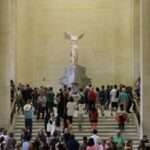
In Greece, the representation of victory was personified as a winged goddess, descending on earth to honor the conqueror. Faithful to this spirit, the colossal work was placed in a rock niche overlooking the theater of the Great Gods Sanctuary in Samothrace, a tiny greek island, at the beginning of the 2nd century BC. It represents a Victory landing on the front of a warship, probably to commemorate a naval victory. By the virtuosity of this sculpture and the ingenuity of its construction, this monument is an unequaled masterpiece of Greek sculpture from the Hellenistic period.
The Wedding Feast at Cana

The Wedding Feast at Cana commissioned to the painter Veronese in 1562 by the Benedictine monks of a monastery in Venice, is an illustration of texts from the Gospel. It is the largest painting in the Louvre. With “The Marriage of Cana”, Veronese transposed the biblical episode of a sumptuous marriage where Jesus performs His first miracle, according to the Gospel of John.
Louis XIV Portrait, King of France

Ordered to be offered to the King of Spain, Philip V, grandson of Louis XIV, this portrait was so successful that it remained in France. Each detail of the painting contributes to make the quintessence image of absolute power, the Sun King dressed in the costume of fleur-de-lis coronation, one of the greatest kings of France. Louis XIV was the last king to live at the Louvre. He moved to the Palace of Versailles.
The Coronation of the Emperor Napoleon I and the Crowning of the Empress Joséphine

The Rite of Napoleon I, Napoleon Bonaparte, commissioned to the painter Jacques-Louis David, staged the Emperor during his coronation and the coronation of the Empress Josephine. He is crowned Emperor, in the cathedral Notre-Dame of Paris, on December 2, 1804, by Pope Pius VII. Eyewitness to the ceremony, the painter David will realistically deliver the colorful crowd but he must also respond to the intentions of the Emperor.
July 28: Liberty Leading the People

The popular insurrection of July 1830 in Paris, aroused by the liberal republicans against the violation of the Constitution by the government of the Second Restoration, overthrows Charles X, the last bourbon king of France and puts in his place Louis Philippe, Duke of Orleans. Witness of the event, the painter Delacroix, found a modern subject that he methodically translated with a romantic fervor. By its allegorical aspect and its political scope, the work was frequently chosen as a symbol of the French Republic or the Democracy or Freedom. The female central figure, half-goddess, half-woman is here between the tangible and the idea.
Piétà de Villeneuve-lès-Avignon
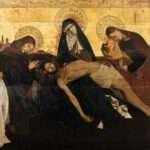
This masterpiece of the Provencal school, long time anonymous, was attributed to Enguerrand Quarton, author of the Coronation of the Virgin painted in 1453-1454 for the Carthusian monastery of the same place (Villeneuve-lès-Avignon, museum). This painting expresses the themes of the lamentation, the devotion, the Passion of Christ with the presence of the Virgin Mary, Saint John the Evangelist and Saint Mary Magdalene, as well as the painter himself on the far left behind Saint John.
Venus de Milo Greek sculpture, gallery of antiquities
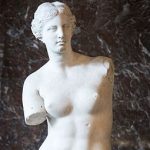
The Louvre’s gallery of antiquities displays masterpieces of Greek sculpture, including the famous Venus de Milo. You would need a heart of stone not to be moved by her grace ! With the Mona Lisa and The Winged Victory of Samothrace, the Venus de Milo is one of the three most famous female figures in the Louvre. Her name comes from the Greek island of Melos (now Milos). She was acquired by the Marquis de Rivière in 1820, French ambassador of Greece. He then presented her to King Louis XVIII, who donated her to the Louvre in March 1821.
Man’s Mommy, Egyptian Antiquities
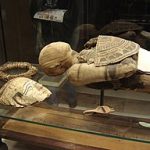
Vania Teofilo / CC BY-SA
This mummy is, according to the results of an X-ray examination, an adult man. This is the only mummy preserved and exhibited at the Louvre Museum in the Department of Egyptian Antiquities. It is particularly well preserved and the braiding of the bands, especially on the face, is impressive. His face is covered with a mask with harmonious features at the top of which is represented a winged scarab, symbol of rebirth.
The Seated Scribe

In fact, sitting cross-legged, the squatting scribe is very often shown in the history textbooks to illustrate writing in the time of ancient Egypt. This character who has kept all his colors is in working position. One can easily imagine his papyrus leaf on his legs and his brush in his right hand.
Law Code of Hammurabi, king of Babylon

The high basalt stele by the king of Babylon in the eighteenth century BC is a work of art, prior to biblical laws. The stele dates from 1750 BC. The Law Code of Hammurabi is the emblem of the Mesopotamian civilization, historic region of the Middle East-Iraq mostly. This basalt stele was erected by King Hammurabi of Babylon (1792–1750 BC) probably at Sippar, city of the sun god Shamash, god of justice. The Law Code of Hammurabi is valuable first and foremost as a model, being a treatise on the exercise of judiciary power in the context of Mesopotamian science.
Not to Miss at the Louvre in Paris, France : Iconic Masterpieces
- Mona Lisa (Leonardo da Vinci) – The most famous painting in the world, in the Denon Wing, Room 711. Expect crowds.
- Venus de Milo – Ancient Greek statue of Aphrodite (Milo of Croton), Sully Wing.
- Winged Victory of Samothrace – A dramatic Hellenistic sculpture at the top of the Daru staircase (Denon Wing).
- Liberty Leading the People (Delacroix) – Romantic French painting celebrating the July Revolution, Denon Wing.
- The Coronation of Napoleon (David) – Huge neoclassical masterpiece depicting Napoleon crowning himself, Denon Wing.
What to see at the Louvre : Ancient Civilizations
- Code of Hammurabi – One of the world’s earliest legal codes (Babylonian), Richelieu Wing.
- Great Sphinx of Tanis – Imposing Egyptian sculpture, Sully Wing.
- Seated Scribe – Lifelike ancient Egyptian statue.
- Lamassu (Winged Bulls of Assyria) – Monumental guardian figures.
What to see at the Louvre : Other Noteworthy Collections
- Italian Renaissance paintings (Raphael, Caravaggio, Veronese).
- French paintings (Poussin, Géricault’s Raft of the Medusa).
- Islamic Art (beautiful ceramics, textiles, and calligraphy).
- Decorative Arts (crown jewels, Napoleon III’s apartments).
Suggested Routes
1–2 hours: Stick to the big five: Mona Lisa, Venus de Milo, Winged Victory, Liberty Leading the People, The Coronation of Napoleon.
Half day: Add Egyptian and Mesopotamian highlights.
Full day or more: Explore specialized sections (Islamic Art, Decorative Arts, French Sculpture Courtyard, etc.).
One of the Largest Museums in the World
The Louvre is one of the largest and most visited museums in the world, housing over 35,000 works of art across 72,735 square meters of exhibition space. To visit the entire museum, it would take approximately 3 days and 2 nights of non-stop viewing, spending just 10 seconds on each artwork on display. With such vast collections, a private guided tour with Art History expertise becomes essential to navigate the masterpieces that matter most to you. The museum is organized into 8 specialized departments, each offering extraordinary treasures from different civilizations and artistic periods:

Greek, Etruscan and Roman Antiquities
Explore the foundations of Western civilization through spectacular ancient sculptures, pottery, and artifacts spanning from the Neolithic period to the 6th century AD. This collection includes some of the most iconic masterpieces in art history.
Highlights:
- Venus de Milo (circa 100 BC) – The epitome of Hellenistic sculpture depicting Aphrodite, Greek goddess of love and beauty, discovered on Milos island in 1820
- Winged Victory of Samothrace (circa 190 BC) – Dramatic marble sculpture commemorating a naval victory, positioned majestically atop the Daru staircase
- Borghese Gladiator – Dynamic Roman marble depicting a warrior in combat stance
- Greek pottery collections – Black-figure and red-figure vases illustrating Greek mythology and daily life
- Roman sarcophagi – Intricately carved marble tombs showing mythological scenes
- Etruscan artifacts – Jewelry, bronze work, and funerary art from ancient Italy
Why This Matters: These works established the artistic principles—proportion, movement, idealized beauty—that influenced all Western art for the next 2,000 years. Understanding Greek and Roman art is understanding the foundation of European civilization.
Egyptian Antiquities
Journey through 5,000 years of ancient Egyptian civilization with one of the world’s finest collections outside Cairo. From monumental statues and golden sarcophagi to intimate daily life objects and hieroglyphic inscriptions, discover the art, religion, and culture of pharaonic Egypt.
Highlights:
- Great Sphinx of Tanis – Monumental pink granite sphinx from the 26th century BC
- Seated Scribe (circa 2500 BC) – Lifelike painted limestone sculpture with inlaid eyes, capturing the essence of ancient Egyptian realism
- Stele of the Serpent King – One of the oldest known Egyptian royal inscriptions
- Sarcophagi and mummies – Elaborately decorated coffins revealing burial practices and beliefs about the afterlife
- Book of the Dead papyri – Ancient funerary texts with colorful illustrations guiding souls through the underworld
- Jewelry and amulets – Gold, lapis lazuli, and turquoise ornaments worn by royalty
- Temple of Dendur reliefs – Carved stone panels from Nubian temples
Thematic Rooms:
- Daily life in ancient Egypt (furniture, cosmetics, tools)
- Religious practices and gods (Osiris, Isis, Anubis)
- Royal power and pharaonic art
- Coptic Christian Egypt (late period)
Why Visit With a Guide: Hieroglyphics and symbolism require expert interpretation. An Art History guide translates inscriptions, explains religious symbolism, and reveals how Egyptian art influenced later civilizations.
Oriental Antiquities (Near Eastern Antiquities)
Discover the cradle of civilization through Mesopotamian, Persian, and Levantine treasures spanning 9,000 years—from the first cities of Sumer to the great Persian Empire. This collection reveals humanity’s earliest writing, law codes, monumental architecture, and artistic achievements.
Highlights:
- Code of Hammurabi (1750 BC) – One of the earliest legal codes in history, carved on a black basalt stele showing the Babylonian king receiving laws from the sun god Shamash
- Lamassu (Winged Bulls) – Massive protective deities with human heads, bull bodies, and eagle wings that guarded Assyrian palace gates
- Ishtar Gate fragments – Brilliant blue-glazed bricks decorated with dragons and bulls from ancient Babylon
- Gudea statues – Serene Sumerian ruler portraits in dark stone (circa 2100 BC)
- Persian archers frieze – Colorful glazed brick relief from Darius I’s palace at Susa
- Ebla tablets – Ancient cuneiform writing revealing early diplomacy and trade
- Phoenician ivories – Intricately carved furniture decorations
Civilizations Represented:
- Mesopotamia (Sumer, Akkad, Babylon, Assyria)
- Persia (Achaemenid Empire)
- Levant (Syria, Lebanon, ancient Israel)
- Anatolia (ancient Turkey)
Why This Matters: These civilizations invented writing, created the first cities, developed law codes, and built the foundations of mathematics, astronomy, and literature that shaped human history.
Paintings
Explore European painting from the 13th to 19th centuries with one of the world’s greatest collections—over 7,500 paintings including Italian Renaissance masterpieces, French Baroque grandeur, Dutch Golden Age realism, and Romantic movement.
Iconic Masterpieces:
- Mona Lisa by Leonardo da Vinci (1503-1519) – The world’s most famous painting, Leonardo’s enigmatic portrait with revolutionary sfumato technique
- The Wedding at Cana by Veronese (1563) – Massive Venetian Renaissance feast scene (the largest painting in the Louvre)
- Liberty Leading the People by Delacroix (1830) – Romantic allegory of the French Revolution
- The Raft of the Medusa by Géricault (1818-1819) – Dramatic Romantic depiction of survival and human suffering
- The Coronation of Napoleon by Jacques-Louis David (1806) – Monumental Neoclassical propaganda masterpiece
By School and Period:
- Italian Renaissance: Botticelli, Raphael, Titian, Caravaggio
- French Classicism: Poussin, Claude Lorrain, Georges de La Tour
- Dutch Golden Age: Rembrandt, Vermeer, Frans Hals
- Spanish Masters: El Greco, Murillo
- French Rococo: Watteau, Boucher, Fragonard
- Romanticism: Delacroix, Géricault
Why Art History Expertise Matters: Understanding composition, technique, historical context, and symbolism transforms paintings from beautiful images into profound cultural documents. An École du Louvre-trained guide reveals layers of meaning invisible to untrained eyes.
Sculptures
Experience three-dimensional art from medieval times through the 19th century with French, Italian, and Northern European masterpieces. From Michelangelo’s captives struggling to break free from marble to Canova’s idealized beauty, sculpture reveals humanity’s desire to capture movement, emotion, and idealism in stone and bronze.
Masterpieces:
- Michelangelo’s Slaves (Dying Slave and Rebellious Slave) (1513-1516) – Unfinished marble figures showing the artist’s technique of “releasing” forms from stone
- Psyche Revived by Cupid’s Kiss by Canova (1787-1793) – Neoclassical marble capturing the moment of awakening love
- Marly Horses by Coustou – Dynamic Baroque sculptures originally created for Louis XIV’s Château de Marly
- Diana of Versailles – Roman copy of Greek original showing thehunt goddess
Collections Include:
- Medieval sculpture: Romanesque and Gothic religious carvings
- Italian Renaissance: Donatello, Cellini
- French Renaissance: Jean Goujon, Germain Pilon
- Baroque drama: Bernini influence, Puget
- Neoclassical revival: Houdon portrait busts, Canova mythological scenes
- Romantic expression: Rude, Barye animal sculptures
Cour Marly & Cour Puget: Two spectacular glass-roofed courtyards displaying monumental French sculptures in natural light—an architectural marvel enhancing the art experience.
Art Objects (Decorative Arts)
Discover the luxury and craftsmanship of European royal courts through furniture, tapestries, jewelry, ceramics, bronzes, and precious objects spanning from the Middle Ages to the 19th century. This collection reveals how the wealthiest patrons lived, displaying extraordinary artistry in functional objects.
Extraordinary Collections:
- Crown Jewels of France: Including the Regent Diamond (140 carats), crowns, scepters, and royal regalia
- Apollo Gallery: Stunning gilded gallery displaying Louis XIV’s crown jewels in a room that inspired the Hall of Mirrors at Versailles
- Medieval treasures: Reliquaries, enamels, ivory carvings, illuminated manuscripts
- Renaissance ceramics: Italian maiolica, French faience
- Royal furniture: Louis XIV, XV, and XVI period pieces with marquetry, gilt bronze, and Sèvres porcelain
- Gobelins tapestries: Monumental woven artworks depicting mythology and royal hunting scenes
- Limoges enamels: Medieval religious objects with vibrant colors
- Scientific instruments: Astronomical clocks, armillary spheres
Rooms to Explore:
- Napoleon III Apartments – Opulent Second Empire interiors preserved as they appeared in the 1860s
- Galerie d’Apollon – Louis XIV’s dazzling jewel gallery
- Medieval and Renaissance galleries
Why This Captivates: These objects reveal how art permeated every aspect of royal life—from dining to worship, from fashion to scientific inquiry. They demonstrate that “decorative” arts required as much mastery as painting or sculpture.
Graphic Arts (Prints and Drawings)
Explore over 200,000 drawings, prints, and illustrated books including preparatory sketches by Leonardo da Vinci, Michelangelo, Raphael, Rembrandt, and Delacroix. Due to light sensitivity, these works are displayed in rotating exhibitions, offering rare glimpses into artists’ creative processes.
Notable Holdings:
- Leonardo da Vinci drawings: Scientific studies, anatomical sketches, engineering
- Michelangelo preparatory drawings: Studies for Sistine Chapel and sculptural works
- Rembrandt etchings: Complete collection showing his printmaking mastery
- French 18th-century drawings: Watteau, Boucher, Fragonard’s rococo elegance
- Albrecht Dürer prints: Northern Renaissance precision and detail
- Delacroix sketches: Romantic movement preparatory studies
Why Drawings Matter: Drawings reveal the artist’s hand directly—spontaneous lines, corrections, creative exploration. They show the thinking process behind finished masterpieces, offering intimate access to artistic genius. Viewing Information: Graphic arts are displayed in temporary exhibitions (Cabinet des Dessins) to protect them from light damage. Check the Louvre website for current exhibitions during your visit.
Islamic Arts
Journey through 1,300 years of Islamic civilization from Spain to India with nearly 18,000 objects displayed in a stunning modern wing designed by architects Rudy Ricciotti and Mario Bellini. Opened in 2012, this department showcases the artistic achievements of Islamic cultures through ceramics, metalwork, textiles, carpets, miniature paintings, and calligraphy.
Highlights:
- Baptistère de Saint Louis (circa 1320-1340) – Spectacular brass basin inlaid with silver and gold, created in Mamluk Egypt
- Peacock Dish (Iznik ceramics) – Colored Turkish pottery from the Ottoman Empire
- Persian miniature paintings: Intricate illustrations from Shahnama (Book of Kings) and other literary masterpieces
- Mughal jewelry and weapons: Jade-hilted daggers, jeweled swords from India
- Moroccan carved wood panels: Geometric Islamic patterns and Arabic calligraphy
- Egyptian mosque lamps: Enameled glass with Quranic inscriptions
- Carpets and textiles: Persian silk carpets, Ottoman embroideries
Geographic Coverage:
- Maghreb (North Africa: Morocco, Algeria, Tunisia)
- Middle East (Egypt, Syria, Iraq, Arabia)
- Persia/Iran (Safavid and Qajar periods)
- Ottoman Turkey (Iznik ceramics, court arts)
- Mughal India (jewelry, miniatures, weapons)
- Islamic Spain (Al-Andalus) (architectural fragments)
Architectural Marvel: The Islamic Arts wing features an undulating golden mesh roof that filters natural light, creating an ethereal atmosphere reminiscent of flowing fabric—a modern architectural achievement housing ancient treasures. Why This Enriches Your Visit: Islamic art demonstrates sophisticated mathematical precision in geometric patterns, reverence for the written word through calligraphy, and artistic achievement across three continents and thirteen centuries expanding beyond Western art traditions.
What to see at the Louvre
The Louvre Museum in Paris is one of the largest and most visited museums in the world, so it’s helpful to plan ahead. What you see depends on your time and interests
Emy,
