

| The Best Covered Passages to Discover in Paris – Paris by Emy |
Covered Passages of Paris: Paris is home to several historic covered passages, each offering a different atmosphere and a unique glimpse into the elegance of nineteenth-century Paris. Some are famous for their architecture, others for their literary connections, antique shops, gourmet restaurants and luxury boutiques, or hidden treasures. During a Covered Passages of Paris private tour with Paris by Emy, you can discover the most remarkable galleries while learning the stories that make each one special.
Enjoy a customized private tour covering 2–3 nearby districts, with the option of a private driving experience for greater comfort and flexibility.
- From €360 for a 3-hour private walking tour
- From €950 for a private driving tour (up to 6 guests)
- Available year-round with flexible start times
- Hotel or central Paris pick-up meeting point
Private Tour Guide in Paris - Paris by Emy
| Pricing | # of Person | Customized private tours in Paris |
|---|---|---|
| From €200 | Per Person | 2-hour Paris private museum tour + skip-the-line |
| From €360 | Up to 6 | 2-hour private walking tour in Paris |
| From €950 | Up to 6 | Paris private walking tour + private museum tour |
| From €950 | Up to 6 | 4-hour car tour Paris with private guide & driver |
| From €1,450 | Up to 6 | Paris Tour by private car + Museum private tour |
Covered Passages of Paris Private Tour
Paris is celebrated for its magnificent monuments, elegant Haussmann boulevards, world-famous museums, and timeless cafés. Yet beyond the Eiffel Tower, Notre-Dame Cathedral, and the Louvre lies another Paris that many visitors never discover. Hidden between bustling streets are the covered passages of Paris, elegant glass-roofed shopping arcades dating back to the early nineteenth century. These remarkable galleries preserve the charm of Belle Époque Paris while offering a peaceful escape from the city’s busy avenues.
A Covered Passages of Paris private tour allows you to experience these architectural treasures with a licensed local guide who brings their fascinating history to life. Behind every decorative façade, mosaic floor, and iron-and-glass ceiling lies a story of Parisian innovation, luxury shopping, literature, gastronomy, and daily life during the nineteenth century.
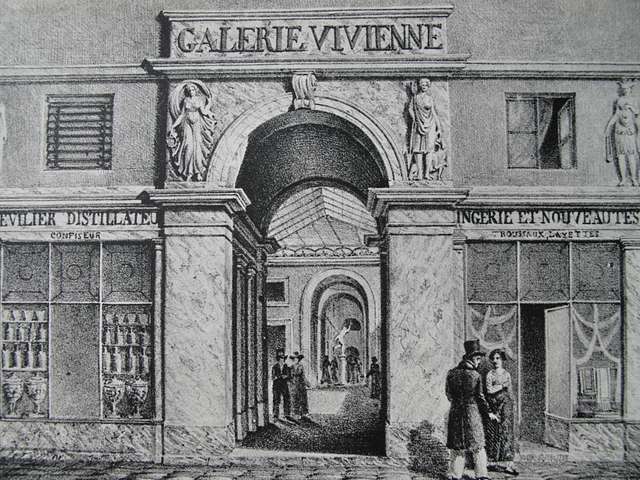
Galerie Vivienne – The Most Elegant Covered Passage in Paris
4 Rue des Petits Champs, 75002 Paris
Located near the Palais-Royal, the Galerie Vivienne is often considered one of the most beautiful covered passages in Paris. Built in 1823 according to the plans of architect François Jean Delannoy, and originally named Galerie Marchoux after its first owner, it was inaugurated in 1826 as the Galerie Vivienne, taking its name from the Rue Vivienne on which it is located. Home to renowned boutiques and restaurants, and a true architectural masterpiece, it is now the venue for numerous events such as film shoots, haute couture fashion shows, and exhibitions by acclaimed artists. Over the years, the Galerie Vivienne has managed to preserve its old-world charm while modernizing to meet contemporary needs.
François-Jacques Delannoy designed a Pompeian-style neoclassical decor covered by an elegant glass roof, composed of mosaics, paintings, and sculptures celebrating commerce. Restoration work has allowed for the rehabilitation of the caducei, anchors, and cornucopias that adorn the semicircular windows, as well as the goddesses and nymphs that decorate the rotunda. Opened in 1826, it is famous for its magnificent mosaic floors, neoclassical decorations, elegant boutiques, and beautifully preserved glass roof. Walking through this gallery feels like entering a refined nineteenth-century Parisian salon.
The floor mosaics, with a terrazzo background, are signed by Giandomenico Facchina and Mazzioli. Their simplicity, emphasized by the repetition of basic geometric shapes, is reminiscent of the style of the mosaics on the Rue de Rivoli. The grand gallery, 42 meters long, is followed by a glass-roofed rotunda with a hemispherical glass dome, all of which are original.
The architect adopted the vocabulary of the Empire style: pilasters, arches, and cornices. He added decoration symbolizing wealth (cornucopias), success (laurel wreaths, sheaves of wheat, palm fronds), and commerce (Hermes’ caduceus). The floor, which is not original, is by Giandomenico Facchina.
Today, Galerie Vivienne combines historical charm with contemporary elegance. Visitors can discover luxury boutiques, wine shops, fashion designers, and charming cafés while admiring one of the finest examples of Parisian commercial architecture. Its connection to the Palais-Royal district makes it an ideal stop for travellers interested in history, architecture, and the refined lifestyle of old Paris. Walter Benjamin: The German philosopher made covered arcades (notably the Galerie Vivienne) the central subject of his monumental, unfinished work, the *Passagenwerk* (The Arcades Project), analyzing these architectural structures as the cradle of 19th-century modernity.
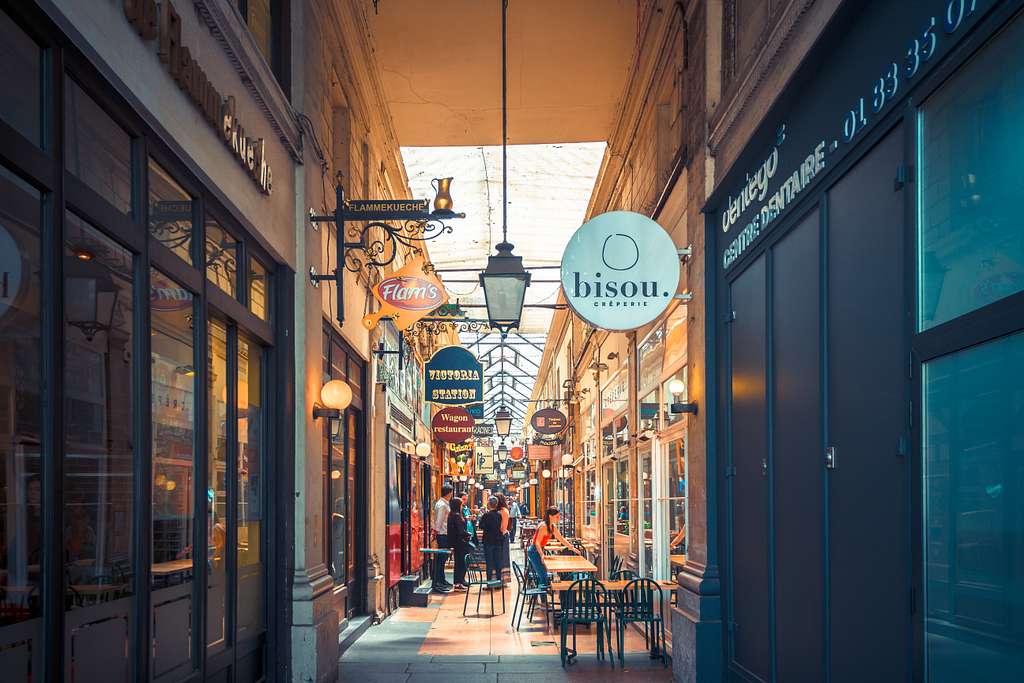
Passage des Panoramas – The Oldest Covered Passage in Paris
11-13 Boulevard Montmartre – 151 Rue Montmartre, 75002 Paris
- The signs: Flam’s (an Alsatian flammekueche restaurant), Bisou crêperie, Wagon restaurant, and what looks like part of the Racines sign on the left. Passage des Panoramas is known for packing restaurants and wine bars into the arcade.
- The look: a glass-and-iron roof, hanging lanterns, and a narrow corridor lined with overhanging signs. It is one of the oldest covered passages in Paris (1799) and has this crowded, atmospheric look.
Opened in 1799, Passage des Panoramas is the oldest surviving covered passage in Paris. Originally created during the revolutionary period, it became a fashionable destination where Parisians could shop, socialize, and enjoy new forms of entertainment. The passage is particularly known for its historic restaurants, stamp collectors, antique shops, and authentic atmosphere. It was also connected to the world of theatre and journalism, reflecting the cultural energy of nineteenth-century Paris. Today, it remains a fascinating place where history and daily Parisian life continue to meet.
The facades and roofs of the buildings at 11-13 Boulevard Montmartre and 48 Rue Vivienne, including the entrances to the passage. In 1799, the American shipowner Thayer had two towers built on Boulevard Montmartre, in which he installed his panoramas, painted frescoes covering the walls of a rotunda. To facilitate access from the Palais Royal to the Boulevard and attract customers, he opened the Passage des Panoramas, which would shelter passersby from the rain and mud, on the site of the former Hôtel de Montmorency.
In 1834, the Galeries Saint-Marc, des Variétés, de Feydeau, and de Montmartre were added by the architect Jean-Louis Grisart to compete with the Galeries Colbert, Vivienne, and Véro-Dodat. The passage was an immediate success thanks to Parisians’ enthusiasm for panoramic views, its exceptional location on the boulevard, near the Bourse (Stock Exchange), and especially the Théâtre des Variétés, which was built against it in 1807. In 1816, gas lighting was tested there. The rotundas on Boulevard Montmartre were demolished in 1831. But while the popularity of panoramic views waned, the passage continued to thrive. In 1989, the southernmost section was significantly altered by the construction of an apartment building on Rue Saint-Marc.
– No. 57: The premises of the famous 19th-century chocolatier Marquis, of which a beautiful coffered ceiling, the wooden entrance columns, and the interior mirrors remain.
– No. 47: Stern Engraver, a shop listed as a historical monument, now Caffé Stern.
– No. 26: Antique postcard shop.
– No. 22: Numerous philatelic shops.
– No. 17 of the Passage des Variétés: The artists’ entrance to the Théâtre des Variétés. The Théâtre des Variétés has enlivened the passage for two centuries.
While the writer Émile Zola may not have been a regular patron, he immortalized the feverish atmosphere of these places in his novels—notably the Passage des Panoramas, which he describes in *Nana*.
Passage Jouffroy – A Journey into Nineteenth-Century Paris
10-12 Boulevard Montmartre – 9 Rue de la Grange Batelière, 75009 Paris
Built in 1846, Passage Jouffroy continues the elegant atmosphere of Passage des Panoramas. Located near the famous Grands Boulevards, it is recognized for its iron and glass structure, marble floors, and charming shops. The passage is home to bookstores, antique dealers, souvenir shops, and the entrance to the famous wax museum Musée Grévin. Its combination of architecture, culture, and history makes it one of the most enjoyable passages to explore during a private walking tour.
The passage itself, the facades and roofs of the buildings at 10-12 Boulevard Montmartre and 9 Rue de la Grange Batelière, including the two entrances to the passage, are listed as historical monuments. Created along the axis of the Passage des Panoramas, it is one of the most frequented passages. In 1882, Mr. Meyer, director of the newspaper “Le Gaulois,” had the idea of partnering with Mr. Grévin, then a famous caricaturist, to create a gallery of wax figures. The Passage Jouffroy was the first arcade built entirely of iron and glass.
Its metal structures bear witness to the evolution of techniques; cast-iron columns support the floors and rise to the glass roof. The arcade was the first to have underfloor heating. Note the pointed arch glass roof.
The terrain required the architects to create an L-shaped recess from a staircase that compensates for a slight slope. Café-concerts and cabarets enjoyed immense popularity in the 19th century; the most famous, the Estaminet Lyrique, was short-lived. The shops in the arcade were always of high quality: cafés, milliners, tailors, hairdressers, lingerie shops, glove shops, and more. It was completely renovated in 1987 and, on that occasion, its original paving was restored. The Passage Jouffroy has retained all its original charm and remains a popular destination.
Note: At the entrance to the passage on Boulevard Montmartre is the Hôtel Ronceray, where the composer Rossini lived from 1828 to 1832. He composed the opera “William Tell” there. Also located here is the entrance to the Musée Grévin.
No. 13: The Salon des Miroirs (Hall of Mirrors), a former cabaret known as a “beuglant” (a type of cabaret). The decorated panels are made of “crumpled” glass. This beautiful room is available for rent for events.
No. 41: “Pain d’Épice” (Gingerbread) shop selling toys and antique dollhouses.
No. 58: Bookstore specializing in magazines and film posters.
Passage Verdeau – A Hidden Gem for Book Lovers and Collectors
Opened in 1847, Passage Verdeau is one of the quieter and more authentic covered passages in Paris. Located just behind Passage Jouffroy, it offers a peaceful atmosphere with antique shops, old booksellers, photography collections, and vintage treasures.
For travellers looking for a more intimate side of Paris, Passage Verdeau provides a wonderful opportunity to slow down, browse unique shops, and experience the charm of a less crowded historic gallery.
Passage du Grand Cerf – One of the Most Impressive Architectural Passages
The Passage du Grand Cerf, opened in 1825, is remarkable for its exceptional height and impressive glass-and-metal structure. With one of the highest ceilings among Parisian covered passages, it creates a bright and spacious atmosphere.
Today, the passage is known for artisan workshops, creative boutiques, and independent designers. It represents the artistic and craftsmanship side of Paris, where visitors can discover handmade creations and meet passionate shop owners.
Passage Choiseul – A Historic Parisian Shopping Arcade
Located near the Opéra district, Passage Choiseul was inaugurated in 1827 and once attracted writers, artists, and intellectuals. The passage has a more local atmosphere and offers a fascinating contrast between historical architecture and modern life.
Recently renovated, Passage Choiseul has regained much of its original charm while welcoming restaurants, boutiques, and creative businesses. It remains a wonderful example of how Paris successfully preserves its heritage.
Louis-Ferdinand Céline: He spent his childhood in the Passage Choiseul, where his mother ran an antique shop. He drew inspiration from this place (which he nicknamed “les Bérézinas”) for his novel *Death on the Installment Plan*.
Experience Authentic Paris
Discovering the covered passages of Paris is like opening a hidden door into another era. Behind their discreet entrances are stories of merchants, artists, writers, architects, and generations of Parisians who shaped the identity of the city.
A private Covered Passages of Paris tour with Paris by Emy allows you to explore these elegant galleries at a relaxed pace while understanding their historical, cultural, and architectural significance. Instead of simply visiting beautiful locations, you experience the atmosphere, stories, and hidden details that make Paris endlessly fascinating.
Beyond the Covered Passages of Paris
Discover all the private guided tours in Paris page with a licensed private tour guide.
Emy,
