

A Personal Journey Through Paris’s Jewish Heritage – Paris Jewish Private Tour
Paris Jewish History Private Tour: The “Pletzl” (Yiddish for “little square”) is the historic Jewish quarter located around the rue des Rosiers in the 4th arrondissement of Paris. Paris carries a deep and complex Jewish history, intertwined with the broader history of France. From centuries of community, culture, and intellectual life to persecution, loss, and resilience, including the experience of Paris during World War II, this history offers a powerful and nuanced perspective on the city of Paris. This private Jewish Paris tour comes from a place of memory as much as expertise, and I bring that perspective to every stop we make together.
As a licensed private tour guide in Paris and founder of Paris by Emy, I offer this private tour, not only as a professional guide, but as someone whose own family history is woven into this story. My grandfather moved to France at 10 years old from Germany in 1938. His cousin moved to the United States in San Francisco, where he graduated, married, raised six children, and became a pharmacist. My great great grand-parents moved from Germany to France in 1938 and were murdered during the Holocaust, deported to Auschwitz and Dachau during the Rafle du Vel d’Hiv from Paris in 1942. My grandfather survived the war together with his brother, who emigrated to Israel afterward and died in 1948 as a general in the Israeli army, fighting for the country’s independence. The graves of my grandfather’s grandparents are located in Munich, Germany. In addition, the city of Augsburg, Germany, dedicated a street to my grandfather’s cousin in recognition of his family’s history and legacy.
Paris Jewish history private tour from €360 – for 3 hours – up to 6 persons, depending on level of customization
- Private driver in option from €950 for 4 hours
- Departure and pickup point in Paris to be agreed upon
- Personalized itinerary based on your interests
- Themed tour – history, memory, community, or all three
- Official Licensed Tour Guide, English speaking
- A Personalized and Private Jewish Paris Tour
Suggested Itinerary
We meet at your hotel or a central Paris location, accompanied by your private guide.
- Le Marais — the historic heart of Jewish Paris
- Rue des Rosiers — the old Jewish quarter, its shops, bakeries, and daily life
- Synagogue at 17 rue des Rosiers — one of the neighborhood’s historic synagogues
- LUNCH BREAK at a traditional Jewish bakery or restaurant in Le Marais
- Mémorial de la Shoah — National Holocaust memorial and documentation center
This is not a fixed, one-size-fits-all itinerary. Whether you want to focus on Le Marais, place des Vosges and its living Jewish community, the memorials and sites of remembrance, or the broader arc of Jewish history in France from the Dreyfus Affair to today, the tour is shaped around what matters most to you.
Paris Jewish History Private Tour
Jewish Private Tour in The Marais – Paris
This district has been home to the Jewish community of Paris for centuries, with synagogues, kosher eateries, and significant historical sites. Le Marais district, very close to Notre-Dame, bears its name from an old marshy area since the XIIe century. Today, this district is one of the busiest of the capital. It has many museums (Picasso Museum, European House of Photography, Carnavalet Museum…). The visit of the Place des Vosges is the highlight of a walk. Victor Hugo, author of the hunchback of Notre-Dame, lived there. The rue des Rosiers, epicenter of the Parisian Jewish community, is to be discovered. There are synagogues and the Holocaust memorial. The Marais is full of designers and luxury fashion boutiques on Rue des Francs-Bourgeois and Rue Vieille du Temple, the BHV department store, delicatessen shops around Saint Paul, contemporaries’ art galleries with the Galerie Perrotin 76 Rue de Turenne, 75003 Paris, one of the world’s first contemporary art gallery. The Marais is also the largest gay district in France.
- Rue des Rosiers – The heart of Jewish life in Paris, lined with traditional bakeries and historic Jewish shops. See iconic places like Sacha Finkelsztajn 27 Rue des Rosiers, 75004 Paris, a famous Jewish bakery known for its challah and strudel.
- Place des Vosges – The oldest Square of Paris where Victor Hugo the writer of Les Misérables once lived.
- Musée d’Art et d’Histoire du Judaïsme (Jewish Museum) — for those who wish to go deeper into art and history
- Memorial de la Shoah – A powerful Holocaust memorial and museum. Pay respects at the Wall of the Righteous, which honors non-Jewish individuals who saved Jews during WWII. France’s national Holocaust memorial and museum houses a wall inscribed with the names of the 76,000 Jews deported from France during the war, along with extensive archives, exhibitions, and a crypt. It stands as both a place of mourning and a center for historical research and education.
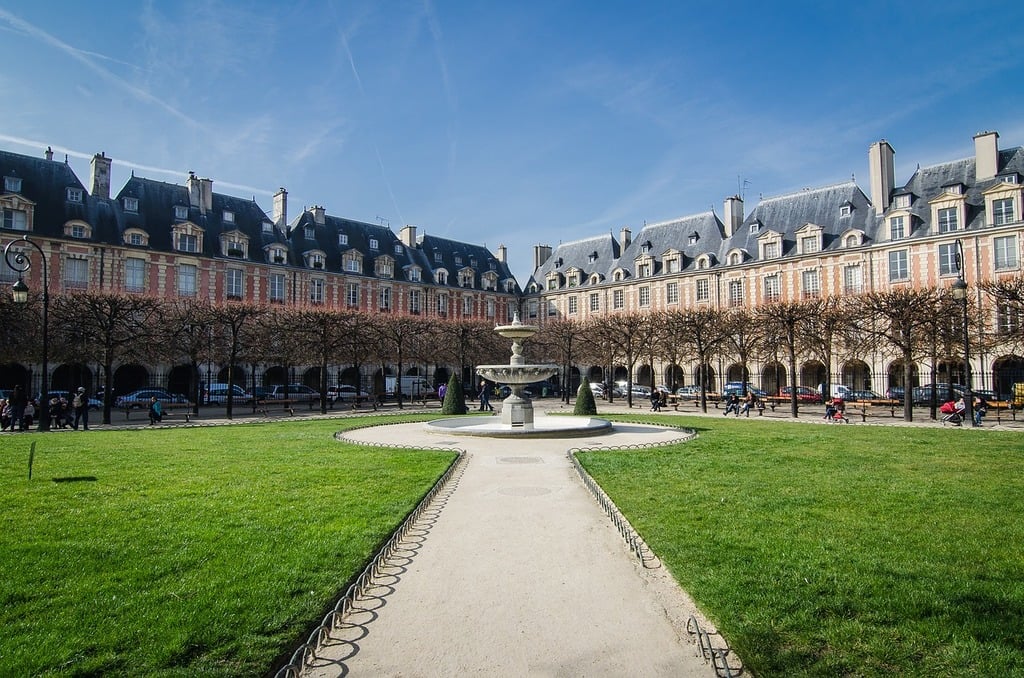
Place des Vosges in the Marais
The Marais is home to several historic synagogues, each with its own story.
- The synagogue at 17 rue des Rosiers sits at the very center of the old Jewish quarter, woven into daily life on the street.
- Nearby, the Synagogue de la Place des Vosges serves the community just steps from one of Paris’s most elegant squares.
And on rue Pavée stands the Synagogue Agoudas Hakehilos, perhaps the most architecturally striking of the three: designed in 1913 by Hector Guimard — the same architect behind Paris’s iconic Art Nouveau metro entrances — its sinuous stone façade is one of the only Art Nouveau synagogues in the world. Guimard, who was married to a Jewish woman, later saw the building damaged by German bombing during the Occupation; it survived and remains an active synagogue today, and a quiet architectural landmark most visitors to Paris never notice.
The Jewish Community in The 13th Century
Jewish presence in Paris predates the Marais by many centuries, and one of the most consequential — and darkest — chapters of that early history unfolded under King Louis IX, later canonized as Saint Louis. A devout and often zealous ruler, Louis IX took a hard line against the Jewish community of France during his reign in the mid-13th century, going well beyond the restrictions and taxations Jews already faced under earlier French kings.
In 1240, Louis IX presided over the Disputation of Paris, a public theological trial in which the Talmud itself was put on trial, accused of containing blasphemous content against Christianity. Jewish scholars, including Rabbi Yechiel of Paris, were compelled to defend the text before a tribunal of churchmen. The outcome was a foregone conclusion: in 1242, on the king’s orders, an estimated 12,000 to 24,000 handwritten volumes of the Talmud and other Jewish texts were publicly burned in Paris, in what is remembered as one of the first large-scale book burnings in European history. It represented a devastating loss of centuries of rabbinic scholarship.
Louis IX’s reign also saw increasingly restrictive decrees governing Jewish life, money lending, and dress, foreshadowing the badge requirements and expulsions that would follow elsewhere in Europe in later centuries. Understanding this 13th-century chapter adds important depth to the story told elsewhere on this tour — it shows that the tensions, restrictions, and persecution Jewish Parisians faced in the 20th century were not without precedent, but part of a much older and recurring pattern in history.
Exploring Jewish Paris
Paris has been home to a Jewish community since the Middle Ages, and that history is layered into the city in ways easy to miss without a guide. From Le Marais’s cobblestone streets to the solemn walls of its memorials, this tour traces both the everyday life of the community and the darkest chapter of its history.
From the Synagogue de Nazareth to the Grande Synagogue
The Synagogue de Nazareth and the Grande Synagogue de Paris tell an important story about the development of Jewish life in 19th-century Paris. Built in 1852, the Synagogue de Nazareth was once the principal synagogue of the city and served as the seat of the Chief Rabbis of France and Paris. When the magnificent Grande Synagogue on rue de la Victoire opened in 1875, the religious center of Parisian Judaism gradually moved westward. Visiting these two historic synagogues allows us to follow this fascinating evolution and discover how the Jewish community grew and established itself in Paris during the 19th century.
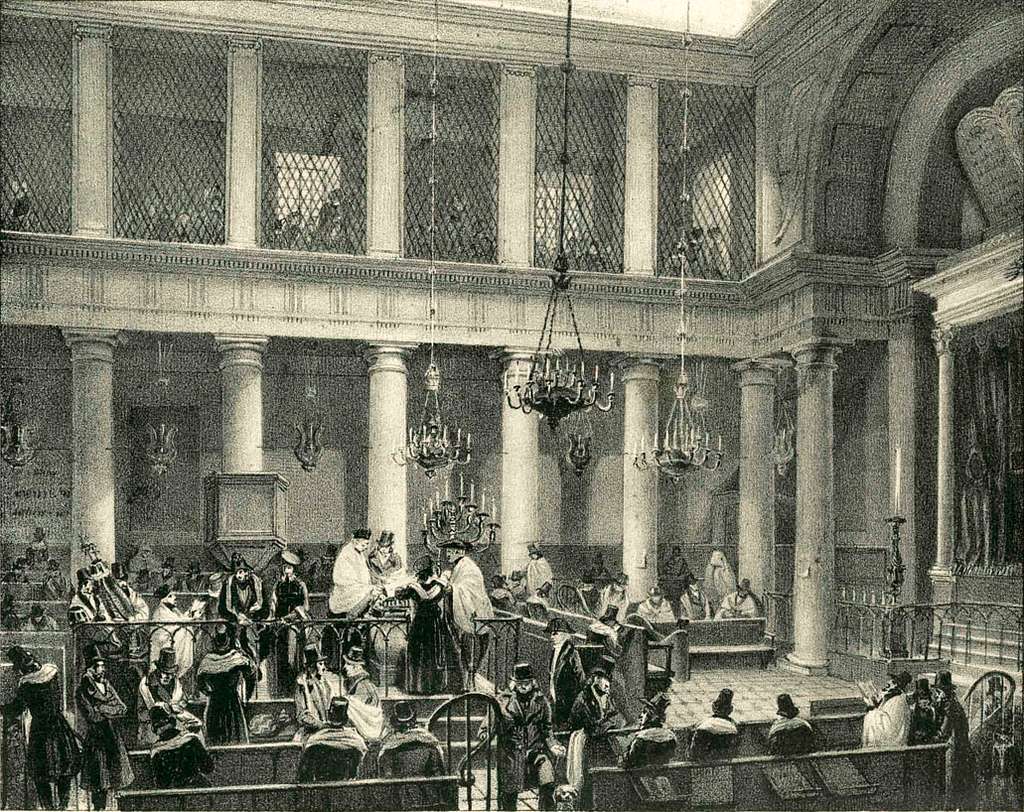
Black-and-white lithograph of the interior of the 1822 building of the Synagogue de Nazareth, located on the Rue Notre-Dame-de-Nazareth, in Paris. Lithograph by Jules-Robert-Pierre-Joseph Challamel after an original drawing by the Marquis de Villeneuve. Published in L’Artiste.
Synagogue de Nazareth
Located in Paris’s 3rd arrondissement, the Synagogue de Nazareth is the oldest of the city’s great historic synagogues. The present building was completed in 1852, replacing an earlier synagogue built in 1822, and was funded in part by Baron James de Rothschild. Its distinctive architecture reflects the 19th-century development of Jewish religious life in France. The synagogue has an important place in the cultural history of Paris. It was frequented by figures such as actress Rachel and composer Jacques Offenbach, and it served as a residence for the Chief Rabbis of France and Paris until the opening of the Grand Synagogue on rue de la Victoire in 1875. During the Occupation, the synagogue was damaged in an attack in 1941, and its chief rabbi, Joseph Saks, was later arrested and deported. After the war, the arrival of Jewish communities from North Africa led to the adoption of the Sephardi rite.
The synagogue has been protected as a Monument historique since 1993.
La Grande Synagogue de Paris
A stunning 19th-century synagogue and a symbol of France’s vibrant Jewish heritage. Discover its impressive architecture and rich history on a private guided tour, available by advance reservation. The Grand Synagogue of Paris, generally known as Synagogue de la Victoire or Grande Synagogue de la Victoire, is an Orthodox Jewish congregation and synagogue, located at 44, Rue de la Victoire, in the IXe arrondissement of Paris. Since its establishment in 1874, the synagogue has served as the official seat of the chief rabbi of Paris; with the Synagogue de Nazareth previously being the seat. The synagogue building was classified as a monument historique on July 8, 1993. With a capacity of 1,800 worshippers, it is the second largest synagogue in Europe, after the Dohány Street Synagogue in Budapest.
The congregation worships in the Ashkenazi rite.
Le Sentier during your Paris Jewish history private tour
Le Sentier is a historic neighborhood in the 2nd arrondissement of Paris, known for its textile industry, Jewish heritage, and vibrant commercial streets. Le Sentier was historically home to a large Sephardic Jewish community, many of whom arrived from North Africa in the mid-20th century. While not as famous as Le Marais, this district has synagogues, kosher eateries, and traces of Jewish life. Le Sentier has transformed into the “Silicon Sentier”, a hub for Parisian startups and digital innovation :
- The Station F Influence – While Station F (Europe’s largest startup incubator) is located further south, its influence is felt in Le Sentier.
- Synagogue Buffault (28 Rue Buffault) – A beautiful 19th-century synagogue with Moorish-style architecture. The Buffault Synagogue, located in the 9th arrondissement of Paris, was built by Sephardic Jews in conflict with the Ashkenazi community who had just built the synagogue on rue de la Victoire, which later became the Great Synagogue of Paris.
- Rue du Caire & Passage du Caire – One of the oldest covered passages in Paris, inspired by Egyptian architecture.
- Passage du Grand-Cerf 145 Rue St Denis, 75002 Paris – A stunning glass-roofed arcade with artisan shops and concept stores. Rue Saint-Denis – One of Paris’s oldest streets, filled with historic charm.
Just north of Le Marais, the Sentier district became another hub of Jewish immigrant life in the 20th century, closely tied to the garment and textile trade. Many Jewish families, particularly those arriving from Eastern Europe and later North Africa, built their livelihoods here, and the neighborhood’s history reflects a different, more commercial side of Jewish Parisian life than the Marais.
The Green Ticket Roundup – May 14, 1941
The Rafle du billet vert, or Green Ticket Roundup, was the first large-scale mass arrest of Jews in Paris under the Vichy regime. On May 13, 1941, French police sent 6,494 foreign Jewish men a green summons ordering them to report for a supposed “examination of their situation.” Believing it to be an administrative procedure, approximately 3,700 men reported as instructed on May 14 and were immediately arrested. One of the principal gathering points was the Gymnase Japy, in Paris’s 11th arrondissement. From there, the men were transferred by bus to Gare d’Austerlitz and then transported to the internment camps of Pithiviers and Beaune-la-Rolande, in the Loiret. Many would later be deported to Auschwitz.
Still standing today, this historic gymnasium was one of the main gathering points during the Rafle du billet vert on May 14, 1941. A commemorative plaque at the entrance recalls the thousands of Jewish men who were arrested here before being transferred to the internment camps of Pithiviers and Beaune-la-Rolande.
This tragic episode also connects directly to the Vel d’Hiv Roundup of July 1942. Many of the women and children who were later arrested had come to Paris the previous year when their husbands, fathers, or relatives were arrested during the Green Ticket Roundup. The two events therefore form an important part of the story of the destruction of Jewish families in France during the Occupation.
The Rafle du Vel d’Hiv
On July 16–17, 1942, French police, acting on orders from the Nazi occupation, arrested nearly 13,000 Jewish men, women, and children across Paris in a single coordinated operation. Many were held at the Vélodrome d’Hiver, a cycling stadium, in brutal conditions before being deported to transit camps and ultimately to Auschwitz. Very few survived. Visiting the site today, marked by a memorial, is a somber but essential part of understanding this history and part of my own family’s story. Today, the former stadium is commemorated by the Jardin mémorial des enfants du Vél d’Hiv and the nearby memorial monument dedicated to the victims. Standing at this site offers a poignant opportunity to understand this tragic chapter of French history and to remember the families who were torn from their homes.
The former Vélodrome d’Hiver stood in Paris’s 15th arrondissement, in the Grenelle district. Today, its memory is preserved at two nearby sites.
- The Jardin mémorial des enfants du Vél’ d’Hiv’, at 7 rue Nélaton, 75015 Paris, stands at the location of the former stadium entrance. The memorial garden commemorates the 4,115 Jewish children who were arrested during the Vel d’Hiv Roundup, separated from their parents, deported, and murdered at Auschwitz-Birkenau. Their names and ages are inscribed on the memorial wall.
- A short walk away, the Monument to the Victims of the Vel d’Hiv Roundup is located at Place des Martyrs-Juifs-du-Vélodrome-d’Hiver, 75015 Paris, beside the Seine and near the Bir-Hakeim bridge. The sculpture commemorates all those arrested during the roundup of July 16–17, 1942.
Together, these two memorials form an essential stop for understanding the history of the Vel d’Hiv Roundup and the persecution of Paris’s Jewish community during the German Occupation.
As part of your private Jewish heritage tour, we can take time here for reflection while placing the events within the broader history of the Jewish community in Paris during the German Occupation and the Holocaust.
Mémorial des Déportés
Located at the eastern tip of the Île de la Cité, behind Notre-Dame, this stark, minimalist memorial honors the 200,000 people deported during the world war II from France to Nazi concentration camps, of all backgrounds. Its narrow underground chambers and inscribed walls create one of the most moving memorial spaces in Paris.
Musée d’Art et d’Histoire du Judaïsme
Discover the rich history, culture, and heritage of Jewish communities through the Musée d’art et d’histoire du Judaïsme (mahJ), located in the historic Hôtel de Saint-Aignan in the Marais. Housed in a beautiful 17th-century mansion in the Marais, this museum traces the history, art, and culture of Jewish communities across Europe and North Africa from the Middle Ages to the present, offering essential context for everything else seen on the tour. The museum brings together an exceptional collection of religious objects, artworks, manuscripts, and historical documents spanning centuries of Jewish life in France and across Europe. It offers a fascinating perspective on Jewish traditions, identity, and the important role of Jewish communities in European history.
A visit to the museum can be combined with a private walking tour of the Jewish Marais, including the historic Pletzl, rue des Rosiers, former Jewish institutions, synagogues, and sites connected to the history of the Parisian Jewish community.
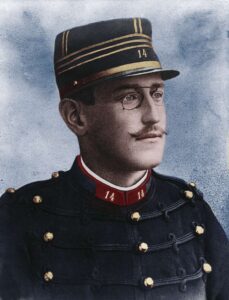
Captain Alfred Dreifus
The Dreyfus Affair
At the end of the 19th century, the wrongful conviction of French army officer Alfred Dreyfus — falsely accused of treason largely because he was Jewish — became one of the defining scandals of Third Republic France. It exposed deep currents of antisemitism in French society and politics, and remains a pivotal moment in understanding both French Jewish history and the roots of political Zionism, as it deeply influenced Theodor Herzl.
Standing beside the Cour de cassation on the Île de la Cité, this powerful bronze statue commemorates Captain Alfred Dreyfus, the Jewish French army officer whose wrongful conviction for treason became one of the most defining episodes in French history. Created by the artist Tim (Louis Mitelberg), the sculpture depicts Dreyfus holding a broken sword, recalling his public military degradation in 1895. After being moved between several locations in Paris, the statue was finally installed here in 2026, directly opposite the institution that definitively recognized Dreyfus’s innocence on July 12, 1906, after twelve years of struggle.
The statue also has a direct connection with the Musée d’art et d’histoire du Judaïsme (mahJ), where a replica of the sculpture and preparatory works are preserved. Together, these two sites offer a meaningful introduction to the Dreyfus Affair, the history of antisemitism in France, and the long struggle for truth and justice.
The Jewish Community in France Today
France is home to the largest Jewish community in Europe today, with roots spanning centuries and waves of immigration — from medieval settlement, to Eastern European arrivals in the early 20th century, to Sephardic Jews from North Africa following decolonization in the mid-20th century. This tour connects that long, layered history to the community as it exists in Paris today.
Beyond a Paris Jewish History Private Tour
Paris by Emy specializes in customized private tours of Paris, blending deep cultural, spiritual, and historical experiences with visits to world-class museums such as the Louvre. Beyond the city itself, Paris by Emy also designs private day trips to Normandy, Versailles, and beyond — each itinerary tailored to your interests, pace, and curiosity, with a licensed guide and private driver in option.
FAQs — Jewish History Tour of Paris
Q: Is this tour appropriate for children or teenagers?
A: The tour can be adapted for younger visitors, with the pace and depth of the historical and Holocaust-related content adjusted accordingly. Just let us know in advance.
Q: Do we need to enter the Mémorial de la Shoah or the Jewish Museum, or can we just walk past them?
A: Entirely up to you. Some guests prefer to go inside for a deeper experience, others prefer an outdoor walking tour with historical context provided along the way.
Q: Is this tour only about the Holocaust?
A: No. While the Holocaust and the Rafle du Vel d’Hiv are an important and unavoidable part of this history, the tour also covers centuries of Jewish life, culture, and community in Paris, both past and present.
Q: Can this tour be combined with other Paris tours?
A: Yes, it can be combined with other Paris by Emy tours, such as Le Marais’s broader history or nearby neighborhoods, depending on your available time.
Q: Why do you offer this particular tour?
A: This history is personal to me. My grandfather survived the Holocaust after his parents were deported in the Rafle du Vel d’Hiv, and his brother later gave his life for Israel’s independence in 1948. I believe this history deserves to be told with both historical accuracy and personal care, and I’m honored to share it with visitors to Paris.
