

| A Saint-Germain Tour Dedicated to the Saint-Germain-des-Prés church and Ancient Abbey |
Saint-Germain-des-Prés Church and Abbey Private Tour: When travelers hear the name Saint-Germain-des-Prés, they often imagine charming cafés, legendary writers, jazz clubs, art galleries, and the intellectual atmosphere that made this Paris district famous during the 20th century. They think of philosophers gathering in cafés, artists discussing ideas over coffee, and the elegant streets that still preserve the spirit of old Paris. But long before becoming the symbol of existentialism and Parisian bohemian culture, Saint-Germain-des-Prés was something entirely different. It was one of the most powerful religious and intellectual centers of medieval France, built around a prestigious royal abbey that stood at the gates of the ancient city.
Enjoy a customized private walking tour covering 2–3 nearby districts, with the option of a private driving experience for greater comfort and flexibility.
- From €360 for a 3-hour private walking tour
- From €950 for a private driving tour (up to 6 guests)
- Available year-round with flexible start times
- Hotel or central Paris pick-up meeting point
Saint-Germain-des-Prés Church Private Tour – Founded in 558
“The monastery must, as much as possible, be arranged in such a way that everything necessary is found there: water, a mill, a garden and workshops so that one can practice the various trades inside of the enclosure. In this way, the monks will not need to disperse outside, which is not at all advantageous for their souls.” Saint Benedict (480-547 Italia)
Saint-Germain-des-Prés Church and Abbey Private Tour Founded in 558 by Childebert I, the son of Clovis was originally the church of a Benedictine abbey. It was destroyed by the Vikings, rebuilt, and renamed in the 8th century for Saint Germain, Bishop of the city. Thus, It was a royal abbey, which therefore benefits from an exemption and was directly subject to the pope. The first abbey church was consecrated on April 23, 558 to the Holy Cross and Saint Vincent of Zaragoza. This basilica had marble columns, a paneled ceiling and glazed windows.
- 3 place Saint-Germain-des -Prés 75006 Paris
- Ordre Saint-Benoît – Benedictine Congrégation de Saint-Maur
- Fondation 558 – VI century
It was also a royal necropolis Germanus and of Childebert, Clovis’son and other rulers of the Merovingian Dynasty until the creation of that of the Saint-Denis basilica in the XII century. Saint Denis was a 3rd-century Christian martyr and the first bishop of Paris who is venerated as the patron saint of France. He was beheaded by Roman authorities and became famous in Christian legend as a cephalophore for allegedly walking while carrying his own head, in Montmartre. The relics of Saint Germain were venerated there, but no medieval burial remains to this day and the relics have considerably diminished.
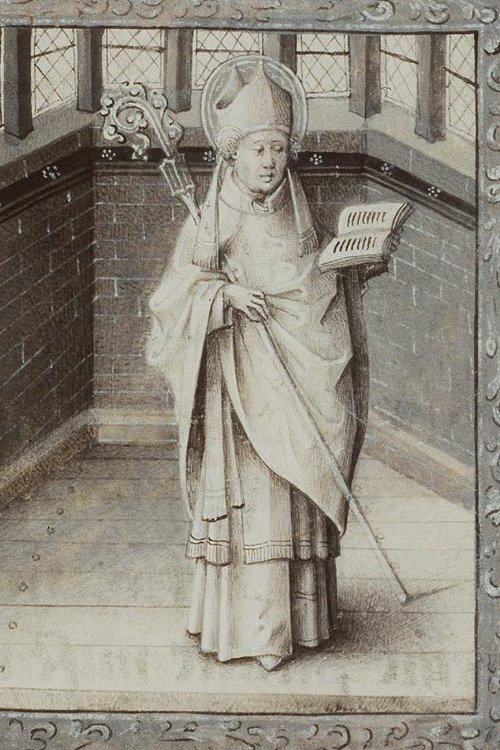
Saint Germain des Près – By Book of Hours, c. 1450-1460. Jean le Tavernier (illuminator)
Saint Germain des Près – Bishop of Paris
Saint Germain wasn’t the first bishop of Paris. That title traditionally belongs to Saint Denis, regarded as the first bishop of Paris, a 3rd-century martyr whose legend gave rise to the Basilica of Saint-Denis. By the time Germain took up the office, Paris had already had a line of bishops for roughly three centuries.
From monk to bishop
Germain studied at Avalon and Luzy under his cousin Scapilion, a priest, and was ordained around age thirty-four by Saint Agrippinus of Autun, becoming Abbot of Saint-Symphorien near Autun. He was known above all for his radical generosity to the poor, his alms-giving was so extreme that his own monks, fearing he’d give away the abbey’s entire wealth, rebelled against him. That reputation earned him the nickname “Germain d’Autun,” later rendered as the “Father of the Poor.”
Bishop of Paris
He happened to be in Paris in 555 when Bishop Eusebius died; Childebert I kept him there, and he was consecrated to the vacant see with the unanimous consent of clergy and people. As bishop, he held considerable moral influence over Childebert’s court and persuaded the king to found the church that would, after Germain’s death, be renamed Saint-Germain-des-Prés and become a royal burial site. He went on to preside over the third and fourth Councils of Paris in 557 and 573, and attended the second Council of Tours in 566.
The abbey’s name
Germain died in 576 and was originally buried in the church’s Saint-Symphorien chapel. He was later canonized, and once his relics were moved into the choir, the church, originally dedicated to the Holy Cross and Saint Vincent, gradually became known by his name instead, giving us “Saint-Germain-des-Prés.”
Different from Saint Germain L’Auxerrois
According to tradition, Germain was born in Autun, in Burgundy, around 496 CE. From an early age, he showed signs of piety and learning, entering the Church and rising through the ranks thanks to his education, humility, and compassion for the poor. Around 555 CE, Germain was appointed Bishop of Paris, making him one of the earliest and most influential spiritual leaders of the city. His episcopacy coincided with the reign of the Merovingian kings, and he became a close advisor to King Childebert I, son of Clovis. Under Germain’s influence, Childebert turned toward acts of Christian charity and religious patronage.
One of Germain’s most important achievements was persuading the king to build a grand basilica just outside the city walls to house holy relics. This church, dedicated to Saint Vincent and the Holy Cross, later became Saint-Germain-des-Prés, one of the oldest churches in Paris. Over time, Germain himself was buried there, and the church took his name. Saint Germain was known for his austerity, charity, and miraculous healings. He worked tirelessly to promote peace among warring nobles, to feed the hungry during famines, and to protect the rights of the poor.
Legends tell of him curing the sick, calming storms, and even interceding to stop invasions. He died on May 28, 576, and was buried in the basilica he founded. Soon after his death, people began to venerate him as a saint, and his tomb became a place of pilgrimage.
Why he matters today
Saint Germain’s legacy still shapes Paris:
- The district of Saint-Germain-des-Prés takes its name from him.
- The church he founded remains a historical landmark.
His life marks the bridge between ancient Roman Lutetia and medieval Christian Paris, showing how religion, politics, and urban growth intertwined.
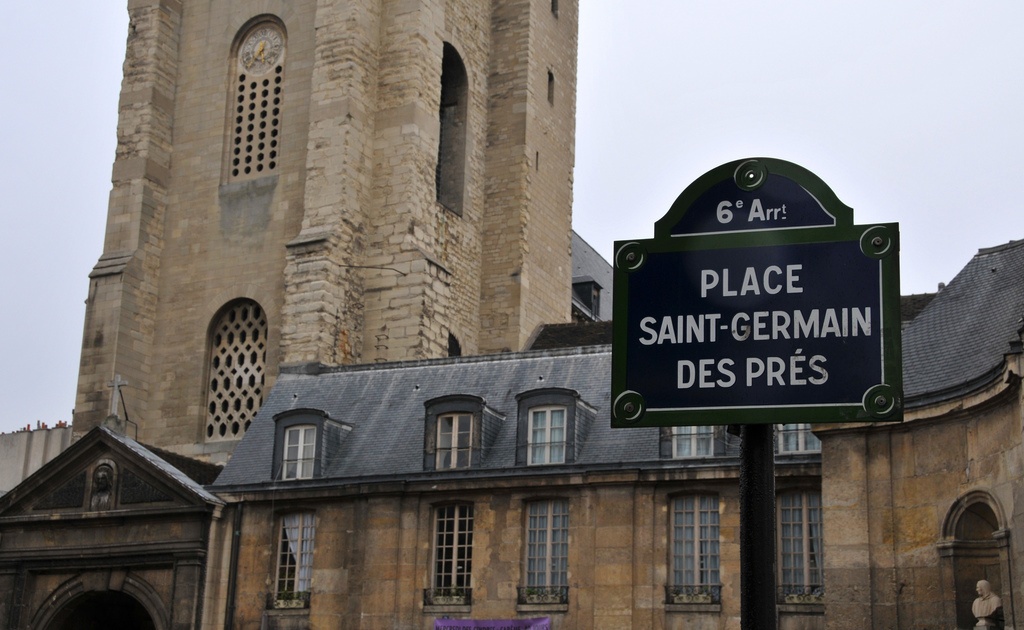
How the Monks Lived in Saint Germain Abbey ?
Life inside the abbey walls followed a rhythm almost entirely foreign to the modern city that surrounds it today. The monks who lived here, first under Merovingian patronage, later as part of the powerful Benedictine network, and finally as the scholarly Maurist congregation organized their entire existence around prayer, manual or intellectual work, and silence.
The abbey was a self-contained world. It had its own dormitory, refectory (dining hall), chapter house for daily meetings, infirmary, cellars, gardens, and eventually one of the finest libraries in Europe. Monks rose before dawn for the first of several daily prayer services, worked through the day copying manuscripts or tending the abbey’s considerable landholdings, and observed periods of enforced silence meant to turn the mind toward contemplation. Guests, pilgrims, and scholars were also housed and fed here, since hospitality was itself considered a sacred duty.
Abbots, Priors, and the Abbot’s Palace
At the head of the community stood the abbot, not merely a spiritual leader but, in the case of Saint-Germain-des-Prés, a powerful feudal lord in his own right. Abbots here held enormous influence: they controlled vast tracts of land on the Left Bank, administered their own justice, and in some periods answered to almost no one but the king and the pope. Among the more famous holders of the title was Louis-César de Bourbon, an illegitimate son of Louis XIV, and John II Casimir Vasa, the former king of Poland who abdicated his throne and retired to become Abbot of Saint-Germain, his heart is still entombed inside the church.
Below the abbot, the prior handled the day-to-day discipline and organization of the monastic community, while a network of officials oversaw everything from the library to the wine cellars. Remarkably, one physical trace of this hierarchy still survives: the former Abbot’s Palace, standing beside the church, is one of only two abbey buildings that escaped destruction during the French Revolution, a rare chance to see, in stone, how a medieval prince of the Church actually lived.
The Rule of Saint Benedict: Ora, Labora, Lectio Divina
Everything about monastic life at Saint-Germain traced back to the Rule of Saint Benedict, written in the 6th century and adopted by Benedictine communities across Europe, including this one. The Rule organized life around three interlocking pillars:
- Ora (pray) — the recitation of the Divine Office at fixed hours day and night
- Labora (work) — manual labor, farming, and later the labor of copying texts
- Lectio Divina (sacred reading) — meditative reading of Scripture to nourish the soul
This triad wasn’t a slogan; it was a literal daily schedule, and it shaped the physical layout of the abbey itself, church for prayer, workshops and fields for labor, library and cloister for reading. It’s also the thread that connects the abbey’s earliest Merovingian monks to its final generation of Maurist scholars over a thousand years later.
The Congregation of Saint-Maur
By the early 17th century, Benedictine monasticism in France was in need of reform, and in 1621 a new congregation was founded that would transform Saint-Germain-des-Prés into something closer to a research institute than a traditional monastery: the Congregation of Saint-Maur, or the Maurists. Named after Saint Maurus, a disciple of Saint Benedict credited with bringing the Benedictine rule to Gaul, the Maurists became famous across Europe for rigorous scholarship in history, theology, and manuscript editing.
Saint-Germain-des-Prés became their headquarters, the seat of the congregation’s superior general and the center of its intellectual output. At its height the Maurist network embraced close to two hundred houses across France. The Maurist library at Saint-Germain grew into one of the most important collections in the country, drawing scholars from across the continent and helping make the Left Bank, alongside the nearby Sorbonne, one of the great learning centers of Europe.
The former Abbot’s Palace (the building right next to the church, at what is now 3 rue de l’Abbaye) is one of the only two structures of the original abbey complex to survive the Revolution, the other being the church itself. Today, part of that building houses premises of the Institut Catholique de Paris. The abbey palace, restored in 1970, houses part of the Catholic Institute of Paris, though it bears little resemblance internally to its original appearance.
The Catholic University of Paris Next to Saint Germain Church
The Institut catholique de Paris was founded in 1875, under the name of the Université catholique de Paris by Maurice Le Sage d’Hauteroche d’Hulst.
The school settled on the site of the former convent of the Carmelites, however the premises were not well adapted. Gabriel Ruprich-Robert developed a new project for the site; however, due to a lack of sufficient funds, he decided to renovate some of the old buildings instead of destroying them. The first phase of the renovation took place between 1894 and 1897. Following the French law establishing the separation of the church and state, ownership of the premises was given to the state. In 1927, the premises were repurchased by the institute, allowing the second phase of the renovation to take place between 1929 and 1930, followed by a third phase between 1932 and 1933. The Neo-gothic architectural style is prevalent on the campus.
ICP is a non-for-profit association pursuant to the French Law of 1901, recognized as promoting public interest, in 1941. The current rector is Bishop Philippe Bordeyne, who has been the rector of ICP since 2011. In 2017, there were 10,000 students attending ICP. This was also the year that ICP inaugurated its renovated campus.
Where and How People Were Buried in Saint Germain?
For roughly two centuries, Saint-Germain-des-Prés functioned as the burial church of the Merovingian dynasty, beginning with Childebert I himself. Kings, queens, and members of the royal family were interred here in a sequence of increasingly elaborate tombs until the role of royal necropolis passed to Saint-Denis in the late 8th century. Later burials reflect the abbey’s continuing prestige: exiled royalty such as John II Casimir Vasa of Poland (whose heart remains entombed here), Scottish nobles who died in French royal service, and scholars such as the philosopher René Descartes were all laid to rest within its walls. Much of this funerary heritage was violently disrupted during the Revolution, when royal tombs were opened and desecrated; some Merovingian sarcophagi discovered in later excavations are now preserved in the Musée de Cluny rather than in the church itself.
Cluny Museum
Saint-Germain-des-Prés and Abbot Suger
The church was rebuilt by Abbé Morard, from the end of the 10th century. The first four levels of the western bell tower, the nave and the transept of the current church date back to this period, in which one can see in particular interesting capitals from around the year one thousand. The current choir was built in the middle of the twelfth century in the primitive Gothic style and consecrated by Pope Alexander III on April 21, 1163. It is one of the first Gothic buildings, which contributes to the spread of this new style and is of of major archaeological importance.
- Originally, in the Merovingian and early Capetian periods, Saint-Germain-des-Prés was closely tied to the French monarchy. Kings and nobles contributed to its construction and maintenance, and it served as a burial and ceremonial site for important figures.
- Over the centuries, the church lost some of its direct royal patronage, especially after the rise of larger royal abbeys and cathedrals, like Saint-Denis, which became the primary royal necropolis. By the 17th and 18th centuries, Saint-Germain-des-Prés functioned mostly as a parish church, though it retained some prestige due to its history.
The definitive break came during the French Revolution (1789–1799). The revolutionary government confiscated church property, secularized religious institutions, and often repurposed churches for civic use. Saint-Germain-des-Prés was stripped of its royal and religious privileges, its abbey dissolved, and its treasures removed.
The building of the Basilica of Saint-Denis, just North of Paris, was ordered in the 12th century by Abbot Suger (c. 1081–1151), one of the most influential churchmen and political figures of medieval France.
Abbot Suger was the abbot of the Abbey of Saint-Denis from 1122 until his death. He was not a king, but he was both a close advisor to the Capetian monarchs (Louis VI and Louis VII) and the effective manager of the abbey’s vast resources. The abbey already existed as a site of deep significance — it was believed to hold the relics of Saint Denis, the 3rd-century martyr and first bishop of Paris, and it had been a burial place for French kings since the early Middle Ages. Around 1135, Suger launched an ambitious rebuilding project to honor Saint Denis, glorify God, and reflect the growing power of the French monarchy.
The vision Suger wanted the church to be not just a shrine, but a symbol of the divine order and the kingdom’s prestige.
He pioneered architectural innovations, especially the use of ribbed vaults, pointed arches, and large stained-glass windows, which allowed the building to be flooded with colored light. This made Saint-Denis the first true masterpiece of Gothic architecture, setting the style for Notre Dame Gothic Cathedral and cathedrals across Europe. Abbot Suger left detailed writings about his work, making him one of the few medieval builders whose thought process we can still read today. Saint-Germain-des-Prés stopped being a royal church gradually during the French Revolution at the end of the 18th century. Here’s the context:
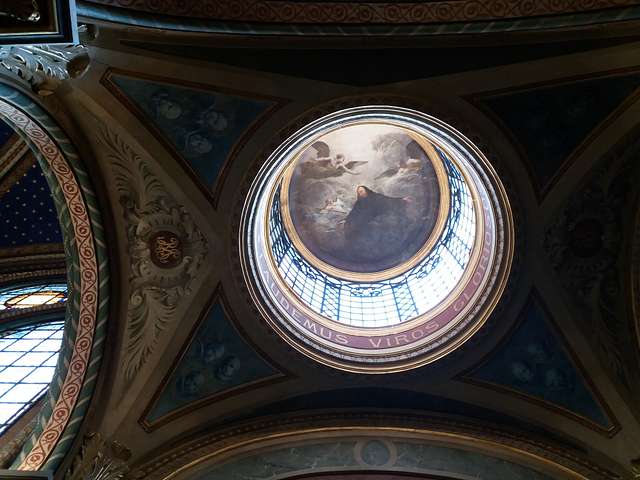
The Saint Germain Abbey’s Influence on Arts, Literature, History, and Archaeology
Few religious sites in France have left a deeper mark on Western culture. As the burial place of Merovingian kings, Saint-Germain-des-Prés was, for centuries, effectively a royal necropolis before that role passed to the Basilica of Saint-Denis. As a Maurist stronghold, its monks produced painstaking historical and textual scholarship that still underpins modern medieval studies. Its library circulated illuminated manuscripts across Europe and made the abbey a genuine center of the Republic of Letters.
Even after the Revolution, the neighborhood the abbey created never lost its intellectual gravity. The philosopher René Descartes is buried inside the church. Centuries later, the same streets around the old abbey walls would host Sartre, de Beauvoir, Picasso, and the Café de Flore crowd, and the district still carries the abbey’s name, a rare case of a demolished institution shaping a neighborhood’s identity for centuries after its disappearance.
Saint Germain Church Through the Ages
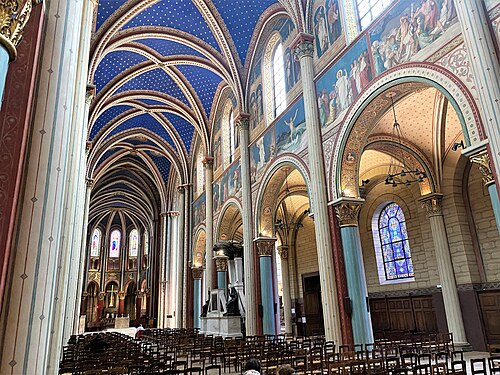
The church itself is a layered document of French architectural history almost every century between the 6th and the 20th has left a visible mark on it.
Merovingian Period (Late Antiquity)
The first church on this site was founded in the 6th century by the Merovingian king Childebert I, reportedly to house relics brought back from Spain, and it quickly became the burial church of the Merovingian dynasty. This original building was extraordinarily rich for its time — marble columns, gilded copper roofing, mosaic floors, and painted decoration befitting a royal mausoleum. Almost nothing of that first building survives above ground; it was burned and plundered repeatedly by Viking raiders toward the end of the 9th century.
Early Romanesque
The church was rebuilt from around the year 1000 under Abbot Morard, who gave it the three-tower Romanesque profile it would carry into the modern era. The surviving bell tower, completed in 1014, is one of the oldest Romanesque structures still standing in Paris, its lower courses date from this rebuilding, even though its upper stage was reworked in the following century.
Early Gothic
Through the 12th century, the church was steadily updated with the new Gothic vocabulary spreading from nearby Île-de-France building sites. The choir was rebuilt in the mid-12th century, and the whole church was reconsecrated by Pope Alexander III in 1163. Flying buttresses were added at the end of the century, among the very first used in the Île-de-France region, and the vast expansion of Gothic-era abbey buildings, including a Lady Chapel by the great architect Pierre de Montreuil, followed in the 13th century.
17th-Century Vaults
As the Maurists established their scholarly headquarters here, they also invested in the fabric of the church. The wooden Gothic-era vaulting of the nave was reworked and decorated with painted ornament during the 17th century, part of a broader campaign to keep the aging building both structurally sound and visually splendid for its new role as an intellectual capital.
19th-Century Restorations
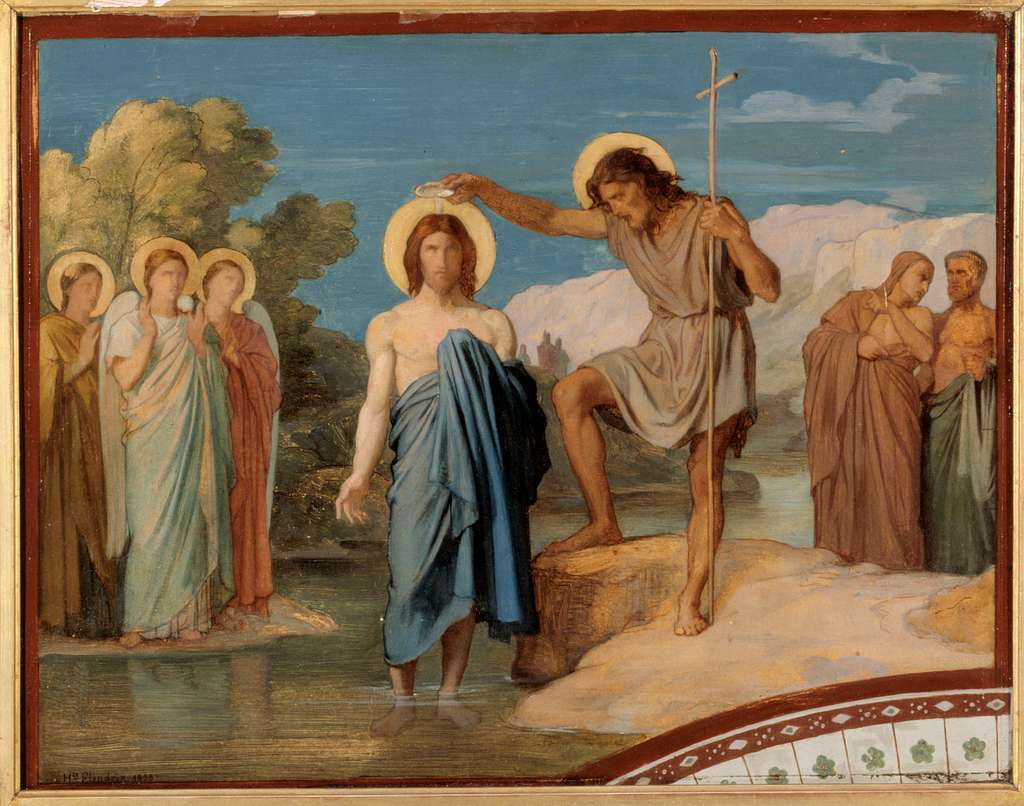
The Revolution left the church badly damaged and its abbey buildings almost entirely destroyed. By the 1820s parts of the structure were genuinely at risk of collapse, and it took a determined public campaign, supported by figures including Victor Hugo to save the building from demolition rather than restore it. The 19th-century campaign gave the church its current spire and included the celebrated mural cycle painted by Hippolyte Flandrin between 1842 and 1849, whose muted golds and terracottas still cover the nave and choir walls.
20th-Century Neo-Roman Work
Restoration didn’t stop with the 19th century. Twentieth-century campaigns, particularly from the 1950s onward, focused on stabilizing the structure, removing later overpainting, and returning parts of the interior closer to their Romanesque character — work that continues, in updated form, into the 21st century.
Saint-Germain-des-Prés Church of Paris – Art and Ornamentation
Merovingian Columns
The most direct physical link to the original 6th-century church survives in its marble columns, spoliated from earlier Roman buildings and reused in the triforium. They are, quite literally, the oldest visible material in the building.
Romanesque Chapiters (Capitals)
Above these ancient columns sit capitals carved in the Romanesque style, decorated with foliage, interlace, and figural scenes typical of 11th- and 12th-century sculpture, a striking contrast between antique material and medieval craftsmanship on the very same column.
Stained Glass, Across the Centuries
The story of the church’s stained glass is largely a story of loss and fragments. Only four windows survive from the 13th century, now grouped in the Chapel of Saint Genevieve; they depict scenes including the Annunciation and the marriage of the Virgin. Almost all the rest of the medieval glazing was destroyed during the Revolution, meaning most of what visitors see today dates from later restoration campaigns rather than the medieval period.
17th-Century Paintings
Alongside the vault decoration, the 17th century brought devotional paintings and sculpted monuments into the church, many commemorating abbots, nobles, and exiled royals connected to the abbey, traces of its role as a fashionable and politically connected institution under the Maurists.
19th-Century Fresco Work
The Flandrin murals remain the dominant artistic statement inside the church today: a continuous cycle running along the nave and choir depicting biblical scenes, allegorical virtues, and the abbey’s own founding legend, rendered in a restrained, almost Byzantine palette that was considered innovative for its time.
CC BY-SA 4.0
Other Buildings and Vestiges of the Abbey
The 13th-Century Lady Chapel
Among the abbey’s most celebrated losses is the Lady Chapel (Chapelle de la Vierge), built in the 13th century by Pierre de Montreuil, the same architect associated with parts of Notre-Dame and the Sainte-Chapelle. Contemporary accounts describe it as one of the most refined pieces of Gothic architecture in Paris, rivaling the royal chapel it was modeled on.
The Lady Chapel did not survive the upheaval of the Revolutionary period. The wider abbey complex — cloister, refectory, dormitory, chapter house — was almost entirely demolished after the monks were expelled in 1792 and the property nationalized. The chapel itself limped on for a few more years before being taken down in 1802, a casualty of the broader dismantling of the abbey’s estate.
Remaining Stained Glass
A small number of the chapel’s stained-glass windows were rescued before demolition and survive within the church today, offering one of the only direct visual links to Pierre de Montreuil’s lost masterpiece.
Other Architectural Remains in the Surrounding Streets
Walk the streets radiating from the church today and the old abbey reveals itself in fragments: carved arches from the Lady Chapel displayed in the small square (square Laurent-Prache) beside the church, medieval cellars preserved beneath private buildings along nearby streets, and the general street pattern of the 6th arrondissement, which still traces the footprint of the abbey’s original walls, gardens, and outbuildings.
A Brick-and-Stone Witness to the Late French Renaissance
Near the church, at the corner of the Place Saint-Germain-des-Prés, the 16th-century former bishop’s residence still stands, a rare example of late French Renaissance civil architecture built in the characteristic combination of red brick and cut stone. Along with the Abbot’s Palace, it’s one of the few structures that lets visitors picture the abbey precinct as a living complex of buildings, rather than the single isolated church that remains today.
Pierre Poschadel, CC BY-SA 3.0
Chapelle Sainte-Marguerite in Église Saint-Germain-des-Prés
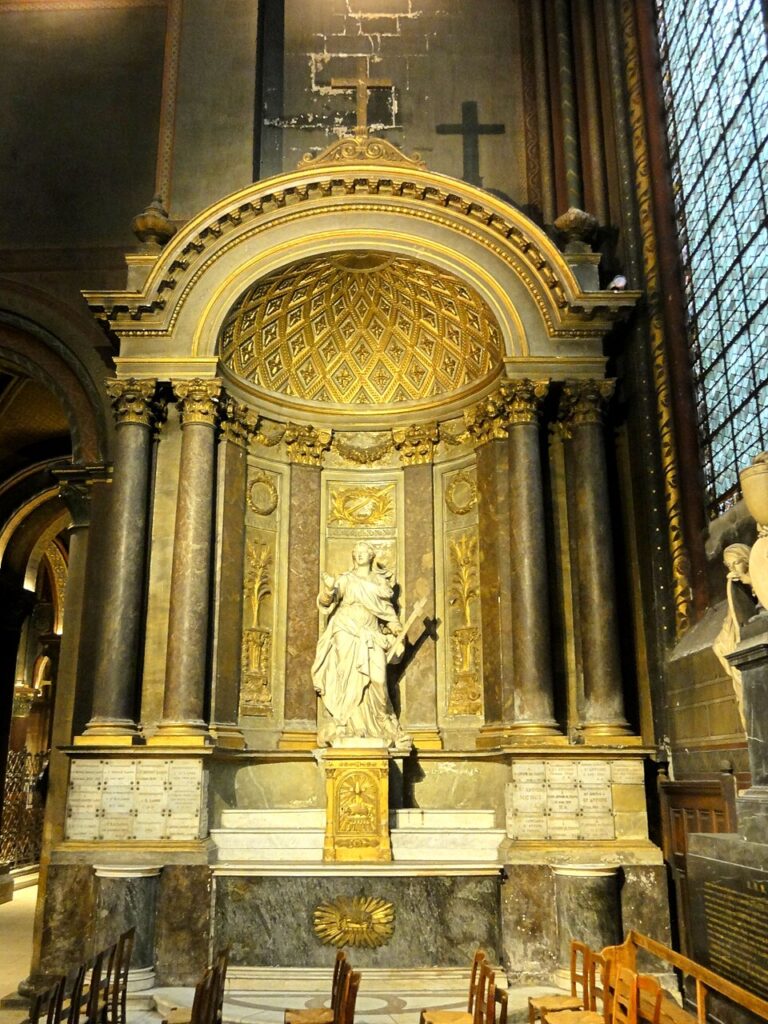
Tucked into the south transept of Saint-Germain-des-Prés is a small, easy-to-miss chapel that holds one of the finest pieces of 17th-century funerary sculpture in the church: the Castellan monument, carved by François Girardon.
Who commissioned it, and why
The chapel was founded in 1675 by Charles de Castellan, a commendatory abbot who financed the decoration of the transept’s south arm on one condition that a mausoleum honoring his family be built there. The result commemorates two soldiers from the Castellan line: Olivier de Castellan, who died fighting for Louis XIII during the war in Catalonia in 1644, and his son Louis, sent by Louis XIV to reinforce the French garrison on Crete, where he was killed charging Ottoman forces in 1669.
The Latin epitaph on the tomb was composed by the great Maurist scholar Dom Mabillon himself, a nice reminder of how tightly this chapel is woven into the abbey’s intellectual and family history.
The sculpture itself
Girardon — official sculptor to Louis XIV, and one of the two or three most important sculptors working at Versailles was commissioned to design the monument, which was installed in 1683. It takes the form of two allegorical female figures flanking the tomb: Fidelity and Piety, each holding an engraved portrait medallion of one of the two Castellan men. Beneath a column topped with an antique-style urn sits the actual burial chamber, containing the hearts of Charles, Olivier, and Louis de Castellan.
A monument that moved
Like much of the church’s decoration, this tomb didn’t stay where it was first placed. It originally stood in the chapelle Saint-Maur, roughly where the confessional is today, before the Revolution scattered and damaged much of the church’s funerary sculpture. In 1828, the architect Étienne-Hippolyte Godde reassembled and reinstalled what survived in the south transept, in what is now the Chapelle Sainte-Marguerite (named for the altar statue of Saint Marguerite carved by the lay brother Jacques Bourlet in 1705).
A further restoration in 1945 removed some later plaster additions flanking the tomb. What visitors see today, then, is a 17th-century masterpiece that has essentially survived the Revolution in fragments — the two allegorical figures — reassembled a full generation after the original composition was broken apart.
It’s worth noting Girardon’s connection to Saint-Germain-des-Prés wasn’t a one-off commission, this is the same sculptor famous for the equestrian statue of Louis XIV once standing in the Place Vendôme (destroyed in 1792) and for major funerary work at the Sorbonne. Finding his hand in a quiet side chapel here is a small but genuine link between the parish church and the grand sculptural program of Versailles.
Chapelle Saint-Symphorien in Saint Germain
If the Castellan monument represents the abbey’s aristocratic 17th-century decoration, the Chapelle Saint-Symphorien represents something much older and rawer — arguably the single most historically dense square meter of the entire building.
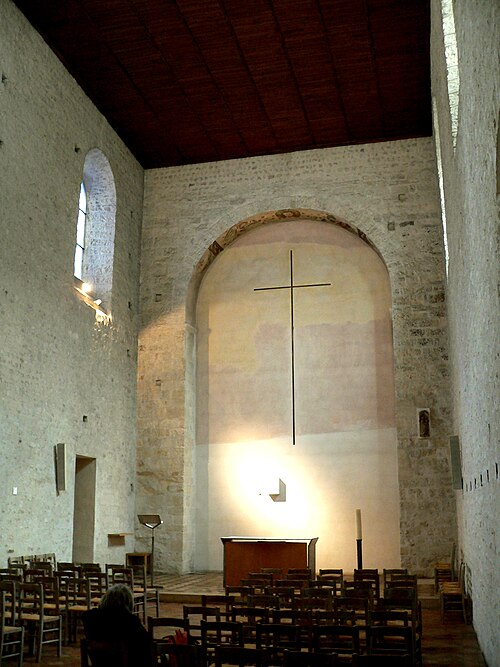
The oldest ground in the church. This chapel, just inside the entrance to the right, honors two figures: Saint Symphorien, a young martyr from the late 2nd century, and Saint Germain himself. Both men, notably, came from Autun, the same town Germain had left behind to become bishop of Paris. Tradition holds that when Germain died in 576, he was buried “under the portico” of Childebert’s original basilica, on this very spot; a stone slab today marks the location traditionally identified as his first tomb, before his relics were later moved into the choir.
Rebuilt and reused across the centuries. Around 1010, under Abbot Morard’s reconstruction of the abbey after the Viking raids, the chapel was rebuilt and enlarged to allow lay members of the surrounding village to attend services separately from the monks effectively functioning as the parish church for the town growing up around the abbey walls. In 1619, Saint Francis de Sales personally consecrated a new altar here in Symphorien’s honor.
The chapel’s darkest chapter came during the Revolution. In September 1792, more than a hundred priests who had refused to swear the oath of loyalty to the revolutionary government were locked inside this chapel before being taken outside and massacred on what is now the square in front of the church. That history is deliberately kept visible: a red rectangle painted on the north wall today evokes, in the words of the parish itself, the imprisonment and the blood of martyrs linking Symphorien’s own 2nd-century martyrdom to the priests killed in 1792 “and of all times.
Archaeology and contemporary art, side by side: In 1971, major excavations uncovered layered remains beneath the chapel floor spanning multiple periods of the building’s history, giving historians a much clearer (if still incomplete) chronology of the site. Two decades later, the City of Paris commissioned contemporary artist Pierre Buraglio to restore and redecorate the space; his work including a spare, modern Stations of the Cross in blue-and-white enameled sheet metal was completed and solemnly blessed by Cardinal Lustiger on 27 January 1993. It’s frequently cited as one of the more successful integrations of contemporary art into a historic French church interior: rather than imitating the past, Buraglio’s minimalist intervention sits quietly alongside sixth-century tombstones and Revolutionary scars.
The “Other” Virgin of Saint Germain – A Case of Mistaken Identity
Here’s the twist: the statue traditionally called the trumeau Virgin of Saint-Germain-des-Prés’s Lady Chapel — the one that passed through the Chantiers de Saint-Denis depot before reaching the Musée de Cluny, may not actually be from Saint-Germain-des-Prés at all.
The physical statue. She stands facing forward, crowned with a fleuron diadem (two of four fleurons now missing), holding the stem of what was likely a lily in one hand while cradling the Child with the other arm. Her dress has a circular clasp; a veil falls back from her head, showing two locks of hair; her cloak drapes in tube-like folds over her left arm. One foot is missing, the other just visible beneath the hem, and a stump of column remains at her back. Despite being stripped of surface material in 1887 and aggressively cleaned again in 1988, faint traces of the original red, blue, and gold paintwork still survive.
Two competing stories. Historians disagree on where she actually came from:
The Saint-Germain-des-Prés theory (the traditional view, going back to Alexandre Lenoir in the early 1800s) says she’s the missing trumeau Virgin from the abbey’s Lady Chapel though there’s a wrinkle: other 19th-century records suggest that when the old Museum of French Monuments closed, this particular Virgin was actually sent back to Saint-Germain-des-Prés, not to Saint-Denis.
The Saint-Denis theory (argued by later scholars, notably Marcel Aubert) holds that this is actually a different statue entirely, one recorded in the Saint-Denis depot in the 1850s and mistaken at the time for the Virgin from Saint-Denis’s own Coronation portal. Viollet-le-Duc even used her as the model for his 1861 restoration of that portal, which is exactly why the two look so alike.
The bigger problem: she might not be medieval at all. Scholars now think the statue’s stiffness, mechanical drapery folds, and oddly flat facial modeling aren’t just the result of heavy-handed restoration, they suggest she may be a 19th-century sculpture rather than a genuine 13th-century original. If so, the real question isn’t just “which abbey did she come from,” but whether she’s an authentic medieval Virgin at all, or a period recreation that later got mixed up with the real thing.
So: two Virgins, two rediscoveries, two contested identities, a fitting piece of art-historical detective work for a chapel that itself no longer exists.
Saint-Germain-des-Prés Tour
Have a look at all the private guided tours in Paris page with a licensed private guide.
Emy,
