

|The Sainte Chapelle and Conciergerie Private Tour|
Private Tour Sainte Chapelle and Conciergerie – From Royal Palace to Revolutionary Prison, the Sainte-Chapelle and the Conciergerie are closely linked as parts of the former royal palace of the Île de la Cité, once the residence of the Kings of France. Built in the 13th century under King Louis IX, the Sainte-Chapelle served as the royal palace chapel, renowned for its breathtaking stained glass windows, while the Conciergerie formed the administrative and residential quarters of the palace before later becoming a prison during the French Revolution. Together, they offer a powerful glimpse into both the grandeur of medieval monarchy and the dramatic history of revolutionary Paris.
Private Paris Museum Tour
| Pricing in Euros | Number of people | Duration | Custom Features |
|---|---|---|---|
| From €25 | Per person | Unlimited | Skip-the-line + audio guide |
| From €200 | Per person | 2 hours | Private Museum tour |
| From €1,450 | Up to 6 | Full Day | 2hr museum + 4hr car tour |
| From €1,500 | Up to 6 | 1.5 hours | VIP access & Exclusive Tour |
Sainte Chapelle and Conciergerie Private Tour with a Licensed Guide
Île de la Cité is the very center of Paris and the medieval city, certainly the oldest part of Paris or Lutèce for its first name. The Île de la Cité is one of the most beautiful neighborhoods in Paris, with some of the main landmarks, like Notre Dame Cathedral, the Sainte Chapelle and the Conciergerie.
From €360 with a Licensed Private Tour Guide
- Priority access tickets – Duration about 2 hours
- Meeting point at the Sainte Chapelle Entrance on the Ile de la Cité island
- 1-hour private tour at Saint Chapelle’ stained glass windows, upper and lower floor
- 1-hour private tour at the Conciergerie’s Guards Room, Soldiers Hall and kitchens
Sainte-Chapelle and Beyond
Sacred Relics of Sainte-Chapelle – Among Christianity’s Most Revered Treasures
King Louis IX, later canonized as Saint Louis, commissioned the construction of the Sainte-Chapelle in Paris to house some of the most sacred relics of the Passion of Christ. Regarded as one of the most devout Christian monarchs of the Middle Ages, he acquired and brought several important relics to Paris. To properly enshrine them, he ordered the creation of the Sainte-Chapelle, an exceptional Gothic chapel located on the Île de la Cité.
These relics helped solidify Paris’s position as a major center of pilgrimage and further enhanced Saint Louis’s reputation as a pious and holy ruler. The sacred objects, including the Crown of Thorns, contributed to making the city one of the most important religious destinations in medieval Europe.

Stained Glass Windows
The Sainte-Chapelle is world-famous for its extraordinary stained glass windows, which illustrate biblical narratives with remarkable color, depth, and detail. Often referred to as the “Jewel Box of Light,” the chapel was originally built to safeguard Christ’s relics brought by Saint Louis. Following the French Revolution (1789–1799), the relics were moved from the Sainte-Chapelle to Notre-Dame Cathedral for protection. During this period, the Sainte-Chapelle suffered significant damage, though the Crown of Thorns and other important relics were preserved by authorities. Transferring them to Notre-Dame ensured their continued safety while maintaining their religious and historical significance. To this day, the relics—particularly the Crown of Thorns—remain under the care of Notre-Dame. The chapel itself remains a masterpiece of 13th-century craftsmanship, with its 15 towering windows especially breathtaking when illuminated by natural light.
Historical Role and Significance in Paris
Originally constructed to preserve precious religious relics acquired by King Louis IX, the Sainte-Chapelle served as a royal chapel and a powerful symbol of both faith and monarchy. Its collection included some of Christianity’s most venerated objects:
- The Crown of Thorns – believed to be the crown placed on the head of Jesus Christ during His Passion
- A Fragment of the True Cross – thought to be a piece of the cross on which Jesus was crucified
- The Holy Lance – believed to be the spear that pierced Christ’s side
- The Holy Sponge – said to have been used to offer vinegar to Jesus during the Crucifixion
- Other Passion Relics – including fragments associated with Christ’s burial and crucifixion
Architectural and Historical Legacy
A Gothic architectural masterpiece, the Sainte-Chapelle’s construction began in 1241. After acquiring the sacred relics from the Emperors of Constantinople, Louis IX significantly elevated Paris’s religious and political standing, helping establish the city as a major center of Christianity. Remarkably, the cost of the relics themselves was said to exceed three times the expense of constructing the chapel. Today, the Sainte-Chapelle stands as both a spiritual monument and a testament to the artistic and cultural ambition of medieval France.
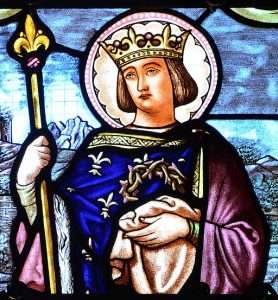
Saint Louis King of France and the Sainte-Chapelle
Saint Louis, born Louis IX of France (1214–1270), was one of the most pious and influential monarchs of medieval Europe. His reign marked a high point in the Capetian dynasty and in the symbolic unity of Church and monarchy. One of the most significant projects of his reign was the commissioning of the Sainte-Chapelle, a royal chapel located within the medieval Palais de la Cité in Paris.
By building the Sainte-Chapelle in Paris:
- He affirmed his devotion: Louis was deeply religious, and the chapel served as a tangible expression of his personal piety.
- He reinforced royal authority: Possessing such sacred relics elevated the prestige of the French monarchy, positioning it as a divinely favored power in Christendom.
- He aligned France with divine will: In a time when religion underpinned governance, Louis used the chapel and its relics to present France as the “new Jerusalem” and himself as a monarch chosen by God.
The Sainte-Chapelle was not only a place of worship but also a political statement—visually and spiritually linking the French Crown to divine legitimacy.
Louis IX the Only Canonized French King
Louis IX is the only French monarch canonized by the Catholic Church, became Saint Louis in 1297, just 27 years after his death. Several reasons explain this unique sanctification:
- His Personal Piety: Louis lived a life with humility, charity, and devoutness. He prayed daily, fasted, and washed the feet of the poor, emulating Christ’s humility.
- Justice and Governance: He was fair and has a strong sense of justice. He established reforms in the legal system and insisted on the king being accountable to Christian values.
- Crusades: Though ultimately unsuccessful, his leadership of the Seventh and Eighth Crusades was an act of religious devotion.
- Martyr-like dimension: His death during the Eighth Crusade in Tunisia added a martyr-like dimension to his legacy.
- Moral Example: Louis, admired throughout Europe for his saintly lifestyle and Christian kingship, became a model of the “ideal Christian ruler.”
No other French monarch combined such deep personal piety, public virtue, and religious symbolism with enduring historical impact. His canonization by Pope Boniface VIII made him a unique figure—a saint who was also a king, embodying both heavenly grace and earthly power.

Sainte Chapelle Destruction During the French Revolution (1789–1799)
Relics Removed and Dispersed:
The most sacred purpose of the Sainte-Chapelle was to house the Passion relics, including the Crown of Thorns. However, in 1791, the relics were transferred to the Cathedral of Notre-Dame de Paris for safekeeping. Eventually, they became property of the state and many were lost or destroyed. The Crown of Thorns survived. It is now held in the treasury of Notre-Dame.
Sainte Chapelle in Paris Desecrated:
The chapel was stripped of its religious function. It was secularized and repurposed as a storage facility for legal archives by the Ministry of Justice. The lower chapel was used for office space. The upper chapel which once held the relics was the main royal chapel. Indeed, it was treated with little regard for its artistic or spiritual significance.
Destruction of Stained Glass and Statues:
Revolutionary mobs damaged or destroyed, broke windows and decapitated statues of the apostles and biblical figures. In fact, they were mistaking for images of the French kings. Fortunately, about two-thirds of the original stained glass panels survived.
Architectural Neglect:
Over the revolutionary and post-revolutionary period, the Sainte-Chapelle fell into disrepair. Moreover, its architectural significance was not widely appreciated until the 19th century.
Sainte Chapelle Restoration in the 19th Century
Under the influence of growing interest in medieval art, the Sainte-Chapelle underwent a major restoration in the mid-1800s. The architect was Eugène Viollet-le-Duc. His team restored the stained glass windows, sculptures, and painted decoration. The goal was to return the chapel to its original Gothic splendor.
Despite the damage, Sainte-Chapelle remains one of the most stunning examples of Rayonnant Gothic architecture. Its surviving stained glass is among the most remarkable in Europe. This church is a gothic style gem, and a masterpiece of 13th-century architecture. Have a private walking tour on the Ile de la Cité to discover our Gothic Treasures.
Visiting the Sainte Chapelle During a Private Tour
Sainte Chapelle Paris has two floors. Only the King and his royal court had access to the top floor chapel and this is where the relics were kept. The first-floor chapel was the place of worship of the Palace personnel.
The stained glass windows of the chapel date from the 19th century on subjects proposed by François de Guilhermy and made by Steinheil.
During the French Revolution the Sainte-Chapelle suffered heavy damage. The remaining relics that survived the Revolution were moved to Notre Dame Cathedral’s treasury.
Upper Sainte Chapelle
The upper chapel has the shpae of a reliquary. Its lavishly decoration has sculptures and enormous stained glass that fill the chapel with light and colour.
The 15 stained glass windows, which leave just enough room for the chapel’s columns, are made of 1,113 scenes that narrate the history of mankind from Genesis to the resurrection of Christ.
Lower Sainte Chapelle
The lower chapel holds the statue of the Virgin Mary, patron of this sanctuary. The interior polychrome decoration, which is mostly red and blue, recreates the original medieval decoration.
The eastern apse still preserves a fresco of the Annunciation made during the thirteenth century. Actually, it is the oldest mural in the city.
During the French Revolution, the Sainte-Chapelle, like many religious buildings in France, suffered significant damage and desecration. Revolutionary ideals were strongly anti-clerical, and churches were seen not just as religious institutions but also as symbols of monarchy and privilege.
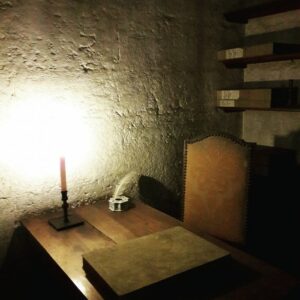
The Conciergerie Private Tour – A Glimpse into Parisian Royal History
Before it became a prison, the Conciergerie was the heart of royal life. Built as part of the Palais de la Cité, it served as the residence of French kings from the 10th to the 14th centuries. Imagine lavish banquets echoing under high stone ceilings and courtiers bustling through candlelit corridors. But as time passed, the monarchy moved to the Louvre and later Versailles. The Conciergerie’s fate changed—it became the symbol of royal justice, and during the French Revolution, the symbol of terror.
The Guards Room – A Royal Legacy of King Philip the Fair
Constructed around 1300 under King Philip IV, also known as Philip the Fair, the Guards Room was the entrance to royal authority. It served as a waiting area for guards and royal officials, a threshold between the outside world and the royal chambers.
Architectural Brilliance
Step inside and you’ll be enveloped by the aura of medieval France. The vaulted ceilings, stone pillars, and pointed arches are quintessential examples of early Gothic design. These arches don’t just hold up the structure—they tell stories of royal ambition.
Symbolism and Royal Power
Philip the Fair was known for centralizing power and strengthening the monarchy. The Guards Room reflects this ambition—strong, symmetrical, and imposing. Its design echoes the order and discipline the king demanded across his realm.
The Hall of the Soldiers – A Monumental Masterpiece
Adjacent to the Guards Room lies the Hall of the Soldiers (Salle des Gens d’Armes)—one of the largest surviving medieval halls in Europe. It was where royal banquets, council meetings, and even judicial hearings took place.
Architectural Design and Features
Four long aisles supported by massive columns give this hall an almost cathedral-like aura. The ribbed vaults soar high above, letting in light that dances across the stone. The space is vast, almost echoing with the laughter and chatter of long-gone feasts.
The Social and Political Role
Beyond its beauty, this hall was a stage for royal authority. Here, knights, courtiers, and soldiers dined side by side—a symbolic gathering of those who protected and served the king.
The Medieval Kitchens – Built Under King John the Good
When King John II (John the Good) took the throne, he envisioned modernization. He ordered the construction of large kitchens to serve the royal court. These weren’t ordinary kitchens—they were masterpieces of medieval engineering.
The Layout and Construction
With four enormous fireplaces, smoke vents, and arched windows, the kitchens were designed for efficiency and grandeur. The stone slabs where meat was carved, the soot-stained walls—all whisper of medieval feasts fit for royalty.
Culinary Life of the 14th Century
Think roasted boar, spiced stews, and sweet pastries dripping with honey. The royal menu reflected power and prestige. Even the aromas from these kitchens were a statement—France was the land of taste and refinement long before modern gastronomy.
The Prison Era of the Conciergerie
By the late 14th century, the Conciergerie had transformed from a royal palace into a state prison. The French Revolution turned it into the antechamber to the guillotine, where prisoners awaited their fate.
Famous Prisoners
The most famous inmate? Queen Marie Antoinette. She spent her final days here before execution in 1793. Alongside her were figures like Robespierre and Danton, once powerful, now humbled by fate.
The Commemorative Chapel of Marie Antoinette
Marie Antoinette’s imprisonment was marked by isolation and sorrow. Her cell was small, dimly lit, and constantly guarded. Yet, she remained a queen until the very end.
The Erection of the Chapel
After the Revolution, King Louis XVIII ordered the construction of a commemorative chapel on the very spot of her cell. It stands as a symbol of mourning and remembrance, dedicated to the queen’s courage and suffering.
Interior Design and Symbolism
Inside, the chapel radiates peace. White marble sculptures depict Marie in prayer, surrounded by religious motifs. The quiet sanctity contrasts sharply with the agony that once filled this space.
Conciergerie – A Walk Through French Revolution History
The Conciergerie, once a royal palace turned prison, played a key role during the French Revolution. This historical site was Marie Antoinette’s jail before her trial and subsequent execution. Visitors can explore her cell and other areas of this infamous prison, getting a somber view of this turbulent period.
- Architectural Significance and Prison Cells Tour
The building’s mix of Gothic and medieval architecture adds depth to its historical ambiance. Your private tour guide brings the experience to life with stories of revolutionary trials and prison life, immersing visitors in the drama of this iconic location.
- French death metal band Gojira Perched on the Conciergerie
One of the most striking moments of the Olympic opening ceremony ! After following the footsteps of the revolutionaries, magnificently portrayed by Eugène Delacroix in his famous painting La Liberté guidant le peuple, we saw a decapitated Marie-Antoinette singing “Ah! ça ira, ça ira, ça ira!”, a revolutionary song written during the French Revolution.
Sainte-Chapelle and the Kings of France Through the Revolution
The Shared Legacy of the Conciergerie and Sainte-Chapelle in Paris
Exploring the Conciergerie and Sainte-Chapelle together on a private tour is like witnessing two sides of the same historical coin, power and faith, majesty and tragedy. Both monuments, standing side by side on the Île de la Cité, capture the essence of medieval France at its height and its fall.
The Sainte-Chapelle, built by King Louis IX (Saint Louis), glows with divine beauty. Its radiant stained-glass windows tell biblical stories through color and light, reflecting a time when kings saw themselves as chosen by God. Just a few steps away, the Conciergerie, once part of the same royal palace, reveals the earthly reality of monarchy: rule, justice, and eventually, downfall.
Private Tour of The Sainte Chapelle and Conciergerie – Paris
On a private guided tour, the contrast becomes deeply personal. One moment you’re bathed in the heavenly hues of Sainte-Chapelle; the next, you stand in the solemn Hall of the Soldiers or Marie Antoinette’s chapel, where history speaks in whispers and shadows. Together, these monuments tell a complete story of France’s glory, faith, and resilience through centuries of change.
Visiting both sites is not just sightseeing, it’s a pilgrimage through time, where sacred beauty and French history intertwine to remind us that every crown, no matter how radiant, casts a shadow.
Enjoy a private tour in Paris with a licensed guide to discover the Sainte Chapelle and the Conciergerie.
Emy,
