

Private Guided Tour of Notre Dame de Paris and Its Historic Surroundings
Notre Dame Private Tour: Explore Notre Dame, inside and around the cathedral, with a licensed Christian tour guide, expert in Gothic architecture, medieval art, and religious history. Discover Christian heritage, and the surroundings of Notre Dame through top landmarks in Paris. The construction of Notre-Dame cathedral began in 1163 under Bishop Maurice de Sully and continued for nearly two centuries. Its design reflected innovative Gothic techniques that were revolutionary at the time. For travelers seeking an immersive and authentic experience, a private guided tour of Notre Dame Cathedral provides an unparalleled way to explore its beatuty, story, and secrets.
Notre-Dame de Paris and Victor Hugo
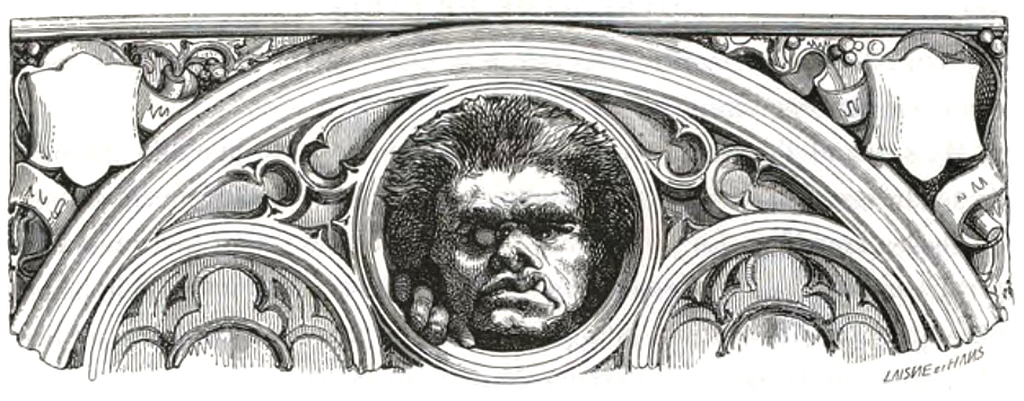
Victor Hugo’s masterpiece, Notre-Dame de Paris (known in English as The Hunchback of Notre-Dame), played a crucial role in saving the cathedral from ruin. Indeed, written in 1831, Hugo’s novel was both a love letter to Gothic architecture and a passionate plea for preservation. Through the story of Quasimodo and Esmeralda, Hugo awakened public interest in the beauty and history of Notre-Dame, inspiring major restoration efforts in the 19th century. Today, as you explore this iconic monument with Paris by Emy’s private Notre-Dame tour, you can feel the spirit of Victor Hugo’s words come alive in every stone, gargoyle, and stained-glass window a timeless reminder of art’s power to protect the cathedral.
2 Hour Notre Dame Private Tour – The Marvel of Paris Cathedral
Enjoy a 2-hour private guided tour of Notre-Dame, inside and around the cathedral with a Christian expert guide in Gothic architecture, religious history, and medieval art.
- From €240 – USD $280 for a 2-hour private tour
- 30 minutes Introduction to Notre Dame’s exterior
- 1 hour dedicated inside Notre Dame Cathedral
- Insights into the cathedral’s restorations and new features
- Historical and spiritual significance of Notre Dame
- Admire the intricate stained glass and iconic Rose Windows
- Explore medieval history inside Notre Dame and sacred art
- Delve into the fascinating details of Notre Dame’s Gothic façade
- Discover Notre-Dame and its historical Surroundings of Île de la Cité
- Faith-centered exploration for Christian travelers in option
- Average waiting time is around 15 minutes to get inside
3-Hour Notre Dame Private Tour – Extended Guided Experience
Experience the beauty of Notre Dame with a private guided tour of Paris’s oldest neighborhoods, between the Left Bank with Saint-Germain and Latin Quarter or the Right Bank with Le Marais and Les Halles.
- From €360 – USD $390 up to 6 persons upon level of customization
- 1 to 2-hour private tour at Notre Dame’s interior and exterior highlights
- 1 to 2-hour private guided tour with stops at the city’s main highlights
- Strolling through Notre Dame surroundings Left or Right Bank
Warning – Fake Tickets for Sale
The average waiting time to get insisde is generally less than 20 minutes, and often significantly shorter on weekdays, in the morning or on Thursday evenings. You can reserve your entrance on the Official Notre Dame website :
https://www.notredamedeparis.fr/en/visit/reservation-free/
The admission is 100% free and can only be booked via the official website. No third-party platform is authorised to sell tickets for visiting Notre Dame.
Book Your Notre Dame Private Tour
Share a few details about your visit, and we will create a personalized Notre Dame private tour with a licensed Christian guide, tailored to your interests, and schedule, revealing the deeper stories behind this iconic landmark that most visitors overlook.
Location and Opening Hours of Notre Dame for a Private Tour
Notre-Dame Cathedral is located on Île de la Cité in the heart of Paris and is generally open daily to visitors, with hours varying depending on the season, religious services, and special events, so it is recommended to confirm the schedule in advance when planning your private tour.
Notre-Dame Cathedral de Paris location
6 Parvis Notre-Dame
Place Jean-Paul II
75004 Paris
Notre Dame Operning Hours
- Monday to Friday: 7:50 am to 7:00 pm.
- Thursday: 7:50 am to 10:00 pm.
- Saturday and Sunday: 8:15 am to 7:30 pm.
- Sunday: 4 p.m. – Grand organ recital (free admission)
Notre Dame Private Tours Prohibited during Services
Group visits, regardless of size, are not permitted during celebrations, masses and religious services, on Saturday afternoons and Sundays.
- Monday to Friday: 8:00 a.m., 12:00 p.m., 5:30 p.m.
- Thursday: 6:45 p.m.
- Friday of the month: 3:00 p.m. to 5:00 p.m.
- Saturday: 8:30 a.m.
- In the event of special services
The cathedral gives special attention to groups involved in social or solidarity initiatives (people in precarious situations, isolation, disability, etc.).
Notre-Dame Inspired Private Tours in Paris
Private Tour of Notre-Dame Cathedral and the Left Bank of Paris
Discover a vibrant Notre-Dame private tour that captures the essence of Paris’s intellectual and artistic heart, Saint-Germain-des-Prés. Begin with Notre Dame, then wander through the lively Latin Quarter, with the Sorbonne University, and elegant Saint-Germain walks, where artists like Picasso, philosophers like Jean-Paul Sartre, writers including Hemingway, cafés, and centuries of history meet.
Notre-Dame Private Tour and The Right Bank of Paris
Experience the majesty of Notre-Dame on a private guided tour, then immerse yourself in the dynamic atmosphere of Le Marais on Paris’s Right Bank. Explore the medieval streets of Le Marais, the place des Vosges, the oldest square of Paris, and the historic marketplace of Les Halles, called the Belly of Paris, with Saint Eustache church.
To Venerate the Crown of Thorns Every Friday
This relic of Notre Dame was purchased by Louis IX from the Latin Emperor of Constantinople in 1239. It is considered one of Christianity’s most revered relics. Each Friday, the faithful gather at Notre Dame for a deeply and sacred moment. Indeed, the veneration of the Holy Crown of Thorns is a very holy experience.
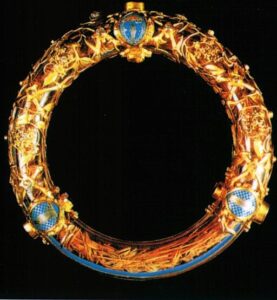
English: Crown of Thorns in the circular reliquary in crystal of 1896. Français : La Couronne d’Épines dans le reliquaire circulaire en cristal de 1896. Notre-Dame de Paris cathedral. Gavigan 2007 non_restricted
The Crown of Thorns adoration is now every Friday afternoon in Notre Dame de Paris. Consequently, groups of any size are prohibited from entering the cathedral on Fridays from 2 pm. This precious relic, believed to have been worn by Christ during His Passion, displayed for public devotion; a rare and powerful opportunity for prayers, reflections, and reverences. Pilgrims and worshippers from around the world come to honor this symbol of Christ’s suffering and love. The tradition is not only an act of personal faith but also a beautiful expression of the Church’s unity across the world.
The Importance of Silence During a Notre Dame Private Tour
Noise can disrupt prayers, reflection, and meditation. Silence allows everyone, visitors and worshippers alike to fully appreciate the serene atmosphere.
Respecting Eucharistic Celebrations in Notre Dame
Never photograph the Eucharist or any part of the Mass. These moments are sacred, and capturing them is considered highly disrespectful.
Turn off your Mobile Phones and Electronic Devices
Phones should always be turned off or set to silent. Even a brief ringtone can disrupt worshippers and ceremonies.
Avoiding Common Dress Mistakes in sacred places
Avoid hats, sunglasses indoors, or overly casual clothing like shorts and tank tops. Modesty shows respect for the sacred space.
Before the Construction of Notre-Dame
Before the construction of Notre-Dame Cathedral, the site was home to earlier sights of worship. In the 4th century, Clovis converted to Christianity. As the Frankish king, he made Paris his capital and developed Christian worship. A first cathedral, Saint-Étienne, Saint Stephen Martyr is a 1st-century preacher, was built on the Île de la Cité. This church dated back to the 4th or 6th century and was built on the remains of a Gallo-Roman temple, reflecting the long history of worship.
The Timeline of Notre-Dame de Paris
Timeline highlighting major events in the history of Notre-Dame Cathedral:
12th – 14th Century: Construction and Early History
- 1163: Construction of Notre Dame began under Bishop Maurice de Sully
- 1182: Completion of the high altar, and the cathedral began to hold services
- 1250: The main construction of the nave, choir, and western façade was completed
- 1260-1345: Additional elements, such as the two towers, spire, and other details
16th – 18th Century: Decline and Damage of Notre Dame
- 1548: Many statues and decorations were damaged during the Huguenot riots
- 1638: The Vow of Louis XIII, father of Louis XIV the Sun King, consecrating
- France to the protection of the Virgin Mary in Notre Dame cathedral
- 1790s: During the French Revolution, the cathedral was desecrated and looted
- The revolutionaries destroyed many of its religious treasures, and statues.
19th Century: Notre Dame de Paris Revival and Restoration
- 1804: Napoleon Bonaparte crowned himself Emperor in Notre Dame, symbolizing a temporary resurgence of interest in the cathedral.
- 1831: Victor Hugo published The Hunchback of Notre Dame, sparking public interest in preserving the building.
- 1844-1864: Architect Eugène Viollet-le-Duc led a major restoration project, adding the iconic spire and restoring damaged elements.
20th Century: War, and Renovation of Notre Dame de Paris
- 1909: Joan of Arc was beatified in the cathedral, which became an important religious and cultural symbol in France.
- 1944: After the liberation of Paris during World War II, the cathedral held a special service in honor of France’s freedom.
- 1963: To celebrate the cathedral’s 800th anniversary, a cleaning project was on to remove centuries of grime and pollution.
21st Century: Fire of Notre Dame in Paris and Reconstruction
- 2008: Pope Benedict XVI, 265th Pope of the Catholic Church and head of state of the Vatican, visits Notre-Dame de Paris
- 2013: Notre Dame celebrated its 850th anniversary, installing new bells and completing various restoration efforts.
- April 15, 2019: A devastating fire broke out in the cathedral, destroying the spire and the wooden roof structure “the forest.”
- 2020-2024: Restoration with the goal of restoring Notre Dame by 2024 – Reopening in December 2024 to the public
Notre-Dame Private Tour Through Middle Ages, Revolution, War and Liberation
During the French Revolution, Notre-Dame de Paris suffered greatly as a symbol of the old monarchy and the Catholic Church. Many of its treasures were looted or destroyed, statues of biblical kings were mistaken for French royalty and decapitated, and the cathedral itself was converted into a “Temple of Reason.” The great bells were melted down for cannon, and for years, the once-majestic cathedral fell into neglect and decay until public admiration, reignited by Victor Hugo’s novel, led to its restoration in the 19th century.
Decades later, Notre-Dame became a beacon of hope once more. On August 26, 1944, just days after the Liberation of Paris from Nazi occupation, a solemn Mass was held within its walls. The deep, resonant sound of the Bourdon Emmanuel bell, one of the cathedral’s oldest and most revered, rang across Paris, announcing freedom and peace to a city reborn. The moment marked Notre-Dame not only as a masterpiece of faith and architecture but also as a witness to France’s enduring spirit through revolution, destruction, and renewal.
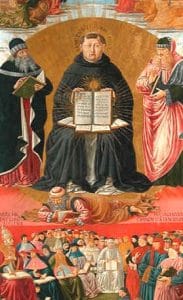
Notre Dame de Paris a Masterpiece of Gothic Architecture
Notre Dame cathedral stands as a masterpiece of Gothic architecture, embodying both technical innovation and profound symbolism. Its soaring arches and ribbed vaults create a sense of verticality that draws the eye heavenward, while the iconic flying buttresses not only support the structure but also symbolize the church’s role as a bridge between earth and heaven. The façade is adorned with intricate sculptural programs, saints, prophets, and allegorical figures that served as visual storytelling for the faithful, teaching biblical lessons through stone. Masterpieces such as the rose windows, glowing with vibrant stained glass, illustrate divine light and cosmic order. Gargoyles and chimeras, often misunderstood as mere decoration, function as both water spouts and symbolic guardians warding off evil. Together, these elements make Notre Dame not just an architectural wonder, but also a living encyclopedia of medieval spirituality and artistry.
Cultural and Religious Significance of Notre Dame
Beyond architecture, Notre-Dame serves Our Lady Mary, mother of Jesus as a center for Catholic worship and a symbol of Paris itself, inspiring countless artists, writers, and visitors.
Notre Dame Influence on Literature and Art
Gothic cathedrals inspired works from Victor Hugo’s “The Hunchback of Notre-Dame” to modern cinematic portrayals, cementing the style in cultural imagination.
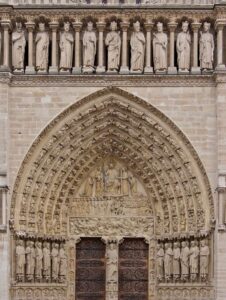
Defining Characteristics of Gothic Architecture in France
From Paris, the Gothic style spread rapidly across France, England, Germany, and Italy. Each region adapted the style to its own traditions, creating unique variations.
Pointed Arches
The pointed arch is the hallmark of Gothic design, allowing for greater height and structural stability compared to the rounded Romanesque arches. This design directs weight more efficiently to the ground, enabling taller walls and larger windows.
Ribbed Vaults
Ribbed vaulting distributes weight across intersecting stone ribs, providing both support and decorative elegance. This allowed for expansive interiors that feel airy.
The Flying Buttresses
Flying buttresses transfer the outward thrust of the roof and walls to external supports. These elegant structures also create a sense of drama and lightness, making massive cathedrals appear almost ethereal.
Stained Glass Windows
Stained glass is not just decorative, it tells biblical stories and bathes interiors in colored light, creating an otherworldly atmosphere. Parisian Gothic cathedrals are famous for their towering rose windows.
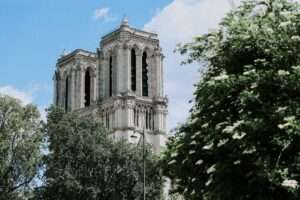
Notre Dame Bell Towers Reopening Since 2025
You can discover the Twin Towers of Notre-Dame, along the 424 steps, heritage treasures and breathtaking views await you. The cathedral’s iconic towers rise approximately 69 meters and offer panoramic views of Paris. These towers are a signature element of Gothic architecture. Climb the Towers of Notre-Dame 424 steps where heritage treasures and breathtaking views of the heart of Paris await you. A masterpiece of Gothic architecture, construction began in 1163 and continued for over 170 years. Until the 13th century and the building of Amiens Cathedral, it stood as the largest religious structure in the Western world. The Towers of Notre-Dame officially reopened to the public on September 20, 2025. You can book tickets on the official website : https://www.tours-notre-dame-de-paris.fr/en
The 21 bells of Notre-Dame twin towers are famous for their size, history, and significance in French culture. They have traditionally played an essential role in marking religious ceremonies, historical events, and daily life in Paris. The most renowned of the bells is the Bourdon, but there are several others in the cathedral. The biggest bell of France is the Savoyarde at the Sacred Heart Basilica.
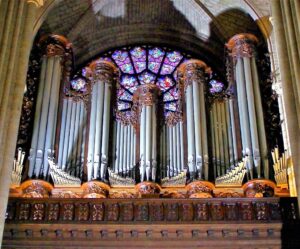
Notre Dame Grand Organ of 8,000 pipes and 5 keyboards
During your private tour, you will be able to see the Grand Organ of Notre-Dame. It is one of the most famous and significant musical instruments in the world. Known for its size, history, and exquisite sound, it has been central to the cathedral’s musical tradition for centuries.
Historical Overview
- The original organ at Notre-Dame dates back to the 14th century, but the current instrument is primarily the result of modifications made over the centuries.
- A major overhaul occurred in the 18th century when the renowned builder François-Henri Clicquot created a new instrument in 1733, incorporating older pipes from previous versions.
- In the 19th century, famed organ builder Aristide Cavaillé-Coll modernized the organ, significantly expanding its capabilities and bringing it to its current grandeur.
Specifications of the Organ
- The Grand Organ has 8,000 pipes, making it the largest organ in France.
- It has 115 stops (sound registers), 5 keyboards, and a pedalboard, allowing for incredible musical versatility.
- Some pipes date back to the medieval and Renaissance periods, giving the organ its unique timbre and historical character.
Usage and Significance
- The organ is played during major religious ceremonies, including Christmas, Easter, and state occasions.
- Notre-Dame’s organists have included some of the greatest names in the world of sacred music, such as Louis Vierne, Pierre Cochereau, and Olivier Latry.
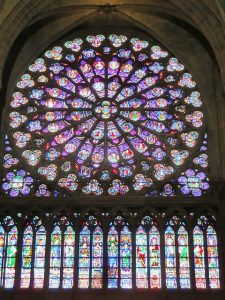
Notre Dame Legendary Rose Windows – Beauty and History
Notre-Dame Cathedral de Paris is world-renowned for its three magnificent rose windows, breathtaking masterpieces of Gothic art and craftsmanship. Each window is a marvel of design, light, and symbolism, reflecting both the artistic genius and the spiritual depth of the Middle Ages.
North Rose Window XIII century
Created around 1250, the North Rose Window is dedicated to the Virgin Mary. It represents the Old Testament and is often called the “Rose of the Virgin.” Its deep blue tones create a mystical atmosphere, and its intricate design radiates harmony and peace. The window’s imagery features prophets, kings, and figures from the Hebrew Scriptures, all arranged around the central image of the Virgin and Child.
South Rose Window XIII century
Constructed shortly after the North Rose, the South Rose Window is devoted to Christ and the New Testament. Its brilliant reds and golds illuminate the southern transept with warmth and glory. Donated by King Louis IX (Saint Louis), this window depicts Christ surrounded by apostles, martyrs, and angels. It serves as a visual celebration of divine light and redemption.
West Rose Window XII century (entrance of Notre Dame)
The oldest of the three, the West Rose Window dates back to around 1220. It adorns the main façade above the cathedral’s entrance. Smaller and simpler than its later counterparts, it nonetheless establishes the foundation of the Gothic rose window tradition. The West Rose symbolizes the Last Judgment, greeting visitors with a powerful vision of faith and eternity as they enter the church.
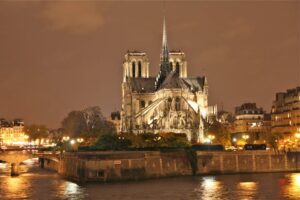
The Chevet of Notre-Dame, Oldest Part of the Cathedral
The chevet of Notre-Dame is part of the Gothic cathedral. Located at the eastern end of the building, it houses the apse and forms a semicircular structure supported by a series of buttresses and flying buttresses. These 14 flying buttresses relieve the pressure exerted by the massive vaults while giving the building an airy elegance. The chevet is also adorned with large bay windows about Mary’s life.
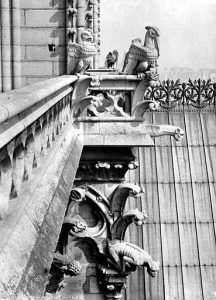
Famous Gargouilles and Chimères – Fascinating Creatures
The gargoyles and chimeras of Notre-Dame de Paris are among the cathedral’s most famous and fascinating features, blending practical engineering with artistic imagination. Perched high along the façade and towers, these stone creatures have long captured the curiosity and wonder of visitors from around the world.
Gargoyles (water spouts)
Gargoyles are stone water spouts to drain rainwater away from the building’s walls and foundations. By projecting the water outward, they help prevent erosion of the stone masonry. Each carved gargoyle has the shape of a grotesque creature, part animal, part monster, sometimes even part human. They often have elongated necks or open mouths, allowing rainwater to flow out dramatically. Their frightening appearance was also symbolic: in medieval times, they ward off evil spirits and remind people of the sin dangers.
Chimeras (only decorative)
Unlike gargoyles, chimeras have no functional role, they are purely decorative sculptures. Eugène Viollet-le-Duc added the most famous chimeras during the 19th-century restoration. These figures perch on the Galerie des Chimères (Gallery of Chimeras), the balcony connecting the cathedral’s two towers. The chimeras include a mix of mythical creatures, demons, birds, and fantastical hybrids, blending medieval imagination with romantic artistry. One of the most recognizable is the “Stryga,” or “The Spitting Gargoyle,” a demon-like figure with hornsd resting its chin in its hands, gazing dreamily over Paris. Though not an actual gargoyle (it doesn’t drain water), it has become a symbol of Notre-Dame itself.
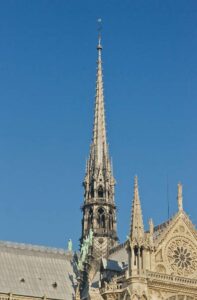
The Iconic Spire of Notre-Dame and Its Apostles Statues
The Statues of Notre-Dame and Spire are among the cathedral’s most iconic and symbolically rich architectural features, blending Gothic artistry, engineering ingenuity, and religious symbolism.
The Spire (La Flèche) of Notre Dame
- First Spire (13th century): The original medieval spire, built in the 13th century, made of wood and lead, deteriorated over time. Itwas was eventually removed in the late 18th century due to instability.
- Viollet-le-Duc’s Spire: architect Eugène Viollet-le-Duc designed the famous spire most people during his restoration of the cathedral between 1844–1864.
- It stood about 96 meters (315 feet) tall and weighed roughly 750 tons, primarily made of oak and covered in lead.
- Destruction and Rebirth: This spire tragically collapsed during the 2019 fire, falling dramatically through the roof.
- Reconstruction faithful to Viollet-le-Duc’s design began in 2020 and is nearing completion for Notre-Dame’s planned reopening in December 2024.
- The spire functioned as a spiritual focal point, drawing the eye heavenward—a literal and figurative aspiration toward the divine.
- Around its base stood 12 copper statues of the Apostles and Saint Éloi (Saint Eligius), the patron saint of metalworkers, symbolically protecting the cathedral.
The Statues The Apostles and the Evangelists:
- Viollet-le-Duc added 16 copper statues in total: 12 Apostles, arranged around the spire’s base, looking outward over Paris.
- 4 Evangelists, positioned at the corners, each accompanied by their traditional symbols (angel, lion, ox, and eagle).
- One of the Apostles, Saint Thomas, who represents architects, bears the face of Viollet-le-Duc himself, a subtle self-portrait watching over his masterpiece.
- Just days before the 2019 fire, all 16 statues removed for restoration, saved them from the blaze. They have since been restored and will be reinstated with the reconstructed spire.
- Current Status (as of 2025): The new spire, an exact reconstruction of Viollet-le-Duc’s, is being finished using traditional materials and craftsmanship.
- The restored statues are set to be replaced around its base in preparation for Notre-Dame’s grand reopening.
Western Art Iconography – Vice and Virtue
The iconography of vices and virtues in Western art, as seen in Notre Dame Cathedral in Paris, serves as a moral and spiritual guide. Sculptures, stained glass, and carvings depict virtues like Justice, Prudence, and Charity as noble, upright figures, while vices such as Greed, Envy, and Lust appear as grotesque, often monstrous forms. This visual contrast reinforces Christian teachings, reminding viewers of the eternal struggle between good and evil and encouraging ethical living through striking imagery. An excellent example of the iconography of vices and virtues in Western art can be seen in the sculptural decoration of the portals of Notre-Dame Cathedral in Paris, particularly on the Last Judgment portal on the west façade (the central portal).
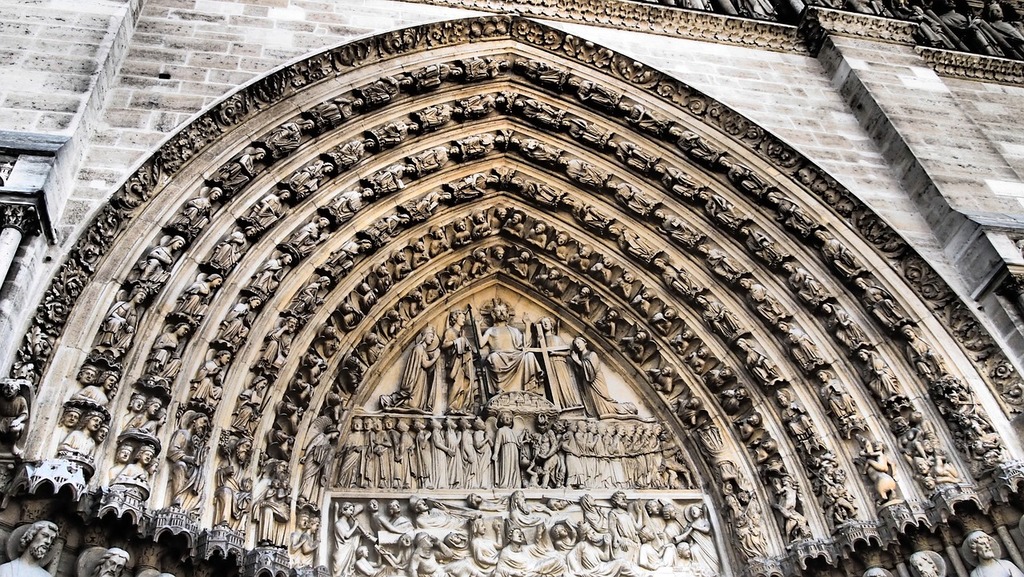
The Last Judgment Portal (West Façade)
Nore Dame’s West façade portal illustrates the Christian concept of judgment after death, where souls are weighed and sent to Heaven or Hell. Around Christ the Judge, sculptors represented the moral struggle between Virtue and Vice through personifications and symbols.
Virtues encourage moral living and the imitation of Christ’s goodness.
- Charity may be shown giving alms or holding a flaming heart.
- Faith is often portrayed with a cross or chalice.
- Justice might hold scales or a sword.
Vices remind viewers of the consequences of sin.
- Pride is often shown being overthrown or humiliated.
- Avarice (Greed) may hold a money bag or treasure chest.
- Lust might be represented by serpents or animals of temptation.
- Envy or Wrath often appear with contorted faces or violent gestures.
At Notre-Dame Cathedral, the iconography of Virtues and Vices serves as a didactic program, a visual lesson teaching medieval Christians the moral path to salvation. The sculptures on the Last Judgment portal embody the eternal struggle between good and evil, encouraging viewers to cultivate the Virtues and avoid the Vices.
Notre-Dame Private Tour – Inside the Restoration of the Gothic Cathedral
The restoration of Notre-Dame following the devastating 2019 fire has been an unprecedented heritage project, combining ancient craftsmanship, scientific precision, and the work of hundreds of specialists from across France. Nearly 1,000 workers labored daily on scaffolds and in workshops, joined by many more contributing behind the scenes — carpenters, stonemasons, leadworkers, sculptors, stained-glass experts, engineers, metalworkers, roofers, and architectural historians all played vital roles.
- One of the most symbolically rich elements was the reconstruction of the cathedral’s medieval timber roof — known as la forêt (hte forest) — and its spire. To recreate these using traditional methods, restoration specialists coordinated with the French National Forestry Office to select more than 1,000 mature oak trees from forests across the country, each carefully chosen for straight grain and structural strength. These trees, many over 150 years old, were felled, documented, and hand-worked into massive beams using centuries-old techniques that mirror those of the original medieval builders.
- Meanwhile, thousands of tonnes of stone and decorative elements damaged by fire and heat were meticulously cleaned and restored. High-powered vacuums and latex coatings were used to remove layers of lead dust and centuries of grime from the cathedral’s limestone, revealing the building’s original light-colored surfaces. Sculptures, gargoyles, wrought-iron railings and carvings were repaired or recarved by master stonemasons, reviving details lost in the blaze.
This collaborative effort was not just construction — it became a living academy of traditional French crafts, with master artisans (including many Meilleurs Ouvriers de France) mentoring younger generations in stonecutting, carpentry, metalwork and more. The project embraced both historical fidelity and modern conservation science, ensuring Notre-Dame will stand for centuries to come.
What’s New inside Notre Dame Cathedral
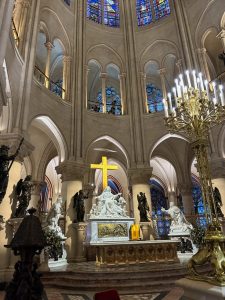
Since its reopening in December 2025, Notre-Dame Cathedral has introduced several significant updates to the baptistery, altar, reliquary, and seating arrangements. Inside the cathedral, visitors find an awe-inspiring atmosphere filled with towering columns, intricate altars, and historical relics. As one of the most visited religious sites in the world, Notre Dame Cathedral remains a place of reflection and spirituality, inviting visitors to experience its sacred aura firsthand.
Baptistery
A new baptistery crafted from bronze, aligning with the cathedral’s restored aesthetic. This modern design complements the other liturgical furnishings, maintaining a cohesive visual narrative within the sacred space.
Altar
The cathedral’s new altar is a monumental bronze piece, symbolizing both resilience and sanctity. During the inaugural Mass, this altar was consecrated with the relics of five saints associated with the Church of Paris
Holy Reliquary
A prominent addition is the new reliquary housing the revered Crown of Thorns. Standing at approximately 13 feet tall, this structure is crafted from cedar wood and bronze, designed by Sylvain Dubuisson. Positioned in the church’s apse, it serves as a focal point for veneration and reflection.
Seating
The cathedral has introduced 1,500 new solid oak chairs, designed to echo the structure of the roof. These chairs feature a minimalist and modern style, aiming for a ‘noble simplicity’ that complements the cathedral’s interior while providing comfort for the faithful.

Notre-Dame Cathedral Private Tour in Paris
Exclusive Notre-Dame Cathedral Private Tour with Optional Extra Sites
Located in the very heart of Paris, Notre-Dame Cathedral serves as the perfect starting point for a private guided tour, offering endless possibilities to explore the city’s treasures such as the world-famous Louvre Museum religious art, or other historic Parisian churches like Saint-Étienne-du-Mont near the Panthéon. To enhance your experience, you can even add a scenic river cruise departing from the Pont Neuf, or discovering the French Revolution and its consequences at Notre Dame.
Notre Dame Private Guided Tour and the Sainte Chapelle
PARIS BY EMY offers a Notre Dame and Sainte Chapelle private guided tour. Please, note that this experience is often very touristy. Sainte-Chapelle is no longer an active place of worship, and while admired for its stained-glass windows, a combined tour doesn’t do justice to either experience. Instead, we believe it is more enriching to dedicate time to Notre Dame and its Historical Parisian surroundings. Thus, we recommend to pair your visit to Sainte-Sainte-Chapelle tour with the historic Conciergerie.
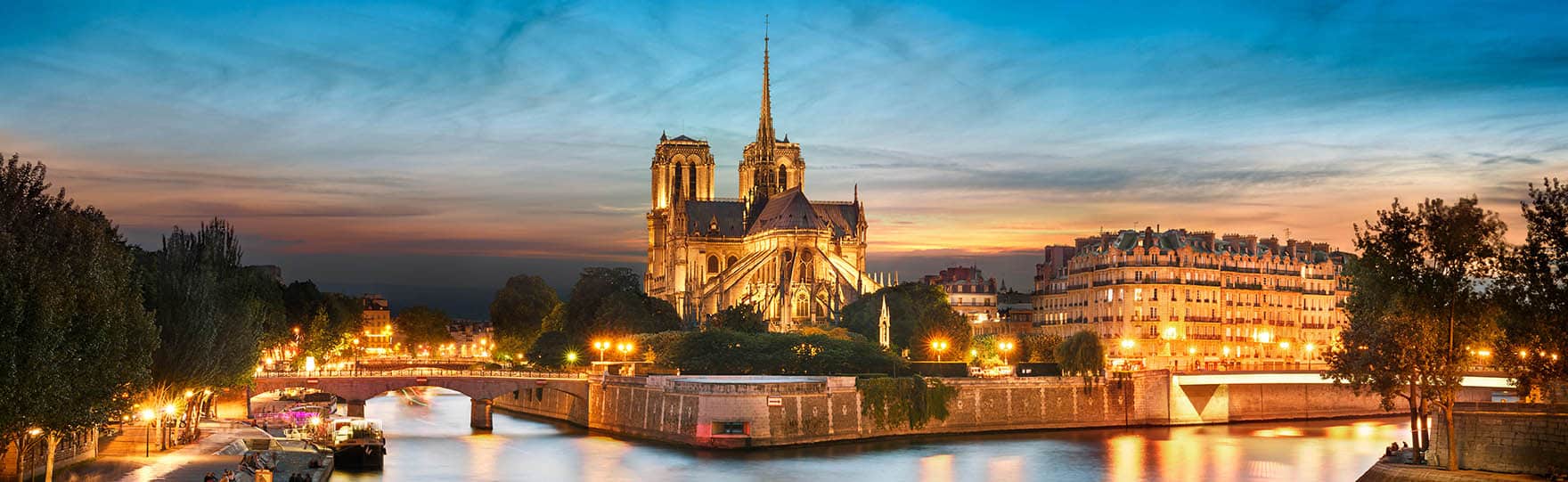
Notre-Dame Private Tour and the Historic Landmarks of Île de la Cité
Discover the historic heart of Paris on your private guided tour of Notre-Dame, set on the beautiful Île de la Cité. This experience invites you to journey back to the Middle Ages, when French kings ruled from this very island and the nearby Latin Quarter thrived as a center of learning. It was here that great intellectual traditions emerged, including the renowned Sorbonne University, shaping Paris into a cultural and academic capital of Europe. A walk along the Seine River reveals Paris’s famous bookstalls, artists, and scenic views that feel like a scene from a romantic film. With customized routes, deep local insights, and exclusive stories, our private tours add a personal touch that allows you to experience the Notre Dame cathedral story.
Notre-Dame and Île de la Cité: Where Paris Was Born
Notre-Dame literally sits on an island in the middle of the Seine River, and that island (Île de la Cité) is where Paris began. So Notre Dame cathedral isn’t just near it — it’s central to the island’s identity, politically, religiously, and historically.
Exploring the Flower and Bird Market
Every Sunday, the Flower and Bird Market on Île de la Cité transforms the area with vibrant colors and sounds. Strolling through the stalls, you’ll find an array of fresh flowers, plants, and birds, as well as a variety of unique Paris souvenirs. It’s a charming spot that offers a more local, leisurely experience amid the island’s historical sites.
Pont Neuf: The Oldest Bridge in Paris
Pont Neuf, the oldest standing bridge in Paris, connects Île de la Cité with the rest of the city and offers beautiful views over the Seine. Built in the late 16th century, the bridge has stone faces carved into its sides, each with unique expressions that have intrigued visitors for centuries. It’s an ideal place to stop and take in the scenery.
Hidden Gems on Île de la Cité
While many visitors flock to the main attractions, Île de la Cité is full of quiet spots and lesser-known areas. Square du Vert-Galant, a small garden at the western tip of the island, is a peaceful spot where you can relax by the water, away from the crowds. It’s an excellent place to unwind and soak in the beauty of Paris.
Our Notre Dame private tour will offer unique insights into the Middle Ages, the architectural wonders of the cathedral, and the important role the Île de la Cité played throughout Parisian history. As you explore the area, we’ll take you through the iconic landmarks surrounding Notre-Dame Cathedral such as the Sainte Chapelle and Conciergerie, and the royal square, place Dauphine.
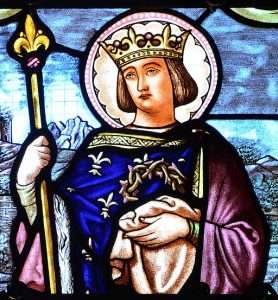
King Saint Louis – Louis IX King of France from 1226 until his death in 1270
Notre-Dame Private Tour and the Charm of Île Saint-Louis
During your private guided tour of Notre-Dame, continue your exploration to the charming Île Saint-Louis, nestled in the Seine just east of Île de la Cité. This elegant island, known in French as Île Saint-Louis, takes its name from King Louis IX of France, later canonized as Saint Louis. He ruled in the 13th century (1226–1270) and was declared a saint in 1297 for his deep faith and commitment to justice. Today, the island reflects a refined and timeless Parisian atmosphere, with its 17th-century architecture, quiet streets, and picturesque river views offering a peaceful contrast to the grandeur of Notre-Dame nearby. Louis XIII and Louis XIV developed the island during the 17th century. The island was a residential area for Parisian elites, featuring elegant townhouses for artists, writers, and intellectuals.
- The island was originally called Île Notre-Dame, and it was mostly marshy land
- Development began under King Louis XIII’s reign, around 1614
- The work was completed under Henri IV’s plans in the 1620s–1640s
By the time Louis XIV became king in 1643, the island had already been laid out with streets and lots. During his reign, the island became more fashionable, attracting wealthy Parisians who built elegant houses there.
Saint Louis The cows’island
In 1356, in the continuity of the surrounding walls of King Philippe Auguste, a channel dug divided the island in two. The West, was Île Notre-Dame and to the East, was called the Île aux vaches (cows). Originally used as pastureland, Saint Louis island became in the 17th century a fashionable neighborhood for aristocrats. It also serves as a warehouse for the construction of boats during the reign of the Carolingian kings of France.
Grandiose mansions and art galleries
As you stroll through Île Saint-Louis, you’ll discover from grandiose 17th-century mansions to charming shops and art galleries. The Hôtel Lambert boasts a remarkable 17th-century architecture. This historic mansion gives the island its distinct character and elegance.
Saint-Louis-en-l’Île Baroque church
Known formally as Saint-Louis-en-l’Île Church, this Parisian church has an understated beauty. The baroque-style architecture and peaceful ambiance provide a lovely spot for quiet reflection.
Berthillon Famous ice-cream maker
A trip to Île Saint-Louis wouldn’t be complete without tasting the legendary Berthillon ice cream. Known for its natural ingredients and rich flavors, Berthillon has been an icon since the 1950s.
Official Audio Guide of Notre-Dame Private Tour
You can have an audio guide at the reception (welcome desk) for €6.
- Languages: French, English, Spanish
They have magnetic loops for hearing-impaired visitors when using the audioguide.

Notre Dame Private Tour – Paris Cathedral Highlights
Explore Notre-Dame Cathedral and its historic Parisian surroundings. A private guided tour in Paris offers an insightful and personalized experience focused on Christian history, iconic landmarks, architecture, and sacred art. It is perfect for anyone wanting to dive deep into Paris’s rich history and culture. With expert guides, a flexible itinerary, and exclusive local insights, this private guided tour of Notre Dame brings Paris to life. PARIS BY EMY takes pride in offering private tours tailored to each visitor’s interests, creating a deeper understanding of Notre-Dame de Paris, whether you are Christian or not.
Discover all the Private Guided Tours in Paris available.